PROBLEM BASED LEARNING IN ENGINEERING:
HOW TO MAKE IT WORK
Erik de Graaff
Delft University of Technology, Aalborg University
UNESCO Chair in Problem Based Learning
PROBLEM BASED LEARNING IN
ENGINEERING: HOW TO MAKE IT WORK
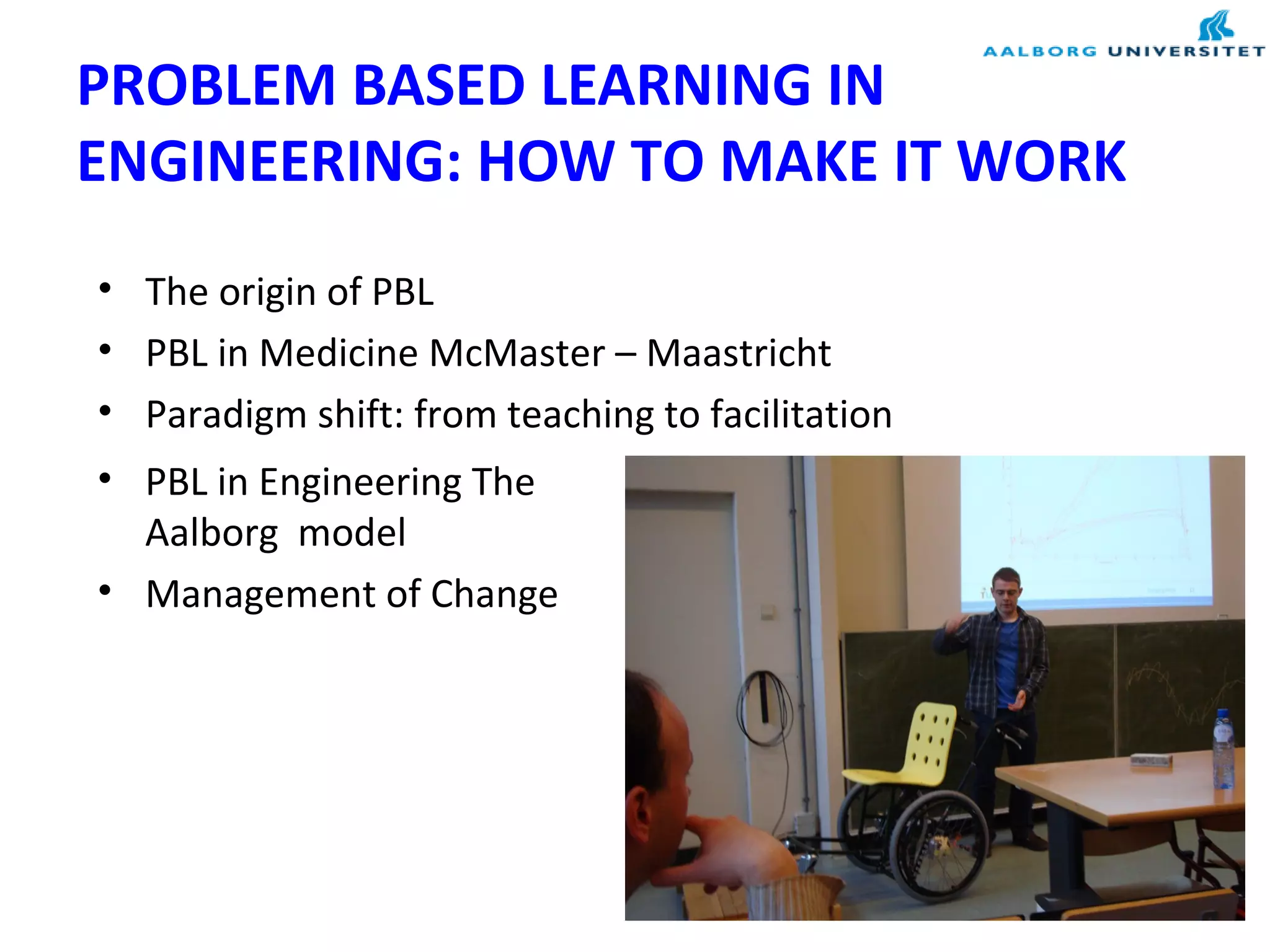
• The origin of PBL
• PBL in Medicine McMaster – Maastricht
• Paradigm shift: from teaching to facilitation
• PBL in Engineering The
Aalborg model
• Management of Change
Assignment
• Each person has to come up with one
advantage of PBL
• Share the ideas in groups of 3-5 persons
• Choose a top 3
4
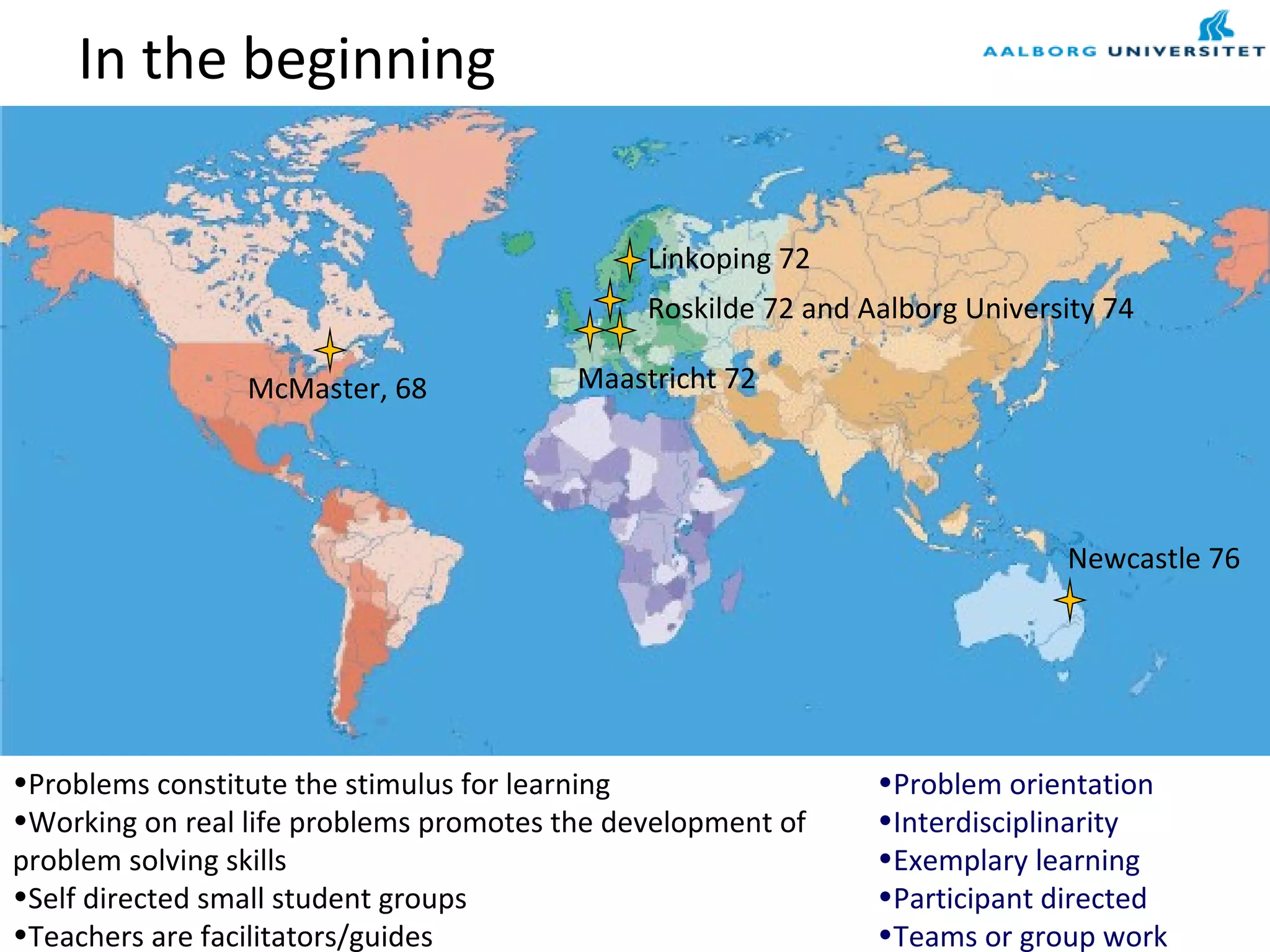
McMaster, 68
Linkoping 72
Roskilde 72 and Aalborg University 74
Maastricht 72
•Problems constitute the stimulus for learning
•Working on real life problems promotes the development of
problem solving skills
•Self directed small student groups
•Teachers are facilitators/guides
•Problem orientation
•Interdisciplinarity
•Exemplary learning
•Participant directed
•Teams or group work
Newcastle 76
In the beginning
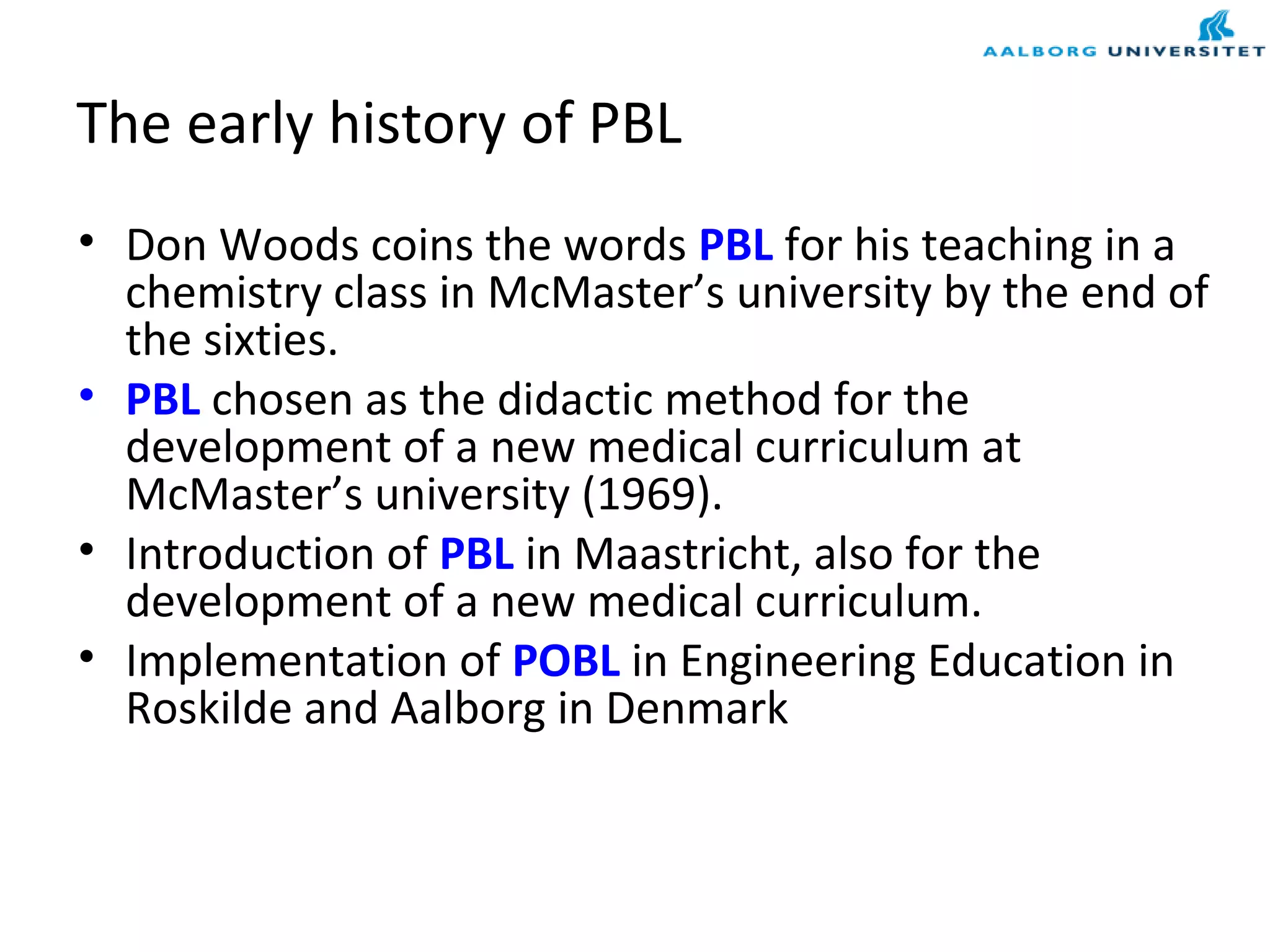
The early history of PBL
• Don Woods coins the words PBL for his teaching in a
chemistry class in McMaster’s university by the end of
the sixties.
• PBL chosen as the didactic method for the
development of a new medical curriculum at
McMaster’s university (1969).
• Introduction of PBL in Maastricht, also for the
development of a new medical curriculum.
• Implementation of POBL in Engineering Education in
Roskilde and Aalborg in Denmark
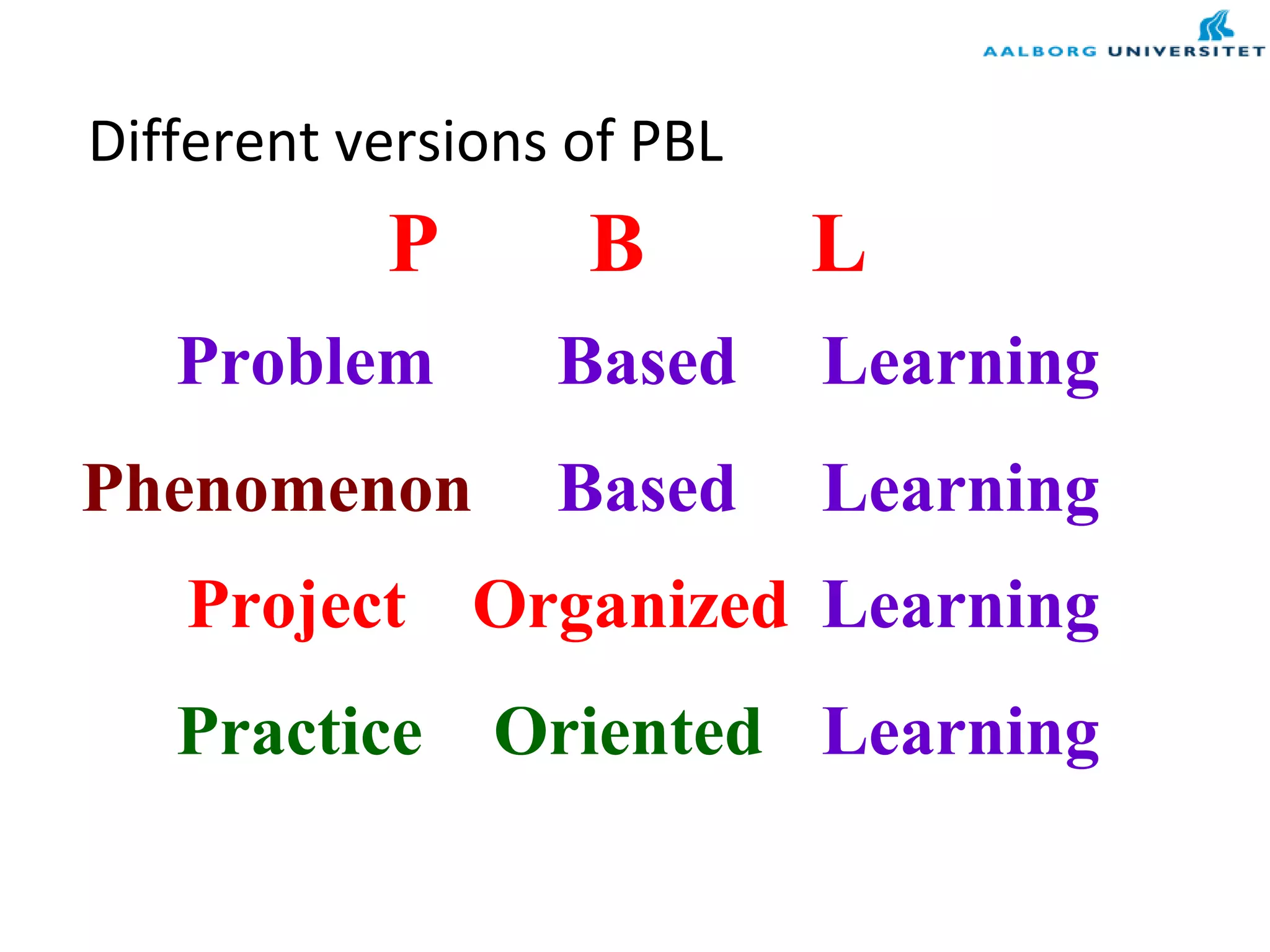
Different versions of PBL
Problem Based Learning
Project
Phenomenon
P B L
Based Learning
Organized Learning
Practice Oriented Learning
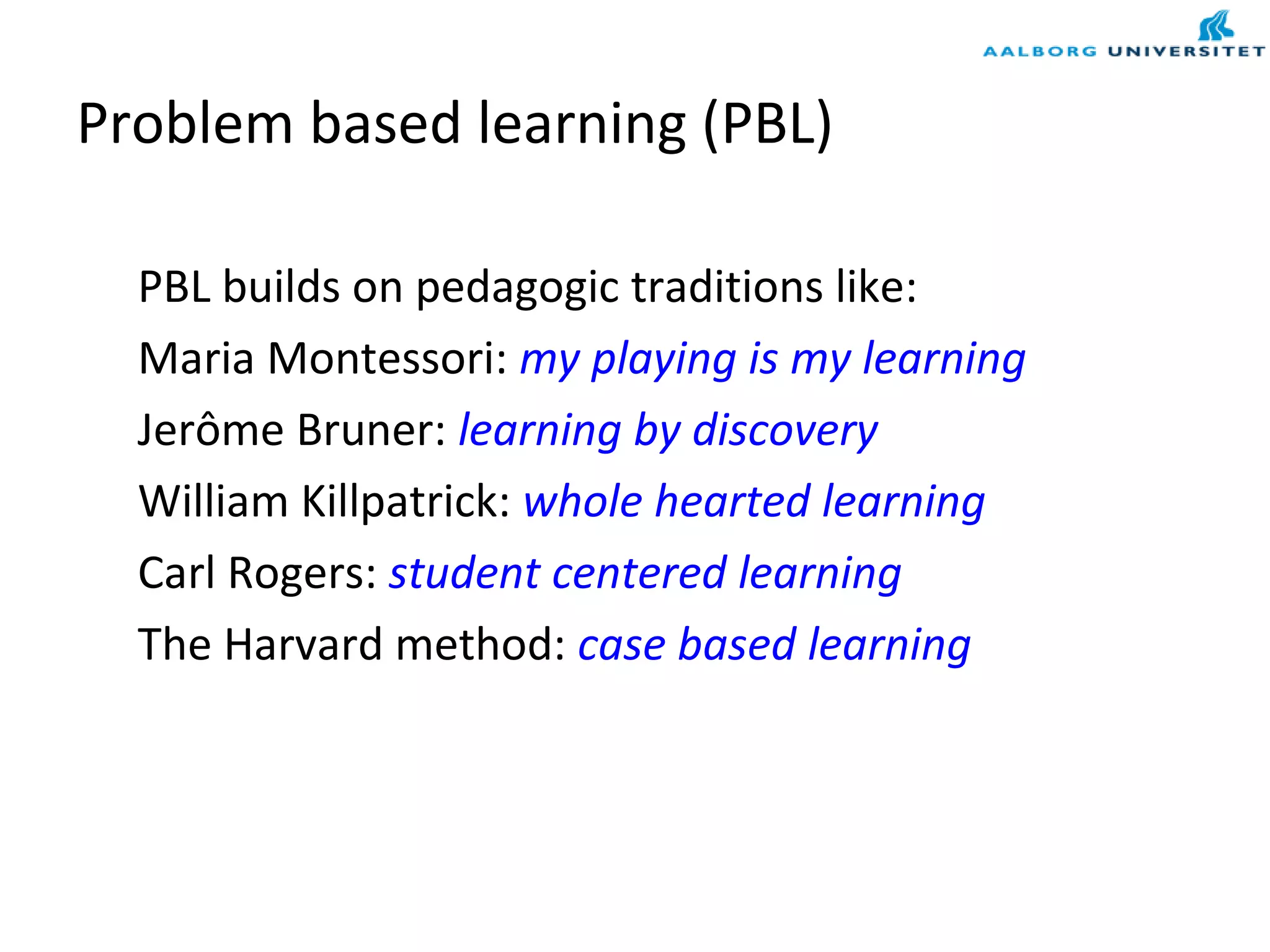
Problem based learning (PBL)
PBL builds on pedagogic traditions like:
Maria Montessori: my playing is my learning
Jerôme Bruner: learning by discovery
William Killpatrick: whole hearted learning
Carl Rogers: student centered learning
The Harvard method: case based learning
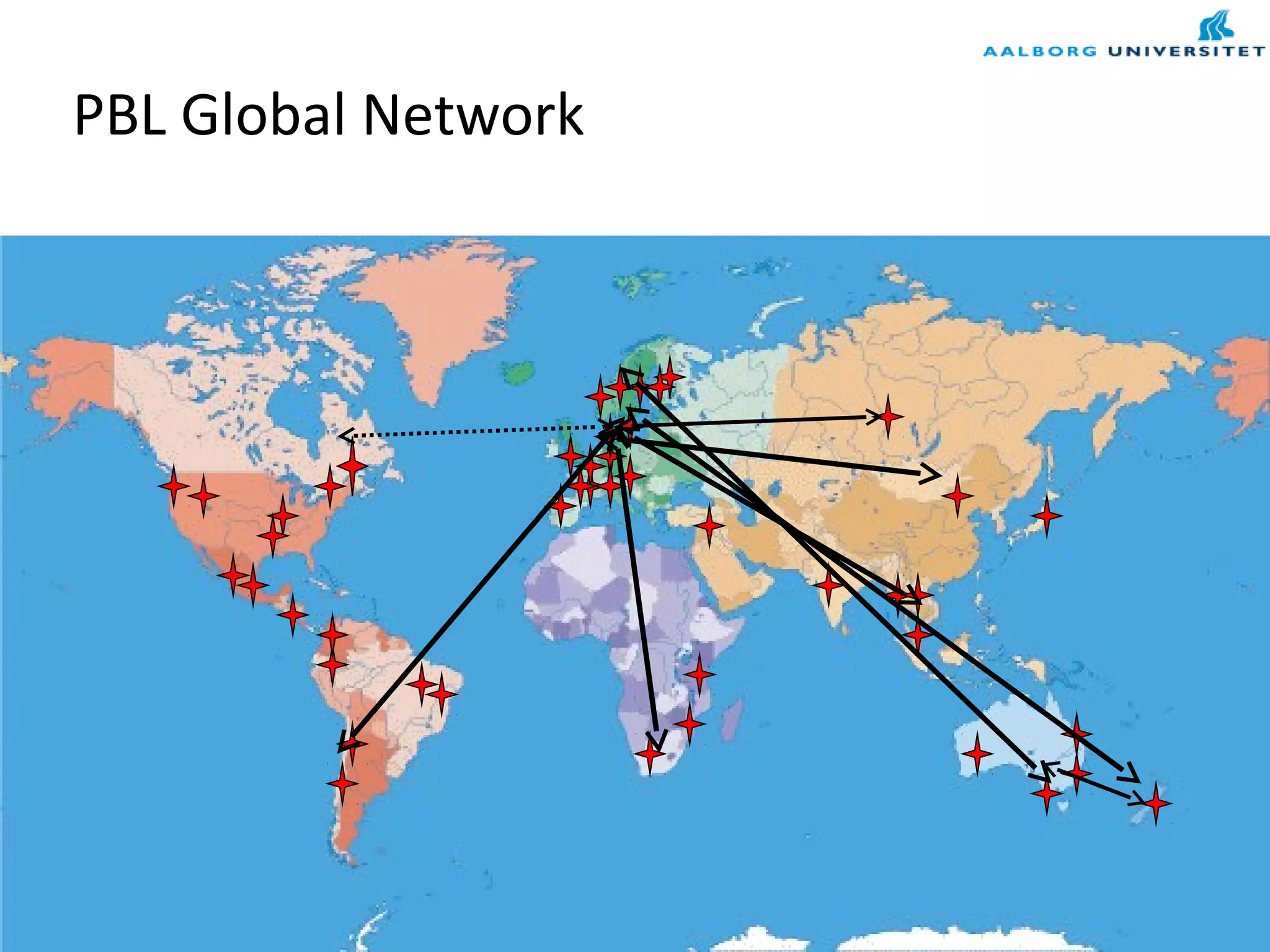
PBL Global Network
8
9
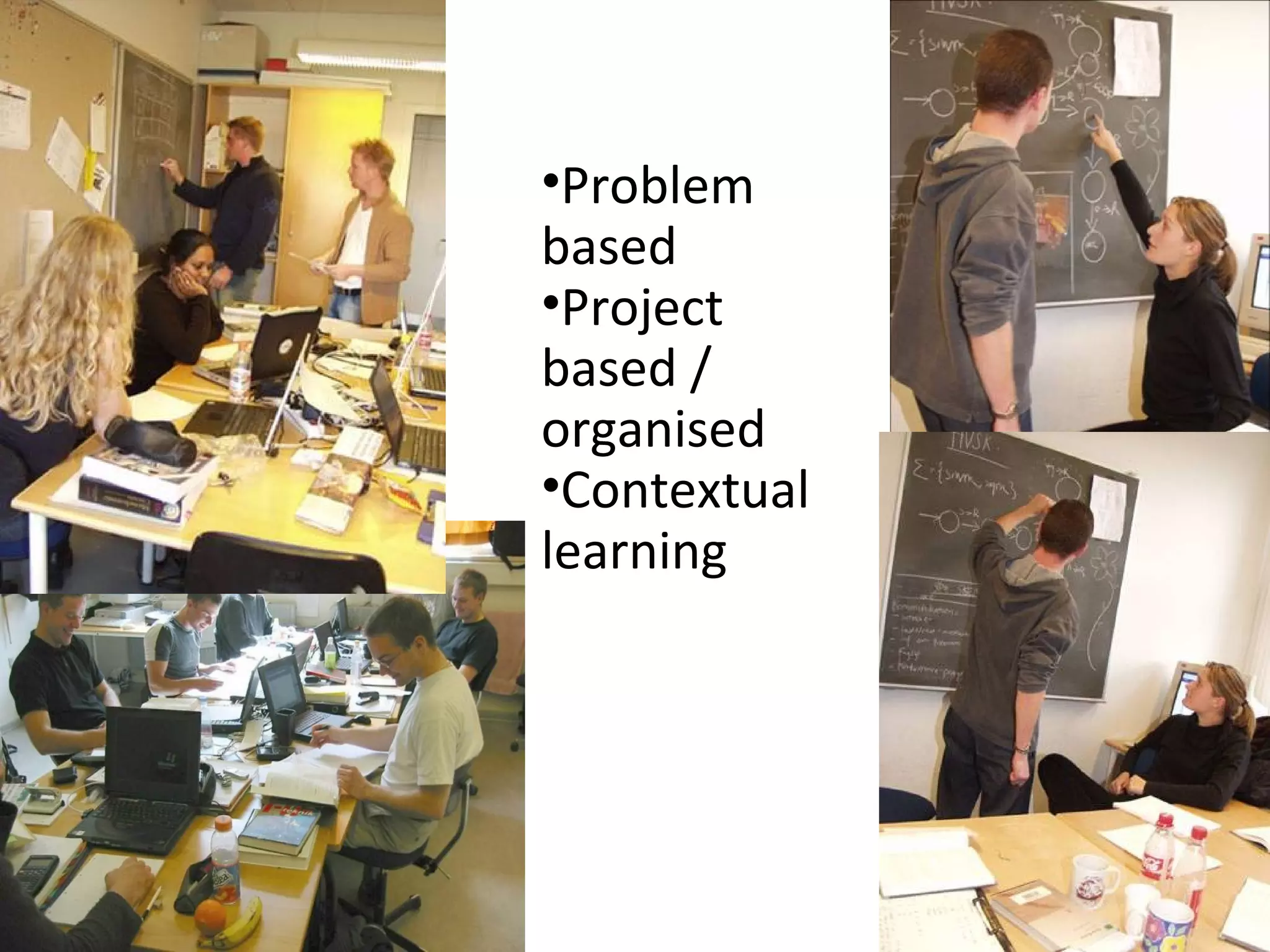
•Problem
based
•Project
based /
organised
•Contextual
learning
10
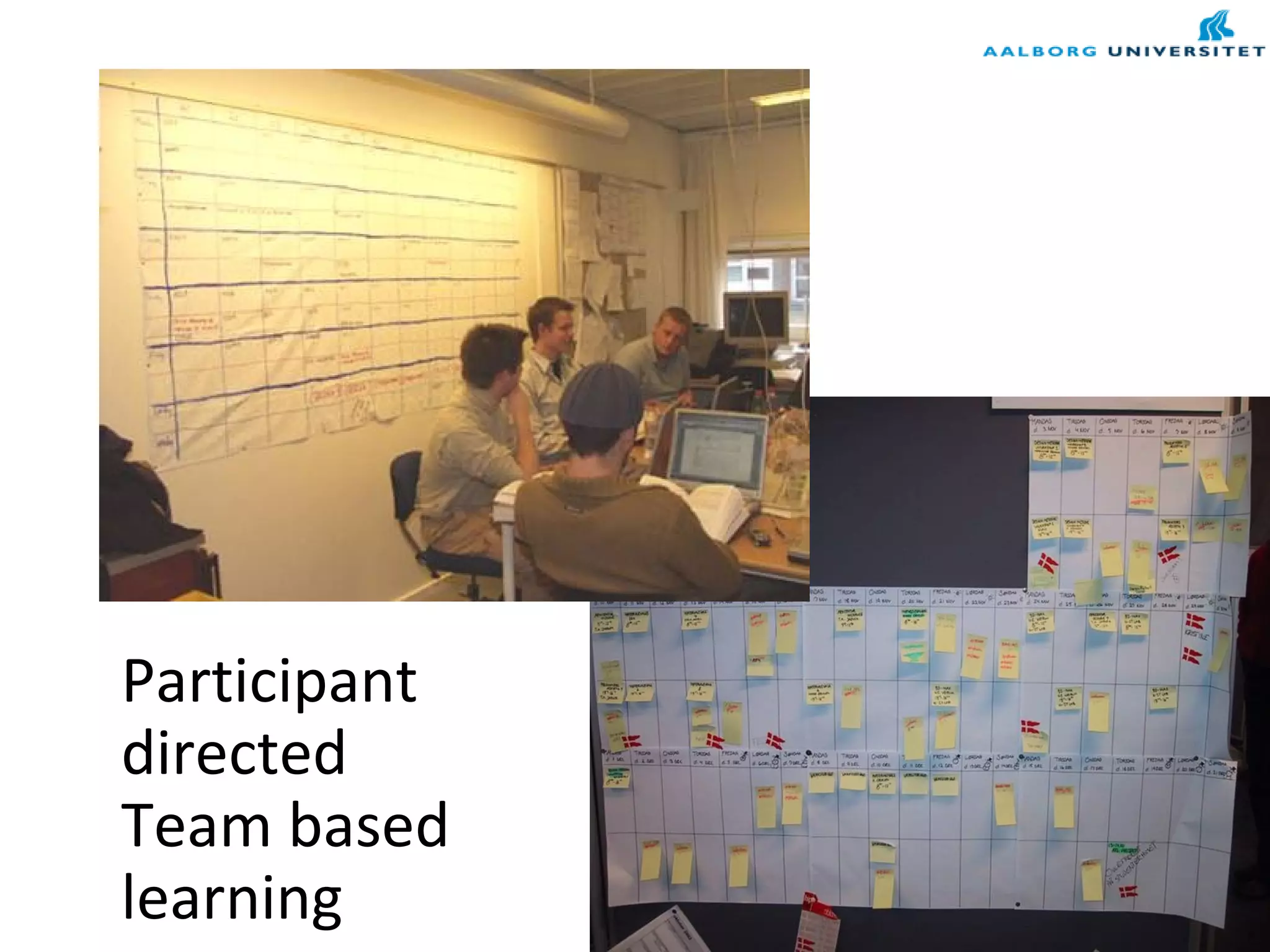
Participant
directed
Team based
learning
11
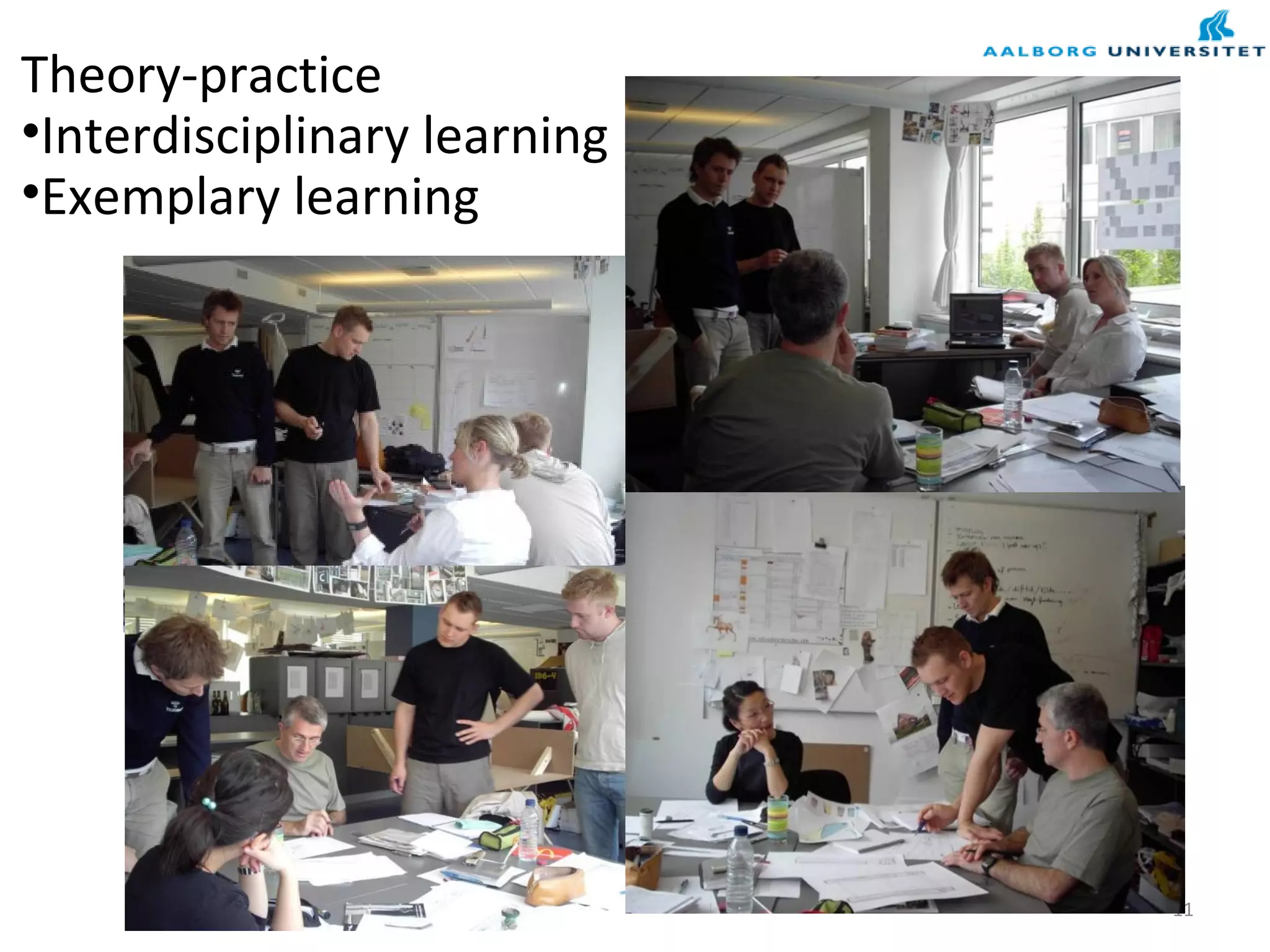
Theory-practice
•Interdisciplinary learning
•Exemplary learning
Characteristics of PBL
Thematic curriculum structure
• Integration of knowledge and skills
• Integration of different domains
Focus on the learning process
• Cooperative learning in small groups
• Students responsible for their own learning
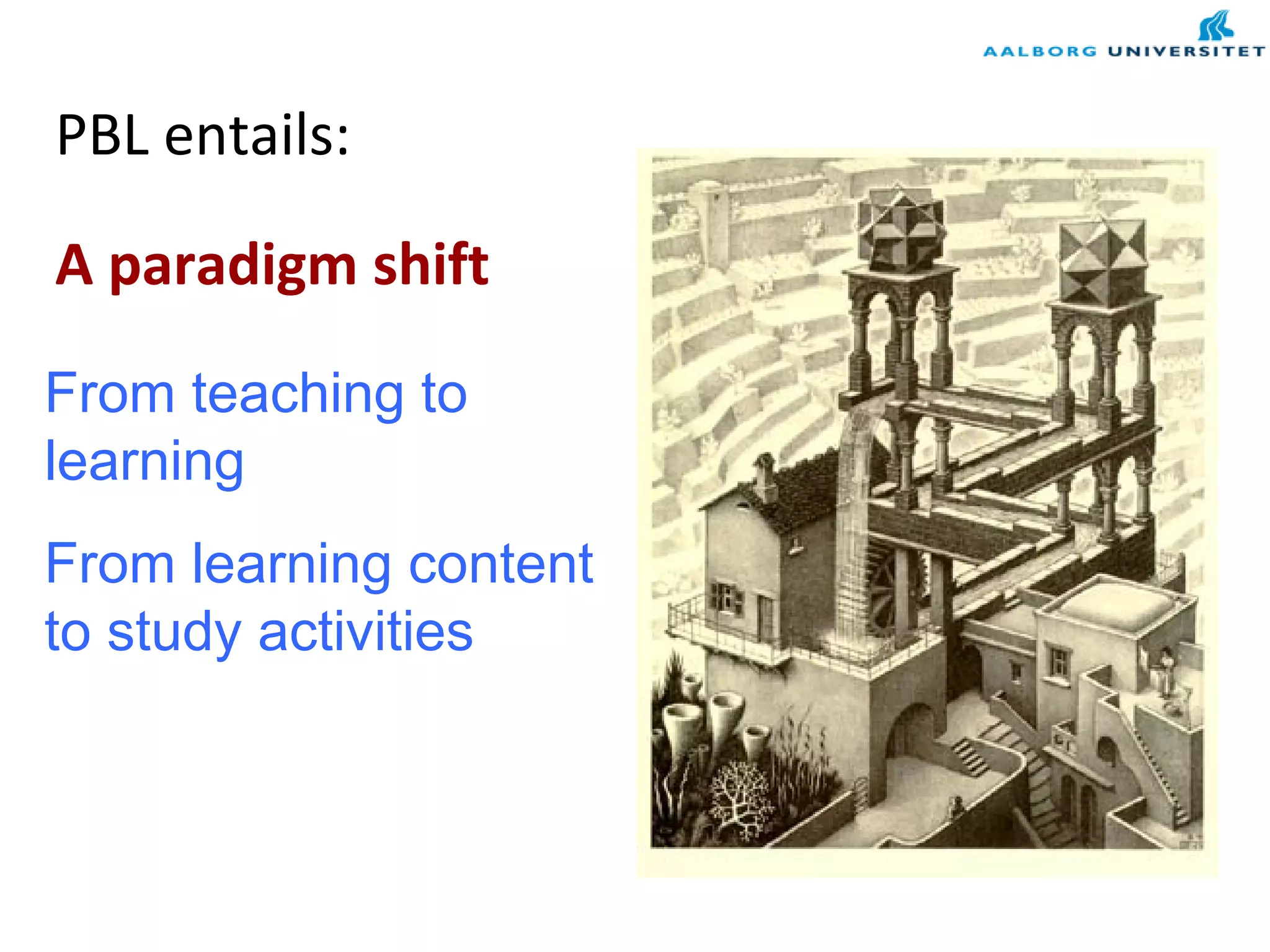
PBL entails:
A paradigm shift
From teaching to
learning
From learning content
to study activities
Paradigm shift in educational design:
form follows function
Educational functions
• Insight in the relationship
between technology and society
• The development of a scientific
attitude of critical reflection
• The development of a sense
responsibility and an
independent personality
• Acquisition of professional
knowledge and skills
Educational form
• Active participation in
cooperating groups, dealing
with insecurity and learning
to take responsibility
• Working on practice oriented
projects and analyzing
theoretically oriented
problems
• Critical reflection on
performance
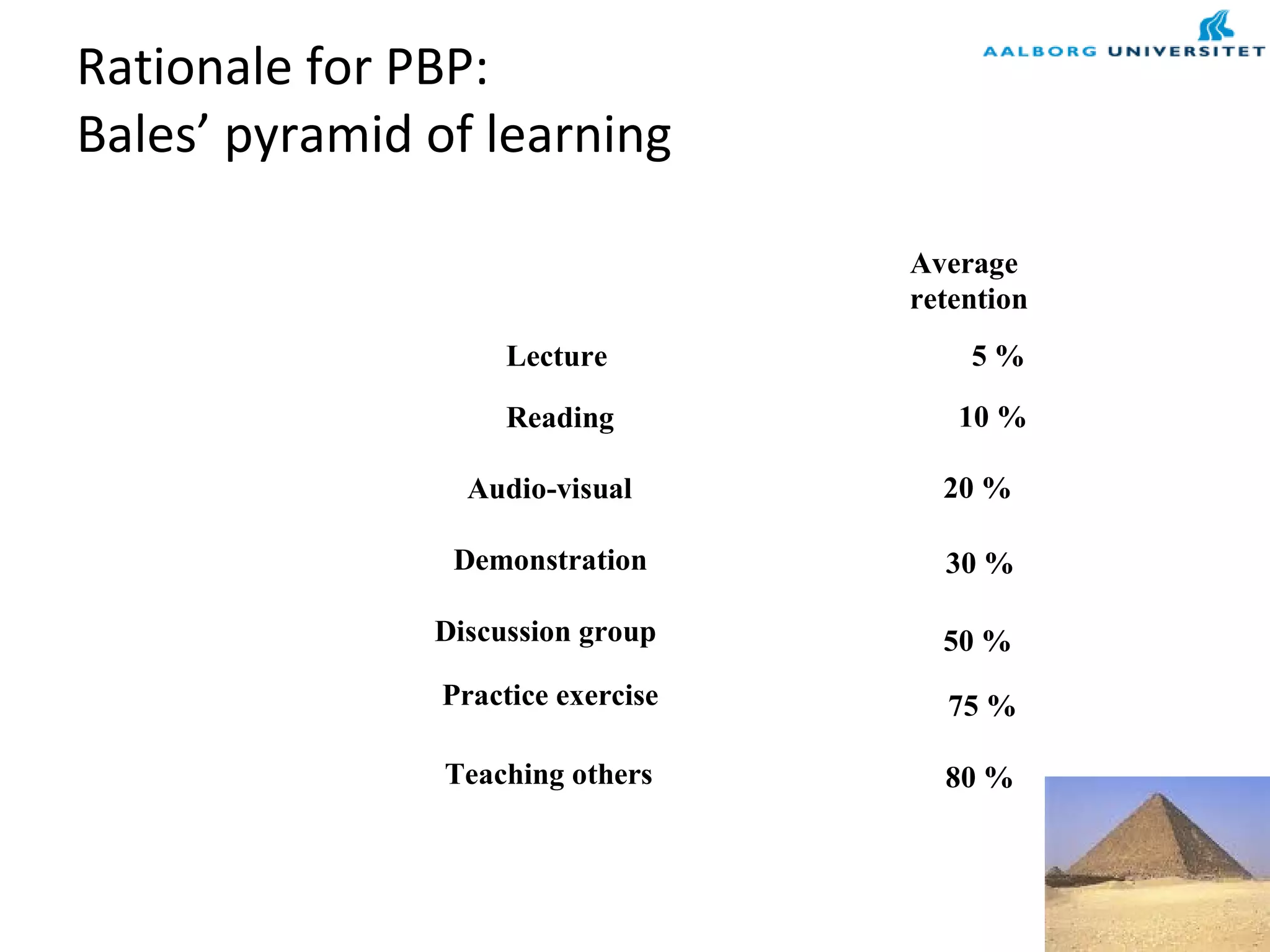
Rationale for PBP:
Bales’ pyramid of learning
5 %
10 %
Lecture
Reading
Audio-visual
Demonstration
Discussion group
Practice exercise
Teaching others
Average
retention
20 %
30 %
50 %
75 %
80 %
17
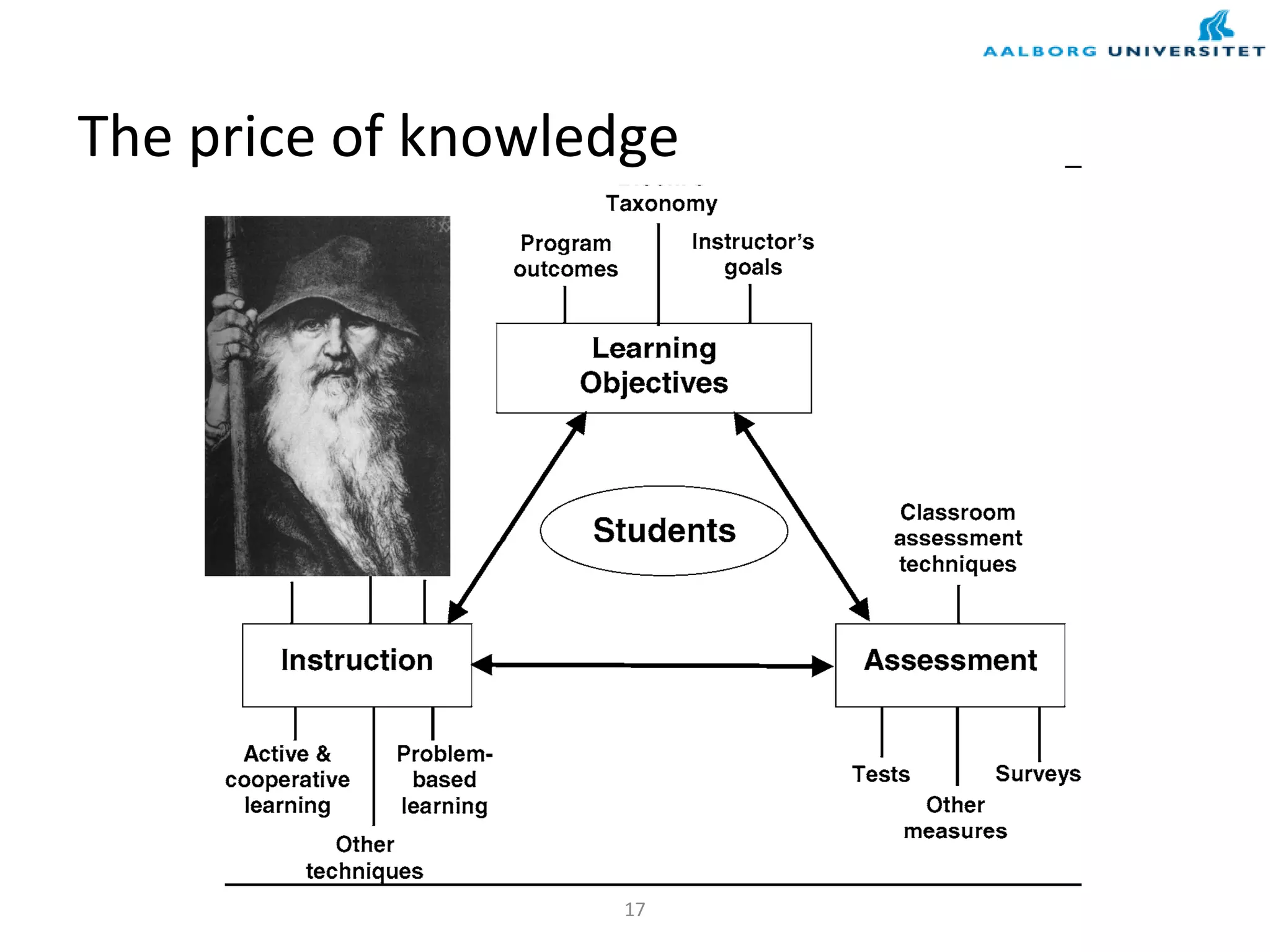
The central role of learning objectivesThe price of knowledge
The Maastricht perspective
PBL Modules:
• lasting six weeks
• containing just some cases
• integrating knowledge form different
disciplines
Tutorial Groups
• self-directed learning
• Eight students in a group
• cooperation and teamwork
Facilitated by a tutor:
• guiding the process without taking the lead
• guarding quality without interfering in the
process
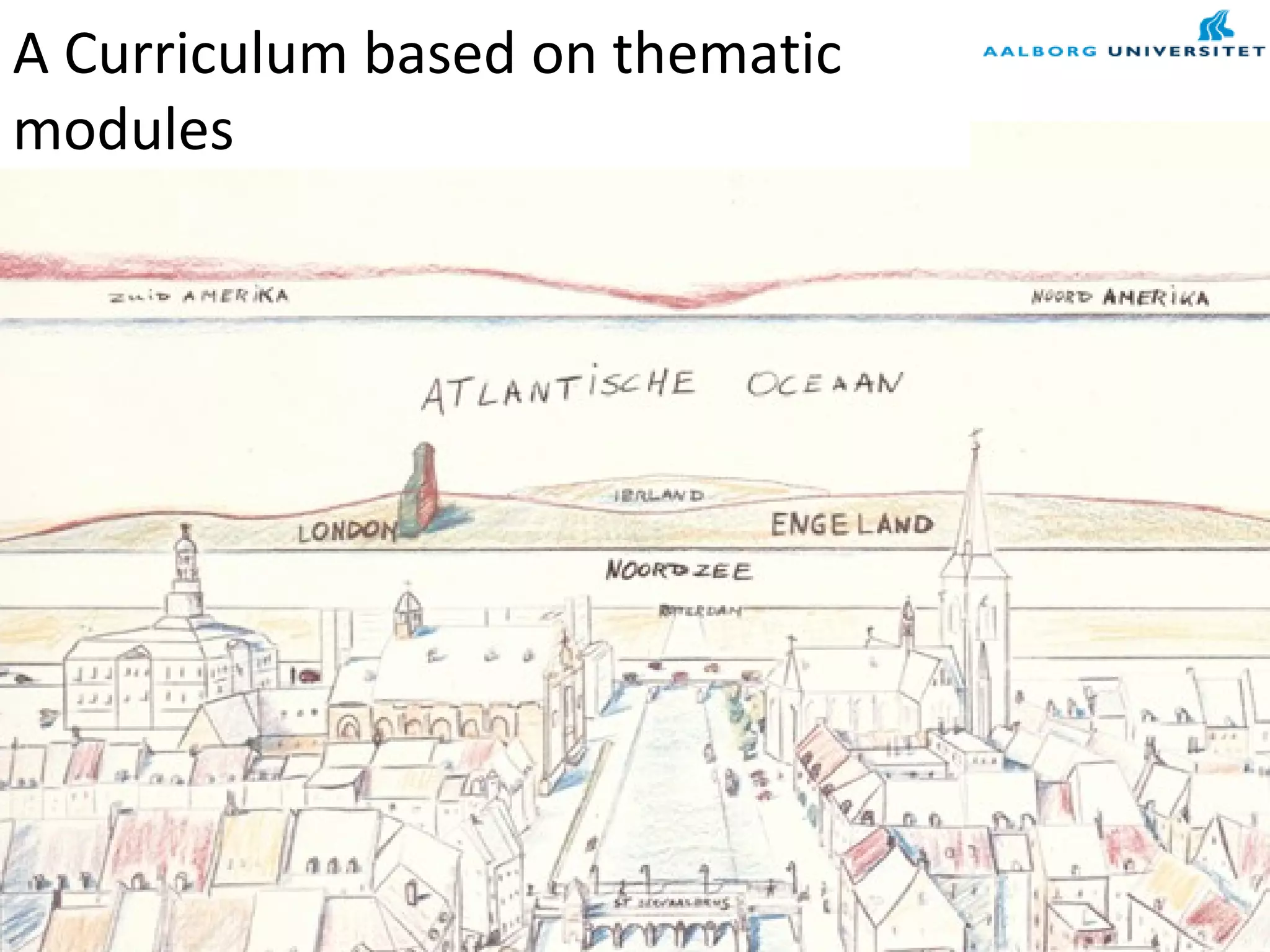
A Curriculum based on thematic
modules
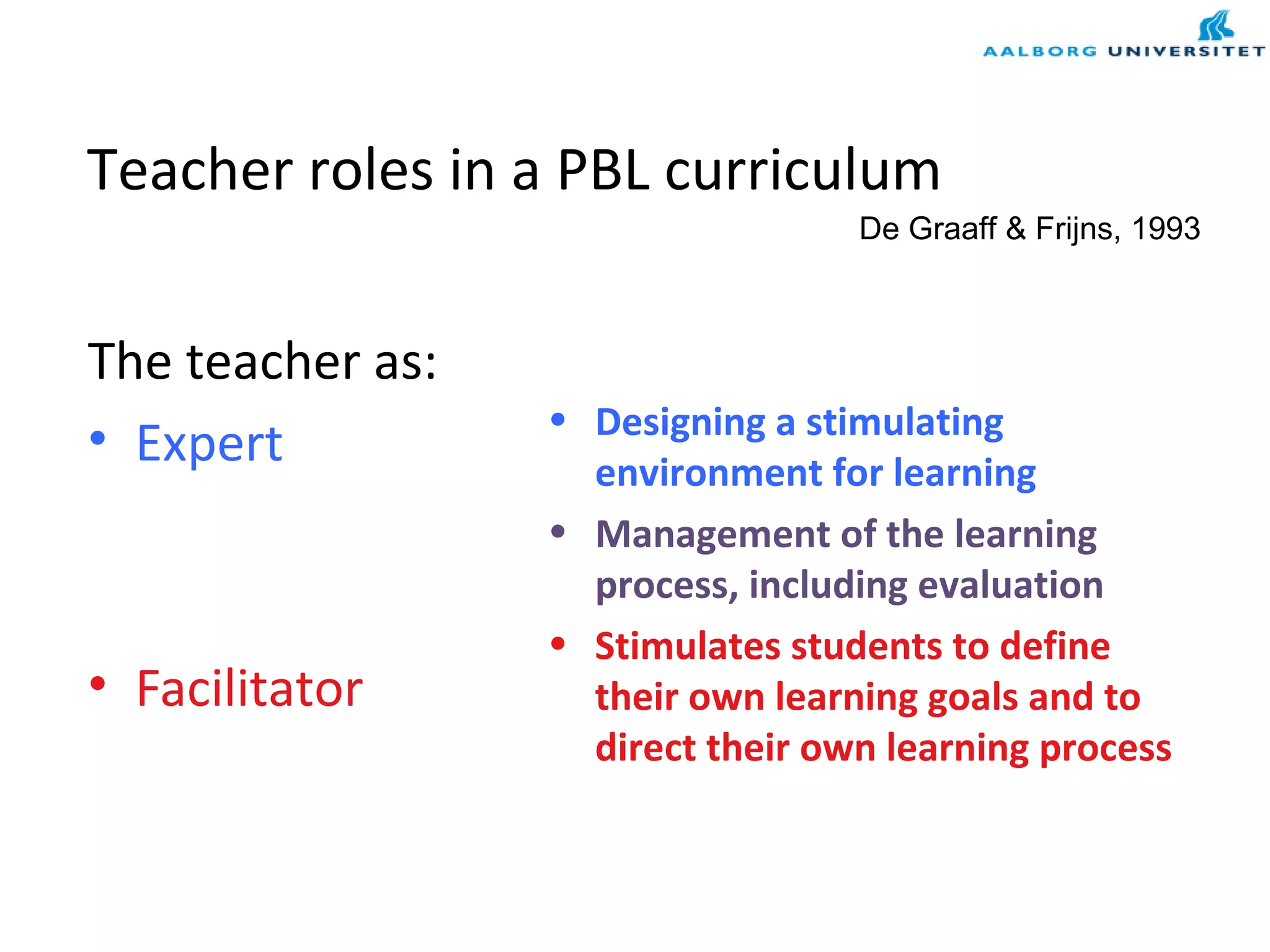
Teacher roles in a PBL curriculum
The teacher as:
• Expert
• Facilitator
De Graaff & Frijns, 1993
• Designing a stimulating
environment for learning
• Management of the learning
process, including evaluation
• Stimulates students to define
their own learning goals and to
direct their own learning process
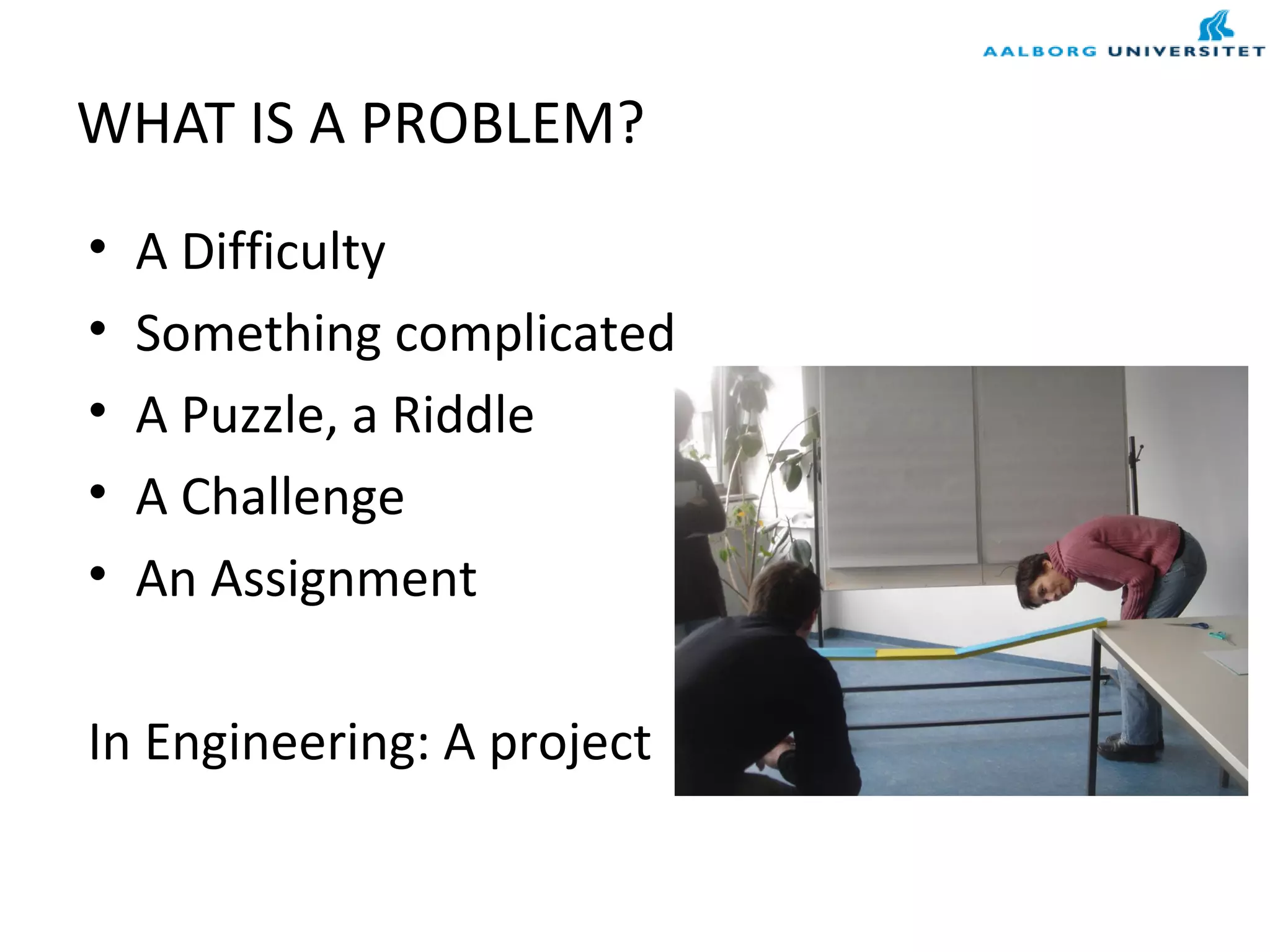
WHAT IS A PROBLEM?
• A Difficulty
• Something complicated
• A Puzzle, a Riddle
• A Challenge
• An Assignment
In Engineering: A project
Video: Pitfalls of tutoring
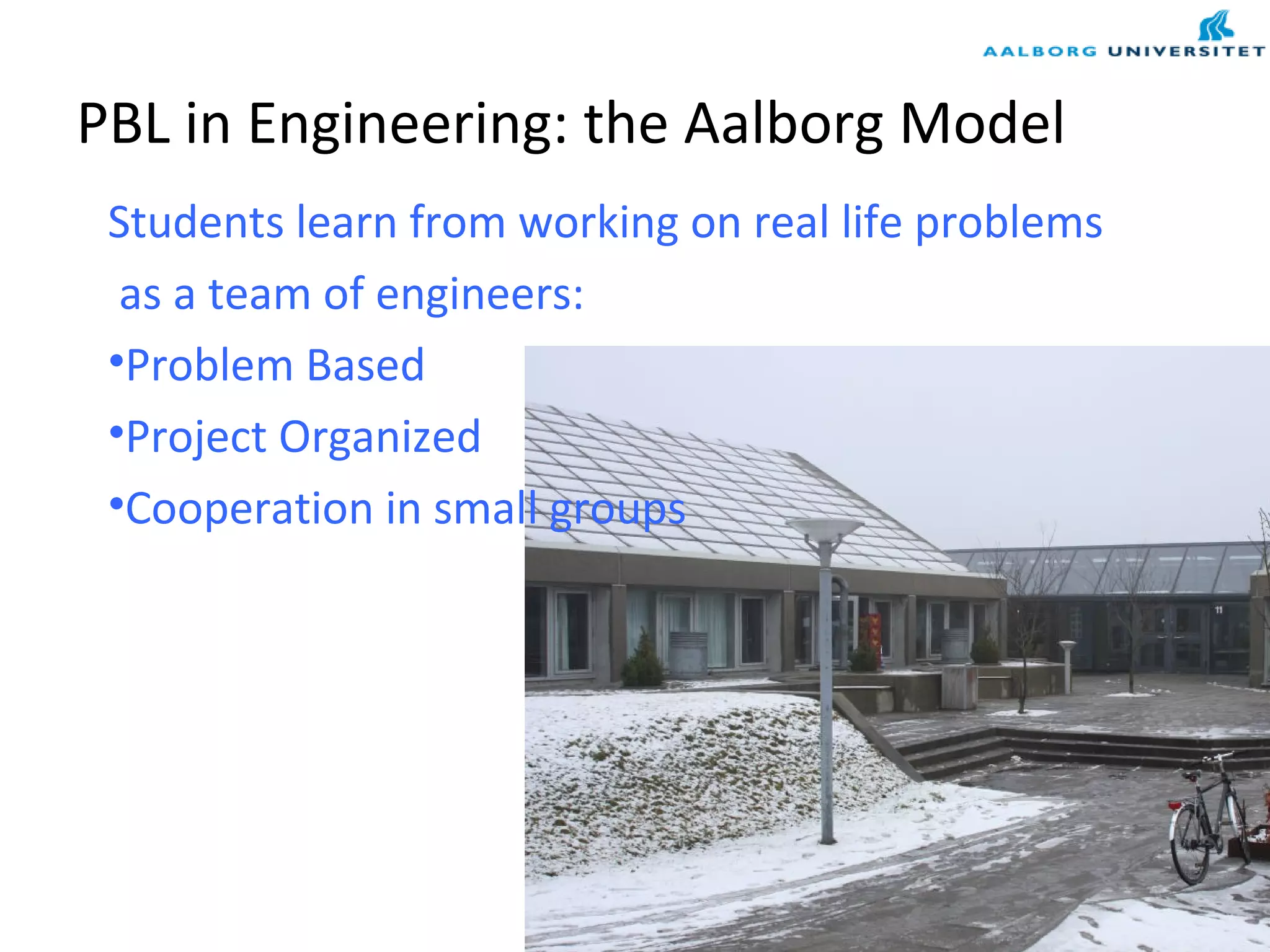
PBL in Engineering: the Aalborg Model
Students learn from working on real life problems
as a team of engineers:
•Problem Based
•Project Organized
•Cooperation in small groups
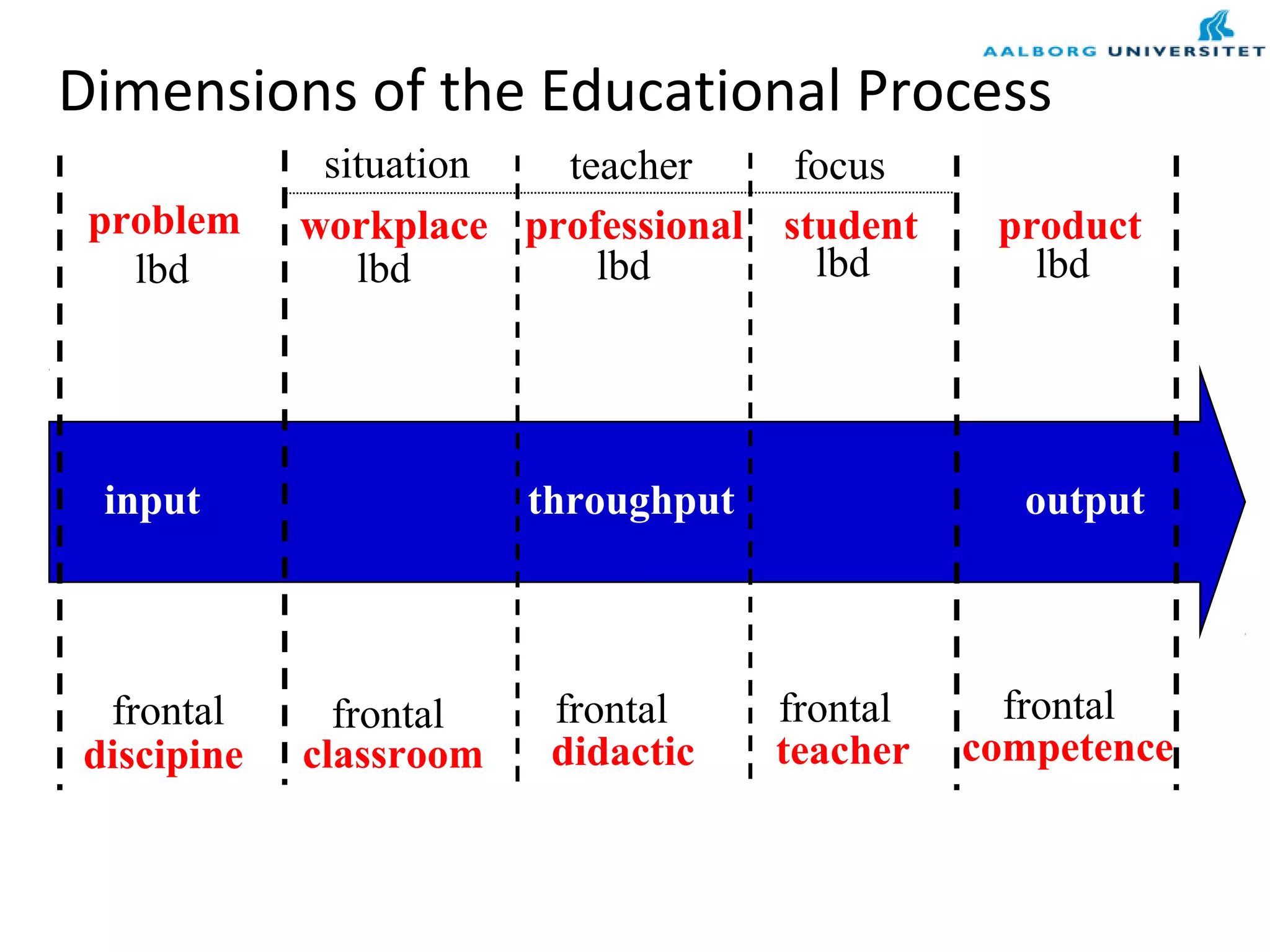
Dimensions of the Educational Process
input throughput output
situation teacher focus
problem
discipine
workplace
classroom
professional
didactic
student
teacher
product
competence
frontal frontal frontal frontal frontal
lbd lbd lbd lbd lbd
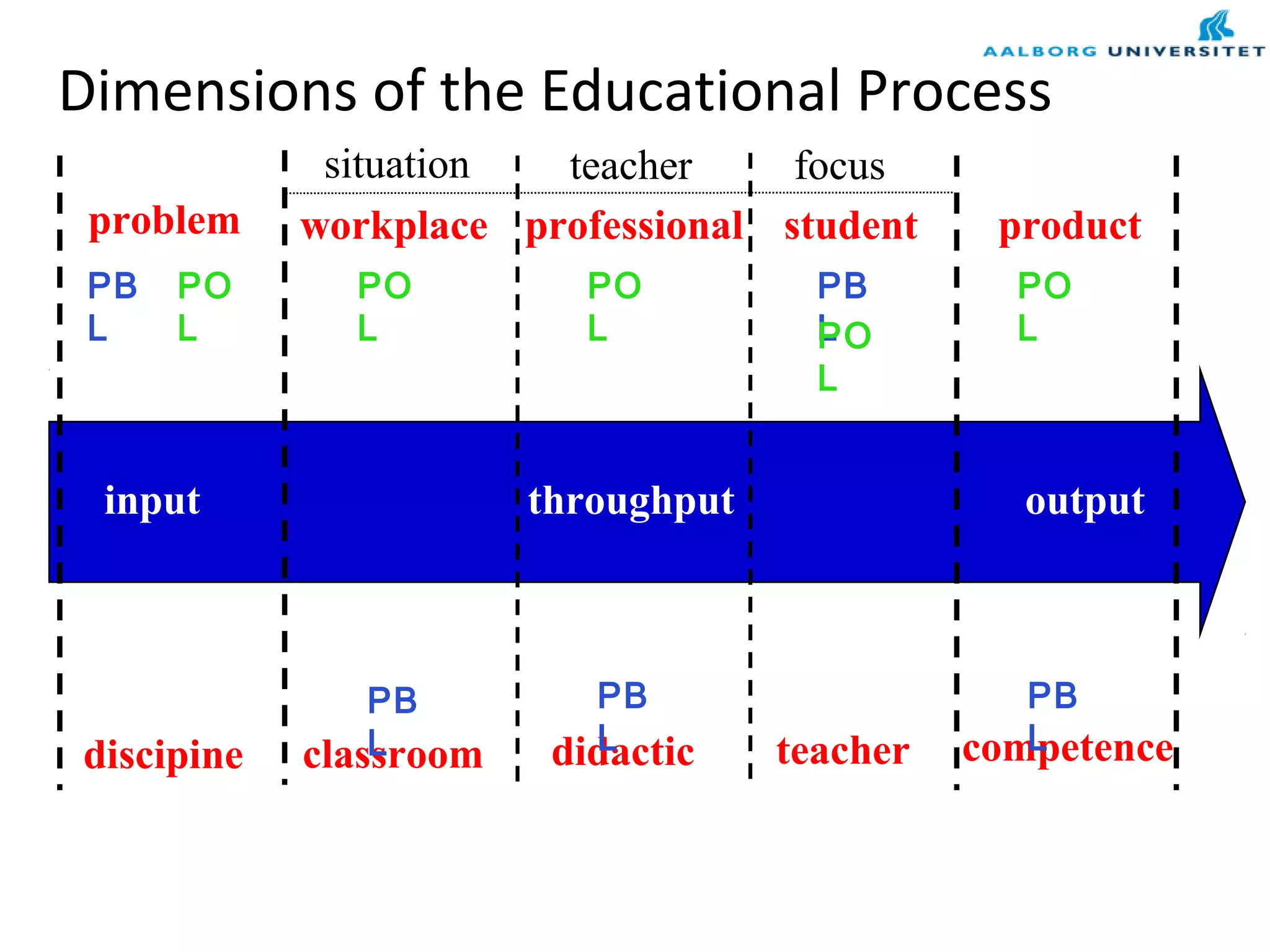
Dimensions of the Educational Process
input throughput output
situation teacher focus
problem
discipine
workplace
classroom
professional
didactic
student
teacher
product
competence
PB
L
PB
L
PB
L
PB
L
PB
L
PO
L
PO
L
PO
L PO
L
PO
L
Differences between Projects and PBL
Type of problem
Time per problem
Number of students
Role of the teachers
Expected results
Assessment
a real life task
broad range
small groups (4-8)
expert
a finished product
product and process
phenomenon
about one week
small groups (6-12)
process facilitator
learning results
individual test of
learning results
Projects PBL
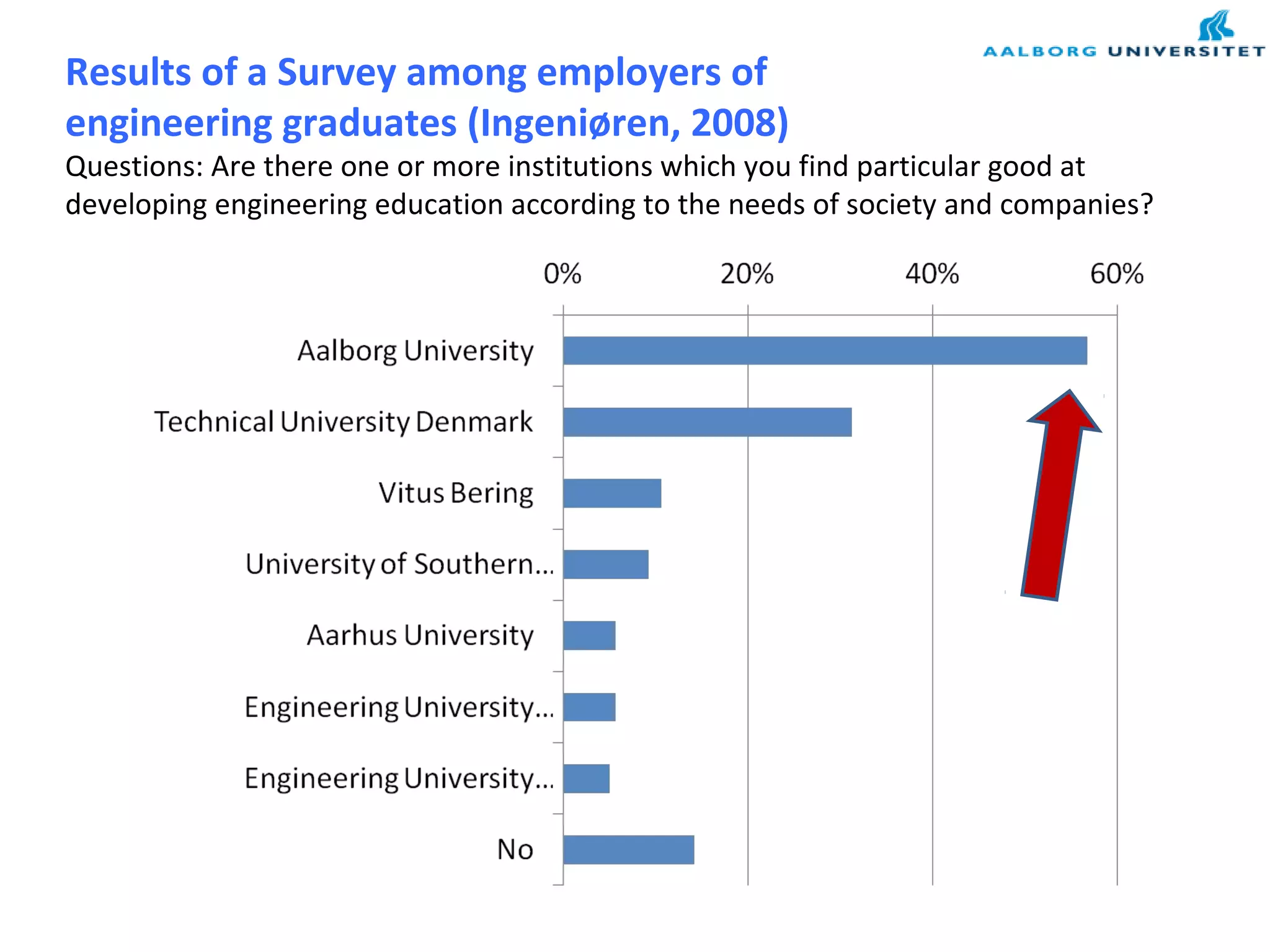
Results of a Survey among employers of
engineering graduates (Ingeniøren, 2008)
Questions: Are there one or more institutions which you find particular good at
developing engineering education according to the needs of society and companies?
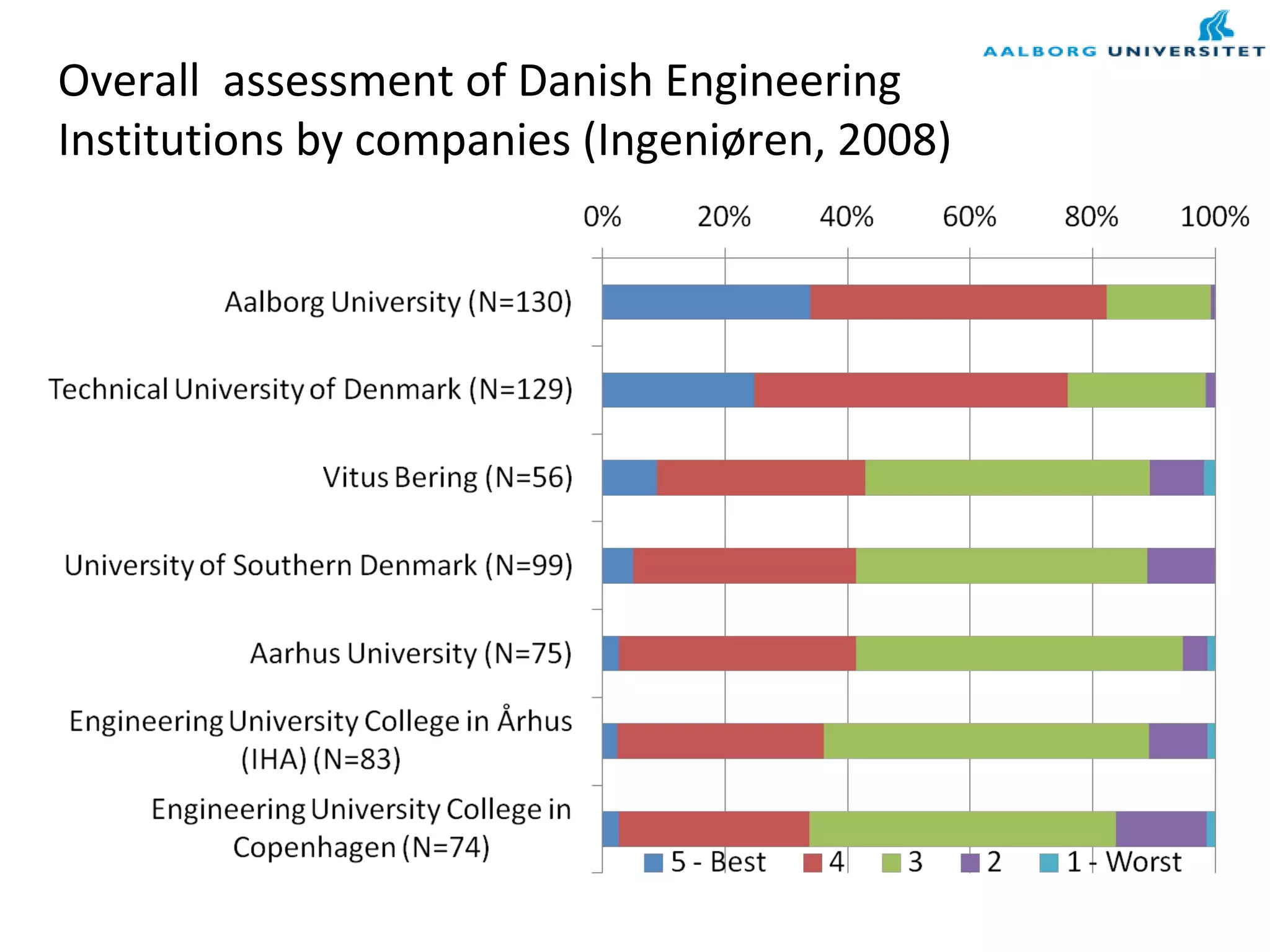
Overall assessment of Danish Engineering
Institutions by companies (Ingeniøren, 2008)
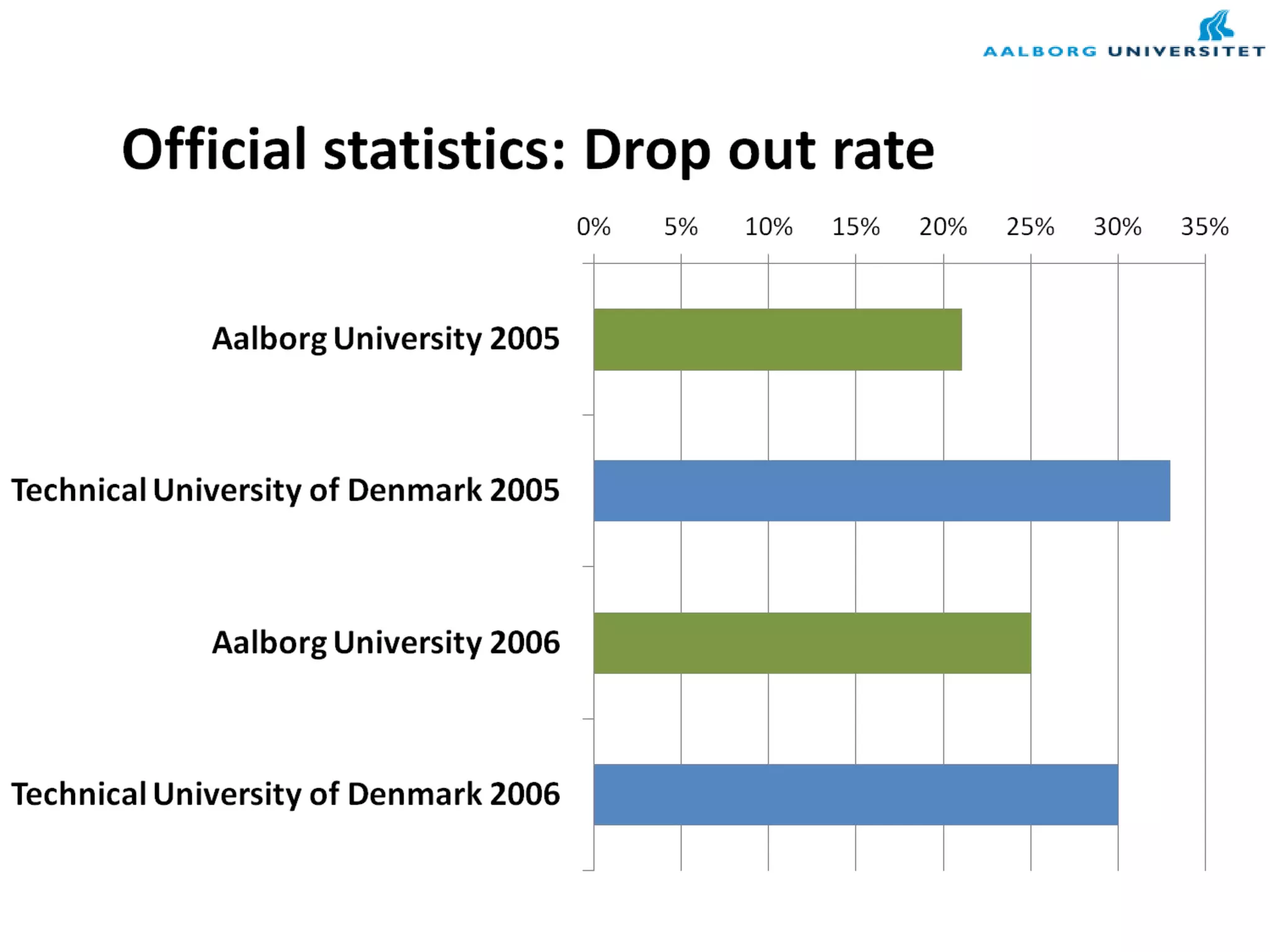
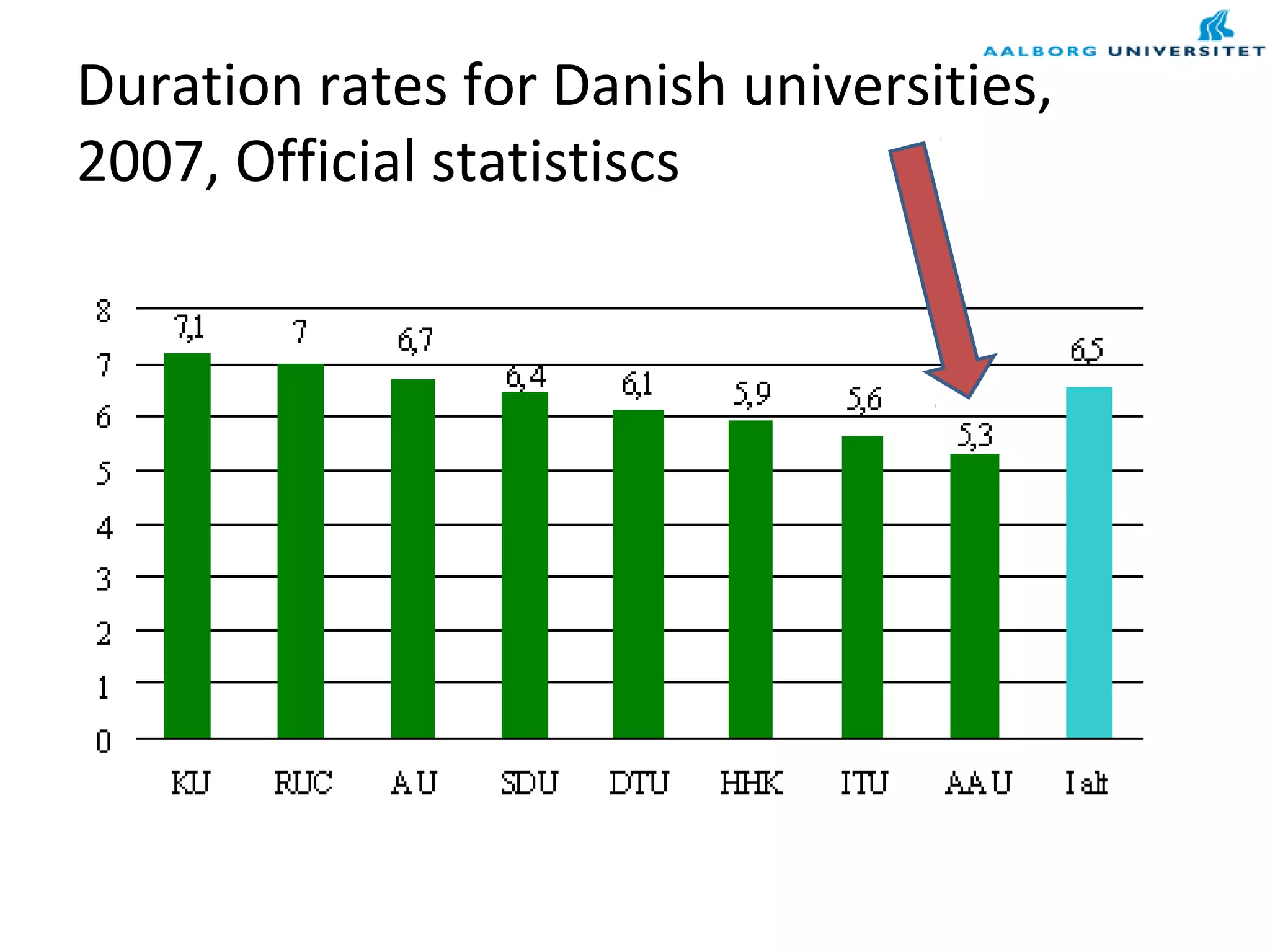
Duration rates for Danish universities,
2007, Official statistiscs
The tripod of successful innovation
Visiononteaching
andlearning
VisiononManandSociety
Educational Philosophy PBLEducational Philosophy PBL
Visionontheprofession
A question of balance
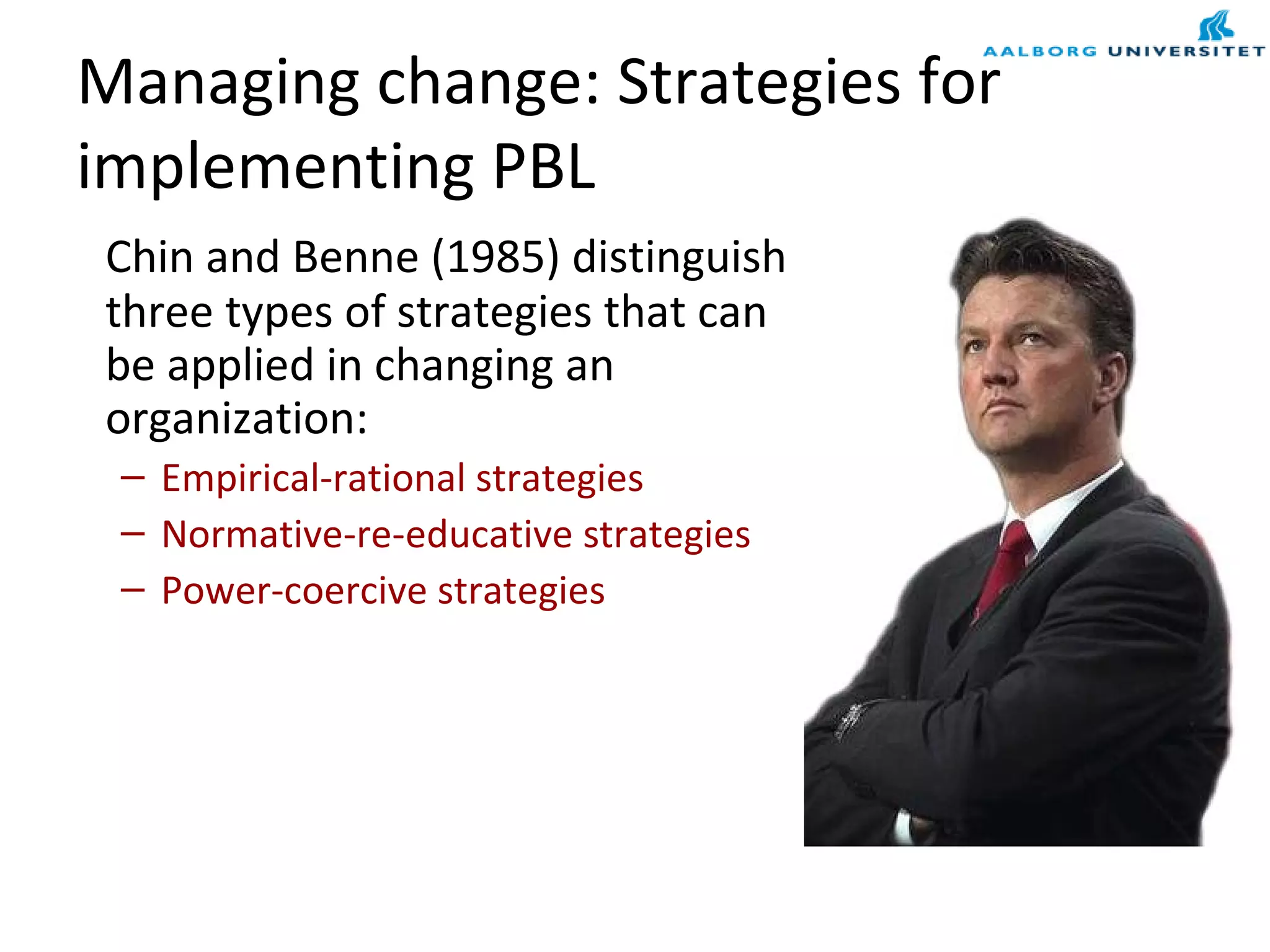
Managing change: Strategies for
implementing PBL
Chin and Benne (1985) distinguish
three types of strategies that can
be applied in changing an
organization:
– Empirical-rational strategies
– Normative-re-educative strategies
– Power-coercive strategies
Research support for PBL
Learning
Motivation and engagement Graff and Cowdroy 1997, Thomas 2000, Kolmos and
Du, 2006
Deep learning Biggs 2003
Self-satisfaction and meaningfulness Savin-Baden 2000, Du 2006a
Skills
Professional Skills improvement Dochy et al 2001, Frenay et al 2007
Process skills Kolmos 1996, 1999, Du 2006, Kolmos and Du 2006,
Croshwaite, 2006,
Complex knowledge and identity
Interdisciplinary knowledge and skills Kjaersdam 1994, Graaff and Kolmos 2003
Professional identity and responsibility Hmelo and Evensen 2000, Kolmos 2006, Du 2006a,
2006b
Management
Higher retention and duration on time Kolmos and Du 2008
40
Complex knowledge and identity
Interdisciplinary knowledge and skills Kjaersdam 1994, Graaff and Kolmos
2003
Creativity and designing skills Schrøder 2006
Professional identity and responsibility Hmelo and Evensen 2000, Kolmos
2006, Du 2006a, 2006b
Management
Higher retention and duration on time Kolmos and Du 2008
Regional development
PBL support entrepreneurship and relation to companies Lundvall et al 2000
41
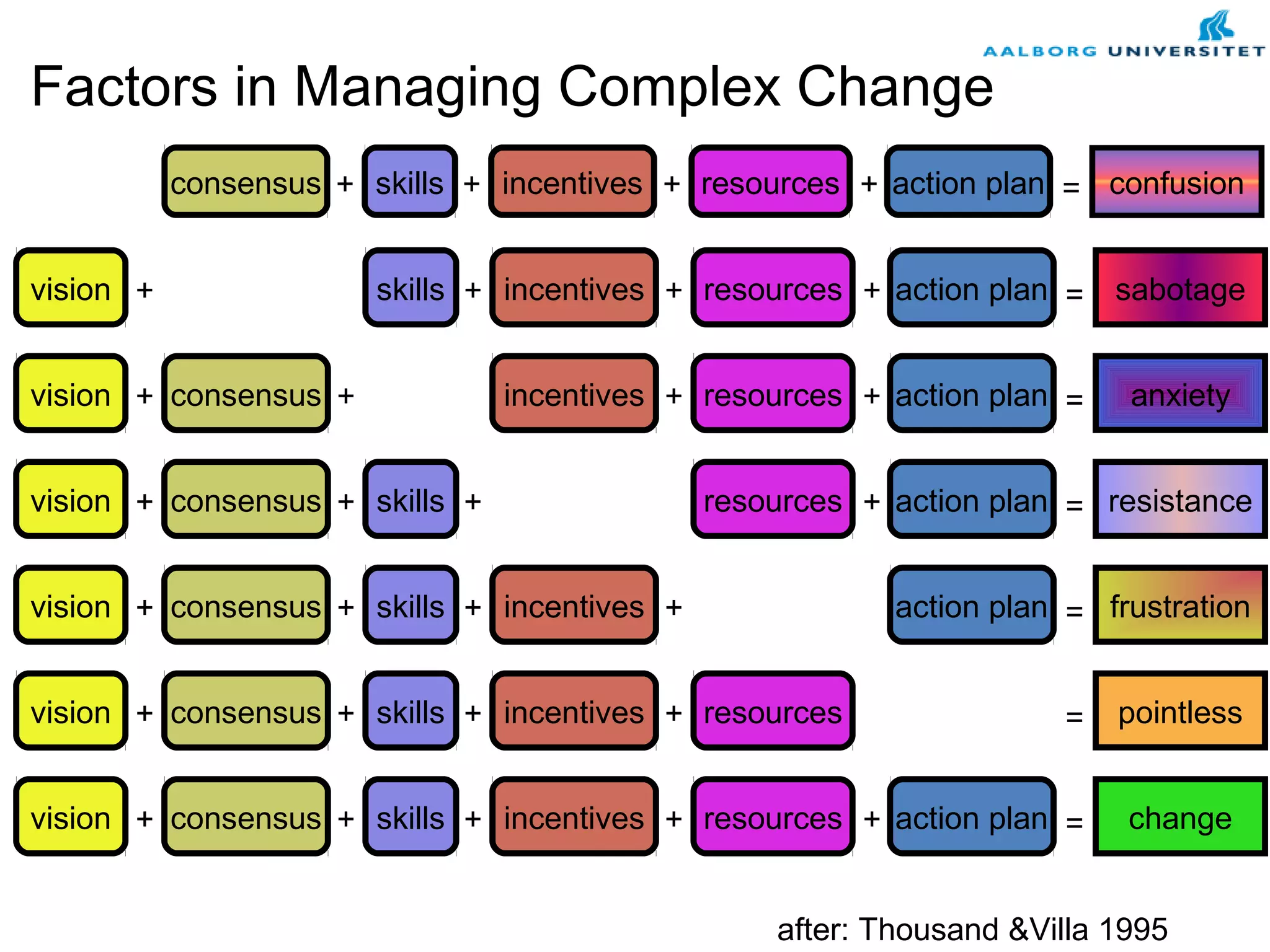
Factors in Managing Complex Change
confusionconsensus skills incentives resources action plan =+ + + +
resistancevision consensus skills resources action plan =+ + + +
=vision consensus skills incentives resources action plan change+ + + + +
=vision consensus skills incentives resources pointless+ + + +
frustrationvision consensus skills incentives action plan =+ + + +
sabotagevision skills incentives resources action plan =+ + + +
after: Thousand &Villa 1995
anxietyvision consensus incentives resources action plan =+ + + +
Key Features in the Success of PBL
• Students responsible for
their own learning process
• A clear purpose of all
learning activities
• Sufficient attention for
Communication Skills
• Balanced support from
Technical experts to
overcome knowledge
barriers
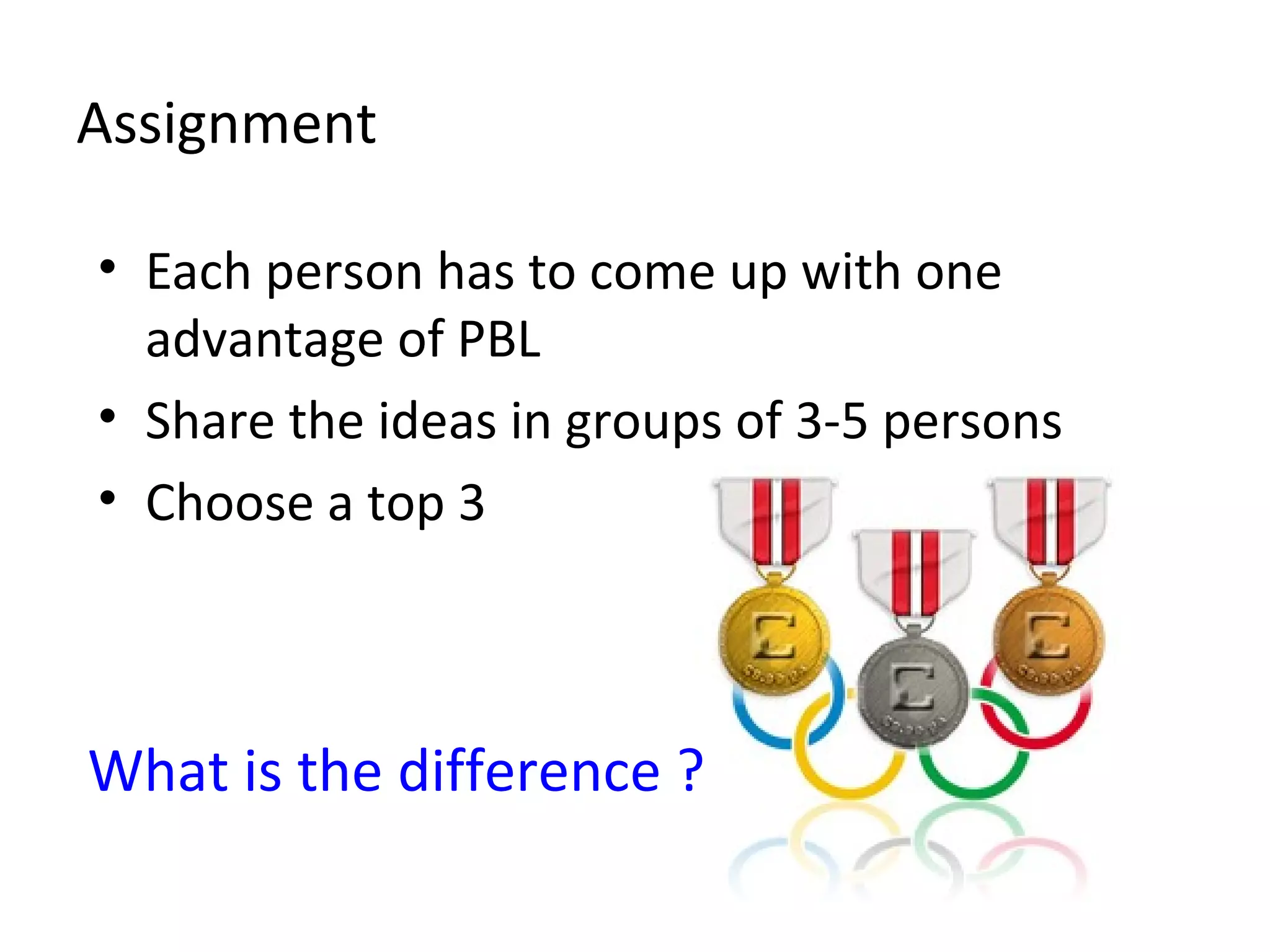
Assignment
• Each person has to come up with one
advantage of PBL
• Share the ideas in groups of 3-5 persons
• Choose a top 3
What is the difference ?
Any Questions ?
Can I get an
ice cream ?
Are we going to the
zoo ?
When is Mama
coming back?
39e SEFI Annual Conference 2011, Lisbon,
28-30 September, 2011, Lisbon, Portugal
REEN 2011
Madrid Oct. 3-6

PBL in engineering

  • 1.
    PROBLEM BASED LEARNINGIN ENGINEERING: HOW TO MAKE IT WORK Erik de Graaff Delft University of Technology, Aalborg University UNESCO Chair in Problem Based Learning
  • 2.
    PROBLEM BASED LEARNINGIN ENGINEERING: HOW TO MAKE IT WORK • The origin of PBL • PBL in Medicine McMaster – Maastricht • Paradigm shift: from teaching to facilitation • PBL in Engineering The Aalborg model • Management of Change
  • 3.
    Assignment • Each personhas to come up with one advantage of PBL • Share the ideas in groups of 3-5 persons • Choose a top 3
  • 4.
    4 McMaster, 68 Linkoping 72 Roskilde72 and Aalborg University 74 Maastricht 72 •Problems constitute the stimulus for learning •Working on real life problems promotes the development of problem solving skills •Self directed small student groups •Teachers are facilitators/guides •Problem orientation •Interdisciplinarity •Exemplary learning •Participant directed •Teams or group work Newcastle 76 In the beginning
  • 5.
    The early historyof PBL • Don Woods coins the words PBL for his teaching in a chemistry class in McMaster’s university by the end of the sixties. • PBL chosen as the didactic method for the development of a new medical curriculum at McMaster’s university (1969). • Introduction of PBL in Maastricht, also for the development of a new medical curriculum. • Implementation of POBL in Engineering Education in Roskilde and Aalborg in Denmark
  • 6.
    Different versions ofPBL Problem Based Learning Project Phenomenon P B L Based Learning Organized Learning Practice Oriented Learning
  • 7.
    Problem based learning(PBL) PBL builds on pedagogic traditions like: Maria Montessori: my playing is my learning Jerôme Bruner: learning by discovery William Killpatrick: whole hearted learning Carl Rogers: student centered learning The Harvard method: case based learning
  • 8.
  • 9.
  • 10.
  • 11.
  • 12.
    Characteristics of PBL Thematiccurriculum structure • Integration of knowledge and skills • Integration of different domains Focus on the learning process • Cooperative learning in small groups • Students responsible for their own learning
  • 13.
    PBL entails: A paradigmshift From teaching to learning From learning content to study activities
  • 14.
    Paradigm shift ineducational design: form follows function Educational functions • Insight in the relationship between technology and society • The development of a scientific attitude of critical reflection • The development of a sense responsibility and an independent personality • Acquisition of professional knowledge and skills Educational form • Active participation in cooperating groups, dealing with insecurity and learning to take responsibility • Working on practice oriented projects and analyzing theoretically oriented problems • Critical reflection on performance
  • 15.
    Rationale for PBP: Bales’pyramid of learning 5 % 10 % Lecture Reading Audio-visual Demonstration Discussion group Practice exercise Teaching others Average retention 20 % 30 % 50 % 75 % 80 %
  • 17.
    17 The central roleof learning objectivesThe price of knowledge
  • 18.
    The Maastricht perspective PBLModules: • lasting six weeks • containing just some cases • integrating knowledge form different disciplines Tutorial Groups • self-directed learning • Eight students in a group • cooperation and teamwork Facilitated by a tutor: • guiding the process without taking the lead • guarding quality without interfering in the process A Curriculum based on thematic modules
  • 19.
    Teacher roles ina PBL curriculum The teacher as: • Expert • Facilitator De Graaff & Frijns, 1993 • Designing a stimulating environment for learning • Management of the learning process, including evaluation • Stimulates students to define their own learning goals and to direct their own learning process
  • 20.
    WHAT IS APROBLEM? • A Difficulty • Something complicated • A Puzzle, a Riddle • A Challenge • An Assignment In Engineering: A project
  • 21.
  • 22.
    PBL in Engineering:the Aalborg Model Students learn from working on real life problems as a team of engineers: •Problem Based •Project Organized •Cooperation in small groups
  • 23.
    Dimensions of theEducational Process input throughput output situation teacher focus problem discipine workplace classroom professional didactic student teacher product competence frontal frontal frontal frontal frontal lbd lbd lbd lbd lbd
  • 24.
    Dimensions of theEducational Process input throughput output situation teacher focus problem discipine workplace classroom professional didactic student teacher product competence PB L PB L PB L PB L PB L PO L PO L PO L PO L PO L
  • 25.
    Differences between Projectsand PBL Type of problem Time per problem Number of students Role of the teachers Expected results Assessment a real life task broad range small groups (4-8) expert a finished product product and process phenomenon about one week small groups (6-12) process facilitator learning results individual test of learning results Projects PBL
  • 26.
    Results of aSurvey among employers of engineering graduates (Ingeniøren, 2008) Questions: Are there one or more institutions which you find particular good at developing engineering education according to the needs of society and companies?
  • 27.
    Overall assessment ofDanish Engineering Institutions by companies (Ingeniøren, 2008)
  • 30.
    Duration rates forDanish universities, 2007, Official statistiscs
  • 31.
    The tripod ofsuccessful innovation Visiononteaching andlearning VisiononManandSociety Educational Philosophy PBLEducational Philosophy PBL Visionontheprofession A question of balance
  • 32.
    Managing change: Strategiesfor implementing PBL Chin and Benne (1985) distinguish three types of strategies that can be applied in changing an organization: – Empirical-rational strategies – Normative-re-educative strategies – Power-coercive strategies
  • 33.
    Research support forPBL Learning Motivation and engagement Graff and Cowdroy 1997, Thomas 2000, Kolmos and Du, 2006 Deep learning Biggs 2003 Self-satisfaction and meaningfulness Savin-Baden 2000, Du 2006a Skills Professional Skills improvement Dochy et al 2001, Frenay et al 2007 Process skills Kolmos 1996, 1999, Du 2006, Kolmos and Du 2006, Croshwaite, 2006, Complex knowledge and identity Interdisciplinary knowledge and skills Kjaersdam 1994, Graaff and Kolmos 2003 Professional identity and responsibility Hmelo and Evensen 2000, Kolmos 2006, Du 2006a, 2006b Management Higher retention and duration on time Kolmos and Du 2008 40
  • 34.
    Complex knowledge andidentity Interdisciplinary knowledge and skills Kjaersdam 1994, Graaff and Kolmos 2003 Creativity and designing skills Schrøder 2006 Professional identity and responsibility Hmelo and Evensen 2000, Kolmos 2006, Du 2006a, 2006b Management Higher retention and duration on time Kolmos and Du 2008 Regional development PBL support entrepreneurship and relation to companies Lundvall et al 2000 41
  • 35.
    Factors in ManagingComplex Change confusionconsensus skills incentives resources action plan =+ + + + resistancevision consensus skills resources action plan =+ + + + =vision consensus skills incentives resources action plan change+ + + + + =vision consensus skills incentives resources pointless+ + + + frustrationvision consensus skills incentives action plan =+ + + + sabotagevision skills incentives resources action plan =+ + + + after: Thousand &Villa 1995 anxietyvision consensus incentives resources action plan =+ + + +
  • 36.
    Key Features inthe Success of PBL • Students responsible for their own learning process • A clear purpose of all learning activities • Sufficient attention for Communication Skills • Balanced support from Technical experts to overcome knowledge barriers
  • 37.
    Assignment • Each personhas to come up with one advantage of PBL • Share the ideas in groups of 3-5 persons • Choose a top 3 What is the difference ?
  • 38.
    Any Questions ? CanI get an ice cream ? Are we going to the zoo ? When is Mama coming back?
  • 39.
    39e SEFI AnnualConference 2011, Lisbon, 28-30 September, 2011, Lisbon, Portugal REEN 2011 Madrid Oct. 3-6

Editor's Notes

  • #15 the American architect Louis Sullivan
  • #36 Of course you will find a lot of mix-models Savin Baden has developed 9 modes – representing different mix between PBL and traditional teaching. I will shortly present some of them. The second one is patchwork PBL or shoestrings – the point is here that PBL is all over – with different purposes, but not really closely reasoned – so the students can get confused
  • #37 These two approahed hve been coordinated on the system level. Both apporachoces try to buidl up a progression