Lesson Study - a collaborative approach to 
developing and researching pedagogy 
www.le.ac.uk 
Lesson Study Research Group 
School of Education 
University of Leicester
Outline 
• The Lesson Study process 
• Initial insights gained 
• Wider lessons
‘We close the classroom door and experience pedagogical 
solitude… I now believe that the reason teaching is not more 
valued in the Academy is because the way we treat teaching 
removes it from the community of scholars.’ 
Shulman (2004, 140-141)
Background to Lesson Study 
•Japanese Lesson Study (‘jugyou kenkyuu’ ) 
•collaborative research-oriented learning activity (plan-teach-observe- 
evaluate) 
•deeper understanding of students’ learning leads to 
continuously refined pedagogy
Some core characteristics of Lesson Study 
• collaborative, 
• case-student specific, 
• classroom-based, 
• lesson specific, 
• qualitative, 
• Learning and pedagogy-focused. 
• FLEXIBLE - Variation in application might occur due to 
purposes and contexts
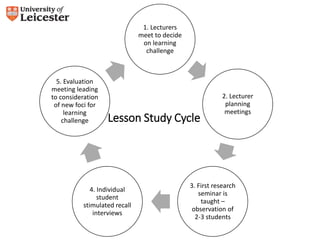
1. Lecturers 
meet to decide 
on learning 
challenge 
Lesson Study Cycle 
2. Lecturer 
planning 
meetings 
3. First research 
seminar is 
taught – 
observation of 
2-3 students 
5. Evaluation 
meeting leading 
to consideration 
of new foci for 
4. Individual 
student 
stimulated recall 
interviews 
learning 
challenge
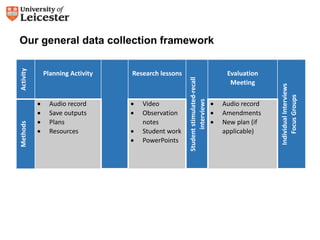
Activity 
Planning Activity Research lessons 
Student stimulated-recall 
interviews 
Evaluation 
Meeting 
Individual Interviews 
Focus Groups 
Methods 
 Audio record 
 Save outputs 
 Plans 
 Resources 
 Video 
 Observation 
notes 
 Student work 
 PowerPoints 
 Audio record 
 Amendments 
 New plan (if 
applicable) 
Our general data collection framework
Two main projects to date: 
1. Developing understanding of international student 
learning 
2. Understanding the role of study skills in the MA 
International Education
Aims of the Research 
1. evaluate the quality of students’ learning 
opportunities in ‘research lesson seminars’ 
2. explore student perspectives on their learning 
experiences 
3. develop a greater understanding of cross-departmental 
working (with ELTU)
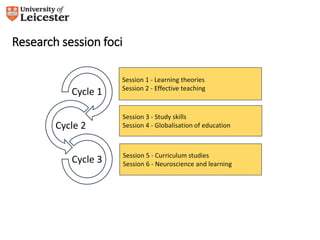
Research session foci 
Session 1 - Learning theories 
Session 2 - Effective teaching 
Session 3 - Study skills 
Session 4 - Globalisation of education 
Session 5 - Curriculum studies 
Session 6 - Neuroscience and learning 
Cycle 1 
Cycle 2 
Cycle 3
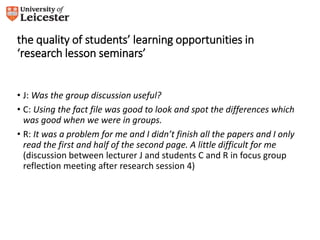
the quality of students’ learning opportunities in 
‘research lesson seminars’ 
• J: Was the group discussion useful? 
• C: Using the fact file was good to look and spot the differences which 
was good when we were in groups. 
• R: It was a problem for me and I didn’t finish all the papers and I only 
read the first and half of the second page. A little difficult for me 
(discussion between lecturer J and students C and R in focus group 
reflection meeting after research session 4)
J: And were you using that [iphone] during the session? 
E: I do use it. Yeah. Like often I have the slides on my iPhone. 
J: And is that to view or can you actually make notes on your iPhone? 
E: No. Just to view it. Like just before class, like going back, but before 
the class of open most of the things. But now I’m using to like now Q 
comes and he gives us the papers, but before class I didn’t have it and I 
didn’t print it. So I just had on my iPhone, but I read it and like this stuff 
we just read, I just read as well in the unit and I’ve read Shepard. Then I 
just sort of moved on. (Lecturer J and student E, individual interview 
after research session 2)
Some initial conclusions 
• LS only partially breaks down ‘pedagogic solitude’ 
• Particular utility with international students 
• Issues of literacy and technology 
• Role of learning ecologies 
• How can we see learning?
Research with ELTU - Outline of the sessions we 
focused on 
• MAIE Study Skills (November 2013) – session supporting first 
assignment writing, focused on analysing papers (empirical and 
position papers) 
• ELTU (December 2013) - In-sessional support class for MAIE 
students – academic Poster presentations 
• MAIE Study Skills (March 2014) - Dissertation Development- creating 
a coherent plan
Study skills project - Initial Implications 
• Importance of working with ELTU in designing student support 
• Integration of study skills into research methods 
• ‘Study skills’ – composed of critical reading, writing, speaking, listening 
and the development of an academic/research community 
• Developing the language of research methods, so should it be ‘research 
literacy’ rather than ‘study skills’? 
• Need for a greater level of team working. Need to tackle pedagogic 
solitude – need for a cultural change 
• Utility of lesson study as a way of gaining new perspectives and insights
Wider lessons 
• Seminar rooms and student learning as a complex 
adaptive system 
‘In building representations of open systems, we are forced 
to leave things out, and since the effects of these omissions 
are nonlinear, we cannot predict their magnitude.’ 
Cilliers (1998: 13) 
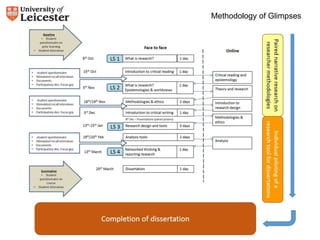
• ‘Methodology of glimpses’ 
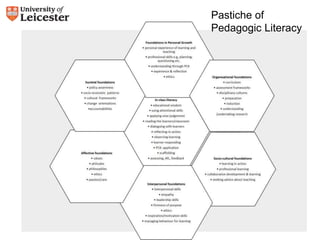
• Pedagogic literacy (Wasyl Cajkler)
Methodology of Glimpses
Pastiche of 
Pedagogic Literacy
Links 
http://hereflections.wordpress.com 
http://leicls.weebly.com 
http://SCITTLs.weebly.com 
pbw2@le.ac.uk 
@geogphil 
wc4@le.ac.uk

SRHE presentation '14

  • 1.
    Lesson Study -a collaborative approach to developing and researching pedagogy www.le.ac.uk Lesson Study Research Group School of Education University of Leicester
  • 2.
    Outline • TheLesson Study process • Initial insights gained • Wider lessons
  • 3.
    ‘We close theclassroom door and experience pedagogical solitude… I now believe that the reason teaching is not more valued in the Academy is because the way we treat teaching removes it from the community of scholars.’ Shulman (2004, 140-141)
  • 4.
    Background to LessonStudy •Japanese Lesson Study (‘jugyou kenkyuu’ ) •collaborative research-oriented learning activity (plan-teach-observe- evaluate) •deeper understanding of students’ learning leads to continuously refined pedagogy
  • 5.
    Some core characteristicsof Lesson Study • collaborative, • case-student specific, • classroom-based, • lesson specific, • qualitative, • Learning and pedagogy-focused. • FLEXIBLE - Variation in application might occur due to purposes and contexts
  • 6.
    1. Lecturers meetto decide on learning challenge Lesson Study Cycle 2. Lecturer planning meetings 3. First research seminar is taught – observation of 2-3 students 5. Evaluation meeting leading to consideration of new foci for 4. Individual student stimulated recall interviews learning challenge
  • 7.
    Activity Planning ActivityResearch lessons Student stimulated-recall interviews Evaluation Meeting Individual Interviews Focus Groups Methods  Audio record  Save outputs  Plans  Resources  Video  Observation notes  Student work  PowerPoints  Audio record  Amendments  New plan (if applicable) Our general data collection framework
  • 8.
    Two main projectsto date: 1. Developing understanding of international student learning 2. Understanding the role of study skills in the MA International Education
  • 9.
    Aims of theResearch 1. evaluate the quality of students’ learning opportunities in ‘research lesson seminars’ 2. explore student perspectives on their learning experiences 3. develop a greater understanding of cross-departmental working (with ELTU)
  • 10.
    Research session foci Session 1 - Learning theories Session 2 - Effective teaching Session 3 - Study skills Session 4 - Globalisation of education Session 5 - Curriculum studies Session 6 - Neuroscience and learning Cycle 1 Cycle 2 Cycle 3
  • 11.
    the quality ofstudents’ learning opportunities in ‘research lesson seminars’ • J: Was the group discussion useful? • C: Using the fact file was good to look and spot the differences which was good when we were in groups. • R: It was a problem for me and I didn’t finish all the papers and I only read the first and half of the second page. A little difficult for me (discussion between lecturer J and students C and R in focus group reflection meeting after research session 4)
  • 12.
    J: And wereyou using that [iphone] during the session? E: I do use it. Yeah. Like often I have the slides on my iPhone. J: And is that to view or can you actually make notes on your iPhone? E: No. Just to view it. Like just before class, like going back, but before the class of open most of the things. But now I’m using to like now Q comes and he gives us the papers, but before class I didn’t have it and I didn’t print it. So I just had on my iPhone, but I read it and like this stuff we just read, I just read as well in the unit and I’ve read Shepard. Then I just sort of moved on. (Lecturer J and student E, individual interview after research session 2)
  • 13.
    Some initial conclusions • LS only partially breaks down ‘pedagogic solitude’ • Particular utility with international students • Issues of literacy and technology • Role of learning ecologies • How can we see learning?
  • 14.
    Research with ELTU- Outline of the sessions we focused on • MAIE Study Skills (November 2013) – session supporting first assignment writing, focused on analysing papers (empirical and position papers) • ELTU (December 2013) - In-sessional support class for MAIE students – academic Poster presentations • MAIE Study Skills (March 2014) - Dissertation Development- creating a coherent plan
  • 15.
    Study skills project- Initial Implications • Importance of working with ELTU in designing student support • Integration of study skills into research methods • ‘Study skills’ – composed of critical reading, writing, speaking, listening and the development of an academic/research community • Developing the language of research methods, so should it be ‘research literacy’ rather than ‘study skills’? • Need for a greater level of team working. Need to tackle pedagogic solitude – need for a cultural change • Utility of lesson study as a way of gaining new perspectives and insights
  • 16.
    Wider lessons •Seminar rooms and student learning as a complex adaptive system ‘In building representations of open systems, we are forced to leave things out, and since the effects of these omissions are nonlinear, we cannot predict their magnitude.’ Cilliers (1998: 13) • ‘Methodology of glimpses’ • Pedagogic literacy (Wasyl Cajkler)
  • 17.
  • 18.
  • 19.
    Links http://hereflections.wordpress.com http://leicls.weebly.com http://SCITTLs.weebly.com pbw2@le.ac.uk @geogphil wc4@le.ac.uk