



Peer Observation and
Feedback in ELT Teacher
Training Programmes: A
Constructive Model
Dr.Bose Vasudevan

Institute of Language Teaching, Jamnagar, Gujarat.
boseenvy@rediffmail.com
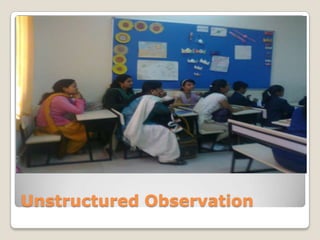
Unstructured Observation


Peer Observation and Feedback: Concept and Objectives




Unstructured Observation and feedback (Phase I)
Outcomes:




Positive feedback
Good/ average/ very good/ excellent/ well done/ good effort/
good command over language/ good personality/good English/
lesson taught as per plan/ everything fine/ great/fairly confident
etc…




Negative feedback
Not so good/below average/poor English/feeble voice/chalkboard
use not appealing/spelling errors on chalkboard/no movement in
the class/no teaching aids used/ everything went wrong/ no
confidence/no eye-contact at all etc…..

Background


Discussion: Should we have Peer
Observation and Feedback?

New design: Observation schedule.(Phase
II)
 Objectives: alternative scheme
 Outcomes: quantitative
 Limitation: Preoccupied with the
completion of observation schedule. Less
beneficial for the person who is observing.


Structured observation


.
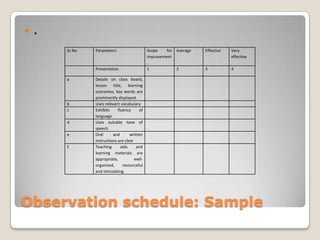
Sr.No

Parameters

Presentation
a

b
c
d
e
f.

Scope
for Average
improvement
.
1
2

Effective

Very
effective

3

4

Details on class board,
lesson title, learning
outcomes, key words are
prominently displayed.
Uses relevant vocabulary
Exhibits
fluency
of
language
Uses suitable tone of
speech
Oral
and
written
instructions are clear
Teaching
aids
and
learning materials are
appropriate,
wellorganized,
resourceful
and stimulating.

Observation schedule: Sample








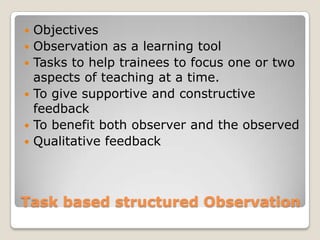
Objectives
Observation as a learning tool
Tasks to help trainees to focus one or two
aspects of teaching at a time.
To give supportive and constructive
feedback
To benefit both observer and the observed
Qualitative feedback

Task based structured Observation
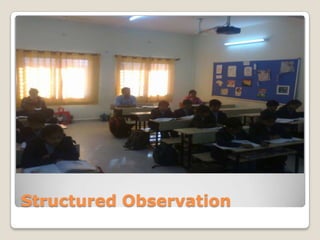
Structured Observation




How does the teacher arrange the class
before the session?

How does the teacher motivate the class?

Sample Tasks







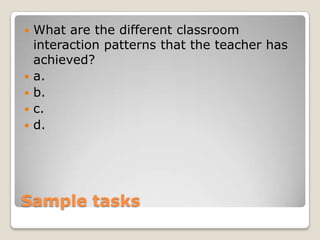
What are the different classroom
interaction patterns that the teacher has
achieved?
a.
b.
c.
d.

Sample tasks











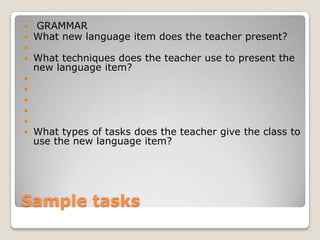
GRAMMAR
What new language item does the teacher present?
What techniques does the teacher use to present the
new language item?

What types of tasks does the teacher give the class to
use the new language item?

Sample tasks
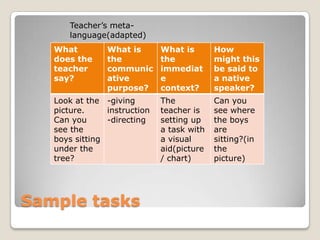
Teacher’s metalanguage(adapted)
What
does the
teacher
say?

What is
the
communic
ative
purpose?

Look at the -giving
picture.
instruction
Can you
-directing
see the
boys sitting
under the
tree?

Sample tasks

What is
the
immediat
e
context?

How
might this
be said to
a native
speaker?

The
teacher is
setting up
a task with
a visual
aid(picture
/ chart)

Can you
see where
the boys
are
sitting?(in
the
picture)
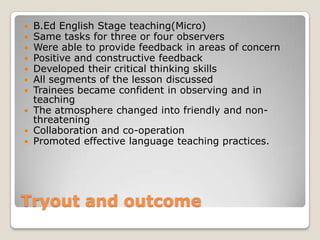
B.Ed English Stage teaching(Micro)
Same tasks for three or four observers
Were able to provide feedback in areas of concern
Positive and constructive feedback
Developed their critical thinking skills
All segments of the lesson discussed
Trainees became confident in observing and in
teaching
 The atmosphere changed into friendly and nonthreatening
 Collaboration and co-operation
 Promoted effective language teaching practices.








Tryout and outcome
Feedback


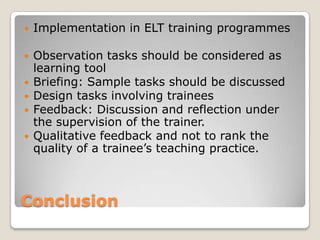
Implementation in ELT training programmes



Observation tasks should be considered as
learning tool
Briefing: Sample tasks should be discussed
Design tasks involving trainees
Feedback: Discussion and reflection under
the supervision of the trainer.
Qualitative feedback and not to rank the
quality of a trainee’s teaching practice.






Conclusion










1. Allwright, Richard and Bailey,Kathleen.M.1991.
Focus on the language Classroom: an introduction to
research for language teachers; Cambridge
University Press.
2. Hester H.P.,Betsy P.and Jacqueline G. 1992. Peer
Observation and Feedback in Teacher Training
Development. TESOL Quarterly;XII.1.
3. Richards,Jack C. and Nunan.David.1990.Second
Language Teacher Education; Cambridge University
Press
4. Wallace,Michael J.1991. Training Foreign
Language teachers: a reflective approach: Cambridge
University Press.
5.Wajnrub,R.1992.Classroom Observation Tasks,
Cambridge University Press.

Reference….
Thanks to my trainees,
 And you observers…..


Thank you…..

Peer observation and feed back in ELT teacher training programmes

  • 1.
    Peer Observation and Feedbackin ELT Teacher Training Programmes: A Constructive Model Dr.Bose Vasudevan Institute of Language Teaching, Jamnagar, Gujarat. boseenvy@rediffmail.com
  • 2.
  • 3.
     Peer Observation andFeedback: Concept and Objectives   Unstructured Observation and feedback (Phase I) Outcomes:   Positive feedback Good/ average/ very good/ excellent/ well done/ good effort/ good command over language/ good personality/good English/ lesson taught as per plan/ everything fine/ great/fairly confident etc…   Negative feedback Not so good/below average/poor English/feeble voice/chalkboard use not appealing/spelling errors on chalkboard/no movement in the class/no teaching aids used/ everything went wrong/ no confidence/no eye-contact at all etc….. Background
  • 4.
     Discussion: Should wehave Peer Observation and Feedback? New design: Observation schedule.(Phase II)  Objectives: alternative scheme  Outcomes: quantitative  Limitation: Preoccupied with the completion of observation schedule. Less beneficial for the person who is observing.  Structured observation
  • 5.
     . Sr.No Parameters Presentation a b c d e f. Scope for Average improvement . 1 2 Effective Very effective 3 4 Details onclass board, lesson title, learning outcomes, key words are prominently displayed. Uses relevant vocabulary Exhibits fluency of language Uses suitable tone of speech Oral and written instructions are clear Teaching aids and learning materials are appropriate, wellorganized, resourceful and stimulating. Observation schedule: Sample
  • 6.
          Objectives Observation as alearning tool Tasks to help trainees to focus one or two aspects of teaching at a time. To give supportive and constructive feedback To benefit both observer and the observed Qualitative feedback Task based structured Observation
  • 7.
  • 8.
      How does theteacher arrange the class before the session? How does the teacher motivate the class? Sample Tasks
  • 9.
         What are thedifferent classroom interaction patterns that the teacher has achieved? a. b. c. d. Sample tasks
  • 10.
              GRAMMAR What new languageitem does the teacher present? What techniques does the teacher use to present the new language item? What types of tasks does the teacher give the class to use the new language item? Sample tasks
  • 11.
    Teacher’s metalanguage(adapted) What does the teacher say? Whatis the communic ative purpose? Look at the -giving picture. instruction Can you -directing see the boys sitting under the tree? Sample tasks What is the immediat e context? How might this be said to a native speaker? The teacher is setting up a task with a visual aid(picture / chart) Can you see where the boys are sitting?(in the picture)
  • 12.
    B.Ed English Stageteaching(Micro) Same tasks for three or four observers Were able to provide feedback in areas of concern Positive and constructive feedback Developed their critical thinking skills All segments of the lesson discussed Trainees became confident in observing and in teaching  The atmosphere changed into friendly and nonthreatening  Collaboration and co-operation  Promoted effective language teaching practices.        Tryout and outcome
  • 13.
  • 14.
     Implementation in ELTtraining programmes  Observation tasks should be considered as learning tool Briefing: Sample tasks should be discussed Design tasks involving trainees Feedback: Discussion and reflection under the supervision of the trainer. Qualitative feedback and not to rank the quality of a trainee’s teaching practice.     Conclusion
  • 15.
         1. Allwright, Richardand Bailey,Kathleen.M.1991. Focus on the language Classroom: an introduction to research for language teachers; Cambridge University Press. 2. Hester H.P.,Betsy P.and Jacqueline G. 1992. Peer Observation and Feedback in Teacher Training Development. TESOL Quarterly;XII.1. 3. Richards,Jack C. and Nunan.David.1990.Second Language Teacher Education; Cambridge University Press 4. Wallace,Michael J.1991. Training Foreign Language teachers: a reflective approach: Cambridge University Press. 5.Wajnrub,R.1992.Classroom Observation Tasks, Cambridge University Press. Reference….
  • 16.
    Thanks to mytrainees,  And you observers…..  Thank you…..