






Teacher Development Via the
Internet
Peter Beech
The Practice of Teaching
• providing instruction
• developing productive relationships with
colleagues and administrators,
• establishing productive relationships with parents
• establishing productive relationships with pupils
• maintaining continuous professional growth and
development
• transforming schools
http://www.ced.appstate.edu/intercollege/3850/readings/cop.html
Development / Training
“A functioning teacher development group
will be a teacher-led peer group which
sets its own agenda. A teacher training
group, by its nature, will not be a peer
group, will have an outstanding agenda
and will be conducted or initiated by ‘an
authority’.”
Paul Davis
http://www.hltmag.co.uk/feb99/mart1.htm
Teacher Development
Continuing development throughout our
careers is essential if we are to reach
our full potential, enhancing both our
professional competence and our
personal fulfillment.
Our priorities include:
• What hinders and what helps me in doing that?
• How can I help myself by working with like-minded
people?
• How can I become the best teacher that I can be?
• What does development mean to me in my context?
IATEFL TD SIG
http://personales.jet.es/bazkat/about.htm
Dialogue with Colleagues
Dialogue with colleagues is the major tool
teachers have available to use for the
improvement of their practices.
Connelly and Clandenin (1988)
Ways to Benefit
• participation in a discussion group
• accessing research published on the
web
• publishing our own articles in online
journals.
Sharing Practice With Fellow-practitioners
We provide ideas and resources for
colleagues to use, while gaining
valuable feedback which stimulates
new cycles of action research.
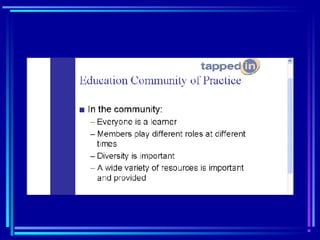
Community of Practice
Various internet facilities can facilitate
induction and participation in peer
networks to support our professional
development.
“Modern theories of learning and
professional development stress the
importance of reflection on experience,
peer enquiry, the need to embed
training in practice, and of collaboration
(Schön 1987; Vygotsky, 1978; Kolb,
1984; Wenger, 1998).”
Phil Riding
www.icce2001.org/cd/pdf/poster1/uk102.pdf
“Teacher networks and communities are
excellent ways of fostering the
conditions in which such collegiate,
reflective, practice-based development
can take place (Lieberman, 2000).”
Phil Riding
www.icce2001.org/cd/pdf/poster1/uk102.pdf
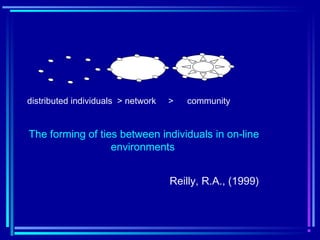
distributed individuals > network > community
The forming of ties between individuals in on-line
environments
Reilly, R.A., (1999)
‘A community of practice is different from
a network in the sense that it is “about”
something; it is not just a set of
relationships. It has an identity as a
community, and thus shapes the
identities of its members.’
(Wenger, 1998)
Professional Growth
An important characteristic of persons
who are members of CoPs is that they
assume responsibility for their own
professional growth and development.
By creating a telecommunications
network dedicated to teacher
professional development we hoped to
entool teachers with the mechanisms
for defining and "growing" their own
professional development
Collaborative Electronic Network Building
by Vanessa DiMauro and Gloria Jacobs
The Journal of Computers in Math and Science Teaching
February 1995
Building Community
True communities are much more than just
Web sites, communication tools or gatherings
of people. Communities require member
participation and contribution, ownership,
quality support and facilitation, shared
direction, goals and projects.
(Wellman & Gulia, 1997; Palloff & Pratt, 1999; Kim, 2000).
Resources Available on the Internet
• Journals
• Discussion boards
• Online teaching resources
• Newsgroups
Journals
TEFL Web Journal
http://www.teflweb-j.org
“TEFL Web Journal is a free, Web based
forum for adult level teachers, teacher
trainers and researchers world-wide.”
Discussion Boards
Developing Teachers.com
Forums for the developing
language teacher
http://foro.developingteachers.com
Online Teaching Resources
http://www.onestopenglish.com
“Solutions for English teaching”
Newsgroups
• TESL-L
• Dogme
• TD SIG
• ELT discussion lists in Greece
TESL-L
• http://www.hunter.cuny.edu/~tesl-l
• To join TESL-L:
SUB TESL-L firstname lastname
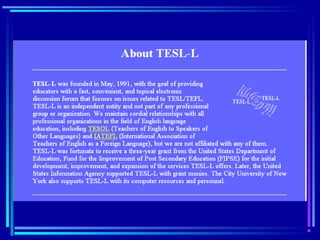
• TESL-L was founded in May, 1991
• As of December 4, 2002, we have
29,232 members in 161 countries. Our
message average is 10 per day
Dogme
• "No one can be told what [dogme] is...
they have to see it for themselves.“
• www.teaching-unplugged.com
• http://groups.yahoo.com/group/dogme
• Members: 175
• Founded: Mar 9, 2000
• 2882 messages
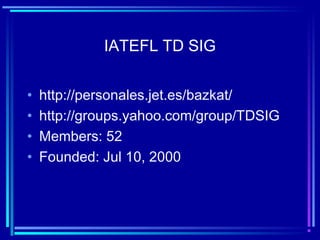
IATEFL TD SIG
• http://personales.jet.es/bazkat/
• http://groups.yahoo.com/group/TDSIG
• Members: 52
• Founded: Jul 10, 2000
Websites and discussion lists in
Greece (1)
TESOL Greece
• www.tesolgreece.com
• http://groups.yahoo.com/group/tesolgreece
• Members: 124
• Founded: Jun 27, 2000
Websites and discussion lists in
Greece (2)
TEFL-GR
• www.teflgr.angelcities.com
• http://groups.yahoo.com/group/tefl-gr/
• Members: 64
• Founded: Oct 22, 1998
Websites and discussion lists in
Greece (3)
Anglo-Hellenic
• www.anglo-hellenic.com
• http://groups.yahoo.com/group/anglo-hellenic
• Members: 411
• Founded: Jun 25, 1999
Websites and discussion lists in
Greece (4)
Greek ELT
• www.greekelt.net
• http://groups.yahoo.com/group/GreekE
LTfeedback/
• Members: 11
• Founded: Oct 23, 2001
The newsgroup as a
community of practice
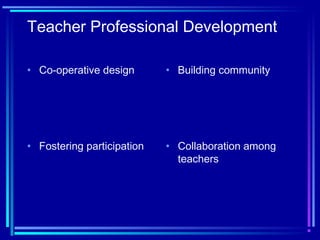
Teacher Professional Development
• Co-operative design • Building community
• Fostering participation • Collaboration among
teachers
Participation
Engagement with such a community can
provide a channel for development,
leading from peripheral to full
participation.
Legitimate Peripheral Participation
A CoP is comprised of a wide range of
expertise in its membership, ranging
from apprentice to expert. Inducting
apprentices into the community sustains
a CoP.
http://www.ced.appstate.edu/intercollege/3850/readings/cop.html
“Practice is an effective teacher and the
community of practice an ideal learning
environment.”
Brown & Duguid (2000)

Teacher development via the internet

  • 1.
    Teacher Development Viathe Internet Peter Beech
  • 2.
    The Practice ofTeaching • providing instruction • developing productive relationships with colleagues and administrators, • establishing productive relationships with parents • establishing productive relationships with pupils • maintaining continuous professional growth and development • transforming schools http://www.ced.appstate.edu/intercollege/3850/readings/cop.html
  • 3.
    Development / Training “Afunctioning teacher development group will be a teacher-led peer group which sets its own agenda. A teacher training group, by its nature, will not be a peer group, will have an outstanding agenda and will be conducted or initiated by ‘an authority’.” Paul Davis http://www.hltmag.co.uk/feb99/mart1.htm
  • 4.
    Teacher Development Continuing developmentthroughout our careers is essential if we are to reach our full potential, enhancing both our professional competence and our personal fulfillment.
  • 5.
    Our priorities include: •What hinders and what helps me in doing that? • How can I help myself by working with like-minded people? • How can I become the best teacher that I can be? • What does development mean to me in my context? IATEFL TD SIG http://personales.jet.es/bazkat/about.htm
  • 6.
    Dialogue with Colleagues Dialoguewith colleagues is the major tool teachers have available to use for the improvement of their practices. Connelly and Clandenin (1988)
  • 7.
    Ways to Benefit •participation in a discussion group • accessing research published on the web • publishing our own articles in online journals.
  • 8.
    Sharing Practice WithFellow-practitioners We provide ideas and resources for colleagues to use, while gaining valuable feedback which stimulates new cycles of action research.
  • 10.
    Community of Practice Variousinternet facilities can facilitate induction and participation in peer networks to support our professional development.
  • 11.
    “Modern theories oflearning and professional development stress the importance of reflection on experience, peer enquiry, the need to embed training in practice, and of collaboration (Schön 1987; Vygotsky, 1978; Kolb, 1984; Wenger, 1998).” Phil Riding www.icce2001.org/cd/pdf/poster1/uk102.pdf
  • 12.
    “Teacher networks andcommunities are excellent ways of fostering the conditions in which such collegiate, reflective, practice-based development can take place (Lieberman, 2000).” Phil Riding www.icce2001.org/cd/pdf/poster1/uk102.pdf
  • 13.
    distributed individuals >network > community The forming of ties between individuals in on-line environments Reilly, R.A., (1999)
  • 14.
    ‘A community ofpractice is different from a network in the sense that it is “about” something; it is not just a set of relationships. It has an identity as a community, and thus shapes the identities of its members.’ (Wenger, 1998)
  • 16.
    Professional Growth An importantcharacteristic of persons who are members of CoPs is that they assume responsibility for their own professional growth and development.
  • 17.
    By creating atelecommunications network dedicated to teacher professional development we hoped to entool teachers with the mechanisms for defining and "growing" their own professional development Collaborative Electronic Network Building by Vanessa DiMauro and Gloria Jacobs The Journal of Computers in Math and Science Teaching February 1995
  • 18.
    Building Community True communitiesare much more than just Web sites, communication tools or gatherings of people. Communities require member participation and contribution, ownership, quality support and facilitation, shared direction, goals and projects. (Wellman & Gulia, 1997; Palloff & Pratt, 1999; Kim, 2000).
  • 19.
    Resources Available onthe Internet • Journals • Discussion boards • Online teaching resources • Newsgroups
  • 20.
    Journals TEFL Web Journal http://www.teflweb-j.org “TEFLWeb Journal is a free, Web based forum for adult level teachers, teacher trainers and researchers world-wide.”
  • 21.
    Discussion Boards Developing Teachers.com Forumsfor the developing language teacher http://foro.developingteachers.com
  • 22.
  • 23.
    Newsgroups • TESL-L • Dogme •TD SIG • ELT discussion lists in Greece
  • 24.
    TESL-L • http://www.hunter.cuny.edu/~tesl-l • Tojoin TESL-L: SUB TESL-L firstname lastname • TESL-L was founded in May, 1991 • As of December 4, 2002, we have 29,232 members in 161 countries. Our message average is 10 per day
  • 27.
    Dogme • "No onecan be told what [dogme] is... they have to see it for themselves.“ • www.teaching-unplugged.com • http://groups.yahoo.com/group/dogme • Members: 175 • Founded: Mar 9, 2000 • 2882 messages
  • 28.
    IATEFL TD SIG •http://personales.jet.es/bazkat/ • http://groups.yahoo.com/group/TDSIG • Members: 52 • Founded: Jul 10, 2000
  • 29.
    Websites and discussionlists in Greece (1) TESOL Greece • www.tesolgreece.com • http://groups.yahoo.com/group/tesolgreece • Members: 124 • Founded: Jun 27, 2000
  • 30.
    Websites and discussionlists in Greece (2) TEFL-GR • www.teflgr.angelcities.com • http://groups.yahoo.com/group/tefl-gr/ • Members: 64 • Founded: Oct 22, 1998
  • 31.
    Websites and discussionlists in Greece (3) Anglo-Hellenic • www.anglo-hellenic.com • http://groups.yahoo.com/group/anglo-hellenic • Members: 411 • Founded: Jun 25, 1999
  • 32.
    Websites and discussionlists in Greece (4) Greek ELT • www.greekelt.net • http://groups.yahoo.com/group/GreekE LTfeedback/ • Members: 11 • Founded: Oct 23, 2001
  • 33.
    The newsgroup asa community of practice
  • 34.
    Teacher Professional Development •Co-operative design • Building community • Fostering participation • Collaboration among teachers
  • 35.
    Participation Engagement with sucha community can provide a channel for development, leading from peripheral to full participation.
  • 36.
    Legitimate Peripheral Participation ACoP is comprised of a wide range of expertise in its membership, ranging from apprentice to expert. Inducting apprentices into the community sustains a CoP. http://www.ced.appstate.edu/intercollege/3850/readings/cop.html
  • 37.
    “Practice is aneffective teacher and the community of practice an ideal learning environment.” Brown & Duguid (2000)