1
For more information ...
Bond University
Quality, Teaching, and Learning
Foundations of Learning and Teaching (FULT)

61 7 5595 5691

othompso@bond.edu.au


                                              2
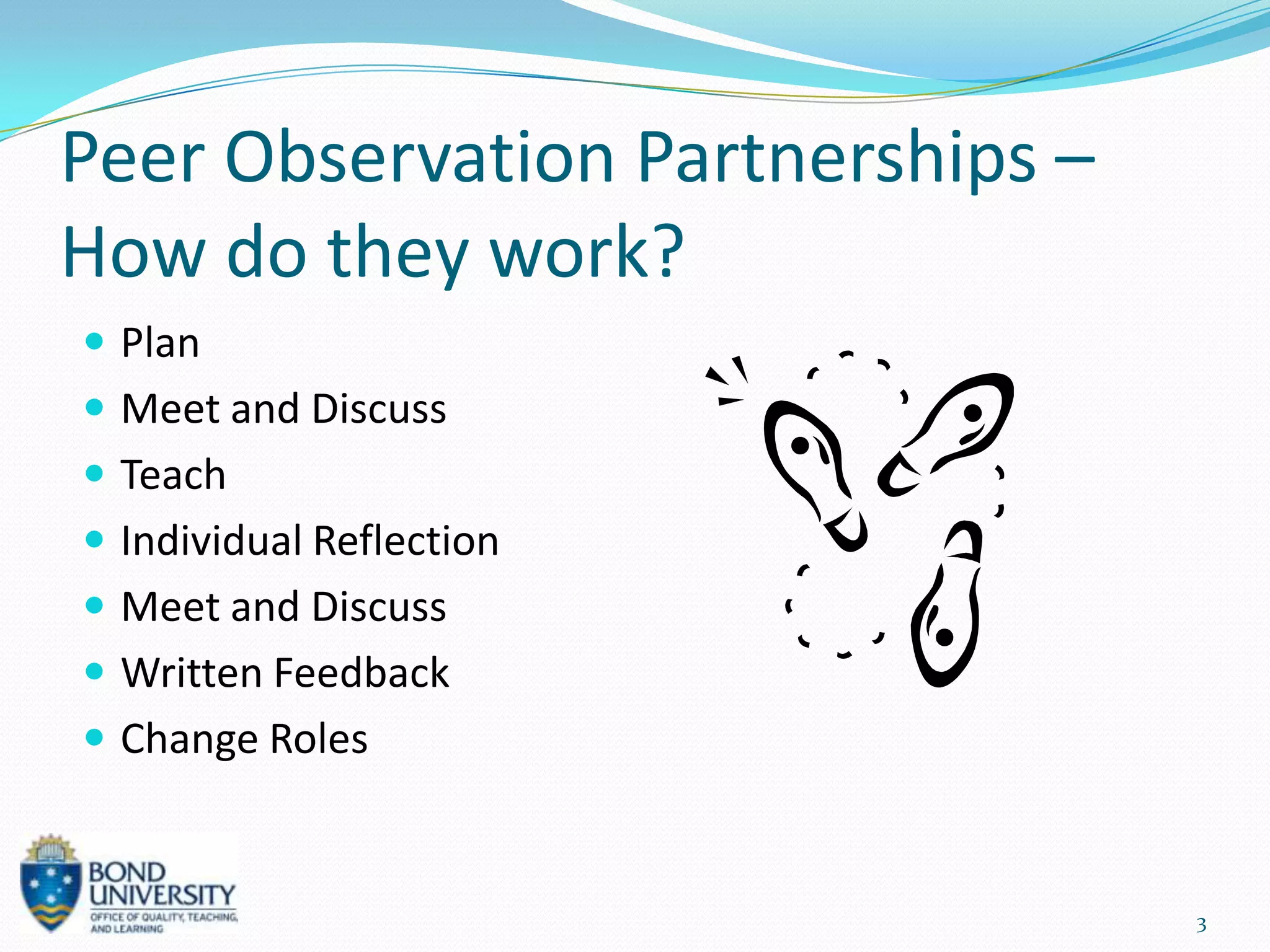
Peer Observation Partnerships –
How do they work?
 Plan
 Meet and Discuss
 Teach
 Individual Reflection
 Meet and Discuss
 Written Feedback
 Change Roles


                                  3
What kind of
Partnership?
          Two people
          Group
          Coordinator
          Experienced
           colleague
          Film

                         4
Who to
 choose…
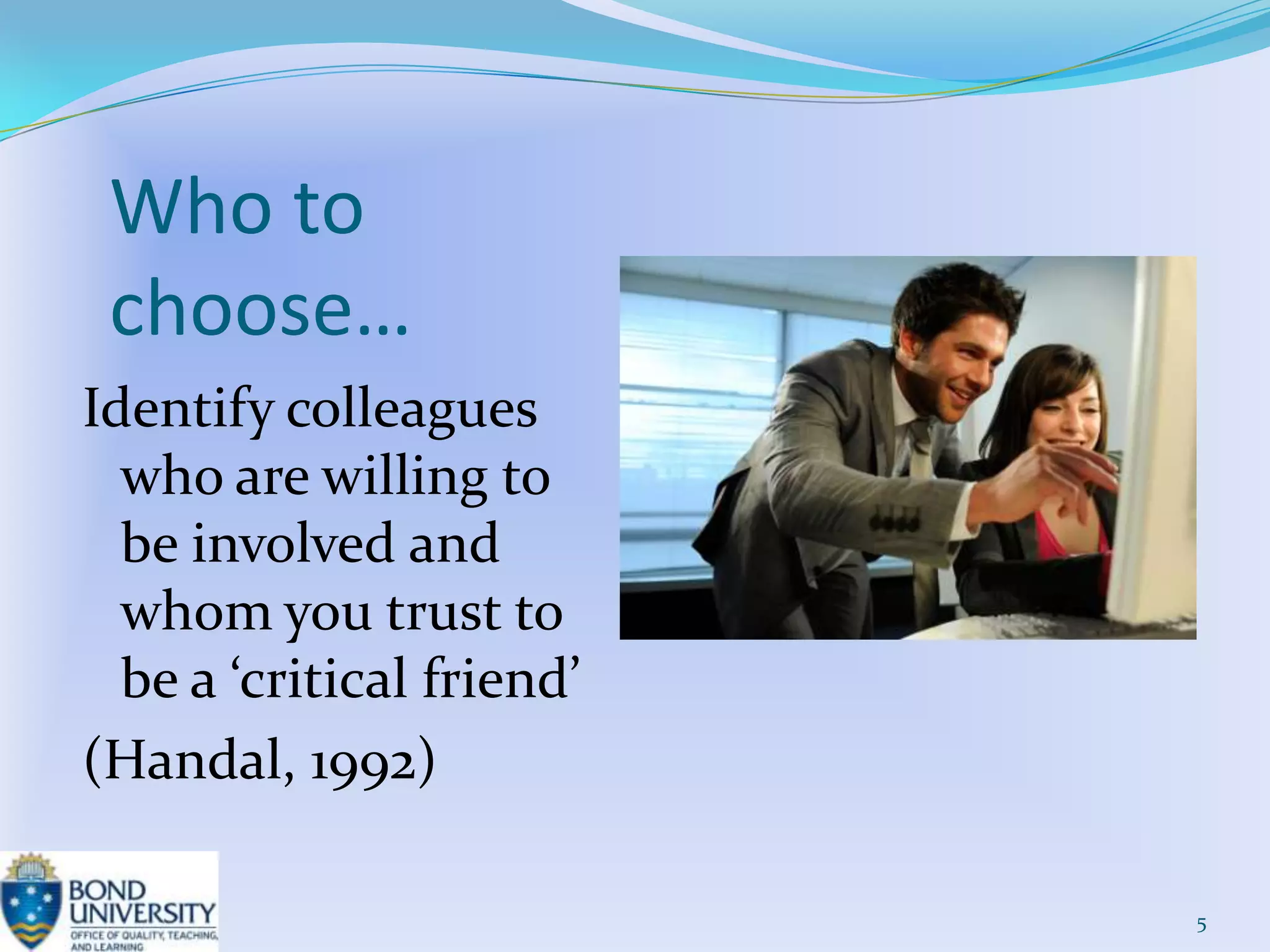
Identify colleagues
  who are willing to
  be involved and
  whom you trust to
  be a ‘critical friend’
(Handal, 1992)

                           5
What do you want to achieve?
        General feedback
        Investigate a ‘problem’
        Share ideas
        Discover what others are doing
        Evaluate effectiveness
        Articulate philosophy
        Develop a teaching portfolio
        Create an open, collegial
         approach in your department
        Test a teaching resource or
         method


                                          6
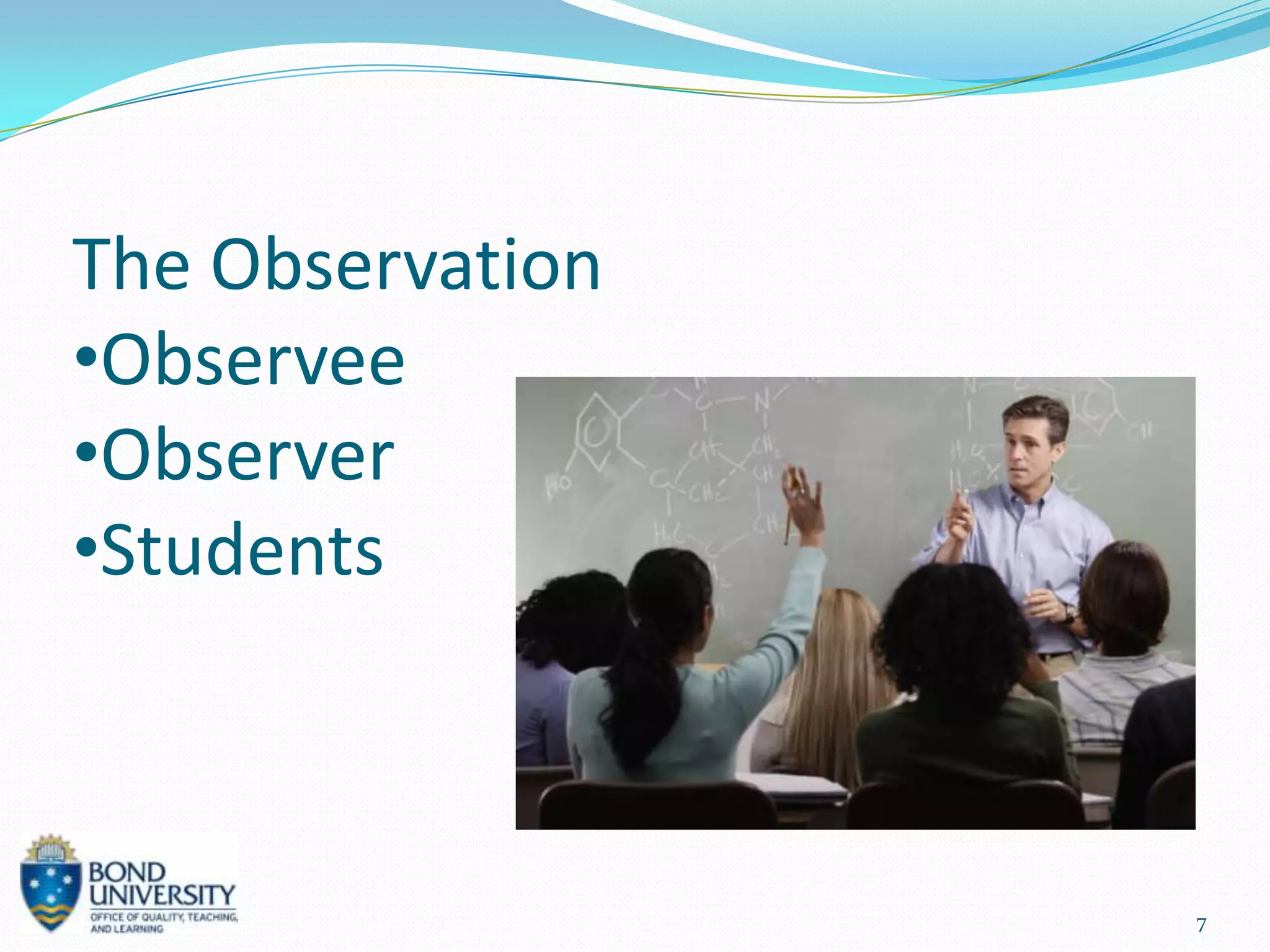
The Observation
•Observee
•Observer
•Students


                  7
Post-Observation Discussions
         •Be prepared
         •Reflect first
         •Listen and ask
         •Give feedback
         •Be specific
         •Examples
         •Avoid judging
         •Positive Conclusion
         •Follow up


                                8
Critical Reflection
•What kind of person
 are you?

•Revisit your
 teaching
 philosophy


                       9
Critical
Reflection
The Kolb Process
•Concrete observation
•Problem definition
•Means-end analysis
•Implications
•Active
experimentation
                   10
How will you know the Peer Observation
Partnership was effective …
 Positive outcomes relate to personal skills and
  attributes, and the ability to give and receive
  critical feedback ~ critique.
 Means for ongoing
 Professional Development.


                                                    11
Stocking your library
Bell, M. (2005). Peer observation partnerships in higher education. Higher
  Education Research and Development Society of Australasia
  (HERDSA).
Bernstein, D., Burnett, A. N., Goodburn, A. & Savory, P. (2006). Making
  teaching and learning visible: Course portfolios and the peer review of
  teaching. Massachusetts: Anker Publishing Company, Inc.
Blackwell, R. (1996). Peer observation of teaching & staff development.
  Higher education quarterly, 50, 156-171.
Donnelly, R. (2007). Perceived impact of peer observation of teaching in
  higher education. International journal of higher education, 19, 117-129.
Handal, G. (1999). Consulting using critical friends. New directions for
  teaching and learning, 79, Fall, 59-70.
McMahon, T., Barrett, T. & O’Neill, G. (2007). Using observation of
  teaching to improve quality: Finding your way through the muddle of
  competing conceptions, confusion of practice and mutually exclusive
  intentions. Teaching in higher education, 12, 499-511.

                                                                              12

Preparation for peer observation of teaching

  • 1.
  • 2.
    For more information... Bond University Quality, Teaching, and Learning Foundations of Learning and Teaching (FULT) 61 7 5595 5691 othompso@bond.edu.au 2
  • 3.
    Peer Observation Partnerships– How do they work?  Plan  Meet and Discuss  Teach  Individual Reflection  Meet and Discuss  Written Feedback  Change Roles 3
  • 4.
    What kind of Partnership?  Two people  Group  Coordinator  Experienced colleague  Film 4
  • 5.
    Who to choose… Identifycolleagues who are willing to be involved and whom you trust to be a ‘critical friend’ (Handal, 1992) 5
  • 6.
    What do youwant to achieve?  General feedback  Investigate a ‘problem’  Share ideas  Discover what others are doing  Evaluate effectiveness  Articulate philosophy  Develop a teaching portfolio  Create an open, collegial approach in your department  Test a teaching resource or method 6
  • 7.
  • 8.
    Post-Observation Discussions •Be prepared •Reflect first •Listen and ask •Give feedback •Be specific •Examples •Avoid judging •Positive Conclusion •Follow up 8
  • 9.
    Critical Reflection •What kindof person are you? •Revisit your teaching philosophy 9
  • 10.
    Critical Reflection The Kolb Process •Concreteobservation •Problem definition •Means-end analysis •Implications •Active experimentation 10
  • 11.
    How will youknow the Peer Observation Partnership was effective …  Positive outcomes relate to personal skills and attributes, and the ability to give and receive critical feedback ~ critique.  Means for ongoing Professional Development. 11
  • 12.
    Stocking your library Bell,M. (2005). Peer observation partnerships in higher education. Higher Education Research and Development Society of Australasia (HERDSA). Bernstein, D., Burnett, A. N., Goodburn, A. & Savory, P. (2006). Making teaching and learning visible: Course portfolios and the peer review of teaching. Massachusetts: Anker Publishing Company, Inc. Blackwell, R. (1996). Peer observation of teaching & staff development. Higher education quarterly, 50, 156-171. Donnelly, R. (2007). Perceived impact of peer observation of teaching in higher education. International journal of higher education, 19, 117-129. Handal, G. (1999). Consulting using critical friends. New directions for teaching and learning, 79, Fall, 59-70. McMahon, T., Barrett, T. & O’Neill, G. (2007). Using observation of teaching to improve quality: Finding your way through the muddle of competing conceptions, confusion of practice and mutually exclusive intentions. Teaching in higher education, 12, 499-511. 12