Computer Assisted
Language Learning
Peter Beech
peter@peterbeech.com
Pedagogical advantages of CALL materials
Nonlinearity
 Students can access information as and how they want
to, rather than in a predetermined sequence
 This is an advantage only if:
 Students know how to find the information they need
 Students have strategies to learn with hypermedia
 The quality of the linked resources is of a sufficiently high
standard
Pedagogical advantages of CALL materials
Multimedia
 Different modalities appeal to different learning styles and
multimedia results in an enriched learning environment
Pedagogical advantages of CALL materials
Empowerment
 CALL offers:
 Easier access to materials
 Greater control for learners
 Opportunities for the development of metacognitive skills
and learner autonomy
Pedagogical advantages of CALL materials
Monitoring of learning behaviour
 CALL programs can record and monitor learners’
behaviour and progress and dynamically alter input or
make suggestions to the learner
Pedagogical advantages of CALL materials
Authenticity
 CALL materials aid in the development of more authentic
materials by allowing selection of content based on
actual language use, e.g. through use of corpora
 CALL resources resemble the types of resources
especially younger learners use in everyday life. The use
of educational games is an example of ways in which
materials developers have attempted to mimic learners’
out-of-class activities
Pedagogical advantages of CALL materials
Feedback
 Immediate feedback is possible with CALL materials
Pedagogical advantages of CALL materials
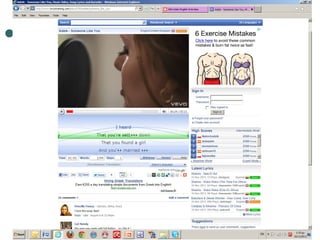
New types of activities
 CALL materials can include activities that are difficult or
impossible to achieve using other learning materials,
such as moving objects across the screen (matching),
recording one’s voice etc.
Pedagogical advantages of CALL materials
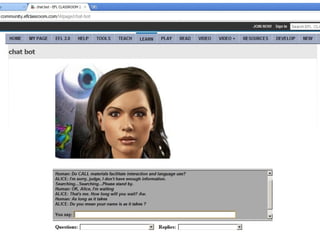
Interaction
 CALL materials facilitate interaction and language use
Spoken English
Spoken language practice has also become much easier to
organise with individuals or groups of learners being
encouraged to communicate with other individuals or
groups of learners around the world.
Speaking and pronunciation
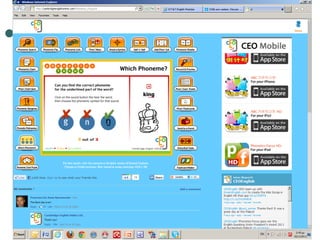
This website from Cambridge
University Press presents
entertaining animations to reinforce
individual phonemes and sound
patterns.
Speaking and pronunciation
 How useful do you think this site is?
 What assumptions does it make?
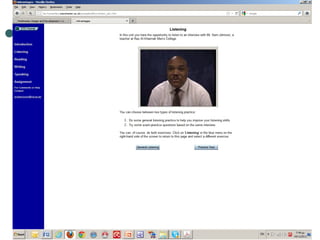
Listening
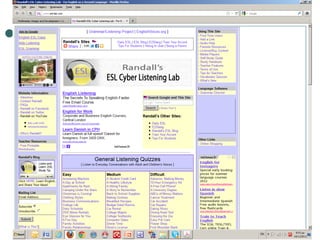
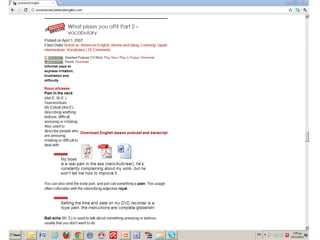
Podcasts can be:
Audio-based content (a sound file)
Enhanced content (inclusive of audio,
visuals and text)
Video
Listening
Podcasts can be:
Audio-based content (a sound file)
Enhanced content (inclusive of audio,
visuals and text)
Video
Listening
Podcasts can be:
Audio-based content (a sound file)
Enhanced content (inclusive of audio,
visuals and text)
Video
Listening
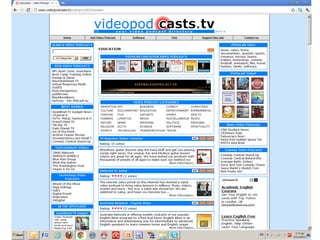
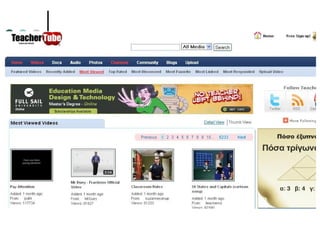
The accessibility of video clips has
increased enormously with the
advent of web 2.0 applications used
on such sites as YouTube
Listening
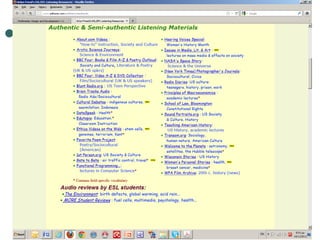
There are listening materials that are
structured specifically for language
learners, using audiovisual content that
is either
 Authentic
 Semi-authentic (i.e., modified or
simplified)
 Custom-made
Listening
Support can be provided through captions,
vocabulary activities, annotations and
transcripts
Listening
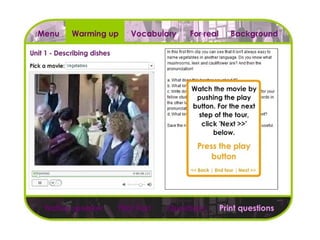
 The Virtex project uses digital video clips
depicting real-life scenarios to prepare
foreign language students for work
placements in hotels and catering
 After watching the video, the students
can access background information,
transcripts, learning tips, isolated audio
playback, cultural notes or lists of
idiomatic expressions
Listening
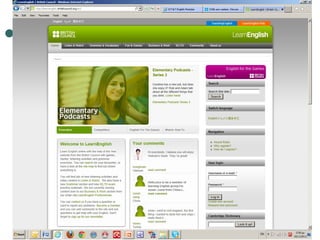
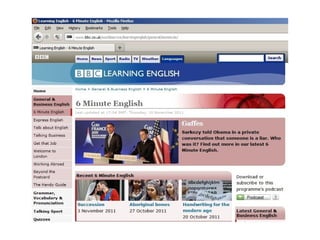
The BBC series six minute English takes a
current news item and reworks it for
learners of English, including
comprehension activities and audio
podcasts
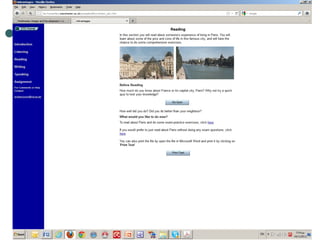
Reading
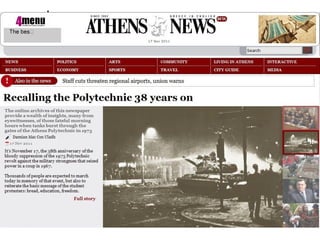
One of the most obvious benefits of the Internet
for language teachers is the unprecedented
access to a copious supply of authentic reading
material such as
 Newspaper reports
 Stories
 Recipes
 Craft activities
 Geographic information
 Journal articles
Reading
Technology can be used to teach students
strategies for comprehension …
Roll-over prompts can be inserted into the text at
key points, encouraging the reader to predict, or
to guess from context, or to use skimming and
scanning skills, or to attend to topic sentences,
or to refer to a relevant image
Contributions to language learning
Enhancing reading through electronic media
 Even a simple word processing program can be used to
advantage by focusing students’ attention on significant
recurring patterns by highlighting, animating, deleting,
changing font and type size, and so on
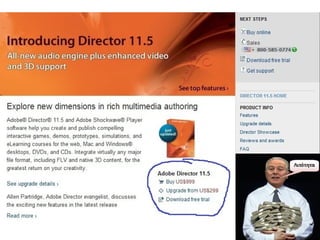
 More powerful programs (e.g., Flash, Director) can be
used to help the reader notice syntactic units by
highlighting these (appropriately ‘chunked’) as the
student listens to the text being read aloud
Contributions to language learning
Making reading easier
 Hypermedia makes it possible to build into a single page
a number of clickable options to support the L2 reader.
These devices, such as pop-ups, rollovers, links to other
pages, menus and so on, are unobtrusive and only
activated when a reader decides to access the
information
 Words can be explained by
 linking to dictionaries
 providing a definition of the word in context
 Providing a photo or animation
Contributions to language learning
Enhancing writing through electronic media
A well-designed writing program will lead the writer through
all the phases of the writing process, providing as much
support as needed along the way
Contributions to language learning
Enhancing writing through electronic media
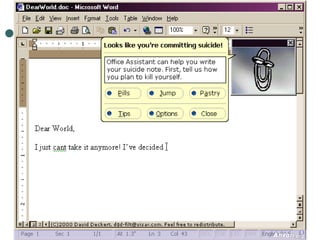
Once the student starts to draft a text, the computer
becomes a powerful resource. The advent of word
processing has revolutionized the writing of text. And yet
it is still surprisingly underexploited in the L2 classroom.
Writing and composing
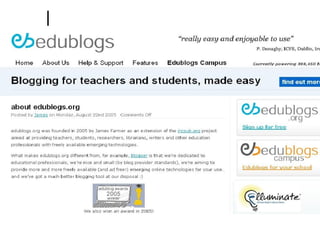
For language learners, blogging
provides an opportunity to participate
in the composing process without the
pressure to produce a whole text
independently
Writing and composing
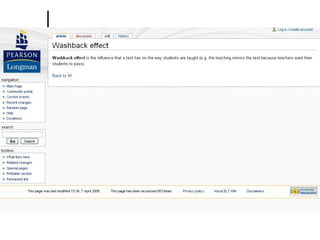
Likewise, wikis allow multiple writers to
contribute towards the development of
a text
Grammar and vocabulary
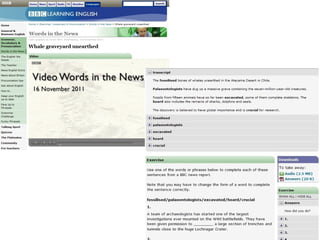
 The BBC news website has a number
of vocabulary activities based on
current news stories
Grammar and vocabulary
 One area in which digital technology
has been used to achieve previously
impossible outcomes in relation to
vocabulary and syntax is the
development of language corpora
 By using a concordancing tool, it is
possible to retrieve innumerable
examples of any particular word
together with its immediate context
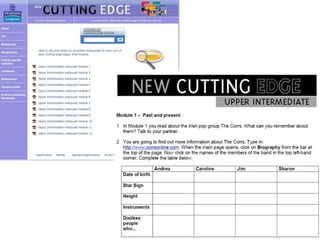
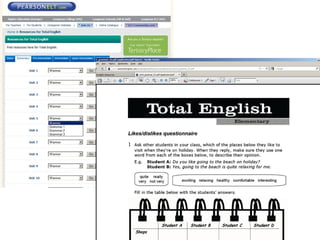
Coursebook support
websites
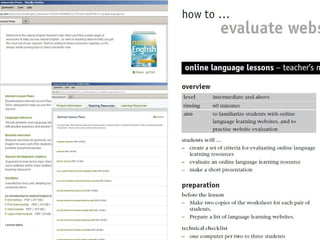
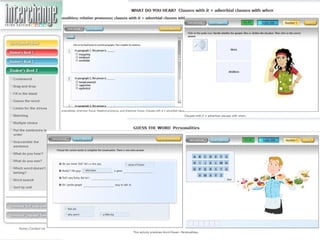
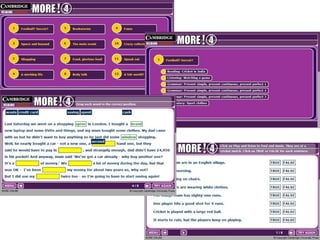
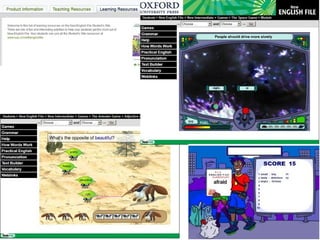
For each of the following websites,
consider:
 What type of material is provided
 How engaging and motivating it is
 How fully it exploits the possibilities of
multimedia
CALL
CALL
CALL
CALL
CALL
CALL
CALL

CALL

  • 1.
  • 2.
    Pedagogical advantages ofCALL materials Nonlinearity  Students can access information as and how they want to, rather than in a predetermined sequence  This is an advantage only if:  Students know how to find the information they need  Students have strategies to learn with hypermedia  The quality of the linked resources is of a sufficiently high standard
  • 4.
    Pedagogical advantages ofCALL materials Multimedia  Different modalities appeal to different learning styles and multimedia results in an enriched learning environment
  • 6.
    Pedagogical advantages ofCALL materials Empowerment  CALL offers:  Easier access to materials  Greater control for learners  Opportunities for the development of metacognitive skills and learner autonomy
  • 8.
    Pedagogical advantages ofCALL materials Monitoring of learning behaviour  CALL programs can record and monitor learners’ behaviour and progress and dynamically alter input or make suggestions to the learner
  • 10.
    Pedagogical advantages ofCALL materials Authenticity  CALL materials aid in the development of more authentic materials by allowing selection of content based on actual language use, e.g. through use of corpora  CALL resources resemble the types of resources especially younger learners use in everyday life. The use of educational games is an example of ways in which materials developers have attempted to mimic learners’ out-of-class activities
  • 12.
    Pedagogical advantages ofCALL materials Feedback  Immediate feedback is possible with CALL materials
  • 14.
    Pedagogical advantages ofCALL materials New types of activities  CALL materials can include activities that are difficult or impossible to achieve using other learning materials, such as moving objects across the screen (matching), recording one’s voice etc.
  • 16.
    Pedagogical advantages ofCALL materials Interaction  CALL materials facilitate interaction and language use
  • 18.
    Spoken English Spoken languagepractice has also become much easier to organise with individuals or groups of learners being encouraged to communicate with other individuals or groups of learners around the world.
  • 20.
    Speaking and pronunciation Thiswebsite from Cambridge University Press presents entertaining animations to reinforce individual phonemes and sound patterns.
  • 22.
    Speaking and pronunciation How useful do you think this site is?  What assumptions does it make?
  • 23.
    Listening Podcasts can be: Audio-basedcontent (a sound file) Enhanced content (inclusive of audio, visuals and text) Video
  • 25.
    Listening Podcasts can be: Audio-basedcontent (a sound file) Enhanced content (inclusive of audio, visuals and text) Video
  • 27.
    Listening Podcasts can be: Audio-basedcontent (a sound file) Enhanced content (inclusive of audio, visuals and text) Video
  • 29.
    Listening The accessibility ofvideo clips has increased enormously with the advent of web 2.0 applications used on such sites as YouTube
  • 31.
    Listening There are listeningmaterials that are structured specifically for language learners, using audiovisual content that is either  Authentic  Semi-authentic (i.e., modified or simplified)  Custom-made
  • 33.
    Listening Support can beprovided through captions, vocabulary activities, annotations and transcripts
  • 35.
    Listening  The Virtexproject uses digital video clips depicting real-life scenarios to prepare foreign language students for work placements in hotels and catering  After watching the video, the students can access background information, transcripts, learning tips, isolated audio playback, cultural notes or lists of idiomatic expressions
  • 37.
    Listening The BBC seriessix minute English takes a current news item and reworks it for learners of English, including comprehension activities and audio podcasts
  • 39.
    Reading One of themost obvious benefits of the Internet for language teachers is the unprecedented access to a copious supply of authentic reading material such as  Newspaper reports  Stories  Recipes  Craft activities  Geographic information  Journal articles
  • 41.
    Reading Technology can beused to teach students strategies for comprehension … Roll-over prompts can be inserted into the text at key points, encouraging the reader to predict, or to guess from context, or to use skimming and scanning skills, or to attend to topic sentences, or to refer to a relevant image
  • 43.
    Contributions to languagelearning Enhancing reading through electronic media  Even a simple word processing program can be used to advantage by focusing students’ attention on significant recurring patterns by highlighting, animating, deleting, changing font and type size, and so on  More powerful programs (e.g., Flash, Director) can be used to help the reader notice syntactic units by highlighting these (appropriately ‘chunked’) as the student listens to the text being read aloud
  • 45.
    Contributions to languagelearning Making reading easier  Hypermedia makes it possible to build into a single page a number of clickable options to support the L2 reader. These devices, such as pop-ups, rollovers, links to other pages, menus and so on, are unobtrusive and only activated when a reader decides to access the information  Words can be explained by  linking to dictionaries  providing a definition of the word in context  Providing a photo or animation
  • 47.
    Contributions to languagelearning Enhancing writing through electronic media A well-designed writing program will lead the writer through all the phases of the writing process, providing as much support as needed along the way
  • 49.
    Contributions to languagelearning Enhancing writing through electronic media Once the student starts to draft a text, the computer becomes a powerful resource. The advent of word processing has revolutionized the writing of text. And yet it is still surprisingly underexploited in the L2 classroom.
  • 51.
    Writing and composing Forlanguage learners, blogging provides an opportunity to participate in the composing process without the pressure to produce a whole text independently
  • 53.
    Writing and composing Likewise,wikis allow multiple writers to contribute towards the development of a text
  • 55.
    Grammar and vocabulary The BBC news website has a number of vocabulary activities based on current news stories
  • 57.
    Grammar and vocabulary One area in which digital technology has been used to achieve previously impossible outcomes in relation to vocabulary and syntax is the development of language corpora  By using a concordancing tool, it is possible to retrieve innumerable examples of any particular word together with its immediate context
  • 59.
    Coursebook support websites For eachof the following websites, consider:  What type of material is provided  How engaging and motivating it is  How fully it exploits the possibilities of multimedia