Initial Stabilisation and
  Resuscitation of the
     Newborn Infant
Learning Outcomes
Initial Stabilisation and Resuscitation of the Newborn Infant

1. Prevention
1.1     Identify the factors that predispose to   the development of
   perinatal hypoxia.
1.2     Propose how perinatal hypoxia can be      prevented.

2. Principles of Diagnosis
2.1     Describe the pathophysiological changes that occur in hypoxia.
2.2     Recognise an asphyxiated newborn
2.3     Classify an asphyxiated newborn based on the predicted
   adverse outcomes (Sarnat staging)

3. Principles of Management
3.1     Resuscitate a newborn who is not adapting to the extra-uterine
   transition.
3.2     Describe the principles involved in the management of mild to
   moderate asphyxiated newborn.
Perinatal Hypoxia-Ischemia

    Birth asphyxia - Failure to initiate
     and sustain breathing at birth

    Causes

5.   Fetal and Antepartum (90%)

7.   Birth process (10%)
Fetal and Antepartum Pathologies

1.   Inadequate oxygenation of maternal blood
     - anesthesia, cyanotic heart disease,
     respiratory failure

3.   Inadequate flow of maternal blood
     (ischemia/hypotension) – spinal
     anesthesia, compression of IVC or aorta
     by uterus

5.   Abruptio placentae

7.   Uterine vasoconstriction (cocaine)
Birth Process
•   Breech

•   Shoulder dystocia

•   Cephalopelvic disproportion

•   Cord compression, knotting

•   Uterine tetany (too much oxytocin)

•   Uterine rupture
Recognition of an Asphyxiated Baby

   Oxygen supply to the fetus is
    reduced, resulting in

     Apnea at birth
    2. Low Apgar scores (severe if <5 at five
       minutes)
    3. Neurologic sequelae (hypoxic-ischaemic
       encephalopathy)
    4. Metabolic acidosis
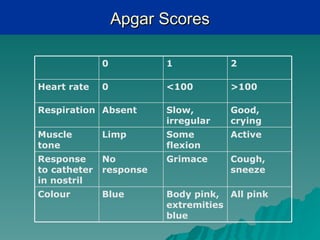
Apgar Scores

              0          1           2

Heart rate    0          <100        >100

Respiration Absent       Slow,       Good,
                         irregular   crying
Muscle        Limp       Some        Active
tone                     flexion
Response      No         Grimace     Cough,
to catheter   response               sneeze
in nostril
Colour        Blue       Body pink, All pink
                         extremities
                         blue
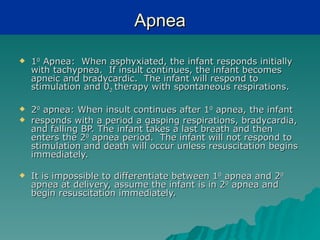
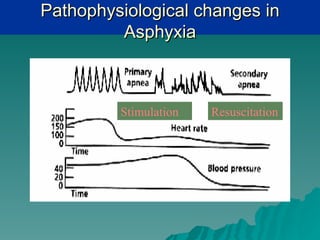
Apnea

   10 Apnea: When asphyxiated, the infant responds initially
    with tachypnea. If insult continues, the infant becomes
    apneic and bradycardic. The infant will respond to
    stimulation and 02 therapy with spontaneous respirations.

   20 apnea: When insult continues after 10 apnea, the infant
   responds with a period a gasping respirations, bradycardia,
    and falling BP. The infant takes a last breath and then
    enters the 20 apnea period. The infant will not respond to
    stimulation and death will occur unless resuscitation begins
    immediately.

   It is impossible to differentiate between 10 apnea and 20
    apnea at delivery, assume the infant is in 20 apnea and
    begin resuscitation immediately.
Pathophysiological changes in
         Asphyxia


         Stimulation   Resuscitation
Neonatal Resuscitation
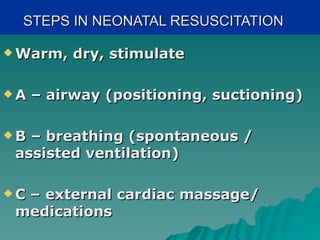
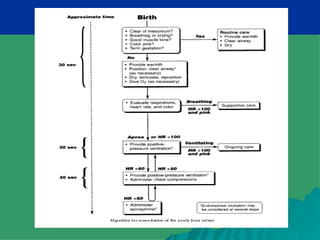
STEPS IN NEONATAL RESUSCITATION

 Warm,   dry, stimulate

A   – airway (positioning, suctioning)

B – breathing (spontaneous /
 assisted ventilation)

C– external cardiac massage/
 medications
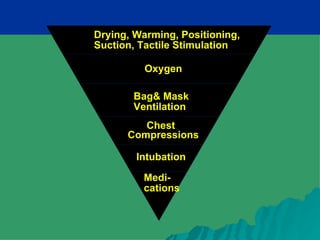
Drying, Warming, Positioning,
Suction, Tactile Stimulation

          Oxygen

       Bag& Mask
       Ventilation
         Chest
      Compressions

        Intubation

         Medi-
         cations
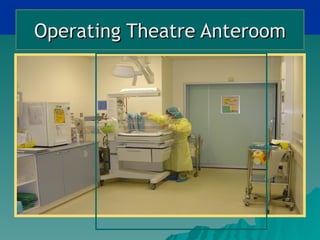
Operating Theatre Anteroom
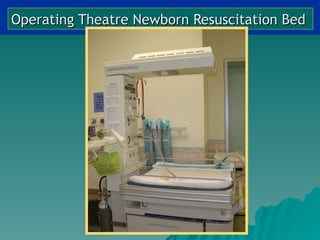
Operating Theatre Newborn Resuscitation Bed
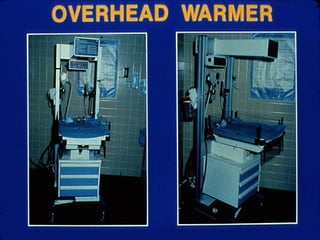
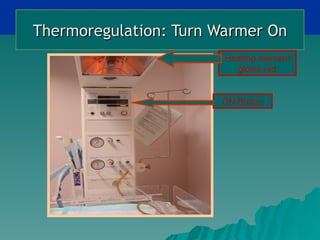
Thermoregulation: Turn Warmer On
                        Heating element
                          glows red


                       ON Button
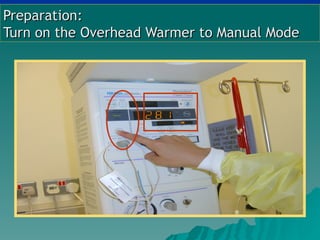
Preparation:
Turn on the Overhead Warmer to Manual Mode
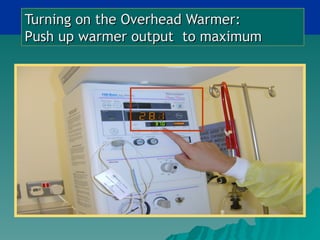
Turning on the Overhead Warmer:
Push up warmer output to maximum
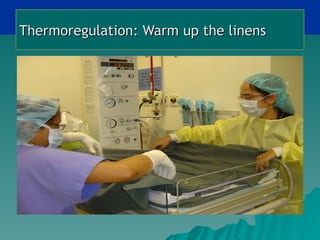
Thermoregulation: Warm up the linens
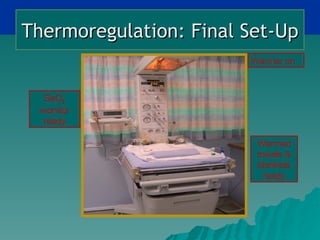
Thermoregulation: Final Set-Up
                        Warmer on


  SaO2
 monitor
 ready

                         Warmed
                         towels &
                         blankets
                           ready
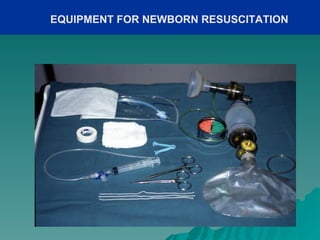
EQUIPMENT FOR NEWBORN RESUSCITATION
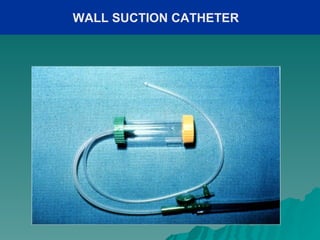
WALL SUCTION CATHETER
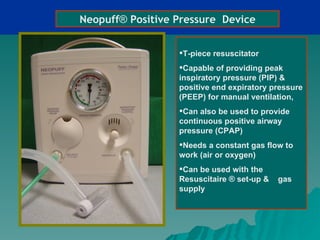
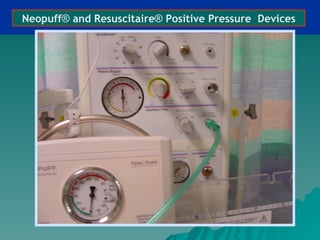
Neopuff® Positive Pressure Device


                  T-piece resuscitator
                  Capable of providing peak
                  inspiratory pressure (PIP) &
                  positive end expiratory pressure
                  (PEEP) for manual ventilation,
                  Can also be used to provide
                  continuous positive airway
                  pressure (CPAP)
                  Needs a constant gas flow to
                  work (air or oxygen)
                  Can be used with the
                  Resuscitaire ® set-up &   gas
                  supply
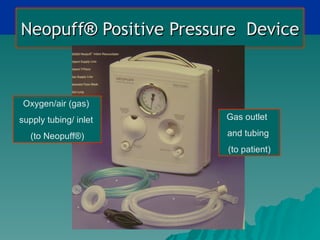
Neopuff® Positive Pressure Device


 Oxygen/air (gas)
supply tubing/ inlet    Gas outlet

   (to Neopuff®)        and tubing
                        (to patient)
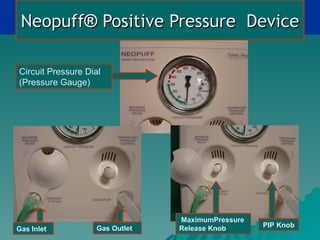
Neopuff® Positive Pressure Device

Circuit Pressure Dial
(Pressure Gauge)


                                MaximumPressure
                   Gas Outlet   Release Knob      PIP Knob
Gas Inlet
Neopuff® and Resuscitaire® Positive Pressure Devices
BASIC STEPS
   Warmth – radiant warmer, dry skin, remove wet
    linen, wrap in pre-warmed blankets


   Positioning – supine, head neutral or slightly
    extended (open airway)


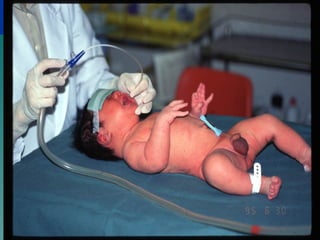
   Suctioning – healthy, vigorous infants do not
    need suctioning (clear airway)


   Tactile stimulation – flick the soles
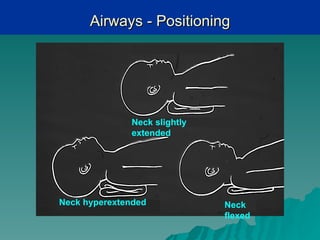
Airways - Positioning


              Neck slightly
              extended


Neck hyperextended            Neck
                              flexed
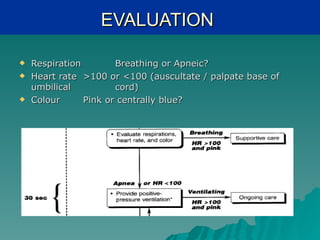
EVALUATION

   Respiration        Breathing or Apneic?
   Heart rate >100 or <100 (auscultate / palpate base of
    umbilical          cord)
   Colour      Pink or centrally blue?
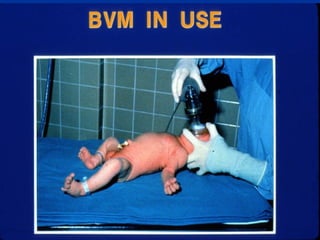
POSITIVE PRESSURE VENTILATION

   Indications: apnea / gasping, HR<100, persistent
    cyanosis

   Bag and mask (self-inflating) with 100% O2
   Adequate chest rise (rather than a particular
    manometer reading)
   Rate – 40 to 60 breaths per minute
   Successful – improving HR and colour

   The key to successful neonatal resuscitation is
    establishment of adequate ventilation
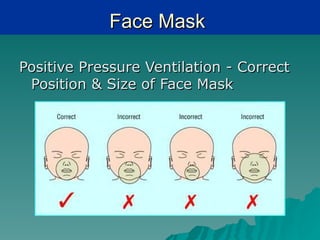
Face Mask

Positive Pressure Ventilation - Correct
 Position & Size of Face Mask
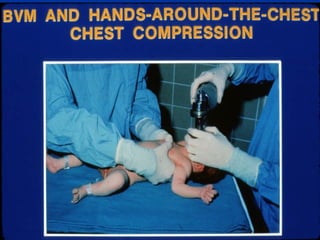
CHEST COMPRESSIONS
   If after 30 seconds of adequate PPV with 100% O2 and
    HR<60, start chest compressions

   Ratio of 3 compressions : 1 breath, to give 90
    compressions and 30 breaths per minute (120 events per
    minute)

   Depth of compression – 1/3 the depth of the chest

   Preferred technique – Two thumb-encircling hands

   Compressions delivered on the lower third of the sternum
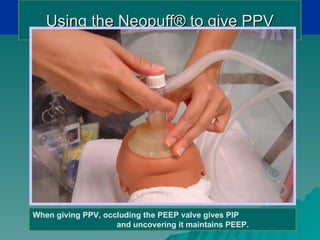
Using the Neopuff® to give PPV


When giving PPV, occluding the PEEP valve gives PIP
                    and uncovering it maintains PEEP.
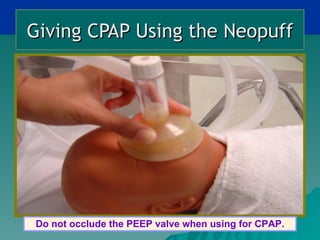
Giving CPAP Using the Neopuff


Do not occlude the PEEP valve when using for CPAP.
Medications
1.   Adrenaline
     – Concentration 1 : 10 000 solution
     – Dose 0.1 – 0.3 ml/kg
     – Route ETT or intravenous
     – Indication if HR < 60 bpm after 30 sec of effective PPV
       and chest compressions

•    Naloxone
     – Dose 0.1 mg/kg, repeat dose if necessary
     – Route intramuscular, intravenous, ETT
     – For respiratory depression with maternal pethidine in
       last 4 hours

3.   Volume expanders (normal saline) 10 ml/kg over 10
     minutes

5.   Sodium bicarbonate
Dept of Neonatology
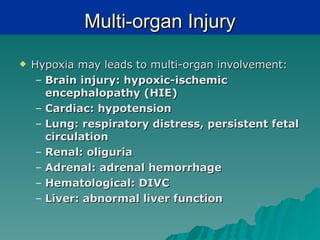
Multi-organ Injury
   Hypoxia may leads to multi-organ involvement:
     – Brain injury: hypoxic-ischemic
       encephalopathy (HIE)
     – Cardiac: hypotension
     – Lung: respiratory distress, persistent fetal
       circulation
     – Renal: oliguria
     – Adrenal: adrenal hemorrhage
     – Hematological: DIVC
     – Liver: abnormal liver function
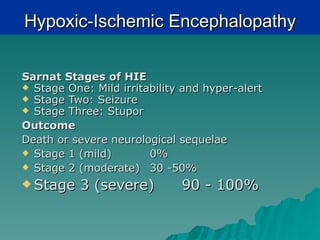
Hypoxic-Ischemic Encephalopathy

Sarnat Stages of HIE
 Stage One: Mild irritability and hyper-alert
 Stage Two: Seizure
 Stage Three: Stupor

Outcome
Death or severe neurological sequelae
 Stage 1 (mild)        0%
 Stage 2 (moderate) 30 -50%

 Stage    3 (severe)         90 - 100%
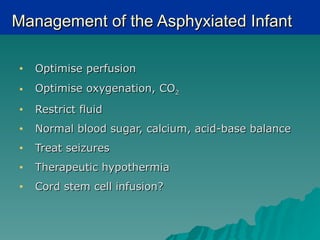
Management of the Asphyxiated Infant

•   Optimise perfusion
•   Optimise oxygenation, CO2
•   Restrict fluid
•   Normal blood sugar, calcium, acid-base balance
•   Treat seizures
•   Therapeutic hypothermia
•   Cord stem cell infusion?
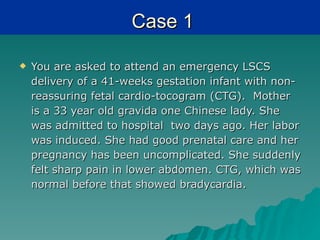
Case 1

   You are asked to attend an emergency LSCS
    delivery of a 41-weeks gestation infant with non-
    reassuring fetal cardio-tocogram (CTG). Mother
    is a 33 year old gravida one Chinese lady. She
    was admitted to hospital two days ago. Her labor
    was induced. She had good prenatal care and her
    pregnancy has been uncomplicated. She suddenly
    felt sharp pain in lower abdomen. CTG, which was
    normal before that showed bradycardia.
Case 1

 What are the possible conditions that
 you can think of in the mother
 causing the problem?

 Whatresuscitation equipments would
 you prepare for delivery?

 Wouldyou involve any other medical
 personnel?
Case 1
 Atdelivery, you receive a floppy and
 blue male infant. His heart rate was
 40/minutes and there is no
 spontaneous respiration. Baby does
 not respond to stimulation.

 Whatis the initial Apgar score in this
 baby?

 What   are the initial steps you would
Case 1

 You  bring him to the radiant warmer,
 quickly positioned, dried, stimulated
 the baby and give free-flow oxygen.
 At 30 seconds of life, he remains
 apneic and cyanotic. His heart rate is
 still 40 per minute.

 What would be the next step in
 resuscitation?
Case 1

 You administer bag and mask
 ventilation with 100% FiO2. There is
 good chest expansion. After one
 minute of bag and mask ventilation
 baby remained apneic. His heart rate
 is 60 per minute.

 What   would be your next step?

 What   are the other possible
Case 1

 Youstart chest compressions and
 decide to intubate the baby.

 How would you ensure proper
 positioning of ETT?

 How would monitor your
 resuscitation?
Case 1
   You check for equal air entry and expansion of
    lung field. Baby’s heart rate after two minutes of
    ventilation is 100/minutes. The color is still pale
    and pulse volume is low.

   What could the possible reason for low volume
    pulse?

   What intervention would you like to consider at
    this point?
Case 1
   You decide to give normal saline bolus 10-15
    ml/kg.

   How can you secure an intravenous access
    quickly?

   How fast do you want to administer the normal
    saline bolus?

   What are other types of fluid you can use?
Case 1

 You cannulate the umbilical vein and
 administer the normal saline over
 five minutes. Baby’s heart rate
 improve to 150/minute and color and
 perfusion are better now. You have
 decided to transfer the baby to
 intensive care nursery.

 Whatare the laboratory test you
 want to order?
Case 1

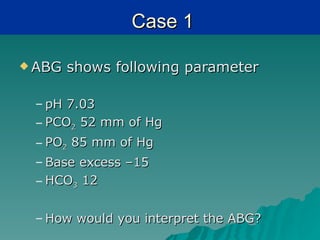
 ABG   shows following parameter

 – pH 7.03
 – PCO2 52 mm of Hg
 – PO2 85 mm of Hg
 – Base excess –15
 – HCO3 12

 – How would you interpret the ABG?
Case 1
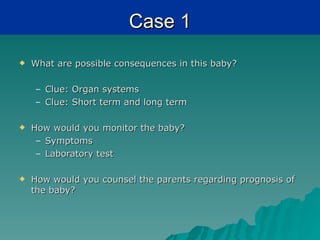
   What are possible consequences in this baby?

    – Clue: Organ systems
    – Clue: Short term and long term

   How would you monitor the baby?
     – Symptoms
     – Laboratory test

   How would you counsel the parents regarding prognosis of
    the baby?
Case 2

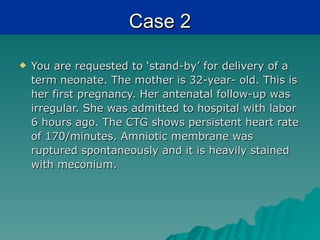
   You are requested to ‘stand-by’ for delivery of a
    term neonate. The mother is 32-year- old. This is
    her first pregnancy. Her antenatal follow-up was
    irregular. She was admitted to hospital with labor
    6 hours ago. The CTG shows persistent heart rate
    of 170/minutes. Amniotic membrane was
    ruptured spontaneously and it is heavily stained
    with meconium.
Case 2

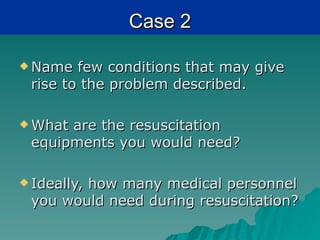
 Name  few conditions that may give
 rise to the problem described.

 Whatare the resuscitation
 equipments you would need?

 Ideally,
        how many medical personnel
 you would need during resuscitation?
Case 2

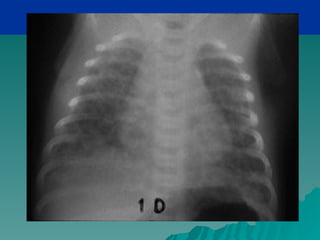
 The baby is delivered vaginally. The
 baby was found to covered with thick
 meconium. There is no spontaneous
 cry. The heart rate is 120/minute and
 the baby has some activity.

 What  would the role of obstetrician?
 What would be your first step in
  resuscitation?
 What are the consequences of
  meconium aspiration?
Conditions That Requires Different
      Resuscitation Approach
 Thickmeconium stained liquor
 Congenital diaphragmatic hernia

 Feto-maternal or feto-placental
  hemorrhage
Reference and Further Readings

1.   Neonatal resuscitation guidelines. Circulation
     2005;112:118– 95.

•    Volpe J. Neurology of the Newborn. 5 ed.
     Philadelphia:W. B. Saunders Company; 2008
     (Chapter on Neonatal Encephalopathy)

•    Nelson Textbook of Pediatrics 18th ed. 2007
     Chapter 99.5: Hypoxia-Ischemia
Thank You
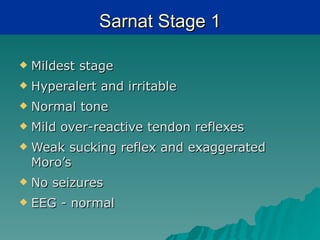
Sarnat Stage 1

   Mildest stage
   Hyperalert and irritable
   Normal tone
   Mild over-reactive tendon reflexes
   Weak sucking reflex and exaggerated
    Moro’s
   No seizures
   EEG - normal
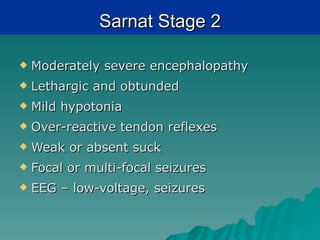
Sarnat Stage 2

   Moderately severe encephalopathy
   Lethargic and obtunded
   Mild hypotonia
   Over-reactive tendon reflexes
   Weak or absent suck
   Focal or multi-focal seizures
   EEG – low-voltage, seizures
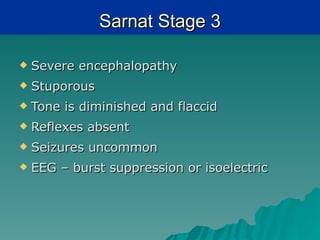
Sarnat Stage 3

   Severe encephalopathy
   Stuporous
   Tone is diminished and flaccid
   Reflexes absent
   Seizures uncommon
   EEG – burst suppression or isoelectric

Initial stablisation and resuscitation in newborn

  • 1.
    Initial Stabilisation and Resuscitation of the Newborn Infant
  • 2.
    Learning Outcomes Initial Stabilisationand Resuscitation of the Newborn Infant 1. Prevention 1.1 Identify the factors that predispose to the development of perinatal hypoxia. 1.2 Propose how perinatal hypoxia can be prevented. 2. Principles of Diagnosis 2.1 Describe the pathophysiological changes that occur in hypoxia. 2.2 Recognise an asphyxiated newborn 2.3 Classify an asphyxiated newborn based on the predicted adverse outcomes (Sarnat staging) 3. Principles of Management 3.1 Resuscitate a newborn who is not adapting to the extra-uterine transition. 3.2 Describe the principles involved in the management of mild to moderate asphyxiated newborn.
  • 3.
    Perinatal Hypoxia-Ischemia  Birth asphyxia - Failure to initiate and sustain breathing at birth  Causes 5. Fetal and Antepartum (90%) 7. Birth process (10%)
  • 4.
    Fetal and AntepartumPathologies 1. Inadequate oxygenation of maternal blood - anesthesia, cyanotic heart disease, respiratory failure 3. Inadequate flow of maternal blood (ischemia/hypotension) – spinal anesthesia, compression of IVC or aorta by uterus 5. Abruptio placentae 7. Uterine vasoconstriction (cocaine)
  • 5.
    Birth Process • Breech • Shoulder dystocia • Cephalopelvic disproportion • Cord compression, knotting • Uterine tetany (too much oxytocin) • Uterine rupture
  • 6.
    Recognition of anAsphyxiated Baby  Oxygen supply to the fetus is reduced, resulting in Apnea at birth 2. Low Apgar scores (severe if <5 at five minutes) 3. Neurologic sequelae (hypoxic-ischaemic encephalopathy) 4. Metabolic acidosis
  • 7.
    Apgar Scores 0 1 2 Heart rate 0 <100 >100 Respiration Absent Slow, Good, irregular crying Muscle Limp Some Active tone flexion Response No Grimace Cough, to catheter response sneeze in nostril Colour Blue Body pink, All pink extremities blue
  • 8.
    Apnea  10 Apnea: When asphyxiated, the infant responds initially with tachypnea. If insult continues, the infant becomes apneic and bradycardic. The infant will respond to stimulation and 02 therapy with spontaneous respirations.  20 apnea: When insult continues after 10 apnea, the infant  responds with a period a gasping respirations, bradycardia, and falling BP. The infant takes a last breath and then enters the 20 apnea period. The infant will not respond to stimulation and death will occur unless resuscitation begins immediately.  It is impossible to differentiate between 10 apnea and 20 apnea at delivery, assume the infant is in 20 apnea and begin resuscitation immediately.
  • 9.
    Pathophysiological changes in Asphyxia Stimulation Resuscitation
  • 10.
  • 11.
    STEPS IN NEONATALRESUSCITATION  Warm, dry, stimulate A – airway (positioning, suctioning) B – breathing (spontaneous / assisted ventilation) C– external cardiac massage/ medications
  • 12.
    Drying, Warming, Positioning, Suction,Tactile Stimulation Oxygen Bag& Mask Ventilation Chest Compressions Intubation Medi- cations
  • 14.
  • 15.
    Operating Theatre NewbornResuscitation Bed
  • 16.
    Thermoregulation: Turn WarmerOn Heating element glows red ON Button
  • 17.
    Preparation: Turn on theOverhead Warmer to Manual Mode
  • 18.
    Turning on theOverhead Warmer: Push up warmer output to maximum
  • 19.
  • 20.
    Thermoregulation: Final Set-Up Warmer on SaO2 monitor ready Warmed towels & blankets ready
  • 21.
    EQUIPMENT FOR NEWBORNRESUSCITATION
  • 22.
  • 23.
    Neopuff® Positive PressureDevice T-piece resuscitator Capable of providing peak inspiratory pressure (PIP) & positive end expiratory pressure (PEEP) for manual ventilation, Can also be used to provide continuous positive airway pressure (CPAP) Needs a constant gas flow to work (air or oxygen) Can be used with the Resuscitaire ® set-up & gas supply
  • 24.
    Neopuff® Positive PressureDevice Oxygen/air (gas) supply tubing/ inlet Gas outlet (to Neopuff®) and tubing (to patient)
  • 25.
    Neopuff® Positive PressureDevice Circuit Pressure Dial (Pressure Gauge) MaximumPressure Gas Outlet Release Knob PIP Knob Gas Inlet
  • 26.
    Neopuff® and Resuscitaire®Positive Pressure Devices
  • 30.
    BASIC STEPS  Warmth – radiant warmer, dry skin, remove wet linen, wrap in pre-warmed blankets  Positioning – supine, head neutral or slightly extended (open airway)  Suctioning – healthy, vigorous infants do not need suctioning (clear airway)  Tactile stimulation – flick the soles
  • 31.
    Airways - Positioning Neck slightly extended Neck hyperextended Neck flexed
  • 33.
    EVALUATION  Respiration Breathing or Apneic?  Heart rate >100 or <100 (auscultate / palpate base of umbilical cord)  Colour Pink or centrally blue?
  • 34.
    POSITIVE PRESSURE VENTILATION  Indications: apnea / gasping, HR<100, persistent cyanosis  Bag and mask (self-inflating) with 100% O2  Adequate chest rise (rather than a particular manometer reading)  Rate – 40 to 60 breaths per minute  Successful – improving HR and colour  The key to successful neonatal resuscitation is establishment of adequate ventilation
  • 36.
    Face Mask Positive PressureVentilation - Correct Position & Size of Face Mask
  • 37.
    CHEST COMPRESSIONS  If after 30 seconds of adequate PPV with 100% O2 and HR<60, start chest compressions  Ratio of 3 compressions : 1 breath, to give 90 compressions and 30 breaths per minute (120 events per minute)  Depth of compression – 1/3 the depth of the chest  Preferred technique – Two thumb-encircling hands  Compressions delivered on the lower third of the sternum
  • 39.
    Using the Neopuff®to give PPV When giving PPV, occluding the PEEP valve gives PIP and uncovering it maintains PEEP.
  • 40.
    Giving CPAP Usingthe Neopuff Do not occlude the PEEP valve when using for CPAP.
  • 41.
    Medications 1. Adrenaline – Concentration 1 : 10 000 solution – Dose 0.1 – 0.3 ml/kg – Route ETT or intravenous – Indication if HR < 60 bpm after 30 sec of effective PPV and chest compressions • Naloxone – Dose 0.1 mg/kg, repeat dose if necessary – Route intramuscular, intravenous, ETT – For respiratory depression with maternal pethidine in last 4 hours 3. Volume expanders (normal saline) 10 ml/kg over 10 minutes 5. Sodium bicarbonate
  • 42.
  • 43.
    Multi-organ Injury  Hypoxia may leads to multi-organ involvement: – Brain injury: hypoxic-ischemic encephalopathy (HIE) – Cardiac: hypotension – Lung: respiratory distress, persistent fetal circulation – Renal: oliguria – Adrenal: adrenal hemorrhage – Hematological: DIVC – Liver: abnormal liver function
  • 44.
    Hypoxic-Ischemic Encephalopathy Sarnat Stagesof HIE  Stage One: Mild irritability and hyper-alert  Stage Two: Seizure  Stage Three: Stupor Outcome Death or severe neurological sequelae  Stage 1 (mild) 0%  Stage 2 (moderate) 30 -50%  Stage 3 (severe) 90 - 100%
  • 45.
    Management of theAsphyxiated Infant • Optimise perfusion • Optimise oxygenation, CO2 • Restrict fluid • Normal blood sugar, calcium, acid-base balance • Treat seizures • Therapeutic hypothermia • Cord stem cell infusion?
  • 46.
    Case 1  You are asked to attend an emergency LSCS delivery of a 41-weeks gestation infant with non- reassuring fetal cardio-tocogram (CTG). Mother is a 33 year old gravida one Chinese lady. She was admitted to hospital two days ago. Her labor was induced. She had good prenatal care and her pregnancy has been uncomplicated. She suddenly felt sharp pain in lower abdomen. CTG, which was normal before that showed bradycardia.
  • 47.
    Case 1  Whatare the possible conditions that you can think of in the mother causing the problem?  Whatresuscitation equipments would you prepare for delivery?  Wouldyou involve any other medical personnel?
  • 48.
    Case 1  Atdelivery,you receive a floppy and blue male infant. His heart rate was 40/minutes and there is no spontaneous respiration. Baby does not respond to stimulation.  Whatis the initial Apgar score in this baby?  What are the initial steps you would
  • 49.
    Case 1  You bring him to the radiant warmer, quickly positioned, dried, stimulated the baby and give free-flow oxygen. At 30 seconds of life, he remains apneic and cyanotic. His heart rate is still 40 per minute.  What would be the next step in resuscitation?
  • 50.
    Case 1  Youadminister bag and mask ventilation with 100% FiO2. There is good chest expansion. After one minute of bag and mask ventilation baby remained apneic. His heart rate is 60 per minute.  What would be your next step?  What are the other possible
  • 51.
    Case 1  Youstartchest compressions and decide to intubate the baby.  How would you ensure proper positioning of ETT?  How would monitor your resuscitation?
  • 52.
    Case 1  You check for equal air entry and expansion of lung field. Baby’s heart rate after two minutes of ventilation is 100/minutes. The color is still pale and pulse volume is low.  What could the possible reason for low volume pulse?  What intervention would you like to consider at this point?
  • 53.
    Case 1  You decide to give normal saline bolus 10-15 ml/kg.  How can you secure an intravenous access quickly?  How fast do you want to administer the normal saline bolus?  What are other types of fluid you can use?
  • 54.
    Case 1  Youcannulate the umbilical vein and administer the normal saline over five minutes. Baby’s heart rate improve to 150/minute and color and perfusion are better now. You have decided to transfer the baby to intensive care nursery.  Whatare the laboratory test you want to order?
  • 55.
    Case 1  ABG shows following parameter – pH 7.03 – PCO2 52 mm of Hg – PO2 85 mm of Hg – Base excess –15 – HCO3 12 – How would you interpret the ABG?
  • 56.
    Case 1  What are possible consequences in this baby? – Clue: Organ systems – Clue: Short term and long term  How would you monitor the baby? – Symptoms – Laboratory test  How would you counsel the parents regarding prognosis of the baby?
  • 57.
    Case 2  You are requested to ‘stand-by’ for delivery of a term neonate. The mother is 32-year- old. This is her first pregnancy. Her antenatal follow-up was irregular. She was admitted to hospital with labor 6 hours ago. The CTG shows persistent heart rate of 170/minutes. Amniotic membrane was ruptured spontaneously and it is heavily stained with meconium.
  • 58.
    Case 2  Name few conditions that may give rise to the problem described.  Whatare the resuscitation equipments you would need?  Ideally, how many medical personnel you would need during resuscitation?
  • 59.
    Case 2  Thebaby is delivered vaginally. The baby was found to covered with thick meconium. There is no spontaneous cry. The heart rate is 120/minute and the baby has some activity.  What would the role of obstetrician?  What would be your first step in resuscitation?  What are the consequences of meconium aspiration?
  • 61.
    Conditions That RequiresDifferent Resuscitation Approach  Thickmeconium stained liquor  Congenital diaphragmatic hernia  Feto-maternal or feto-placental hemorrhage
  • 62.
    Reference and FurtherReadings 1. Neonatal resuscitation guidelines. Circulation 2005;112:118– 95. • Volpe J. Neurology of the Newborn. 5 ed. Philadelphia:W. B. Saunders Company; 2008 (Chapter on Neonatal Encephalopathy) • Nelson Textbook of Pediatrics 18th ed. 2007 Chapter 99.5: Hypoxia-Ischemia
  • 63.
  • 64.
    Sarnat Stage 1  Mildest stage  Hyperalert and irritable  Normal tone  Mild over-reactive tendon reflexes  Weak sucking reflex and exaggerated Moro’s  No seizures  EEG - normal
  • 65.
    Sarnat Stage 2  Moderately severe encephalopathy  Lethargic and obtunded  Mild hypotonia  Over-reactive tendon reflexes  Weak or absent suck  Focal or multi-focal seizures  EEG – low-voltage, seizures
  • 66.
    Sarnat Stage 3  Severe encephalopathy  Stuporous  Tone is diminished and flaccid  Reflexes absent  Seizures uncommon  EEG – burst suppression or isoelectric