Congenital
Tuberculosis
Presented By :- Dr. Sonali Paradhi Mhatre
Updated 2020
Introduction
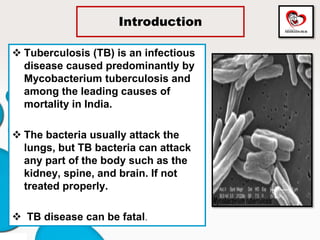
 Tuberculosis (TB) is an infectious
disease caused predominantly by
Mycobacterium tuberculosis and
among the leading causes of
mortality in India.
 The bacteria usually attack the
lungs, but TB bacteria can attack
any part of the body such as the
kidney, spine, and brain. If not
treated properly.
 TB disease can be fatal.
Congenital Tuberculosis
 Congenital TB in neonates is potentially serious, with
morbidity and mortality approaching 50%.
 It is relatively rare, with fewer than 200 cases reported
in the English literature.
 These numbers, however, reflect, in part, the difficulty
of confirming a congenital case, which often requires
organ biopsy.
 Signs and symptoms are nonspecific
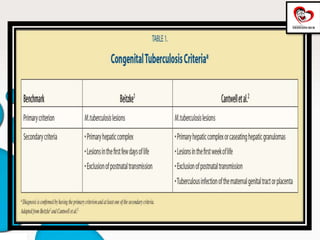
Cantwell criteria
• Presence of proven Tuberculous disease with atleast
1 of the following :
1. Lesions in the newborn baby during the first week of life.
2. Primary hepatic complex or caseating hepatic granuloma.
3. Tuberculous infection of the placenta or maternal genital
tract.
4. Exclusion of possibility of postnatal transmission by
investigation of contacts, including hospital staff.
Pathophysiology
Of
Congenital TB
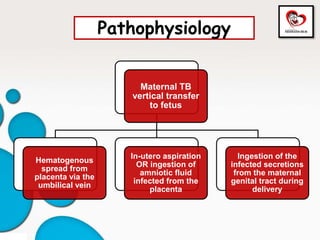
Pathophysiology
Maternal TB
vertical transfer
to fetus
Hematogenous
spread from
placenta via the
umbilical vein
In-utero aspiration
OR ingestion of
amniotic fluid
infected from the
placenta
Ingestion of the
infected secretions
from the maternal
genital tract during
delivery
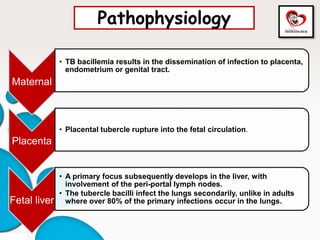
Pathophysiology
Maternal
• TB bacillemia results in the dissemination of infection to placenta,
endometrium or genital tract.
Placenta
• Placental tubercle rupture into the fetal circulation.
Fetal liver
• A primary focus subsequently develops in the liver, with
involvement of the peri-portal lymph nodes.
• The tubercle bacilli infect the lungs secondarily, unlike in adults
where over 80% of the primary infections occur in the lungs.
Congenital TB
clinically
Clinical Features
• Tuberculosis in female commonly results in :
Infertility
Recurrent abortions
Stillbirths
Premature rupture of membranes
Preterm labour.
• Baby born to a TB mother generally tends to be preterm,
VLBW , IUGR.
Clinical Features of
Congenital Tuberculosis
 Age of presentation is 1 – 84 days (average 24 days of life)
 Commonly associated clinical manifestations include :
• Poor feeding (100%)
• Fever (100%)
• Irritability (100%)
• Failure to thrive (100%)
• Cough (88.9%)
• Respiratory distress (66.7%)
Clinical Features of
Congenital Tuberculosis
 Examination findings include :
• Hepatosplenomegaly (100%)
• Splenomegaly (77.9%)
• Abdominal distension (77.2%)
• Lymphadenopathy (38%)
• Lethargy (21%)
• Meningitis, Septicemia, Recurrent pneumonias, Jaundice,
Ascitis, otitis media, mastoiditis, parotitis, osteomyelitis, cold
abscess, papular/pustular skin lesions (14%)
• Rarely : Apnea, cyanosis, seizure, petechiae.
Management
of
Congenital TB
Diagnosis
 Treatment of TB during pregnancy requires consideration for the
developing fetus. In all cases, proper medical treatment of the
mother is of benefit to the fetus if the treatment is carefully planned
to minimize the risk of congenital anomalies.
 Therapeutic abortion is not indicated.
 Because of the risk of tuberculosis to the fetus, treatment of
tuberculosis in pregnant women should be initiated whenever the
probability of maternal disease is moderate to high.
 The initial treatment regimen should consist of INH, RIF, and EMB.
Although all of these drugs cross the placenta, they do not appear
to have teratogenic effects.
Diagnosis ( cont..)
 Streptomycin is the only antituberculosis drug documented to have
harmful effects on the human fetus (congenital deafness) and should not
be used.
 If there is believed to be no significant resistance in the M tuberculosis
strain, then INH and rifampin (RMP) are used as first-line therapy. If there is
low suspicion of resistance, then EMB should be added, while a highly
resistant strain would prompt the consideration of PZA.
 Breastfeeding should not be discouraged for women being treated with the
first-line antituberculosis agents because the small concentrations of
these drugs in breast milk do not produce toxicity in the nursing newborn.
Diagnosis in Neonate
 High Index of Suspicion.
 In the setting of poor response to antibiotics
and supportive therapy
+
negative results of microbiological evaluation
and serological tests for acute and chronic
intrauterine infections…………TB should be suspected.
Diagnosis in Neonate
 Detailed Maternal History
 Screening of Contacts.
 Placental morphologic and histological examination.
Neonatal samples suitable for culture and microscopy
include:
Bronchoalveolar lavage, Gastric aspirates, Tracheal aspirates,
Skin lesion swabs,
Ear discharge, Ascitic fluid, Pleural fluid, CSF.
( for acid fast bacilli and cultured on standard egg based media
for 12 wks)
 Detailed Maternal History
 Screening of Contacts.
 Placental morphologic and histological examination.
Neonatal samples suitable for culture and microscopy
include:
Bronchoalveolar lavage, Gastric aspirates, Tracheal
aspirates, Skin lesion swabs,
Ear discharge, Ascitic fluid, Pleural fluid, CSF.
( for acid fast bacilli and cultured on standard egg based media
for 12 wks)
Diagnosis in Neonate
Diagnosis ( cont..)
 Detection of M. Tuberculosis DNA in Bronchoalveolar lavage fluid
by PCR is diagnostic of tuberculosis in a newborn.
 Liver or lymph node biopsy may be undertaken for histology and
culture.
 Ultrasonography abdomen may show hepatic granulomas. CXRay.
 CT thorax may show presence of scattered infiltrates,
bronchopneumonia, consolidation or periportal hypodensity.
 Mantoux test if positive, is supportive evidence, but negative
results do not rule out disease.
Diagnosis ( cont..)
 Growth of the mycobacteria can take up to 6 weeks. The
development of newer technologies, such as radiometric culture
techniques, genetic probes, high-pressure liquid chromatology,
and monoclonal antibody testing, are greatly accelerating
identification and susceptibility testing.
 The WHO has accredited LED (light emitting diode) flourescence
microscopy and liquid based mycobacteria growth indicator tube
(MGIT) in developed countries for fast results.
 Indirect methods include rapid interferon gamma assays,
QuantiFERON-TB Gold assay and T-SPOT using antigens ESAT-6,
CFP-10 and TB7 but have shown inconsistent results in newborns
Untreated tuberculosis
represents a far greater
hazard to a pregnant woman
and her fetus, than does
treatment of the disease
Centre for Disease Control, “Treatment of tuberculosis,” MMWR, vol. 52, no. RR-11, pp. 1–77, 2003
Drug Management for
congenital TB
 The American Academy of Pediatrics recommends treatment
once/day with:
1. INH 10 to 15 mg/kg po
2. Rifampin 10 to 20 mg/kg po
3. Pyrazinamide 30 to 40 mg/kg po and
4. An aminoglycoside (eg, amikacin).
 This regimen should be modified as indicated based on results of
testing for resistance.
 Pyridoxine is given if the neonate is exclusively breastfed.
 After the first 2 mo of treatment, INH and rifampin are continued to
complete a 6 month course.
Drug Management for
congenital TB (cont..)
 When the CNS is involved, initial therapy also includes
corticosteroids (prednisone 2 mg/kg po once/day [maximum 60
mg/day] for 4 to 6 wk, then gradually tapered).
 Other therapy continues until all signs of meningitis have
disappeared and cultures are negative on 2 successive lumbar
punctures at least 1 wk apart.
 Therapy can then be continued with INH and rifampin once/day or
twice/wk for another 10 mo.
 Corticosteroids may also be considered for infants and children
with severe miliary disease, pleural or pericardial effusions, or
endobronchial disease or those with abdominal TB.
Prophylaxis
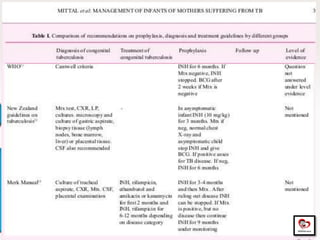
 The decision to start isoniazid (INH) prophylaxis to the neonate depends
on a number of factors including the history of detection and duration of
maternal disease (before or during or after pregnancy), type of
tuberculosis (pulmonary or extrapulmonary), and maternal compliance of
treatment (regular or irregular).
 INH prophylaxis is recommended in the neonate if the mother has received
treatment for <2 wk, or those who are on therapy for >2 wk but are sputum
smear positive. In all other situations there is no need of therapy.
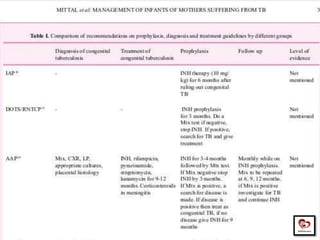
 IAP does not comment on maternal treatment or Mantoux test and
suggests isoniazid therapy to all newborns for at least 6-9 months or a
minimum for three months until mother is culture negative.
 Suggested dosage : Isoniazid 10mkd
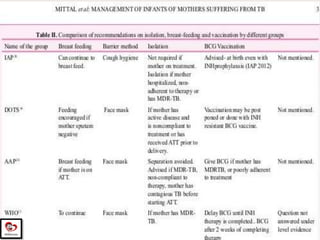
 Exclusively breastfed infants on INH prophylaxis need to be started on
Pyridoxine supplement.
Breastfeeding
 Breastmilk is by far the best nutritional means for an infant.
 Human milk in addition to providing nutrition has immunological benefits
and all efforts to continue breastfeeding in newborns with mothers having
tuberculosis should be made.
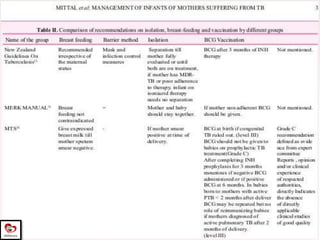
 The American Academy of Pediatrics recommends that women with
tuberculosis who have been treated appropriately for two weeks or more
and who are not considered contagious may breastfeed.
 In case of maternal sickness or if mother is smear positive at the time of
delivery or mothers with MDR TB, when breastfeeding may not be
possible, expressed breast milk feeding is an alternative, with personal
hygiene.
 The RNTCP recommends breast-feeding of neonates regardless of the
mother’s TB status.
Breastfeeding
 Antituberculous drugs are excreted into breast milk, though the
dose is less compared with the therapeutic dose for infants.
 No toxicity has been reported from this small concentration in
breast milk.
 Pyridoxine deficiency may cause seizures in the newborn.
Supplemental pyridoxine should, therefore, be administered to
infants on INH or whose baby & mother are both taking the drug.
 Breastfeeding should be continued in these neonates and isolation
is recommended only till mother is infectious, has multidrug
resistant tuberculosis or non adherent to treatment.
 Cough hygiene has to be strictly followed.
Mantoux Test
 A single-needle intradermal injection of 0.1 mL of purified protein
derivative (5 Tuberculin units) is administered, and the skin
reaction is analysed 48–72 hours later, based on the largest
diameter of the in durations developed.
 IAP in the recent recommendations has decreased the strength of
PPD for skin testing to 2 TU.
 Utility of Mantoux test in neonates is poor due to low
reactogenicity and poor helper T cell responses.
 Current recommendations support use of Mantoux test after three
months or six months.
BCG vaccine
 Bacillus Calmettee Guerin (BCG) vaccination protects against the
dissemination of tuberculosis and severe disease.
 In neonates with congenital tuberculosis there is no utility of BCG
vaccine.
 In countries with significant number of TB patients in the
community children are vulnerable to get TB infection early in life:
Therefore, BCG vaccination as early as possible preferably after
stopping of INH prophylaxis should be followed.
 Indian Academy of Pedaitrics advises BCG vaccination at birth to
all neonates after excluding congenital tuberculosis even if
chemoprophylaxis is planned.
BCG vaccine
 In neonates receiving INH prophylaxis, BCG vaccine is
recommended after completion of INH dosage or giving
INH resistant vaccine.
 WHO recommends BCG vaccine until completion of
INH therapy.
 AAP has advised BCG vaccine after completion of
chemoprophylaxis at six months or at birth along with
isoniazid if follow up cannot be ensured.
Introduction
Introduction
Introduction
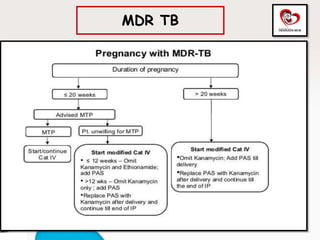
Special note – MDR TB
• An MDR-TB suspect who is sputum culture positive and has M.
tuberculosis resistant to isoniazid and rifampicin, with or without
resistance to other antitubercular drugs based on DST results
from an RNTCP accredited laboratory
• Patients with are not MDR but have any Rifampicin resistance
will also be treated with Cat IV regimen.
• Drug used are : Kanamycin, Ofloxacin, (Levofloxacin),
Ethionamide, Ethambutol, Pyrazinamide, Cycloserine, PAS (80%
Bioavailability) ‡ Pyridoxine .
• There is a lack of experience in treating pregnant women with
MDR-TB. Teratogenicity has been demonstrated with only some
of the drugs used to treat MDR-TB.
MDR TB
Congenital Tuberculosis (Updated in 2020)

Congenital Tuberculosis (Updated in 2020)

  • 1.
    Congenital Tuberculosis Presented By :-Dr. Sonali Paradhi Mhatre Updated 2020
  • 2.
    Introduction  Tuberculosis (TB)is an infectious disease caused predominantly by Mycobacterium tuberculosis and among the leading causes of mortality in India.  The bacteria usually attack the lungs, but TB bacteria can attack any part of the body such as the kidney, spine, and brain. If not treated properly.  TB disease can be fatal.
  • 3.
    Congenital Tuberculosis  CongenitalTB in neonates is potentially serious, with morbidity and mortality approaching 50%.  It is relatively rare, with fewer than 200 cases reported in the English literature.  These numbers, however, reflect, in part, the difficulty of confirming a congenital case, which often requires organ biopsy.  Signs and symptoms are nonspecific
  • 5.
    Cantwell criteria • Presenceof proven Tuberculous disease with atleast 1 of the following : 1. Lesions in the newborn baby during the first week of life. 2. Primary hepatic complex or caseating hepatic granuloma. 3. Tuberculous infection of the placenta or maternal genital tract. 4. Exclusion of possibility of postnatal transmission by investigation of contacts, including hospital staff.
  • 6.
  • 7.
    Pathophysiology Maternal TB vertical transfer tofetus Hematogenous spread from placenta via the umbilical vein In-utero aspiration OR ingestion of amniotic fluid infected from the placenta Ingestion of the infected secretions from the maternal genital tract during delivery
  • 8.
    Pathophysiology Maternal • TB bacillemiaresults in the dissemination of infection to placenta, endometrium or genital tract. Placenta • Placental tubercle rupture into the fetal circulation. Fetal liver • A primary focus subsequently develops in the liver, with involvement of the peri-portal lymph nodes. • The tubercle bacilli infect the lungs secondarily, unlike in adults where over 80% of the primary infections occur in the lungs.
  • 9.
  • 10.
    Clinical Features • Tuberculosisin female commonly results in : Infertility Recurrent abortions Stillbirths Premature rupture of membranes Preterm labour. • Baby born to a TB mother generally tends to be preterm, VLBW , IUGR.
  • 11.
    Clinical Features of CongenitalTuberculosis  Age of presentation is 1 – 84 days (average 24 days of life)  Commonly associated clinical manifestations include : • Poor feeding (100%) • Fever (100%) • Irritability (100%) • Failure to thrive (100%) • Cough (88.9%) • Respiratory distress (66.7%)
  • 12.
    Clinical Features of CongenitalTuberculosis  Examination findings include : • Hepatosplenomegaly (100%) • Splenomegaly (77.9%) • Abdominal distension (77.2%) • Lymphadenopathy (38%) • Lethargy (21%) • Meningitis, Septicemia, Recurrent pneumonias, Jaundice, Ascitis, otitis media, mastoiditis, parotitis, osteomyelitis, cold abscess, papular/pustular skin lesions (14%) • Rarely : Apnea, cyanosis, seizure, petechiae.
  • 13.
  • 14.
    Diagnosis  Treatment ofTB during pregnancy requires consideration for the developing fetus. In all cases, proper medical treatment of the mother is of benefit to the fetus if the treatment is carefully planned to minimize the risk of congenital anomalies.  Therapeutic abortion is not indicated.  Because of the risk of tuberculosis to the fetus, treatment of tuberculosis in pregnant women should be initiated whenever the probability of maternal disease is moderate to high.  The initial treatment regimen should consist of INH, RIF, and EMB. Although all of these drugs cross the placenta, they do not appear to have teratogenic effects.
  • 15.
    Diagnosis ( cont..) Streptomycin is the only antituberculosis drug documented to have harmful effects on the human fetus (congenital deafness) and should not be used.  If there is believed to be no significant resistance in the M tuberculosis strain, then INH and rifampin (RMP) are used as first-line therapy. If there is low suspicion of resistance, then EMB should be added, while a highly resistant strain would prompt the consideration of PZA.  Breastfeeding should not be discouraged for women being treated with the first-line antituberculosis agents because the small concentrations of these drugs in breast milk do not produce toxicity in the nursing newborn.
  • 16.
    Diagnosis in Neonate High Index of Suspicion.  In the setting of poor response to antibiotics and supportive therapy + negative results of microbiological evaluation and serological tests for acute and chronic intrauterine infections…………TB should be suspected.
  • 17.
    Diagnosis in Neonate Detailed Maternal History  Screening of Contacts.  Placental morphologic and histological examination. Neonatal samples suitable for culture and microscopy include: Bronchoalveolar lavage, Gastric aspirates, Tracheal aspirates, Skin lesion swabs, Ear discharge, Ascitic fluid, Pleural fluid, CSF. ( for acid fast bacilli and cultured on standard egg based media for 12 wks)
  • 18.
     Detailed MaternalHistory  Screening of Contacts.  Placental morphologic and histological examination. Neonatal samples suitable for culture and microscopy include: Bronchoalveolar lavage, Gastric aspirates, Tracheal aspirates, Skin lesion swabs, Ear discharge, Ascitic fluid, Pleural fluid, CSF. ( for acid fast bacilli and cultured on standard egg based media for 12 wks) Diagnosis in Neonate
  • 19.
    Diagnosis ( cont..) Detection of M. Tuberculosis DNA in Bronchoalveolar lavage fluid by PCR is diagnostic of tuberculosis in a newborn.  Liver or lymph node biopsy may be undertaken for histology and culture.  Ultrasonography abdomen may show hepatic granulomas. CXRay.  CT thorax may show presence of scattered infiltrates, bronchopneumonia, consolidation or periportal hypodensity.  Mantoux test if positive, is supportive evidence, but negative results do not rule out disease.
  • 20.
    Diagnosis ( cont..) Growth of the mycobacteria can take up to 6 weeks. The development of newer technologies, such as radiometric culture techniques, genetic probes, high-pressure liquid chromatology, and monoclonal antibody testing, are greatly accelerating identification and susceptibility testing.  The WHO has accredited LED (light emitting diode) flourescence microscopy and liquid based mycobacteria growth indicator tube (MGIT) in developed countries for fast results.  Indirect methods include rapid interferon gamma assays, QuantiFERON-TB Gold assay and T-SPOT using antigens ESAT-6, CFP-10 and TB7 but have shown inconsistent results in newborns
  • 21.
    Untreated tuberculosis represents afar greater hazard to a pregnant woman and her fetus, than does treatment of the disease Centre for Disease Control, “Treatment of tuberculosis,” MMWR, vol. 52, no. RR-11, pp. 1–77, 2003
  • 22.
    Drug Management for congenitalTB  The American Academy of Pediatrics recommends treatment once/day with: 1. INH 10 to 15 mg/kg po 2. Rifampin 10 to 20 mg/kg po 3. Pyrazinamide 30 to 40 mg/kg po and 4. An aminoglycoside (eg, amikacin).  This regimen should be modified as indicated based on results of testing for resistance.  Pyridoxine is given if the neonate is exclusively breastfed.  After the first 2 mo of treatment, INH and rifampin are continued to complete a 6 month course.
  • 23.
    Drug Management for congenitalTB (cont..)  When the CNS is involved, initial therapy also includes corticosteroids (prednisone 2 mg/kg po once/day [maximum 60 mg/day] for 4 to 6 wk, then gradually tapered).  Other therapy continues until all signs of meningitis have disappeared and cultures are negative on 2 successive lumbar punctures at least 1 wk apart.  Therapy can then be continued with INH and rifampin once/day or twice/wk for another 10 mo.  Corticosteroids may also be considered for infants and children with severe miliary disease, pleural or pericardial effusions, or endobronchial disease or those with abdominal TB.
  • 24.
    Prophylaxis  The decisionto start isoniazid (INH) prophylaxis to the neonate depends on a number of factors including the history of detection and duration of maternal disease (before or during or after pregnancy), type of tuberculosis (pulmonary or extrapulmonary), and maternal compliance of treatment (regular or irregular).  INH prophylaxis is recommended in the neonate if the mother has received treatment for <2 wk, or those who are on therapy for >2 wk but are sputum smear positive. In all other situations there is no need of therapy.  IAP does not comment on maternal treatment or Mantoux test and suggests isoniazid therapy to all newborns for at least 6-9 months or a minimum for three months until mother is culture negative.  Suggested dosage : Isoniazid 10mkd  Exclusively breastfed infants on INH prophylaxis need to be started on Pyridoxine supplement.
  • 25.
    Breastfeeding  Breastmilk isby far the best nutritional means for an infant.  Human milk in addition to providing nutrition has immunological benefits and all efforts to continue breastfeeding in newborns with mothers having tuberculosis should be made.  The American Academy of Pediatrics recommends that women with tuberculosis who have been treated appropriately for two weeks or more and who are not considered contagious may breastfeed.  In case of maternal sickness or if mother is smear positive at the time of delivery or mothers with MDR TB, when breastfeeding may not be possible, expressed breast milk feeding is an alternative, with personal hygiene.  The RNTCP recommends breast-feeding of neonates regardless of the mother’s TB status.
  • 26.
    Breastfeeding  Antituberculous drugsare excreted into breast milk, though the dose is less compared with the therapeutic dose for infants.  No toxicity has been reported from this small concentration in breast milk.  Pyridoxine deficiency may cause seizures in the newborn. Supplemental pyridoxine should, therefore, be administered to infants on INH or whose baby & mother are both taking the drug.  Breastfeeding should be continued in these neonates and isolation is recommended only till mother is infectious, has multidrug resistant tuberculosis or non adherent to treatment.  Cough hygiene has to be strictly followed.
  • 27.
    Mantoux Test  Asingle-needle intradermal injection of 0.1 mL of purified protein derivative (5 Tuberculin units) is administered, and the skin reaction is analysed 48–72 hours later, based on the largest diameter of the in durations developed.  IAP in the recent recommendations has decreased the strength of PPD for skin testing to 2 TU.  Utility of Mantoux test in neonates is poor due to low reactogenicity and poor helper T cell responses.  Current recommendations support use of Mantoux test after three months or six months.
  • 28.
    BCG vaccine  BacillusCalmettee Guerin (BCG) vaccination protects against the dissemination of tuberculosis and severe disease.  In neonates with congenital tuberculosis there is no utility of BCG vaccine.  In countries with significant number of TB patients in the community children are vulnerable to get TB infection early in life: Therefore, BCG vaccination as early as possible preferably after stopping of INH prophylaxis should be followed.  Indian Academy of Pedaitrics advises BCG vaccination at birth to all neonates after excluding congenital tuberculosis even if chemoprophylaxis is planned.
  • 29.
    BCG vaccine  Inneonates receiving INH prophylaxis, BCG vaccine is recommended after completion of INH dosage or giving INH resistant vaccine.  WHO recommends BCG vaccine until completion of INH therapy.  AAP has advised BCG vaccine after completion of chemoprophylaxis at six months or at birth along with isoniazid if follow up cannot be ensured.
  • 30.
  • 32.
  • 33.
  • 34.
    Special note –MDR TB • An MDR-TB suspect who is sputum culture positive and has M. tuberculosis resistant to isoniazid and rifampicin, with or without resistance to other antitubercular drugs based on DST results from an RNTCP accredited laboratory • Patients with are not MDR but have any Rifampicin resistance will also be treated with Cat IV regimen. • Drug used are : Kanamycin, Ofloxacin, (Levofloxacin), Ethionamide, Ethambutol, Pyrazinamide, Cycloserine, PAS (80% Bioavailability) ‡ Pyridoxine . • There is a lack of experience in treating pregnant women with MDR-TB. Teratogenicity has been demonstrated with only some of the drugs used to treat MDR-TB.
  • 35.