Information Technology and
Information Technology
Applications
Mr. Roshan Bhattarai
Kathmandu, Nepal
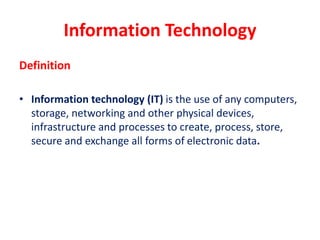
Information Technology
Definition
• Information technology (IT) is the use of any computers,
storage, networking and other physical devices,
infrastructure and processes to create, process, store,
secure and exchange all forms of electronic data.
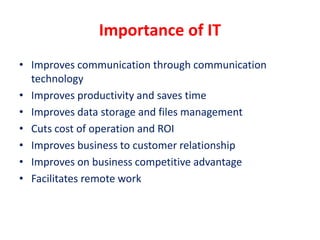
Importance of IT
• Improves communication through communication
technology
• Improves productivity and saves time
• Improves data storage and files management
• Cuts cost of operation and ROI
• Improves business to customer relationship
• Improves on business competitive advantage
• Facilitates remote work
• Facilitates work automation
• Data capture, processing, storage and output
• Consistency, reliability and accuracy of functions
• Helps in re-engineering of work practices
• Helps in stakeholders integration
• Helps to view changes in global business etc
Importance of IT (continued..)
Applications of IT
a) Entertainment
• Computer games
• Computer graphics and animation
• Music and its composition
• Video films
• Internet surfing
• Music/Video on Demand
• Television networks
• Social networking sites
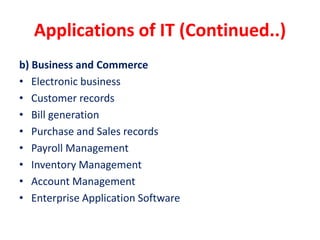
Applications of IT (Continued..)
b) Business and Commerce
• Electronic business
• Customer records
• Bill generation
• Purchase and Sales records
• Payroll Management
• Inventory Management
• Account Management
• Enterprise Application Software
Applications of IT (Continued..)
• Electronic Marketing
• Internet and Mobile Banking
• Audio/Video conferencing
• Electronic Data Interchange
• Business data analysis
• Resource sharing
• Information sharing
• Research and development
• Electronic Payment
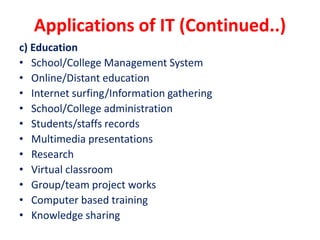
Applications of IT (Continued..)
c) Education
• School/College Management System
• Online/Distant education
• Internet surfing/Information gathering
• School/College administration
• Students/staffs records
• Multimedia presentations
• Research
• Virtual classroom
• Group/team project works
• Computer based training
• Knowledge sharing
Applications of IT (Continued..)
d) Medicine
• Hospital Information System
• Computer assisted therapy
• Data Analysis in Medicine
• Medical imaging (CT scan, MRI, ultrasound)
• ECG machines
• Blood analysis
• Vision Testing
• Telemedicine
Applications of IT (Continued..)
e) Science and Engineering
• Design of atomic weapons
• Computer aided design
• Rigorous mathematical calculations
• Scientific Research
• Artificial Intelligence
• Computer simulations
• Software tools for laboratory
Applications of IT (Continued..)
f) Government
• Online delivery of public services
• Better communication channel between government
sectors
• Smart driving license
• National Identification Card
• Design of government projects
• Regulations of traffic
• Criminal databases
Applications of IT (Continued..)
• Budgeting and capital planning
• Business to government commerce
• Citizen to government commerce
• Government to government commerce
• Research and development
• Monitoring and controlling
• Information sharing and dissemination

Information Technology and its Applications

  • 1.
    Information Technology and InformationTechnology Applications Mr. Roshan Bhattarai Kathmandu, Nepal
  • 2.
    Information Technology Definition • Informationtechnology (IT) is the use of any computers, storage, networking and other physical devices, infrastructure and processes to create, process, store, secure and exchange all forms of electronic data.
  • 3.
    Importance of IT •Improves communication through communication technology • Improves productivity and saves time • Improves data storage and files management • Cuts cost of operation and ROI • Improves business to customer relationship • Improves on business competitive advantage • Facilitates remote work
  • 4.
    • Facilitates workautomation • Data capture, processing, storage and output • Consistency, reliability and accuracy of functions • Helps in re-engineering of work practices • Helps in stakeholders integration • Helps to view changes in global business etc Importance of IT (continued..)
  • 5.
    Applications of IT a)Entertainment • Computer games • Computer graphics and animation • Music and its composition • Video films • Internet surfing • Music/Video on Demand • Television networks • Social networking sites
  • 6.
    Applications of IT(Continued..) b) Business and Commerce • Electronic business • Customer records • Bill generation • Purchase and Sales records • Payroll Management • Inventory Management • Account Management • Enterprise Application Software
  • 7.
    Applications of IT(Continued..) • Electronic Marketing • Internet and Mobile Banking • Audio/Video conferencing • Electronic Data Interchange • Business data analysis • Resource sharing • Information sharing • Research and development • Electronic Payment
  • 8.
    Applications of IT(Continued..) c) Education • School/College Management System • Online/Distant education • Internet surfing/Information gathering • School/College administration • Students/staffs records • Multimedia presentations • Research • Virtual classroom • Group/team project works • Computer based training • Knowledge sharing
  • 9.
    Applications of IT(Continued..) d) Medicine • Hospital Information System • Computer assisted therapy • Data Analysis in Medicine • Medical imaging (CT scan, MRI, ultrasound) • ECG machines • Blood analysis • Vision Testing • Telemedicine
  • 10.
    Applications of IT(Continued..) e) Science and Engineering • Design of atomic weapons • Computer aided design • Rigorous mathematical calculations • Scientific Research • Artificial Intelligence • Computer simulations • Software tools for laboratory
  • 11.
    Applications of IT(Continued..) f) Government • Online delivery of public services • Better communication channel between government sectors • Smart driving license • National Identification Card • Design of government projects • Regulations of traffic • Criminal databases
  • 12.
    Applications of IT(Continued..) • Budgeting and capital planning • Business to government commerce • Citizen to government commerce • Government to government commerce • Research and development • Monitoring and controlling • Information sharing and dissemination