INFORMATION Technology
• Collectionof meaningful data is called information.
• Technology has been defined as systematic knowledge and action usually industrial processes but
applicable to any recurrent activity.
• Macmillan Dictionary of Information Technology defines IT as "the acquisition, processing,
storage and dissemination of vocal, pictorial, textual and numerical information by a micro-
electronics-based combination of computing and telecommunications".
• UNESCO defines Information Technology as "scientific, technological and engineering
disciplines and the management techniques used in information handling and processing
information, their applications; computers and their interaction with man and machine and
associated social, economic and cultural matters".
3.
INFORMATION Technology
• Thisdefinition, while emphasizing the significant role of computers,
appears not to take into its purview the communication systems. It
may, however, be stated that communication systems are as essential to
information technology as computers. As a consequence, we have a
convergence of three strands of technologies: computers, micro-
electronics and communications.
4.
Objectives
• Automation andintegration: To improve efficiency, productivity, and how tools and platforms
work together
• Business processes and communication: To improve workflows and collaboration
• Data and information security: To provide access to and security of sensitive information
• Data center: To modernize data center facilities and adopt cloud strategies
• Infrastructure: To provide core infrastructure and operational elements for the organization,
including hardware and software
• Risk management: To identify threats and mitigate risks
• Self-service: To empower teams and individuals to complete tasks without reaching out to IT
• Software delivery: To improve release management processes, deployments, and quality
assurance (QA)
6.
Evolution and growthof IT
• Electronic computers, using either relays or valves, began to appear in the early 1940s.
• The electromechanical Zuse Z3, completed in 1941, was the world's first programmable computer, and by
modern standards one of the first machines that could be considered a complete computing machine.
• Colossus, developed during the Second World War to decrypt German messages was the
first electronic digital computer. Although it was programmable, it was not general-purpose, being designed
to perform only a single task.
• The development of transistors in the late 1940s at Bell Laboratories allowed a new generation of computers
to be designed with greatly reduced power consumption. The first commercially available stored-program
computer, the Ferranti Mark I, contained 4050 valves and had a power consumption of 25 kilowatts. By
comparison the first transistorized computer, developed at the University of Manchester and operational by
November 1953, consumed only 150 watts in its final version.
7.
Evolution and growthof IT
• Electronic computers, using either relays or valves, began to appear in the early 1940s.
• The electromechanical Zuse Z3, completed in 1941, was the world's first programmable computer, and by
modern standards one of the first machines that could be considered a complete computing machine.
• Colossus, developed during the Second World War to decrypt German messages was the
first electronic digital computer. Although it was programmable, it was not general-purpose, being designed
to perform only a single task.
• The development of transistors in the late 1940s at Bell Laboratories allowed a new generation of computers
to be designed with greatly reduced power consumption. The first commercially available stored-program
computer, the Ferranti Mark I, contained 4050 valves and had a power consumption of 25 kilowatts. By
comparison the first transistorized computer, developed at the University of Manchester and operational by
November 1953, consumed only 150 watts in its final version.
8.
Purpose of IT
•Develop, process, analyze, exchange, store, and secure
information.
• Manage computer systems to solve problems and handle
information.
• Build communication networks, safeguard data, create and
administer databases, and troubleshoot computer or mobile
device issues.
• Facilitate efficient data management, enhance communication
networks, and support organizational processes.
9.
Importance of IT
1.Enhancingconnectivity and financial inclusion.
2.Transforming societies and providing technical support for
customers and business operations.
3.Enabling decision-making through data-driven insights.
4.Supporting innovation and a perpetual-learning culture.
5.Expanding trust boundaries.
10.
Advantages/Applications of IT
1.Social Networking
This can be described as the most common and most important use of information
technology. IT has helped to bring the society together, ensuring that strong relationships
are formed and maintained. Social media sites, such as Facebook, are a good proof of this.
2. Management of Departments
When computers were invented, the business world underwent a tremendous
transformation. Computer software is now being used to ensure the smooth running of
different departments in organizations. These departments may include security, human
resources, among other departments.
11.
Advantages/Applications of IT
3.Ensuring Success in the Global Market
Software packages are used by businesses to get jobs done faster and easier. This way, businesses, and
industries gain a better and quick outlook of the global markets. Information technology is also used to
manage these software packages.
4. Online Businesses
The development of information technology has led to the growth of online businesses. More
customers are demanding faster access to their purchased items. Due to this, online business platforms
have been created to help in keeping up with the demand and supply. A good example of such a
platform is Amazon, which uses information technology to make online transactions with customers.
12.
Advantages/Applications of IT
5.Education System
Information technology has found applications in the modern-day education system. Online
classes are now being offered in almost every school. Students can access these classes from
anywhere, using laptops, smartphones, or even tablets. Information technology has indeed made
learning easier.
6. Online Bank Transactions
Information technology is used to ensure that online Internet transactions are kept safe and secure.
Security networks and programs are used to enhance the safety of these transactions. In the
absence of information technology, secure online bank transactions would be almost impossible.
13.
Advantages/Applications of IT
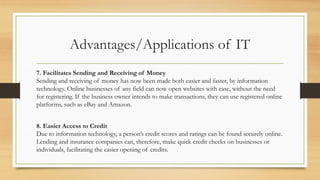
7.Facilitates Sending and Receiving of Money
Sending and receiving of money has now been made both easier and faster, by information
technology. Online businesses of any field can now open websites with ease, without the need
for registering. If the business owner intends to make transactions, they can use registered online
platforms, such as eBay and Amazon.
8. Easier Access to Credit
Due to information technology, a person’s credit scores and ratings can be found securely online.
Lending and insurance companies can, therefore, make quick credit checks on businesses or
individuals, facilitating the easier opening of credits.
14.
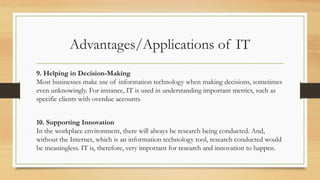
Advantages/Applications of IT
9.Helping in Decision-Making
Most businesses make use of information technology when making decisions, sometimes
even unknowingly. For instance, IT is used in understanding important metrics, such as
specific clients with overdue accounts.
10. Supporting Innovation
In the workplace environment, there will always be research being conducted. And,
without the Internet, which is an information technology tool, research conducted would
be meaningless. IT is, therefore, very important for research and innovation to happen.
15.
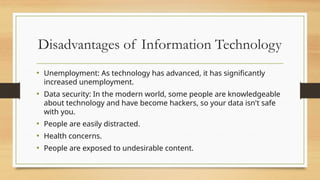
Disadvantages of InformationTechnology
• Unemployment: As technology has advanced, it has significantly
increased unemployment.
• Data security: In the modern world, some people are knowledgeable
about technology and have become hackers, so your data isn't safe
with you.
• People are easily distracted.
• Health concerns.
• People are exposed to undesirable content.
16.
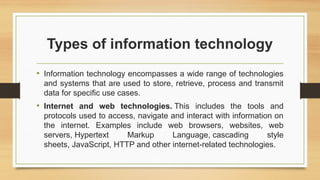
Types of informationtechnology
• Information technology encompasses a wide range of technologies
and systems that are used to store, retrieve, process and transmit
data for specific use cases.
• Internet and web technologies. This includes the tools and
protocols used to access, navigate and interact with information on
the internet. Examples include web browsers, websites, web
servers, Hypertext Markup Language, cascading style
sheets, JavaScript, HTTP and other internet-related technologies.
17.
Types of informationtechnology
• Cloud computing. This involves the delivery of computing
resources and services over the internet on a pay-per-use basis.
This can include infrastructure as a service, platform as a
service, software as a service and cloud storage options.
• Databases. This includes IT systems and software used to store,
organize and retrieve data. Examples include MySQL, NoSQL,
relational database management systems and MongoDB.
18.
Types of informationtechnology
• Cloud computing. This involves the delivery of computing
resources and services over the internet on a pay-per-use basis.
This can include infrastructure as a service, platform as a
service, software as a service and cloud storage options.
• Databases. This includes IT systems and software used to store,
organize and retrieve data. Examples include MySQL, NoSQL,
relational database management systems and MongoDB.
19.
Types of informationtechnology
• Artificial intelligence and machine learning. AI and ML-based IT technologies
use algorithms and statistical models to enable computers to perform tasks that
typically require human intelligence. Examples include speech recognition, image
recognition and natural language processing.
• Cybersecurity. This type of IT includes technologies and best practices designed
to protect IT systems, networks and data from unauthorized access, cyber attacks
and other security threats. Cybersecurity can be enforced through firewalls,
antivirus software, encryption, intrusion detection systems and security policies.
20.
Types of informationtechnology
• Internet of things. This includes the network of interconnected
devices and sensors that collect, exchange and analyze data. IoT
technologies enable the integration of physical objects into
computer systems, providing automation, monitoring and control in
various domains.
• IT governance. This involves making policies and rules for the
organization to ensure effective operation.
21.
Types of informationtechnology
• Data analytics and business intelligence. BI focuses on tools
and techniques for extracting insights from large data sets to
support decision-making and business operations. This can
include data mining, statistical analysis, data visualization
and predictive modeling.
22.
The Role ofInformation Technology in
E-commerce
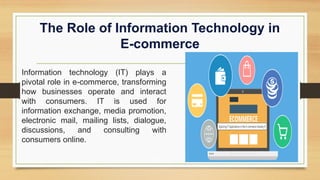
Information technology (IT) plays a
pivotal role in e-commerce, transforming
how businesses operate and interact
with consumers. IT is used for
information exchange, media promotion,
electronic mail, mailing lists, dialogue,
discussions, and consulting with
consumers online.
23.
The Role ofInformation Technology in
E-commerce
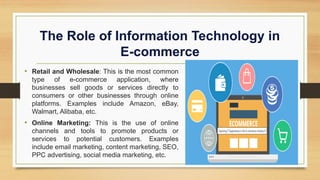
• Retail and Wholesale: This is the most common
type of e-commerce application, where
businesses sell goods or services directly to
consumers or other businesses through online
platforms. Examples include Amazon, eBay,
Walmart, Alibaba, etc.
• Online Marketing: This is the use of online
channels and tools to promote products or
services to potential customers. Examples
include email marketing, content marketing, SEO,
PPC advertising, social media marketing, etc.
24.
The Role ofInformation Technology in
E-commerce
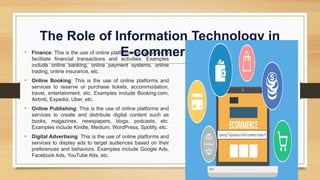
• Finance: This is the use of online platforms and services to
facilitate financial transactions and activities. Examples
include online banking, online payment systems, online
trading, online insurance, etc.
• Online Booking: This is the use of online platforms and
services to reserve or purchase tickets, accommodation,
travel, entertainment, etc. Examples include Booking.com,
Airbnb, Expedia, Uber, etc.
• Online Publishing: This is the use of online platforms and
services to create and distribute digital content such as
books, magazines, newspapers, blogs, podcasts, etc.
Examples include Kindle, Medium, WordPress, Spotify, etc.
• Digital Advertising: This is the use of online platforms and
services to display ads to target audiences based on their
preferences and behaviors. Examples include Google Ads,
Facebook Ads, YouTube Ads, etc.
25.
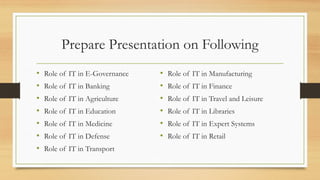
Prepare Presentation onFollowing
• Role of IT in E-Governance
• Role of IT in Banking
• Role of IT in Agriculture
• Role of IT in Education
• Role of IT in Medicine
• Role of IT in Defense
• Role of IT in Transport
• Role of IT in Manufacturing
• Role of IT in Finance
• Role of IT in Travel and Leisure
• Role of IT in Libraries
• Role of IT in Expert Systems
• Role of IT in Retail
26.
The Internet
• TheInternet is a global system of interconnected computer networks that use the
standard Internet Protocol Suite (TCP/IP) to serve billions of users worldwide. It
is a network of networks that consists of millions of private, public, academic,
business, and government networks, of local to global scope, that are linked by a
broad array of electronic, wireless and optical networking technologies.
• The Internet carries a vast range of information resources and services, such as
the inter-linked hypertext documents of the World Wide Web (WWW) and the
infrastructure to support electronic mail.



![IObit Malware Fighter Pro Crack with Crack Download [Latest]](https://cdn.slidesharecdn.com/ss_thumbnails/informationtechnology8-250601163842-6307cc68-thumbnail.jpg?width=640&height=640&fit=bounds)


