Exploring the Foundations and Evolution of IT in the Modern World
Information
Technology
Introduction
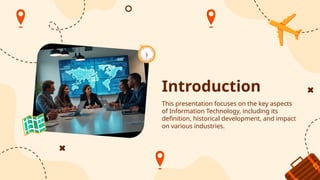
This presentation focuses on the key aspects
of Information Technology, including its
definition, historical development, and impact
on various industries.
Overview
01
Definition of
Information Technology
Information Technology (IT) encompasses the use
of computers, software, networks, and other
electronic devices to process, store, and transmit
data. It plays a crucial role in supporting business
operations, enhancing communication, and
driving efficiency.
Historical
Evolution
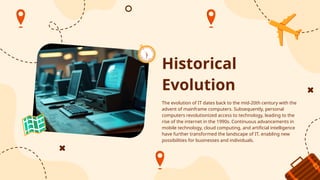
The evolution of IT dates back to the mid-20th century with the
advent of mainframe computers. Subsequently, personal
computers revolutionized access to technology, leading to the
rise of the internet in the 1990s. Continuous advancements in
mobile technology, cloud computing, and artificial intelligence
have further transformed the landscape of IT, enabling new
possibilities for businesses and individuals.
Current Trends
Current trends in Information Technology include the
increasing reliance on cloud computing, the growing
importance of cybersecurity, and the integration of
artificial intelligence and machine learning into
business processes. Additionally, the rise of remote
work has accelerated the demand for collaboration
tools and digital communication platforms.
Applications
02
Business
Integration
Information Technology facilitates seamless business
integration through tools such as Enterprise
Resource Planning (ERP) systems and Customer
Relationship Management (CRM) software. These
applications help organizations streamline processes,
enhance communication, and improve decision-
making by providing real-time data access.
Educational
Tools
In education, Information Technology enables the
creation of interactive learning environments
through platforms like Learning Management
Systems (LMS) and educational software. IT
supports personalized learning experiences,
increases accessibility to information, and fosters
collaboration among students and educators.
Healthcare
Innovations
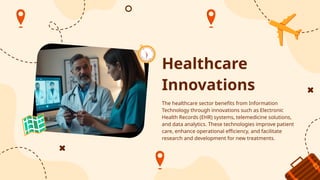
The healthcare sector benefits from Information
Technology through innovations such as Electronic
Health Records (EHR) systems, telemedicine solutions,
and data analytics. These technologies improve patient
care, enhance operational efficiency, and facilitate
research and development for new treatments.
Conclusions
In summary, Information Technology continues to
evolve, shaping various sectors by enhancing
processes and promoting innovation. Its
applications in business, education, and healthcare
demonstrate its vital role in driving efficiency and
improving outcomes.
Credits: This presentation template was created
by Slidesgo, and includes icons, infographics &
images by Freepik
Thank you!
Do you have any questions?