APPLICATIONS OF IT—ITeS
INDUSTRY
- B Y P R A T Y U S H S H R A W A N K A R
I X I N D R A Y A N I
INTRODUCTION
• Technological development has
revolutionized our everyday life to
a great extent.
• It has led to the emergence of a
new global economy.
• Technology has virtually
transformed the world into a global
village.
Q. WHAT IS INFORMATION
TECHNOLOGY ?
Information Technology (IT) is simply the use of
computers and other technology to store,
manage, and share information. Informational
Technology has changed everything over the
years. Nowadays, IT refers to the use of
Computers and other resources to create, store,
manage, and exchange all kinds information. It
is an essential and tightly integrated part of
every business today.
Q. WHAT ARE THE BENEFITS
OF IT IN BUSINESSES ?
IT has multiple benefits for a business, such as:
• Helps to reach more potential customers,
• Provides better service to customers.
• Allows customers to provide feedback to improve the business
• reduces costs and improves efficiency
• streamlines and recognizes operations
• maximizes profit and minimizes waste
• sustains better relations with key associates
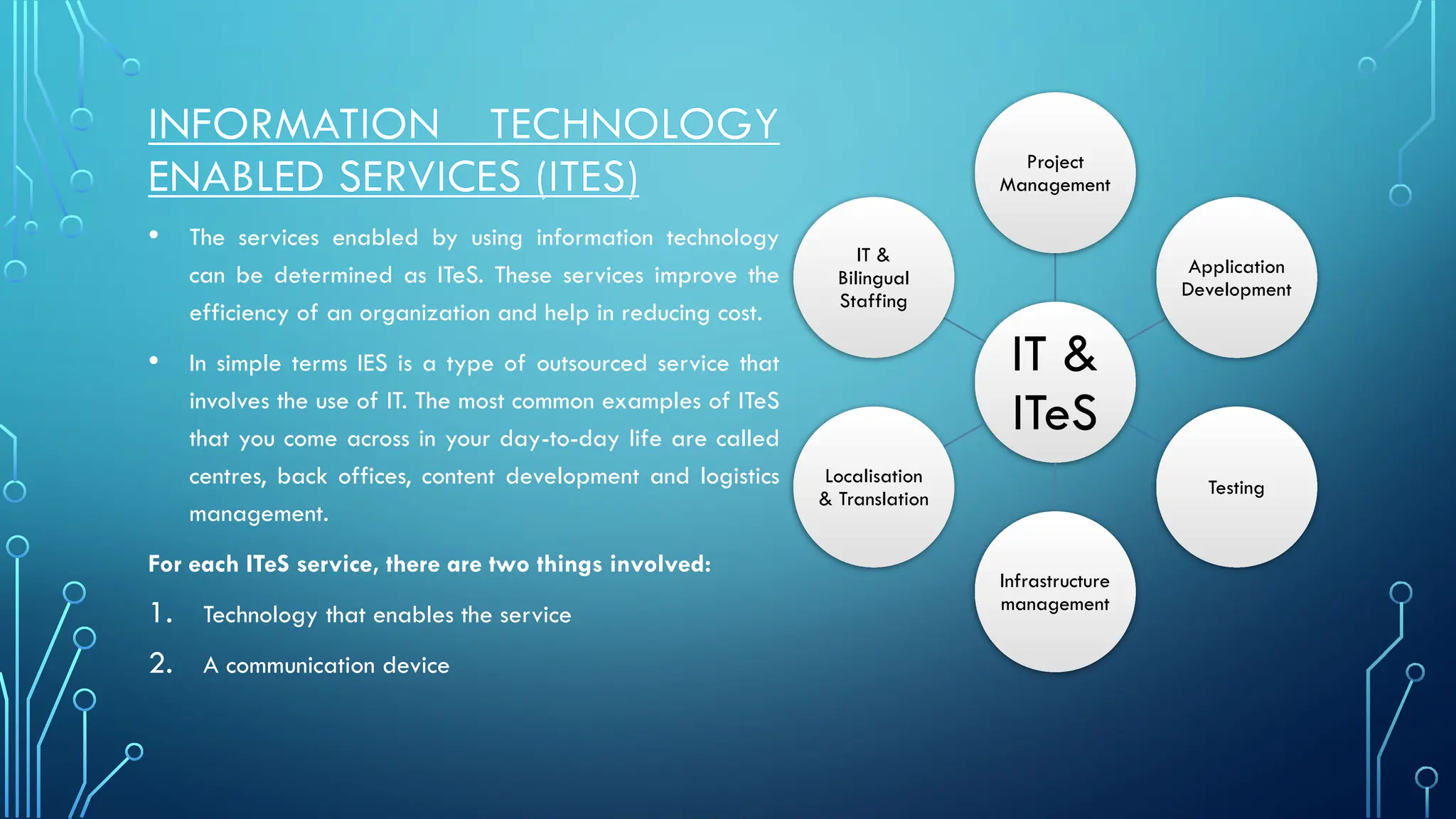
INFORMATION TECHNOLOGY
ENABLED SERVICES (ITES)
IT &
ITeS
Project
Management
Application
Development
Testing
Infrastructure
management
Localisation
& Translation
IT &
Bilingual
Staffing
• The services enabled by using information technology
can be determined as ITeS. These services improve the
efficiency of an organization and help in reducing cost.
• In simple terms IES is a type of outsourced service that
involves the use of IT. The most common examples of ITeS
that you come across in your day-to-day life are called
centres, back offices, content development and logistics
management.
For each ITeS service, there are two things involved:
1. Technology that enables the service
2. A communication device
Common
IT
enabled
Services
Call Centre
Business
Process
Outsourcing
(BPO)
Business
process
management
(BPM)
Modeling
Execution
Monitoring
Optimization
Design
Customer
Support
Call
Answering
Third Party
verification
Tele-
Marketing
IT Help
Desk
APPLICATIONS OF IT
Every aspect of our daily routine has altered
with the advent of IT. It helps to improve the
quality of our lives, by giving us easy access to
information as well as many products and
services. It has transformed the way we live, the
way we work, the way we conduct businesses,
and the way we communicate with each other.
Therefore, in this topic we will discuss further
about the different applications of IT.
1. ENHANCING LEARNING AND TEACHING:
• Educational resources: Information technology makes it
easy to access at academic information at any time. A
variety of teaching resources are available for teachers to
teach in a better way. This breaks the boundaries of
accessing information.
• Online learning: Before learning was limited to a physical
classroom. But nowadays, a student can access information
at any given time of the day. Information technology has
facilitated online education.
• Learning management system (LMS): A learning
management system is a software application or web-
based technology used to plan, implement, and access a
specific learning process.
2. ROLE OF IT AT WORKSPACE
• It facilitates innovation, creative expression, time
management, work efficiency, and effective
management at workspace.
• I'm an integral part of every workplace because
it provides cost effectiveness, enhanced
satisfaction, faster and simpler execution of
work, rapid responses, earn easier operational
procedures.
• Improves communication
• makes job easier
• increases productivity
• improves work efficiency
Some of
the
benefits of
IT at
offices
are:
3. IT IN HOME AND EVERYDAY LIFE
IT literacy has become a functional requirement to ease our lives. Some of the ways we
use it in our everyday lives are:
• Use of online services to pay bills.
• Reading online newspapers and stay updated.
• Watch entertainment programs on the Internet.
• Washing machine microwave oven and many
other products that we use.
• Playing offline & online games on the computer.
• Communication with our family and friends.
• E-commerce
• Booking tickets
• Helps in getting any information from the
Internet.
4. IT IN THE MODERN LIBRARY
• Digital Collections and Access: Libraries now offer e-books, databases,
and digital archives, allowing users to access resources.
• Automation and Management Systems: Integrated Library Systems (ILS)
and digital cataloging streamline operations like acquisitions, circulation,
and inventory.
• User Experience Enhancements: Self-service kiosks, online portals, and
mobile apps improve convenience and user interaction.
• Data and Analytics: IT enables libraries to track usage patterns and user
needs, supporting better decision-making and personalized services.
• Digital Literacy and Training: Libraries serve as centers for teaching
digital skills and offering tech support, especially for underserved
populations.
• Collaboration and Innovation: Tools like cloud computing, digital
collaboration platforms, and maker spaces foster innovation and
community engagement.
5. BOOSTING BUSINESS USING IT
IT facilitates e-commerce which includes marketing, product
browsing, shopping, and processing orders. Some IT tools that
are used to reach out to people across the world are:
• Blogging
• Computerised Presentations
• Customer Relation Management (CRM) systems
• E-mail
• Graphic Design software
• Websites
• Social Media
6. SECURED BANKING USING IT
• Encryption & Authentication: Protects data transmission and ensures only authorized
access.
• Two-Factor Authentication (2FA): Adds an extra layer of security for online
transactions.
• Real-Time Fraud Detection: AI and machine learning monitor suspicious activities
instantly.
• Blockchain Technology: Ensures transparency and reduces risk of tampering in
transactions.
• Secure Mobile Banking Apps: Provide encrypted, user-friendly access to financial
services.
• Regular Security Updates & Firewalls: Defend against evolving cyber threats.
• Biometric Verification: Enhances security using fingerprint, facial, or voice recognition.
• Insurance: with the help of a computer database, the insurance companies can keep
all the records up-to-date. Insurance policies can also be purchased online through the
respective company’s website.
7. IT FOR OUR SAKE
• Communication: IT has made communication faster and easier. Emails, messaging
apps, and video calls connect people instantly across the globe. Cloud tools help
teams work together in real time, and AI-powered translators bridge language
gaps.
• Social Media: Social media runs on IT. Platforms like Instagram and TikTok use
algorithms to deliver personalized content and connect billions. Users share stories
and ideas in real time, while data tools help brands understand and reach their
audiences.
• Entertainment: IT has transformed entertainment into a digital experience.
Streaming platforms offer on-demand movies and music, while gaming uses high-
tech graphics and VR. Smart devices make it easy to enjoy content anytime,
anywhere. IT makes entertainment more immersive and accessible.
• Arts: Artists now use IT to create and share their work digitally. Tools like Adobe
help make digital paintings, while 3D and animation are used in games and films.
NFTs and online galleries give artists new ways to showcase and sell their work.
8. A BETTER HEALTH WITH IT
· Electronic Health Records (EHRs): Enable accurate, accessible, and efficient
patient data management.
· Telemedicine: Provides remote consultations, reducing travel and improving
access to care.
· Health Information Systems: Support decision-making, resource management,
and performance tracking.
· Medical Imaging & Diagnostics: Advanced software aids in early detection and
diagnosis.
· Wearable Technology & Mobile Apps: Monitor vital signs, promote wellness,
and enable patient engagement.
· Data Analytics & AI: Improve diagnoses, predict outbreaks, and personalize
treatment plans.
· Cybersecurity: Protects sensitive patient data and ensures compliance with
regulations.
9. IT IN SCIENTIFIC RESEARCH
AND ENGINEERING
• Data Collection & Analysis: High-speed computing enables
handling of large datasets and complex simulations.
• Modeling & Simulation: IT tools simulate real-world phenomena
(e.g., climate models, stress testing in engineering).
• Collaboration Tools: Cloud platforms and digital workspaces
support global teamwork and knowledge sharing.
• Automation & Robotics: Enhance precision and efficiency in
experiments and manufacturing processes.
• AI & Machine Learning: Accelerate discovery, optimize designs,
and reveal patterns in vast research data.
• Access to Knowledge: Digital libraries, databases, and research
portals facilitate quick access to scientific literature.
10. IT WITH GOVERNMENT AND PUBLIC SERVICES
IT plays a transformative role in enhancing efficiency, transparency,
and accessibility in government and public services. Its integration
helps streamline operations, improve citizen engagement, and support
evidence-based decision-making.
Key Roles of IT in Government:
1.Digital Governance:
• E-Government platforms allow citizens to access services online
(e.g., tax filing, license renewal).
• Promotes transparency and reduces bureaucratic delays.
2.Data Management and Analytics:
• IT systems help in collecting, storing, and analyzing large
volumes of data.
S u m m a r y
Information Technology (IT) refers to the use of computers and tech to store, manage, and exchange data.
Information Technology Enabled Services (ITES) are outsourced services that rely on IT, such as call centers
and content development.
Applications of IT include:
• Education – Online learning, digital resources, and Learning Management Systems.
• Workplace – Boosts productivity, innovation, and efficiency.
• Home Life – Used in appliances, online communication, and entertainment.
• Libraries – Digital collections, automation, and user-friendly services.
• Business – E-commerce, CRM, and online marketing.
• Banking – Secure transactions with encryption, biometrics, and fraud detection.
• Communication & Entertainment – Instant messaging, social media, digital art, and streaming.
• Healthcare – Telemedicine, health records, wearables, and AI diagnostics.
• Research & Engineering – Data analysis, simulations, robotics, and global collaboration.
• Government – E-governance, public service delivery, and data management.
Thank you!!!

Applications of IT—ITeS industries.pptx

  • 1.
    APPLICATIONS OF IT—ITeS INDUSTRY -B Y P R A T Y U S H S H R A W A N K A R I X I N D R A Y A N I
  • 2.
    INTRODUCTION • Technological developmenthas revolutionized our everyday life to a great extent. • It has led to the emergence of a new global economy. • Technology has virtually transformed the world into a global village.
  • 3.
    Q. WHAT ISINFORMATION TECHNOLOGY ? Information Technology (IT) is simply the use of computers and other technology to store, manage, and share information. Informational Technology has changed everything over the years. Nowadays, IT refers to the use of Computers and other resources to create, store, manage, and exchange all kinds information. It is an essential and tightly integrated part of every business today.
  • 4.
    Q. WHAT ARETHE BENEFITS OF IT IN BUSINESSES ? IT has multiple benefits for a business, such as: • Helps to reach more potential customers, • Provides better service to customers. • Allows customers to provide feedback to improve the business • reduces costs and improves efficiency • streamlines and recognizes operations • maximizes profit and minimizes waste • sustains better relations with key associates
  • 5.
    INFORMATION TECHNOLOGY ENABLED SERVICES(ITES) IT & ITeS Project Management Application Development Testing Infrastructure management Localisation & Translation IT & Bilingual Staffing • The services enabled by using information technology can be determined as ITeS. These services improve the efficiency of an organization and help in reducing cost. • In simple terms IES is a type of outsourced service that involves the use of IT. The most common examples of ITeS that you come across in your day-to-day life are called centres, back offices, content development and logistics management. For each ITeS service, there are two things involved: 1. Technology that enables the service 2. A communication device
  • 6.
  • 7.
    APPLICATIONS OF IT Everyaspect of our daily routine has altered with the advent of IT. It helps to improve the quality of our lives, by giving us easy access to information as well as many products and services. It has transformed the way we live, the way we work, the way we conduct businesses, and the way we communicate with each other. Therefore, in this topic we will discuss further about the different applications of IT.
  • 8.
    1. ENHANCING LEARNINGAND TEACHING: • Educational resources: Information technology makes it easy to access at academic information at any time. A variety of teaching resources are available for teachers to teach in a better way. This breaks the boundaries of accessing information. • Online learning: Before learning was limited to a physical classroom. But nowadays, a student can access information at any given time of the day. Information technology has facilitated online education. • Learning management system (LMS): A learning management system is a software application or web- based technology used to plan, implement, and access a specific learning process.
  • 9.
    2. ROLE OFIT AT WORKSPACE • It facilitates innovation, creative expression, time management, work efficiency, and effective management at workspace. • I'm an integral part of every workplace because it provides cost effectiveness, enhanced satisfaction, faster and simpler execution of work, rapid responses, earn easier operational procedures. • Improves communication • makes job easier • increases productivity • improves work efficiency Some of the benefits of IT at offices are:
  • 10.
    3. IT INHOME AND EVERYDAY LIFE IT literacy has become a functional requirement to ease our lives. Some of the ways we use it in our everyday lives are: • Use of online services to pay bills. • Reading online newspapers and stay updated. • Watch entertainment programs on the Internet. • Washing machine microwave oven and many other products that we use. • Playing offline & online games on the computer. • Communication with our family and friends. • E-commerce • Booking tickets • Helps in getting any information from the Internet.
  • 11.
    4. IT INTHE MODERN LIBRARY • Digital Collections and Access: Libraries now offer e-books, databases, and digital archives, allowing users to access resources. • Automation and Management Systems: Integrated Library Systems (ILS) and digital cataloging streamline operations like acquisitions, circulation, and inventory. • User Experience Enhancements: Self-service kiosks, online portals, and mobile apps improve convenience and user interaction. • Data and Analytics: IT enables libraries to track usage patterns and user needs, supporting better decision-making and personalized services. • Digital Literacy and Training: Libraries serve as centers for teaching digital skills and offering tech support, especially for underserved populations. • Collaboration and Innovation: Tools like cloud computing, digital collaboration platforms, and maker spaces foster innovation and community engagement.
  • 12.
    5. BOOSTING BUSINESSUSING IT IT facilitates e-commerce which includes marketing, product browsing, shopping, and processing orders. Some IT tools that are used to reach out to people across the world are: • Blogging • Computerised Presentations • Customer Relation Management (CRM) systems • E-mail • Graphic Design software • Websites • Social Media
  • 13.
    6. SECURED BANKINGUSING IT • Encryption & Authentication: Protects data transmission and ensures only authorized access. • Two-Factor Authentication (2FA): Adds an extra layer of security for online transactions. • Real-Time Fraud Detection: AI and machine learning monitor suspicious activities instantly. • Blockchain Technology: Ensures transparency and reduces risk of tampering in transactions. • Secure Mobile Banking Apps: Provide encrypted, user-friendly access to financial services. • Regular Security Updates & Firewalls: Defend against evolving cyber threats. • Biometric Verification: Enhances security using fingerprint, facial, or voice recognition. • Insurance: with the help of a computer database, the insurance companies can keep all the records up-to-date. Insurance policies can also be purchased online through the respective company’s website.
  • 14.
    7. IT FOROUR SAKE • Communication: IT has made communication faster and easier. Emails, messaging apps, and video calls connect people instantly across the globe. Cloud tools help teams work together in real time, and AI-powered translators bridge language gaps. • Social Media: Social media runs on IT. Platforms like Instagram and TikTok use algorithms to deliver personalized content and connect billions. Users share stories and ideas in real time, while data tools help brands understand and reach their audiences. • Entertainment: IT has transformed entertainment into a digital experience. Streaming platforms offer on-demand movies and music, while gaming uses high- tech graphics and VR. Smart devices make it easy to enjoy content anytime, anywhere. IT makes entertainment more immersive and accessible. • Arts: Artists now use IT to create and share their work digitally. Tools like Adobe help make digital paintings, while 3D and animation are used in games and films. NFTs and online galleries give artists new ways to showcase and sell their work.
  • 15.
    8. A BETTERHEALTH WITH IT · Electronic Health Records (EHRs): Enable accurate, accessible, and efficient patient data management. · Telemedicine: Provides remote consultations, reducing travel and improving access to care. · Health Information Systems: Support decision-making, resource management, and performance tracking. · Medical Imaging & Diagnostics: Advanced software aids in early detection and diagnosis. · Wearable Technology & Mobile Apps: Monitor vital signs, promote wellness, and enable patient engagement. · Data Analytics & AI: Improve diagnoses, predict outbreaks, and personalize treatment plans. · Cybersecurity: Protects sensitive patient data and ensures compliance with regulations.
  • 16.
    9. IT INSCIENTIFIC RESEARCH AND ENGINEERING • Data Collection & Analysis: High-speed computing enables handling of large datasets and complex simulations. • Modeling & Simulation: IT tools simulate real-world phenomena (e.g., climate models, stress testing in engineering). • Collaboration Tools: Cloud platforms and digital workspaces support global teamwork and knowledge sharing. • Automation & Robotics: Enhance precision and efficiency in experiments and manufacturing processes. • AI & Machine Learning: Accelerate discovery, optimize designs, and reveal patterns in vast research data. • Access to Knowledge: Digital libraries, databases, and research portals facilitate quick access to scientific literature.
  • 17.
    10. IT WITHGOVERNMENT AND PUBLIC SERVICES IT plays a transformative role in enhancing efficiency, transparency, and accessibility in government and public services. Its integration helps streamline operations, improve citizen engagement, and support evidence-based decision-making. Key Roles of IT in Government: 1.Digital Governance: • E-Government platforms allow citizens to access services online (e.g., tax filing, license renewal). • Promotes transparency and reduces bureaucratic delays. 2.Data Management and Analytics: • IT systems help in collecting, storing, and analyzing large volumes of data.
  • 18.
    S u mm a r y Information Technology (IT) refers to the use of computers and tech to store, manage, and exchange data. Information Technology Enabled Services (ITES) are outsourced services that rely on IT, such as call centers and content development. Applications of IT include: • Education – Online learning, digital resources, and Learning Management Systems. • Workplace – Boosts productivity, innovation, and efficiency. • Home Life – Used in appliances, online communication, and entertainment. • Libraries – Digital collections, automation, and user-friendly services. • Business – E-commerce, CRM, and online marketing. • Banking – Secure transactions with encryption, biometrics, and fraud detection. • Communication & Entertainment – Instant messaging, social media, digital art, and streaming. • Healthcare – Telemedicine, health records, wearables, and AI diagnostics. • Research & Engineering – Data analysis, simulations, robotics, and global collaboration. • Government – E-governance, public service delivery, and data management.
  • 19.