Fundamentals of
Information Technology
(IT-162)
Meer Qaisar Javed
qaisar.javed@uog.edu.pk
Lecture # 02
Department of Information Technology, University of Gujrat
Information and Technology:
 Information (Latin: idea, conception)
 Knowledge communicated or received concerning a
particular fact or circumstance
 Quantity needed by a system to complete a task
 Technology (Greek: systematic treatment)
 The practical application of knowledge in a particular area
(ex: Engineering, science, etc..)
 The human process of applying resources to satisfy our
wants and needs to extend our capabilities
Information Technology:
 IT (information technology) is a term that
encompasses all forms of technology used to create,
store, exchange, and use information in its various
forms.
 It is a convenient term for including both telephony
and computer technology in the same word. It is the
technology that is driving what has often been called
“The Information Revolution."
Information Technology Cont…
 The term Information Technology Comprehensively
can be defined as:
 Use of Computing along with high speed telecommunication networks in
order to spread the information from a source to the remote destination
over the globe of world.
 IT discipline include:
 Computing
 Information Engineering
 Telecommunication
 Database Management
 Software Engineering
 Organizational Behavior
The Various Forms of
Information
 Images
 Sound
 Text
 Numbers
Business data, voice conversations, still
images, motion pictures, multimedia
presentations, and other forms, including
those not yet conceived.
Alphanumeric
Characters
Historical Perspective
Information and its uses have always been an integral
part of mankind
 Mankind initially utilized non-verbal communication methods
to convey information (gestures, etc.)
 The very first indication of information
communication/storage/retrieval is considered to be through
cave drawings
 Words and subsequently languages were later developed to
efficiently communicate with each other
 Information sharing across a wide audience was made
possible by the invention of the printing press in the early
1450’s by Johannes Gutenberg through the process of
printing and distributing manuscripts
 The printing press is widely thought of as the origin of mass
communication. It marked Western culture's first viable
method of disseminating ideas and information from a single
source to a large and far-ranging audience (Jones telecom & multimedia
encyclopedia)
 Some significant developments in IT include:

The telegraph by Samuel Morse in 1837

The telephone by Alexander Graham Bell in 1876

Black and white TV in the 1940’s

The Atanasoff-Berry Computer (ABC) between 1937-1942

The ENIAC (first electronic digital computer) during WW-II

The transistor by Bell lab scientists, replacing the vacuum tube in 1947

The integrated circuit by Jack Kilby in the late 1950’s

ARPANET in the 1960’s

The personal digital computer in the 1970’s

The world wide web in 1991
Historical Perspective Cont…
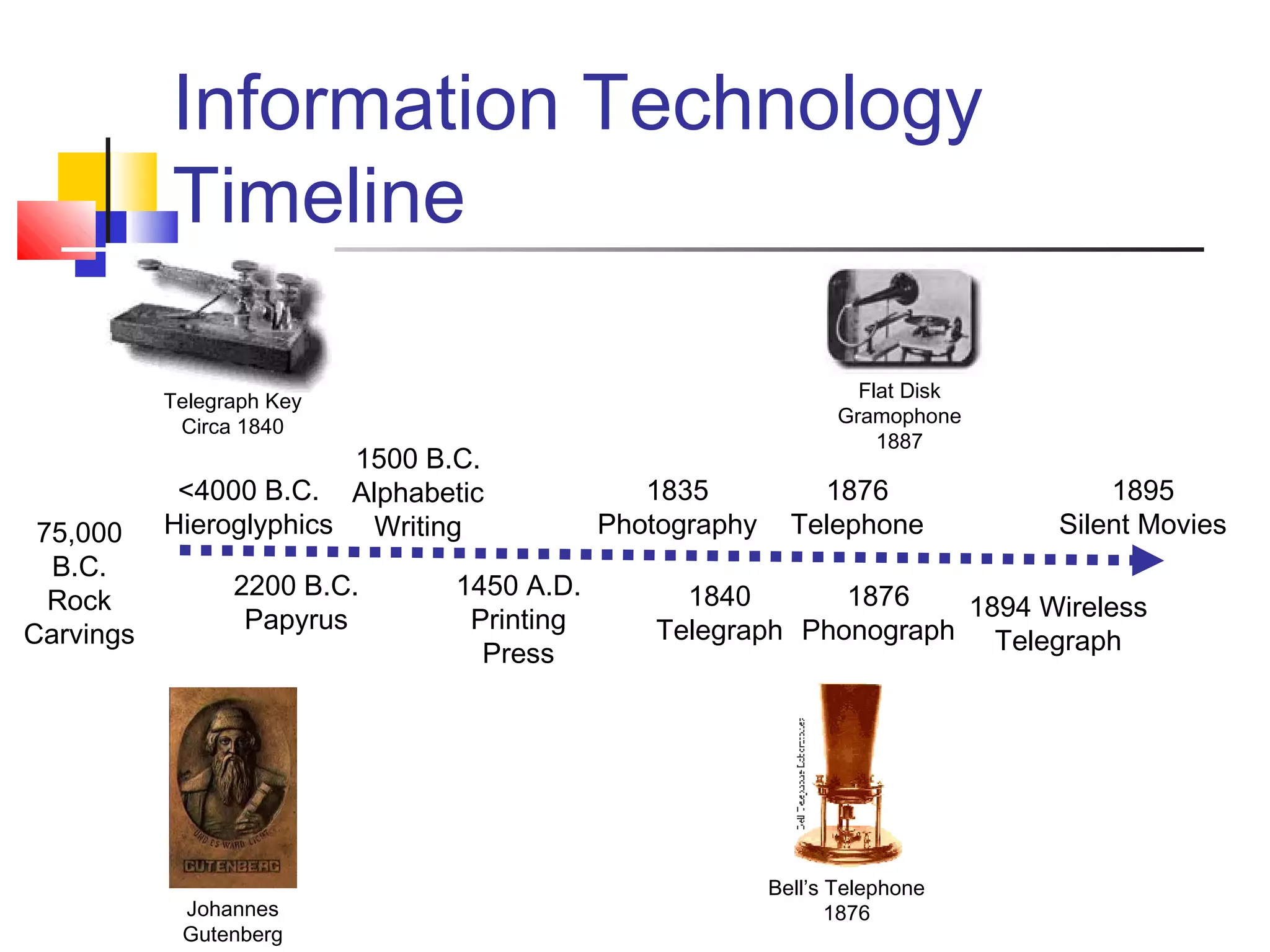
Information Technology
Timeline
Johannes
Gutenberg
Telegraph Key
Circa 1840
Bell’s Telephone
1876
Flat Disk
Gramophone
1887
75,000
B.C.
Rock
Carvings
<4000 B.C.
Hieroglyphics
2200 B.C.
Papyrus
1500 B.C.
Alphabetic
Writing
1450 A.D.
Printing
Press
1876
Telephone
1835
Photography
1895
Silent Movies
1894 Wireless
Telegraph
1840
Telegraph
1876
Phonograph
Information Technology
Timeline cont…
Sputnik
1957
Fiber Optics
1977
Apple Mac
1984
IBM PC
1981
1922 Radio
Broadcasts
1991
World Wide
Web
1965 Local
Cable TV
1973 Fax
Machines
1980s Cell
Phones
1970s
VCR
1947
Transistor 1983 CDs1977 Apple II
Home Computers
1990 Digital
Photography 1998 MP-3
(Compresse
d Sound
Files)
1940 Black
and White
TV 1942 ABC
The Information Age
 Day-to-Day Living – Online shopping, virtual education,
telecommuting, online banking and bill payment, online
course registration, airline reservations.
 Entertainment – Television, movies, radio, CDs, video
cameras, computer games, web surfing.
 Social Life – Web communities, instant messaging,
email, cell phones, personal communication devices.
 Economics – IT use in business and government has
causes significant productivity increases. The IT
industry itself has become a major economic sector.
Today, information technology touches every aspect of our lives.
Benefits of Information
Technology
 Increased productivity
 Information flow
 Access to information (ex: the Internet)
 Access to personnel
 Data entry
 Personal flexibility
 Virtual workplaces
 Recreation
 Gaming
Costs of Information
Technology
 Equipment expense
 Ex: personal computers and CPU’s
 Social costs
 Increased unemployment
 Job elimination
 Reduction in middle management
 Personal costs
Comments for next class
 Go over syllabus
 Go over today’s lecture notes
 Download and print lecture notes
 Obtain textbook
 Read chapters 1 and 3 from textbook

Basics of information technology

  • 1.
    Fundamentals of Information Technology (IT-162) MeerQaisar Javed qaisar.javed@uog.edu.pk Lecture # 02 Department of Information Technology, University of Gujrat
  • 2.
    Information and Technology: Information (Latin: idea, conception)  Knowledge communicated or received concerning a particular fact or circumstance  Quantity needed by a system to complete a task  Technology (Greek: systematic treatment)  The practical application of knowledge in a particular area (ex: Engineering, science, etc..)  The human process of applying resources to satisfy our wants and needs to extend our capabilities
  • 3.
    Information Technology:  IT(information technology) is a term that encompasses all forms of technology used to create, store, exchange, and use information in its various forms.  It is a convenient term for including both telephony and computer technology in the same word. It is the technology that is driving what has often been called “The Information Revolution."
  • 4.
    Information Technology Cont… The term Information Technology Comprehensively can be defined as:  Use of Computing along with high speed telecommunication networks in order to spread the information from a source to the remote destination over the globe of world.  IT discipline include:  Computing  Information Engineering  Telecommunication  Database Management  Software Engineering  Organizational Behavior
  • 5.
    The Various Formsof Information  Images  Sound  Text  Numbers Business data, voice conversations, still images, motion pictures, multimedia presentations, and other forms, including those not yet conceived. Alphanumeric Characters
  • 6.
    Historical Perspective Information andits uses have always been an integral part of mankind  Mankind initially utilized non-verbal communication methods to convey information (gestures, etc.)  The very first indication of information communication/storage/retrieval is considered to be through cave drawings  Words and subsequently languages were later developed to efficiently communicate with each other  Information sharing across a wide audience was made possible by the invention of the printing press in the early 1450’s by Johannes Gutenberg through the process of printing and distributing manuscripts
  • 7.
     The printingpress is widely thought of as the origin of mass communication. It marked Western culture's first viable method of disseminating ideas and information from a single source to a large and far-ranging audience (Jones telecom & multimedia encyclopedia)  Some significant developments in IT include:  The telegraph by Samuel Morse in 1837  The telephone by Alexander Graham Bell in 1876  Black and white TV in the 1940’s  The Atanasoff-Berry Computer (ABC) between 1937-1942  The ENIAC (first electronic digital computer) during WW-II  The transistor by Bell lab scientists, replacing the vacuum tube in 1947  The integrated circuit by Jack Kilby in the late 1950’s  ARPANET in the 1960’s  The personal digital computer in the 1970’s  The world wide web in 1991 Historical Perspective Cont…
  • 8.
    Information Technology Timeline Johannes Gutenberg Telegraph Key Circa1840 Bell’s Telephone 1876 Flat Disk Gramophone 1887 75,000 B.C. Rock Carvings <4000 B.C. Hieroglyphics 2200 B.C. Papyrus 1500 B.C. Alphabetic Writing 1450 A.D. Printing Press 1876 Telephone 1835 Photography 1895 Silent Movies 1894 Wireless Telegraph 1840 Telegraph 1876 Phonograph
  • 9.
    Information Technology Timeline cont… Sputnik 1957 FiberOptics 1977 Apple Mac 1984 IBM PC 1981 1922 Radio Broadcasts 1991 World Wide Web 1965 Local Cable TV 1973 Fax Machines 1980s Cell Phones 1970s VCR 1947 Transistor 1983 CDs1977 Apple II Home Computers 1990 Digital Photography 1998 MP-3 (Compresse d Sound Files) 1940 Black and White TV 1942 ABC
  • 10.
    The Information Age Day-to-Day Living – Online shopping, virtual education, telecommuting, online banking and bill payment, online course registration, airline reservations.  Entertainment – Television, movies, radio, CDs, video cameras, computer games, web surfing.  Social Life – Web communities, instant messaging, email, cell phones, personal communication devices.  Economics – IT use in business and government has causes significant productivity increases. The IT industry itself has become a major economic sector. Today, information technology touches every aspect of our lives.
  • 11.
    Benefits of Information Technology Increased productivity  Information flow  Access to information (ex: the Internet)  Access to personnel  Data entry  Personal flexibility  Virtual workplaces  Recreation  Gaming
  • 12.
    Costs of Information Technology Equipment expense  Ex: personal computers and CPU’s  Social costs  Increased unemployment  Job elimination  Reduction in middle management  Personal costs
  • 13.
    Comments for nextclass  Go over syllabus  Go over today’s lecture notes  Download and print lecture notes  Obtain textbook  Read chapters 1 and 3 from textbook

Editor's Notes

  • #4 Sound, images, text, numbers (alphanumeric)