Applications of Information and Communication Technologies
Lecture #2
Introduction to Information and
Communication Technologies (ICT)
Applications of Information and Communication Technologies
• Information technology is the technology that uses computing with high
speed communication links to spread information from one place to
another.
• Information Technology (IT) is the use, development, and management of
computer systems, software, and networks to process and distribute data.
• Computer is a very important component of information technology.
• The world has become “global village” due to advancement in IT.
• IT professionals work in various industries, helping organizations
leverage technology to improve efficiency, solve problems, and make
informed decisions.
Information Technology
Applications of Information and Communication Technologies
• It refers to the tools and systems used to transmit, receive, and process
information between individuals or devices. It encompasses various
technologies that enable communication over distances, facilitating the
exchange of data, voice, video, and other forms of information.
• Enables people to stay connected across the globe, facilitating both
personal and professional interactions.
• Enhances productivity by streamlining communication processes and
enabling real-time data exchange.
• Provides access to vast amounts of information and resources,
supporting education, business, and decision-making.
Communication Technology
Applications of Information and Communication Technologies
• Information and Communication Technologies can be broadly defined
as the means of storage, management and dissemination of
information by electronic means.
• ICT is the technology required for information processing, in
particular, the use of electronic computers, communication devices
and software applications to convert, store, protect, process, transmit
and retrieve information from anywhere, anytime.
• Those technologies that enable the handling of information and
facilitate different forms of communication.
Information and Communication Technology
(ICT)
Applications of Information and Communication Technologies
INFORMATION
• Information refers to the knowledge obtained from reading, investigation,
study or research.
• The tools to transmit information are the telephone, television and radio.
• Information is knowledge and helps us to fulfill our daily tasks.
• For example, scientists can detect the formation of a tsunami using the
latest technology and warn the public to avoid disasters in the affected
areas.
(Scientists gather data about the ocean, like changes in sea level or seismic
activity. This information helps them identify the early signs of a tsunami.)
Introduction to ICT
Applications of Information and Communication Technologies
COMMUNICATION
• Communication is an act of transmitting messages. It is a process whereby
information is exchanged between individuals using symbols, signs or verbal
interactions.
• With the advent of technology, these ‘older’ forms of communication are less
utilized as compared to the use of the Internet, e-mail or video conferencing.
TECHNOLOGY
• Technology is the use of scientific knowledge, experience and resources to
create processes and products that fulfill human needs. Technology is vital in
communication.
Introduction to ICT
Applications of Information and Communication Technologies
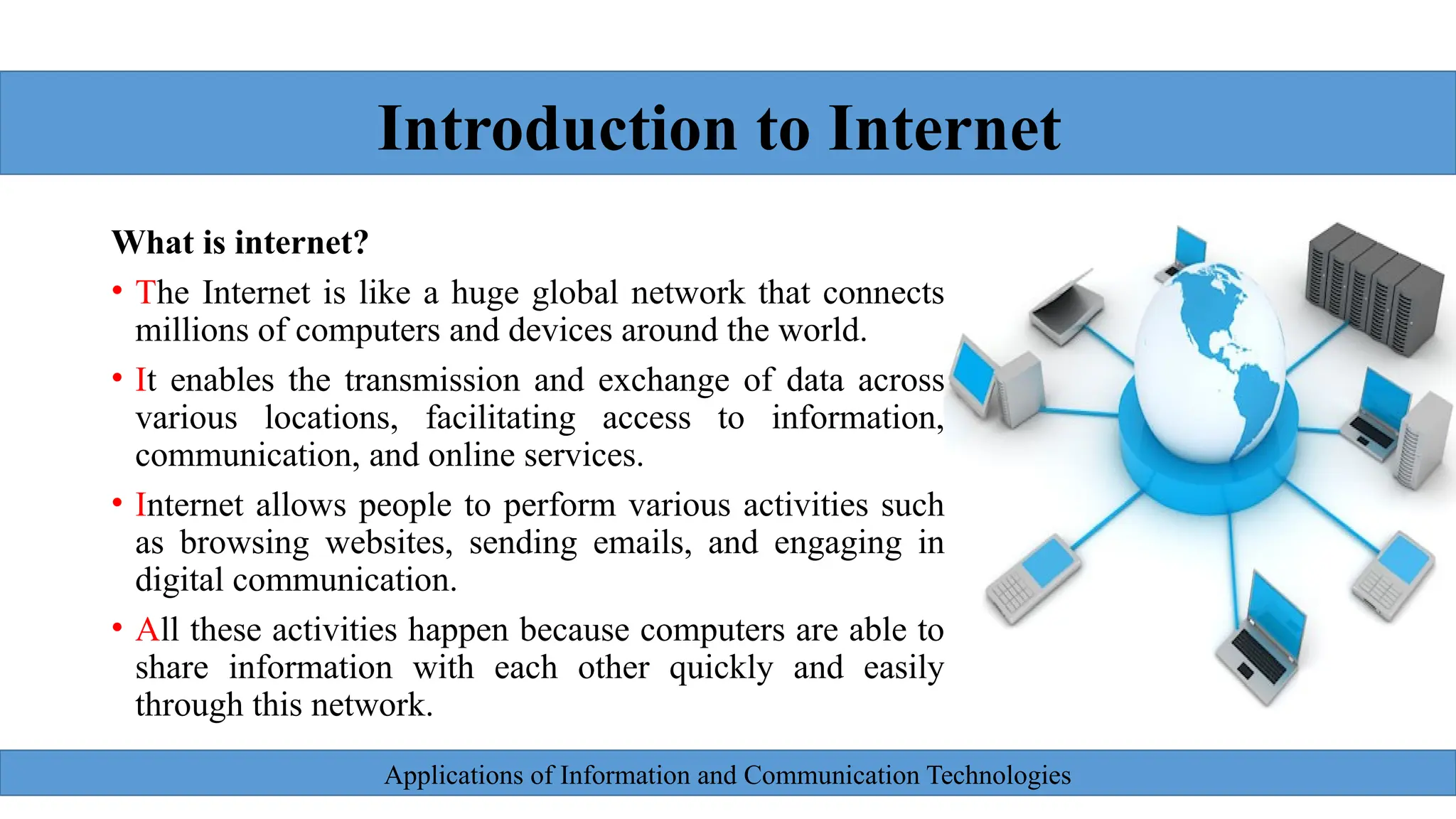
What is internet?
• The Internet is like a huge global network that connects
millions of computers and devices around the world.
• It enables the transmission and exchange of data across
various locations, facilitating access to information,
communication, and online services.
• Internet allows people to perform various activities such
as browsing websites, sending emails, and engaging in
digital communication.
• All these activities happen because computers are able to
share information with each other quickly and easily
through this network.
Introduction to Internet
Applications of Information and Communication Technologies
The components of Information and Communication Technologies (ICT)
encompass(surround) a wide range of hardware, software, and networking elements
that work together to manage and facilitate the storage, processing, and
communication of information.
1. Hardware components:
• Computers:
Desktops and Laptops: Primary devices used for processing data, running applications, and
accessing the internet.
Servers: Powerful computers that manage network resources, host applications, and store large
amounts of data.
• Storage Devices:
Hard Drives (HDDs) and Solid-State Drives (SSDs): Devices used to store data permanently.
Components of ICT
Applications of Information and Communication Technologies
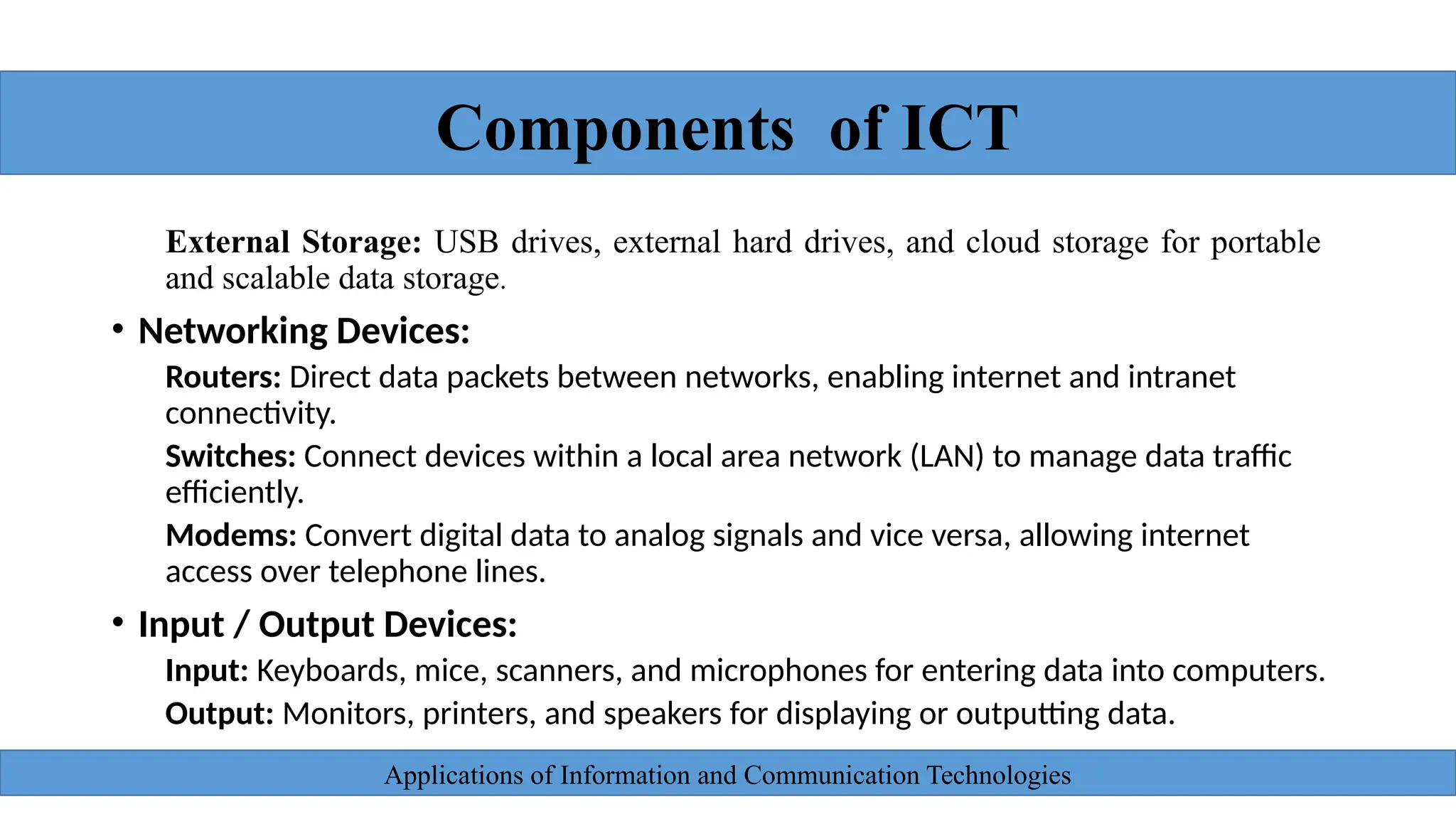
External Storage: USB drives, external hard drives, and cloud storage for portable
and scalable data storage.
• Networking Devices:
Routers: Direct data packets between networks, enabling internet and intranet
connectivity.
Switches: Connect devices within a local area network (LAN) to manage data traffic
efficiently.
Modems: Convert digital data to analog signals and vice versa, allowing internet
access over telephone lines.
• Input / Output Devices:
Input: Keyboards, mice, scanners, and microphones for entering data into computers.
Output: Monitors, printers, and speakers for displaying or outputting data.
Components of ICT
Applications of Information and Communication Technologies
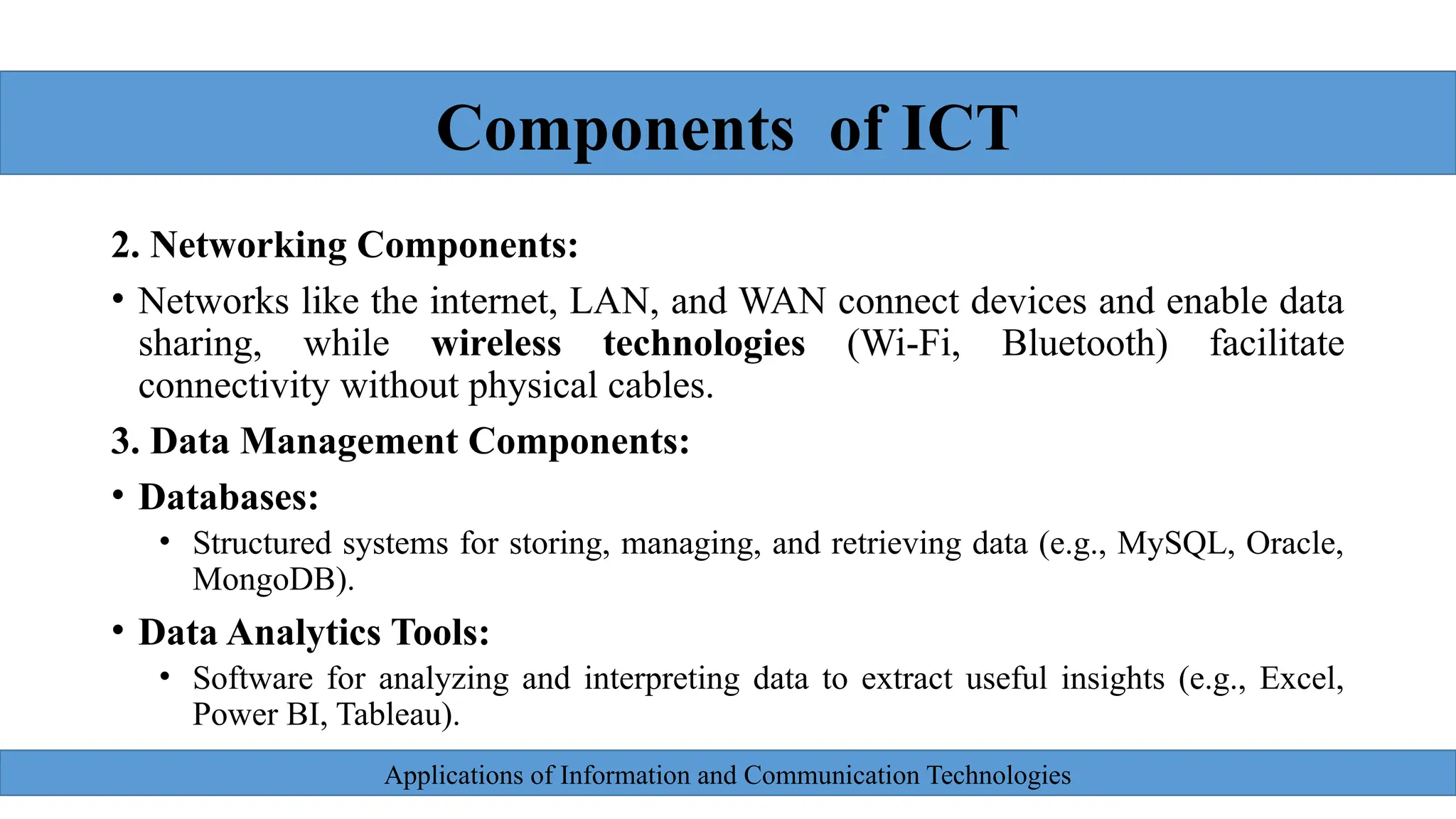
2. Networking Components:
• Networks like the internet, LAN, and WAN connect devices and enable data
sharing, while wireless technologies (Wi-Fi, Bluetooth) facilitate
connectivity without physical cables.
3. Data Management Components:
• Databases:
• Structured systems for storing, managing, and retrieving data (e.g., MySQL, Oracle,
MongoDB).
• Data Analytics Tools:
• Software for analyzing and interpreting data to extract useful insights (e.g., Excel,
Power BI, Tableau).
Components of ICT
Applications of Information and Communication Technologies
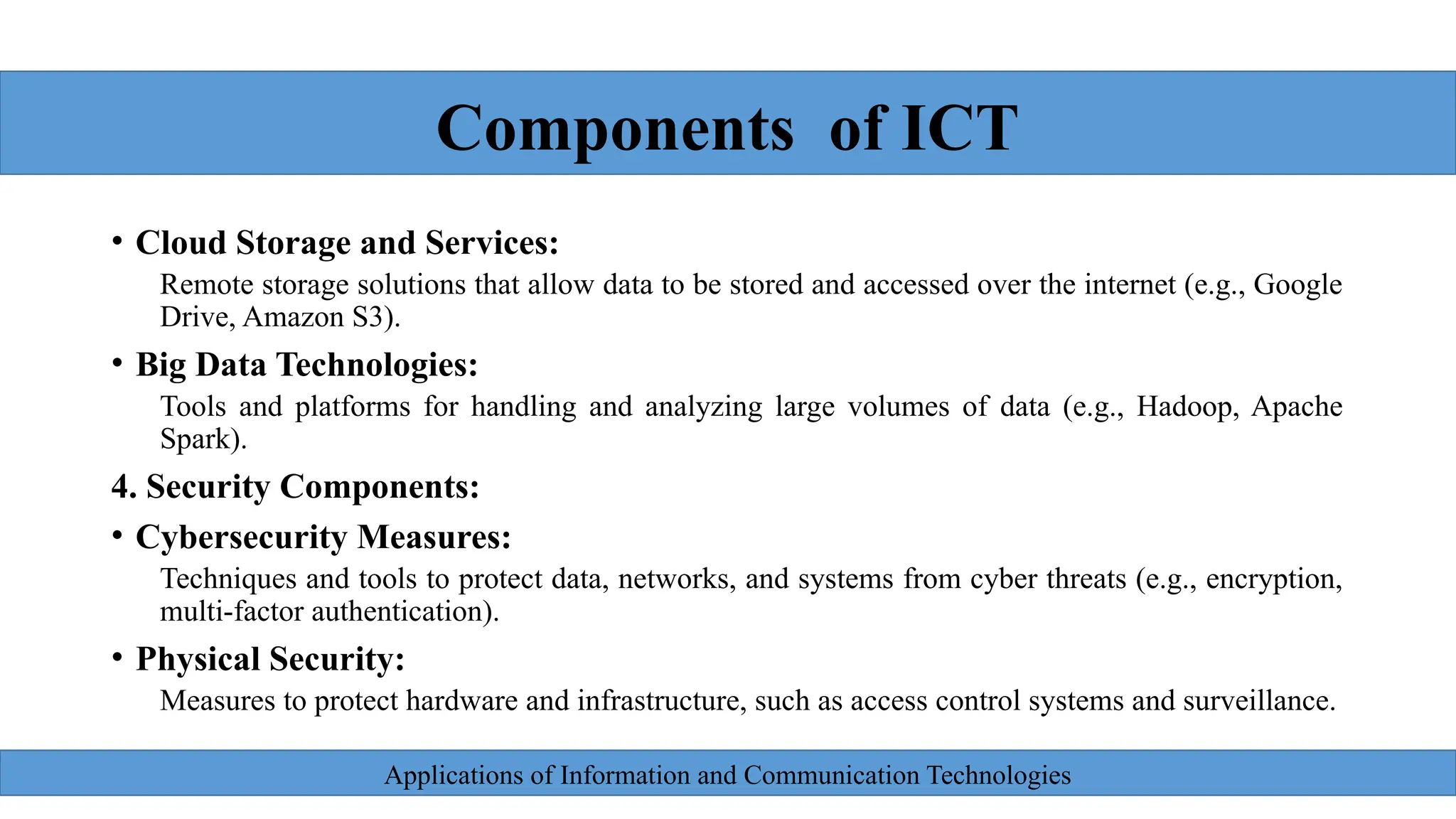
• Cloud Storage and Services:
Remote storage solutions that allow data to be stored and accessed over the internet (e.g., Google
Drive, Amazon S3).
• Big Data Technologies:
Tools and platforms for handling and analyzing large volumes of data (e.g., Hadoop, Apache
Spark).
4. Security Components:
• Cybersecurity Measures:
Techniques and tools to protect data, networks, and systems from cyber threats (e.g., encryption,
multi-factor authentication).
• Physical Security:
Measures to protect hardware and infrastructure, such as access control systems and surveillance.
Components of ICT
Applications of Information and Communication Technologies
2
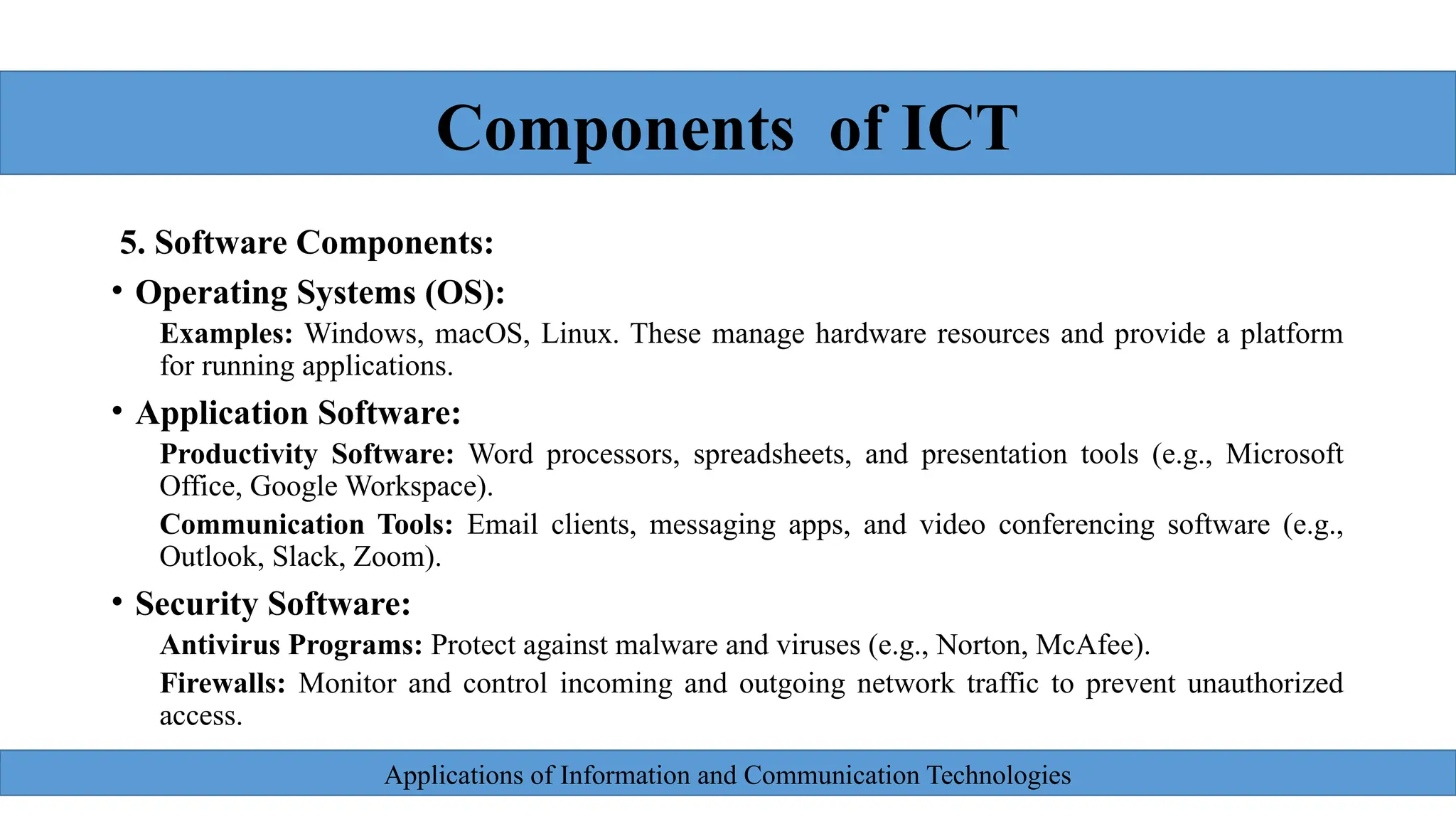
5. Software Components:
• Operating Systems (OS):
Examples: Windows, macOS, Linux. These manage hardware resources and provide a platform
for running applications.
• Application Software:
Productivity Software: Word processors, spreadsheets, and presentation tools (e.g., Microsoft
Office, Google Workspace).
Communication Tools: Email clients, messaging apps, and video conferencing software (e.g.,
Outlook, Slack, Zoom).
• Security Software:
Antivirus Programs: Protect against malware and viruses (e.g., Norton, McAfee).
Firewalls: Monitor and control incoming and outgoing network traffic to prevent unauthorized
access.
Components of ICT
Applications of Information and Communication Technologies
bg
6. Communication Technologies:
• Email:
Systems for sending and receiving electronic messages (e.g., Gmail, Outlook).
• Instant Messaging:
Real-time text communication tools (e.g., WhatsApp, Microsoft Teams).
• Video Conferencing:
Tools for virtual meetings and video calls (e.g., Zoom, Skype).
• Telephony:
Traditional landline and VoIP (Voice over Internet Protocol) systems for voice communication.
• Social Media Platforms:
Online platforms for social networking and content sharing (e.g., Facebook, Twitter, LinkedIn).
Components of ICT
Applications of Information and Communication Technologies
7. Human Resources:
• IT Professionals:
Individuals who manage and support ICT systems, including network
administrators, software developers, and data analysts.
• End Users:
People who interact with ICT systems to perform their work, access
information, and communicate.
Components of ICT
Applications of Information and Communication Technologies
• Business: Manages data, communication, and financial operations to
enhance productivity and efficiency.
• Education: Facilitates online learning, research, and administrative
tasks in educational institutions.
• Healthcare: Manages medical records, supports diagnostics, and
enables telemedicine services.
• Finance: Processes transactions, manages accounts, and assists in
trading and risk analysis.
• Government: Handles public services, cybersecurity, and data analysis
for effective administration.
Scope of ICT
Applications of Information and Communication Technologies
• Entertainment: Powers video games, media production, and streaming
services for leisure and creativity.
• Science and Research: Assists in simulations, data analysis, and
engineering design for scientific advancements.
• Manufacturing: Automates production, supports design through CAD,
and manages inventory.
• Transportation: Provides navigation, traffic management, and logistics
optimization for efficient travel and shipping.
• Telecommunications: Manages communication networks and customer
service through computer systems.
Scope of ICT
Applications of Information and Communication Technologies
.
Economic Impact:
• Increased Productivity: ICT tools automate processes, reduce manual
labor, and improve efficiency, leading to higher productivity in businesses.
• Job Creation: The ICT sector has created new job opportunities in fields
like software development, IT support, cybersecurity, and data analysis.
• Globalization: ICT enables businesses to operate and compete on a global
scale, facilitating international trade and collaboration.
• E-commerce: ICT has transformed retail with online shopping platforms,
allowing businesses to reach more customers and consumers to shop
conveniently.
Impact of ICT
Applications of Information and Communication Technologies
Social Impact:
• Communication: ICT has revolutionized the way people communicate,
enabling instant messaging, video calls, and social media, which help maintain
personal and professional relationships across distances.
• Access to Information: The internet and ICT devices provide vast amounts of
information at our fingertips, improving education, awareness, and informed
decision-making.
• Social Networking: Social media platforms have created new ways for people
to connect, share ideas, and collaborate on projects.
• Digital Inclusion: ICT initiatives aim to bridge the digital divide, ensuring that
disadvantaged groups have access to technology and the internet.
Impact of ICT
Applications of Information and Communication Technologies
Educational Impact:
• E-learning: ICT has enabled online education, making learning
accessible to people anywhere, anytime, and allowing for personalized
learning experiences.
• Educational Resources: Students and educators have access to a wide
range of digital resources, such as e-books, tutorials, and online
courses.
• Collaboration Tools: ICT tools facilitate collaboration between
students and teachers, both within and across institutions, enhancing
the learning experience.
Impact of ICT
Applications of Information and Communication Technologies
Healthcare Impact:
• Telemedicine: ICT enables remote consultations, diagnostics, and
monitoring, improving access to healthcare, especially in rural or
underserved areas.
• Electronic Health Records (EHR): Digital records improve the
efficiency and accuracy of patient care by providing healthcare
providers with instant access to patient information.
• Health Information Systems: ICT systems help manage healthcare
data, track diseases, and support public health initiatives.
Impact of ICT
Applications of Information and Communication Technologies
Government and Public Services:
• E-Governance: ICT improves government services through online
portals, enabling citizens to access services like tax filing, license
renewals, and voting more efficiently.
• Transparency: ICT tools promote transparency and accountability in
governance by providing public access to information and facilitating
communication between government and citizens.
• Disaster Management: ICT plays a critical role in disaster prediction,
management, and communication, helping to mitigate the impact of
natural disasters.
Impact of ICT
Applications of Information and Communication Technologies
Environmental Impact:
• Smart Technologies: ICT enables the development of smart grids,
smart cities, and efficient energy management systems that reduce
environmental impact.
• Remote Work: ICT has facilitated the rise of remote work, reducing
the need for commuting and lowering carbon emissions.
• Resource Management: ICT tools help monitor and manage natural
resources more effectively, contributing to environmental conservation
efforts.
Impact of ICT
Applications of Information and Communication Technologies
Artificial Intelligence (AI) and Machine Learning (ML):
• AI Integration: AI is being integrated into various applications, from
customer service to predictive analytics, enhancing automation and
decision-making.
• Machine Learning: ML models are improving in accuracy and
efficiency, enabling better data analysis, personalization, and real-time
decision-making.
• AI Ethics and Governance: As AI becomes more prevalent, there is a
growing focus on ethical AI, transparency, and regulation.
Emerging technologies and future trends in ICT
Applications of Information and Communication Technologies
5G and Next-Generation Networks:
• 5G Deployment: The rollout of 5G networks offers significantly
faster data speeds, lower latency, and improved connectivity, enabling
new applications in IoT, autonomous vehicles, and smart cities.
• Edge Computing: 5G enables edge computing, where data processing
occurs closer to the data source, reducing latency and improving real-
time processing.
Emerging technologies and future trends in ICT
Applications of Information and Communication Technologies
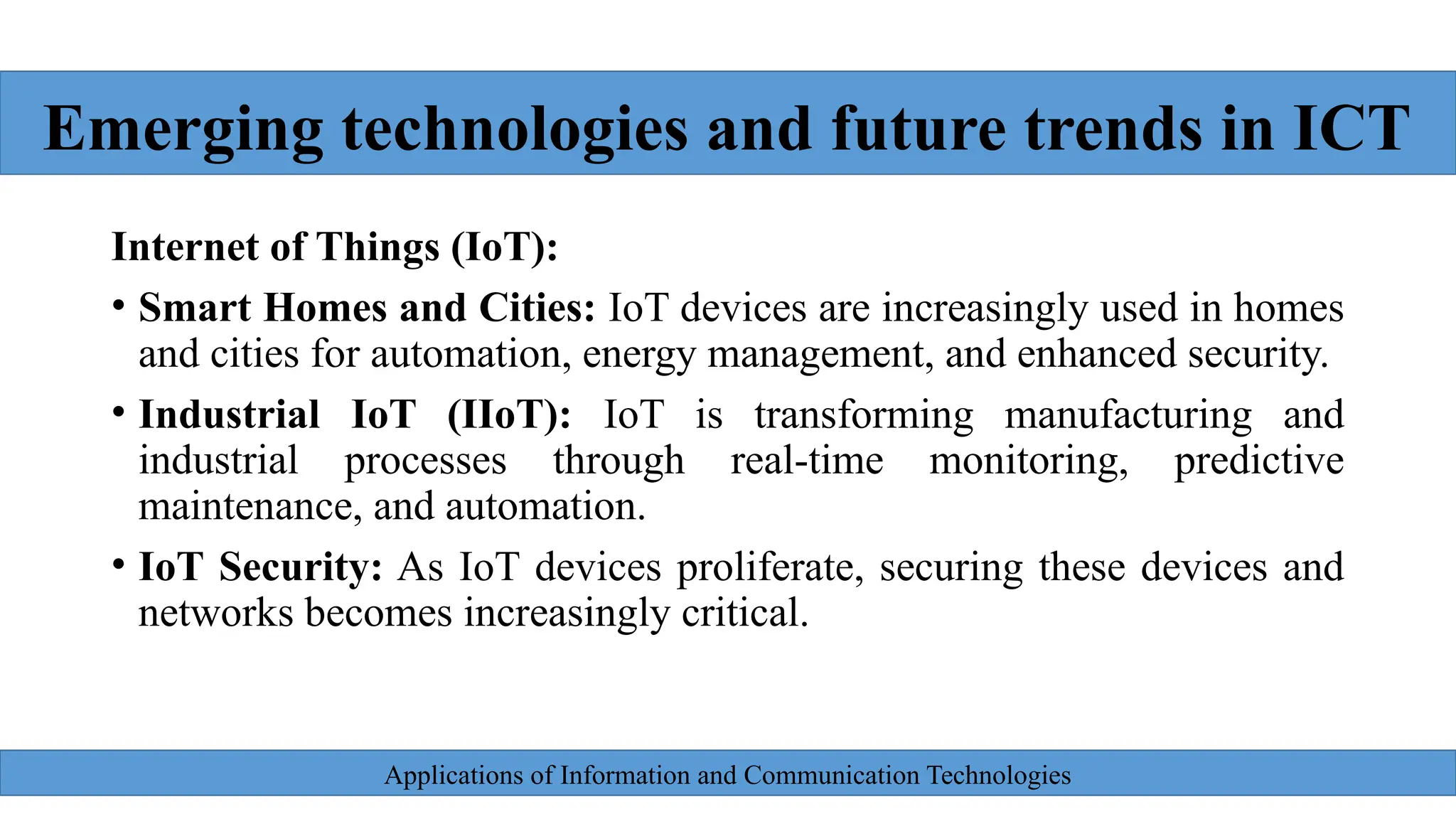
Internet of Things (IoT):
• Smart Homes and Cities: IoT devices are increasingly used in homes
and cities for automation, energy management, and enhanced security.
• Industrial IoT (IIoT): IoT is transforming manufacturing and
industrial processes through real-time monitoring, predictive
maintenance, and automation.
• IoT Security: As IoT devices proliferate, securing these devices and
networks becomes increasingly critical.
Emerging technologies and future trends in ICT
Applications of Information and Communication Technologies
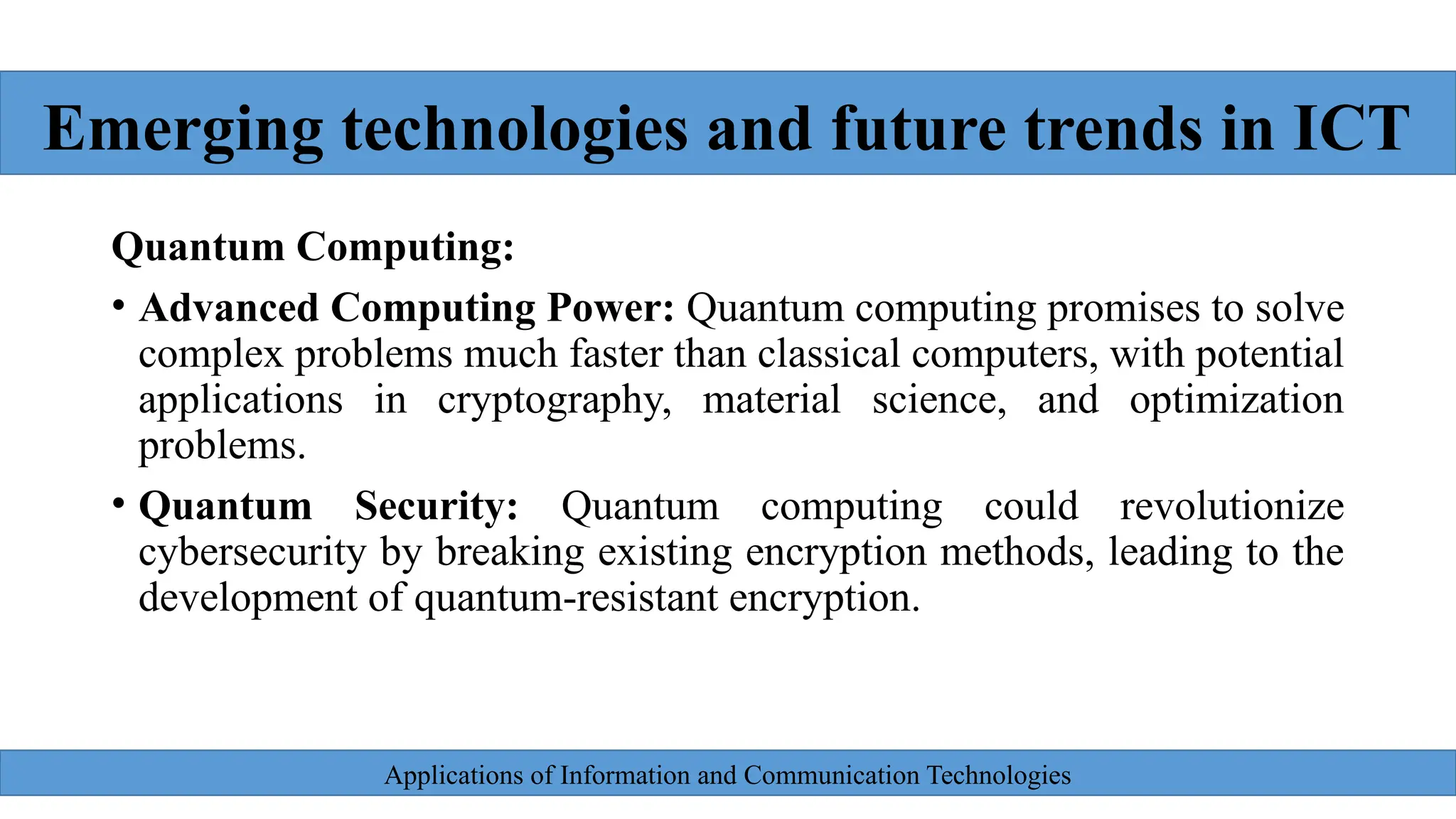
Quantum Computing:
• Advanced Computing Power: Quantum computing promises to solve
complex problems much faster than classical computers, with potential
applications in cryptography, material science, and optimization
problems.
• Quantum Security: Quantum computing could revolutionize
cybersecurity by breaking existing encryption methods, leading to the
development of quantum-resistant encryption.
Emerging technologies and future trends in ICT
Applications of Information and Communication Technologies
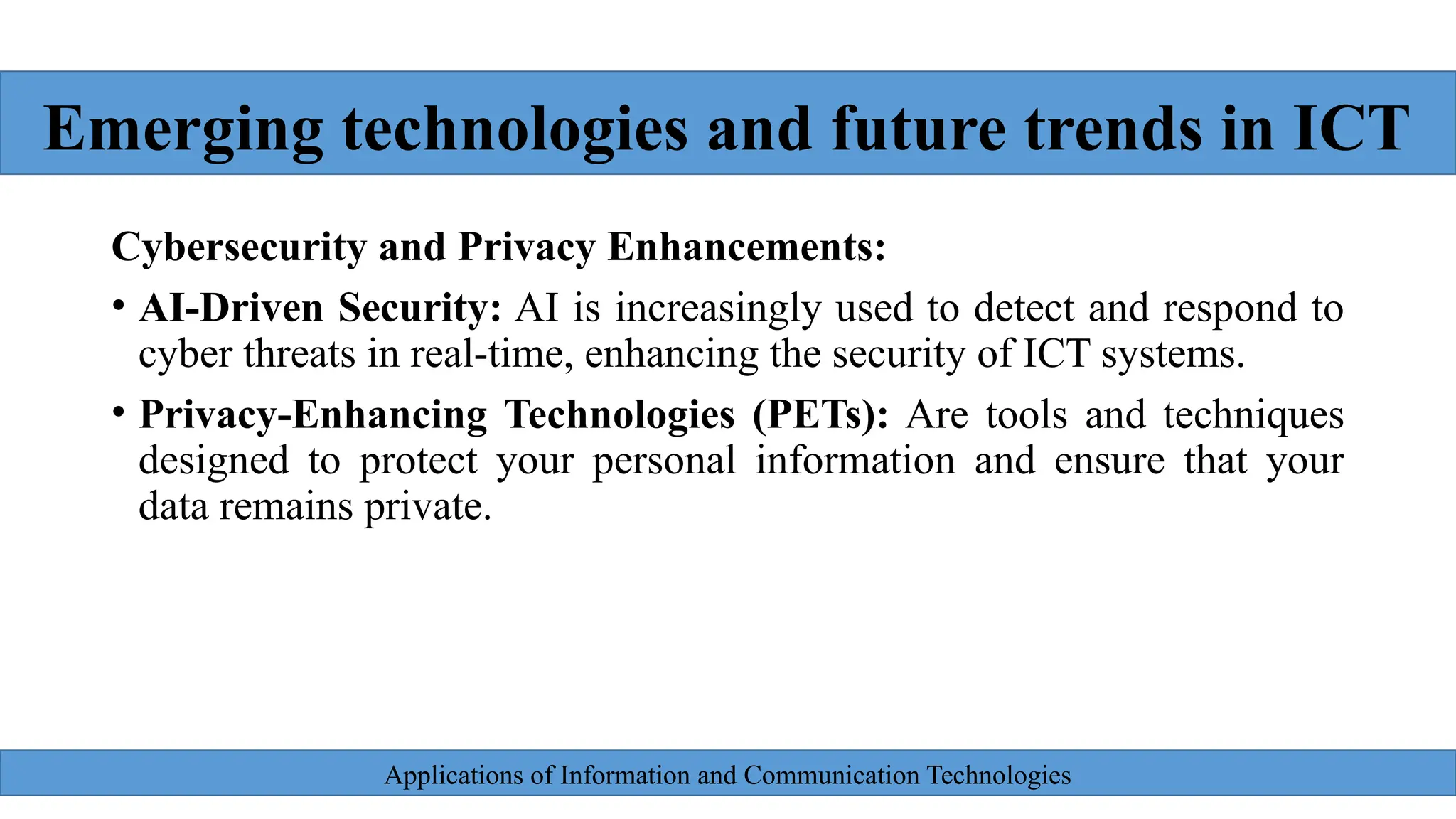
Cybersecurity and Privacy Enhancements:
• AI-Driven Security: AI is increasingly used to detect and respond to
cyber threats in real-time, enhancing the security of ICT systems.
• Privacy-Enhancing Technologies (PETs): Are tools and techniques
designed to protect your personal information and ensure that your
data remains private.
Emerging technologies and future trends in ICT
Applications of Information and Communication Technologies
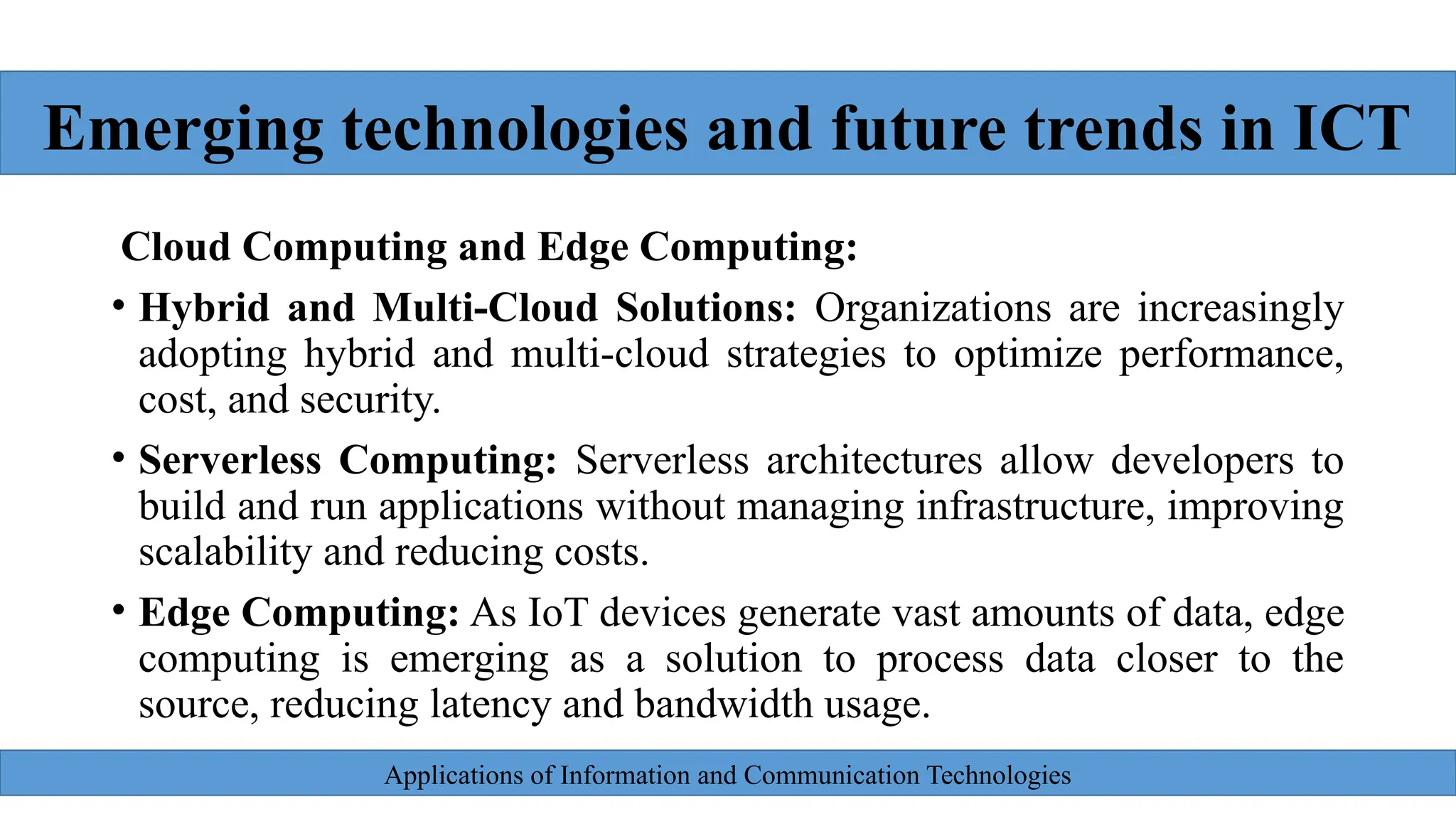
Cloud Computing and Edge Computing:
• Hybrid and Multi-Cloud Solutions: Organizations are increasingly
adopting hybrid and multi-cloud strategies to optimize performance,
cost, and security.
• Serverless Computing: Serverless architectures allow developers to
build and run applications without managing infrastructure, improving
scalability and reducing costs.
• Edge Computing: As IoT devices generate vast amounts of data, edge
computing is emerging as a solution to process data closer to the
source, reducing latency and bandwidth usage.
Emerging technologies and future trends in ICT
Applications of Information and Communication Technologies
Big Data and Data Analytics:
• Advanced Analytics: The use of big data analytics is expanding, enabling more
precise insights, predictions, and decision-making across industries.
• Real-Time Analytics: With advancements in data processing, real-time analytics
is becoming more accessible, allowing businesses to respond to events as they
happen.
Biometric Technologies:
• Advanced Authentication: Biometric technologies, such as facial recognition and
fingerprint scanning, are becoming more widespread for secure authentication.
• Privacy Concerns: The increased use of biometric data is leading to new
challenges in data privacy and security.
Emerging technologies and future trends in ICT
Applications of Information and Communication Technologies
Robotics and Automation:
• Autonomous Systems: Robotics and AI are driving advancements in
autonomous systems, including self-driving cars, drones, and robotic process
automation (RPA) in industries.
• Collaborative Robots (Cobots): These robots work alongside humans,
enhancing productivity and safety in manufacturing and other sectors.
Wearable Technology:
• Health Monitoring: Wearables like smartwatches and fitness trackers provide
real-time health monitoring, offering insights into personal health and fitness.
• AR Integration: Future wearables may integrate AR capabilities, enhancing both
personal and professional applications.
Emerging technologies and future trends in ICT
Introduction to Application of (ICT) - Lecture#2 AICT.pptx

Introduction to Application of (ICT) - Lecture#2 AICT.pptx

  • 2.
    Applications of Informationand Communication Technologies Lecture #2 Introduction to Information and Communication Technologies (ICT)
  • 3.
    Applications of Informationand Communication Technologies • Information technology is the technology that uses computing with high speed communication links to spread information from one place to another. • Information Technology (IT) is the use, development, and management of computer systems, software, and networks to process and distribute data. • Computer is a very important component of information technology. • The world has become “global village” due to advancement in IT. • IT professionals work in various industries, helping organizations leverage technology to improve efficiency, solve problems, and make informed decisions. Information Technology
  • 4.
    Applications of Informationand Communication Technologies • It refers to the tools and systems used to transmit, receive, and process information between individuals or devices. It encompasses various technologies that enable communication over distances, facilitating the exchange of data, voice, video, and other forms of information. • Enables people to stay connected across the globe, facilitating both personal and professional interactions. • Enhances productivity by streamlining communication processes and enabling real-time data exchange. • Provides access to vast amounts of information and resources, supporting education, business, and decision-making. Communication Technology
  • 5.
    Applications of Informationand Communication Technologies • Information and Communication Technologies can be broadly defined as the means of storage, management and dissemination of information by electronic means. • ICT is the technology required for information processing, in particular, the use of electronic computers, communication devices and software applications to convert, store, protect, process, transmit and retrieve information from anywhere, anytime. • Those technologies that enable the handling of information and facilitate different forms of communication. Information and Communication Technology (ICT)
  • 6.
    Applications of Informationand Communication Technologies INFORMATION • Information refers to the knowledge obtained from reading, investigation, study or research. • The tools to transmit information are the telephone, television and radio. • Information is knowledge and helps us to fulfill our daily tasks. • For example, scientists can detect the formation of a tsunami using the latest technology and warn the public to avoid disasters in the affected areas. (Scientists gather data about the ocean, like changes in sea level or seismic activity. This information helps them identify the early signs of a tsunami.) Introduction to ICT
  • 7.
    Applications of Informationand Communication Technologies COMMUNICATION • Communication is an act of transmitting messages. It is a process whereby information is exchanged between individuals using symbols, signs or verbal interactions. • With the advent of technology, these ‘older’ forms of communication are less utilized as compared to the use of the Internet, e-mail or video conferencing. TECHNOLOGY • Technology is the use of scientific knowledge, experience and resources to create processes and products that fulfill human needs. Technology is vital in communication. Introduction to ICT
  • 8.
    Applications of Informationand Communication Technologies What is internet? • The Internet is like a huge global network that connects millions of computers and devices around the world. • It enables the transmission and exchange of data across various locations, facilitating access to information, communication, and online services. • Internet allows people to perform various activities such as browsing websites, sending emails, and engaging in digital communication. • All these activities happen because computers are able to share information with each other quickly and easily through this network. Introduction to Internet
  • 9.
    Applications of Informationand Communication Technologies The components of Information and Communication Technologies (ICT) encompass(surround) a wide range of hardware, software, and networking elements that work together to manage and facilitate the storage, processing, and communication of information. 1. Hardware components: • Computers: Desktops and Laptops: Primary devices used for processing data, running applications, and accessing the internet. Servers: Powerful computers that manage network resources, host applications, and store large amounts of data. • Storage Devices: Hard Drives (HDDs) and Solid-State Drives (SSDs): Devices used to store data permanently. Components of ICT
  • 10.
    Applications of Informationand Communication Technologies External Storage: USB drives, external hard drives, and cloud storage for portable and scalable data storage. • Networking Devices: Routers: Direct data packets between networks, enabling internet and intranet connectivity. Switches: Connect devices within a local area network (LAN) to manage data traffic efficiently. Modems: Convert digital data to analog signals and vice versa, allowing internet access over telephone lines. • Input / Output Devices: Input: Keyboards, mice, scanners, and microphones for entering data into computers. Output: Monitors, printers, and speakers for displaying or outputting data. Components of ICT
  • 11.
    Applications of Informationand Communication Technologies 2. Networking Components: • Networks like the internet, LAN, and WAN connect devices and enable data sharing, while wireless technologies (Wi-Fi, Bluetooth) facilitate connectivity without physical cables. 3. Data Management Components: • Databases: • Structured systems for storing, managing, and retrieving data (e.g., MySQL, Oracle, MongoDB). • Data Analytics Tools: • Software for analyzing and interpreting data to extract useful insights (e.g., Excel, Power BI, Tableau). Components of ICT
  • 12.
    Applications of Informationand Communication Technologies • Cloud Storage and Services: Remote storage solutions that allow data to be stored and accessed over the internet (e.g., Google Drive, Amazon S3). • Big Data Technologies: Tools and platforms for handling and analyzing large volumes of data (e.g., Hadoop, Apache Spark). 4. Security Components: • Cybersecurity Measures: Techniques and tools to protect data, networks, and systems from cyber threats (e.g., encryption, multi-factor authentication). • Physical Security: Measures to protect hardware and infrastructure, such as access control systems and surveillance. Components of ICT
  • 13.
    Applications of Informationand Communication Technologies 2 5. Software Components: • Operating Systems (OS): Examples: Windows, macOS, Linux. These manage hardware resources and provide a platform for running applications. • Application Software: Productivity Software: Word processors, spreadsheets, and presentation tools (e.g., Microsoft Office, Google Workspace). Communication Tools: Email clients, messaging apps, and video conferencing software (e.g., Outlook, Slack, Zoom). • Security Software: Antivirus Programs: Protect against malware and viruses (e.g., Norton, McAfee). Firewalls: Monitor and control incoming and outgoing network traffic to prevent unauthorized access. Components of ICT
  • 14.
    Applications of Informationand Communication Technologies bg 6. Communication Technologies: • Email: Systems for sending and receiving electronic messages (e.g., Gmail, Outlook). • Instant Messaging: Real-time text communication tools (e.g., WhatsApp, Microsoft Teams). • Video Conferencing: Tools for virtual meetings and video calls (e.g., Zoom, Skype). • Telephony: Traditional landline and VoIP (Voice over Internet Protocol) systems for voice communication. • Social Media Platforms: Online platforms for social networking and content sharing (e.g., Facebook, Twitter, LinkedIn). Components of ICT
  • 15.
    Applications of Informationand Communication Technologies 7. Human Resources: • IT Professionals: Individuals who manage and support ICT systems, including network administrators, software developers, and data analysts. • End Users: People who interact with ICT systems to perform their work, access information, and communicate. Components of ICT
  • 16.
    Applications of Informationand Communication Technologies • Business: Manages data, communication, and financial operations to enhance productivity and efficiency. • Education: Facilitates online learning, research, and administrative tasks in educational institutions. • Healthcare: Manages medical records, supports diagnostics, and enables telemedicine services. • Finance: Processes transactions, manages accounts, and assists in trading and risk analysis. • Government: Handles public services, cybersecurity, and data analysis for effective administration. Scope of ICT
  • 17.
    Applications of Informationand Communication Technologies • Entertainment: Powers video games, media production, and streaming services for leisure and creativity. • Science and Research: Assists in simulations, data analysis, and engineering design for scientific advancements. • Manufacturing: Automates production, supports design through CAD, and manages inventory. • Transportation: Provides navigation, traffic management, and logistics optimization for efficient travel and shipping. • Telecommunications: Manages communication networks and customer service through computer systems. Scope of ICT
  • 18.
    Applications of Informationand Communication Technologies . Economic Impact: • Increased Productivity: ICT tools automate processes, reduce manual labor, and improve efficiency, leading to higher productivity in businesses. • Job Creation: The ICT sector has created new job opportunities in fields like software development, IT support, cybersecurity, and data analysis. • Globalization: ICT enables businesses to operate and compete on a global scale, facilitating international trade and collaboration. • E-commerce: ICT has transformed retail with online shopping platforms, allowing businesses to reach more customers and consumers to shop conveniently. Impact of ICT
  • 19.
    Applications of Informationand Communication Technologies Social Impact: • Communication: ICT has revolutionized the way people communicate, enabling instant messaging, video calls, and social media, which help maintain personal and professional relationships across distances. • Access to Information: The internet and ICT devices provide vast amounts of information at our fingertips, improving education, awareness, and informed decision-making. • Social Networking: Social media platforms have created new ways for people to connect, share ideas, and collaborate on projects. • Digital Inclusion: ICT initiatives aim to bridge the digital divide, ensuring that disadvantaged groups have access to technology and the internet. Impact of ICT
  • 20.
    Applications of Informationand Communication Technologies Educational Impact: • E-learning: ICT has enabled online education, making learning accessible to people anywhere, anytime, and allowing for personalized learning experiences. • Educational Resources: Students and educators have access to a wide range of digital resources, such as e-books, tutorials, and online courses. • Collaboration Tools: ICT tools facilitate collaboration between students and teachers, both within and across institutions, enhancing the learning experience. Impact of ICT
  • 21.
    Applications of Informationand Communication Technologies Healthcare Impact: • Telemedicine: ICT enables remote consultations, diagnostics, and monitoring, improving access to healthcare, especially in rural or underserved areas. • Electronic Health Records (EHR): Digital records improve the efficiency and accuracy of patient care by providing healthcare providers with instant access to patient information. • Health Information Systems: ICT systems help manage healthcare data, track diseases, and support public health initiatives. Impact of ICT
  • 22.
    Applications of Informationand Communication Technologies Government and Public Services: • E-Governance: ICT improves government services through online portals, enabling citizens to access services like tax filing, license renewals, and voting more efficiently. • Transparency: ICT tools promote transparency and accountability in governance by providing public access to information and facilitating communication between government and citizens. • Disaster Management: ICT plays a critical role in disaster prediction, management, and communication, helping to mitigate the impact of natural disasters. Impact of ICT
  • 23.
    Applications of Informationand Communication Technologies Environmental Impact: • Smart Technologies: ICT enables the development of smart grids, smart cities, and efficient energy management systems that reduce environmental impact. • Remote Work: ICT has facilitated the rise of remote work, reducing the need for commuting and lowering carbon emissions. • Resource Management: ICT tools help monitor and manage natural resources more effectively, contributing to environmental conservation efforts. Impact of ICT
  • 24.
    Applications of Informationand Communication Technologies Artificial Intelligence (AI) and Machine Learning (ML): • AI Integration: AI is being integrated into various applications, from customer service to predictive analytics, enhancing automation and decision-making. • Machine Learning: ML models are improving in accuracy and efficiency, enabling better data analysis, personalization, and real-time decision-making. • AI Ethics and Governance: As AI becomes more prevalent, there is a growing focus on ethical AI, transparency, and regulation. Emerging technologies and future trends in ICT
  • 25.
    Applications of Informationand Communication Technologies 5G and Next-Generation Networks: • 5G Deployment: The rollout of 5G networks offers significantly faster data speeds, lower latency, and improved connectivity, enabling new applications in IoT, autonomous vehicles, and smart cities. • Edge Computing: 5G enables edge computing, where data processing occurs closer to the data source, reducing latency and improving real- time processing. Emerging technologies and future trends in ICT
  • 26.
    Applications of Informationand Communication Technologies Internet of Things (IoT): • Smart Homes and Cities: IoT devices are increasingly used in homes and cities for automation, energy management, and enhanced security. • Industrial IoT (IIoT): IoT is transforming manufacturing and industrial processes through real-time monitoring, predictive maintenance, and automation. • IoT Security: As IoT devices proliferate, securing these devices and networks becomes increasingly critical. Emerging technologies and future trends in ICT
  • 27.
    Applications of Informationand Communication Technologies Quantum Computing: • Advanced Computing Power: Quantum computing promises to solve complex problems much faster than classical computers, with potential applications in cryptography, material science, and optimization problems. • Quantum Security: Quantum computing could revolutionize cybersecurity by breaking existing encryption methods, leading to the development of quantum-resistant encryption. Emerging technologies and future trends in ICT
  • 28.
    Applications of Informationand Communication Technologies Cybersecurity and Privacy Enhancements: • AI-Driven Security: AI is increasingly used to detect and respond to cyber threats in real-time, enhancing the security of ICT systems. • Privacy-Enhancing Technologies (PETs): Are tools and techniques designed to protect your personal information and ensure that your data remains private. Emerging technologies and future trends in ICT
  • 29.
    Applications of Informationand Communication Technologies Cloud Computing and Edge Computing: • Hybrid and Multi-Cloud Solutions: Organizations are increasingly adopting hybrid and multi-cloud strategies to optimize performance, cost, and security. • Serverless Computing: Serverless architectures allow developers to build and run applications without managing infrastructure, improving scalability and reducing costs. • Edge Computing: As IoT devices generate vast amounts of data, edge computing is emerging as a solution to process data closer to the source, reducing latency and bandwidth usage. Emerging technologies and future trends in ICT
  • 30.
    Applications of Informationand Communication Technologies Big Data and Data Analytics: • Advanced Analytics: The use of big data analytics is expanding, enabling more precise insights, predictions, and decision-making across industries. • Real-Time Analytics: With advancements in data processing, real-time analytics is becoming more accessible, allowing businesses to respond to events as they happen. Biometric Technologies: • Advanced Authentication: Biometric technologies, such as facial recognition and fingerprint scanning, are becoming more widespread for secure authentication. • Privacy Concerns: The increased use of biometric data is leading to new challenges in data privacy and security. Emerging technologies and future trends in ICT
  • 31.
    Applications of Informationand Communication Technologies Robotics and Automation: • Autonomous Systems: Robotics and AI are driving advancements in autonomous systems, including self-driving cars, drones, and robotic process automation (RPA) in industries. • Collaborative Robots (Cobots): These robots work alongside humans, enhancing productivity and safety in manufacturing and other sectors. Wearable Technology: • Health Monitoring: Wearables like smartwatches and fitness trackers provide real-time health monitoring, offering insights into personal health and fitness. • AR Integration: Future wearables may integrate AR capabilities, enhancing both personal and professional applications. Emerging technologies and future trends in ICT