INFORMATION TECHNOLOGY
Contents:
 Introduction
 History of IT
 Present role of IT
 Hardware and Software
 Advantages & Disadvantages of IT
 Benefits from IT
1
INFORMATION
TECHNOLOGY
Information technology is a contemporary term that
describes the combination of computer technology
(hardware and software) with telecommunications
technology (data, image, and voice networks).
2
In some companies, this is referred to as
Management Information Services (or MIS) or
simply as Information Services (or IS).
These innovations enable the processing and
storage of enormous amounts of information, along
with rapid distribution of information through
communication networks
 IT has enabled the globalisation of the economy and
competition, and caused large-scale changes in
many industries
 IT is also bringing a major shift in the job market;
resulting in a more polarised occupational structure,
consisting of
highly skilled=well paid jobs
lower skilled=low wages 3
Communication: Basic need for most human
activities
Tarditional- telephone, fax, mail...
In the new information era- e-mail, internet, video
conferencing
The new communication technology enables
people located in different places to work together
as if they were in the same office. Big multinational
companies are already exploiting this technology to
achieve better use of the resources of their
seperate offices. In this way projects can be shared
between offices with the application of the best
expertise, and around the clock
4
5
Computer Use
The purpose of a computer is to process data into
information
 Data consist of the raw facts and figures that are
processed into information
 Information is data that has been summarized or
otherwise manipulated for use in desicion making
Hardware and Software
 Hardware consist of all the machinery and equipment in
a computer system
 Software , or programs , consist of all the electronic
instructions that tell the computer how to perform a task
6
Hardware and software
revolution
 The diminishing cost of personal computers has put
computing power within the reach of even the
smallest contractors.
 Rapidly developing hardware performance, coupled
with the development of storage drives with very
large volumes, modems, scanners, and back up
devices has made the computer suitable for storage
and distribution of drawings and other data in
electronic format.
 The evolution of servers, network cards, modems and
routers have linked computers together providing a
forum for community collaboration.
7
Internet
The value of the Internet to construction
companies derives from its ability to easily connect
globally to a vast amount of data, which would
otherwise have taken more time and money to
organise. By exploiting the resources of the Internet
construction companies can gain the following
benefits.
 Acceleration in the distribution of knowledge
resources within and out with the company
 Promotion and marketing for the company
8
On-line services: The rapid development of the
Internet and the World Wide Web has enabled many
services that traditionally required face to face
meetings to be delivered on-line.
Internet distance learning: opportunities of university
education, widening access to higher education
(delivering teaching and learning to people who
cannot attend lectures)-increases a country’s
competitiveness in a global market.
E-business: Internet provides a virtual market place for
buyers, suppliers, distributors and sellers to
exchange information, negotiate and trade
Teleworking: Flexibility in working conditions, less
office space, more productive workers.
9
How is information technology being used in
education?
 E-mail
 Distance learning
How are computers being used in health and
medicine?
 Telemedicine
 Robots
How will computers affect my financial matters?
 Virtual money
 Micro-Credits
10
History and Development of Information
Technology
In the 1960s and 1970s, the term information
technology (IT) was a little known phrase that was used by
those who worked in places like banks and hospitals to
store information. With the paradigm shift to computing
technology and "paperless" workplaces, information
technology has come to be a household phrase. It defines
an industry that uses computers, networking, software
programming, and other equipment and processes to
store, process, transmit, and protect information.
11
Software development and computer
programming were best left to the computer scientists
and mathematical engineers, due to their complicated
nature. As time passed and technology advanced, such as
with the advent of the personal computer in the 1980s and
its everyday use in the home and the workplace, the world
moved into the information age.
12
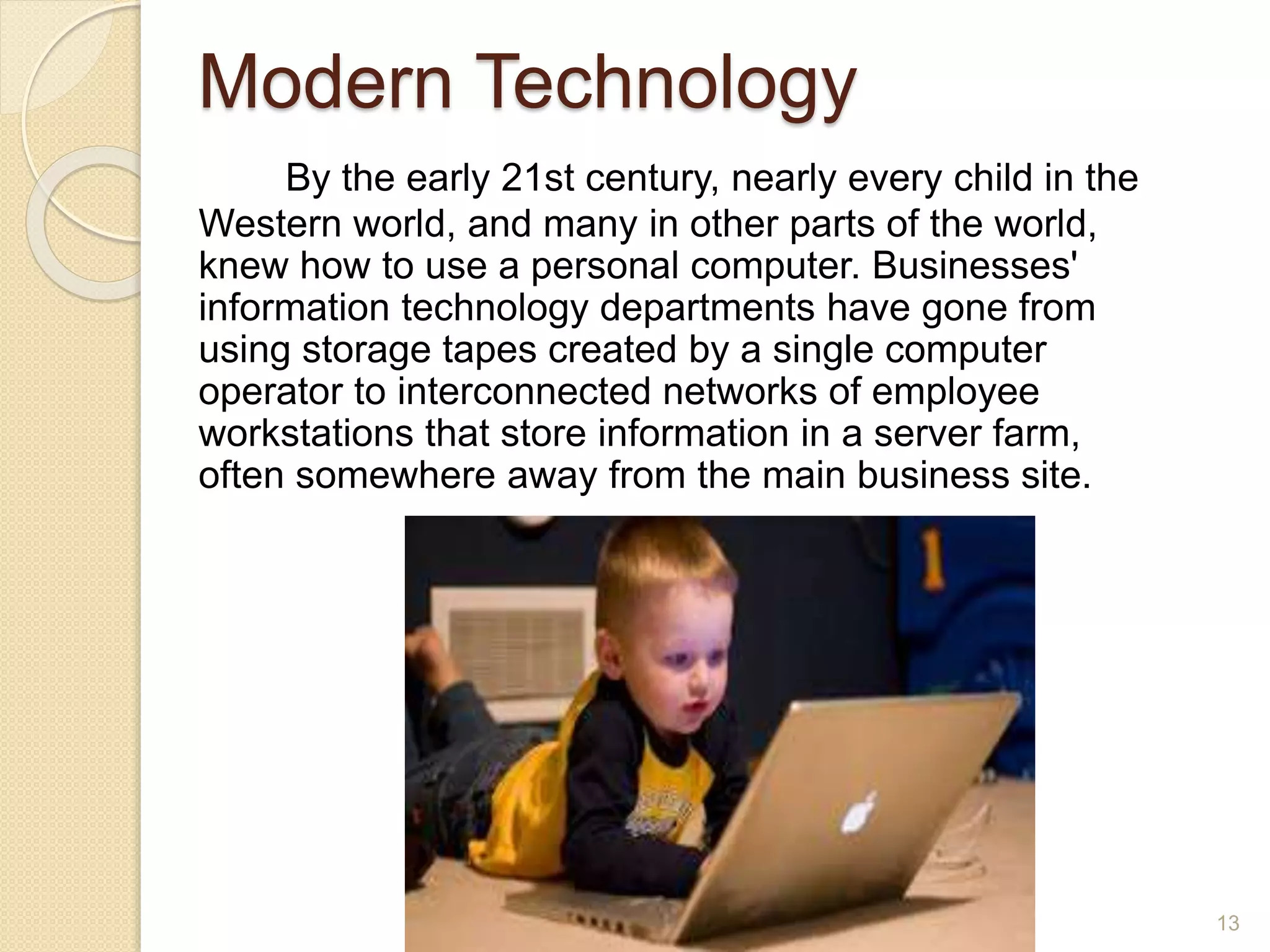
Modern Technology
By the early 21st century, nearly every child in the
Western world, and many in other parts of the world,
knew how to use a personal computer. Businesses'
information technology departments have gone from
using storage tapes created by a single computer
operator to interconnected networks of employee
workstations that store information in a server farm,
often somewhere away from the main business site.
13
Technology facilitate our life
Technology and information may be regarded as
two things are mutually binding. Both support functions
that are fairly similar. Advances in technology are
always facilitate the delivery of information. The rate
information from one country can spread rapidly to
other countries, even to all countries, through
increasingly sophisticated technology.
Advances in information technology provide
enormous benefit in human survival. Information
technology can provide facilities in various aspects of
life. One area of ​​life that has a close relationship with
the use of information technology is the world of work.
14
Impact of Advanced Information
Technology
Advances in information technology is to be
grateful and appreciated as a remarkable achievement.
Therefore, we must take advantage of advances in
information technology is to do positive things.
Why is that?
In fact, advances in information technology not only
provides a positive effect. Many also brought along the
negative impact of information technology advances.
15
Here's a positive impact of information technology
development.
 Make it easier for companies or individual business
transaction-based information technology or so-called E-
Commerce.
 Simplify access to information needed for various
purposes.
16
Besides positive impacts, advances in
information technology have a negative effect.
 The rapid advancement in information technology,
internet and other media, facilitate the entry of banned
sites and violence.
 Ease of transactions via the Internet will provide
opportunities to perform transacts forbidden, such as
drug and contraband transactions.
As a result, anything that is required is completed
in quick time to be done by utilizing flash technology as
well. Finally, human life can not be separated from the
flow of information technology.
17
The Role of IT
 It is accepted that telecommunication is a basic
infrastructure necessary for economic and social
development of a country.
 This is even becoming more strong than ever as
information related economic activities are growing.
 Information and communications technology may be
described as the support of the central nervous
system of complex societies, transmitting and
processing information and commands among the
various parts of such societies.
 Internet plays a fundamental function in IT role
18
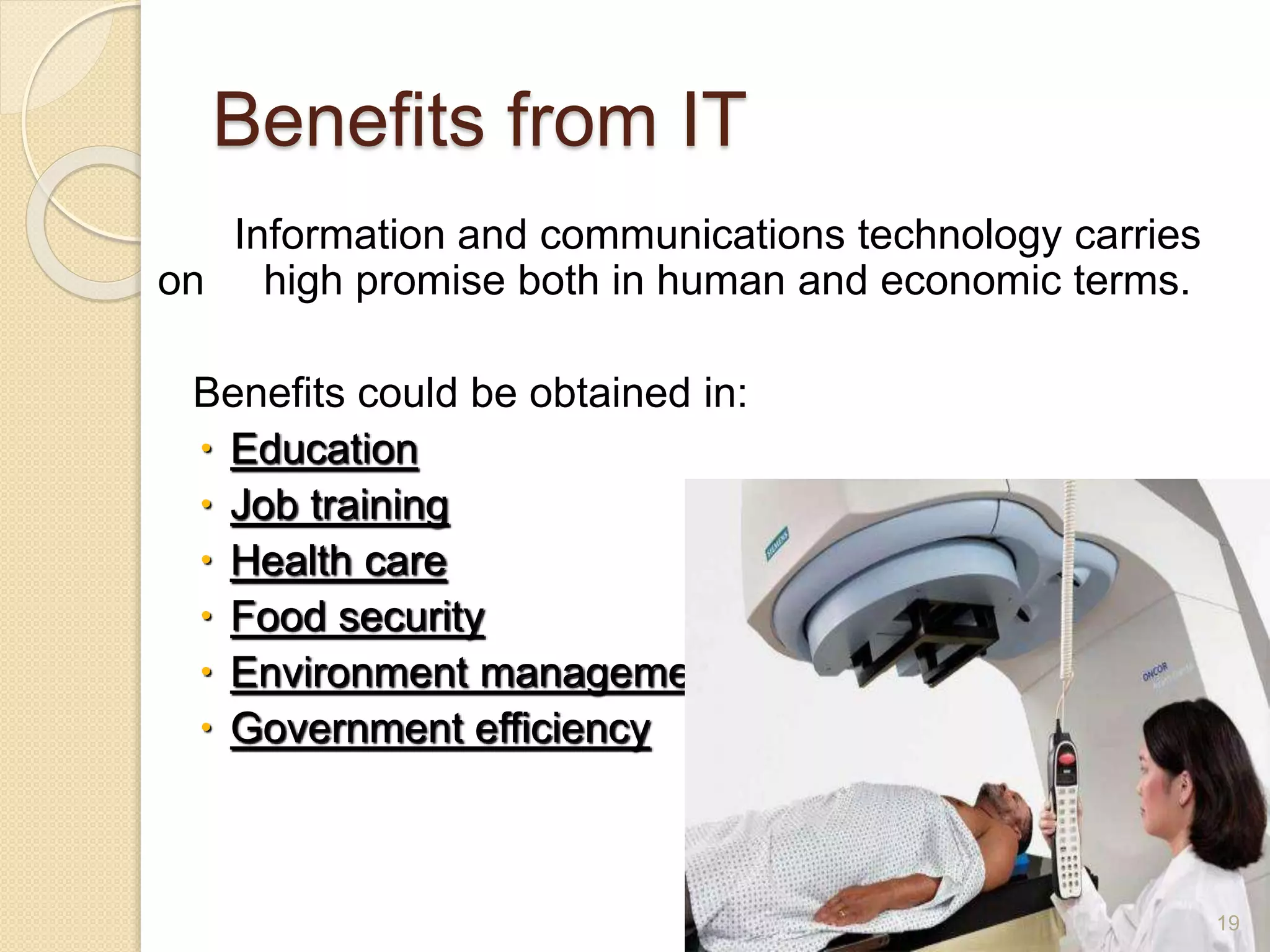
Benefits from IT
Information and communications technology carries
on high promise both in human and economic terms.
Benefits could be obtained in:
 Education
 Job training
 Health care
 Food security
 Environment management
 Government efficiency
19
IT is useful in all areas
Many tourism businesses are involved in
developing their internet services including traditional
travel agents , tour operators , national tourist offices,
airlines , hotels and other accommodation providers
and car hire firms.
20
Thank you for your attention
21

Information technology

  • 1.
    INFORMATION TECHNOLOGY Contents:  Introduction History of IT  Present role of IT  Hardware and Software  Advantages & Disadvantages of IT  Benefits from IT 1
  • 2.
    INFORMATION TECHNOLOGY Information technology isa contemporary term that describes the combination of computer technology (hardware and software) with telecommunications technology (data, image, and voice networks). 2
  • 3.
    In some companies,this is referred to as Management Information Services (or MIS) or simply as Information Services (or IS). These innovations enable the processing and storage of enormous amounts of information, along with rapid distribution of information through communication networks  IT has enabled the globalisation of the economy and competition, and caused large-scale changes in many industries  IT is also bringing a major shift in the job market; resulting in a more polarised occupational structure, consisting of highly skilled=well paid jobs lower skilled=low wages 3
  • 4.
    Communication: Basic needfor most human activities Tarditional- telephone, fax, mail... In the new information era- e-mail, internet, video conferencing The new communication technology enables people located in different places to work together as if they were in the same office. Big multinational companies are already exploiting this technology to achieve better use of the resources of their seperate offices. In this way projects can be shared between offices with the application of the best expertise, and around the clock 4
  • 5.
  • 6.
    Computer Use The purposeof a computer is to process data into information  Data consist of the raw facts and figures that are processed into information  Information is data that has been summarized or otherwise manipulated for use in desicion making Hardware and Software  Hardware consist of all the machinery and equipment in a computer system  Software , or programs , consist of all the electronic instructions that tell the computer how to perform a task 6
  • 7.
    Hardware and software revolution The diminishing cost of personal computers has put computing power within the reach of even the smallest contractors.  Rapidly developing hardware performance, coupled with the development of storage drives with very large volumes, modems, scanners, and back up devices has made the computer suitable for storage and distribution of drawings and other data in electronic format.  The evolution of servers, network cards, modems and routers have linked computers together providing a forum for community collaboration. 7
  • 8.
    Internet The value ofthe Internet to construction companies derives from its ability to easily connect globally to a vast amount of data, which would otherwise have taken more time and money to organise. By exploiting the resources of the Internet construction companies can gain the following benefits.  Acceleration in the distribution of knowledge resources within and out with the company  Promotion and marketing for the company 8
  • 9.
    On-line services: Therapid development of the Internet and the World Wide Web has enabled many services that traditionally required face to face meetings to be delivered on-line. Internet distance learning: opportunities of university education, widening access to higher education (delivering teaching and learning to people who cannot attend lectures)-increases a country’s competitiveness in a global market. E-business: Internet provides a virtual market place for buyers, suppliers, distributors and sellers to exchange information, negotiate and trade Teleworking: Flexibility in working conditions, less office space, more productive workers. 9
  • 10.
    How is informationtechnology being used in education?  E-mail  Distance learning How are computers being used in health and medicine?  Telemedicine  Robots How will computers affect my financial matters?  Virtual money  Micro-Credits 10
  • 11.
    History and Developmentof Information Technology In the 1960s and 1970s, the term information technology (IT) was a little known phrase that was used by those who worked in places like banks and hospitals to store information. With the paradigm shift to computing technology and "paperless" workplaces, information technology has come to be a household phrase. It defines an industry that uses computers, networking, software programming, and other equipment and processes to store, process, transmit, and protect information. 11
  • 12.
    Software development andcomputer programming were best left to the computer scientists and mathematical engineers, due to their complicated nature. As time passed and technology advanced, such as with the advent of the personal computer in the 1980s and its everyday use in the home and the workplace, the world moved into the information age. 12
  • 13.
    Modern Technology By theearly 21st century, nearly every child in the Western world, and many in other parts of the world, knew how to use a personal computer. Businesses' information technology departments have gone from using storage tapes created by a single computer operator to interconnected networks of employee workstations that store information in a server farm, often somewhere away from the main business site. 13
  • 14.
    Technology facilitate ourlife Technology and information may be regarded as two things are mutually binding. Both support functions that are fairly similar. Advances in technology are always facilitate the delivery of information. The rate information from one country can spread rapidly to other countries, even to all countries, through increasingly sophisticated technology. Advances in information technology provide enormous benefit in human survival. Information technology can provide facilities in various aspects of life. One area of ​​life that has a close relationship with the use of information technology is the world of work. 14
  • 15.
    Impact of AdvancedInformation Technology Advances in information technology is to be grateful and appreciated as a remarkable achievement. Therefore, we must take advantage of advances in information technology is to do positive things. Why is that? In fact, advances in information technology not only provides a positive effect. Many also brought along the negative impact of information technology advances. 15
  • 16.
    Here's a positiveimpact of information technology development.  Make it easier for companies or individual business transaction-based information technology or so-called E- Commerce.  Simplify access to information needed for various purposes. 16
  • 17.
    Besides positive impacts,advances in information technology have a negative effect.  The rapid advancement in information technology, internet and other media, facilitate the entry of banned sites and violence.  Ease of transactions via the Internet will provide opportunities to perform transacts forbidden, such as drug and contraband transactions. As a result, anything that is required is completed in quick time to be done by utilizing flash technology as well. Finally, human life can not be separated from the flow of information technology. 17
  • 18.
    The Role ofIT  It is accepted that telecommunication is a basic infrastructure necessary for economic and social development of a country.  This is even becoming more strong than ever as information related economic activities are growing.  Information and communications technology may be described as the support of the central nervous system of complex societies, transmitting and processing information and commands among the various parts of such societies.  Internet plays a fundamental function in IT role 18
  • 19.
    Benefits from IT Informationand communications technology carries on high promise both in human and economic terms. Benefits could be obtained in:  Education  Job training  Health care  Food security  Environment management  Government efficiency 19
  • 20.
    IT is usefulin all areas Many tourism businesses are involved in developing their internet services including traditional travel agents , tour operators , national tourist offices, airlines , hotels and other accommodation providers and car hire firms. 20
  • 21.
    Thank you foryour attention 21