Network Security
Grading
 Mid Term=
 Assignments =
 Quizzes =
 Term Project/viva/presentation =
 Final Term =
PU Gujranwala
The art of war teaches us to rely not
on the likelihood of the enemy's not
coming, but on our own readiness to
receive him; not on the chance of his
not attacking, but rather on the fact
that we have made our position
unassailable.
PU Gujranwala
—The Art of War, Sun Tzu
Information Security
What is Information Security…?
PU Gujranwala
Information Security
 Information Security is the name given to the
preventive steps we take to guard our
Information and Information System.
 Measures adopted to prevent the
unauthorized access, misuse, modification,
disclosure or destruction.
PU Gujranwala
Critical Characteristics of
Information Security
 Confidentiality
 Integrity
 Availability
PU Gujranwala
Confidentiality
 Confidentiality is the property of preventing
disclosure of information to unauthorized individuals
or systems.
 Information is available only to people with rightful
access.
 Ensuring that only those with the rights and
privileges to access a particular set of information are
able to do so.
Methods:
Data Encryption
User IDs and Passwords
PU Gujranwala
Integrity
 Information can only be changed by authorized
personnel.
 The quality or state of being whole, complete and
uncorrupted is the integrity of information.
 Integrity can be violated by a virus or a user.
 Integrity check can be done through:
 File size
 Checksums for verification of data integrity
 File hashing
PU Gujranwala
Availability
 Enables users who need to access information to do
so without interference or obstruction and receive it
in required format.
 The information is available only to the authorized
users all the time.
 Backups and Recovery
 RAID
 Alternate Links
PU Gujranwala
Authenticity
 Authenticity of information is the quality or state of
being genuine or original, rather than a reproduction
or fabrication.
PU Gujranwala
Privacy
 Privacy-means different things to different people, is
the right to be left alone and right to be free of
unreasonable personal instructions.
 Information privacy – The right to determine when
and up to what extent information about oneself can
be shared with others
 Organizational privacy – Governments agencies,
corporations, and other organizations may desire to
keep their activities or secrets from being revealed to
other organizations or individuals.
PU Gujranwala
Components of an Information
System
 Software
 Hardware
 Data
 People
 Procedures
PU Gujranwala
Software
 Bugs, Weaknesses and Holes.
 An error or defect in software or hardware that causes a
program to malfunction
 Security Hole (something you need to fix now)
 Security Warning ( something you need to fix soon)
 Security Note (something you need to fix when you get
around to it, or just some information that you should
consider)
 Patches and Service Packs.
 A patch is a piece of software designed to fix problems or
update a computer program and its supporting data. This
includes fixing security vulnerabilities and other bugs.
 A service pack (in short SP) is a collection of updates, fixes
and/or enhancements to a software program delivered in
the form of a single installable package.
PU Gujranwala
Hardware
 It Houses and Executes a software.
 Stores and carries the data.
 Provides Interfaces for the entry and removal of
information from the system.
 Physical security policies deal with the H/W.
PU Gujranwala
Data
 The most important and valuable thing for any
organization.
 Main object of intentional attacks.
 Must be protected from unauthorized access.
PU Gujranwala
People
 All that interact with the System.
 Main threat to information security.
PU Gujranwala
Procedures
 Procedures are written instructions for accomplishing
a specific task.
 Mechanism adopted to achieve an objective.
PU Gujranwala
What is Network Security?
 Network Security is the protection of networking
components, connections and contents.
 Effort to create a secure computing platform, so
users or programs cannot perform actions that they
are not allowed to do.
PU Gujranwala
Network Security as a Continuous
Process
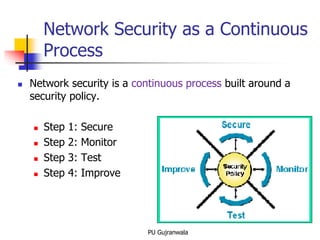
 Network security is a continuous process built around a
security policy.
 Step 1: Secure
 Step 2: Monitor
 Step 3: Test
 Step 4: Improve
PU Gujranwala
Step 1: Secure the Network
 Implement security solutions to prevent unauthorized
access and to protect information.
 Authentication
 Encryption
 Firewalls
 Vulnerability Patching
PU Gujranwala
Step 2: Monitor Security
 Detects violations to the security policy
 Involves system auditing and real-time intrusion
detection
 Validates the security implementation in
Step 1
PU Gujranwala
Step 3: Test Security
 Validates effectiveness of the security policy through
system auditing and network scanning
 Whether the system fulfills the security requirements
or not.
PU Gujranwala
Step 4: Improve Security
 Use information from the monitor and test phases to
make improvements to the security implementation.
 Adjust the security policy as security holes and risks
are identified.
PU Gujranwala
Terms related to Security
 Assets
 Threats
 Attack
 Vulnerability
 Risk Analysis
 Countermeasures
 Hacking
PU Gujranwala
Asset
 An asset is the organizational resource that is being
protected.
 It can be logical like website, information, data.
 It can be physical like computer system or other
tangible object.
PU Gujranwala
 Threat
 A person, thing, event or idea which poses some danger to an
asset (in terms of confidentiality, integrity, availability or legitimate
use).
 A possible means by which a security policy may be breached.
 An attack
 An assault against a computer system or network as a result of
deliberate, intelligent action; for example, denial of service attacks,
penetration and sabotage.
 It is a realization of a threat.
Threats and Attack
PU Gujranwala
 Vulnerability
 A weakness in the system that can be exploited to cause loss or
harm
 In computer security, the word vulnerability refers to a weakness in
a system allowing an attacker to violate the confidentiality,
integrity, availability ,access control, consistency or audit
mechanisms of the system or the data and applications it hosts
 Control, Countermeasure, safeguard
 An action, device, procedure or technique that removes or reduces
a vulnerability.
PU Gujranwala
Vulnerability and Countermeasure
Risk = Threat + Vulnerability
 Threats without vulnerabilities pose no risk.
 Likewise, vulnerabilities without threats pose no risk.
 Risk is the probability that something can happen.
 Risk analysis can be quantitative or qualitative.
PU Gujranwala
Cont…
 Risk can be qualitatively defined in three levels:
 Low- Action to remove the vulnerability should be taken if possible
 Medium- Action to remove the vulnerability is advisable
 High- Action should be taken immediately to remove this
vulnerability
PU Gujranwala
Hacking
 Can be defined positively and negatively:
 To write computer programs for enjoyment.
 To gain access to a computer illegally.
 A person who writes programs in assembly language or in system-
level languages, such as C. The term often refers to any
programmer, but its true meaning is someone with a strong
technical background who is "hacking away" at the bits and bytes.
 During the 1990s, the term "hacker" became synonymous with
"cracker," which is a person who performs some form of computer
sabotage. The association is understandable. In order to be an
effective cracker, you had to be a good hacker, thus the terms got
intertwined, and hacker won out in the popular press.
PU Gujranwala
Summary
What we have studied:
 What is Information Security?
 What is Network Security?
 Assets, Threats and Countermeasures.
PU Gujranwala

Basic Concepts of information security.ppt

  • 1.
  • 2.
    Grading  Mid Term= Assignments =  Quizzes =  Term Project/viva/presentation =  Final Term = PU Gujranwala
  • 3.
    The art ofwar teaches us to rely not on the likelihood of the enemy's not coming, but on our own readiness to receive him; not on the chance of his not attacking, but rather on the fact that we have made our position unassailable. PU Gujranwala —The Art of War, Sun Tzu
  • 4.
    Information Security What isInformation Security…? PU Gujranwala
  • 5.
    Information Security  InformationSecurity is the name given to the preventive steps we take to guard our Information and Information System.  Measures adopted to prevent the unauthorized access, misuse, modification, disclosure or destruction. PU Gujranwala
  • 6.
    Critical Characteristics of InformationSecurity  Confidentiality  Integrity  Availability PU Gujranwala
  • 7.
    Confidentiality  Confidentiality isthe property of preventing disclosure of information to unauthorized individuals or systems.  Information is available only to people with rightful access.  Ensuring that only those with the rights and privileges to access a particular set of information are able to do so. Methods: Data Encryption User IDs and Passwords PU Gujranwala
  • 8.
    Integrity  Information canonly be changed by authorized personnel.  The quality or state of being whole, complete and uncorrupted is the integrity of information.  Integrity can be violated by a virus or a user.  Integrity check can be done through:  File size  Checksums for verification of data integrity  File hashing PU Gujranwala
  • 9.
    Availability  Enables userswho need to access information to do so without interference or obstruction and receive it in required format.  The information is available only to the authorized users all the time.  Backups and Recovery  RAID  Alternate Links PU Gujranwala
  • 10.
    Authenticity  Authenticity ofinformation is the quality or state of being genuine or original, rather than a reproduction or fabrication. PU Gujranwala
  • 11.
    Privacy  Privacy-means differentthings to different people, is the right to be left alone and right to be free of unreasonable personal instructions.  Information privacy – The right to determine when and up to what extent information about oneself can be shared with others  Organizational privacy – Governments agencies, corporations, and other organizations may desire to keep their activities or secrets from being revealed to other organizations or individuals. PU Gujranwala
  • 12.
    Components of anInformation System  Software  Hardware  Data  People  Procedures PU Gujranwala
  • 13.
    Software  Bugs, Weaknessesand Holes.  An error or defect in software or hardware that causes a program to malfunction  Security Hole (something you need to fix now)  Security Warning ( something you need to fix soon)  Security Note (something you need to fix when you get around to it, or just some information that you should consider)  Patches and Service Packs.  A patch is a piece of software designed to fix problems or update a computer program and its supporting data. This includes fixing security vulnerabilities and other bugs.  A service pack (in short SP) is a collection of updates, fixes and/or enhancements to a software program delivered in the form of a single installable package. PU Gujranwala
  • 14.
    Hardware  It Housesand Executes a software.  Stores and carries the data.  Provides Interfaces for the entry and removal of information from the system.  Physical security policies deal with the H/W. PU Gujranwala
  • 15.
    Data  The mostimportant and valuable thing for any organization.  Main object of intentional attacks.  Must be protected from unauthorized access. PU Gujranwala
  • 16.
    People  All thatinteract with the System.  Main threat to information security. PU Gujranwala
  • 17.
    Procedures  Procedures arewritten instructions for accomplishing a specific task.  Mechanism adopted to achieve an objective. PU Gujranwala
  • 18.
    What is NetworkSecurity?  Network Security is the protection of networking components, connections and contents.  Effort to create a secure computing platform, so users or programs cannot perform actions that they are not allowed to do. PU Gujranwala
  • 19.
    Network Security asa Continuous Process  Network security is a continuous process built around a security policy.  Step 1: Secure  Step 2: Monitor  Step 3: Test  Step 4: Improve PU Gujranwala
  • 20.
    Step 1: Securethe Network  Implement security solutions to prevent unauthorized access and to protect information.  Authentication  Encryption  Firewalls  Vulnerability Patching PU Gujranwala
  • 21.
    Step 2: MonitorSecurity  Detects violations to the security policy  Involves system auditing and real-time intrusion detection  Validates the security implementation in Step 1 PU Gujranwala
  • 22.
    Step 3: TestSecurity  Validates effectiveness of the security policy through system auditing and network scanning  Whether the system fulfills the security requirements or not. PU Gujranwala
  • 23.
    Step 4: ImproveSecurity  Use information from the monitor and test phases to make improvements to the security implementation.  Adjust the security policy as security holes and risks are identified. PU Gujranwala
  • 24.
    Terms related toSecurity  Assets  Threats  Attack  Vulnerability  Risk Analysis  Countermeasures  Hacking PU Gujranwala
  • 25.
    Asset  An assetis the organizational resource that is being protected.  It can be logical like website, information, data.  It can be physical like computer system or other tangible object. PU Gujranwala
  • 26.
     Threat  Aperson, thing, event or idea which poses some danger to an asset (in terms of confidentiality, integrity, availability or legitimate use).  A possible means by which a security policy may be breached.  An attack  An assault against a computer system or network as a result of deliberate, intelligent action; for example, denial of service attacks, penetration and sabotage.  It is a realization of a threat. Threats and Attack PU Gujranwala
  • 27.
     Vulnerability  Aweakness in the system that can be exploited to cause loss or harm  In computer security, the word vulnerability refers to a weakness in a system allowing an attacker to violate the confidentiality, integrity, availability ,access control, consistency or audit mechanisms of the system or the data and applications it hosts  Control, Countermeasure, safeguard  An action, device, procedure or technique that removes or reduces a vulnerability. PU Gujranwala Vulnerability and Countermeasure
  • 28.
    Risk = Threat+ Vulnerability  Threats without vulnerabilities pose no risk.  Likewise, vulnerabilities without threats pose no risk.  Risk is the probability that something can happen.  Risk analysis can be quantitative or qualitative. PU Gujranwala
  • 29.
    Cont…  Risk canbe qualitatively defined in three levels:  Low- Action to remove the vulnerability should be taken if possible  Medium- Action to remove the vulnerability is advisable  High- Action should be taken immediately to remove this vulnerability PU Gujranwala
  • 30.
    Hacking  Can bedefined positively and negatively:  To write computer programs for enjoyment.  To gain access to a computer illegally.  A person who writes programs in assembly language or in system- level languages, such as C. The term often refers to any programmer, but its true meaning is someone with a strong technical background who is "hacking away" at the bits and bytes.  During the 1990s, the term "hacker" became synonymous with "cracker," which is a person who performs some form of computer sabotage. The association is understandable. In order to be an effective cracker, you had to be a good hacker, thus the terms got intertwined, and hacker won out in the popular press. PU Gujranwala
  • 31.
    Summary What we havestudied:  What is Information Security?  What is Network Security?  Assets, Threats and Countermeasures. PU Gujranwala

Editor's Notes

  • #4 Twenty-Five Hundred years ago, Sun Tzu wrote this classic book of military strategy based on Chinese warfare and military thought. Since that time, all levels of military have used the teaching on Sun Tzu to warfare and civilization have adapted these teachings for use in politics, business and everyday life. The Art of War is a book which should be used to gain advantage of opponents in the boardroom and battlefield alike.