A N U S H K A M U K H E R J E E
B M C O M M 1 6 0 7
Theories of Media Cognition and
Information Processing Theory
Strengths/Limitations of Cognitive Theories
 Can be easy to observe cognitive effects
 People can be asked if they know something
 Observation can follow media exposure
 Many methods exist to measure knowledge
 But “so what” -- how important or enduring are cognitive effects?
 Do cognitive effects influence action or just fade away over time?
Information Processing Theory
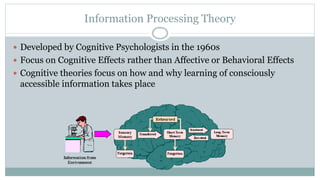
 Developed by Cognitive Psychologists in the 1960s
 Focus on Cognitive Effects rather than Affective or Behavioral Effects
 Cognitive theories focus on how and why learning of consciously
accessible information takes place
Information Processing
Theory Assumptions
 The human mind is made up of many cognitive processes
that need to be activated and operate properly for learning
to occur
 Most incoming new sensory information is filtered and
processed by a cognitive processes that operate out of
conscious awareness
 Most incoming new information is processed with no
conscious awareness = passive information
processing
 Conscious attention has some ability to force some
processing into awareness = active information
processing
More Assumptions
 Most information received is filtered out and never reaches
consciousness (1% or less)
 Majority of information received and processed in social situations
concerns orientation to other people (90%+)
 Processing resources are limited and easily overwhelmed
 Visual information dominates all other forms of information when
competing for processing resources
 A variety of problems arise when cognitive processes fail or are
overwhelmed -- perception errors, gaps in information, meltdown effects
Role of Memory in Processing
 Two types of Consciously Accessible Memory
Short-term (several
seconds to a few minutes)
Long-term (hours, days,
weeks, years)
Working Memory :
 Working memory functions as a temporary working memory, whereby further processing is carried out to make
information for long term storage.
 It holds information for a limited amount of time and holds a limited amount of information as well.
 The working memory will process information for longer period of time if the person
is actively concentrating.
 Working memory are of two types : Encoding
Retrieval
 Encoding : Recasts sensory information into meaningful representations suitable for manipulation, using
strategies like
-Rehearsal
-Organization
-Elaboration
 Retrieval : is the ability to access information when you need it.
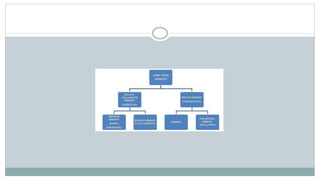
Long term Memory
 is the memory where the information is moved from working memory
to the long term memory
 It represents our permanent storehouse of information, capable of
retaining an unlimited amount and variety of information.
Long Term Memory are of two types :
 Implicit
 Explicit
Continuation….
 Explicit : Involves all of the memories that are available in consciousness.
 Episodic Memory : Refers to the memory for specific events in times as well as supporting their
information.
 Semantic Memory : It refers to knowledge about factual information, such as the meaning of words.
 Implicit : Involves memories of body movement and how to use objects in the
environment. Like driving a car.
 Priming : Priming is an implicit memory effect in which exposure to one stimulus (i.e., perceptual
pattern) influences the response to another stimulus.
 Procedural memories : Procedural memory is a part of the long-term memory that is responsible
for knowing how to do things, also known as motor skills. As the name implies, procedural
memory stores information on how to perform certain procedures, such as walking, talking and
riding a bike.
Memory and Learning
 Factors that influence learning of information so it is consciously accessible in
long-term memory
 Active processing of information
 Cognitive resources available for processing
 Redundancy of information
 Degree to with current information fits with past information
 Emotion experienced while processing information
 Schemas are developed by processing information – Once developed, schemas
guide interpretation of information
 Media content can elaborate or reinforce existing schemas
 In rare cases, powerful media content could challenge and change existing schemas
Conscious Experience of
Information Processing
 We experience information processing as an on-going sense making activity
 We seem to have an ability to consciously control this activity but our control
is limited
 We can seek to actively process information so that learning will be more
likely
 We can try to focus our attention on specific information and guard against
competition from other forms of information
 However, most media use is done without much conscious effort (passive
information processing)
 Even when we process information passively, we tend to think that our
memory of media content is accurate
 Gap filling effects (fill in missing information with old information)
 Melt down effects (blending of information)
Implications for Media Research
 Different media content is processed by different cognitive processes
 Multi-media that deliver content to several processes through different senses could be more
effective
 Content can be effective even if it never reaches conscious awareness
 Visual information will normally dominate auditory information
 Visual images of “real” objects will dominate abstract images
 As individuals our cognitive processing abilities vary widely
 Some of us process written language better than others
 Some of us process visual images better than others
 Some of us process auditory information better than others
Information Processing Theory
 Application of Information Processing Theory
 Predicts when information is likely (or unlikely) to be learned
 Active processing will usually result in better learning
 Learning should be better if people have developed schemas to guide interpretation
 Learning is less likely if there is high competition for cognitive resources (multi-tasking,
powerful pictures)
 Learning should be better if information is repeated (redundant)
 Predicts when mistakes are likely to be made
 Predicts when gaps will be filled by old information
 Predicts when new information will be blended with old information
Applying Information Processing Theory to Research on Children
 Children have:
 Less ability to consciously control and focus information processing
 Very few schemas, poorly developed schemas
 Tendency to engage in passive information processing
 Visual information dominates other forms of information
Applying Information Processing Theory to Research on Children
 Learning by Children can be Increased by:
 Slowing down the flow of information
 Reduce changes in images and sounds
 If important verbal information is in the audio channel, it should be presented slowly
 Increasing redundancy of information
 Repeat important verbal information
 Using images and sound to attract attention and then providing important
information
 Providing visual information that reinforces or is consistent with auditory
information – avoid distracting images
Information Processing
and Violent TV Content
 Violent TV content features elements that attract and focus attention
 Fast moving, powerful visual images
 Unusual sounds
 Children can be expected to have difficulty processing violent content
 Recall of violent content should be inaccurate
 Lack of schemas to learn from it
 Low redundancy in the content
 Powerful pictures will distract from other information
 Strong likelihood of gap-filling and melt down effects
Predicted Consequences of Violent TV Content for Children
 Recall of content will be quite inaccurate – especially recall of abstract
verbal information
 Recall will focus on images and sounds but will show gap-filling and
meltdown effects
Information Processing and TV Advertising for Children
 TV advertising contains elements that attract and focus attention
 Fast moving, powerful visual images
 Familiar characters doing interesting things
 Learning from TV advertising is likely to be enhanced by
 Repetition of information (slogans, characters, product images)
 Images that reinforce verbal information (show product use while explaining use)
Learning from Reality TV Shows
 Perceived reality of TV shows increases the likelihood of active information
processing = better learning
 If gap filling or meltdown effects occur, information from real life may be
mixed with TV information
 For teens the programs could guide development of schemas that are used to
interpret real life information
 Could powerful images on the shows lead to problematic learning (meltdown
or gap filling)?
 Is important information presented slowly, repeatedly and without
distracting visual information?
Examples of Research Findings
 TV news with powerful pictures is often less effective than print news; pictures
are vaguely remembered without context
 TV news stories are structured in ways that make it more difficult to learn
information
 Details for similar TV news stories are confused
 News stories are best remembered if they fit established frames learned in the
past -- details that don’t fit such frames are ignored or forgotten
Conclusion
Although the theory does not provide a
complete justification for learning, it offers
some insight into how students perceive,
remember, retrieve and process information.
This theory suggests that the key to learning is
“encoding” – transferring knowledge
permanently into long term memory.
Continuation
 Some of the main strategies for facilitating this transfer are as follows:
· Meaningfulness: gaining and focusing student attention using
cues and signals
· Organization: showing students how to chunk and categorize
material
· Metacognition: being aware of learning strategies maximizes
learning potential
· Elaboration: bringing to mind relevant prior learning to enable
encoding and retrieval.

Information processing theory

  • 1.
    A N US H K A M U K H E R J E E B M C O M M 1 6 0 7 Theories of Media Cognition and Information Processing Theory
  • 2.
    Strengths/Limitations of CognitiveTheories  Can be easy to observe cognitive effects  People can be asked if they know something  Observation can follow media exposure  Many methods exist to measure knowledge  But “so what” -- how important or enduring are cognitive effects?  Do cognitive effects influence action or just fade away over time?
  • 3.
    Information Processing Theory Developed by Cognitive Psychologists in the 1960s  Focus on Cognitive Effects rather than Affective or Behavioral Effects  Cognitive theories focus on how and why learning of consciously accessible information takes place
  • 4.
    Information Processing Theory Assumptions The human mind is made up of many cognitive processes that need to be activated and operate properly for learning to occur  Most incoming new sensory information is filtered and processed by a cognitive processes that operate out of conscious awareness  Most incoming new information is processed with no conscious awareness = passive information processing  Conscious attention has some ability to force some processing into awareness = active information processing
  • 5.
    More Assumptions  Mostinformation received is filtered out and never reaches consciousness (1% or less)  Majority of information received and processed in social situations concerns orientation to other people (90%+)  Processing resources are limited and easily overwhelmed  Visual information dominates all other forms of information when competing for processing resources  A variety of problems arise when cognitive processes fail or are overwhelmed -- perception errors, gaps in information, meltdown effects
  • 6.
    Role of Memoryin Processing  Two types of Consciously Accessible Memory Short-term (several seconds to a few minutes) Long-term (hours, days, weeks, years)
  • 7.
    Working Memory : Working memory functions as a temporary working memory, whereby further processing is carried out to make information for long term storage.  It holds information for a limited amount of time and holds a limited amount of information as well.  The working memory will process information for longer period of time if the person is actively concentrating.  Working memory are of two types : Encoding Retrieval  Encoding : Recasts sensory information into meaningful representations suitable for manipulation, using strategies like -Rehearsal -Organization -Elaboration  Retrieval : is the ability to access information when you need it.
  • 9.
    Long term Memory is the memory where the information is moved from working memory to the long term memory  It represents our permanent storehouse of information, capable of retaining an unlimited amount and variety of information. Long Term Memory are of two types :  Implicit  Explicit
  • 10.
    Continuation….  Explicit :Involves all of the memories that are available in consciousness.  Episodic Memory : Refers to the memory for specific events in times as well as supporting their information.  Semantic Memory : It refers to knowledge about factual information, such as the meaning of words.  Implicit : Involves memories of body movement and how to use objects in the environment. Like driving a car.  Priming : Priming is an implicit memory effect in which exposure to one stimulus (i.e., perceptual pattern) influences the response to another stimulus.  Procedural memories : Procedural memory is a part of the long-term memory that is responsible for knowing how to do things, also known as motor skills. As the name implies, procedural memory stores information on how to perform certain procedures, such as walking, talking and riding a bike.
  • 11.
    Memory and Learning Factors that influence learning of information so it is consciously accessible in long-term memory  Active processing of information  Cognitive resources available for processing  Redundancy of information  Degree to with current information fits with past information  Emotion experienced while processing information  Schemas are developed by processing information – Once developed, schemas guide interpretation of information  Media content can elaborate or reinforce existing schemas  In rare cases, powerful media content could challenge and change existing schemas
  • 12.
    Conscious Experience of InformationProcessing  We experience information processing as an on-going sense making activity  We seem to have an ability to consciously control this activity but our control is limited  We can seek to actively process information so that learning will be more likely  We can try to focus our attention on specific information and guard against competition from other forms of information  However, most media use is done without much conscious effort (passive information processing)  Even when we process information passively, we tend to think that our memory of media content is accurate  Gap filling effects (fill in missing information with old information)  Melt down effects (blending of information)
  • 13.
    Implications for MediaResearch  Different media content is processed by different cognitive processes  Multi-media that deliver content to several processes through different senses could be more effective  Content can be effective even if it never reaches conscious awareness  Visual information will normally dominate auditory information  Visual images of “real” objects will dominate abstract images  As individuals our cognitive processing abilities vary widely  Some of us process written language better than others  Some of us process visual images better than others  Some of us process auditory information better than others
  • 14.
    Information Processing Theory Application of Information Processing Theory  Predicts when information is likely (or unlikely) to be learned  Active processing will usually result in better learning  Learning should be better if people have developed schemas to guide interpretation  Learning is less likely if there is high competition for cognitive resources (multi-tasking, powerful pictures)  Learning should be better if information is repeated (redundant)  Predicts when mistakes are likely to be made  Predicts when gaps will be filled by old information  Predicts when new information will be blended with old information
  • 15.
    Applying Information ProcessingTheory to Research on Children  Children have:  Less ability to consciously control and focus information processing  Very few schemas, poorly developed schemas  Tendency to engage in passive information processing  Visual information dominates other forms of information
  • 16.
    Applying Information ProcessingTheory to Research on Children  Learning by Children can be Increased by:  Slowing down the flow of information  Reduce changes in images and sounds  If important verbal information is in the audio channel, it should be presented slowly  Increasing redundancy of information  Repeat important verbal information  Using images and sound to attract attention and then providing important information  Providing visual information that reinforces or is consistent with auditory information – avoid distracting images
  • 17.
    Information Processing and ViolentTV Content  Violent TV content features elements that attract and focus attention  Fast moving, powerful visual images  Unusual sounds  Children can be expected to have difficulty processing violent content  Recall of violent content should be inaccurate  Lack of schemas to learn from it  Low redundancy in the content  Powerful pictures will distract from other information  Strong likelihood of gap-filling and melt down effects
  • 18.
    Predicted Consequences ofViolent TV Content for Children  Recall of content will be quite inaccurate – especially recall of abstract verbal information  Recall will focus on images and sounds but will show gap-filling and meltdown effects
  • 19.
    Information Processing andTV Advertising for Children  TV advertising contains elements that attract and focus attention  Fast moving, powerful visual images  Familiar characters doing interesting things  Learning from TV advertising is likely to be enhanced by  Repetition of information (slogans, characters, product images)  Images that reinforce verbal information (show product use while explaining use)
  • 20.
    Learning from RealityTV Shows  Perceived reality of TV shows increases the likelihood of active information processing = better learning  If gap filling or meltdown effects occur, information from real life may be mixed with TV information  For teens the programs could guide development of schemas that are used to interpret real life information  Could powerful images on the shows lead to problematic learning (meltdown or gap filling)?  Is important information presented slowly, repeatedly and without distracting visual information?
  • 21.
    Examples of ResearchFindings  TV news with powerful pictures is often less effective than print news; pictures are vaguely remembered without context  TV news stories are structured in ways that make it more difficult to learn information  Details for similar TV news stories are confused  News stories are best remembered if they fit established frames learned in the past -- details that don’t fit such frames are ignored or forgotten
  • 22.
    Conclusion Although the theorydoes not provide a complete justification for learning, it offers some insight into how students perceive, remember, retrieve and process information. This theory suggests that the key to learning is “encoding” – transferring knowledge permanently into long term memory.
  • 23.
    Continuation  Some ofthe main strategies for facilitating this transfer are as follows: · Meaningfulness: gaining and focusing student attention using cues and signals · Organization: showing students how to chunk and categorize material · Metacognition: being aware of learning strategies maximizes learning potential · Elaboration: bringing to mind relevant prior learning to enable encoding and retrieval.