MONTESSORI EDUCATION
SENSITIVE PERIOD
SUBMITTED BY,
PAVITHRA.P,
19USDH011,
II-B.Ed SPECIAL EDUCATION (HI) AND
MATHEMATICS.
Sensitive period:
Sensitive periods are periods of psychological
development in the child. This period is a time of limited
duration. During the sensitive periods, the child has very
powerful capacities. The child is able to do great things
and make very important acquisitions, like language and
movement. But after some time, these powers disappear.
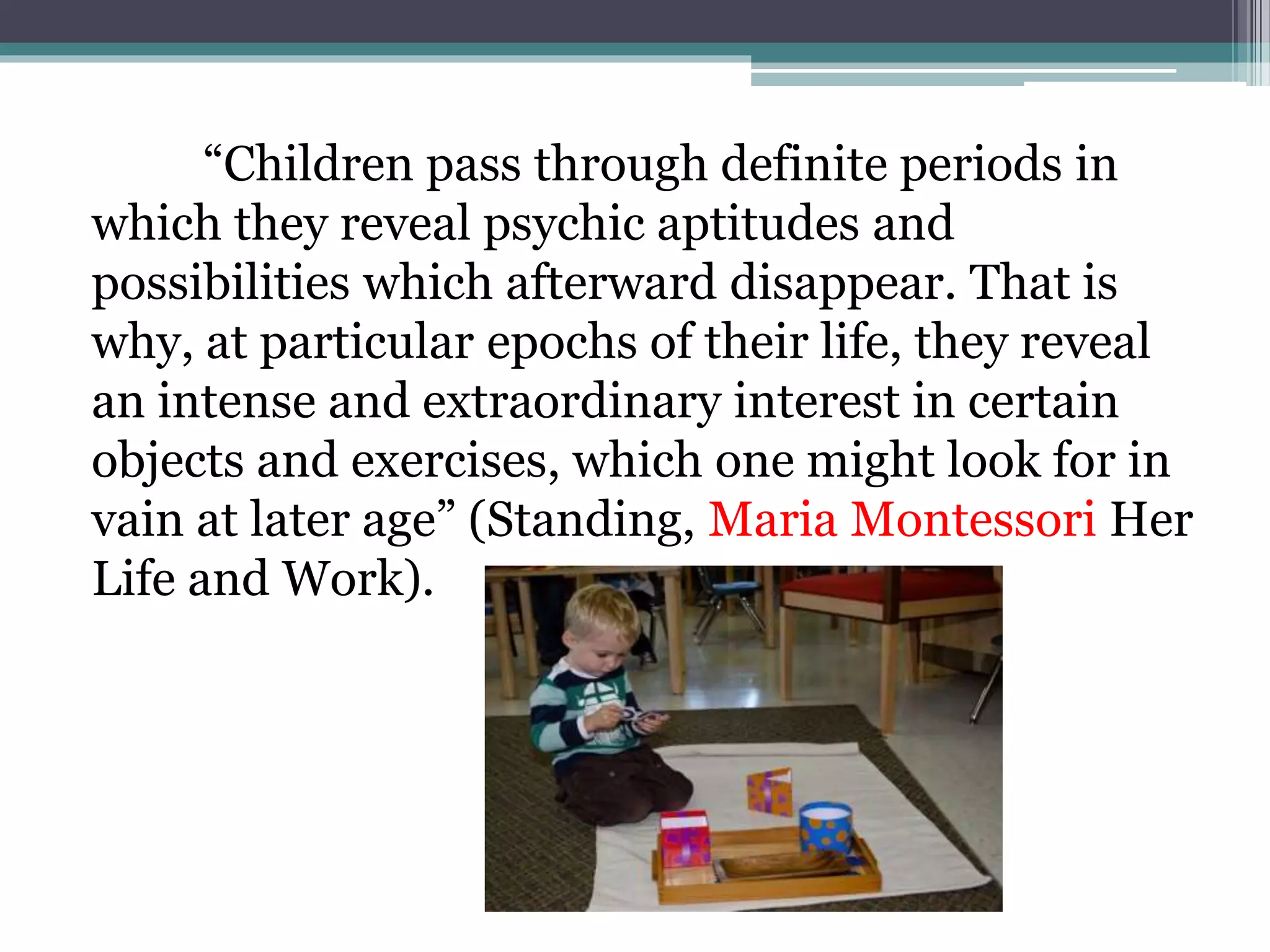
“Children pass through definite periods in
which they reveal psychic aptitudes and
possibilities which afterward disappear. That is
why, at particular epochs of their life, they reveal
an intense and extraordinary interest in certain
objects and exercises, which one might look for in
vain at later age” (Standing, Maria Montessori Her
Life and Work).
Each sensitive period:
• A period of special sensibility and psychical attitudes.
• An overpowering force, interest, or encourages directing the
child to particular qualities and elements in the environment.
• A period of time during which the child centres his or her
attention on specific aspects of the environment, to the
exclusion of all else.
• A passion and a commitment.
• A guide towards creative activities.
• An intense and prolonged period which does not lead to
fatigue or boredom but instead leads to persistent energy and
interest.
• A transitory state; once realized, the sensitive period
disappears.
• Never relived or regained.
The eleven Sensitive Periods
Montessori identified eleven different sensitive periods
occurring from birth through the age of six. The eleven Sensitive
Periods occur from birth through the age of six. While each
continues throughout life, the approximate ages for the onset of
each as a “sensitive period” and its conclusion are indicated
after the general description of each period below:
• Order:
This sensitive period is characterized by a desire for
consistency and repetition. A passionate love for established
routines, children can be deeply disturbed by disorder. The
environment must be carefully organized with a place for
everything and with carefully established ground-rules.
(ages 2-4)
• Movement:
Random movements become coordinated and controlled:
grasping, Touching, turning, balancing, crawling, and walking.(birth-1)
• Small Objects:
Children experience a fixation on small objects and tiny details.
(1- 4)
• Grace and Courtesy:
Imitation of polite and considerate behaviour leads to an
internalization of these qualities into the personality. (2- 6)
• Refinement of the Senses:
A fascination with sensorial experiences (taste, sound, touch,
weight, smell) results in children learning to observe and make
increasingly refined sensorial discriminations. (2- 6)
• Writing:
Children become fascinated with letters and numerals.
They attempt to reproduce these with pencil or pen and paper.
Montessori discovered that writing precedes reading. (3- 4)
• Reading:
Spontaneous interest in the symbolic representations of
the sounds of each letter and in the formation of words. (3- 5)
• Expressive Language:
Use of words to communicate: a progression from
babbling to words to phrases to sentences, with a continuously
expanding vocabulary and comprehension. (birth to 6)
• Spatial Relationships:
Forming impressions about relationships in space: the
design of familiar places, able to find the way around the
neighbourhood, and increasingly able to work complex puzzles.
(4-6)
• Music:
Spontaneous interest in, and the development of, pitch,
rhythm, and melody. (2 - 6)
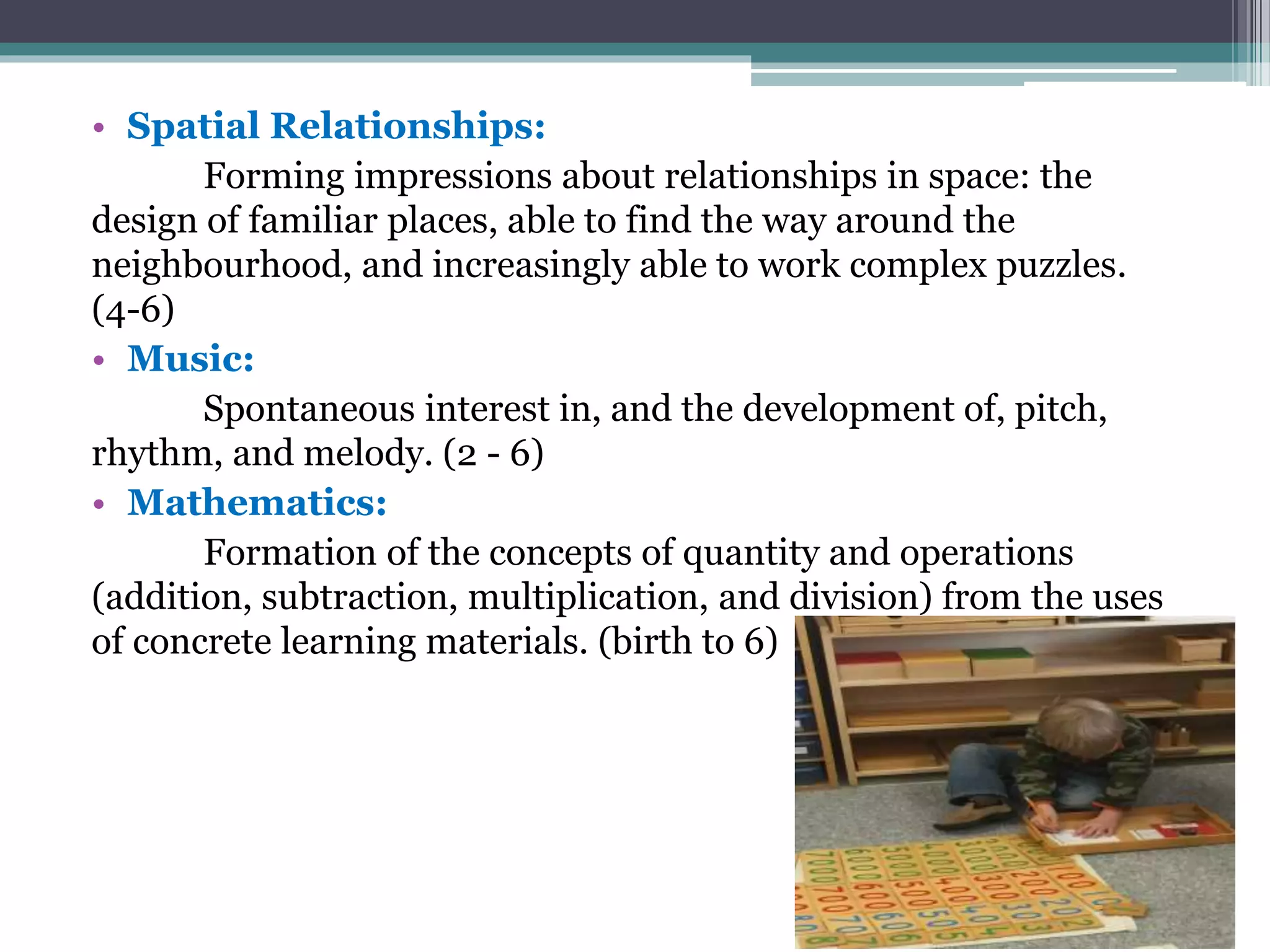
• Mathematics:
Formation of the concepts of quantity and operations
(addition, subtraction, multiplication, and division) from the uses
of concrete learning materials. (birth to 6)
Conclusion:
When the classroom and teacher are child- centered ,
children will learn more, and they will learn with greater
comprehension. When children are allowed to make choices,
move about the classroom, and explore objects that
demonstrate relationships, their academic achievements tend
towards deeper understanding.
Children in our Montessori classrooms enjoy
optimal learning conditions which also offer opportunities to
achieve self-discipline, confidence, and develop proficiencies in
communication and problem solving. How you learn does
influence who you will become.
Montessori Education Sensitive Period

Montessori Education Sensitive Period

  • 1.
    MONTESSORI EDUCATION SENSITIVE PERIOD SUBMITTEDBY, PAVITHRA.P, 19USDH011, II-B.Ed SPECIAL EDUCATION (HI) AND MATHEMATICS.
  • 2.
    Sensitive period: Sensitive periodsare periods of psychological development in the child. This period is a time of limited duration. During the sensitive periods, the child has very powerful capacities. The child is able to do great things and make very important acquisitions, like language and movement. But after some time, these powers disappear.
  • 3.
    “Children pass throughdefinite periods in which they reveal psychic aptitudes and possibilities which afterward disappear. That is why, at particular epochs of their life, they reveal an intense and extraordinary interest in certain objects and exercises, which one might look for in vain at later age” (Standing, Maria Montessori Her Life and Work).
  • 4.
    Each sensitive period: •A period of special sensibility and psychical attitudes. • An overpowering force, interest, or encourages directing the child to particular qualities and elements in the environment. • A period of time during which the child centres his or her attention on specific aspects of the environment, to the exclusion of all else. • A passion and a commitment. • A guide towards creative activities. • An intense and prolonged period which does not lead to fatigue or boredom but instead leads to persistent energy and interest. • A transitory state; once realized, the sensitive period disappears. • Never relived or regained.
  • 5.
    The eleven SensitivePeriods Montessori identified eleven different sensitive periods occurring from birth through the age of six. The eleven Sensitive Periods occur from birth through the age of six. While each continues throughout life, the approximate ages for the onset of each as a “sensitive period” and its conclusion are indicated after the general description of each period below: • Order: This sensitive period is characterized by a desire for consistency and repetition. A passionate love for established routines, children can be deeply disturbed by disorder. The environment must be carefully organized with a place for everything and with carefully established ground-rules. (ages 2-4)
  • 6.
    • Movement: Random movementsbecome coordinated and controlled: grasping, Touching, turning, balancing, crawling, and walking.(birth-1) • Small Objects: Children experience a fixation on small objects and tiny details. (1- 4) • Grace and Courtesy: Imitation of polite and considerate behaviour leads to an internalization of these qualities into the personality. (2- 6) • Refinement of the Senses: A fascination with sensorial experiences (taste, sound, touch, weight, smell) results in children learning to observe and make increasingly refined sensorial discriminations. (2- 6)
  • 7.
    • Writing: Children becomefascinated with letters and numerals. They attempt to reproduce these with pencil or pen and paper. Montessori discovered that writing precedes reading. (3- 4) • Reading: Spontaneous interest in the symbolic representations of the sounds of each letter and in the formation of words. (3- 5) • Expressive Language: Use of words to communicate: a progression from babbling to words to phrases to sentences, with a continuously expanding vocabulary and comprehension. (birth to 6)
  • 8.
    • Spatial Relationships: Formingimpressions about relationships in space: the design of familiar places, able to find the way around the neighbourhood, and increasingly able to work complex puzzles. (4-6) • Music: Spontaneous interest in, and the development of, pitch, rhythm, and melody. (2 - 6) • Mathematics: Formation of the concepts of quantity and operations (addition, subtraction, multiplication, and division) from the uses of concrete learning materials. (birth to 6)
  • 9.
    Conclusion: When the classroomand teacher are child- centered , children will learn more, and they will learn with greater comprehension. When children are allowed to make choices, move about the classroom, and explore objects that demonstrate relationships, their academic achievements tend towards deeper understanding. Children in our Montessori classrooms enjoy optimal learning conditions which also offer opportunities to achieve self-discipline, confidence, and develop proficiencies in communication and problem solving. How you learn does influence who you will become.