Alley, Andrea , Kathleen , Ryan, Gisselle , Jeffrey
                     Team 4
• Developed after the influence of Behaviorism.
• “Cognition: literally means ‘knowing’, and is the mental act
  or process to which knowledge is acquired (Mcleod,S.A.).”
• Cognitive Theory compared our thoughts and recollections
  to our behavior:
  •    Both are tendencies of the individual, and therefore should be
      analyzed as such. (Gary, Shelly B. Pg 371).
• The human mind and the present day computer have a
  synergistic function:
  • Input, store and retrieve information.
  • As humans, we hear/see/do certain things which are placed into our
      memory for us to use this acquired knowledge in the future.
 Dual Coding Theory (Allvan Palvio) : proposes that information is processed through either
  visual images or interpreting language.
          How verbal/ nonverbal information is displayed will effect the influence on the
            individual.
          How the verbal and nonverbal systems are activated in presence of one another
          How text with images can trigger us to store the information
          (Gary, Shelly B, Pg. 372)
 9 events of Instruction (Gagne) : belief that learning depends on
  verbal, information, intellectual skills, attitudes, and cognitive strategies.
    Grabbing the learners attention, displaying the objectives for the learner, activating
      human recall (PREVIEW information- then REVIEW information), introducing new
      information with guidance and direction, participation followed by feedback, evaluate
      their new level of understanding, and continue to increase level of retaining information
 View on Intelligence (Gardner): each individual holds the ability to learn and demonstrate
  through a variety of multiple intelligences.
 Cognitive Domain (Bloom): how we use what we know to form ideas and thoughts.
    Psychomotor Domain: motor skills and physical abilities.
          Bloom’s Taxonomy: is a hierarchy of learning to stimulate student comprehension
              Master Learning: Bloom’s model for learning, where students continue to retain
               more knowledge, only once previous knowledge is mastered.
 Merrill -Component Display Theory (CDT)
 Reigeluth (Elaboration Theory)
 Gagne
 Briggs
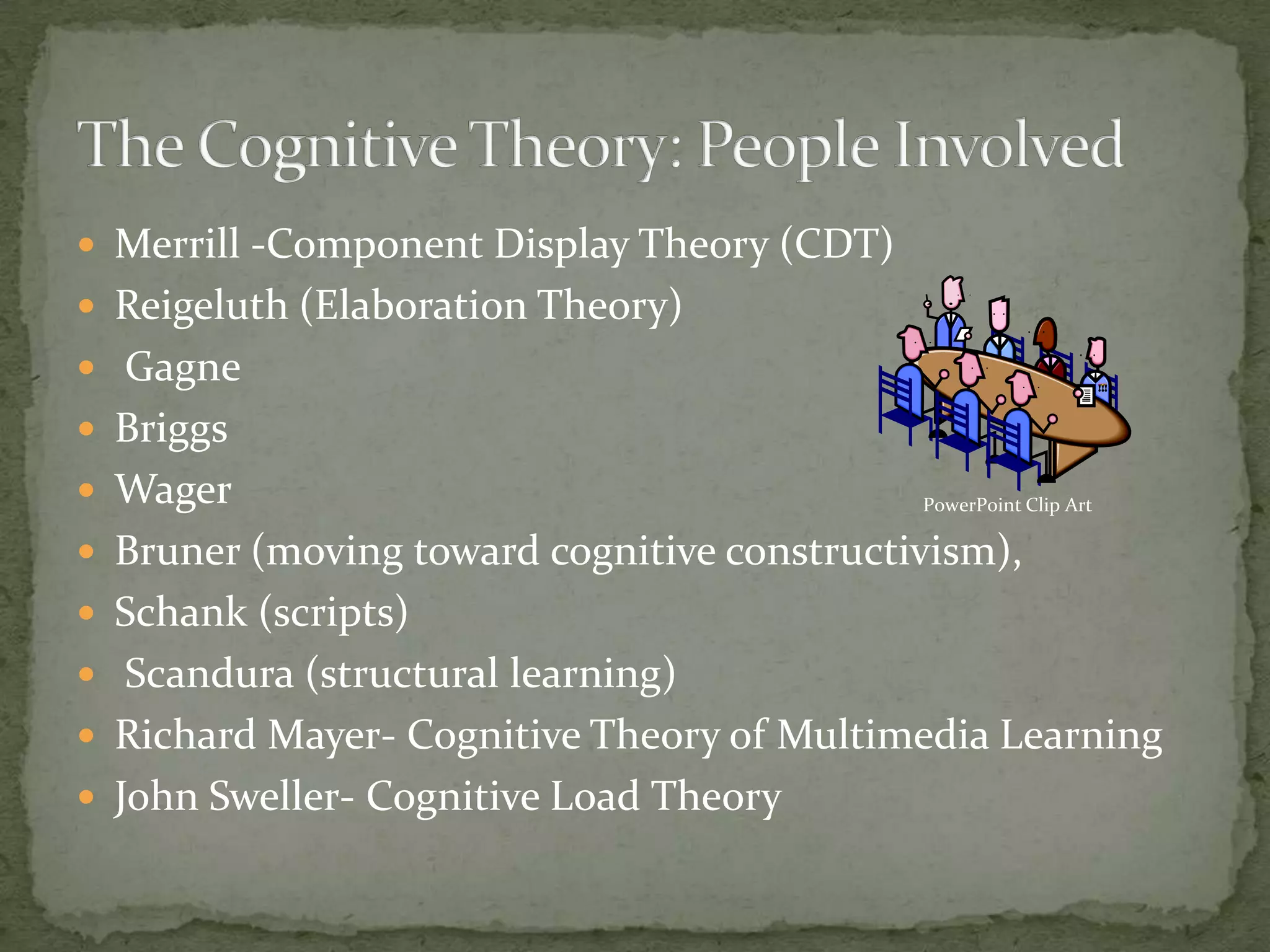
 Wager                                     PowerPoint Clip Art

 Bruner (moving toward cognitive constructivism),
 Schank (scripts)
 Scandura (structural learning)
 Richard Mayer- Cognitive Theory of Multimedia Learning
 John Sweller- Cognitive Load Theory
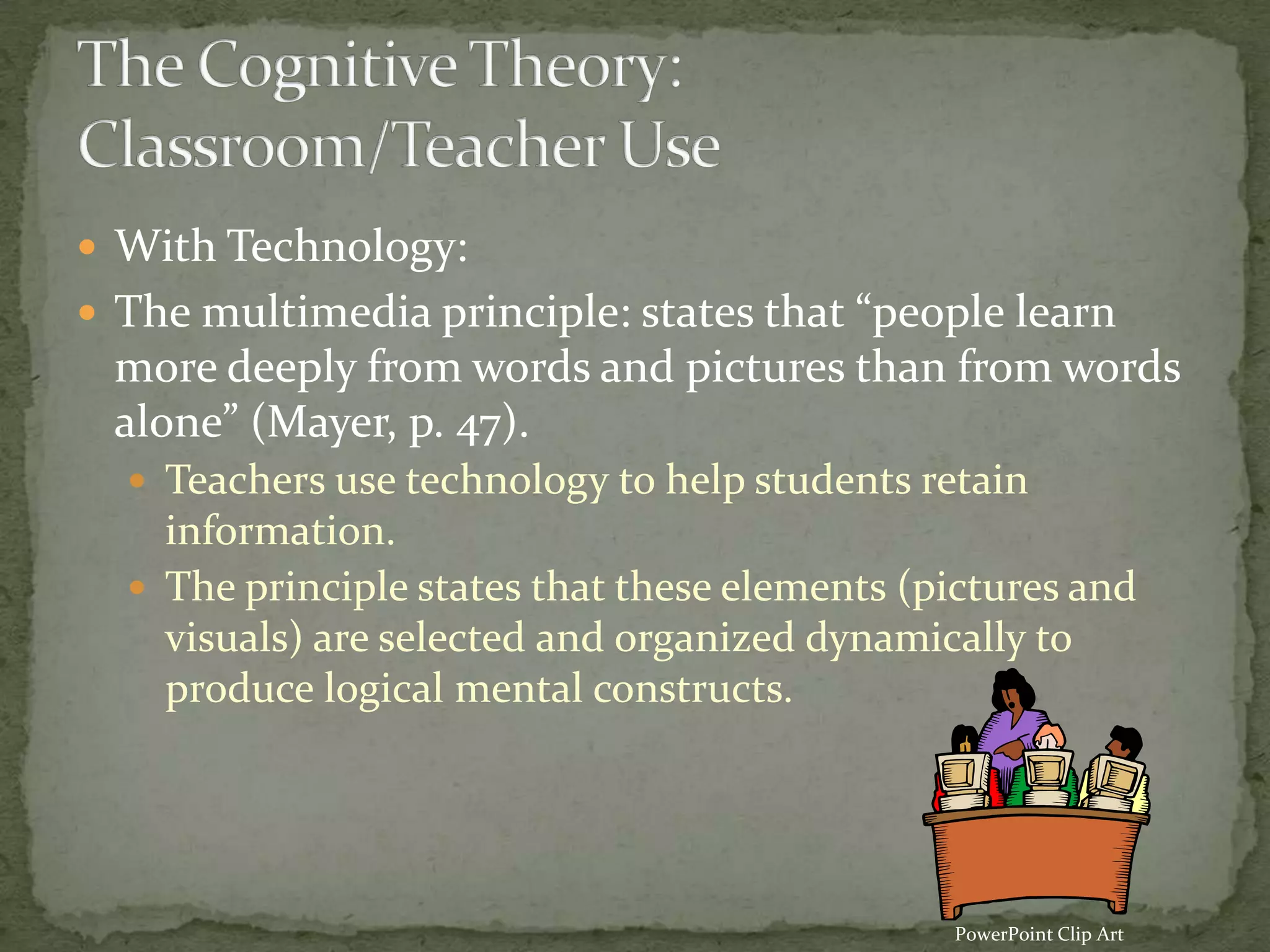
 With Technology:
 The multimedia principle: states that “people learn
 more deeply from words and pictures than from words
 alone” (Mayer, p. 47).
   Teachers use technology to help students retain
    information.
   The principle states that these elements (pictures and
    visuals) are selected and organized dynamically to
    produce logical mental constructs.


                                               PowerPoint Clip Art
 Without Technology:
 Teachers in the classroom will teach students with
  repetition for the students to input the information.
 Information comes in, is processed, and leads to
  certain outcomes.
   Using assessments to see these outcomes is how the
      teacher implements this theory.


  PowerPoint Clip Art
 With Technology:
 Students see what the teacher presents as a visual
 They will then start to process and input the
  information into their memory
 Then they will recall that information when tested on
  that particular visual presentation
 Without Technology:
 Students will use the thought process to successfully
  perform the problem by recalling information that the
  instructor lectured about prior to an assessment.
 They use problem solving, analysis, and then they
  explain the result.


                                     PowerPoint Clip Art
 Using a vocabulary curriculum to allow the students to
  input new information into their brains.
 Giving students formulas to know if in a mathematics-
  based classroom.
 Showing the students different videos (implementing
  technology) and then testing them on what they
  learned.
 Constantly adding new information for the students to
  input into their memory, then reviewing what they
  have learned by assessments.
 "Cognitive Theories." Learning Theories. Web. 20 Nov.
  2011. <http://www.learning-
  theories.com/category/cognitive-theories>.
 Gary, Shelly B. Boston (2010). 6th Edition. Teacher’s
  Discovering Computers; Integrating Technology and
  Digital media in the Classroom.
 Mayer, R. E.; R. Moreno (1998). “A Cognitive Theory of
  Multimedia Learning: Implications for Design
  Principles”.
  http://www.unm.edu/~moreno/PDFS/chi.pdf.
 Mcleod, S. A. (2007). Simply Psychology; Cognitive
  Approach in Psychology. Retrieved 20 November
  2011, from
  http://www.simplypsychology.org/cognitive.html

The Cognitive Theory

  • 1.
    Alley, Andrea ,Kathleen , Ryan, Gisselle , Jeffrey Team 4
  • 2.
    • Developed afterthe influence of Behaviorism. • “Cognition: literally means ‘knowing’, and is the mental act or process to which knowledge is acquired (Mcleod,S.A.).” • Cognitive Theory compared our thoughts and recollections to our behavior: • Both are tendencies of the individual, and therefore should be analyzed as such. (Gary, Shelly B. Pg 371). • The human mind and the present day computer have a synergistic function: • Input, store and retrieve information. • As humans, we hear/see/do certain things which are placed into our memory for us to use this acquired knowledge in the future.
  • 3.
     Dual CodingTheory (Allvan Palvio) : proposes that information is processed through either visual images or interpreting language.  How verbal/ nonverbal information is displayed will effect the influence on the individual.  How the verbal and nonverbal systems are activated in presence of one another  How text with images can trigger us to store the information  (Gary, Shelly B, Pg. 372)  9 events of Instruction (Gagne) : belief that learning depends on verbal, information, intellectual skills, attitudes, and cognitive strategies.  Grabbing the learners attention, displaying the objectives for the learner, activating human recall (PREVIEW information- then REVIEW information), introducing new information with guidance and direction, participation followed by feedback, evaluate their new level of understanding, and continue to increase level of retaining information  View on Intelligence (Gardner): each individual holds the ability to learn and demonstrate through a variety of multiple intelligences.  Cognitive Domain (Bloom): how we use what we know to form ideas and thoughts.  Psychomotor Domain: motor skills and physical abilities.  Bloom’s Taxonomy: is a hierarchy of learning to stimulate student comprehension  Master Learning: Bloom’s model for learning, where students continue to retain more knowledge, only once previous knowledge is mastered.
  • 4.
     Merrill -ComponentDisplay Theory (CDT)  Reigeluth (Elaboration Theory)  Gagne  Briggs  Wager PowerPoint Clip Art  Bruner (moving toward cognitive constructivism),  Schank (scripts)  Scandura (structural learning)  Richard Mayer- Cognitive Theory of Multimedia Learning  John Sweller- Cognitive Load Theory
  • 5.
     With Technology: The multimedia principle: states that “people learn more deeply from words and pictures than from words alone” (Mayer, p. 47).  Teachers use technology to help students retain information.  The principle states that these elements (pictures and visuals) are selected and organized dynamically to produce logical mental constructs. PowerPoint Clip Art
  • 6.
     Without Technology: Teachers in the classroom will teach students with repetition for the students to input the information.  Information comes in, is processed, and leads to certain outcomes.  Using assessments to see these outcomes is how the teacher implements this theory. PowerPoint Clip Art
  • 7.
     With Technology: Students see what the teacher presents as a visual  They will then start to process and input the information into their memory  Then they will recall that information when tested on that particular visual presentation
  • 8.
     Without Technology: Students will use the thought process to successfully perform the problem by recalling information that the instructor lectured about prior to an assessment.  They use problem solving, analysis, and then they explain the result. PowerPoint Clip Art
  • 9.
     Using avocabulary curriculum to allow the students to input new information into their brains.  Giving students formulas to know if in a mathematics- based classroom.  Showing the students different videos (implementing technology) and then testing them on what they learned.  Constantly adding new information for the students to input into their memory, then reviewing what they have learned by assessments.
  • 10.
     "Cognitive Theories."Learning Theories. Web. 20 Nov. 2011. <http://www.learning- theories.com/category/cognitive-theories>.  Gary, Shelly B. Boston (2010). 6th Edition. Teacher’s Discovering Computers; Integrating Technology and Digital media in the Classroom.  Mayer, R. E.; R. Moreno (1998). “A Cognitive Theory of Multimedia Learning: Implications for Design Principles”. http://www.unm.edu/~moreno/PDFS/chi.pdf.  Mcleod, S. A. (2007). Simply Psychology; Cognitive Approach in Psychology. Retrieved 20 November 2011, from http://www.simplypsychology.org/cognitive.html