Information and Network Security: 8
Security Mechanisms
Prof Neeraj Bhargava
Vaibhav Khanna
Department of Computer Science
School of Engineering and Systems Sciences
Maharshi Dayanand Saraswati University Ajmer
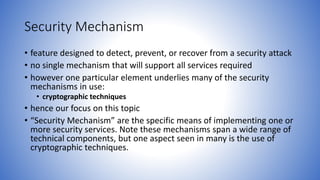
Security Mechanism
• feature designed to detect, prevent, or recover from a security attack
• no single mechanism that will support all services required
• however one particular element underlies many of the security
mechanisms in use:
• cryptographic techniques
• hence our focus on this topic
• “Security Mechanism” are the specific means of implementing one or
more security services. Note these mechanisms span a wide range of
technical components, but one aspect seen in many is the use of
cryptographic techniques.
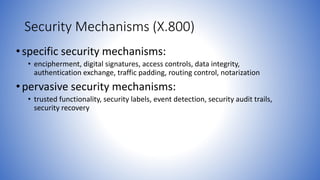
Security Mechanisms (X.800)
•specific security mechanisms:
• encipherment, digital signatures, access controls, data integrity,
authentication exchange, traffic padding, routing control, notarization
•pervasive security mechanisms:
• trusted functionality, security labels, event detection, security audit trails,
security recovery
Security Mechanisms (X.800)
• Some examples of mechanisms from X.800. Note that the “specific
security mechanisms” are protocol layer specific, whilst the “pervasive
security mechanisms” are not.
• We will meet some of these mechanisms in much greater detail later.
Specific security mechanisms
• SPECIFIC SECURITY MECHANISMS
• May be incorporated into the appropriate protocol layer in order to provide
some of the OSI security services.
• Encipherment
• The use of mathematical algorithms to transform data into a form that is
not readily intelligible.The transformation and subsequent recovery of the
data depend on an algorithm and zero or more encryption keys.
Specific security mechanisms
• Digital Signature
• Data appended to, or a cryptographic transformation of, a data unit that allows a
recipient of the data unit to prove the source and integrity of the data unit and
protect against forgery (e.g., by the recipient).
• Access Control
• A variety of mechanisms that enforce access rights to resources.
• Data Integrity
• A variety of mechanisms used to assure the integrity of a data unit or stream of
data units.
Specific security mechanisms
• Authentication Exchange A mechanism intended to ensure the identity of an entity by
means of information exchange.
• Traffic Padding The insertion of bits into gaps in a data stream to frustrate traffic analysis
attempts.
• Routing Control Enables selection of particular physically secure routes for certain data
and allows routing changes, especially when a breach of security is suspected.
• Notarization The use of a trusted third party to assure certain properties of a data
exchange.
Pervasive security mechanisms
• PERVASIVE SECURITY MECHANISMS
• Mechanisms that are not specific to any particular OSI security service or
protocol layer.
• Trusted Functionality That which is perceived to be correct with respect
to some criteria (e.g., as established by a security policy).
• Security Label The marking bound to a resource (which may be a data
unit) that names or designates the security attributes of that resource.
Pervasive security mechanisms
• Event Detection Detection of security-relevant events.
• Security Audit Trail Data collected and potentially used to
facilitate a security audit, which is an independent review and
examination of system records and activities.
• Security Recovery Deals with requests from mechanisms,
such as event handling and management functions, and takes
recovery actions.
Assignment
• What do you understand by security mechanism
• Explain Specific security mechanisms
• Explain Pervasive security mechanisms

Information and network security 8 security mechanisms

  • 1.
    Information and NetworkSecurity: 8 Security Mechanisms Prof Neeraj Bhargava Vaibhav Khanna Department of Computer Science School of Engineering and Systems Sciences Maharshi Dayanand Saraswati University Ajmer
  • 2.
    Security Mechanism • featuredesigned to detect, prevent, or recover from a security attack • no single mechanism that will support all services required • however one particular element underlies many of the security mechanisms in use: • cryptographic techniques • hence our focus on this topic • “Security Mechanism” are the specific means of implementing one or more security services. Note these mechanisms span a wide range of technical components, but one aspect seen in many is the use of cryptographic techniques.
  • 3.
    Security Mechanisms (X.800) •specificsecurity mechanisms: • encipherment, digital signatures, access controls, data integrity, authentication exchange, traffic padding, routing control, notarization •pervasive security mechanisms: • trusted functionality, security labels, event detection, security audit trails, security recovery
  • 4.
    Security Mechanisms (X.800) •Some examples of mechanisms from X.800. Note that the “specific security mechanisms” are protocol layer specific, whilst the “pervasive security mechanisms” are not. • We will meet some of these mechanisms in much greater detail later.
  • 5.
    Specific security mechanisms •SPECIFIC SECURITY MECHANISMS • May be incorporated into the appropriate protocol layer in order to provide some of the OSI security services. • Encipherment • The use of mathematical algorithms to transform data into a form that is not readily intelligible.The transformation and subsequent recovery of the data depend on an algorithm and zero or more encryption keys.
  • 6.
    Specific security mechanisms •Digital Signature • Data appended to, or a cryptographic transformation of, a data unit that allows a recipient of the data unit to prove the source and integrity of the data unit and protect against forgery (e.g., by the recipient). • Access Control • A variety of mechanisms that enforce access rights to resources. • Data Integrity • A variety of mechanisms used to assure the integrity of a data unit or stream of data units.
  • 7.
    Specific security mechanisms •Authentication Exchange A mechanism intended to ensure the identity of an entity by means of information exchange. • Traffic Padding The insertion of bits into gaps in a data stream to frustrate traffic analysis attempts. • Routing Control Enables selection of particular physically secure routes for certain data and allows routing changes, especially when a breach of security is suspected. • Notarization The use of a trusted third party to assure certain properties of a data exchange.
  • 8.
    Pervasive security mechanisms •PERVASIVE SECURITY MECHANISMS • Mechanisms that are not specific to any particular OSI security service or protocol layer. • Trusted Functionality That which is perceived to be correct with respect to some criteria (e.g., as established by a security policy). • Security Label The marking bound to a resource (which may be a data unit) that names or designates the security attributes of that resource.
  • 9.
    Pervasive security mechanisms •Event Detection Detection of security-relevant events. • Security Audit Trail Data collected and potentially used to facilitate a security audit, which is an independent review and examination of system records and activities. • Security Recovery Deals with requests from mechanisms, such as event handling and management functions, and takes recovery actions.
  • 10.
    Assignment • What doyou understand by security mechanism • Explain Specific security mechanisms • Explain Pervasive security mechanisms