60-467 Network Security
Instructor: Dr. Robert D. Kent
Course Description
• This course will introduce students to advanced
topics in network security. Topics will include
encryption and authentication techniques,
detection and analysis of intrusions, and the
security of electronic mail and web access.
(Restricted to Computer Science students)
(Prerequisite: 60-367.)
– Through study of theory and exploration and more
practical application of technologies and techniques
Primary Requirements
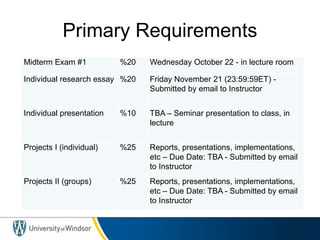
Midterm Exam #1 %20 Wednesday October 22 - in lecture room
Individual research essay %20 Friday November 21 (23:59:59ET) -
Submitted by email to Instructor
Individual presentation %10 TBA – Seminar presentation to class, in
lecture
Projects I (individual) %25 Reports, presentations, implementations,
etc – Due Date: TBA - Submitted by email
to Instructor
Projects II (groups) %25 Reports, presentations, implementations,
etc – Due Date: TBA - Submitted by email
to Instructor
Basic Course Information
• Dr. Kent’s Office hours: MW 10-12noon
– Email: rkent@uwindsor.ca
– Make an appointment if necessary
• Use the Computer Science facilities, web based
resources and your own computing and networking
resources
– Exercise caution when downloading or connecting to some sites
– install reputable security software and heed warnings about
risks with remote sites.
• The course website is:
– http://rkent.myweb.cs.uwindsor.ca/cs467/
Cryptography
and Network
Security
Sixth Edition
by William Stallings
Adapted for 60-467, Robert D. Kent, University of Windsor
Chapter 1
Overview
A bit of Philosophy
“The combination of space, time, and
strength that must be considered as the
basic elements of this theory of defense
makes this a fairly complicated matter.
Consequently, it is not easy to find a fixed
point of departure.”
— On War,
Carl Von Clausewitz
Computer Security
• the protection afforded to an automated
information system in order to attain the
applicable objectives of preserving the
integrity, availability and confidentiality of
information system resources (includes
hardware, software, firmware,
information/data, and telecommunications)
• Computer security targets the variety of threats
and stops them entering on your network.
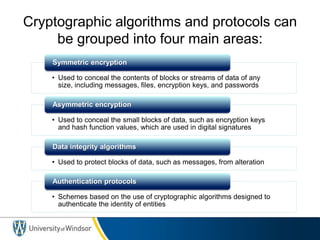
Cryptographic algorithms and protocols can
be grouped into four main areas:
• Used to conceal the contents of blocks or streams of data of any
size, including messages, files, encryption keys, and passwords
Symmetric encryption
• Used to conceal the small blocks of data, such as encryption keys
and hash function values, which are used in digital signatures
Asymmetric encryption
• Used to protect blocks of data, such as messages, from alteration
Data integrity algorithms
• Schemes based on the use of cryptographic algorithms designed to
authenticate the identity of entities
Authentication protocols
Computer Security
• The NIST* Computer Security Handbook
defines the term computer security as:
“the protection afforded to an automated
information system in order to attain the
applicable objectives of preserving the
integrity, availability and confidentiality of
information system resources” (includes
hardware, software, firmware, information/
data, and telecommunications)
* National Institute of Standards and Technology, USA
Computer Security Objectives
• Data confidentiality
• Protection of data from un-authorized disclosure.
• Authentication is the most basic service to ensure that desired permission is well
verified and safe.
• Privacy
• Assures that individuals control or influence what information related to them
may be collected and stored and by whom and to whom that information
may be disclosed
Confidentiality
Contii
• Data integrity
• Assures that information and programs are changed only in a specified and
authorized manner
• System integrity
• Assures that a system performs its intended function in an unimpaired
manner, free from deliberate or inadvertent unauthorized manipulation of the
system
• Assures that a systems work promptly and services is not denied to
authorized users
Integrity
Availability
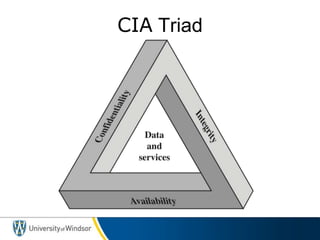
CIA Triad
Possible additional concepts:
Authenticity
• Verifying that users
are who they say
they are and that
each input arriving at
the system came
from a trusted source
Accountability
• The security goal
that generates the
requirement for
actions of an entity to
be traced uniquely to
that entity
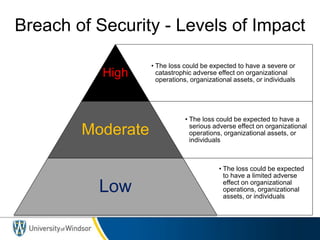
Breach of Security - Levels of Impact
• The loss could be expected to have a severe or
catastrophic adverse effect on organizational
operations, organizational assets, or individuals
High
• The loss could be expected to have a
serious adverse effect on organizational
operations, organizational assets, or
individuals
Moderate
• The loss could be expected
to have a limited adverse
effect on organizational
operations, organizational
assets, or individuals
Low
Computer Security Challenges
• Security is not simple
• Potential attacks on the
security features need to
be considered
• Procedures used to
provide particular services
are often counter-intuitive
• It is necessary to decide
where to use the various
security mechanisms
• Requires constant
monitoring
• Is too often an afterthought
• Security mechanisms
typically involve more than
a particular algorithm or
protocol
• Security is essentially a
battle of wits between a
perpetrator and the
designer
• Little benefit from security
investment is perceived
until a security failure
occurs
• Strong security is often
viewed as an impediment
to efficient and user-
friendly operation
OSI* Security Architecture
• Security attack
– Any action that compromises the security of information
owned by an organization
• Security mechanism
– A process (or a device incorporating such a process)
that is designed to detect, prevent, or recover from a
security attack
• Security service
– A processing or communication service that enhances
the security of the data processing systems and the
information transfers of an organization
– Intended to counter security attacks, and they make use
of one or more security mechanisms to provide the
service
*(OSI) Open Systems Interconnection model
Security Services
• Defined by X.800 as:
• A service provided by a protocol layer of
communicating open systems and that ensures
adequate security of the systems or of data transfers
• Defined by RFC 4949 as:
• A processing or communication service provided by a
system to give a specific kind of protection to system
resources
A central issue for Security Service design and implementation:
Policy and Mechanism ! Policy versus Mechanism ?
X.800 Service Categories
• Authentication
• Access control
• Data confidentiality
• Data integrity
• Non-repudiation
Authentication
– Assurance that communicating entity in one
claimed.
– Authentication is the most basic service is ensure
that desired permission is well verified & safe.
– In the case of a single message, assures the
recipient that the message is from the source that it
claims to be form
– In the case of ongoing interaction, assures the two
entities are authentic and that the connection is not
interfered.
Two specific authentication services are defined in
X.800:
• Peer entity authentication
• Data origin authentication
Access Control
• Prevention of the un-authorized use of a resource.
• This service assures that only the authorized
entities are accessing the resources and prevents
unauthorized access.
• Currently, Authorization is administered locally.
• Distributed Authorization is a significant research
challenge problem.
Data Confidentiality
• The protection of transmitted data from passive attacks
– Broadest service protects all the users data transmitted between
two users over a period of time
• The protection of traffic flow from analysis
– This requires that an attacker not be able to observe the source
and destination, frequency, length, or other characteristics of the
traffic on a communications facility
Data Integrity
Assures that the information's and protocols are
changed only a specified and authorized manner.
Connection-oriented integrity service, one that deals
with a stream of messages, assures that messages
are received as sent with no duplication, insertion,
modification, reordering, or replays
A connectionless integrity service, one that deals
with individual messages without regard to any
larger context, generally provides protection against
message modification only
Nonrepudiation
• Protection against denial by one of the parties in a
communication.
• E.G. - Authentication/Blue Tick Of WhatsApp
Text
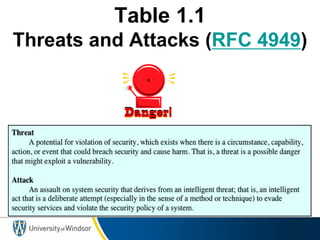
Table 1.1
Threats and Attacks (RFC 4949)
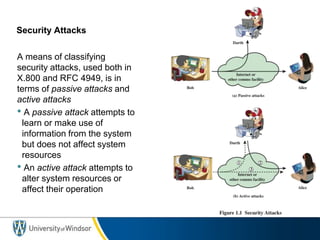
Security Attacks
A means of classifying
security attacks, used both in
X.800 and RFC 4949, is in
terms of passive attacks and
active attacks
• A passive attack attempts to
learn or make use of
information from the system
but does not affect system
resources
• An active attack attempts to
alter system resources or
affect their operation
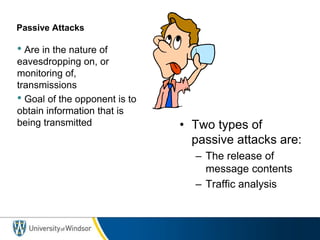
Passive Attacks
• Two types of
passive attacks are:
– The release of
message contents
– Traffic analysis
• Are in the nature of
eavesdropping on, or
monitoring of,
transmissions
• Goal of the opponent is to
obtain information that is
being transmitted
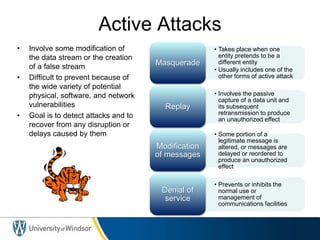
Active Attacks
• Involve some modification of
the data stream or the creation
of a false stream
• Difficult to prevent because of
the wide variety of potential
physical, software, and network
vulnerabilities
• Goal is to detect attacks and to
recover from any disruption or
delays caused by them
• Takes place when one
entity pretends to be a
different entity
• Usually includes one of the
other forms of active attack
Masquerade
• Involves the passive
capture of a data unit and
its subsequent
retransmission to produce
an unauthorized effect
Replay
• Some portion of a
legitimate message is
altered, or messages are
delayed or reordered to
produce an unauthorized
effect
Modification
of messages
• Prevents or inhibits the
normal use or
management of
communications facilities
Denial of
service
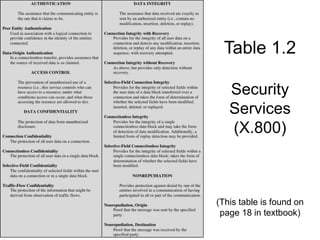
Table 1.2
Security
Services
(X.800)
(This table is found on
page 18 in textbook)
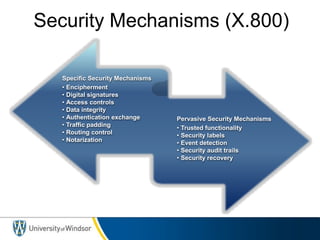
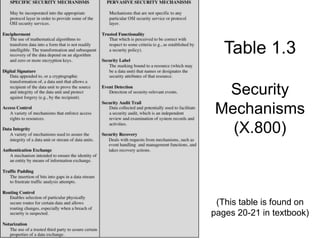
Security Mechanisms (X.800)
Specific Security Mechanisms
• Encipherment
• Digital signatures
• Access controls
• Data integrity
• Authentication exchange
• Traffic padding
• Routing control
• Notarization
Pervasive Security Mechanisms
• Trusted functionality
• Security labels
• Event detection
• Security audit trails
• Security recovery
Table 1.3
Security
Mechanisms
(X.800)
(This table is found on
pages 20-21 in textbook)
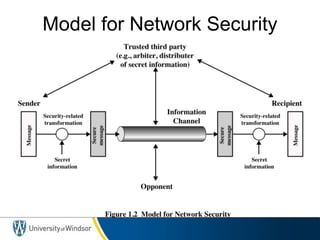
Model for Network Security
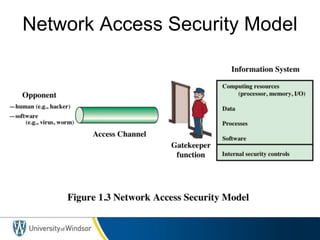
Network Access Security Model
Unwanted Access
• Placement in a computer system of logic
that exploits vulnerabilities in the system and
that can be affect application programs as well
as utility programs such as editors and
compilers
• Programs can present two kinds of threats:
– Information access threats
• Intercept or modify data on behalf of users
who should not have access to that data
– Service threats
• Exploit service flaws in computers to
inhibit use by legitimate users
Summary
• Computer security
concepts
– Definition
– Examples
– Challenges
• The OSI security
architecture
• Security attacks
– Passive attacks
– Active attacks
• Security services
– Authentication
– Access control
– Data confidentiality
– Data integrity
– Nonrepudiation
– Availability service
• Security mechanisms

Ch1 Cryptography network security slides.pptx

  • 1.
  • 2.
    Course Description • Thiscourse will introduce students to advanced topics in network security. Topics will include encryption and authentication techniques, detection and analysis of intrusions, and the security of electronic mail and web access. (Restricted to Computer Science students) (Prerequisite: 60-367.) – Through study of theory and exploration and more practical application of technologies and techniques
  • 3.
    Primary Requirements Midterm Exam#1 %20 Wednesday October 22 - in lecture room Individual research essay %20 Friday November 21 (23:59:59ET) - Submitted by email to Instructor Individual presentation %10 TBA – Seminar presentation to class, in lecture Projects I (individual) %25 Reports, presentations, implementations, etc – Due Date: TBA - Submitted by email to Instructor Projects II (groups) %25 Reports, presentations, implementations, etc – Due Date: TBA - Submitted by email to Instructor
  • 4.
    Basic Course Information •Dr. Kent’s Office hours: MW 10-12noon – Email: rkent@uwindsor.ca – Make an appointment if necessary • Use the Computer Science facilities, web based resources and your own computing and networking resources – Exercise caution when downloading or connecting to some sites – install reputable security software and heed warnings about risks with remote sites. • The course website is: – http://rkent.myweb.cs.uwindsor.ca/cs467/
  • 5.
    Cryptography and Network Security Sixth Edition byWilliam Stallings Adapted for 60-467, Robert D. Kent, University of Windsor
  • 6.
  • 7.
    A bit ofPhilosophy “The combination of space, time, and strength that must be considered as the basic elements of this theory of defense makes this a fairly complicated matter. Consequently, it is not easy to find a fixed point of departure.” — On War, Carl Von Clausewitz
  • 8.
    Computer Security • theprotection afforded to an automated information system in order to attain the applicable objectives of preserving the integrity, availability and confidentiality of information system resources (includes hardware, software, firmware, information/data, and telecommunications) • Computer security targets the variety of threats and stops them entering on your network.
  • 9.
    Cryptographic algorithms andprotocols can be grouped into four main areas: • Used to conceal the contents of blocks or streams of data of any size, including messages, files, encryption keys, and passwords Symmetric encryption • Used to conceal the small blocks of data, such as encryption keys and hash function values, which are used in digital signatures Asymmetric encryption • Used to protect blocks of data, such as messages, from alteration Data integrity algorithms • Schemes based on the use of cryptographic algorithms designed to authenticate the identity of entities Authentication protocols
  • 10.
    Computer Security • TheNIST* Computer Security Handbook defines the term computer security as: “the protection afforded to an automated information system in order to attain the applicable objectives of preserving the integrity, availability and confidentiality of information system resources” (includes hardware, software, firmware, information/ data, and telecommunications) * National Institute of Standards and Technology, USA
  • 11.
    Computer Security Objectives •Data confidentiality • Protection of data from un-authorized disclosure. • Authentication is the most basic service to ensure that desired permission is well verified and safe. • Privacy • Assures that individuals control or influence what information related to them may be collected and stored and by whom and to whom that information may be disclosed Confidentiality
  • 12.
    Contii • Data integrity •Assures that information and programs are changed only in a specified and authorized manner • System integrity • Assures that a system performs its intended function in an unimpaired manner, free from deliberate or inadvertent unauthorized manipulation of the system • Assures that a systems work promptly and services is not denied to authorized users Integrity Availability
  • 13.
  • 14.
    Possible additional concepts: Authenticity •Verifying that users are who they say they are and that each input arriving at the system came from a trusted source Accountability • The security goal that generates the requirement for actions of an entity to be traced uniquely to that entity
  • 15.
    Breach of Security- Levels of Impact • The loss could be expected to have a severe or catastrophic adverse effect on organizational operations, organizational assets, or individuals High • The loss could be expected to have a serious adverse effect on organizational operations, organizational assets, or individuals Moderate • The loss could be expected to have a limited adverse effect on organizational operations, organizational assets, or individuals Low
  • 16.
    Computer Security Challenges •Security is not simple • Potential attacks on the security features need to be considered • Procedures used to provide particular services are often counter-intuitive • It is necessary to decide where to use the various security mechanisms • Requires constant monitoring • Is too often an afterthought • Security mechanisms typically involve more than a particular algorithm or protocol • Security is essentially a battle of wits between a perpetrator and the designer • Little benefit from security investment is perceived until a security failure occurs • Strong security is often viewed as an impediment to efficient and user- friendly operation
  • 17.
    OSI* Security Architecture •Security attack – Any action that compromises the security of information owned by an organization • Security mechanism – A process (or a device incorporating such a process) that is designed to detect, prevent, or recover from a security attack • Security service – A processing or communication service that enhances the security of the data processing systems and the information transfers of an organization – Intended to counter security attacks, and they make use of one or more security mechanisms to provide the service *(OSI) Open Systems Interconnection model
  • 18.
    Security Services • Definedby X.800 as: • A service provided by a protocol layer of communicating open systems and that ensures adequate security of the systems or of data transfers • Defined by RFC 4949 as: • A processing or communication service provided by a system to give a specific kind of protection to system resources A central issue for Security Service design and implementation: Policy and Mechanism ! Policy versus Mechanism ?
  • 19.
    X.800 Service Categories •Authentication • Access control • Data confidentiality • Data integrity • Non-repudiation
  • 20.
    Authentication – Assurance thatcommunicating entity in one claimed. – Authentication is the most basic service is ensure that desired permission is well verified & safe. – In the case of a single message, assures the recipient that the message is from the source that it claims to be form – In the case of ongoing interaction, assures the two entities are authentic and that the connection is not interfered. Two specific authentication services are defined in X.800: • Peer entity authentication • Data origin authentication
  • 21.
    Access Control • Preventionof the un-authorized use of a resource. • This service assures that only the authorized entities are accessing the resources and prevents unauthorized access. • Currently, Authorization is administered locally. • Distributed Authorization is a significant research challenge problem.
  • 22.
    Data Confidentiality • Theprotection of transmitted data from passive attacks – Broadest service protects all the users data transmitted between two users over a period of time • The protection of traffic flow from analysis – This requires that an attacker not be able to observe the source and destination, frequency, length, or other characteristics of the traffic on a communications facility
  • 23.
    Data Integrity Assures thatthe information's and protocols are changed only a specified and authorized manner. Connection-oriented integrity service, one that deals with a stream of messages, assures that messages are received as sent with no duplication, insertion, modification, reordering, or replays A connectionless integrity service, one that deals with individual messages without regard to any larger context, generally provides protection against message modification only
  • 24.
    Nonrepudiation • Protection againstdenial by one of the parties in a communication. • E.G. - Authentication/Blue Tick Of WhatsApp Text
  • 25.
    Table 1.1 Threats andAttacks (RFC 4949)
  • 26.
    Security Attacks A meansof classifying security attacks, used both in X.800 and RFC 4949, is in terms of passive attacks and active attacks • A passive attack attempts to learn or make use of information from the system but does not affect system resources • An active attack attempts to alter system resources or affect their operation
  • 27.
    Passive Attacks • Twotypes of passive attacks are: – The release of message contents – Traffic analysis • Are in the nature of eavesdropping on, or monitoring of, transmissions • Goal of the opponent is to obtain information that is being transmitted
  • 28.
    Active Attacks • Involvesome modification of the data stream or the creation of a false stream • Difficult to prevent because of the wide variety of potential physical, software, and network vulnerabilities • Goal is to detect attacks and to recover from any disruption or delays caused by them • Takes place when one entity pretends to be a different entity • Usually includes one of the other forms of active attack Masquerade • Involves the passive capture of a data unit and its subsequent retransmission to produce an unauthorized effect Replay • Some portion of a legitimate message is altered, or messages are delayed or reordered to produce an unauthorized effect Modification of messages • Prevents or inhibits the normal use or management of communications facilities Denial of service
  • 29.
    Table 1.2 Security Services (X.800) (This tableis found on page 18 in textbook)
  • 30.
    Security Mechanisms (X.800) SpecificSecurity Mechanisms • Encipherment • Digital signatures • Access controls • Data integrity • Authentication exchange • Traffic padding • Routing control • Notarization Pervasive Security Mechanisms • Trusted functionality • Security labels • Event detection • Security audit trails • Security recovery
  • 31.
    Table 1.3 Security Mechanisms (X.800) (This tableis found on pages 20-21 in textbook)
  • 32.
  • 33.
  • 34.
    Unwanted Access • Placementin a computer system of logic that exploits vulnerabilities in the system and that can be affect application programs as well as utility programs such as editors and compilers • Programs can present two kinds of threats: – Information access threats • Intercept or modify data on behalf of users who should not have access to that data – Service threats • Exploit service flaws in computers to inhibit use by legitimate users
  • 35.
    Summary • Computer security concepts –Definition – Examples – Challenges • The OSI security architecture • Security attacks – Passive attacks – Active attacks • Security services – Authentication – Access control – Data confidentiality – Data integrity – Nonrepudiation – Availability service • Security mechanisms