Database Management
Systems
Unit-7
Database Security
Topics to be covered
• Introduction
• Authentication and Authorization
• Data encryption
• Access control
• DAC (Discretionary access control)
• MAC (Mandatory access control)
• RBAC models
• Intrusion detection
• SQL injection
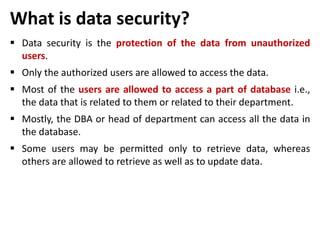
What is data security?
 Data security is the protection of the data from unauthorized
users.
 Only the authorized users are allowed to access the data.
 Most of the users are allowed to access a part of database i.e.,
the data that is related to them or related to their department.
 Mostly, the DBA or head of department can access all the data in
the database.
 Some users may be permitted only to retrieve data, whereas
others are allowed to retrieve as well as to update data.
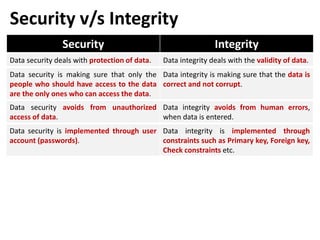
Security v/s Integrity
Security Integrity
Data security deals with protection of data. Data integrity deals with the validity of data.
Data security is making sure that only the
people who should have access to the data
are the only ones who can access the data.
Data integrity is making sure that the data is
correct and not corrupt.
Data security avoids from unauthorized
access of data.
Data integrity avoids from human errors,
when data is entered.
Data security is implemented through user
account (passwords).
Data integrity is implemented through
constraints such as Primary key, Foreign key,
Check constraints etc.
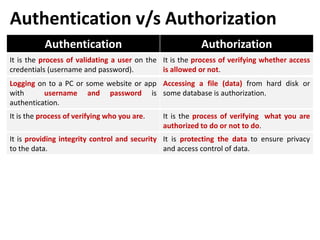
Authentication v/s Authorization
Authentication Authorization
Logging on to a PC or some website or app
with username and password is
authentication.
Accessing a file (data) from hard disk or
some database is authorization.
It is the process of verifying who you are. It is the process of verifying what you are
authorized to do or not to do.
It is providing integrity control and security
to the data.
It is protecting the data to ensure privacy
and access control of data.
It is the process of validating a user on the
credentials (username and password).
It is the process of verifying whether access
is allowed or not.
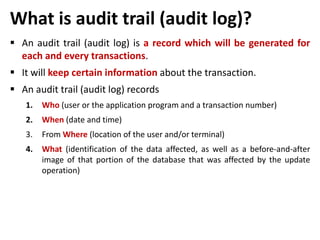
What is audit trail (audit log)?
 An audit trail (audit log) is a record which will be generated for
each and every transactions.
 It will keep certain information about the transaction.
 An audit trail (audit log) records
1. Who (user or the application program and a transaction number)
2. When (date and time)
3. From Where (location of the user and/or terminal)
4. What (identification of the data affected, as well as a before-and-after
image of that portion of the database that was affected by the update
operation)
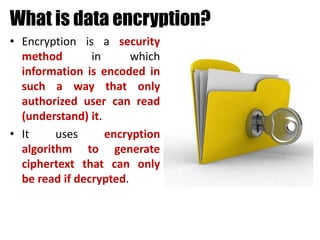
• Encryption is a security
method in which
information is encoded in
such a way that only
authorized user can read
(understand) it.
• It uses encryption
algorithm to generate
ciphertext that can only
be read if decrypted.
What is data encryption?
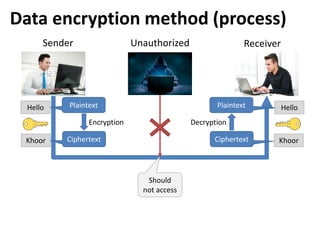
Data encryption method (process)
Sender Receiver
Unauthorized
Hello
Khoor
Hello
Khoor
Plaintext
Ciphertext
Should
not access
Plaintext
Ciphertext
Encryption Decryption
What is data encryption?
 Data encryption is the process of encoding (translating) a
message or information in such a way that only authorized
persons can access it and those who are not authorized cannot.
 Encryption is the process of translating plaintext data (plaintext)
into something that appears to be meaningless (ciphertext).
 Decryption is the process of converting ciphertext back to
plaintext.
Types of Encryption
 There are two types of encryptions schemes:
1. Symmetric key encryption / Private key encryption
2. Asymmetric key encryption / Public key encryption
Types of Encryption
 Symmetric key encryption
• Encryption and decryption keys are the same.
• The same key is used by the sender to encrypt the data, and again by the
receiver to decrypt the data.
• Symmetric key encryption is fast in execution.
 Asymmetric key encryption
• Encryption and decryption keys are the different (Public Key and Private
Key).
• Messages are encrypted by sender with one key (Public Key) and can be
decrypted by receiver only by the other key (Private Key).
• Asymmetric key encryption is slow in execution due to the high
computational burden.
Access control methods of data security
 There are two different methods of data access control:
1. Discretionary access control
2. Mandatory access control
Discretionary access control
 In discretionary access control (DAC), the owner of the object
specifies (decides) which subjects (user) can access the object.
 In this method a single user can have different rights on different
objects, as well as different user can have different rights on the
same objects.
 SQL support discretionary access control through the GRANT and
REVOKE commands.
 GRANT
• This command gives rights to user for an object.
• Syntax:- GRANT privilege ON object TO user [WITH GRANT OPTION]
 REVOKE
• This command takes back rights from user for an object.
• Syntax:- REVOKE privilege ON object FROM user {RESTRICT/CASCADE}
Mandatory access control
 In this method individual user cannot get rights.
 But all the users as well as all the objects are classified into
different categories.
 Each user is assigned a clearance level and each object is
assigned a security level.
 A user can access object of particular security level only if he has
proper clearance level.
 The DBMS (system) determines whether the given user can read
or write a given object based on some rules.
 This rule makes sure that sensitive data can never be passed to a
user without necessary clearance.
Mandatory access control
 Mandatory access control technique for multi-level security uses
four components as given below:
1. Subjects:- Such as users, accounts, programs etc.
2. Objects:- Such as relation (table), tuples (records), attribute (column),
view etc.
3. Clearance level:- Such as top secret (TS), secret (S), confidential (C),
Unclassified (U). Each subject is classified into one of these four classes.
4. Security level:- Such as top secret (TS), secret (S), confidential (C),
Unclassified (U). Each object is classified into one of these four classes.
 In the above system TS>S>C>U, where TS>S means class TS object
is more sensitive than class S object.
Mandatory access control rules
 A user can access data by following two rules
1. Security property:-
• Security property states that a subject at a given security level may not
read an object at a higher security level.
2. Star (*) security property:-
• Star (*) property states that a subject at a given security level may not
write to any object at a lower security level.
Role based access control (RBAC) rules
 It restricts database access based on a person's role within an
organization. The roles in RBAC refer to the levels of access that
employees have to the network.
 Employees are only allowed to access the information necessary
to effectively perform their job duties.
 Access can be based on several factors, such as authority,
responsibility, and job competency.
 In addition, access to computer resources can be limited to
specific tasks such as the ability to view, create, or modify a file.
 Lower-level employees usually do not have access to sensitive
data if they do not need it to fulfil their responsibilities.
 Using RBAC will help in securing your company’s sensitive data
and important applications.
Intrusion detection
 An Intrusion Detection System (IDS) is a system or software
application that monitors network traffic or system for suspicious
activity or policy violations and issues alerts when such activity is
discovered.
 It is a software application that scans a network or a system for
harmful activity or policy breaching.
 Any malicious venture or violation is normally reported either to
an administrator or collected centrally using a security
information and event management (SIEM) system.
 A SIEM system integrates outputs from multiple sources and uses
alarm filtering techniques to differentiate malicious activity from
false alarms.
SQL injection
 SQL injection, also known as SQLI, is a
common attack vector that uses
malicious SQL code for backend database
manipulation to access information that
was not intended to be displayed.
 This information may include any number
of items, including sensitive company
data, user lists or private customer
details.
 A successful attack may result in the
unauthorized viewing of user lists, the
deletion of entire tables, gaining
administrative rights to a database, all of
which are highly detrimental to a
business.
Questions asked in GTU
1. Describe GRANT and REVOKE commands with suitable example.
2. What is difference between authorization and authentication?
Explain the use of audit trail.
3. Explain data encryption with its types.
4. Differentiate discretionary access control and mandatory access
control.
5. What is the difference between data security and data integrity?

Database managementsystemes_Unit-7.pptxe

  • 1.
  • 2.
    Topics to becovered • Introduction • Authentication and Authorization • Data encryption • Access control • DAC (Discretionary access control) • MAC (Mandatory access control) • RBAC models • Intrusion detection • SQL injection
  • 3.
    What is datasecurity?  Data security is the protection of the data from unauthorized users.  Only the authorized users are allowed to access the data.  Most of the users are allowed to access a part of database i.e., the data that is related to them or related to their department.  Mostly, the DBA or head of department can access all the data in the database.  Some users may be permitted only to retrieve data, whereas others are allowed to retrieve as well as to update data.
  • 4.
    Security v/s Integrity SecurityIntegrity Data security deals with protection of data. Data integrity deals with the validity of data. Data security is making sure that only the people who should have access to the data are the only ones who can access the data. Data integrity is making sure that the data is correct and not corrupt. Data security avoids from unauthorized access of data. Data integrity avoids from human errors, when data is entered. Data security is implemented through user account (passwords). Data integrity is implemented through constraints such as Primary key, Foreign key, Check constraints etc.
  • 5.
    Authentication v/s Authorization AuthenticationAuthorization Logging on to a PC or some website or app with username and password is authentication. Accessing a file (data) from hard disk or some database is authorization. It is the process of verifying who you are. It is the process of verifying what you are authorized to do or not to do. It is providing integrity control and security to the data. It is protecting the data to ensure privacy and access control of data. It is the process of validating a user on the credentials (username and password). It is the process of verifying whether access is allowed or not.
  • 6.
    What is audittrail (audit log)?  An audit trail (audit log) is a record which will be generated for each and every transactions.  It will keep certain information about the transaction.  An audit trail (audit log) records 1. Who (user or the application program and a transaction number) 2. When (date and time) 3. From Where (location of the user and/or terminal) 4. What (identification of the data affected, as well as a before-and-after image of that portion of the database that was affected by the update operation)
  • 7.
    • Encryption isa security method in which information is encoded in such a way that only authorized user can read (understand) it. • It uses encryption algorithm to generate ciphertext that can only be read if decrypted. What is data encryption?
  • 8.
    Data encryption method(process) Sender Receiver Unauthorized Hello Khoor Hello Khoor Plaintext Ciphertext Should not access Plaintext Ciphertext Encryption Decryption
  • 9.
    What is dataencryption?  Data encryption is the process of encoding (translating) a message or information in such a way that only authorized persons can access it and those who are not authorized cannot.  Encryption is the process of translating plaintext data (plaintext) into something that appears to be meaningless (ciphertext).  Decryption is the process of converting ciphertext back to plaintext.
  • 10.
    Types of Encryption There are two types of encryptions schemes: 1. Symmetric key encryption / Private key encryption 2. Asymmetric key encryption / Public key encryption
  • 11.
    Types of Encryption Symmetric key encryption • Encryption and decryption keys are the same. • The same key is used by the sender to encrypt the data, and again by the receiver to decrypt the data. • Symmetric key encryption is fast in execution.  Asymmetric key encryption • Encryption and decryption keys are the different (Public Key and Private Key). • Messages are encrypted by sender with one key (Public Key) and can be decrypted by receiver only by the other key (Private Key). • Asymmetric key encryption is slow in execution due to the high computational burden.
  • 12.
    Access control methodsof data security  There are two different methods of data access control: 1. Discretionary access control 2. Mandatory access control
  • 13.
    Discretionary access control In discretionary access control (DAC), the owner of the object specifies (decides) which subjects (user) can access the object.  In this method a single user can have different rights on different objects, as well as different user can have different rights on the same objects.  SQL support discretionary access control through the GRANT and REVOKE commands.  GRANT • This command gives rights to user for an object. • Syntax:- GRANT privilege ON object TO user [WITH GRANT OPTION]  REVOKE • This command takes back rights from user for an object. • Syntax:- REVOKE privilege ON object FROM user {RESTRICT/CASCADE}
  • 14.
    Mandatory access control In this method individual user cannot get rights.  But all the users as well as all the objects are classified into different categories.  Each user is assigned a clearance level and each object is assigned a security level.  A user can access object of particular security level only if he has proper clearance level.  The DBMS (system) determines whether the given user can read or write a given object based on some rules.  This rule makes sure that sensitive data can never be passed to a user without necessary clearance.
  • 15.
    Mandatory access control Mandatory access control technique for multi-level security uses four components as given below: 1. Subjects:- Such as users, accounts, programs etc. 2. Objects:- Such as relation (table), tuples (records), attribute (column), view etc. 3. Clearance level:- Such as top secret (TS), secret (S), confidential (C), Unclassified (U). Each subject is classified into one of these four classes. 4. Security level:- Such as top secret (TS), secret (S), confidential (C), Unclassified (U). Each object is classified into one of these four classes.  In the above system TS>S>C>U, where TS>S means class TS object is more sensitive than class S object.
  • 16.
    Mandatory access controlrules  A user can access data by following two rules 1. Security property:- • Security property states that a subject at a given security level may not read an object at a higher security level. 2. Star (*) security property:- • Star (*) property states that a subject at a given security level may not write to any object at a lower security level.
  • 17.
    Role based accesscontrol (RBAC) rules  It restricts database access based on a person's role within an organization. The roles in RBAC refer to the levels of access that employees have to the network.  Employees are only allowed to access the information necessary to effectively perform their job duties.  Access can be based on several factors, such as authority, responsibility, and job competency.  In addition, access to computer resources can be limited to specific tasks such as the ability to view, create, or modify a file.  Lower-level employees usually do not have access to sensitive data if they do not need it to fulfil their responsibilities.  Using RBAC will help in securing your company’s sensitive data and important applications.
  • 18.
    Intrusion detection  AnIntrusion Detection System (IDS) is a system or software application that monitors network traffic or system for suspicious activity or policy violations and issues alerts when such activity is discovered.  It is a software application that scans a network or a system for harmful activity or policy breaching.  Any malicious venture or violation is normally reported either to an administrator or collected centrally using a security information and event management (SIEM) system.  A SIEM system integrates outputs from multiple sources and uses alarm filtering techniques to differentiate malicious activity from false alarms.
  • 19.
    SQL injection  SQLinjection, also known as SQLI, is a common attack vector that uses malicious SQL code for backend database manipulation to access information that was not intended to be displayed.  This information may include any number of items, including sensitive company data, user lists or private customer details.  A successful attack may result in the unauthorized viewing of user lists, the deletion of entire tables, gaining administrative rights to a database, all of which are highly detrimental to a business.
  • 20.
    Questions asked inGTU 1. Describe GRANT and REVOKE commands with suitable example. 2. What is difference between authorization and authentication? Explain the use of audit trail. 3. Explain data encryption with its types. 4. Differentiate discretionary access control and mandatory access control. 5. What is the difference between data security and data integrity?