Dr. Tasneem Bashir
Internal Medicine Resident PGY4
 Definition & Classification
 Risk factors
 Pathophysiology
 Clinical manifestations
 Approach to diagnosis
 Differential diagnosis
 Treatment
Topics
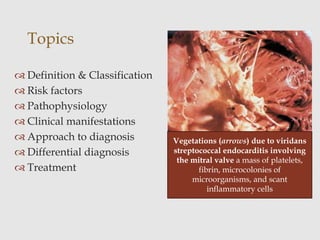
Vegetations (arrows) due to viridans
streptococcal endocarditis involving
the mitral valve a mass of platelets,
fibrin, microcolonies of
microorganisms, and scant
inflammatory cells

 (IE) is the infection of the endocardial surface of the heart
 Usually refers to infection of one or more heart valves
or infection of an intracardiac device.
 Caused by a wide variety of bacteria and fungi.
 Incidence: between 2 and 6 cases per 100,000 person-years
 Clearly higher incidence in patients with underlying valvular heart
diseases and those with intravenous drug abuse (IVDA).
 Invasive procedures performed may cause bloodstream infections
and result in endocarditis.
Definition:

Clasification:
 Provides therapeutic and prognostic insight
 Acute endocarditis is a hectically febrile illness that rapidly damages
cardiac structures, seeds extracardiac sites, and, if untreated,
progresses to death within weeks.
 Subacute endocarditis follows an indolent course; causes structural
cardiac damage only slowly, if at all; rarely metastasizes; and is
gradually progressive unless complicated by a major embolic event
or a ruptured mycotic aneurysm.
 Chronic endocarditis.
 Although historically rheumatic valvulitis was considered a frequent
predisposing factor for endocarditis, times have changed. Mitral valve
prolapse, aortic sclerosis, and bicuspid aortic valvular heart disease
are now more frequent causes.
 In addition, prosthetic valvular heart disease accounts for about one
third of all cases of endocarditis, and occurs in 1% to 3% of patients
after valvular heart surgery, risk is higher in first 6 to 12 months after
valve replacement.
Risk factors:
 Risk is similar for mechanical and bioprosthetic devices.
 In developed countries, 25–35% of cases of native valve endocarditis
(NVE) that affects the ‘natural’ valves are associated with health care,
and 16–30% of all cases of endocarditis involve prosthetic valves.

 Other risk factors include previous IE, age >60 years, male gender,
poor dentition/or dental infections, chronic hemodialysis & HIV
specially in IVDA, poorly controlled diabetes.
 Uncertain. It is believed that cardiac valves and other
endocardial surfaces become infected after exposure to
microemboli from bacteria or fungi circulating in the
bloodstream.
 Few bacteria have a virulence factor that promotes
adherence to endovascular surfaces, others produce a
biofilm on prosthetic surfaces, which also promotes
adherence.
Pathophysiology
 Some bacteria lack recognized adherence factors, and
appear less likely to cause endocarditis. Endocardial
surfaces previously damaged from valvular heart
disease, endocarditis, surgery, or pacemaker wires
provide a favorable environment for thrombus
formation.
 Over time, microorganisms proliferate in the
thrombus, resulting in a classic vegetation.
Microorganisms are released into the circulation,
usually on a continuous basis, which often results in
interesting findings.

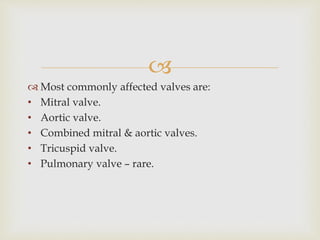
 Most commonly affected valves are:
• Mitral valve.
• Aortic valve.
• Combined mitral & aortic valves.
• Tricuspid valve.
• Pulmonary valve – rare.

 Highly variable, identified with thorough H&P.
 IE may present as an acute, rapidly progressive infection or as a
subacute or chronic disease with low-grade fever and non specific
symptoms.
 Fever is the most common symptom of IE (90% of cases); it is often
associated with chills, anorexia, and weight loss.
 Other symptoms of IE include malaise, headache, myalgias,
arthralgias, night sweats, abdominal pain, dyspnea, cough, and
pleuritic pain.
 Cardiac murmurs are observed in approximately 85%of patients.
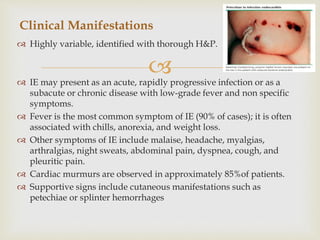
 Supportive signs include cutaneous manifestations such as
petechiae or splinter hemorrhages
Clinical Manifestations
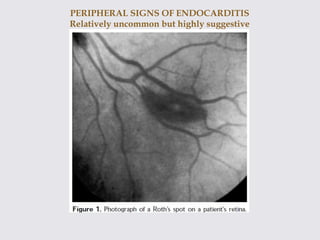
PERIPHERAL SIGNS OF ENDOCARDITIS
Relatively uncommon but highly suggestive

 Clinical manifestations reflecting complications of IE
may be present at the time of initial presentation
and/or may develop subsequently. When present,
such findings warrant independent diagnostic
evaluation, concurrent with evaluation for IE.

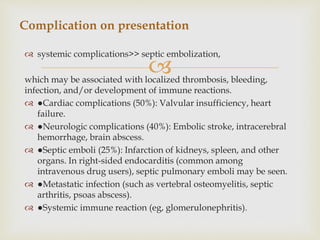
 systemic complications>> septic embolization,
which may be associated with localized thrombosis, bleeding,
infection, and/or development of immune reactions.
 ●Cardiac complications (50%): Valvular insufficiency, heart
failure.
 ●Neurologic complications (40%): Embolic stroke, intracerebral
hemorrhage, brain abscess.
 ●Septic emboli (25%): Infarction of kidneys, spleen, and other
organs. In right-sided endocarditis (common among
intravenous drug users), septic pulmonary emboli may be seen.
 ●Metastatic infection (such as vertebral osteomyelitis, septic
arthritis, psoas abscess).
 ●Systemic immune reaction (eg, glomerulonephritis).
Complication on presentation

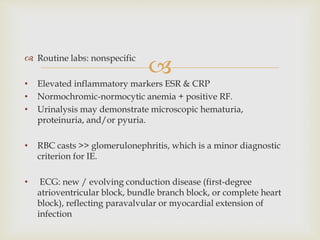
 Routine labs: nonspecific
• Elevated inflammatory markers ESR & CRP
• Normochromic-normocytic anemia + positive RF.
• Urinalysis may demonstrate microscopic hematuria,
proteinuria, and/or pyuria.
• RBC casts >> glomerulonephritis, which is a minor diagnostic
criterion for IE.
• ECG: new / evolving conduction disease (first-degree
atrioventricular block, bundle branch block, or complete heart
block), reflecting paravalvular or myocardial extension of
infection

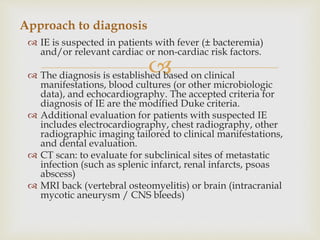
 IE is suspected in patients with fever (± bacteremia)
and/or relevant cardiac or non-cardiac risk factors.
 The diagnosis is established based on clinical
manifestations, blood cultures (or other microbiologic
data), and echocardiography. The accepted criteria for
diagnosis of IE are the modified Duke criteria.
 Additional evaluation for patients with suspected IE
includes electrocardiography, chest radiography, other
radiographic imaging tailored to clinical manifestations,
and dental evaluation.
 CT scan: to evaluate for subclinical sites of metastatic
infection (such as splenic infarct, renal infarcts, psoas
abscess)
 MRI back (vertebral osteomyelitis) or brain (intracranial
mycotic aneurysm / CNS bleeds)
Approach to diagnosis
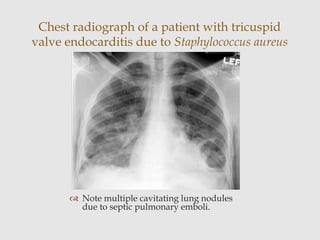
 Note multiple cavitating lung nodules
due to septic pulmonary emboli.
Chest radiograph of a patient with tricuspid
valve endocarditis due to Staphylococcus aureus

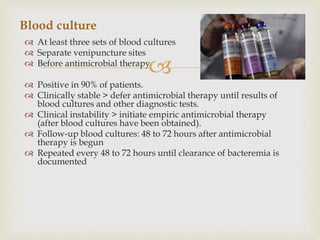
 At least three sets of blood cultures
 Separate venipuncture sites
 Before antimicrobial therapy
 Positive in 90% of patients.
 Clinically stable > defer antimicrobial therapy until results of
blood cultures and other diagnostic tests.
 Clinical instability > initiate empiric antimicrobial therapy
(after blood cultures have been obtained).
 Follow-up blood cultures: 48 to 72 hours after antimicrobial
therapy is begun
 Repeated every 48 to 72 hours until clearance of bacteremia is
documented
Blood culture

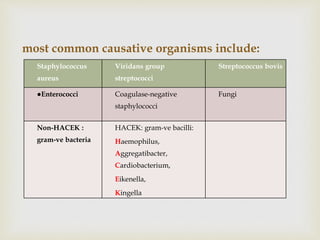
most common causative organisms include:
Staphylococcus
aureus
Viridans group
streptococci
Streptococcus bovis
●Enterococci Coagulase-negative
staphylococci
Fungi
Non-HACEK :
gram-ve bacteria
HACEK: gram-ve bacilli:
Haemophilus,
Aggregatibacter,
Cardiobacterium,
Eikenella,
Kingella

 NVE is mostly caused by the bacteria Streptococcus (70% of the
cases) and Staphylococcus (25% of the cases).
 Early Prosthetic Valve Endocarditis is usually caused by
Staphylococcus sp. It can also be caused by Corynebacterium,
Legionella, and HACEK group of gram-negative bacteria, and
fungus including Candida and Aspergillus
 Late Prosthetic Valve Endocarditis is usually caused by the
bacterial species Streptococcus

 Culture-negative endocarditis: no definitive microbiologic
etiology following inoculation of 3+ independently
obtained blood samples in a standard blood-culture
system, with -ve cultures after 5 days of incubation and
subculturing.
 suspected in patients with:
• negative blood cultures
• persistent fever
• one or more clinical findings consistent with IE (eg,
stroke/emboli)
• vegetation on echocardiogram
• no clear microbiologic diagnosis
 Some causes of culture-negative IE may be identified via
serology or polymerase chain reaction (PCR); these
include Coxiella burnetii, Bartonella spp, Chlamydia spp,
Legionella spp, Mycoplasma, and Brucella

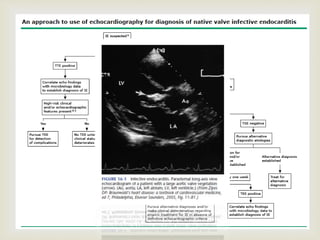
 Should be performed in all patients with suspected
IE.
 In general, TTE is the first diagnostic test for patients
with suspected IE.
 TEE has higher sensitivity than TTE and is better for
detection of cardiac complications such as abscess,
leaflet perforation, and pseudoaneurysm.
 In some circumstances, it is reasonable to forgo TTE
and proceed to TEE.
Echocardiography


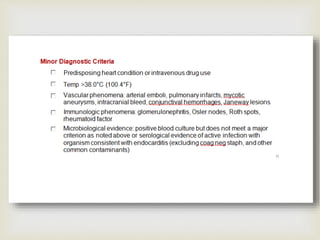
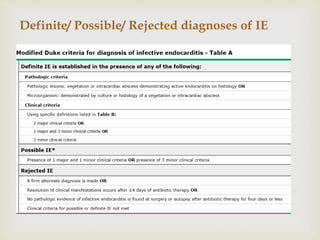
 Endocarditis is usually diagnosed using Duke’s diagnostic
criteria for endocarditis, which consists of a combination of
major criteria and minor criteria. A definitive diagnosis should
satisfy any of the following conditions:
 The presence of any 2 major criteria
 The presence of 1 major criterion and 3 minor criteria
 The presence of 5 minor criteria
Clinical diagnosis of IE



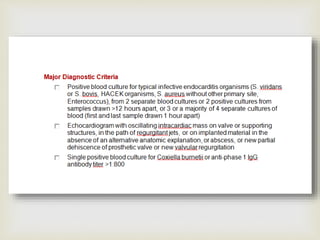
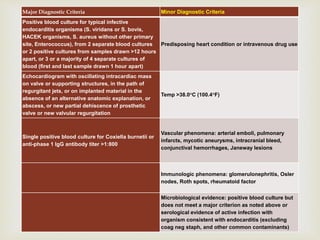
Major Diagnostic Criteria Minor Diagnostic Criteria
Positive blood culture for typical infective
endocarditis organisms (S. viridans or S. bovis,
HACEK organisms, S. aureus without other primary
site, Enterococcus), from 2 separate blood cultures
or 2 positive cultures from samples drawn >12 hours
apart, or 3 or a majority of 4 separate cultures of
blood (first and last sample drawn 1 hour apart)
Predisposing heart condition or intravenous drug use
Echocardiogram with oscillating intracardiac mass
on valve or supporting structures, in the path of
regurgitant jets, or on implanted material in the
absence of an alternative anatomic explanation, or
abscess, or new partial dehiscence of prosthetic
valve or new valvular regurgitation
Temp >38.0°C (100.4°F)
Single positive blood culture for Coxiella burnetii or
anti-phase 1 IgG antibody titer >1:800
Vascular phenomena: arterial emboli, pulmonary
infarcts, mycotic aneurysms, intracranial bleed,
conjunctival hemorrhages, Janeway lesions
Immunologic phenomena: glomerulonephritis, Osler
nodes, Roth spots, rheumatoid factor
Microbiological evidence: positive blood culture but
does not meet a major criterion as noted above or
serological evidence of active infection with
organism consistent with endocarditis (excluding
coag neg staph, and other common contaminants)

Definite/ Possible/ Rejected diagnoses of IE

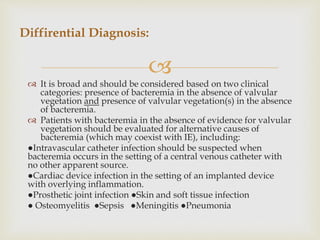
 It is broad and should be considered based on two clinical
categories: presence of bacteremia in the absence of valvular
vegetation and presence of valvular vegetation(s) in the absence
of bacteremia.
 Patients with bacteremia in the absence of evidence for valvular
vegetation should be evaluated for alternative causes of
bacteremia (which may coexist with IE), including:
●Intravascular catheter infection should be suspected when
bacteremia occurs in the setting of a central venous catheter with
no other apparent source.
●Cardiac device infection in the setting of an implanted device
with overlying inflammation.
●Prosthetic joint infection ●Skin and soft tissue infection
● Osteomyelitis ●Sepsis ●Meningitis ●Pneumonia
Diffirential Diagnosis:

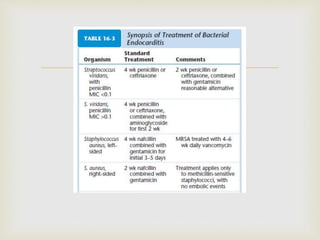
 The choice of empiric therapy should take into
consideration the most likely pathogens & should cover
staphylococci (methicillin susceptible and resistant),
streptococci, and enterococci.
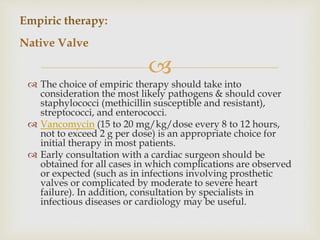
 Vancomycin (15 to 20 mg/kg/dose every 8 to 12 hours,
not to exceed 2 g per dose) is an appropriate choice for
initial therapy in most patients.
 Early consultation with a cardiac surgeon should be
obtained for all cases in which complications are observed
or expected (such as in infections involving prosthetic
valves or complicated by moderate to severe heart
failure). In addition, consultation by specialists in
infectious diseases or cardiology may be useful.
Empiric therapy:
Native Valve

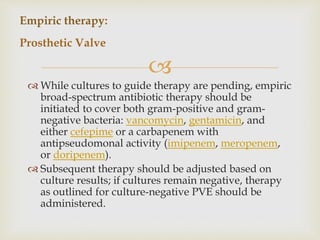
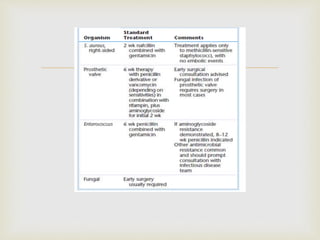
 While cultures to guide therapy are pending, empiric
broad-spectrum antibiotic therapy should be
initiated to cover both gram-positive and gram-
negative bacteria: vancomycin, gentamicin, and
either cefepime or a carbapenem with
antipseudomonal activity (imipenem, meropenem,
or doripenem).
 Subsequent therapy should be adjusted based on
culture results; if cultures remain negative, therapy
as outlined for culture-negative PVE should be
administered.
Empiric therapy:
Prosthetic Valve



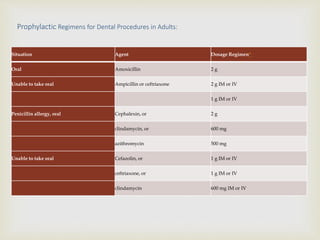
Situation Agent Dosage Regimen*
Oral Amoxicillin 2 g
Unable to take oral Ampicillin or ceftriaxone 2 g IM or IV
1 g IM or IV
Penicillin allergy, oral Cephalexin, or 2 g
clindamycin, or 600 mg
azithromycin 500 mg
Unable to take oral Cefazolin, or 1 g IM or IV
ceftriaxone, or 1 g IM or IV
clindamycin 600 mg IM or IV
Prophylactic Regimens for Dental Procedures in Adults:
 Death from infective endocarditis is usually caused by CHF,
often accompanied by valve dysfunction.
 Surgery during acute infection does not increase mortality; in
fact, restoration of a failing pump improves function and
outcome.
 Valve failure causing moderate to severe congestive heart failure
(NYHA Class III or IV) is a strong indication for urgent surgery.
 An endocardial abscess, is another indication for urgent
intervention.
Surgical Treatment
 Other conditions favoring surgery include vegetations >1cm in
diameter, a major embolic event, and failure or relapse of
medical therapy.
 Even though surgery may not be required during
hospitalization, it may be needed later on because of
progressive valve damage from healed endocarditis. In one
study, 47% of patients eventually required surgery, usually
within 2 years after completing medical therapy.
 Persistent fever during the treatment of endocarditis is worrisome.
Annular or ring abscesses may cause this and are strong indications
for surgery. Other causes of fever include myocarditis, pulmonary
and systemic emboli, and intravascular catheter site infections.
Drug fevers without other manifestations, such as rash and renal
findings, are unusual, but must also be considered.
 Neurologic complications from endocarditis are common and can
present difficult and sometimes vexing management dilemmas.
Leading causes are stroke, encephalopathy, and retinal emboli.
Brain abscesses and mycotic aneurysms are relatively infrequent.
Persistent Fever:

 References:
 UpToDate
 Harrison principals of IM book
Thank You !!

Infective endocarditis updated

  • 1.
    Dr. Tasneem Bashir InternalMedicine Resident PGY4
  • 2.
     Definition &Classification  Risk factors  Pathophysiology  Clinical manifestations  Approach to diagnosis  Differential diagnosis  Treatment Topics Vegetations (arrows) due to viridans streptococcal endocarditis involving the mitral valve a mass of platelets, fibrin, microcolonies of microorganisms, and scant inflammatory cells
  • 3.
      (IE) isthe infection of the endocardial surface of the heart  Usually refers to infection of one or more heart valves or infection of an intracardiac device.  Caused by a wide variety of bacteria and fungi.  Incidence: between 2 and 6 cases per 100,000 person-years  Clearly higher incidence in patients with underlying valvular heart diseases and those with intravenous drug abuse (IVDA).  Invasive procedures performed may cause bloodstream infections and result in endocarditis. Definition:
  • 4.
     Clasification:  Provides therapeuticand prognostic insight  Acute endocarditis is a hectically febrile illness that rapidly damages cardiac structures, seeds extracardiac sites, and, if untreated, progresses to death within weeks.  Subacute endocarditis follows an indolent course; causes structural cardiac damage only slowly, if at all; rarely metastasizes; and is gradually progressive unless complicated by a major embolic event or a ruptured mycotic aneurysm.  Chronic endocarditis.
  • 5.
     Although historicallyrheumatic valvulitis was considered a frequent predisposing factor for endocarditis, times have changed. Mitral valve prolapse, aortic sclerosis, and bicuspid aortic valvular heart disease are now more frequent causes.  In addition, prosthetic valvular heart disease accounts for about one third of all cases of endocarditis, and occurs in 1% to 3% of patients after valvular heart surgery, risk is higher in first 6 to 12 months after valve replacement. Risk factors:
  • 6.
     Risk issimilar for mechanical and bioprosthetic devices.  In developed countries, 25–35% of cases of native valve endocarditis (NVE) that affects the ‘natural’ valves are associated with health care, and 16–30% of all cases of endocarditis involve prosthetic valves.  Other risk factors include previous IE, age >60 years, male gender, poor dentition/or dental infections, chronic hemodialysis & HIV specially in IVDA, poorly controlled diabetes.
  • 7.
     Uncertain. Itis believed that cardiac valves and other endocardial surfaces become infected after exposure to microemboli from bacteria or fungi circulating in the bloodstream.  Few bacteria have a virulence factor that promotes adherence to endovascular surfaces, others produce a biofilm on prosthetic surfaces, which also promotes adherence. Pathophysiology
  • 8.
     Some bacterialack recognized adherence factors, and appear less likely to cause endocarditis. Endocardial surfaces previously damaged from valvular heart disease, endocarditis, surgery, or pacemaker wires provide a favorable environment for thrombus formation.  Over time, microorganisms proliferate in the thrombus, resulting in a classic vegetation. Microorganisms are released into the circulation, usually on a continuous basis, which often results in interesting findings.
  • 9.
      Most commonlyaffected valves are: • Mitral valve. • Aortic valve. • Combined mitral & aortic valves. • Tricuspid valve. • Pulmonary valve – rare.
  • 10.
      Highly variable,identified with thorough H&P.  IE may present as an acute, rapidly progressive infection or as a subacute or chronic disease with low-grade fever and non specific symptoms.  Fever is the most common symptom of IE (90% of cases); it is often associated with chills, anorexia, and weight loss.  Other symptoms of IE include malaise, headache, myalgias, arthralgias, night sweats, abdominal pain, dyspnea, cough, and pleuritic pain.  Cardiac murmurs are observed in approximately 85%of patients.  Supportive signs include cutaneous manifestations such as petechiae or splinter hemorrhages Clinical Manifestations
  • 11.
    PERIPHERAL SIGNS OFENDOCARDITIS Relatively uncommon but highly suggestive
  • 12.
      Clinical manifestationsreflecting complications of IE may be present at the time of initial presentation and/or may develop subsequently. When present, such findings warrant independent diagnostic evaluation, concurrent with evaluation for IE.
  • 13.
      systemic complications>>septic embolization, which may be associated with localized thrombosis, bleeding, infection, and/or development of immune reactions.  ●Cardiac complications (50%): Valvular insufficiency, heart failure.  ●Neurologic complications (40%): Embolic stroke, intracerebral hemorrhage, brain abscess.  ●Septic emboli (25%): Infarction of kidneys, spleen, and other organs. In right-sided endocarditis (common among intravenous drug users), septic pulmonary emboli may be seen.  ●Metastatic infection (such as vertebral osteomyelitis, septic arthritis, psoas abscess).  ●Systemic immune reaction (eg, glomerulonephritis). Complication on presentation
  • 14.
      Routine labs:nonspecific • Elevated inflammatory markers ESR & CRP • Normochromic-normocytic anemia + positive RF. • Urinalysis may demonstrate microscopic hematuria, proteinuria, and/or pyuria. • RBC casts >> glomerulonephritis, which is a minor diagnostic criterion for IE. • ECG: new / evolving conduction disease (first-degree atrioventricular block, bundle branch block, or complete heart block), reflecting paravalvular or myocardial extension of infection
  • 15.
      IE issuspected in patients with fever (± bacteremia) and/or relevant cardiac or non-cardiac risk factors.  The diagnosis is established based on clinical manifestations, blood cultures (or other microbiologic data), and echocardiography. The accepted criteria for diagnosis of IE are the modified Duke criteria.  Additional evaluation for patients with suspected IE includes electrocardiography, chest radiography, other radiographic imaging tailored to clinical manifestations, and dental evaluation.  CT scan: to evaluate for subclinical sites of metastatic infection (such as splenic infarct, renal infarcts, psoas abscess)  MRI back (vertebral osteomyelitis) or brain (intracranial mycotic aneurysm / CNS bleeds) Approach to diagnosis
  • 16.
     Note multiplecavitating lung nodules due to septic pulmonary emboli. Chest radiograph of a patient with tricuspid valve endocarditis due to Staphylococcus aureus
  • 17.
      At leastthree sets of blood cultures  Separate venipuncture sites  Before antimicrobial therapy  Positive in 90% of patients.  Clinically stable > defer antimicrobial therapy until results of blood cultures and other diagnostic tests.  Clinical instability > initiate empiric antimicrobial therapy (after blood cultures have been obtained).  Follow-up blood cultures: 48 to 72 hours after antimicrobial therapy is begun  Repeated every 48 to 72 hours until clearance of bacteremia is documented Blood culture
  • 18.
     most common causativeorganisms include: Staphylococcus aureus Viridans group streptococci Streptococcus bovis ●Enterococci Coagulase-negative staphylococci Fungi Non-HACEK : gram-ve bacteria HACEK: gram-ve bacilli: Haemophilus, Aggregatibacter, Cardiobacterium, Eikenella, Kingella
  • 19.
      NVE ismostly caused by the bacteria Streptococcus (70% of the cases) and Staphylococcus (25% of the cases).  Early Prosthetic Valve Endocarditis is usually caused by Staphylococcus sp. It can also be caused by Corynebacterium, Legionella, and HACEK group of gram-negative bacteria, and fungus including Candida and Aspergillus  Late Prosthetic Valve Endocarditis is usually caused by the bacterial species Streptococcus
  • 20.
      Culture-negative endocarditis:no definitive microbiologic etiology following inoculation of 3+ independently obtained blood samples in a standard blood-culture system, with -ve cultures after 5 days of incubation and subculturing.  suspected in patients with: • negative blood cultures • persistent fever • one or more clinical findings consistent with IE (eg, stroke/emboli) • vegetation on echocardiogram • no clear microbiologic diagnosis  Some causes of culture-negative IE may be identified via serology or polymerase chain reaction (PCR); these include Coxiella burnetii, Bartonella spp, Chlamydia spp, Legionella spp, Mycoplasma, and Brucella
  • 21.
      Should beperformed in all patients with suspected IE.  In general, TTE is the first diagnostic test for patients with suspected IE.  TEE has higher sensitivity than TTE and is better for detection of cardiac complications such as abscess, leaflet perforation, and pseudoaneurysm.  In some circumstances, it is reasonable to forgo TTE and proceed to TEE. Echocardiography
  • 22.
  • 23.
      Endocarditis isusually diagnosed using Duke’s diagnostic criteria for endocarditis, which consists of a combination of major criteria and minor criteria. A definitive diagnosis should satisfy any of the following conditions:  The presence of any 2 major criteria  The presence of 1 major criterion and 3 minor criteria  The presence of 5 minor criteria Clinical diagnosis of IE
  • 24.
  • 25.
  • 26.
     Major Diagnostic CriteriaMinor Diagnostic Criteria Positive blood culture for typical infective endocarditis organisms (S. viridans or S. bovis, HACEK organisms, S. aureus without other primary site, Enterococcus), from 2 separate blood cultures or 2 positive cultures from samples drawn >12 hours apart, or 3 or a majority of 4 separate cultures of blood (first and last sample drawn 1 hour apart) Predisposing heart condition or intravenous drug use Echocardiogram with oscillating intracardiac mass on valve or supporting structures, in the path of regurgitant jets, or on implanted material in the absence of an alternative anatomic explanation, or abscess, or new partial dehiscence of prosthetic valve or new valvular regurgitation Temp >38.0°C (100.4°F) Single positive blood culture for Coxiella burnetii or anti-phase 1 IgG antibody titer >1:800 Vascular phenomena: arterial emboli, pulmonary infarcts, mycotic aneurysms, intracranial bleed, conjunctival hemorrhages, Janeway lesions Immunologic phenomena: glomerulonephritis, Osler nodes, Roth spots, rheumatoid factor Microbiological evidence: positive blood culture but does not meet a major criterion as noted above or serological evidence of active infection with organism consistent with endocarditis (excluding coag neg staph, and other common contaminants)
  • 27.
  • 28.
      It isbroad and should be considered based on two clinical categories: presence of bacteremia in the absence of valvular vegetation and presence of valvular vegetation(s) in the absence of bacteremia.  Patients with bacteremia in the absence of evidence for valvular vegetation should be evaluated for alternative causes of bacteremia (which may coexist with IE), including: ●Intravascular catheter infection should be suspected when bacteremia occurs in the setting of a central venous catheter with no other apparent source. ●Cardiac device infection in the setting of an implanted device with overlying inflammation. ●Prosthetic joint infection ●Skin and soft tissue infection ● Osteomyelitis ●Sepsis ●Meningitis ●Pneumonia Diffirential Diagnosis:
  • 29.
      The choiceof empiric therapy should take into consideration the most likely pathogens & should cover staphylococci (methicillin susceptible and resistant), streptococci, and enterococci.  Vancomycin (15 to 20 mg/kg/dose every 8 to 12 hours, not to exceed 2 g per dose) is an appropriate choice for initial therapy in most patients.  Early consultation with a cardiac surgeon should be obtained for all cases in which complications are observed or expected (such as in infections involving prosthetic valves or complicated by moderate to severe heart failure). In addition, consultation by specialists in infectious diseases or cardiology may be useful. Empiric therapy: Native Valve
  • 30.
      While culturesto guide therapy are pending, empiric broad-spectrum antibiotic therapy should be initiated to cover both gram-positive and gram- negative bacteria: vancomycin, gentamicin, and either cefepime or a carbapenem with antipseudomonal activity (imipenem, meropenem, or doripenem).  Subsequent therapy should be adjusted based on culture results; if cultures remain negative, therapy as outlined for culture-negative PVE should be administered. Empiric therapy: Prosthetic Valve
  • 31.
  • 32.
  • 33.
     Situation Agent DosageRegimen* Oral Amoxicillin 2 g Unable to take oral Ampicillin or ceftriaxone 2 g IM or IV 1 g IM or IV Penicillin allergy, oral Cephalexin, or 2 g clindamycin, or 600 mg azithromycin 500 mg Unable to take oral Cefazolin, or 1 g IM or IV ceftriaxone, or 1 g IM or IV clindamycin 600 mg IM or IV Prophylactic Regimens for Dental Procedures in Adults:
  • 34.
     Death frominfective endocarditis is usually caused by CHF, often accompanied by valve dysfunction.  Surgery during acute infection does not increase mortality; in fact, restoration of a failing pump improves function and outcome.  Valve failure causing moderate to severe congestive heart failure (NYHA Class III or IV) is a strong indication for urgent surgery.  An endocardial abscess, is another indication for urgent intervention. Surgical Treatment
  • 35.
     Other conditionsfavoring surgery include vegetations >1cm in diameter, a major embolic event, and failure or relapse of medical therapy.  Even though surgery may not be required during hospitalization, it may be needed later on because of progressive valve damage from healed endocarditis. In one study, 47% of patients eventually required surgery, usually within 2 years after completing medical therapy.
  • 36.
     Persistent feverduring the treatment of endocarditis is worrisome. Annular or ring abscesses may cause this and are strong indications for surgery. Other causes of fever include myocarditis, pulmonary and systemic emboli, and intravascular catheter site infections. Drug fevers without other manifestations, such as rash and renal findings, are unusual, but must also be considered.  Neurologic complications from endocarditis are common and can present difficult and sometimes vexing management dilemmas. Leading causes are stroke, encephalopathy, and retinal emboli. Brain abscesses and mycotic aneurysms are relatively infrequent. Persistent Fever:
  • 37.
      References:  UpToDate Harrison principals of IM book Thank You !!

Editor's Notes

  • #23 ¶ Low risk/low suspicion for IE: for example, patient with fever and previously known cardiac murmur and no other stigmata of IE. Δ High risk/high suspicion for IE: for example, S. aureus bacteremia, new murmur, prior IE, congenital heart disease. Patients with prosthetic heart valve or intracardiac device are also high risk; the approach to diagnosis of IE in these circumstances is discussed further separately (refer to the UpToDate topics on prosthetic valve endocarditis and cardiac device infections). ◊ High-risk clinical features include new atrioventricular block (prolonged PR interval), persistent fever despite appropriate antimicrobial therapy, and Staphylococcus aureus bacteremia; high-risk echocardiographic features include large or mobile vegetations, valvular insufficiency, suggestion of paravalvular extension, or ventricular dysfunction. § Patients with high suspicion for paravalvular complications (such as prolonged PR interval) and indeterminate or negative TEE may warrant additional imaging such as cardiac computed tomography; refer to text for further discussion.