CONTENTS
Introduction
Etiology
Pathogenesis
Clinical manifestations and complications
Diagnosis
Treatment
Prognosis
INTRODUCTION
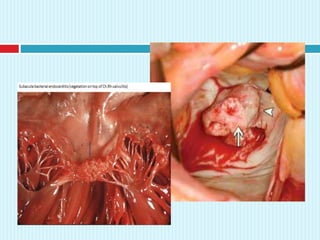
Infective endocarditis (IE) is defined as an infection of
the
endocardial surface of the heart, which may include one
or
the Antibiotic Era,” in the New England Journal of
Medicine.
IE currently can be described as infective endocarditis
in the era
of intravascular devices.
RISK FACTORS
Valvular heart disease – MR with degenerative MVP
m/c, 2nd
m/c is AR.
Congenital heart disease – M/c is VSD.
Prosthetic valves
IV drug use
Chronic IV access
H/O invasive dental procedures.
Diabetes, malignancy, renal failure on hemodialysis
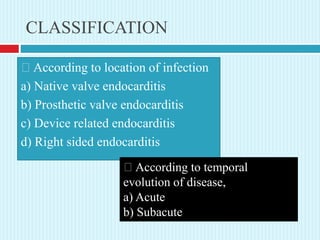
CLASSIFICATION
According to location of infection
a) Native valve endocarditis
b) Prosthetic valve endocarditis
c) Device related endocarditis
d) Right sided endocarditis
According to temporal
evolution of disease,
a) Acute
b) Subacute
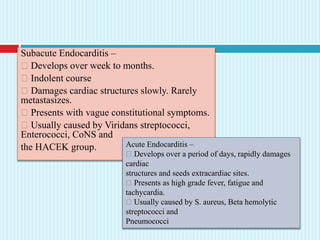
Subacute Endocarditis –
Develops over week to months.
Indolent course
Damages cardiac structures slowly. Rarely
metastasizes.
Presents with vague constitutional symptoms.
Usually caused by Viridans streptococci,
Enterococci, CoNS and
the HACEK group. Acute Endocarditis –
Develops over a period of days, rapidly damages
cardiac
structures and seeds extracardiac sites.
Presents as high grade fever, fatigue and
tachycardia.
Usually caused by S. aureus, Beta hemolytic
streptococci and
Pneumococci
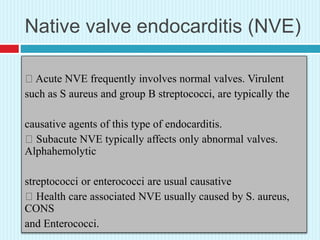
Native valve endocarditis (NVE)
Acute NVE frequently involves normal valves. Virulent
such as S aureus and group B streptococci, are typically the
causative agents of this type of endocarditis.
Subacute NVE typically affects only abnormal valves.
Alphahemolytic
streptococci or enterococci are usual causative
Health care associated NVE usually caused by S. aureus,
CONS
and Enterococci.
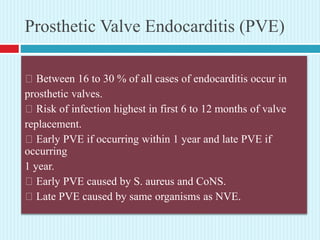
Prosthetic Valve Endocarditis (PVE)
Between 16 to 30 % of all cases of endocarditis occur in
prosthetic valves.
Risk of infection highest in first 6 to 12 months of valve
replacement.
Early PVE if occurring within 1 year and late PVE if
occurring
1 year.
Early PVE caused by S. aureus and CoNS.
Late PVE caused by same organisms as NVE.
Device – related Endocarditis
IE related to Cardiovascular Implantable Electronic
Devices
involves the device or the endothelium point of
device contact.
Mostly caused by S. aureus and CoNS.
Risk factors are Renal failure, DM, hematoma at
the site of
implantation.
Right – sided Endocarditis
Mostly associated with IV drug use.
S. aureus is the most common causative organism.
Tricuspid valve is most commonly affected.
Pulmonary valve may also be involved.
ORGANISMS causing IE
Streptococcus viridans – Cause native valve infection in RHD pts
Beta Hemolytic Streptococci – Acute presentation. Frequent complications.
Streptococcus gallolyticus - <10% cases of IE
S. aureus – Both NVE and PVE. Acute presentation
Coagulase negative staphylococci – Mostly in prosthetic valve. Subacute
presentation
Enterococcus – A/w CV catheter use. Multi drug resistance.
HACEK group – Subacute presentation. Large vegetation.
Aerobic gram –ve bacilli – E. coli, Klebsiella, Enterobacter, Pseudomonas
Fungi – Candida m/c organism. a/w IV drug use and in prosthetic valve.
Surgery needed.
Atypical organisms – Coxiella, Bartonella, Brucella, T.whipelli, Legionella
PATHOGENESIS
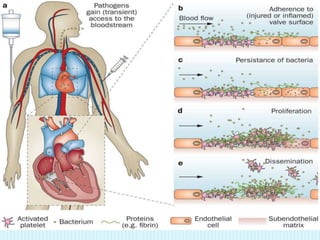
Organisms enter
bloodstream from
skin, mucosal
surfaces or
focal sites of infection.
Organisms express
surface adhesins
(MSCRAMMS) that
mediate adherence to
NBTE or damaged
endothelium.
Adhesins are – Fibronectin
binding proteins, clumping
factor
in S. aureus, Fibrinogen
binding surface proteins
(Fss2),
Collagen binding protein in
Enterococcus, Glucans or
FimA
on streptococci.
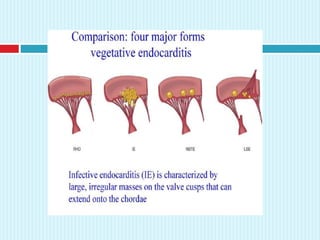
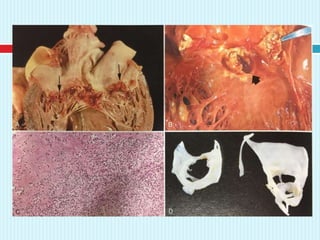
Prototypic lesion is the
Vegetation which is a mass of
platelet, fibrin, microcolonies
of organism and scant
inflammatory cells.
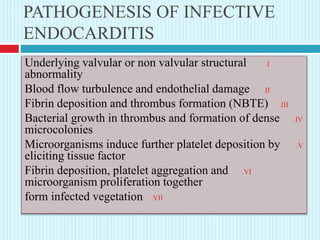
PATHOGENESIS OF INFECTIVE
ENDOCARDITIS
.IUnderlying valvular or non valvular structural
abnormality
.IIBlood flow turbulence and endothelial damage
.IIIFibrin deposition and thrombus formation (NBTE)
.IVBacterial growth in thrombus and formation of dense
microcolonies
.VMicroorganisms induce further platelet deposition by
eliciting tissue factor
.VIFibrin deposition, platelet aggregation and
microorganism proliferation together
.VIIform infected vegetation
CLINICAL MANIFESTATIONS
SYMPTOMS
Fever – m/c symptom but maybe absent in upto 20% cases.
Constitutional symptoms like chills, night sweats, headache,
malaise, nausea, myalgia, arthralgia.
Dyspnea if present is indicative of a severe hemodynamic lesion
probably a left sided valvular regurgitation.
Orthopnea/ PND indicate onset of heart failure.
Pleuritic chest pain may occur due to septic embolization and
infarction complicating tricuspid valve IE.
SIGNS
Murmurs – Occur in less than half of the
patients. New
or worsened regurgitant murmur occurs.
Splenomegaly
Clubbing may be seen
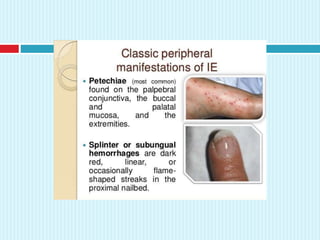
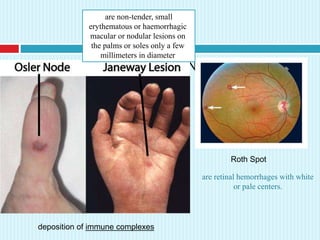
Peripheral manifestations like Osler ’s node,
subungal
hemorrhages, Janeway lesions, Roth’s spot.
JANEWAY LESIONS
JANEWAY LESIONS
deposition of immune complexes
Roth Spot
are retinal hemorrhages with white
or pale centers.
are non-tender, small
erythematous or haemorrhagic
macular or nodular lesions on
the palms or soles only a few
millimeters in diameter
MODIFIED DUKE CRITERIA
A highly sensitive and specific diagnostic criteria
known as the Modified Duke Criteria is
based on clinical, laboratory and
echocardioagraphic findings commonly
encountered
in patients of IE.
Definite Endocarditis –
2 major criterion or
1 major + 3 minor criterion or
5 minor criterion
Possible IE –
1 major + 1 minor
3 minor criteria
Diagnosis of IE rejected if,
Alternative diagnosis established
If symptoms resolve with <4 days of antimicrobial
therapy
If surgery or autopsy reveals no histologic
evidence of IE after <4days of antimicrobial
therapy
MAJOR CRITERIA
1. Blood culture positive
2. Evidence of endocardial involvement
MINOR CRITERIA
1. Predisposing condition
2. Fever ≥38° C
3. Vascular phenomena: arterial embolism,
septic
pulmonary emboli, mycotic aneurysm,
intracranial
hemorrhage, conjunctival hemorrhages,
Janeway
lesions
4. Immunologic phenomena:
glomerulonephritis, Osler
nodes, Roth spots, rheumatoid factor
5. Microbiologic evidence: positive blood
cultures not
meeting major criteria or serologic evidence of
active
infection consistent with endocarditis
TREATMENT
Infective endocarditis

Infective endocarditis

  • 2.
  • 3.
    INTRODUCTION Infective endocarditis (IE)is defined as an infection of the endocardial surface of the heart, which may include one or the Antibiotic Era,” in the New England Journal of Medicine. IE currently can be described as infective endocarditis in the era of intravascular devices.
  • 4.
    RISK FACTORS Valvular heartdisease – MR with degenerative MVP m/c, 2nd m/c is AR. Congenital heart disease – M/c is VSD. Prosthetic valves IV drug use Chronic IV access H/O invasive dental procedures. Diabetes, malignancy, renal failure on hemodialysis
  • 5.
    CLASSIFICATION According to locationof infection a) Native valve endocarditis b) Prosthetic valve endocarditis c) Device related endocarditis d) Right sided endocarditis According to temporal evolution of disease, a) Acute b) Subacute
  • 6.
    Subacute Endocarditis – Developsover week to months. Indolent course Damages cardiac structures slowly. Rarely metastasizes. Presents with vague constitutional symptoms. Usually caused by Viridans streptococci, Enterococci, CoNS and the HACEK group. Acute Endocarditis – Develops over a period of days, rapidly damages cardiac structures and seeds extracardiac sites. Presents as high grade fever, fatigue and tachycardia. Usually caused by S. aureus, Beta hemolytic streptococci and Pneumococci
  • 7.
    Native valve endocarditis(NVE) Acute NVE frequently involves normal valves. Virulent such as S aureus and group B streptococci, are typically the causative agents of this type of endocarditis. Subacute NVE typically affects only abnormal valves. Alphahemolytic streptococci or enterococci are usual causative Health care associated NVE usually caused by S. aureus, CONS and Enterococci.
  • 8.
    Prosthetic Valve Endocarditis(PVE) Between 16 to 30 % of all cases of endocarditis occur in prosthetic valves. Risk of infection highest in first 6 to 12 months of valve replacement. Early PVE if occurring within 1 year and late PVE if occurring 1 year. Early PVE caused by S. aureus and CoNS. Late PVE caused by same organisms as NVE.
  • 9.
    Device – relatedEndocarditis IE related to Cardiovascular Implantable Electronic Devices involves the device or the endothelium point of device contact. Mostly caused by S. aureus and CoNS. Risk factors are Renal failure, DM, hematoma at the site of implantation.
  • 10.
    Right – sidedEndocarditis Mostly associated with IV drug use. S. aureus is the most common causative organism. Tricuspid valve is most commonly affected. Pulmonary valve may also be involved.
  • 11.
    ORGANISMS causing IE Streptococcusviridans – Cause native valve infection in RHD pts Beta Hemolytic Streptococci – Acute presentation. Frequent complications. Streptococcus gallolyticus - <10% cases of IE S. aureus – Both NVE and PVE. Acute presentation Coagulase negative staphylococci – Mostly in prosthetic valve. Subacute presentation Enterococcus – A/w CV catheter use. Multi drug resistance. HACEK group – Subacute presentation. Large vegetation. Aerobic gram –ve bacilli – E. coli, Klebsiella, Enterobacter, Pseudomonas Fungi – Candida m/c organism. a/w IV drug use and in prosthetic valve. Surgery needed. Atypical organisms – Coxiella, Bartonella, Brucella, T.whipelli, Legionella
  • 12.
    PATHOGENESIS Organisms enter bloodstream from skin,mucosal surfaces or focal sites of infection. Organisms express surface adhesins (MSCRAMMS) that mediate adherence to NBTE or damaged endothelium. Adhesins are – Fibronectin binding proteins, clumping factor in S. aureus, Fibrinogen binding surface proteins (Fss2), Collagen binding protein in Enterococcus, Glucans or FimA on streptococci. Prototypic lesion is the Vegetation which is a mass of platelet, fibrin, microcolonies of organism and scant inflammatory cells.
  • 14.
    PATHOGENESIS OF INFECTIVE ENDOCARDITIS .IUnderlyingvalvular or non valvular structural abnormality .IIBlood flow turbulence and endothelial damage .IIIFibrin deposition and thrombus formation (NBTE) .IVBacterial growth in thrombus and formation of dense microcolonies .VMicroorganisms induce further platelet deposition by eliciting tissue factor .VIFibrin deposition, platelet aggregation and microorganism proliferation together .VIIform infected vegetation
  • 18.
    CLINICAL MANIFESTATIONS SYMPTOMS Fever –m/c symptom but maybe absent in upto 20% cases. Constitutional symptoms like chills, night sweats, headache, malaise, nausea, myalgia, arthralgia. Dyspnea if present is indicative of a severe hemodynamic lesion probably a left sided valvular regurgitation. Orthopnea/ PND indicate onset of heart failure. Pleuritic chest pain may occur due to septic embolization and infarction complicating tricuspid valve IE.
  • 19.
    SIGNS Murmurs – Occurin less than half of the patients. New or worsened regurgitant murmur occurs. Splenomegaly Clubbing may be seen Peripheral manifestations like Osler ’s node, subungal hemorrhages, Janeway lesions, Roth’s spot.
  • 21.
    JANEWAY LESIONS JANEWAY LESIONS depositionof immune complexes Roth Spot are retinal hemorrhages with white or pale centers. are non-tender, small erythematous or haemorrhagic macular or nodular lesions on the palms or soles only a few millimeters in diameter
  • 22.
    MODIFIED DUKE CRITERIA Ahighly sensitive and specific diagnostic criteria known as the Modified Duke Criteria is based on clinical, laboratory and echocardioagraphic findings commonly encountered in patients of IE. Definite Endocarditis – 2 major criterion or 1 major + 3 minor criterion or 5 minor criterion
  • 23.
    Possible IE – 1major + 1 minor 3 minor criteria Diagnosis of IE rejected if, Alternative diagnosis established If symptoms resolve with <4 days of antimicrobial therapy If surgery or autopsy reveals no histologic evidence of IE after <4days of antimicrobial therapy
  • 24.
    MAJOR CRITERIA 1. Bloodculture positive 2. Evidence of endocardial involvement MINOR CRITERIA 1. Predisposing condition 2. Fever ≥38° C 3. Vascular phenomena: arterial embolism, septic pulmonary emboli, mycotic aneurysm, intracranial hemorrhage, conjunctival hemorrhages, Janeway lesions 4. Immunologic phenomena: glomerulonephritis, Osler nodes, Roth spots, rheumatoid factor 5. Microbiologic evidence: positive blood cultures not meeting major criteria or serologic evidence of active infection consistent with endocarditis
  • 25.