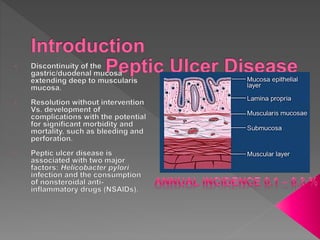
 Mr. Ali is a 45 years old male, who presents
to your clinic with epigastric pain for 2
weeks.
 What is your initial differential diagnosis
at this point given the limited information?
GERD Dyspepsia/gastritis
Biliary cholic Pancreatitis
IBS Gastroenteritis
 Mr. Ali has got epigastric abdominal pain for 2
weeks. He describes it as moderately severe,
burning, with no radiation, worse after he eats
by 2-5 hours. Sometimes wakes him from
sleep.
He has frequent belching, with bloating
sensation, but denies nausea, vomiting,
diarrhea, constipation, or weight loss. He tried
using Maalox which do help a little.
 PMHx: controlled HTN, osteoarthritis of the
knee.
 Meds: Hydrochlorothiazide, ibuprofen prn.
 Social hx: married, bank manager.
10 pack-years.
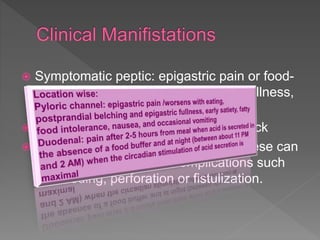
 Symptomatic peptic: epigastric pain or food-
provoked epigastric discomfort and fullness,
early satiety, and nausea.
 Pain can be atypical & radiating to back
 Commonly asymptomatic in 70%. These can
present later with ulcer complications such
as bleeding, perforation or fistulization.
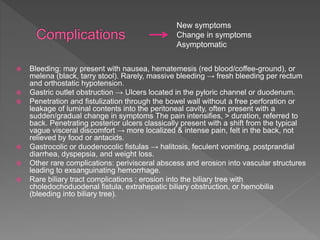
 Bleeding: may present with nausea, hematemesis (red blood/coffee-ground), or
melena (black, tarry stool). Rarely, massive bleeding → fresh bleeding per rectum
and orthostatic hypotension.
 Gastric outlet obstruction → Ulcers located in the pyloric channel or duodenum.
 Penetration and fistulization through the bowel wall without a free perforation or
leakage of luminal contents into the peritoneal cavity, often present with a
sudden/gradual change in symptoms The pain intensifies, > duration, referred to
back. Penetrating posterior ulcers classically present with a shift from the typical
vague visceral discomfort → more localized & intense pain, felt in the back, not
relieved by food or antacids.
 Gastrocolic or duodenocolic fistulas → halitosis, feculent vomiting, postprandial
diarrhea, dyspepsia, and weight loss.
 Other rare complications: perivisceral abscess and erosion into vascular structures
leading to exsanguinating hemorrhage.
 Rare biliary tract complications : erosion into the biliary tree with
choledochoduodenal fistula, extrahepatic biliary obstruction, or hemobilia
(bleeding into biliary tree).
New symptoms
Change in symptoms
Asymptomatic
 Most patients have a normal CBC.
 Some may have anemia due to GI loss.
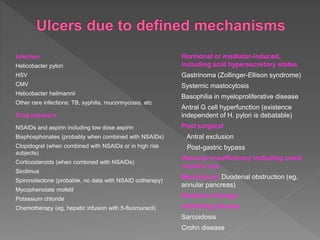
Infection
Helicobacter pylori
HSV
CMV
Helicobacter heilmannii
Other rare infections: TB, syphilis, mucormycosis, etc
Drug exposure
NSAIDs and aspirin including low dose aspirin
Bisphosphonates (probably when combined with NSAIDs)
Clopidogrel (when combined with NSAIDs or in high risk
subjects)
Corticosteroids (when combined with NSAIDs)
Sirolimus
Spironolactone (probable, no data with NSAID cotherapy)
Mycophenolate mofetil
Potassium chloride
Chemotherapy (eg, hepatic infusion with 5-fluorouracil)
Hormonal or mediator-induced,
including acid hypersecretory states
Gastrinoma (Zollinger-Ellison syndrome)
Systemic mastocytosis
Basophilia in myeloproliferative disease
Antral G cell hyperfunction (existence
independent of H. pylori is debatable)
Post surgical
Antral exclusion
Post-gastric bypass
Vascular insufficiency including crack
cocaine use
Mechanical: Duodenal obstruction (eg,
annular pancreas)
Radiation therapy
Infiltrating disease
Sarcoidosis
Crohn disease
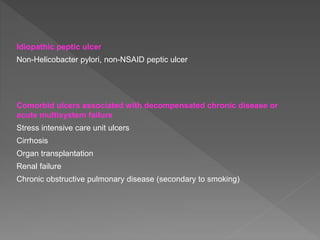
Idiopathic peptic ulcer
Non-Helicobacter pylori, non-NSAID peptic ulcer
Comorbid ulcers associated with decompensated chronic disease or
acute multisystem failure
Stress intensive care unit ulcers
Cirrhosis
Organ transplantation
Renal failure
Chronic obstructive pulmonary disease (secondary to smoking)
 The diagnosis of peptic ulcer disease is
suspected in patients with dyspepsia, NSAID
use or a history of Helicobacter pylori
infection.
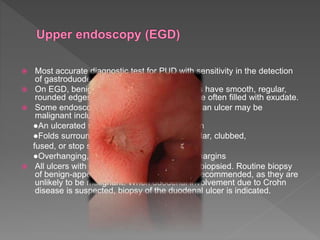
 Most accurate diagnostic test for PUD with sensitivity in the detection
of gastroduodenal lesions ~ 90%.
 On EGD, benign gastric and duodenal ulcers have smooth, regular,
rounded edges, with a flat, smooth ulcer base often filled with exudate.
 Some endoscopic features that suggest that an ulcer may be
malignant include:
●An ulcerated mass protruding into the lumen
●Folds surrounding the ulcer crater are nodular, clubbed,
fused, or stop short of the ulcer margin
●Overhanging, irregular, or thickened ulcer margins
 All ulcers with malignant features should be biopsied. Routine biopsy
of benign-appearing duodenal ulcers is not recommended, as they are
unlikely to be malignant. When duodenal involvement due to Crohn
disease is suspected, biopsy of the duodenal ulcer is indicated.
 CT performed for abdominal pain can identify
non-perforated peptic ulcers.
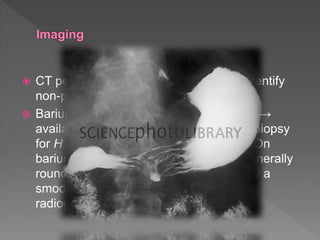
 Barium radiography is infrequently used →
availability of EGD which enables us to biopsy
for H. pylori testing and histopathology. On
barium radiography, an ulcer niche is generally
round or oval and may be surrounded by a
smooth mound of edema. It requires
radiographer expertise.
 All patients diagnosed with PUD should undergo testing
for H. pylori infection regardless of NSAIDs use.
 In the absence of acute upper GI bleeding, & during EGD
→ endoscopic biopsy of the stomach. Biopsy urease
testing may be performed in patients who are not on
antibiotics or a proton pump inhibitor (PPI). Other options
to diagnose H. pylori infection include the urea breath test
and stool antigen tests. However, patients who are taking
PPIs can have false negative breath tests and stool tests.
 During acute GI bleeding, a urea breath test
should be performed after the bleeding has
been controlled. It detects 86% of H. pylori
positive patients during hospitalization.
However, sensitivity decreases with the
increasing duration of antisecretory therapy.
Stool H. pylori antigen tests lack specificity
when blood is present in the stool due to
cross reactivity with blood constituents.
 A history of NSAIDs use should be sought.
Urine salicylate levels are not helpful for the
detection of low-dose aspirin use or other
widely used NSAIDs. Testing for individual
agents is possible but is limited by its
expense.
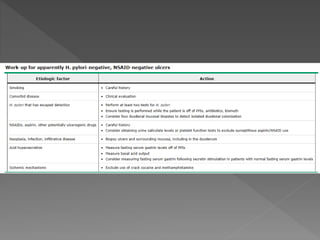
 Other causes of peptic ulcer disease should be considered
when H. pylori and use of NSAIDs have been excluded
(eg, gastrinoma in patients with multiple simultaneous
ulcers, or those in unusual locations [second portion of the
duodenum & into the proximal jejunum]).
 In patients with gastric ulcers without a clear etiology, we
perform an EGD12 weeks after initiating medical therapy
(with biopsies if refractory). This allows to exclude
neoplastic, infiltrative, or infectious causes of ulceration.
This decision may need to be individualized based on the
prevalence of gastric cancer in the community and
individual risk factors for the patient.
 Eradication of H. pylori infection with peptic
ulcer disease is associated with higher
healing rates in patients with duodenal and
gastric ulcers.
 In addition, eradication of H. pylori infection
is associated with lower ulcer recurrence
rates in patients with gastric and duodenal
ulcers who are not placed on maintenance
antisecretory therapy
 In patients treated for H. pylori, eradication of
infection should be confirmed four or more
weeks after the completion of therapy.
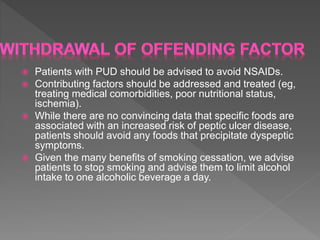
 Patients with PUD should be advised to avoid NSAIDs.
 Contributing factors should be addressed and treated (eg,
treating medical comorbidities, poor nutritional status,
ischemia).
 While there are no convincing data that specific foods are
associated with an increased risk of peptic ulcer disease,
patients should avoid any foods that precipitate dyspeptic
symptoms.
 Given the many benefits of smoking cessation, we advise
patients to stop smoking and advise them to limit alcohol
intake to one alcoholic beverage a day.
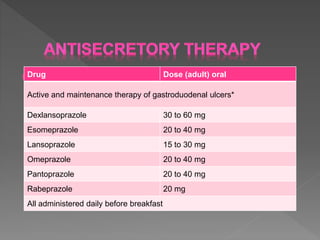
 All patients with peptic ulcers should receive
antisecretory therapy to facilitate ulcer
healing.
Drug Dose (adult) oral
Active and maintenance therapy of gastroduodenal ulcers*
Dexlansoprazole 30 to 60 mg
Esomeprazole 20 to 40 mg
Lansoprazole 15 to 30 mg
Omeprazole 20 to 40 mg
Pantoprazole 20 to 40 mg
Rabeprazole 20 mg
All administered daily before breakfast
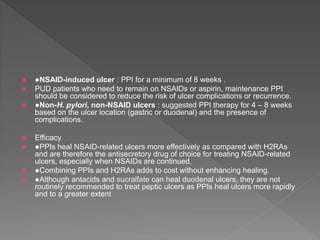
 ●NSAID-induced ulcer : PPI for a minimum of 8 weeks .
 PUD patients who need to remain on NSAIDs or aspirin, maintenance PPI
should be considered to reduce the risk of ulcer complications or recurrence.
 ●Non-H. pylori, non-NSAID ulcers : suggested PPI therapy for 4 – 8 weeks
based on the ulcer location (gastric or duodenal) and the presence of
complications.
 Efficacy
 ●PPIs heal NSAID-related ulcers more effectively as compared with H2RAs
and are therefore the antisecretory drug of choice for treating NSAID-related
ulcers, especially when NSAIDs are continued.
 ●Combining PPIs and H2RAs adds to cost without enhancing healing.
 ●Although antacids and sucralfate can heal duodenal ulcers, they are not
routinely recommended to treat peptic ulcers as PPIs heal ulcers more rapidly
and to a greater extent
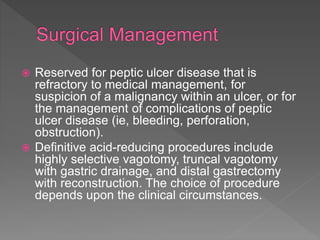
 Reserved for peptic ulcer disease that is
refractory to medical management, for
suspicion of a malignancy within an ulcer, or for
the management of complications of peptic
ulcer disease (ie, bleeding, perforation,
obstruction).
 Definitive acid-reducing procedures include
highly selective vagotomy, truncal vagotomy
with gastric drainage, and distal gastrectomy
with reconstruction. The choice of procedure
depends upon the clinical circumstances.
 For patients with duodenal bleeding or perforation related
to PUD who have received a fully adequate trial of medical
management, its suggested to perform a definitive acid-
reducing procedure in addition to managing the ulcer bed.
When choosing to add an acid-reducing procedure, it is
suggested to do truncal vagotomy and pyloroplasty, rather
than another acid-reducing procedure.
 Managing the ulcer bed alone is appropriate to control
bleeding in hemodynamically unstable patients and for
managing ulcer complications in those with significant
comorbidities that limit life expectancy.
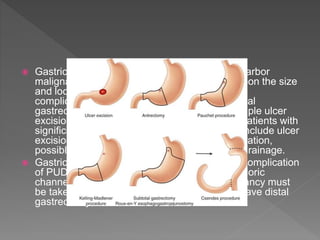
 Gastric resection for gastric ulcer, which may harbor
malignancy, the extent of resection depends upon the size
and location of the ulcer. For uncomplicated or
complicated gastric ulcer, suggested to do partial
gastrectomy and reconstruction rather than simple ulcer
excision in good-risk surgical candidates. For patients with
significant medical comorbidities, alternatives include ulcer
excision for bleeding or patch closure for perforation,
possibly combined with vagotomy and gastric drainage.
 Gastric outlet obstruction is the least frequent complication
of PUD, mostly associated with duodenal or pyloric
channel ulceration, but the potential for malignancy must
be taken into account. Thus, its suggested to have distal
gastrectomy.
 http://novella.mhhe.com/sites/0071363610/st
udent_view0/chapter33/self_assessment_qui
z.html
Peptic ulcler disease

Peptic ulcler disease

  • 2.
     Mr. Aliis a 45 years old male, who presents to your clinic with epigastric pain for 2 weeks.  What is your initial differential diagnosis at this point given the limited information? GERD Dyspepsia/gastritis Biliary cholic Pancreatitis IBS Gastroenteritis
  • 3.
     Mr. Alihas got epigastric abdominal pain for 2 weeks. He describes it as moderately severe, burning, with no radiation, worse after he eats by 2-5 hours. Sometimes wakes him from sleep. He has frequent belching, with bloating sensation, but denies nausea, vomiting, diarrhea, constipation, or weight loss. He tried using Maalox which do help a little.
  • 4.
     PMHx: controlledHTN, osteoarthritis of the knee.  Meds: Hydrochlorothiazide, ibuprofen prn.  Social hx: married, bank manager. 10 pack-years.
  • 6.
     Symptomatic peptic:epigastric pain or food- provoked epigastric discomfort and fullness, early satiety, and nausea.  Pain can be atypical & radiating to back  Commonly asymptomatic in 70%. These can present later with ulcer complications such as bleeding, perforation or fistulization.
  • 7.
     Bleeding: maypresent with nausea, hematemesis (red blood/coffee-ground), or melena (black, tarry stool). Rarely, massive bleeding → fresh bleeding per rectum and orthostatic hypotension.  Gastric outlet obstruction → Ulcers located in the pyloric channel or duodenum.  Penetration and fistulization through the bowel wall without a free perforation or leakage of luminal contents into the peritoneal cavity, often present with a sudden/gradual change in symptoms The pain intensifies, > duration, referred to back. Penetrating posterior ulcers classically present with a shift from the typical vague visceral discomfort → more localized & intense pain, felt in the back, not relieved by food or antacids.  Gastrocolic or duodenocolic fistulas → halitosis, feculent vomiting, postprandial diarrhea, dyspepsia, and weight loss.  Other rare complications: perivisceral abscess and erosion into vascular structures leading to exsanguinating hemorrhage.  Rare biliary tract complications : erosion into the biliary tree with choledochoduodenal fistula, extrahepatic biliary obstruction, or hemobilia (bleeding into biliary tree). New symptoms Change in symptoms Asymptomatic
  • 8.
     Most patientshave a normal CBC.  Some may have anemia due to GI loss.
  • 9.
    Infection Helicobacter pylori HSV CMV Helicobacter heilmannii Otherrare infections: TB, syphilis, mucormycosis, etc Drug exposure NSAIDs and aspirin including low dose aspirin Bisphosphonates (probably when combined with NSAIDs) Clopidogrel (when combined with NSAIDs or in high risk subjects) Corticosteroids (when combined with NSAIDs) Sirolimus Spironolactone (probable, no data with NSAID cotherapy) Mycophenolate mofetil Potassium chloride Chemotherapy (eg, hepatic infusion with 5-fluorouracil) Hormonal or mediator-induced, including acid hypersecretory states Gastrinoma (Zollinger-Ellison syndrome) Systemic mastocytosis Basophilia in myeloproliferative disease Antral G cell hyperfunction (existence independent of H. pylori is debatable) Post surgical Antral exclusion Post-gastric bypass Vascular insufficiency including crack cocaine use Mechanical: Duodenal obstruction (eg, annular pancreas) Radiation therapy Infiltrating disease Sarcoidosis Crohn disease
  • 10.
    Idiopathic peptic ulcer Non-Helicobacterpylori, non-NSAID peptic ulcer Comorbid ulcers associated with decompensated chronic disease or acute multisystem failure Stress intensive care unit ulcers Cirrhosis Organ transplantation Renal failure Chronic obstructive pulmonary disease (secondary to smoking)
  • 11.
     The diagnosisof peptic ulcer disease is suspected in patients with dyspepsia, NSAID use or a history of Helicobacter pylori infection.
  • 12.
     Most accuratediagnostic test for PUD with sensitivity in the detection of gastroduodenal lesions ~ 90%.  On EGD, benign gastric and duodenal ulcers have smooth, regular, rounded edges, with a flat, smooth ulcer base often filled with exudate.  Some endoscopic features that suggest that an ulcer may be malignant include: ●An ulcerated mass protruding into the lumen ●Folds surrounding the ulcer crater are nodular, clubbed, fused, or stop short of the ulcer margin ●Overhanging, irregular, or thickened ulcer margins  All ulcers with malignant features should be biopsied. Routine biopsy of benign-appearing duodenal ulcers is not recommended, as they are unlikely to be malignant. When duodenal involvement due to Crohn disease is suspected, biopsy of the duodenal ulcer is indicated.
  • 13.
     CT performedfor abdominal pain can identify non-perforated peptic ulcers.  Barium radiography is infrequently used → availability of EGD which enables us to biopsy for H. pylori testing and histopathology. On barium radiography, an ulcer niche is generally round or oval and may be surrounded by a smooth mound of edema. It requires radiographer expertise.
  • 14.
     All patientsdiagnosed with PUD should undergo testing for H. pylori infection regardless of NSAIDs use.  In the absence of acute upper GI bleeding, & during EGD → endoscopic biopsy of the stomach. Biopsy urease testing may be performed in patients who are not on antibiotics or a proton pump inhibitor (PPI). Other options to diagnose H. pylori infection include the urea breath test and stool antigen tests. However, patients who are taking PPIs can have false negative breath tests and stool tests.
  • 15.
     During acuteGI bleeding, a urea breath test should be performed after the bleeding has been controlled. It detects 86% of H. pylori positive patients during hospitalization. However, sensitivity decreases with the increasing duration of antisecretory therapy. Stool H. pylori antigen tests lack specificity when blood is present in the stool due to cross reactivity with blood constituents.
  • 16.
     A historyof NSAIDs use should be sought. Urine salicylate levels are not helpful for the detection of low-dose aspirin use or other widely used NSAIDs. Testing for individual agents is possible but is limited by its expense.
  • 17.
     Other causesof peptic ulcer disease should be considered when H. pylori and use of NSAIDs have been excluded (eg, gastrinoma in patients with multiple simultaneous ulcers, or those in unusual locations [second portion of the duodenum & into the proximal jejunum]).  In patients with gastric ulcers without a clear etiology, we perform an EGD12 weeks after initiating medical therapy (with biopsies if refractory). This allows to exclude neoplastic, infiltrative, or infectious causes of ulceration. This decision may need to be individualized based on the prevalence of gastric cancer in the community and individual risk factors for the patient.
  • 20.
     Eradication ofH. pylori infection with peptic ulcer disease is associated with higher healing rates in patients with duodenal and gastric ulcers.  In addition, eradication of H. pylori infection is associated with lower ulcer recurrence rates in patients with gastric and duodenal ulcers who are not placed on maintenance antisecretory therapy
  • 22.
     In patientstreated for H. pylori, eradication of infection should be confirmed four or more weeks after the completion of therapy.
  • 23.
     Patients withPUD should be advised to avoid NSAIDs.  Contributing factors should be addressed and treated (eg, treating medical comorbidities, poor nutritional status, ischemia).  While there are no convincing data that specific foods are associated with an increased risk of peptic ulcer disease, patients should avoid any foods that precipitate dyspeptic symptoms.  Given the many benefits of smoking cessation, we advise patients to stop smoking and advise them to limit alcohol intake to one alcoholic beverage a day.
  • 24.
     All patientswith peptic ulcers should receive antisecretory therapy to facilitate ulcer healing. Drug Dose (adult) oral Active and maintenance therapy of gastroduodenal ulcers* Dexlansoprazole 30 to 60 mg Esomeprazole 20 to 40 mg Lansoprazole 15 to 30 mg Omeprazole 20 to 40 mg Pantoprazole 20 to 40 mg Rabeprazole 20 mg All administered daily before breakfast
  • 25.
     ●NSAID-induced ulcer: PPI for a minimum of 8 weeks .  PUD patients who need to remain on NSAIDs or aspirin, maintenance PPI should be considered to reduce the risk of ulcer complications or recurrence.  ●Non-H. pylori, non-NSAID ulcers : suggested PPI therapy for 4 – 8 weeks based on the ulcer location (gastric or duodenal) and the presence of complications.  Efficacy  ●PPIs heal NSAID-related ulcers more effectively as compared with H2RAs and are therefore the antisecretory drug of choice for treating NSAID-related ulcers, especially when NSAIDs are continued.  ●Combining PPIs and H2RAs adds to cost without enhancing healing.  ●Although antacids and sucralfate can heal duodenal ulcers, they are not routinely recommended to treat peptic ulcers as PPIs heal ulcers more rapidly and to a greater extent
  • 26.
     Reserved forpeptic ulcer disease that is refractory to medical management, for suspicion of a malignancy within an ulcer, or for the management of complications of peptic ulcer disease (ie, bleeding, perforation, obstruction).  Definitive acid-reducing procedures include highly selective vagotomy, truncal vagotomy with gastric drainage, and distal gastrectomy with reconstruction. The choice of procedure depends upon the clinical circumstances.
  • 27.
     For patientswith duodenal bleeding or perforation related to PUD who have received a fully adequate trial of medical management, its suggested to perform a definitive acid- reducing procedure in addition to managing the ulcer bed. When choosing to add an acid-reducing procedure, it is suggested to do truncal vagotomy and pyloroplasty, rather than another acid-reducing procedure.  Managing the ulcer bed alone is appropriate to control bleeding in hemodynamically unstable patients and for managing ulcer complications in those with significant comorbidities that limit life expectancy.
  • 28.
     Gastric resectionfor gastric ulcer, which may harbor malignancy, the extent of resection depends upon the size and location of the ulcer. For uncomplicated or complicated gastric ulcer, suggested to do partial gastrectomy and reconstruction rather than simple ulcer excision in good-risk surgical candidates. For patients with significant medical comorbidities, alternatives include ulcer excision for bleeding or patch closure for perforation, possibly combined with vagotomy and gastric drainage.  Gastric outlet obstruction is the least frequent complication of PUD, mostly associated with duodenal or pyloric channel ulceration, but the potential for malignancy must be taken into account. Thus, its suggested to have distal gastrectomy.
  • 29.

Editor's Notes

  • #10 Drug exposure (all probably worse when combined with NSAIDs or in high risk subjects)