HOST-MICROBE
INTERACTIONS
BY
DILIP O. MORANI,
ASST. PROF.
SHRI D.D. VISPUTE COLLEGE OF PHARMACY
AND RESEARCH CENTER, PANVEL
Introduction
• Micro-organisms live in close association with insects, plants, animals
and human beings.
• Infection is the invasion of body by pathogenic micro-organisms.
• It is not synonymous with the infectious disease.
• Disease is defined as a ‘departure from the normal state of health
when the host is visibly or sensibly injured.
• Thus, recognizable interaction between infectious agent and the host
is called ‘disease’.
Continue…
• Micro-organisms that cause damage to their hosts are referred as
parasites and the relationship is known as ‘parasitism’.
• Some etiological agents of infectious diseases are obligate ‘parasites’
because they are unable to reproduce outside their host.
• Some micro-organisms are opportunistic parasites because they
cause disease only under specific conditions.
• Parasitic microbes may be either pathogens or commensals.
• Pathogens are micro-organisms that are capable of producing disease
in the host.
Continue…
• Majority of host-microbe combinations involving micro-organisms
appear relatively harmless to the host.
• This type of relationship is known as ‘commensalism’ in which one
species benefits from the association, and other is unaffected.
• Symbiotic relationships are considered to be mutualistic if both
species are benefitted.
• Some micro-organisms are free-living microbes that live on dead or
decaying organic matter.
• They are found in soil and water and play an important role in the
degradation of organic materials.
Continue…
• They are generally incapable of multiplying in living tissues.
• However, sometimes when host resistance is lowered, some
saprophytes may cause an infection.
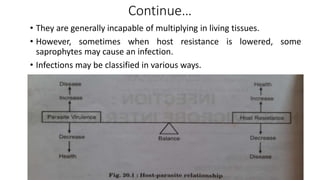
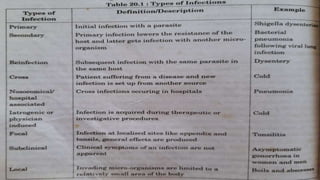
• Infections may be classified in various ways.
Continue…
• Infectious diseases may be localized or generalized.
• Depending on the spread of infectious disease in the community, they
may be classified into different types.
• ‘Endemic’ diseases are those which are constantly present in a
particular area e.g. typhoid fever in India, cold etc.
• ‘Sporadic’ diseases mainly occur occasionally e.g. typhoid fever in
USA.
• An epidemic disease is one that spreads rapidly, involving many
persons in area at the same time e.g. influenza.
Continue…
• Pandemic is an epidemic that spreads through many areas of the
world involving very large number of persons within a short period.
E.g. influenza, cholera, plague etc.
• Communicable or contagious diseases are those that spreads from
one host to another e.g. tuberculosis, measles, typhoid fever, chicken
pox, etc.
• Non-communicable diseases do not spread from one host to another
host e.g. tetanus.
Sources of infection
• The term source of infection is described as thing, person, animal or
object from which an infectious agent passes immediately to the host.
• The usual places where organisms live are called ‘reservoirs of
infection’.
• Infections may be due to organisms of normal flora (endogenous) or
from a source outside the body (exogenous).
• Most of the infections are exogenous in origin.
Continue…
• The sources of infection are as follows
1. Human beings
2. Animals
3. Insects
4. Environment
1. Human beings
• The commonest source of human infection is man himself who may
be a patient or a carrier.
• Infections due to some micro-organisms are acquired from ill persons
e.g. hepatitis B, influenza, poliomyelitis, mumps, whooping cough,
pulmonary tuberculosis, leprosy, gonorrhea, syphilis, AIDS etc.
• A carrier is a person who harbours the pathogenic micro-organism
without suffering from any ill effects.
• A healthy carrier is one who harbours the pathogen but has never
suffered from the disease while a covalescent carrier is one who has
recovered from disease and continues to harbour the pathogen in his
body.
Continue..,
• Depending on the duration of carriage, carriers are classified as
temporary (upto 6 months) and chronic (many years).
• Contact carrier is applied to a person who acquires the pathogen
from a patient while paradoxical carrier refers to a carrier who
acquires the pathogen from another carrier.
2. Animals
• Certain pathogens are capable of causing infection in both man and
animals.
• Animals may act as a source of infection of such micro-organisms.
• The infection may be acquired by contact with animal, animal bite
and ingestion of milk or meat of infectious animal.
• Infectious diseases transmitted from animals to man are known as
zoonoses.
• Zoonotic diseases may be bacterial e.g. bovine tuberculosis, plague,
salmonella food poisoning; viral e.g. rabies, yellow fever; fungal e.g.
zoophilic dermatophytes; protozoal e.g. leishmaniasis and helminthic
e.g. hydatid disease.
3. Insects
• The diseases caused by insects are called arthropod borne diseases.
• Blood sucking insects such as mosquitos, ticks, mites, flies and lice act
as a source of a number of human and animal infections.
• Insects transmitting pathogens are known as vectors.
• Vectors are mainly classified as mechanical vectors and biological
vectors.
Continue…
• Mechanical vectors are those which carry micro-organisms on their
legs, wings and body and transmit them to eatables which then act as
a source of infection e.g. transmission of dysentry or typhoid bacilli by
the domestic fly through food.
• Biological vectors are those in whom the pathogens multiply or
undergo developmental changes with or without multiplications e.g.
Anopheles mosquito in malaria, Aedes aegypti mosquito in yellow
fever etc.
4. Environment
• This includes soil, water and food.
• Soil may serve as source of parasitic infection like roundworm and
hookworm.
• Spores of tetanus and gas gangrene bacilli remain viable in the soil for
several decades and serve a source of infection.
• Fungi like Histoplasma capsulatum and higher bacteria like Nocardia
asteroids also survive in soil and cause human infection.
• Water may be contaminated with vibrio cholerae, shigella,
salmonella, hepatitis A virus, poliomyelitis virus and which act as
source of respective infections.
• Contaminated food acts as a source of micro-organisms causing
diarrhoea, dysentery, gastroenteritis and food poisoning.
Important terms
• Infection- The state produced by the establishment of one or more
pathogenic agents (such as bacteria, protozoans or viruses) in or on
the body of a suitable host.
• Infestation- The presence of an unusually large number of insects or
animals in a place, typically so as to cause damage or disease.
• Pathogen- A tiny living organism such as a bacterium or virus that
makes people suck.
• Resistance- The act of fighting against something that is attacking you
or refusing to accept something.
• Susceptibility- Likelihood of individual to develop ill effects from an
external agent such as mycobacterium tuberculosis , high altitude or
ambient temperature.
REFERENCE
• Pharmaceutical Microbiology- Principles and Applications by Prof.
Chandrakant Kokare, Sixth edition-September 2009, Nirali Prakashan,
page no. 20.1-20.4

Host microbe interactions

  • 1.
    HOST-MICROBE INTERACTIONS BY DILIP O. MORANI, ASST.PROF. SHRI D.D. VISPUTE COLLEGE OF PHARMACY AND RESEARCH CENTER, PANVEL
  • 2.
    Introduction • Micro-organisms livein close association with insects, plants, animals and human beings. • Infection is the invasion of body by pathogenic micro-organisms. • It is not synonymous with the infectious disease. • Disease is defined as a ‘departure from the normal state of health when the host is visibly or sensibly injured. • Thus, recognizable interaction between infectious agent and the host is called ‘disease’.
  • 3.
    Continue… • Micro-organisms thatcause damage to their hosts are referred as parasites and the relationship is known as ‘parasitism’. • Some etiological agents of infectious diseases are obligate ‘parasites’ because they are unable to reproduce outside their host. • Some micro-organisms are opportunistic parasites because they cause disease only under specific conditions. • Parasitic microbes may be either pathogens or commensals. • Pathogens are micro-organisms that are capable of producing disease in the host.
  • 4.
    Continue… • Majority ofhost-microbe combinations involving micro-organisms appear relatively harmless to the host. • This type of relationship is known as ‘commensalism’ in which one species benefits from the association, and other is unaffected. • Symbiotic relationships are considered to be mutualistic if both species are benefitted. • Some micro-organisms are free-living microbes that live on dead or decaying organic matter. • They are found in soil and water and play an important role in the degradation of organic materials.
  • 5.
    Continue… • They aregenerally incapable of multiplying in living tissues. • However, sometimes when host resistance is lowered, some saprophytes may cause an infection. • Infections may be classified in various ways.
  • 8.
    Continue… • Infectious diseasesmay be localized or generalized. • Depending on the spread of infectious disease in the community, they may be classified into different types. • ‘Endemic’ diseases are those which are constantly present in a particular area e.g. typhoid fever in India, cold etc. • ‘Sporadic’ diseases mainly occur occasionally e.g. typhoid fever in USA. • An epidemic disease is one that spreads rapidly, involving many persons in area at the same time e.g. influenza.
  • 9.
    Continue… • Pandemic isan epidemic that spreads through many areas of the world involving very large number of persons within a short period. E.g. influenza, cholera, plague etc. • Communicable or contagious diseases are those that spreads from one host to another e.g. tuberculosis, measles, typhoid fever, chicken pox, etc. • Non-communicable diseases do not spread from one host to another host e.g. tetanus.
  • 10.
    Sources of infection •The term source of infection is described as thing, person, animal or object from which an infectious agent passes immediately to the host. • The usual places where organisms live are called ‘reservoirs of infection’. • Infections may be due to organisms of normal flora (endogenous) or from a source outside the body (exogenous). • Most of the infections are exogenous in origin.
  • 11.
    Continue… • The sourcesof infection are as follows 1. Human beings 2. Animals 3. Insects 4. Environment
  • 12.
    1. Human beings •The commonest source of human infection is man himself who may be a patient or a carrier. • Infections due to some micro-organisms are acquired from ill persons e.g. hepatitis B, influenza, poliomyelitis, mumps, whooping cough, pulmonary tuberculosis, leprosy, gonorrhea, syphilis, AIDS etc. • A carrier is a person who harbours the pathogenic micro-organism without suffering from any ill effects. • A healthy carrier is one who harbours the pathogen but has never suffered from the disease while a covalescent carrier is one who has recovered from disease and continues to harbour the pathogen in his body.
  • 13.
    Continue.., • Depending onthe duration of carriage, carriers are classified as temporary (upto 6 months) and chronic (many years). • Contact carrier is applied to a person who acquires the pathogen from a patient while paradoxical carrier refers to a carrier who acquires the pathogen from another carrier.
  • 14.
    2. Animals • Certainpathogens are capable of causing infection in both man and animals. • Animals may act as a source of infection of such micro-organisms. • The infection may be acquired by contact with animal, animal bite and ingestion of milk or meat of infectious animal. • Infectious diseases transmitted from animals to man are known as zoonoses. • Zoonotic diseases may be bacterial e.g. bovine tuberculosis, plague, salmonella food poisoning; viral e.g. rabies, yellow fever; fungal e.g. zoophilic dermatophytes; protozoal e.g. leishmaniasis and helminthic e.g. hydatid disease.
  • 15.
    3. Insects • Thediseases caused by insects are called arthropod borne diseases. • Blood sucking insects such as mosquitos, ticks, mites, flies and lice act as a source of a number of human and animal infections. • Insects transmitting pathogens are known as vectors. • Vectors are mainly classified as mechanical vectors and biological vectors.
  • 16.
    Continue… • Mechanical vectorsare those which carry micro-organisms on their legs, wings and body and transmit them to eatables which then act as a source of infection e.g. transmission of dysentry or typhoid bacilli by the domestic fly through food. • Biological vectors are those in whom the pathogens multiply or undergo developmental changes with or without multiplications e.g. Anopheles mosquito in malaria, Aedes aegypti mosquito in yellow fever etc.
  • 17.
    4. Environment • Thisincludes soil, water and food. • Soil may serve as source of parasitic infection like roundworm and hookworm. • Spores of tetanus and gas gangrene bacilli remain viable in the soil for several decades and serve a source of infection. • Fungi like Histoplasma capsulatum and higher bacteria like Nocardia asteroids also survive in soil and cause human infection. • Water may be contaminated with vibrio cholerae, shigella, salmonella, hepatitis A virus, poliomyelitis virus and which act as source of respective infections. • Contaminated food acts as a source of micro-organisms causing diarrhoea, dysentery, gastroenteritis and food poisoning.
  • 18.
    Important terms • Infection-The state produced by the establishment of one or more pathogenic agents (such as bacteria, protozoans or viruses) in or on the body of a suitable host. • Infestation- The presence of an unusually large number of insects or animals in a place, typically so as to cause damage or disease. • Pathogen- A tiny living organism such as a bacterium or virus that makes people suck. • Resistance- The act of fighting against something that is attacking you or refusing to accept something. • Susceptibility- Likelihood of individual to develop ill effects from an external agent such as mycobacterium tuberculosis , high altitude or ambient temperature.
  • 19.
    REFERENCE • Pharmaceutical Microbiology-Principles and Applications by Prof. Chandrakant Kokare, Sixth edition-September 2009, Nirali Prakashan, page no. 20.1-20.4