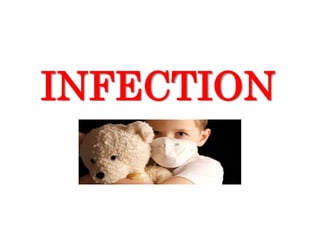
INFECTION
LEARNING OUTCOMES
• At the end of this class the student will be
able to:
1. Definition and know the Classification of infection
2. Recognize the Acute Infection Vs. Chronic Infection
3. Describe the Primary Infection, Secondary Infection, Reinfection,
Local/Focal Infection, Systemic Infection, Cross/Exogenous,
Endogenous Infection, Nosocomial Infections
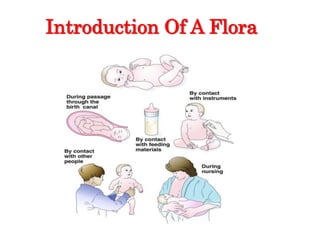
4. Describe the introduction of the pathway of Normal Flora
5. Comprehend the Chain of Infection
6. To know the minimize Risk and Prevention of Infection
DEFINITIONS
Infection - The colonization and multiplication of a microbe
in or on the tissues of a host.
- Infecting Microbes seek to use the host's
resources to reproduce, often resulting in disease.
Disease - Any deviation from a condition of good health &
well-being
Infectious - A disease condition caused by the presence or
Disease growth of infectious microorganisms or parasites
• Caused by microorganisms like viruses, prions,
bacteria, viroid, parasites and fungi.
• Invasion by and multiplication of pathogenic in a
bodily part or tissue, which may produce
subsequent tissue injury and progress to
manifested disease through cellular or toxic
mechanisms.
• An infection that
• produces symptoms is an apparent infection.
• is active, but does not produce noticeable symptoms, may be
called in apparent, silent, or subclinical
• is inactive or dormant is called a latent infection
INFECTION
Conditions Required For
Infection To Spread From One
Person To Another
3 key components
i. One person must be infected with a
microorganism
ii. The other person must be susceptible to
infection with that microorganism
iii. The microorganism must be able to leave the
body of the infected person and enter the body
of the susceptible person.
Time Parameters Of
Interaction
• Latency Period = the INCUBATION PERIOD of an infectious disease,
BEFORE symptoms appear
= the interval between exposure to an infectious
organism (stimulus) and the clinical appearance of
disease (response).
• Incubation Period = the time between infection and onset of
symptoms
Range of relationships
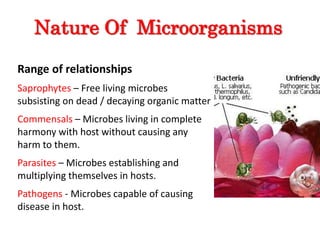
Saprophytes – Free living microbes
subsisting on dead / decaying organic matter
Commensals – Microbes living in complete
harmony with host without causing any
harm to them.
Parasites – Microbes establishing and
multiplying themselves in hosts.
Pathogens - Microbes capable of causing
disease in host.
Nature Of Microorganisms
Definitions - Pathogenicity
& Virulence
–Pathogenicity
• The ability of a microbe to cause disease
• This term is often used to describe or compare species
–Virulence
• The degree of pathogenicity in a microorganism
• used to describe or compare strains within a species
Based on:
• Invasive qualities
• Toxic qualities
• Presence of pili or fimbriae for adhesion
• Ability to avoid host defenses (mutate)
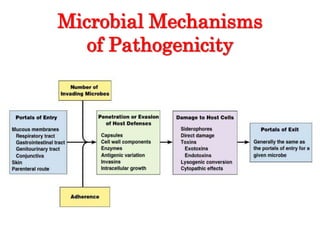
Microbial Mechanisms
of Pathogenicity
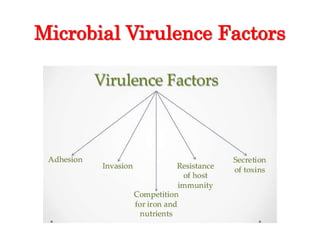
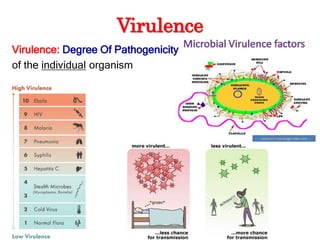
Microbial Virulence Factors
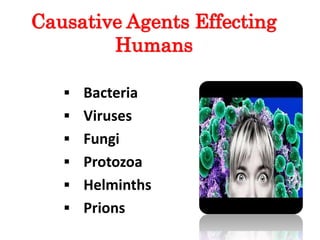
Causative Agents Effecting
Humans
 Bacteria
 Viruses
 Fungi
 Protozoa
 Helminths
 Prions
11
Defining - The Suffix “-emia”
-emia suffix meaning “presence of an infectious agent”
1. Bacteremia = Presence of infectious bacteria
2. Viremia = Presence of infectious virus
3. Fungemia = Presence of infectious fungus
4. Septicemia = Presence of an infectious agent in
the bloodstream
Defining - The suffix “-itis”
-itis meaning “inflammation of”
Examples:
1. Pharyngitis = Inflammation of the pharynx
2. Endocarditis = Inflammation of the heart chambers
3. Gastroenteritis = Inflammation of the
gastrointestinal tract
DEFINITIONS
1. Epidemiology
Epidemiology is the study and analysis of the distribution
(who, when, and where) and determinants of health and
disease conditions in defined populations.
2. Communicable Disease
A disease that can be transmitted from one individual to
another
3. Contagious Disease
A communicable disease that is easily spread from one
individual to another
4. Non communicable Disease
A disease that is not transmitted from one individual to
another
Definitions: Epidemiological
Terms
1. ENDEMIC - Disease constantly present in particular area
or in a certain percentage of a population
2. EPIDEMIC - spreads rapidly, involves many persons in an
area at a time (E.g. - meningococcal meningitis, Influenza)
3. PANDEMIC - spreads many areas in world involves large
number within short period (E.g. - Cholera, Enterovirus)
Classification Of Infection
ACUTE INFECTION VS. CHRONIC INFECTION
Acute Infection
•An infection characterized by sudden onset, rapid
progression, and often with severe symptoms
•However, there is a balance between production
and degradation of molecules e.g. collagen,
extracellular matrix
Classification Of Infection
ACUTE INFECTION VS. CHRONIC INFECTION
Chronic Infection
• An infection characterized by delayed onset and slow
progression of healing process
• Why? – the healing process doesn’t occur orderly as by
stages and at the possible duration of the healing period
(take more than 3 months - years)
• E.g. Wound remain in the inflammatory state for longer time.
• Acute and chronic wounds are at opposite sides of a
range of wound healing types that progress which
healed at different rates.
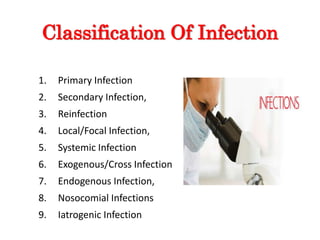
1. Primary Infection
2. Secondary Infection,
3. Reinfection
4. Local/Focal Infection,
5. Systemic Infection
6. Exogenous/Cross Infection
7. Endogenous Infection,
8. Nosocomial Infections
9. Iatrogenic Infection
Classification Of Infection
Primary, Secondary,
Reinfection
1. Primary Infection
Initial infection that develops in an healthy individual
2. Secondary Infection
An infection that develops in an individual who is already
infected with a different pathogen
3. Reinfection
Subsequent infection with the same pathogen in same
host
Local, Systemic, Cross
4. Localized Infection (focal)
An infection that is restricted to a specific location or
region within the body of the host
5. Systemic Infection
Spread to several regions or areas in the body of the host
6. Cross infection
Already suffering from disease and acquire new disease
from another host or another external sources
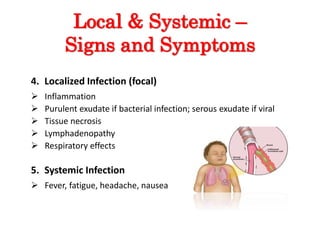
Local & Systemic –
Signs and Symptoms
4. Localized Infection (focal)
 Inflammation
 Purulent exudate if bacterial infection; serous exudate if viral
 Tissue necrosis
 Lymphadenopathy
 Respiratory effects
5. Systemic Infection
 Fever, fatigue, headache, nausea
Hospital Acquired Infection
Nosocomial & Iatrogenic
8. Nosocomial infection
Relating to or being an infection that a patient acquires
while being treated in a hospital /health care facility
(workers to patient).
9. Iatrogenic Infection
Induced unintentionally in a patient by a physician during
therapeutic or investigative procedure
Clinical vs. Subclinical
Infection
1. Clinical Infection
An infection with obvious observable or detectable symptoms
2. Subclinical Infection
An infection with few or no obvious symptoms
3. Atypical infection
Typical clinical features of particular infection is not present
Principles of Infection
Understanding the basic principles of infection is
essential for any health care worker in any field of
health care.
1. Disease transmission
2. Prevention of disease transmission
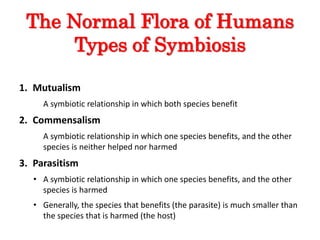
The Normal Flora of Humans
Types of Symbiosis
1. Mutualism
A symbiotic relationship in which both species benefit
2. Commensalism
A symbiotic relationship in which one species benefits, and the other
species is neither helped nor harmed
3. Parasitism
• A symbiotic relationship in which one species benefits, and the other
species is harmed
• Generally, the species that benefits (the parasite) is much smaller than
the species that is harmed (the host)
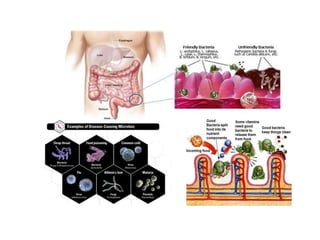
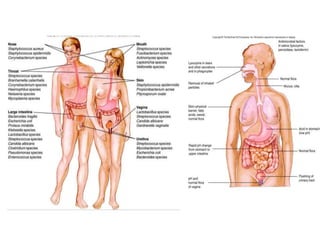
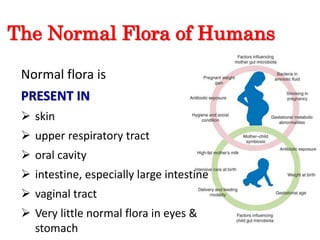
The Normal Flora of Humans
Normal flora is
PRESENT IN
 skin
 upper respiratory tract
 oral cavity
 intestine, especially large intestine
 vaginal tract
 Very little normal flora in eyes &
stomach
Introduction Of A Flora
The Normal Flora Is Absent
• Notably absent in most all internal organs
ABSENT IN:
1. lower respiratory tract
2. muscle tissue
3. blood & tissue fluid
4. cerebrospinal fluid
5. peritoneum
6. pericardium
7. meninges
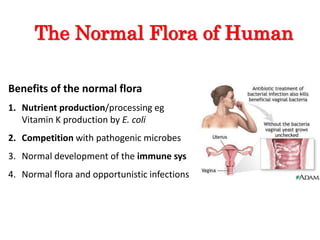
Benefits of the normal flora
1. Nutrient production/processing eg
Vitamin K production by E. coli
2. Competition with pathogenic microbes
3. Normal development of the immune sys
4. Normal flora and opportunistic infections
The Normal Flora of Human
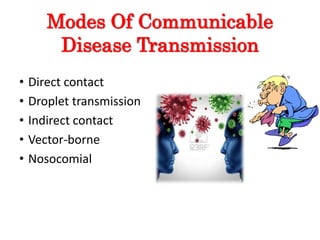
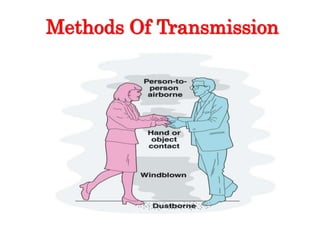
Modes Of Communicable
Disease Transmission
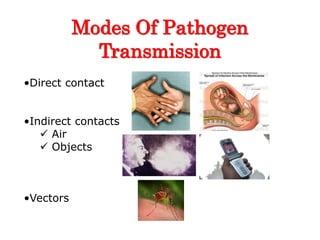
• Direct contact
• Droplet transmission
• Indirect contact
• Vector-borne
• Nosocomial
•Direct contact
•Indirect contacts
 Air
 Objects
•Vectors
Modes Of Pathogen
Transmission
Direct Transmission
• Immediate transfer of the disease agent by direct
contact between the infected and the susceptible
individuals
• Occurs through acts such as touching, biting, kissing,
sexual intercourse, or by direct projection (droplet
spread) by coughing or sneezing within a distance of
one meter
• E.g. of diseases AIDS, syphilis, gonorrhea and
common cold
1. Air-borne transmission - transmission of microbial
aerosols to a suitable port of entry, usually the
respiratory tract.
–Microbial aerosols are suspensions of dust or
droplet nuclei made up wholly or in part by
microorganisms - may be suspended and
transmittable for long periods of time
–E.g. of air-borne diseases - tuberculosis, influenza,
Histoplasmosis, and Legionellosis
Indirect Transmission
May be 1 of 3 types: Air-borne, Vehicle-borne Or Vector-borne
2. Vehicle-borne transmission - contaminated objects
(fomites) serve as vehicles, nonliving by which contagious
agents are transferred to a susceptible host
–The agent may or may not have multiplied or
developed on the vehicle
–E.g. of vehicles include toys, handkerchiefs, soiled
clothes, food service utensils, and surgical instruments
–Also water, milk, food (e.g., common vehicles), or
biological products such as blood, serum, plasma,
organs and tissues
Indirect Transmission
May be 1 of 3 types: Air-borne, Vehicle-borne Or Vector-borne
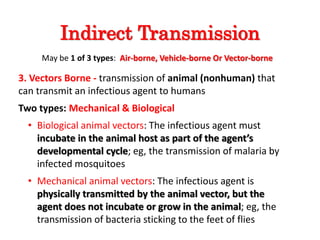
3. Vectors Borne - transmission of animal (nonhuman) that
can transmit an infectious agent to humans
Two types: Mechanical & Biological
• Biological animal vectors: The infectious agent must
incubate in the animal host as part of the agent’s
developmental cycle; eg, the transmission of malaria by
infected mosquitoes
• Mechanical animal vectors: The infectious agent is
physically transmitted by the animal vector, but the
agent does not incubate or grow in the animal; eg, the
transmission of bacteria sticking to the feet of flies
Indirect Transmission
May be 1 of 3 types: Air-borne, Vehicle-borne Or Vector-borne
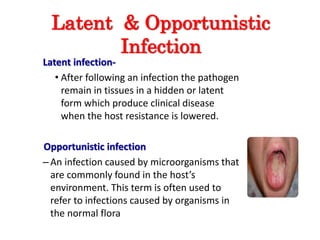
Latent & Opportunistic
Infection
Latent infection-
• After following an infection the pathogen
remain in tissues in a hidden or latent
form which produce clinical disease
when the host resistance is lowered.
Opportunistic infection
–An infection caused by microorganisms that
are commonly found in the host’s
environment. This term is often used to
refer to infections caused by organisms in
the normal flora
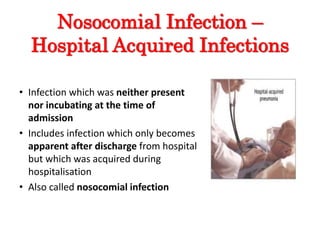
Nosocomial Infection –
Hospital Acquired Infections
• Infection which was neither present
nor incubating at the time of
admission
• Includes infection which only becomes
apparent after discharge from hospital
but which was acquired during
hospitalisation
• Also called nosocomial infection
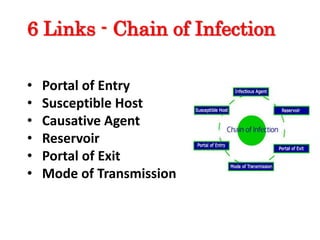
• Portal of Entry
• Susceptible Host
• Causative Agent
• Reservoir
• Portal of Exit
• Mode of Transmission
6 Links - Chain of Infection
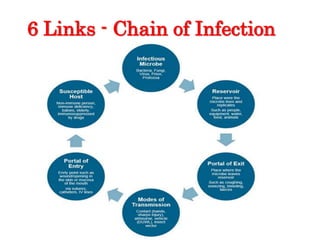
Links in the Chain
Transmitted through a chain (six links)
1. Pathogen - disease causing microorganism
2. Reservoir - natural environment of the pathogen:
Person, animal or environmental component
3. Portal of Exit
4. Means of transmission
• Direct transmission
• Indirect transmission
5. Portal of entry
• Penetration of the skin
• Inhalation
• Ingestion
6. New host
Breaking the Chain
6 Links - Chain of Infection
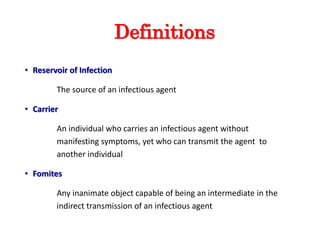
Definitions
• Reservoir of Infection
The source of an infectious agent
• Carrier
An individual who carries an infectious agent without
manifesting symptoms, yet who can transmit the agent to
another individual
• Fomites
Any inanimate object capable of being an intermediate in the
indirect transmission of an infectious agent
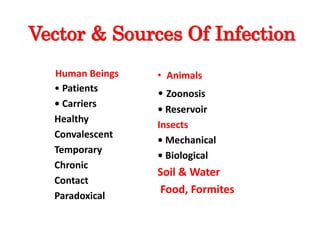
Vector & Sources Of Infection
Human Beings • Animals
• Patients
• Carriers
Healthy
Convalescent
Temporary
Chronic
Contact
Paradoxical
• Zoonosis
• Reservoir
Insects
• Mechanical
• Biological
Soil & Water
Food, Formites
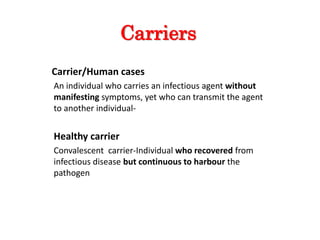
Carriers
Carrier/Human cases
An individual who carries an infectious agent without
manifesting symptoms, yet who can transmit the agent
to another individual-
Healthy carrier
Convalescent carrier-Individual who recovered from
infectious disease but continuous to harbour the
pathogen
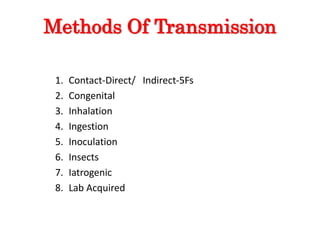
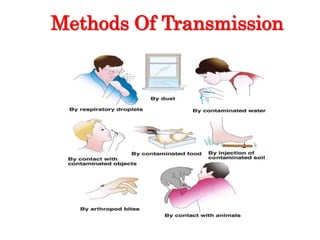
Methods Of Transmission
1. Contact-Direct/ Indirect-5Fs
2. Congenital
3. Inhalation
4. Ingestion
5. Inoculation
6. Insects
7. Iatrogenic
8. Lab Acquired
Methods Of Transmission
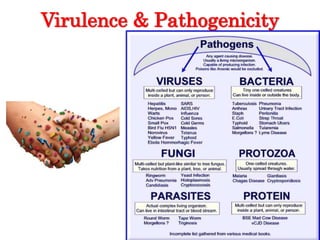
Virulence & Pathogenicity
Virulence
Virulence: Degree Of Pathogenicity
of the individual organism
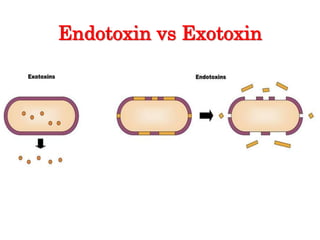
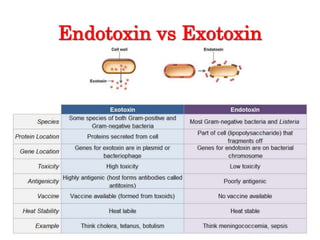
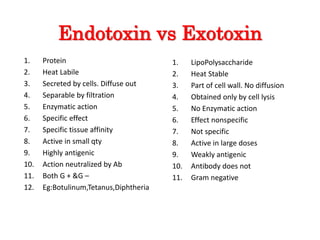
Endotoxin vs Exotoxin
1. Protein
2. Heat Labile
3. Secreted by cells. Diffuse out
4. Separable by filtration
5. Enzymatic action
6. Specific effect
7. Specific tissue affinity
8. Active in small qty
9. Highly antigenic
10. Action neutralized by Ab
11. Both G + &G –
12. Eg:Botulinum,Tetanus,Diphtheria
1. LipoPolysaccharide
2. Heat Stable
3. Part of cell wall. No diffusion
4. Obtained only by cell lysis
5. No Enzymatic action
6. Effect nonspecific
7. Not specific
8. Active in large doses
9. Weakly antigenic
10. Antibody does not
11. Gram negative
Endotoxin vs Exotoxin
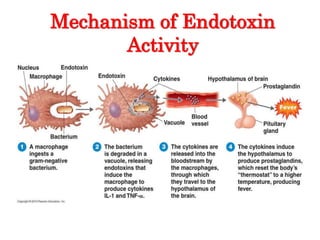
Mechanism of Endotoxin
Activity
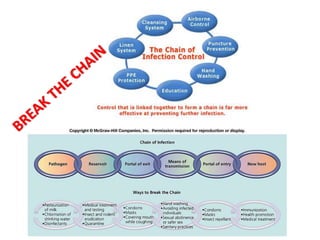
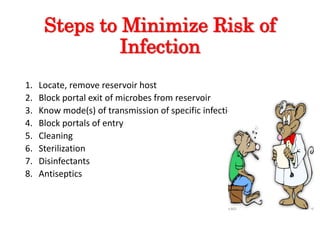
Steps to Minimize Risk of
Infection
1. Locate, remove reservoir host
2. Block portal exit of microbes from reservoir
3. Know mode(s) of transmission of specific infections
4. Block portals of entry
5. Cleaning
6. Sterilization
7. Disinfectants
8. Antiseptics
1st Principle Of Infection
Prevention
1st principle of infection prévention at least 35-50%
of all nosocomial infections are associated with
patient care practices:
1. Use and care of urinary catheters
2. Use and care of vascular access lines
3. Therapy and support of pulmonary functions
4. Experience with surgical procedures
5. Hand hygiene and standard precautions
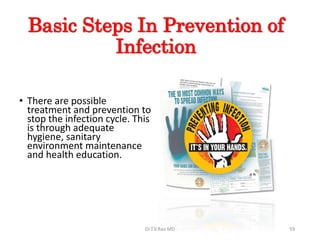
Basic Steps In Prevention of
Infection
• There are possible
treatment and prevention to
stop the infection cycle. This
is through adequate
hygiene, sanitary
environment maintenance
and health education.
Dr.T.V.Rao MD 59
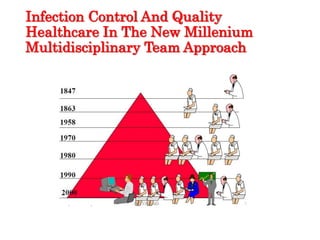
Infection Control And Quality
Healthcare In The New Millenium
Multidisciplinary Team Approach

8. Infection.pptx

  • 1.
  • 2.
    LEARNING OUTCOMES • Atthe end of this class the student will be able to: 1. Definition and know the Classification of infection 2. Recognize the Acute Infection Vs. Chronic Infection 3. Describe the Primary Infection, Secondary Infection, Reinfection, Local/Focal Infection, Systemic Infection, Cross/Exogenous, Endogenous Infection, Nosocomial Infections 4. Describe the introduction of the pathway of Normal Flora 5. Comprehend the Chain of Infection 6. To know the minimize Risk and Prevention of Infection
  • 3.
    DEFINITIONS Infection - Thecolonization and multiplication of a microbe in or on the tissues of a host. - Infecting Microbes seek to use the host's resources to reproduce, often resulting in disease. Disease - Any deviation from a condition of good health & well-being Infectious - A disease condition caused by the presence or Disease growth of infectious microorganisms or parasites
  • 4.
    • Caused bymicroorganisms like viruses, prions, bacteria, viroid, parasites and fungi. • Invasion by and multiplication of pathogenic in a bodily part or tissue, which may produce subsequent tissue injury and progress to manifested disease through cellular or toxic mechanisms. • An infection that • produces symptoms is an apparent infection. • is active, but does not produce noticeable symptoms, may be called in apparent, silent, or subclinical • is inactive or dormant is called a latent infection INFECTION
  • 5.
    Conditions Required For InfectionTo Spread From One Person To Another 3 key components i. One person must be infected with a microorganism ii. The other person must be susceptible to infection with that microorganism iii. The microorganism must be able to leave the body of the infected person and enter the body of the susceptible person.
  • 6.
    Time Parameters Of Interaction •Latency Period = the INCUBATION PERIOD of an infectious disease, BEFORE symptoms appear = the interval between exposure to an infectious organism (stimulus) and the clinical appearance of disease (response). • Incubation Period = the time between infection and onset of symptoms
  • 7.
    Range of relationships Saprophytes– Free living microbes subsisting on dead / decaying organic matter Commensals – Microbes living in complete harmony with host without causing any harm to them. Parasites – Microbes establishing and multiplying themselves in hosts. Pathogens - Microbes capable of causing disease in host. Nature Of Microorganisms
  • 8.
    Definitions - Pathogenicity &Virulence –Pathogenicity • The ability of a microbe to cause disease • This term is often used to describe or compare species –Virulence • The degree of pathogenicity in a microorganism • used to describe or compare strains within a species Based on: • Invasive qualities • Toxic qualities • Presence of pili or fimbriae for adhesion • Ability to avoid host defenses (mutate)
  • 9.
  • 10.
  • 11.
    Causative Agents Effecting Humans Bacteria  Viruses  Fungi  Protozoa  Helminths  Prions 11
  • 13.
    Defining - TheSuffix “-emia” -emia suffix meaning “presence of an infectious agent” 1. Bacteremia = Presence of infectious bacteria 2. Viremia = Presence of infectious virus 3. Fungemia = Presence of infectious fungus 4. Septicemia = Presence of an infectious agent in the bloodstream
  • 14.
    Defining - Thesuffix “-itis” -itis meaning “inflammation of” Examples: 1. Pharyngitis = Inflammation of the pharynx 2. Endocarditis = Inflammation of the heart chambers 3. Gastroenteritis = Inflammation of the gastrointestinal tract
  • 15.
    DEFINITIONS 1. Epidemiology Epidemiology isthe study and analysis of the distribution (who, when, and where) and determinants of health and disease conditions in defined populations. 2. Communicable Disease A disease that can be transmitted from one individual to another 3. Contagious Disease A communicable disease that is easily spread from one individual to another 4. Non communicable Disease A disease that is not transmitted from one individual to another
  • 16.
    Definitions: Epidemiological Terms 1. ENDEMIC- Disease constantly present in particular area or in a certain percentage of a population 2. EPIDEMIC - spreads rapidly, involves many persons in an area at a time (E.g. - meningococcal meningitis, Influenza) 3. PANDEMIC - spreads many areas in world involves large number within short period (E.g. - Cholera, Enterovirus)
  • 17.
    Classification Of Infection ACUTEINFECTION VS. CHRONIC INFECTION Acute Infection •An infection characterized by sudden onset, rapid progression, and often with severe symptoms •However, there is a balance between production and degradation of molecules e.g. collagen, extracellular matrix
  • 18.
    Classification Of Infection ACUTEINFECTION VS. CHRONIC INFECTION Chronic Infection • An infection characterized by delayed onset and slow progression of healing process • Why? – the healing process doesn’t occur orderly as by stages and at the possible duration of the healing period (take more than 3 months - years) • E.g. Wound remain in the inflammatory state for longer time. • Acute and chronic wounds are at opposite sides of a range of wound healing types that progress which healed at different rates.
  • 19.
    1. Primary Infection 2.Secondary Infection, 3. Reinfection 4. Local/Focal Infection, 5. Systemic Infection 6. Exogenous/Cross Infection 7. Endogenous Infection, 8. Nosocomial Infections 9. Iatrogenic Infection Classification Of Infection
  • 20.
    Primary, Secondary, Reinfection 1. PrimaryInfection Initial infection that develops in an healthy individual 2. Secondary Infection An infection that develops in an individual who is already infected with a different pathogen 3. Reinfection Subsequent infection with the same pathogen in same host
  • 21.
    Local, Systemic, Cross 4.Localized Infection (focal) An infection that is restricted to a specific location or region within the body of the host 5. Systemic Infection Spread to several regions or areas in the body of the host 6. Cross infection Already suffering from disease and acquire new disease from another host or another external sources
  • 22.
    Local & Systemic– Signs and Symptoms 4. Localized Infection (focal)  Inflammation  Purulent exudate if bacterial infection; serous exudate if viral  Tissue necrosis  Lymphadenopathy  Respiratory effects 5. Systemic Infection  Fever, fatigue, headache, nausea
  • 23.
    Hospital Acquired Infection Nosocomial& Iatrogenic 8. Nosocomial infection Relating to or being an infection that a patient acquires while being treated in a hospital /health care facility (workers to patient). 9. Iatrogenic Infection Induced unintentionally in a patient by a physician during therapeutic or investigative procedure
  • 24.
    Clinical vs. Subclinical Infection 1.Clinical Infection An infection with obvious observable or detectable symptoms 2. Subclinical Infection An infection with few or no obvious symptoms 3. Atypical infection Typical clinical features of particular infection is not present
  • 25.
    Principles of Infection Understandingthe basic principles of infection is essential for any health care worker in any field of health care. 1. Disease transmission 2. Prevention of disease transmission
  • 26.
    The Normal Floraof Humans Types of Symbiosis 1. Mutualism A symbiotic relationship in which both species benefit 2. Commensalism A symbiotic relationship in which one species benefits, and the other species is neither helped nor harmed 3. Parasitism • A symbiotic relationship in which one species benefits, and the other species is harmed • Generally, the species that benefits (the parasite) is much smaller than the species that is harmed (the host)
  • 28.
    The Normal Floraof Humans Normal flora is PRESENT IN  skin  upper respiratory tract  oral cavity  intestine, especially large intestine  vaginal tract  Very little normal flora in eyes & stomach
  • 29.
  • 30.
    The Normal FloraIs Absent • Notably absent in most all internal organs ABSENT IN: 1. lower respiratory tract 2. muscle tissue 3. blood & tissue fluid 4. cerebrospinal fluid 5. peritoneum 6. pericardium 7. meninges
  • 31.
    Benefits of thenormal flora 1. Nutrient production/processing eg Vitamin K production by E. coli 2. Competition with pathogenic microbes 3. Normal development of the immune sys 4. Normal flora and opportunistic infections The Normal Flora of Human
  • 32.
    Modes Of Communicable DiseaseTransmission • Direct contact • Droplet transmission • Indirect contact • Vector-borne • Nosocomial
  • 33.
    •Direct contact •Indirect contacts Air  Objects •Vectors Modes Of Pathogen Transmission
  • 34.
    Direct Transmission • Immediatetransfer of the disease agent by direct contact between the infected and the susceptible individuals • Occurs through acts such as touching, biting, kissing, sexual intercourse, or by direct projection (droplet spread) by coughing or sneezing within a distance of one meter • E.g. of diseases AIDS, syphilis, gonorrhea and common cold
  • 35.
    1. Air-borne transmission- transmission of microbial aerosols to a suitable port of entry, usually the respiratory tract. –Microbial aerosols are suspensions of dust or droplet nuclei made up wholly or in part by microorganisms - may be suspended and transmittable for long periods of time –E.g. of air-borne diseases - tuberculosis, influenza, Histoplasmosis, and Legionellosis Indirect Transmission May be 1 of 3 types: Air-borne, Vehicle-borne Or Vector-borne
  • 36.
    2. Vehicle-borne transmission- contaminated objects (fomites) serve as vehicles, nonliving by which contagious agents are transferred to a susceptible host –The agent may or may not have multiplied or developed on the vehicle –E.g. of vehicles include toys, handkerchiefs, soiled clothes, food service utensils, and surgical instruments –Also water, milk, food (e.g., common vehicles), or biological products such as blood, serum, plasma, organs and tissues Indirect Transmission May be 1 of 3 types: Air-borne, Vehicle-borne Or Vector-borne
  • 37.
    3. Vectors Borne- transmission of animal (nonhuman) that can transmit an infectious agent to humans Two types: Mechanical & Biological • Biological animal vectors: The infectious agent must incubate in the animal host as part of the agent’s developmental cycle; eg, the transmission of malaria by infected mosquitoes • Mechanical animal vectors: The infectious agent is physically transmitted by the animal vector, but the agent does not incubate or grow in the animal; eg, the transmission of bacteria sticking to the feet of flies Indirect Transmission May be 1 of 3 types: Air-borne, Vehicle-borne Or Vector-borne
  • 38.
    Latent & Opportunistic Infection Latentinfection- • After following an infection the pathogen remain in tissues in a hidden or latent form which produce clinical disease when the host resistance is lowered. Opportunistic infection –An infection caused by microorganisms that are commonly found in the host’s environment. This term is often used to refer to infections caused by organisms in the normal flora
  • 39.
    Nosocomial Infection – HospitalAcquired Infections • Infection which was neither present nor incubating at the time of admission • Includes infection which only becomes apparent after discharge from hospital but which was acquired during hospitalisation • Also called nosocomial infection
  • 40.
    • Portal ofEntry • Susceptible Host • Causative Agent • Reservoir • Portal of Exit • Mode of Transmission 6 Links - Chain of Infection
  • 41.
    Links in theChain Transmitted through a chain (six links) 1. Pathogen - disease causing microorganism 2. Reservoir - natural environment of the pathogen: Person, animal or environmental component 3. Portal of Exit 4. Means of transmission • Direct transmission • Indirect transmission 5. Portal of entry • Penetration of the skin • Inhalation • Ingestion 6. New host Breaking the Chain 6 Links - Chain of Infection
  • 42.
    6 Links -Chain of Infection
  • 44.
    Definitions • Reservoir ofInfection The source of an infectious agent • Carrier An individual who carries an infectious agent without manifesting symptoms, yet who can transmit the agent to another individual • Fomites Any inanimate object capable of being an intermediate in the indirect transmission of an infectious agent
  • 45.
    Vector & SourcesOf Infection Human Beings • Animals • Patients • Carriers Healthy Convalescent Temporary Chronic Contact Paradoxical • Zoonosis • Reservoir Insects • Mechanical • Biological Soil & Water Food, Formites
  • 46.
    Carriers Carrier/Human cases An individualwho carries an infectious agent without manifesting symptoms, yet who can transmit the agent to another individual- Healthy carrier Convalescent carrier-Individual who recovered from infectious disease but continuous to harbour the pathogen
  • 47.
    Methods Of Transmission 1.Contact-Direct/ Indirect-5Fs 2. Congenital 3. Inhalation 4. Ingestion 5. Inoculation 6. Insects 7. Iatrogenic 8. Lab Acquired
  • 48.
  • 49.
  • 51.
  • 52.
    Virulence Virulence: Degree OfPathogenicity of the individual organism
  • 53.
  • 54.
  • 55.
    1. Protein 2. HeatLabile 3. Secreted by cells. Diffuse out 4. Separable by filtration 5. Enzymatic action 6. Specific effect 7. Specific tissue affinity 8. Active in small qty 9. Highly antigenic 10. Action neutralized by Ab 11. Both G + &G – 12. Eg:Botulinum,Tetanus,Diphtheria 1. LipoPolysaccharide 2. Heat Stable 3. Part of cell wall. No diffusion 4. Obtained only by cell lysis 5. No Enzymatic action 6. Effect nonspecific 7. Not specific 8. Active in large doses 9. Weakly antigenic 10. Antibody does not 11. Gram negative Endotoxin vs Exotoxin
  • 56.
  • 57.
    Steps to MinimizeRisk of Infection 1. Locate, remove reservoir host 2. Block portal exit of microbes from reservoir 3. Know mode(s) of transmission of specific infections 4. Block portals of entry 5. Cleaning 6. Sterilization 7. Disinfectants 8. Antiseptics
  • 58.
    1st Principle OfInfection Prevention 1st principle of infection prévention at least 35-50% of all nosocomial infections are associated with patient care practices: 1. Use and care of urinary catheters 2. Use and care of vascular access lines 3. Therapy and support of pulmonary functions 4. Experience with surgical procedures 5. Hand hygiene and standard precautions
  • 59.
    Basic Steps InPrevention of Infection • There are possible treatment and prevention to stop the infection cycle. This is through adequate hygiene, sanitary environment maintenance and health education. Dr.T.V.Rao MD 59
  • 60.
    Infection Control AndQuality Healthcare In The New Millenium Multidisciplinary Team Approach