Workshop on
Automobile Basics & Advanced System
organized by
Autonext
Jamshedpur
A report by
Debanjan Paul
student of
Department of Mechanical Engineering
Academy of Technology
Adisaptagram, Hooghly, West Bengal
India – 712121
Autonext
Automobile workshop
1
Contents
ABSTRACT 2
INTRODUCTION 3
TYPES OF AUTOMOBILES 4
PARTS OF AN AUTOMOBILE 5
Engine 5
Camshaft 6
Crankshaft 7
Cylinder block 7
Carburetor 7
Inlet Manifold and Exhaust Manifold 8
Starter Motor 8
Transmission System 9
Clutch 10
Gearbox 11
Differential 11
Drive shaft 13
Universal Joint 13
Engine Cooling System 13
Braking System 14
Suspension 16
Springs and dampers 16
Steering 17
The rack and pinion system 18
The steering-box system 18
Wheels and Tyres 19
Chassis 24
Ladder frame 25
Unibody frame 25
Space frame 26
ADVANCED TECHNOLOGIES IN AUTOMOBILES 27
CONCLUSION 32
BIBLIOGRAPHY 33
Autonext
Automobile workshop
2
Abstract
This report relates to the workshop on “Automobile Basics & Advanced
System” organized by Autonext in Jamshedpur from December 28,
2015 to January 10, 2016, which I attended during the 2nd
year of my
undergraduate Mechanical Engineering course at Academy Of
Technology. The report elaborates on automobile types, the various
functional parts and the advanced technologies being developed. The
topics included in this report were covered during the workshop.
_________________
(Debanjan Paul)
Autonext
Automobile workshop
3
Introduction
The term automobile means “self-propelled” and motor
vehicles/automobiles are ones that are able to power themselves
generally with the use of internal combustion engines, and are able to
run on roads or off roads (unlike trains or trams).
Automobiles are an integral part of our lives today, and while self
propelled steam vehicles can be dated to as early as the 17th
century,
automobiles as we know them, operating on IC engines, did not appear
until the 19th
century. The advent of automobiles did overlap largely
with the industrial revolution, and gradual development and
refinements have brought the automobile industry to what it is today.
This report will not delve on the history of automobiles, but rather
serve as an introduction to the technical aspects of automobiles such as
engines, vehicular parts and peripheral technologies. To be specific, we
will be discussing about cars, i.e., four wheeled passenger vehicles
typically housing one to eight people.
Autonext
Automobile workshop
4
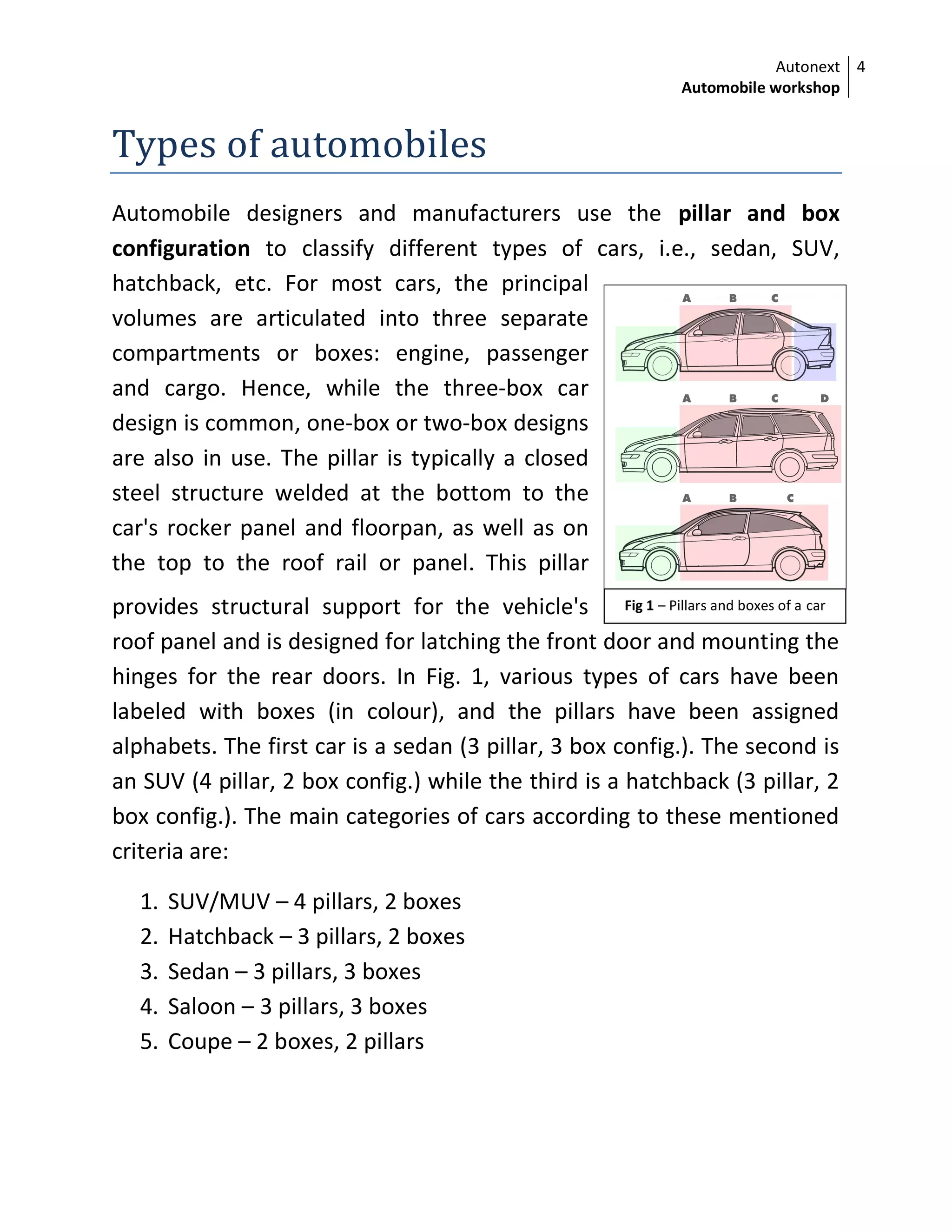
Fig 1 – Pillars and boxes of a car
Types of automobiles
Automobile designers and manufacturers use the pillar and box
configuration to classify different types of cars, i.e., sedan, SUV,
hatchback, etc. For most cars, the principal
volumes are articulated into three separate
compartments or boxes: engine, passenger
and cargo. Hence, while the three-box car
design is common, one-box or two-box designs
are also in use. The pillar is typically a closed
steel structure welded at the bottom to the
car's rocker panel and floorpan, as well as on
the top to the roof rail or panel. This pillar
provides structural support for the vehicle's
roof panel and is designed for latching the front door and mounting the
hinges for the rear doors. In Fig. 1, various types of cars have been
labeled with boxes (in colour), and the pillars have been assigned
alphabets. The first car is a sedan (3 pillar, 3 box config.). The second is
an SUV (4 pillar, 2 box config.) while the third is a hatchback (3 pillar, 2
box config.). The main categories of cars according to these mentioned
criteria are:
1. SUV/MUV – 4 pillars, 2 boxes
2. Hatchback – 3 pillars, 2 boxes
3. Sedan – 3 pillars, 3 boxes
4. Saloon – 3 pillars, 3 boxes
5. Coupe – 2 boxes, 2 pillars
Autonext
Automobile workshop
5
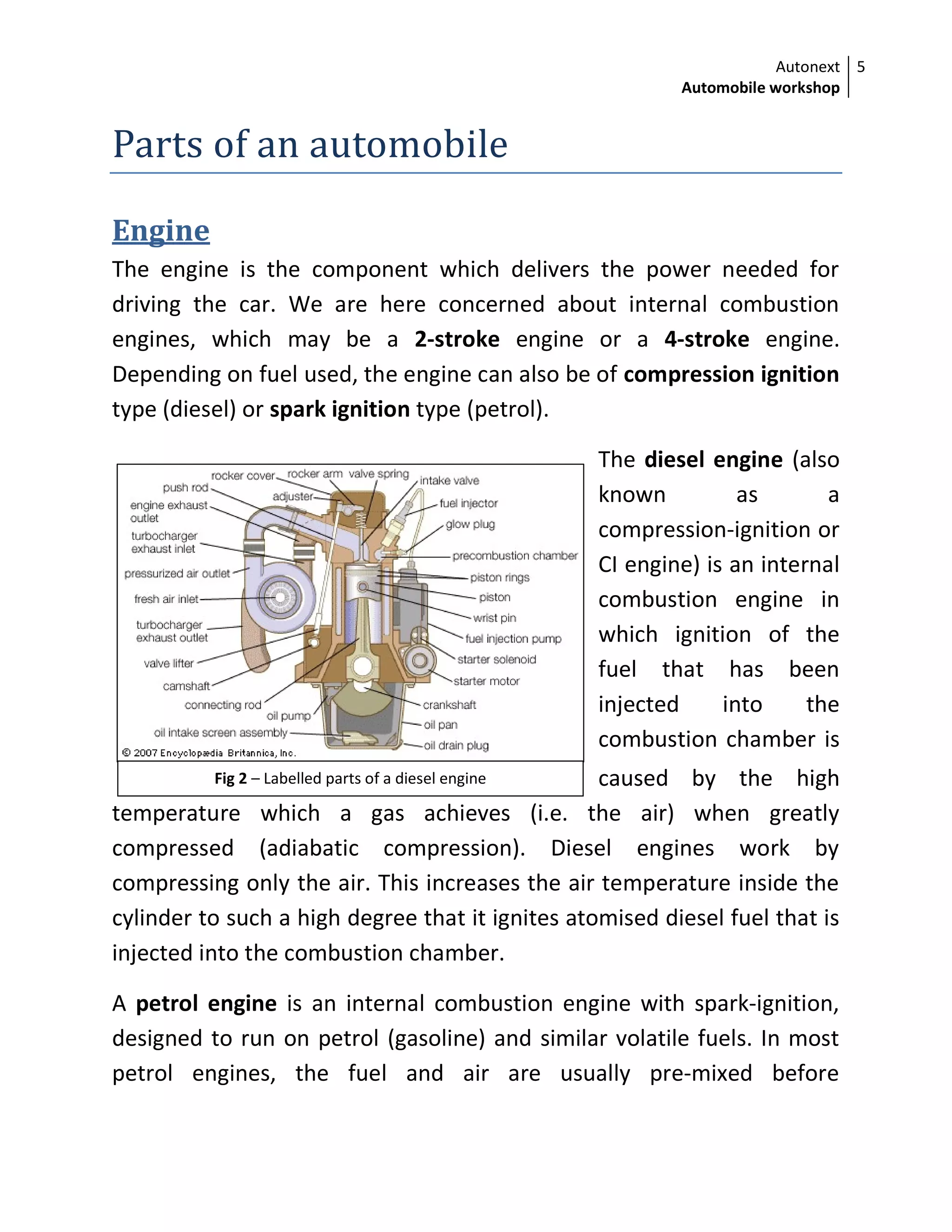
Fig 2 – Labelled parts of a diesel engine
Parts of an automobile
Engine
The engine is the component which delivers the power needed for
driving the car. We are here concerned about internal combustion
engines, which may be a 2-stroke engine or a 4-stroke engine.
Depending on fuel used, the engine can also be of compression ignition
type (diesel) or spark ignition type (petrol).
The diesel engine (also
known as a
compression-ignition or
CI engine) is an internal
combustion engine in
which ignition of the
fuel that has been
injected into the
combustion chamber is
caused by the high
temperature which a gas achieves (i.e. the air) when greatly
compressed (adiabatic compression). Diesel engines work by
compressing only the air. This increases the air temperature inside the
cylinder to such a high degree that it ignites atomised diesel fuel that is
injected into the combustion chamber.
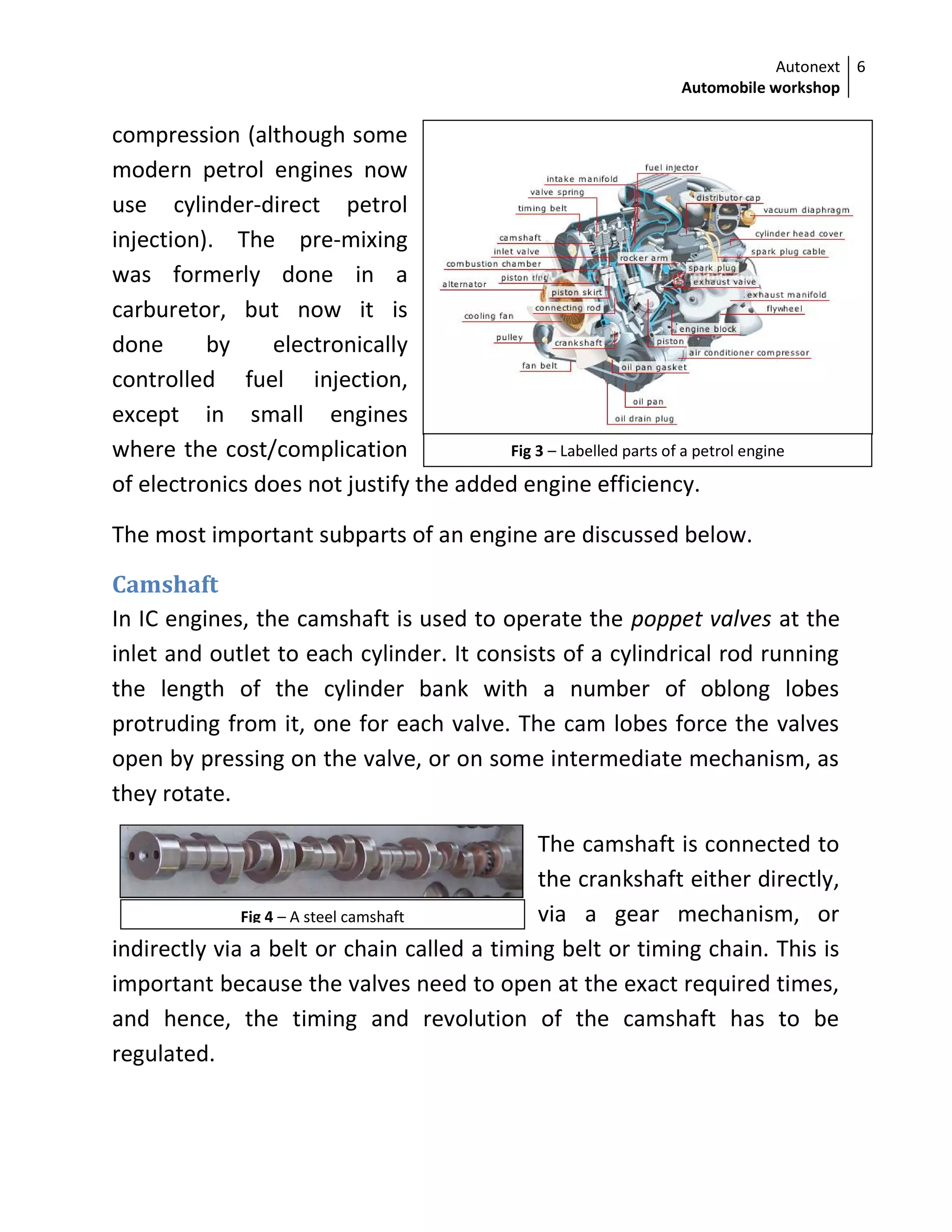
A petrol engine is an internal combustion engine with spark-ignition,
designed to run on petrol (gasoline) and similar volatile fuels. In most
petrol engines, the fuel and air are usually pre-mixed before
Autonext
Automobile workshop
6
Fig 3 – Labelled parts of a petrol engine
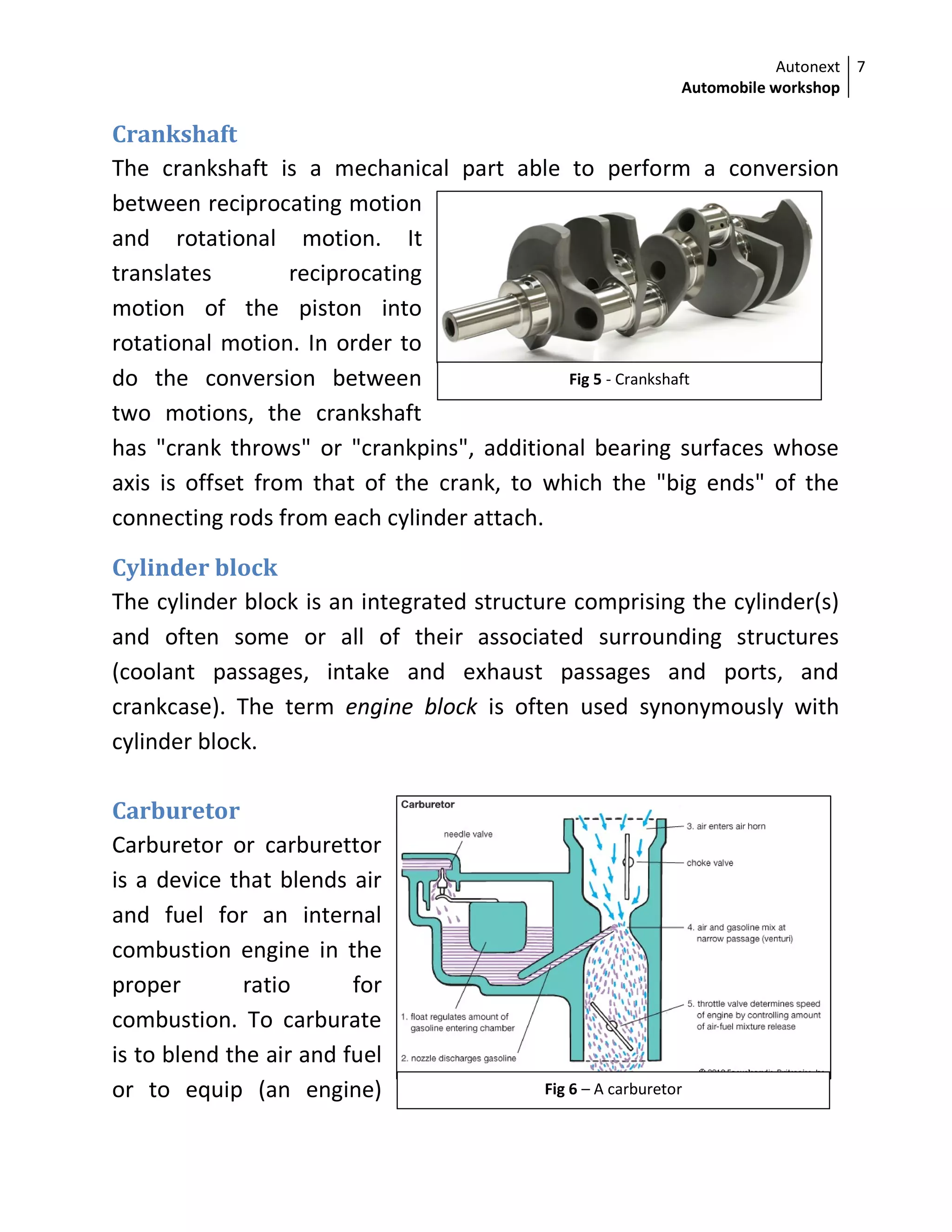
Fig 4 – A steel camshaft
compression (although some
modern petrol engines now
use cylinder-direct petrol
injection). The pre-mixing
was formerly done in a
carburetor, but now it is
done by electronically
controlled fuel injection,
except in small engines
where the cost/complication
of electronics does not justify the added engine efficiency.
The most important subparts of an engine are discussed below.
Camshaft
In IC engines, the camshaft is used to operate the poppet valves at the
inlet and outlet to each cylinder. It consists of a cylindrical rod running
the length of the cylinder bank with a number of oblong lobes
protruding from it, one for each valve. The cam lobes force the valves
open by pressing on the valve, or on some intermediate mechanism, as
they rotate.
The camshaft is connected to
the crankshaft either directly,
via a gear mechanism, or
indirectly via a belt or chain called a timing belt or timing chain. This is
important because the valves need to open at the exact required times,
and hence, the timing and revolution of the camshaft has to be
regulated.
Autonext
Automobile workshop
7
Fig 5 - Crankshaft
Fig 6 – A carburetor
Crankshaft
The crankshaft is a mechanical part able to perform a conversion
between reciprocating motion
and rotational motion. It
translates reciprocating
motion of the piston into
rotational motion. In order to
do the conversion between
two motions, the crankshaft
has "crank throws" or "crankpins", additional bearing surfaces whose
axis is offset from that of the crank, to which the "big ends" of the
connecting rods from each cylinder attach.
Cylinder block
The cylinder block is an integrated structure comprising the cylinder(s)
and often some or all of their associated surrounding structures
(coolant passages, intake and exhaust passages and ports, and
crankcase). The term engine block is often used synonymously with
cylinder block.
Carburetor
Carburetor or carburettor
is a device that blends air
and fuel for an internal
combustion engine in the
proper ratio for
combustion. To carburate
is to blend the air and fuel
or to equip (an engine)
Autonext
Automobile workshop
8
with a carburetor for that purpose. Carburetor is a vital part of an SI
engine, but today, carburetors have generally been replaced by fuel
injection systems.
Inlet Manifold and Exhaust Manifold
Inlet manifold or intake manifold is the part of an engine that evenly
distributes the combustion mixture (or just air in a direct injection
engine) to each intake port in the cylinder head(s). In contrast, an
exhaust manifold collects the exhaust gases from multiple cylinders
into a smaller number of pipes – often down to one pipe. Important
parts of the intake manifold include the carburetor, the fuel injectors
and the supercharger. The exhaust manifold houses the turbocharger
and muffler.
While a turbocharger and a supercharger are essentially the same in
the fact that they force extra pressurized air into the combustion
chamber, they differ with respect to their source of power. The
turbocharger draws power from a turbine driven by the exhaust gases
while a supercharger is mechanically driven by the engine itself.
A muffler is a device for decreasing the amount of noise emitted by the
exhaust of an internal combustion engine. In the said device, the
emitted noise of the engine is abated by a series of passages and
chambers lined with roving fiberglass insulation and/or resonating
chambers harmonically tuned to cause destructive interference,
wherein opposite sound waves cancel each other out.
Starter Motor
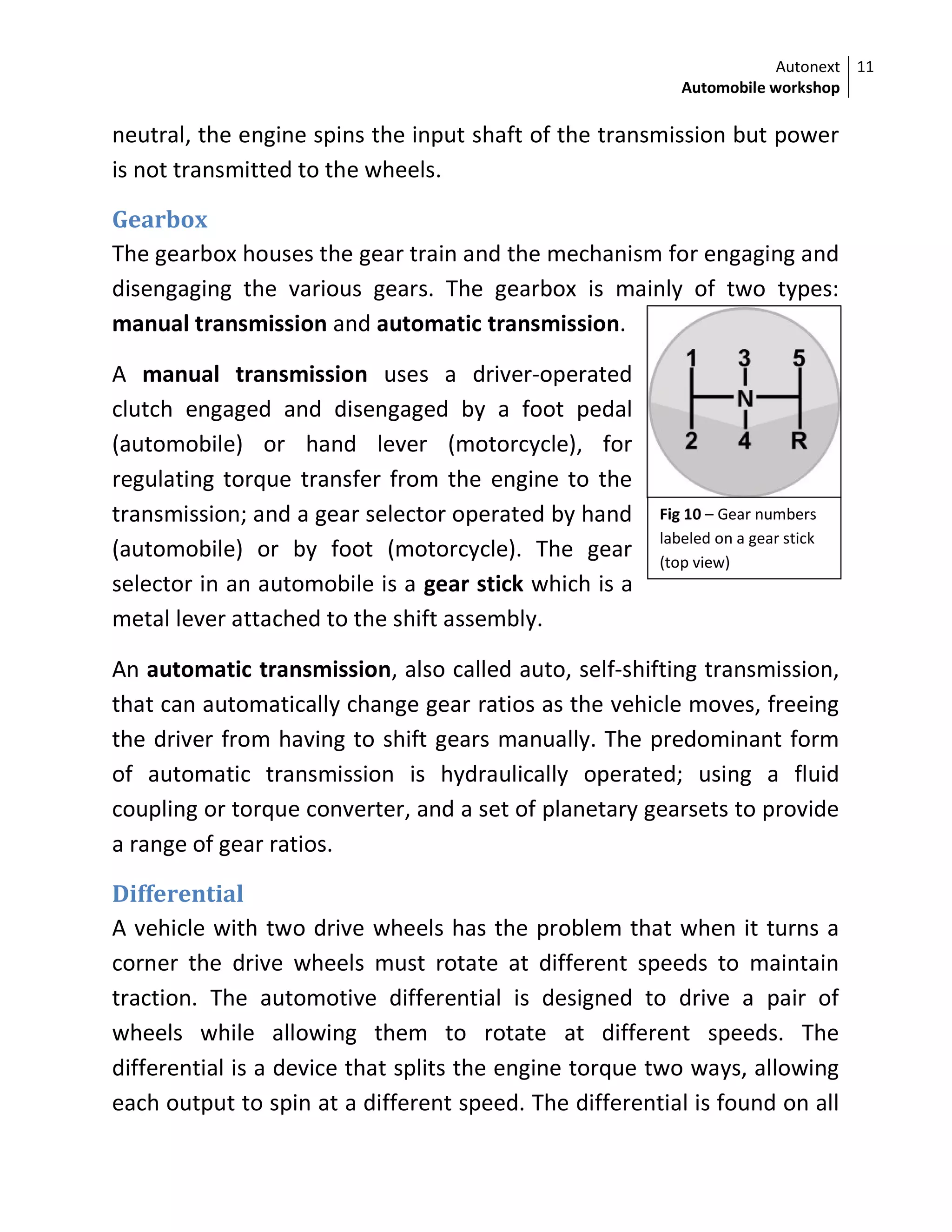
A starter (also self starter, self, cranking motor, or starter motor) is a
device used to rotate an internal-combustion engine so as to initiate
Autonext
Automobile workshop
9
Fig 7 – A starter motor
the engine's operation under its own power. Starters can be electric,
pneumatic, or hydraulic.
Internal-combustion engines are
feedback systems, which, once
started, rely on the inertia from each
cycle to initiate the next cycle. In a
four-stroke engine, the third stroke
releases energy from the fuel,
powering the fourth (exhaust) stroke
and also the first two (intake,
compression) strokes of the next
cycle, as well as powering the engine's external load. To start the first
cycle at the beginning of any particular session, the first two strokes
must be powered in some other way than from the engine itself. The
starter motor is used for this purpose and is not required once the
engine starts running and its feedback loop becomes self-sustaining.
Transmission System
The transmission system in a car helps to transmit mechanical power
from the car engine to give kinetic energy to the wheels. It is an
interconnected system of gears, shafts, and other electrical gadgets
that form a bridge to transfer power and energy from the engine to the
wheels. The main components of the transmission system in an
automobile are discussed below.
Autonext
Automobile workshop
10
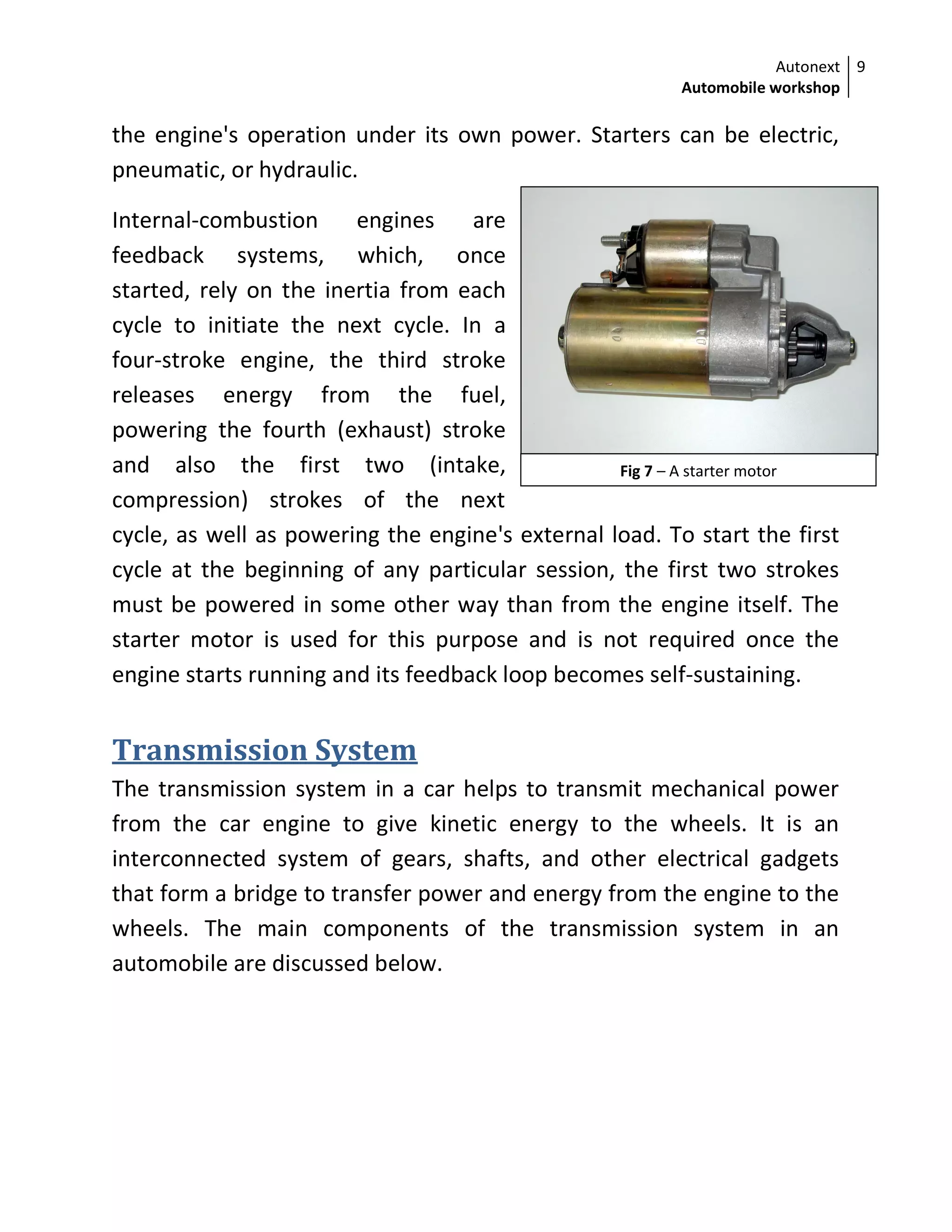
Fig 9 - The clutch is initially shown
disengaged and then it is engaged as
the diaphragm spring presses the
clutch plate against the driven plate
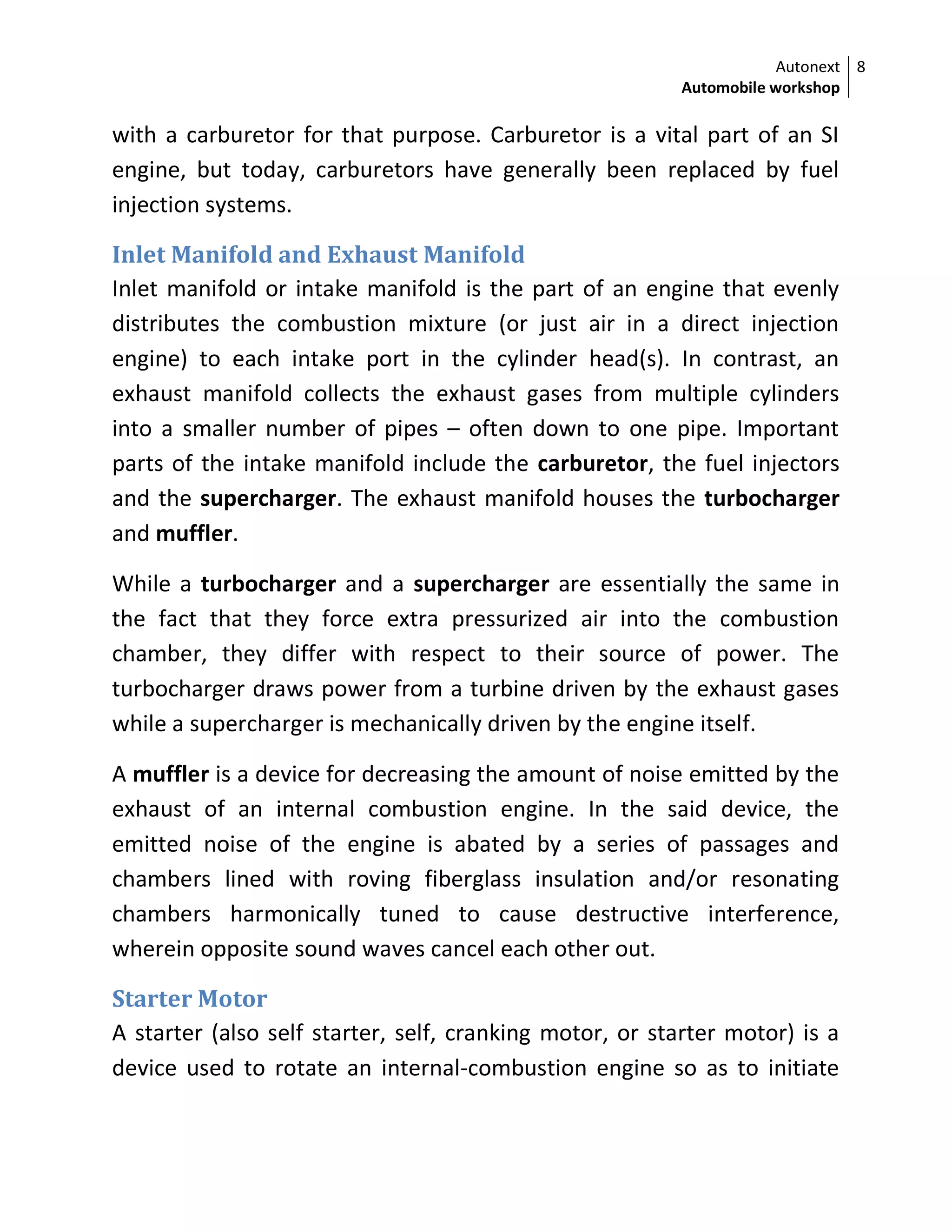
Fig 8 – A clutch with the labeled parts
Clutch
A clutch is a mechanical
device which engages
and disengages power
transmission especially
from driving shaft to
driven shaft. Clutches
connect and disconnect
two rotating shafts
(drive shafts or line
shafts). In these
devices, one shaft is
typically attached to an
engine or other power
unit (the driving
member) while the other shaft (the driven member) provides output
power for work.
In a modern car with a manual
transmission the clutch is operated by
the left-most pedal using a hydraulic or
cable connection from the pedal to the
clutch mechanism. The default state of
the clutch is engaged - that is the
connection between engine and
gearbox is always "on" unless the driver
presses the pedal and disengages it. If
the engine is running with the clutch engaged and the transmission in
Autonext
Automobile workshop
11
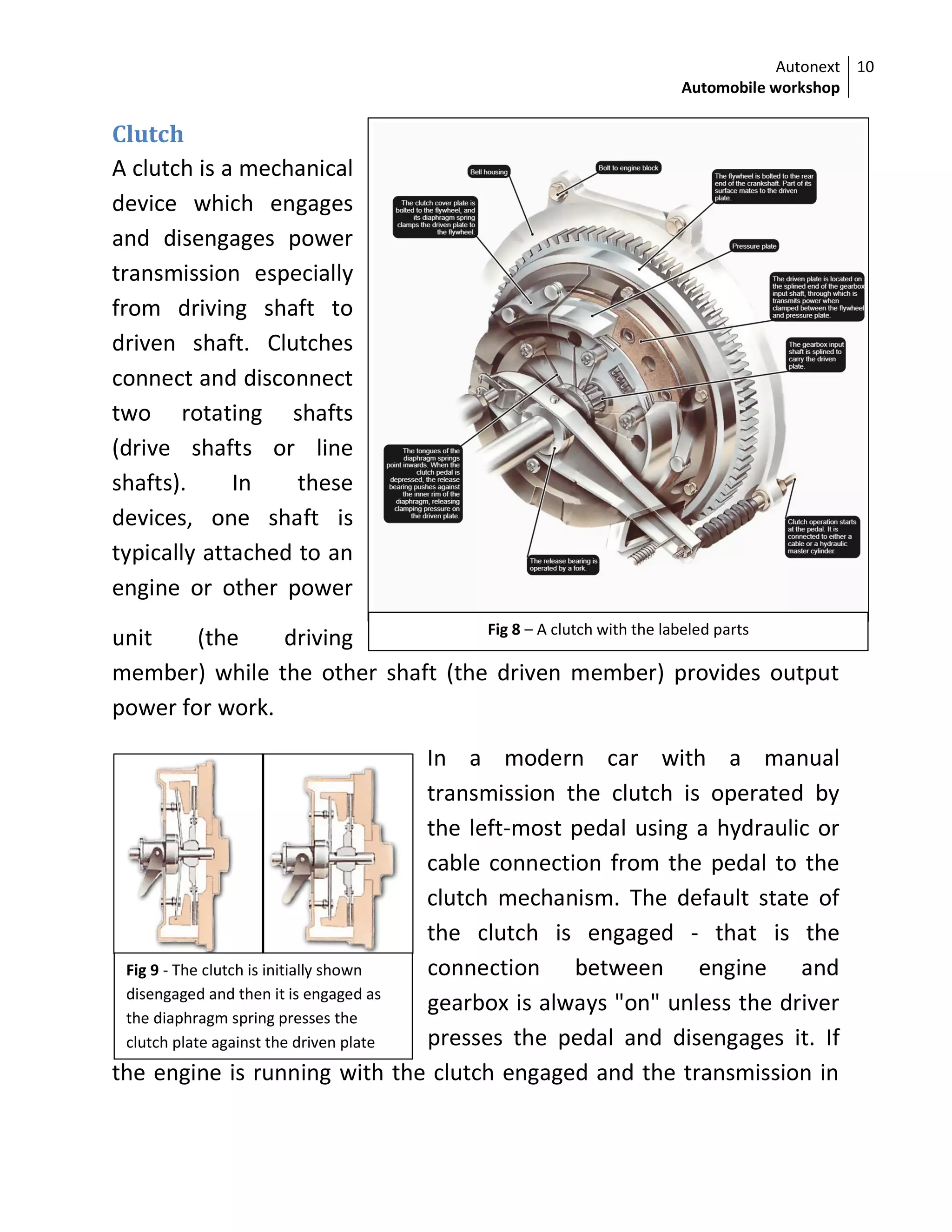
Fig 10 – Gear numbers
labeled on a gear stick
(top view)
neutral, the engine spins the input shaft of the transmission but power
is not transmitted to the wheels.
Gearbox
The gearbox houses the gear train and the mechanism for engaging and
disengaging the various gears. The gearbox is mainly of two types:
manual transmission and automatic transmission.
A manual transmission uses a driver-operated
clutch engaged and disengaged by a foot pedal
(automobile) or hand lever (motorcycle), for
regulating torque transfer from the engine to the
transmission; and a gear selector operated by hand
(automobile) or by foot (motorcycle). The gear
selector in an automobile is a gear stick which is a
metal lever attached to the shift assembly.
An automatic transmission, also called auto, self-shifting transmission,
that can automatically change gear ratios as the vehicle moves, freeing
the driver from having to shift gears manually. The predominant form
of automatic transmission is hydraulically operated; using a fluid
coupling or torque converter, and a set of planetary gearsets to provide
a range of gear ratios.
Differential
A vehicle with two drive wheels has the problem that when it turns a
corner the drive wheels must rotate at different speeds to maintain
traction. The automotive differential is designed to drive a pair of
wheels while allowing them to rotate at different speeds. The
differential is a device that splits the engine torque two ways, allowing
each output to spin at a different speed. The differential is found on all
Autonext
Automobile workshop
12
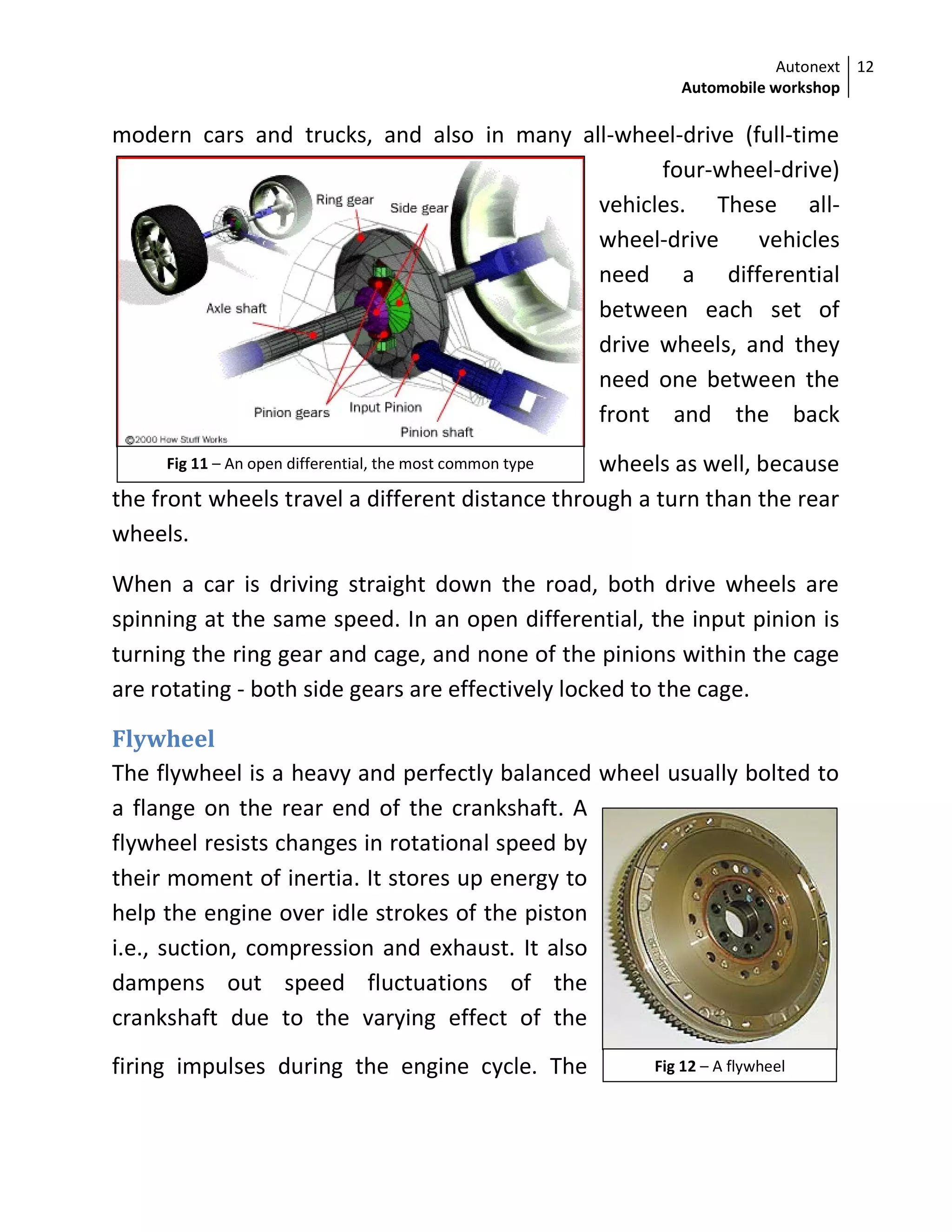
Fig 11 – An open differential, the most common type
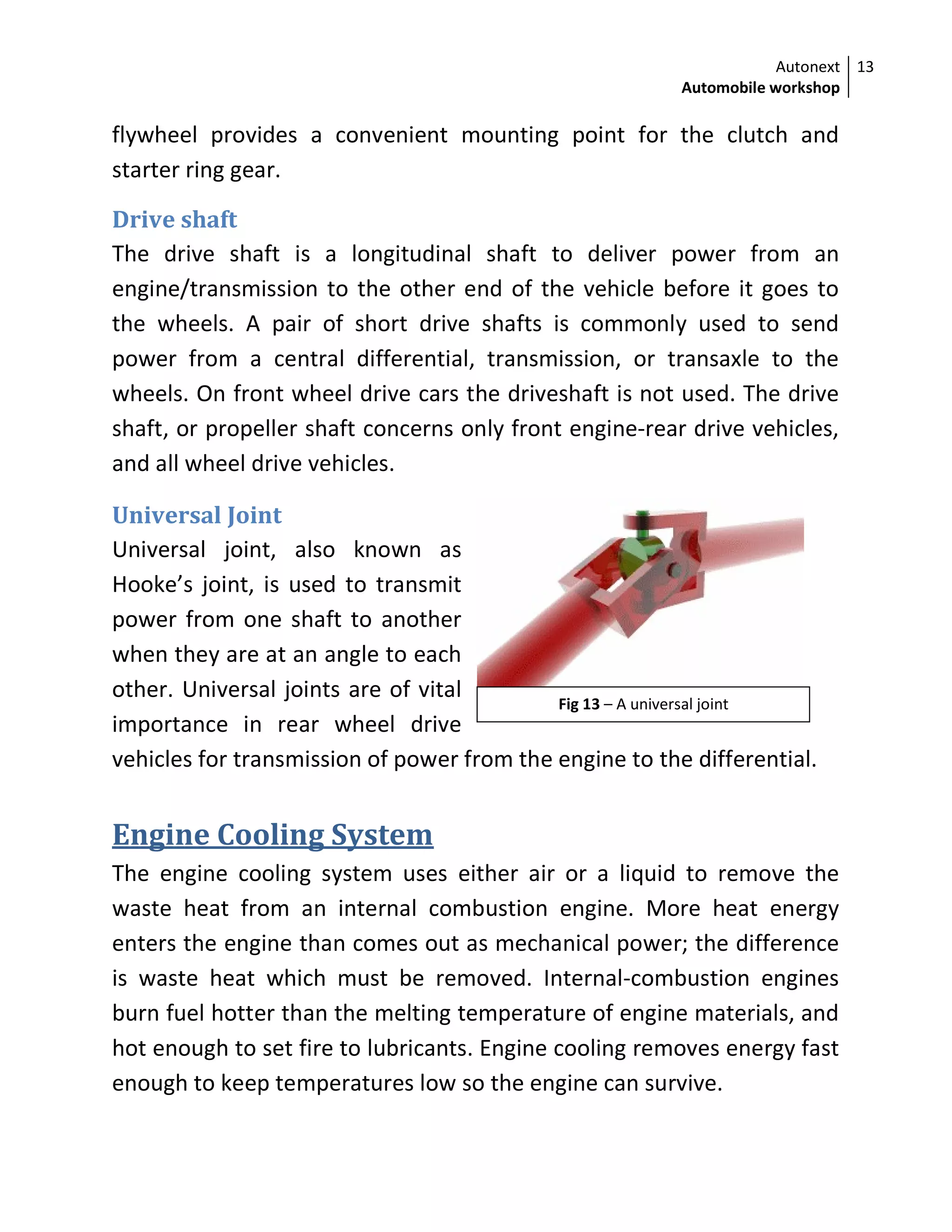
Fig 12 – A flywheel
modern cars and trucks, and also in many all-wheel-drive (full-time
four-wheel-drive)
vehicles. These all-
wheel-drive vehicles
need a differential
between each set of
drive wheels, and they
need one between the
front and the back
wheels as well, because
the front wheels travel a different distance through a turn than the rear
wheels.
When a car is driving straight down the road, both drive wheels are
spinning at the same speed. In an open differential, the input pinion is
turning the ring gear and cage, and none of the pinions within the cage
are rotating - both side gears are effectively locked to the cage.
Flywheel
The flywheel is a heavy and perfectly balanced wheel usually bolted to
a flange on the rear end of the crankshaft. A
flywheel resists changes in rotational speed by
their moment of inertia. It stores up energy to
help the engine over idle strokes of the piston
i.e., suction, compression and exhaust. It also
dampens out speed fluctuations of the
crankshaft due to the varying effect of the
firing impulses during the engine cycle. The
Autonext
Automobile workshop
13
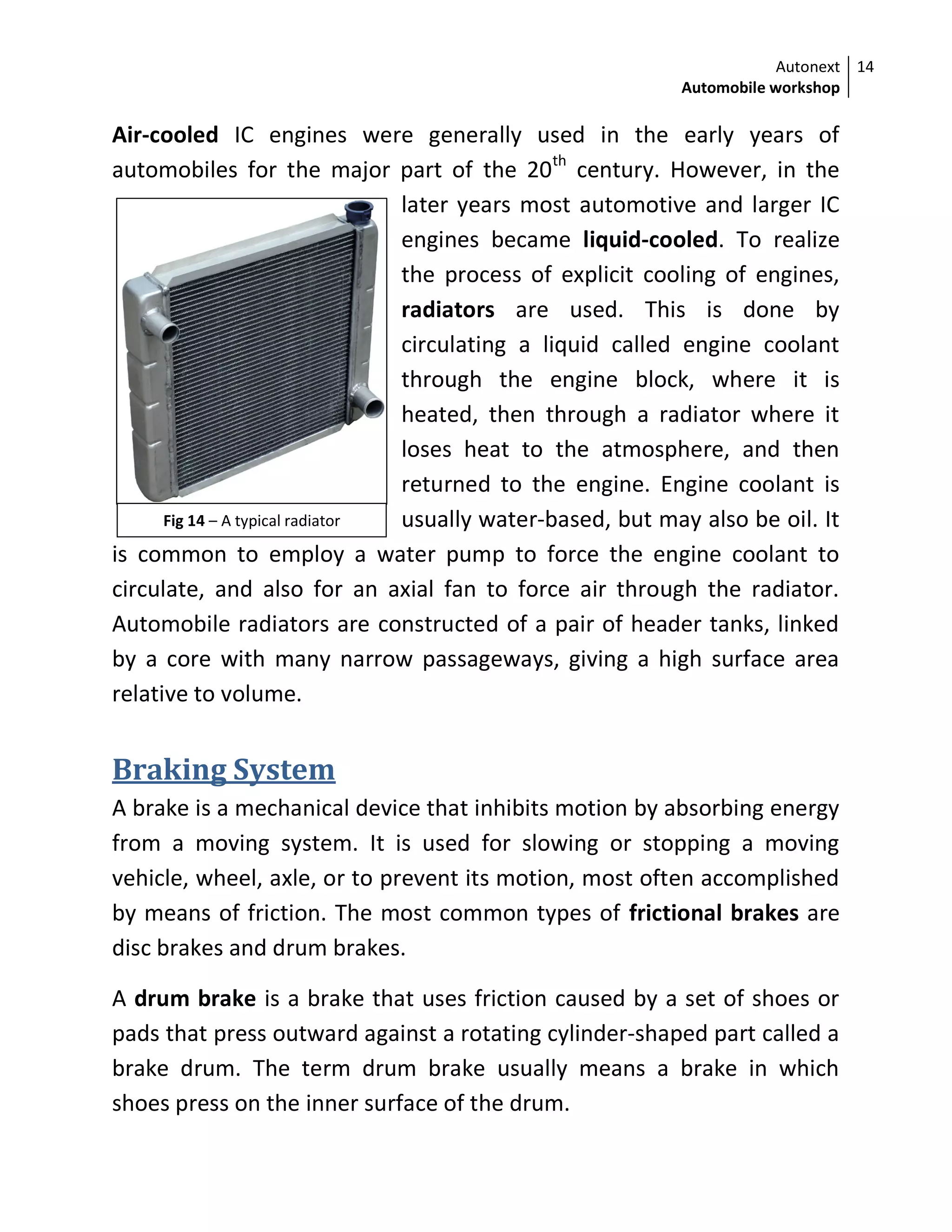
Fig 13 – A universal joint
flywheel provides a convenient mounting point for the clutch and
starter ring gear.
Drive shaft
The drive shaft is a longitudinal shaft to deliver power from an
engine/transmission to the other end of the vehicle before it goes to
the wheels. A pair of short drive shafts is commonly used to send
power from a central differential, transmission, or transaxle to the
wheels. On front wheel drive cars the driveshaft is not used. The drive
shaft, or propeller shaft concerns only front engine-rear drive vehicles,
and all wheel drive vehicles.
Universal Joint
Universal joint, also known as
Hooke’s joint, is used to transmit
power from one shaft to another
when they are at an angle to each
other. Universal joints are of vital
importance in rear wheel drive
vehicles for transmission of power from the engine to the differential.
Engine Cooling System
The engine cooling system uses either air or a liquid to remove the
waste heat from an internal combustion engine. More heat energy
enters the engine than comes out as mechanical power; the difference
is waste heat which must be removed. Internal-combustion engines
burn fuel hotter than the melting temperature of engine materials, and
hot enough to set fire to lubricants. Engine cooling removes energy fast
enough to keep temperatures low so the engine can survive.
Autonext
Automobile workshop
14
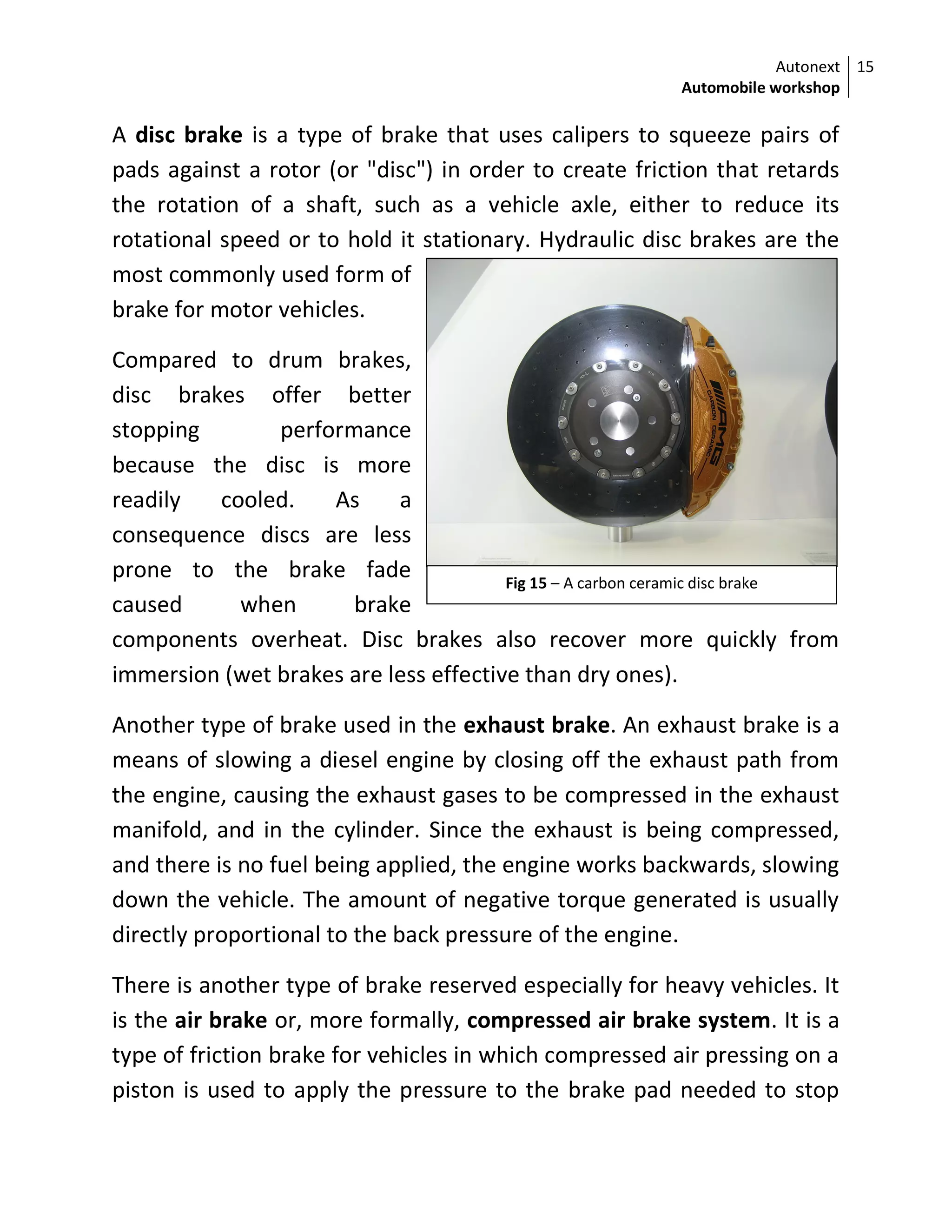
Fig 14 – A typical radiator
Air-cooled IC engines were generally used in the early years of
automobiles for the major part of the 20th
century. However, in the
later years most automotive and larger IC
engines became liquid-cooled. To realize
the process of explicit cooling of engines,
radiators are used. This is done by
circulating a liquid called engine coolant
through the engine block, where it is
heated, then through a radiator where it
loses heat to the atmosphere, and then
returned to the engine. Engine coolant is
usually water-based, but may also be oil. It
is common to employ a water pump to force the engine coolant to
circulate, and also for an axial fan to force air through the radiator.
Automobile radiators are constructed of a pair of header tanks, linked
by a core with many narrow passageways, giving a high surface area
relative to volume.
Braking System
A brake is a mechanical device that inhibits motion by absorbing energy
from a moving system. It is used for slowing or stopping a moving
vehicle, wheel, axle, or to prevent its motion, most often accomplished
by means of friction. The most common types of frictional brakes are
disc brakes and drum brakes.
A drum brake is a brake that uses friction caused by a set of shoes or
pads that press outward against a rotating cylinder-shaped part called a
brake drum. The term drum brake usually means a brake in which
shoes press on the inner surface of the drum.
Autonext
Automobile workshop
15
Fig 15 – A carbon ceramic disc brake
A disc brake is a type of brake that uses calipers to squeeze pairs of
pads against a rotor (or "disc") in order to create friction that retards
the rotation of a shaft, such as a vehicle axle, either to reduce its
rotational speed or to hold it stationary. Hydraulic disc brakes are the
most commonly used form of
brake for motor vehicles.
Compared to drum brakes,
disc brakes offer better
stopping performance
because the disc is more
readily cooled. As a
consequence discs are less
prone to the brake fade
caused when brake
components overheat. Disc brakes also recover more quickly from
immersion (wet brakes are less effective than dry ones).
Another type of brake used in the exhaust brake. An exhaust brake is a
means of slowing a diesel engine by closing off the exhaust path from
the engine, causing the exhaust gases to be compressed in the exhaust
manifold, and in the cylinder. Since the exhaust is being compressed,
and there is no fuel being applied, the engine works backwards, slowing
down the vehicle. The amount of negative torque generated is usually
directly proportional to the back pressure of the engine.
There is another type of brake reserved especially for heavy vehicles. It
is the air brake or, more formally, compressed air brake system. It is a
type of friction brake for vehicles in which compressed air pressing on a
piston is used to apply the pressure to the brake pad needed to stop
Autonext
Automobile workshop
16
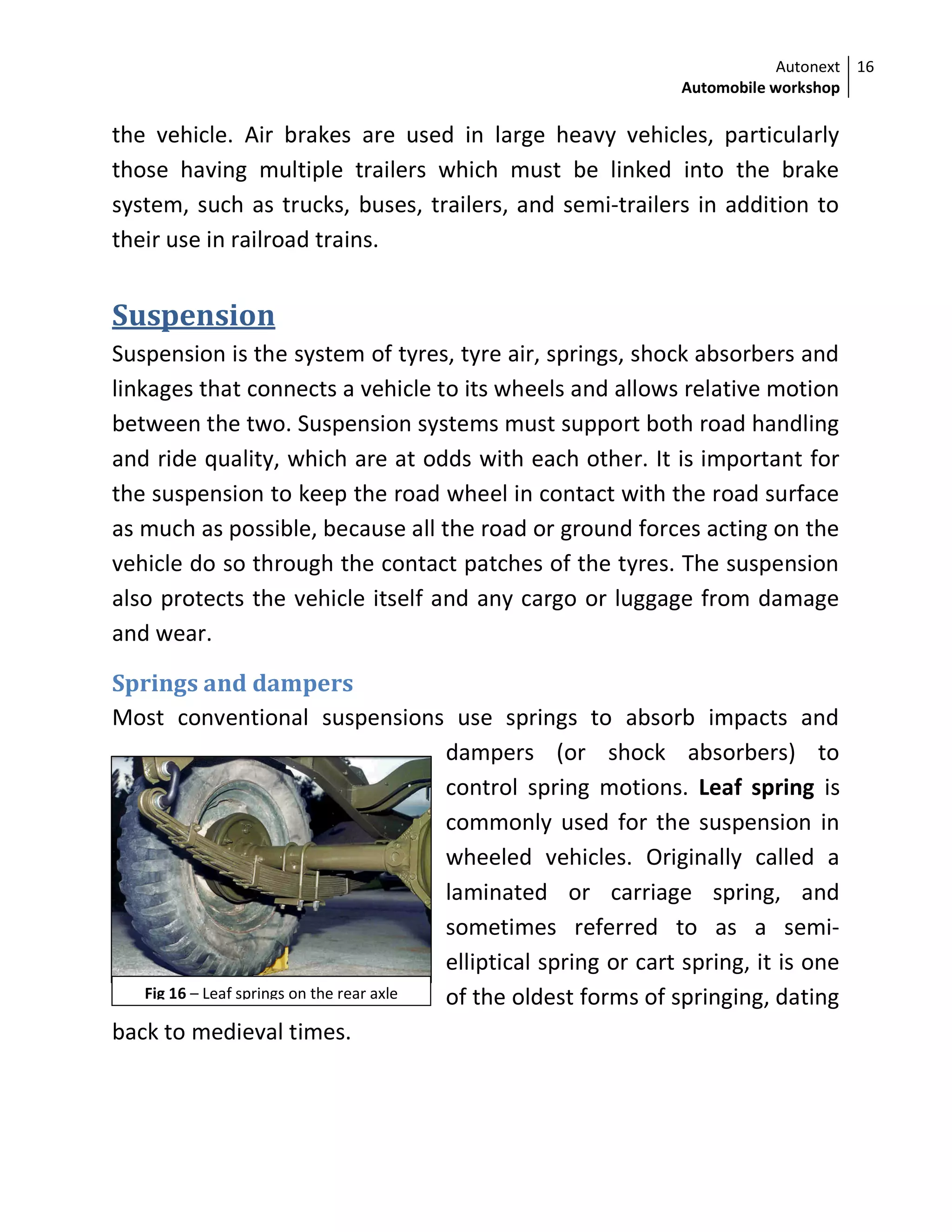
Fig 16 – Leaf springs on the rear axle
the vehicle. Air brakes are used in large heavy vehicles, particularly
those having multiple trailers which must be linked into the brake
system, such as trucks, buses, trailers, and semi-trailers in addition to
their use in railroad trains.
Suspension
Suspension is the system of tyres, tyre air, springs, shock absorbers and
linkages that connects a vehicle to its wheels and allows relative motion
between the two. Suspension systems must support both road handling
and ride quality, which are at odds with each other. It is important for
the suspension to keep the road wheel in contact with the road surface
as much as possible, because all the road or ground forces acting on the
vehicle do so through the contact patches of the tyres. The suspension
also protects the vehicle itself and any cargo or luggage from damage
and wear.
Springs and dampers
Most conventional suspensions use springs to absorb impacts and
dampers (or shock absorbers) to
control spring motions. Leaf spring is
commonly used for the suspension in
wheeled vehicles. Originally called a
laminated or carriage spring, and
sometimes referred to as a semi-
elliptical spring or cart spring, it is one
of the oldest forms of springing, dating
back to medieval times.
Autonext
Automobile workshop
17
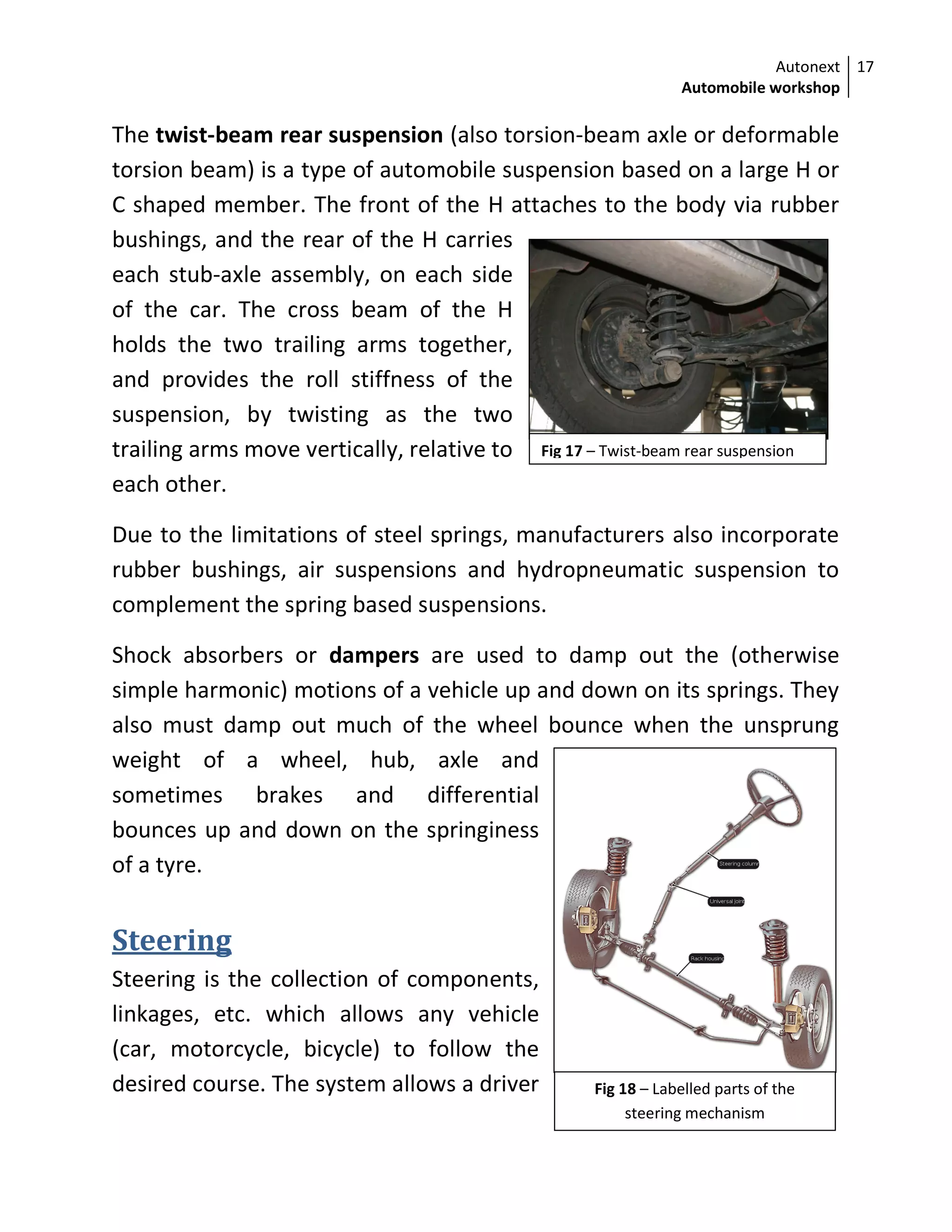
Fig 17 – Twist-beam rear suspension
The twist-beam rear suspension (also torsion-beam axle or deformable
torsion beam) is a type of automobile suspension based on a large H or
C shaped member. The front of the H attaches to the body via rubber
bushings, and the rear of the H carries
each stub-axle assembly, on each side
of the car. The cross beam of the H
holds the two trailing arms together,
and provides the roll stiffness of the
suspension, by twisting as the two
trailing arms move vertically, relative to
each other.
Due to the limitations of steel springs, manufacturers also incorporate
rubber bushings, air suspensions and hydropneumatic suspension to
complement the spring based suspensions.
Shock absorbers or dampers are used to damp out the (otherwise
simple harmonic) motions of a vehicle up and down on its springs. They
also must damp out much of the wheel bounce when the unsprung
weight of a wheel, hub, axle and
sometimes brakes and differential
bounces up and down on the springiness
of a tyre.
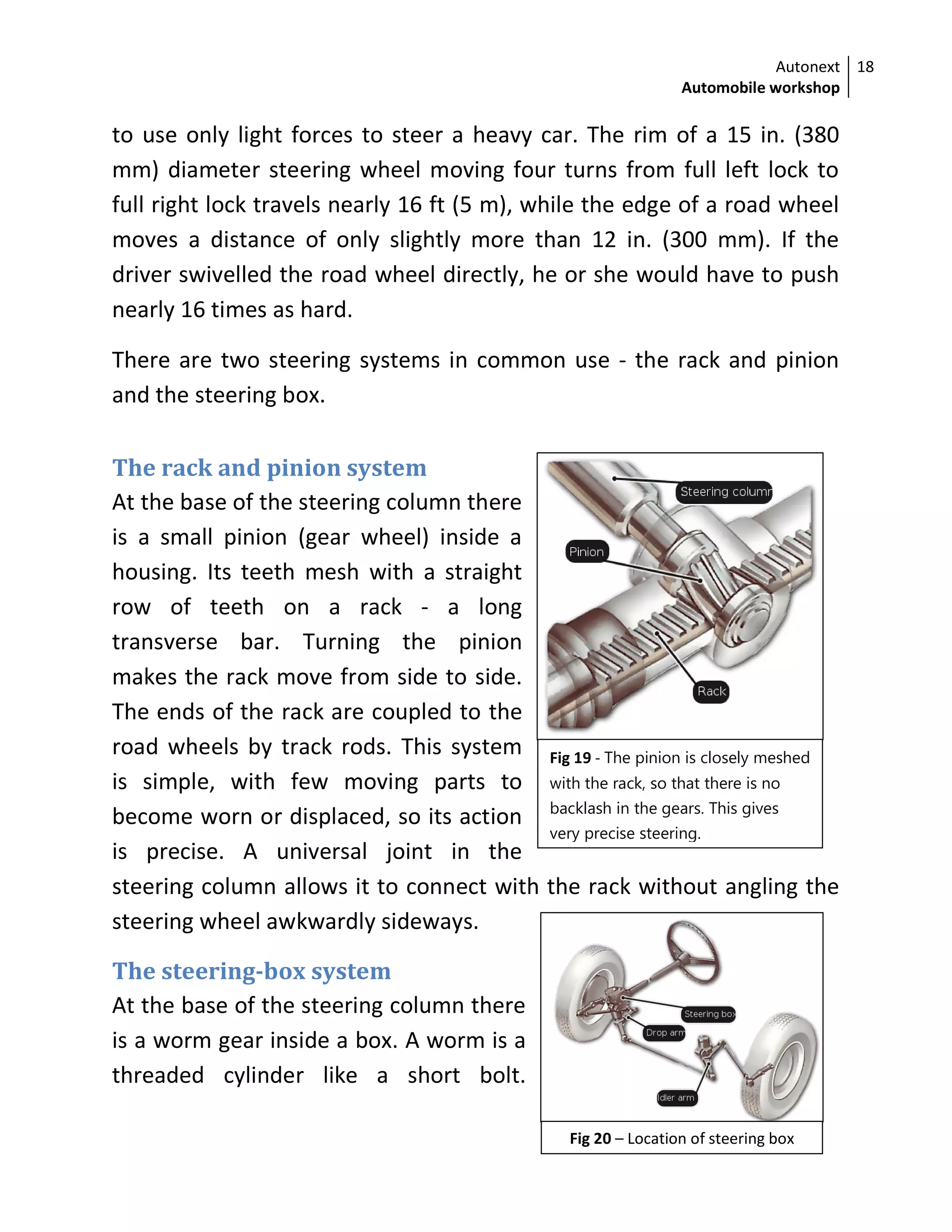
Steering
Steering is the collection of components,
linkages, etc. which allows any vehicle
(car, motorcycle, bicycle) to follow the
desired course. The system allows a driver Fig 18 – Labelled parts of the
steering mechanism
Autonext
Automobile workshop
18
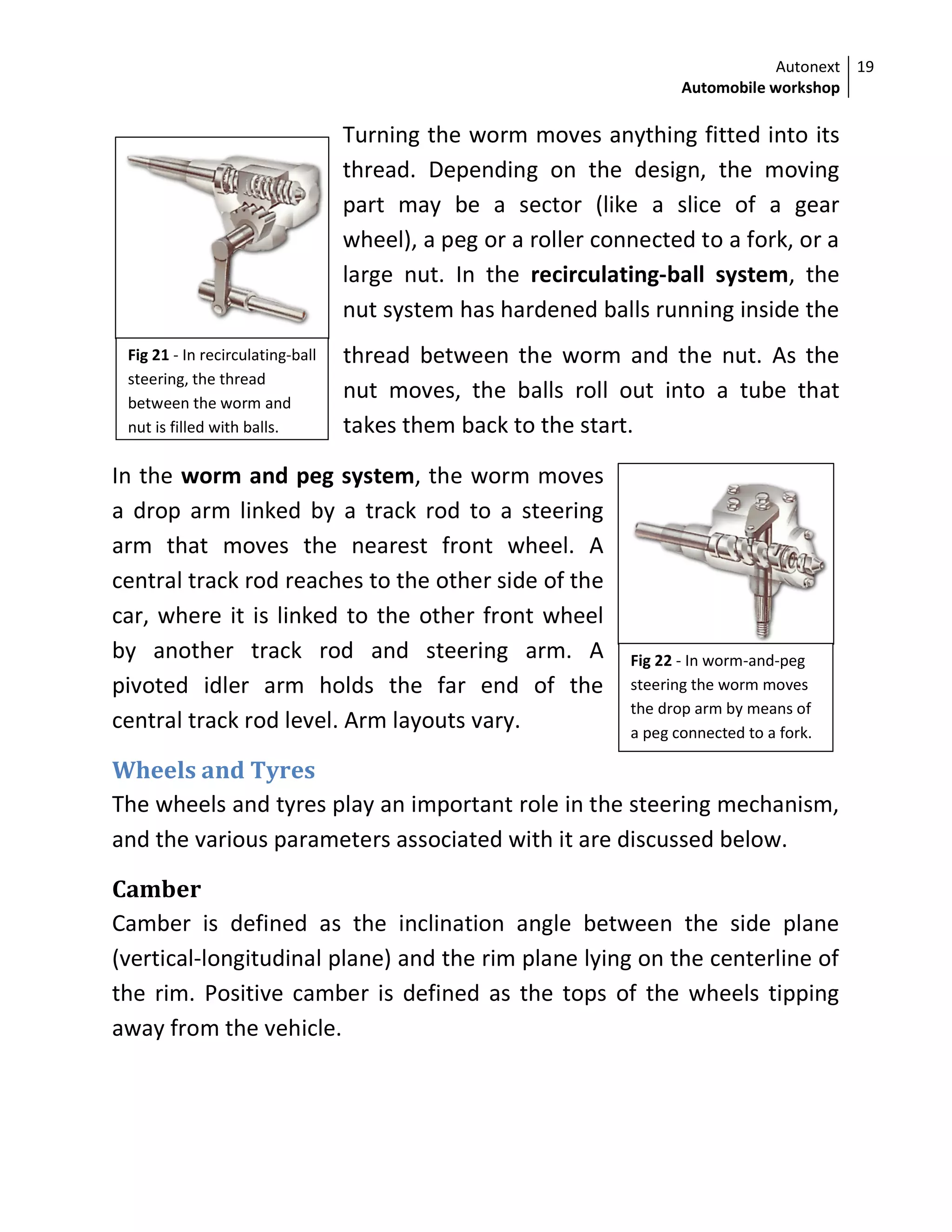
Fig 19 - The pinion is closely meshed
with the rack, so that there is no
backlash in the gears. This gives
very precise steering.
Fig 20 – Location of steering box
to use only light forces to steer a heavy car. The rim of a 15 in. (380
mm) diameter steering wheel moving four turns from full left lock to
full right lock travels nearly 16 ft (5 m), while the edge of a road wheel
moves a distance of only slightly more than 12 in. (300 mm). If the
driver swivelled the road wheel directly, he or she would have to push
nearly 16 times as hard.
There are two steering systems in common use - the rack and pinion
and the steering box.
The rack and pinion system
At the base of the steering column there
is a small pinion (gear wheel) inside a
housing. Its teeth mesh with a straight
row of teeth on a rack - a long
transverse bar. Turning the pinion
makes the rack move from side to side.
The ends of the rack are coupled to the
road wheels by track rods. This system
is simple, with few moving parts to
become worn or displaced, so its action
is precise. A universal joint in the
steering column allows it to connect with the rack without angling the
steering wheel awkwardly sideways.
The steering-box system
At the base of the steering column there
is a worm gear inside a box. A worm is a
threaded cylinder like a short bolt.
Autonext
Automobile workshop
19
Fig 22 - In worm-and-peg
steering the worm moves
the drop arm by means of
a peg connected to a fork.
Turning the worm moves anything fitted into its
thread. Depending on the design, the moving
part may be a sector (like a slice of a gear
wheel), a peg or a roller connected to a fork, or a
large nut. In the recirculating-ball system, the
nut system has hardened balls running inside the
thread between the worm and the nut. As the
nut moves, the balls roll out into a tube that
takes them back to the start.
In the worm and peg system, the worm moves
a drop arm linked by a track rod to a steering
arm that moves the nearest front wheel. A
central track rod reaches to the other side of the
car, where it is linked to the other front wheel
by another track rod and steering arm. A
pivoted idler arm holds the far end of the
central track rod level. Arm layouts vary.
Wheels and Tyres
The wheels and tyres play an important role in the steering mechanism,
and the various parameters associated with it are discussed below.
Camber
Camber is defined as the inclination angle between the side plane
(vertical-longitudinal plane) and the rim plane lying on the centerline of
the rim. Positive camber is defined as the tops of the wheels tipping
away from the vehicle.
Fig 21 - In recirculating-ball
steering, the thread
between the worm and
nut is filled with balls.
Autonext
Automobile workshop
20
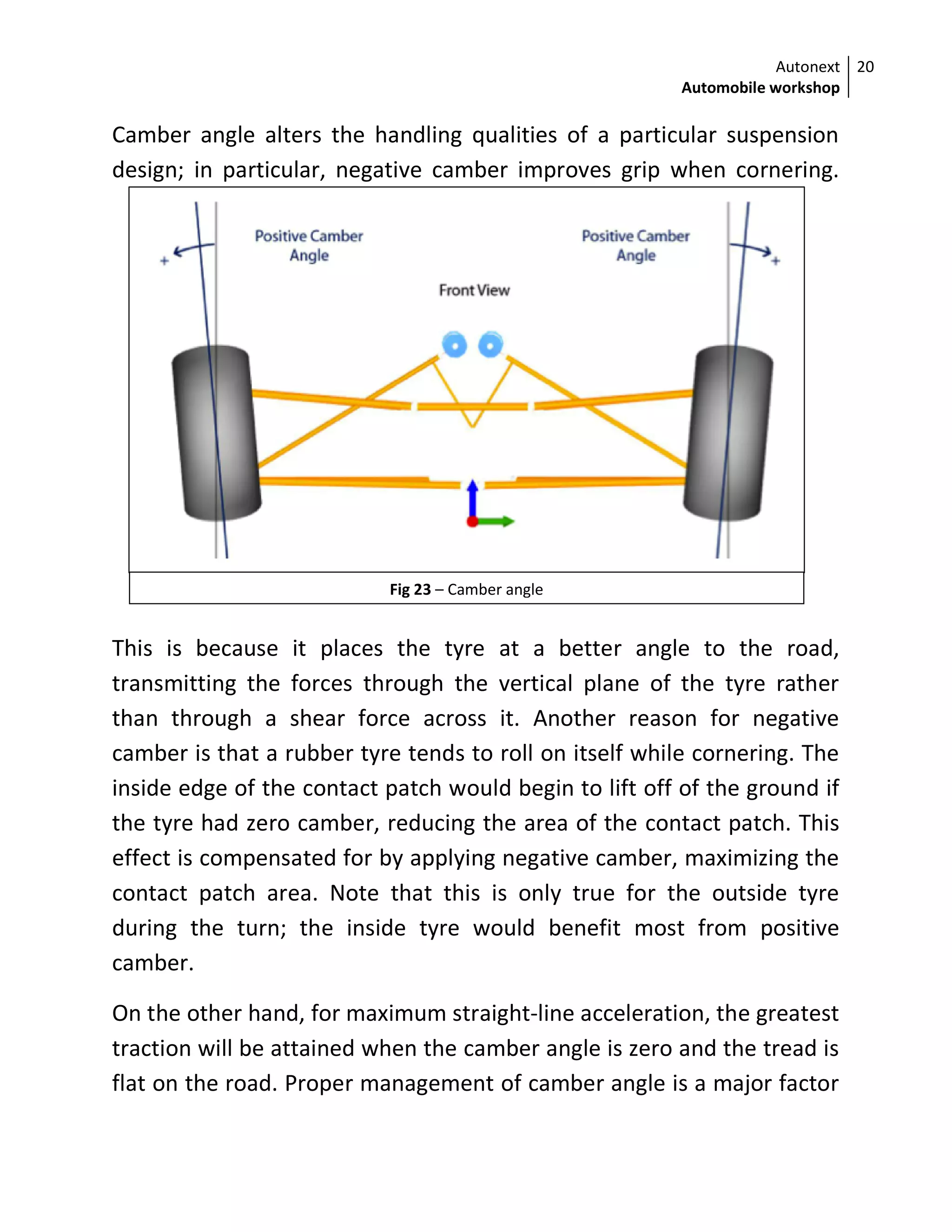
Fig 23 – Camber angle
Camber angle alters the handling qualities of a particular suspension
design; in particular, negative camber improves grip when cornering.
This is because it places the tyre at a better angle to the road,
transmitting the forces through the vertical plane of the tyre rather
than through a shear force across it. Another reason for negative
camber is that a rubber tyre tends to roll on itself while cornering. The
inside edge of the contact patch would begin to lift off of the ground if
the tyre had zero camber, reducing the area of the contact patch. This
effect is compensated for by applying negative camber, maximizing the
contact patch area. Note that this is only true for the outside tyre
during the turn; the inside tyre would benefit most from positive
camber.
On the other hand, for maximum straight-line acceleration, the greatest
traction will be attained when the camber angle is zero and the tread is
flat on the road. Proper management of camber angle is a major factor
Autonext
Automobile workshop
21
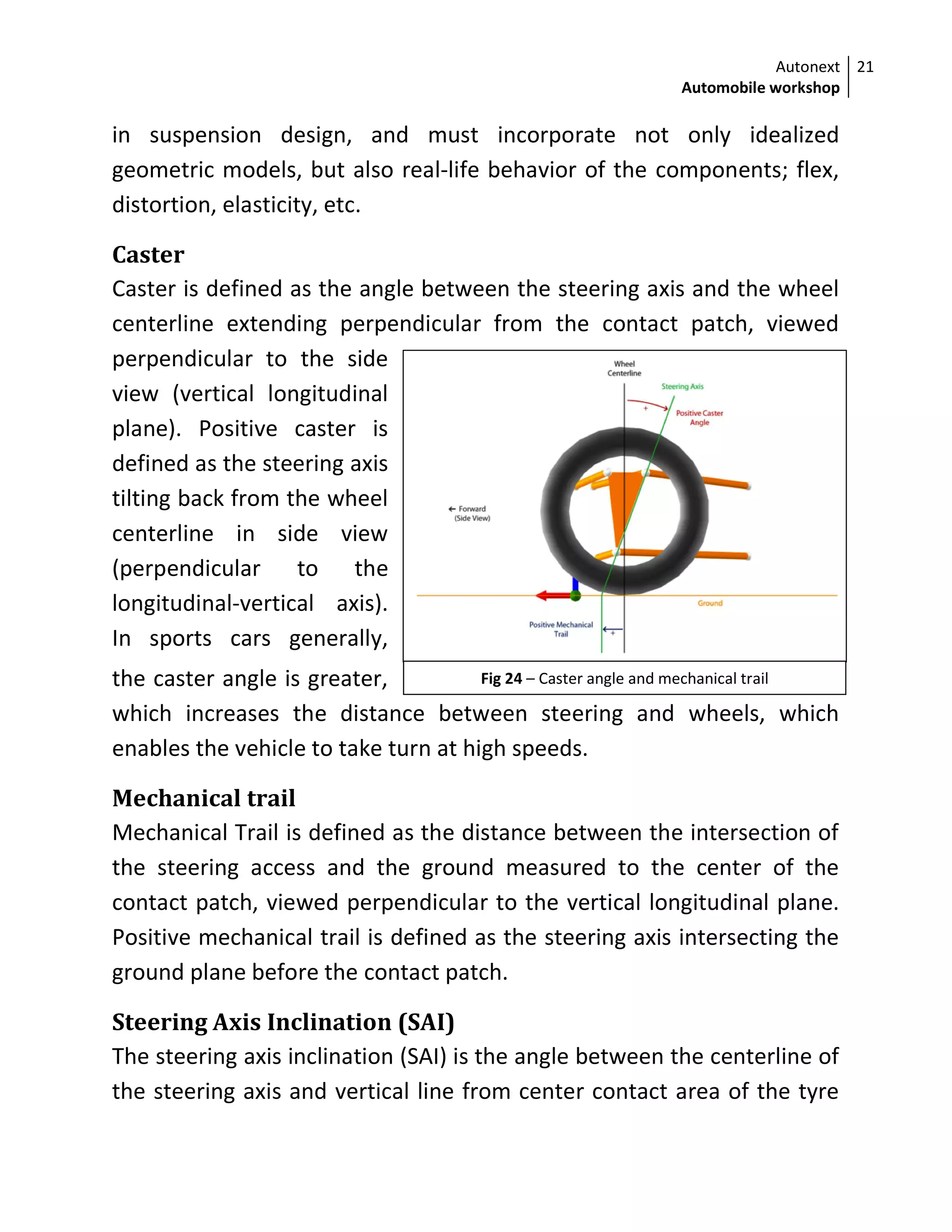
Fig 24 – Caster angle and mechanical trail
in suspension design, and must incorporate not only idealized
geometric models, but also real-life behavior of the components; flex,
distortion, elasticity, etc.
Caster
Caster is defined as the angle between the steering axis and the wheel
centerline extending perpendicular from the contact patch, viewed
perpendicular to the side
view (vertical longitudinal
plane). Positive caster is
defined as the steering axis
tilting back from the wheel
centerline in side view
(perpendicular to the
longitudinal-vertical axis).
In sports cars generally,
the caster angle is greater,
which increases the distance between steering and wheels, which
enables the vehicle to take turn at high speeds.
Mechanical trail
Mechanical Trail is defined as the distance between the intersection of
the steering access and the ground measured to the center of the
contact patch, viewed perpendicular to the vertical longitudinal plane.
Positive mechanical trail is defined as the steering axis intersecting the
ground plane before the contact patch.
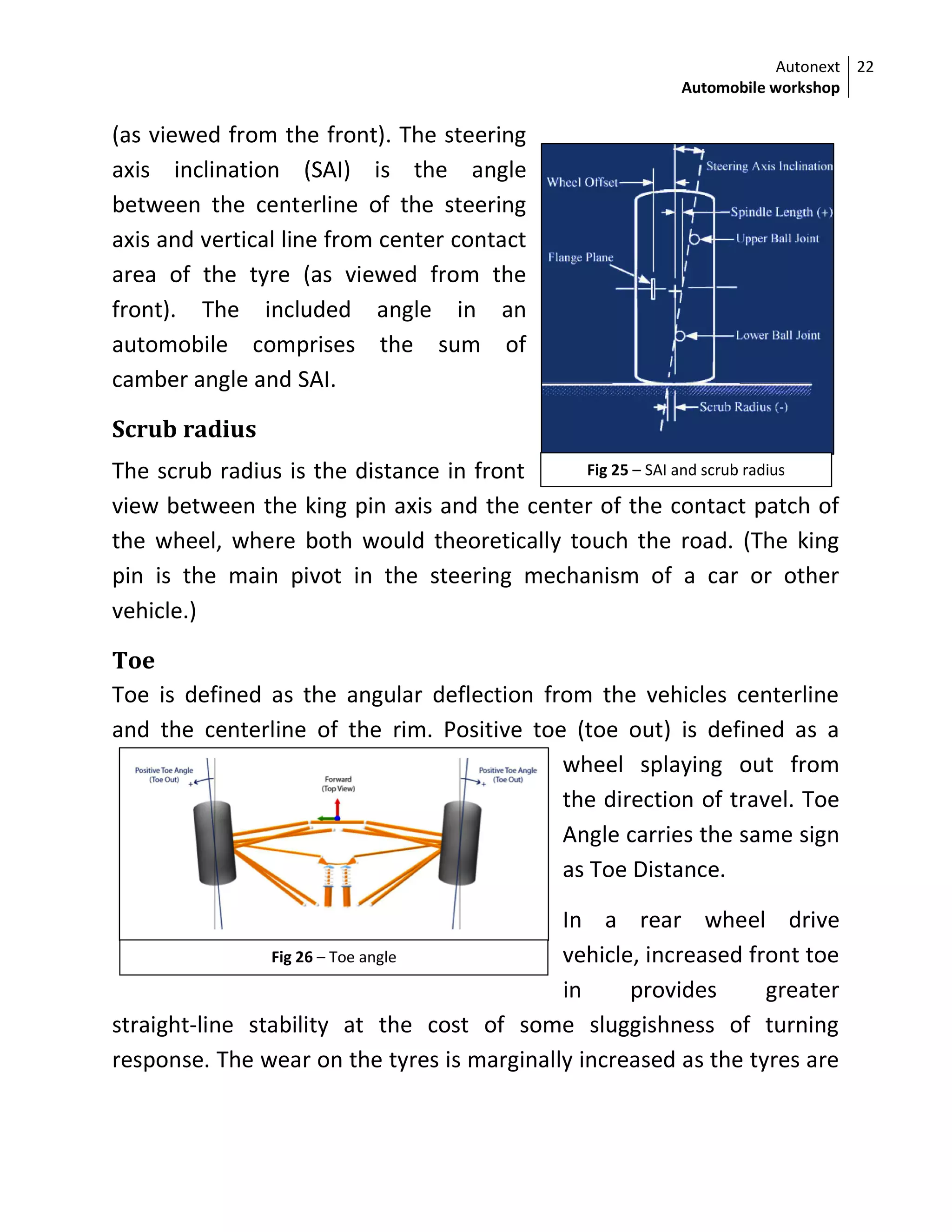
Steering Axis Inclination (SAI)
The steering axis inclination (SAI) is the angle between the centerline of
the steering axis and vertical line from center contact area of the tyre
Autonext
Automobile workshop
22
Fig 25 – SAI and scrub radius
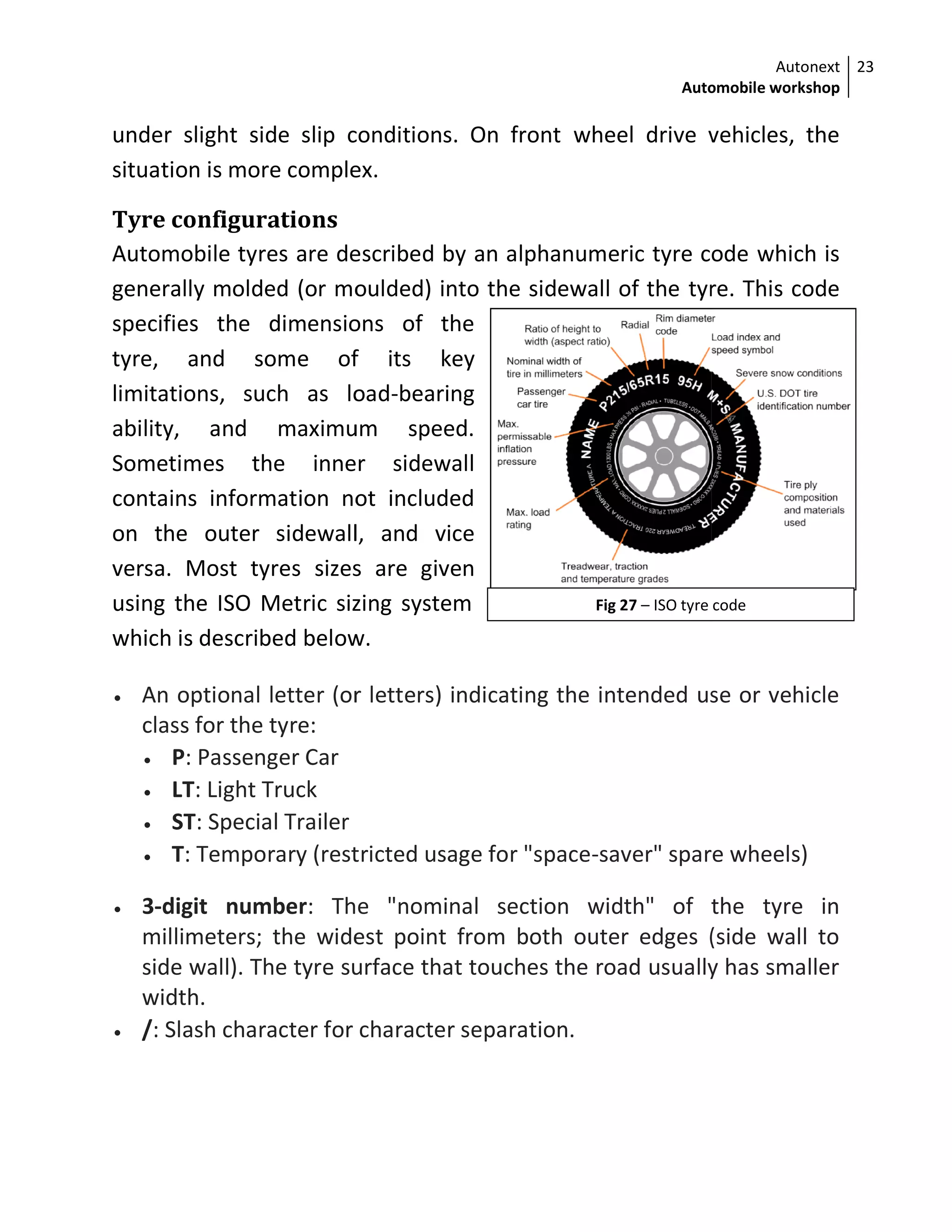
Fig 26 – Toe angle
(as viewed from the front). The steering
axis inclination (SAI) is the angle
between the centerline of the steering
axis and vertical line from center contact
area of the tyre (as viewed from the
front). The included angle in an
automobile comprises the sum of
camber angle and SAI.
Scrub radius
The scrub radius is the distance in front
view between the king pin axis and the center of the contact patch of
the wheel, where both would theoretically touch the road. (The king
pin is the main pivot in the steering mechanism of a car or other
vehicle.)
Toe
Toe is defined as the angular deflection from the vehicles centerline
and the centerline of the rim. Positive toe (toe out) is defined as a
wheel splaying out from
the direction of travel. Toe
Angle carries the same sign
as Toe Distance.
In a rear wheel drive
vehicle, increased front toe
in provides greater
straight-line stability at the cost of some sluggishness of turning
response. The wear on the tyres is marginally increased as the tyres are
under slight side slip conditions. On front
situation is more complex.
Tyre configurations
Automobile tyres are described by an alphanumeric tyre code
generally molded (or moulded) into the sidewall of the
specifies the dimensions of the
tyre, and some of its key
limitations, such as load
ability, and maximum speed.
Sometimes the inner sidewall
contains information not included
on the outer sidewall, and vice
versa. Most tyres sizes are g
using the ISO Metric sizing system
which is described below.
 An optional letter (or letters) indicating the intended use or vehicle
class for the tyre:
 P: Passenger Car
 LT: Light Truck
 ST: Special Trailer
 T: Temporary (restricted usage for "space
 3-digit number: The "nominal section width" of the
millimeters; the widest point from both outer edges (side wall to
side wall). The tyre surface that touches the road usually has smaller
width.
 /: Slash character for character se
Automobile workshop
Fig 27 – ISO tyre code
under slight side slip conditions. On front wheel drive vehicles, the
situation is more complex.
res are described by an alphanumeric tyre code
generally molded (or moulded) into the sidewall of the tyre
specifies the dimensions of the
, and some of its key
limitations, such as load-bearing
ability, and maximum speed.
Sometimes the inner sidewall
contains information not included
on the outer sidewall, and vice
s sizes are given
ng the ISO Metric sizing system
which is described below.
An optional letter (or letters) indicating the intended use or vehicle
: Temporary (restricted usage for "space-saver" spare wheels)
: The "nominal section width" of the
millimeters; the widest point from both outer edges (side wall to
surface that touches the road usually has smaller
: Slash character for character separation.
Autonext
Automobile workshop
23
ISO tyre code
wheel drive vehicles, the
res are described by an alphanumeric tyre code which is
tyre. This code
An optional letter (or letters) indicating the intended use or vehicle
er" spare wheels)
: The "nominal section width" of the tyre in
millimeters; the widest point from both outer edges (side wall to
surface that touches the road usually has smaller
Autonext
Automobile workshop
24
 2- or 3-digit number: The "aspect ratio" of the sidewall height as a
percentage of the nominal section width of the tyre. An optional
letter indicating construction of the fabric carcass of the tyre:
 B: bias belt (where the sidewalls are the same material as the
tread, leading to a rigid ride)
 D: diagonal
 R: radial
 if omitted, then it is a cross-ply tyre
 1- or 2-digit number: Diameter in inches of the wheel that the tyres
are designed to fit.
 2- or 3-digit number: Load index. Some light-truck tyres are
approved for "dual use", that is they can be run in pairs next to each
other. If so, separate load indexes will be specified for single and
dual usage.
 1- or 2-digit/letter combo: Speed rating. It is the speed which the
tyre can withstand.
Chassis
The chassis is a skeletal frame on which various mechanical parts like
engine, tires, axle assemblies, brakes, steering etc. are bolted. The
chassis is considered to be the most significant component of an
automobile. It is the most crucial element that gives strength and
stability to the vehicle under different conditions. Automobile frames
provide strength and flexibility to the automobile. The backbone of any
automobile, it is the supporting frame to which the body of an engine,
axle assemblies are affixed. Tie bars, that are essential parts of
automotive frames, are fasteners that bind different auto parts
together. Some of the popular types of chassis used today are
discussed below.
Autonext
Automobile workshop
25
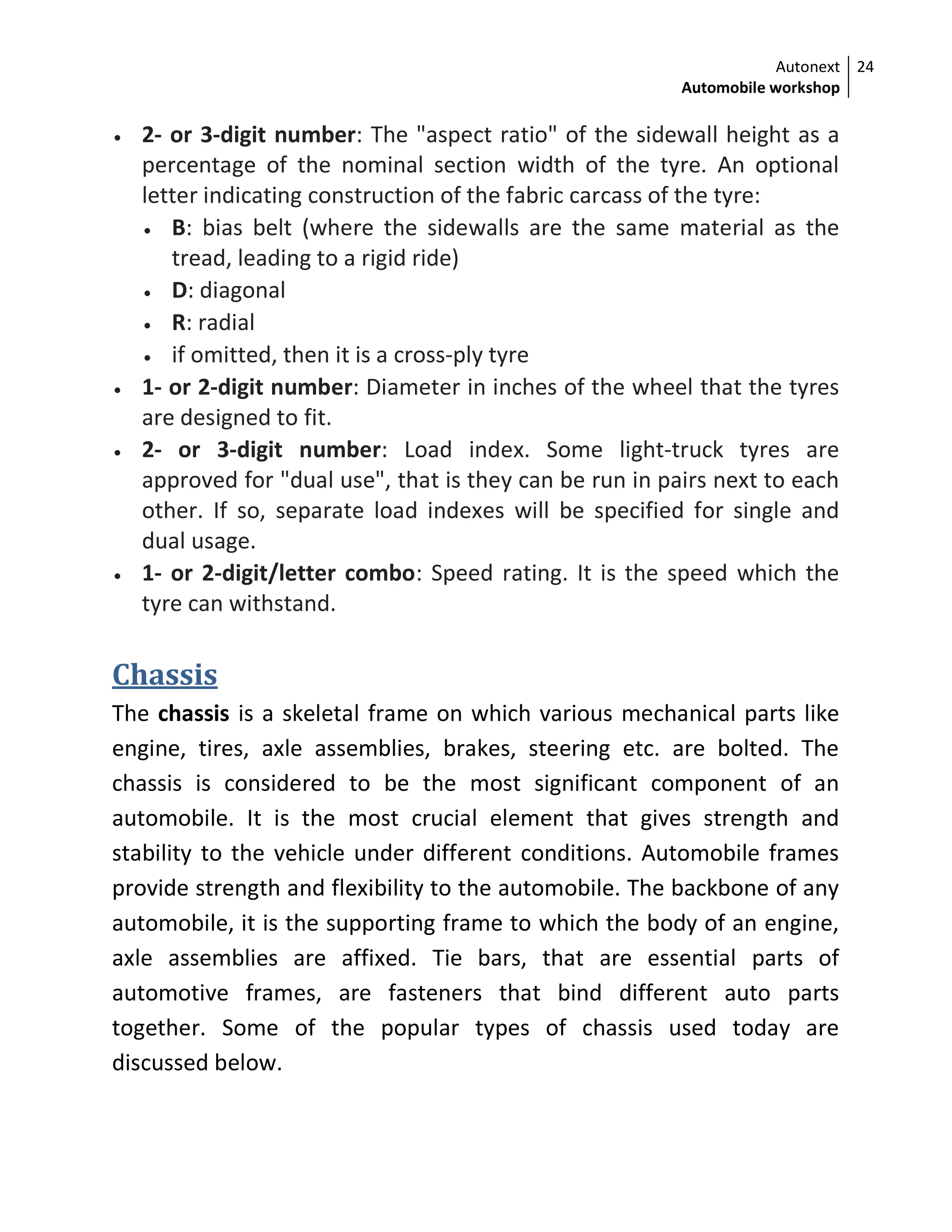
Fig 28 – Ladder chassis
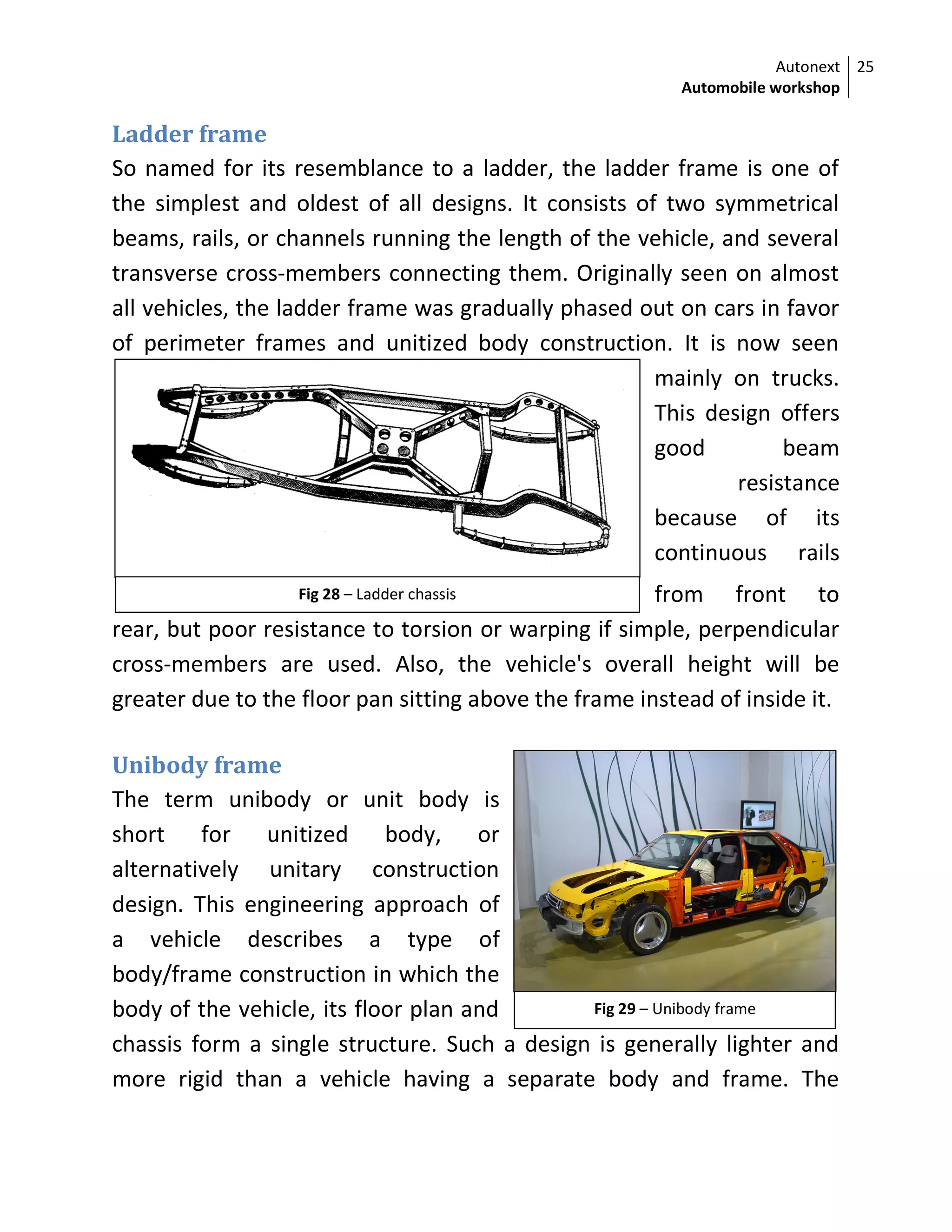
Fig 29 – Unibody frame
Ladder frame
So named for its resemblance to a ladder, the ladder frame is one of
the simplest and oldest of all designs. It consists of two symmetrical
beams, rails, or channels running the length of the vehicle, and several
transverse cross-members connecting them. Originally seen on almost
all vehicles, the ladder frame was gradually phased out on cars in favor
of perimeter frames and unitized body construction. It is now seen
mainly on trucks.
This design offers
good beam
resistance
because of its
continuous rails
from front to
rear, but poor resistance to torsion or warping if simple, perpendicular
cross-members are used. Also, the vehicle's overall height will be
greater due to the floor pan sitting above the frame instead of inside it.
Unibody frame
The term unibody or unit body is
short for unitized body, or
alternatively unitary construction
design. This engineering approach of
a vehicle describes a type of
body/frame construction in which the
body of the vehicle, its floor plan and
chassis form a single structure. Such a design is generally lighter and
more rigid than a vehicle having a separate body and frame. The
Autonext
Automobile workshop
26
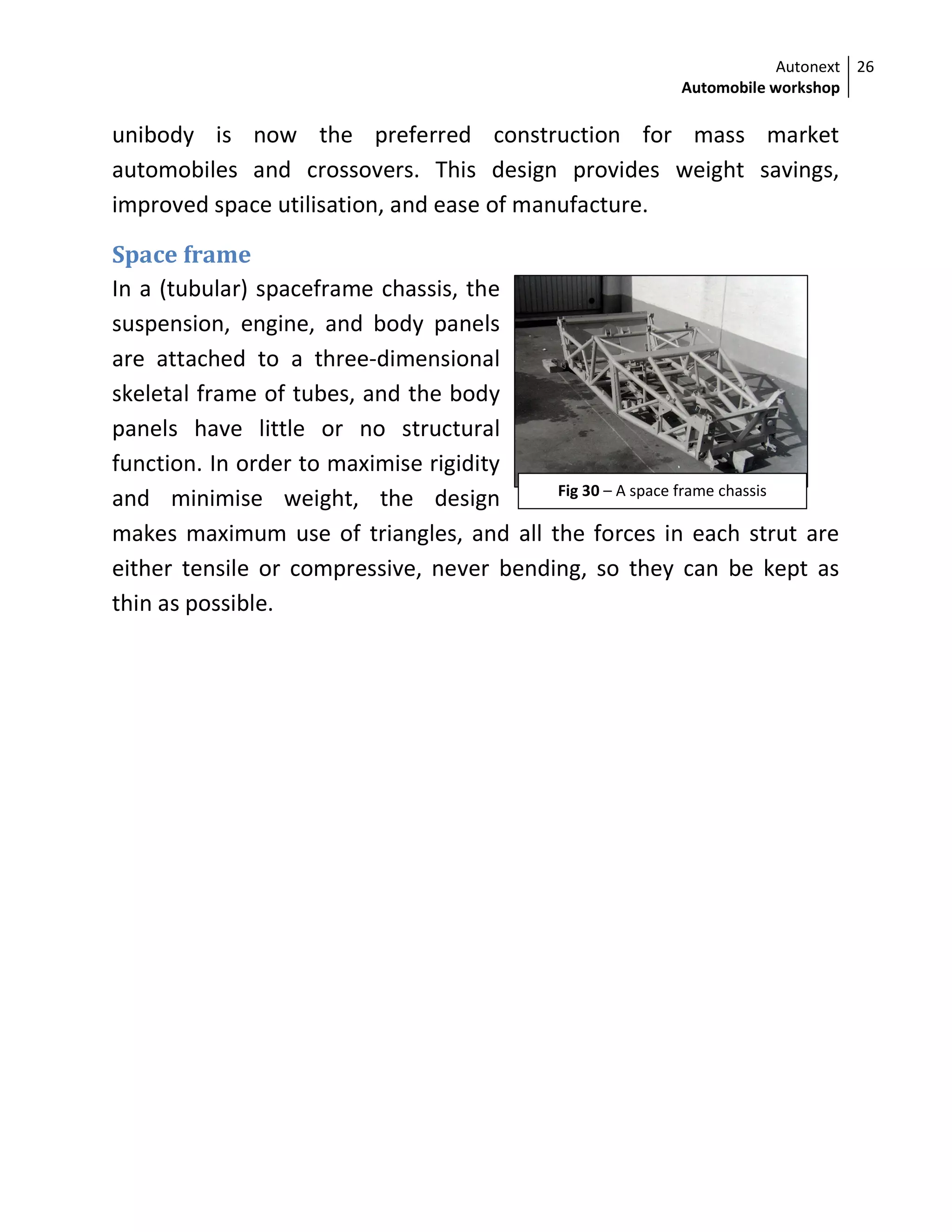
Fig 30 – A space frame chassis
unibody is now the preferred construction for mass market
automobiles and crossovers. This design provides weight savings,
improved space utilisation, and ease of manufacture.
Space frame
In a (tubular) spaceframe chassis, the
suspension, engine, and body panels
are attached to a three-dimensional
skeletal frame of tubes, and the body
panels have little or no structural
function. In order to maximise rigidity
and minimise weight, the design
makes maximum use of triangles, and all the forces in each strut are
either tensile or compressive, never bending, so they can be kept as
thin as possible.
Autonext
Automobile workshop
27
Advanced technologies in automobiles
Major improvements and refinements have come in automobiles in
important aspects like fuel intake and braking system, while other
peripheral aspects of automobiles have also seen marked development
of new technologies, such as car safety. Some of the most important
modern advancements are given below.
 CRDi/MPFi - Common rail direct fuel injection (CRDi) is a direct
fuel injection system for petrol and diesel engines. Multipoint fuel
injection (MPFi) injects fuel into the intake ports just upstream of
each cylinder's intake valve, rather than at a central point within
an intake manifold. Both these methods offer better atomization
of the fuel and hence, better ignition and efficiency.
 ABS/EBD - An anti-lock braking system or anti-skid braking
system(ABS) is an automobile safety system that allows the
wheels on a motor vehicle to maintain tractive contact with the
road surface according to driver inputs while braking, preventing
the wheels from locking up (ceasing rotation) and avoiding
uncontrolled skidding. It is an automated system that uses the
principles of threshold braking and cadence braking which were
practiced by skillful drivers with previous generation braking
systems. It does this at a much faster rate and with better control
than many drivers could manage.
Electronic brakeforce distribution (EBD) is an automobile brake
technology that automatically varies the amount of force applied
to each of a vehicle's wheels, based on road conditions, speed,
loading, etc. Always coupled with anti-lock braking systems (ABS),
EBD can apply more or less braking pressure to each wheel in
Autonext
Automobile workshop
28
order to maximize stopping power whilst maintaining vehicular
control. Typically, the front end carries the most weight and EBD
distributes less braking pressure to the rear brakes so the rear
brakes do not lock up and cause a skid.
 ESP/ESC - Electronic stability program (ESP) or dynamic stability
control (DSC), is a computerized technology that improves a
vehicle's stability by detecting and reducing loss of traction
(skidding). When ESC detects loss of steering control, it
automatically applies the brakes to help "steer" the vehicle where
the driver intends to go. Braking is automatically applied to
wheels individually.
An electronic speed control (ESC) is an electronic circuit with the
purpose to vary an electric motor's speed, its direction and
possibly also to act as a dynamic brake. ESCs are often used on
electrically powered radio controlled models, with the variety
most often used for brushless motors essentially providing an
electronically generated three-phase electric power low voltage
source of energy for the motor.
 SRS (Airbags) – Supplementary Restraint System (SRS) generally
refers to airbags. The supplementary status is due to the fact that
the airbag is not a replacement for the primary safety of the
seatbelt. The airbag module is designed to inflate extremely
rapidly then quickly deflate during a collision or impact with a
surface or a rapid sudden deceleration. It consists of the airbag
cushion, a flexible fabric bag, inflation module and impact sensor.
The purpose of the airbag is to provide the occupants a soft
cushioning and restraint during a crash event to prevent any
Autonext
Automobile workshop
29
Fig 31 – Cruise Control switch and knobs
impact or impact-caused injuries between the flailing occupant
and the interior of the vehicle.
 Cruise Control – Cruise control is a system that automatically
controls the speed of a motor
vehicle. The driver must bring
the vehicle up to speed
manually and use a button to
set the cruise control to the
current speed. The cruise
control takes its speed signal
from a rotating driveshaft,
speedometer cable, wheel speed sensor from the engine's RPM,
or from internal speed pulses produced electronically by the
vehicle. Most systems do not allow the use of the cruise control
below a certain speed - typically around 25 mph (40 km/h). The
vehicle will maintain the desired speed by pulling the throttle
cable with a solenoid, a vacuum driven servomechanism, or by
using the electronic systems built into the vehicle (fully
electronic) if it uses a 'drive-by-wire' system.
 ESS - The Emergency Signal System (ESS) causes the hazard lights
to flash at high speed if the driver suddenly brakes when traveling
at high speed. This helps prevent collisions by warning following
vehicles that the car is braking hard. If the vehicle comes to a
complete stop, the hazard lights switch to a normal flashing
speed to help prevent rear-end collisions.
 GPS Navigation - It typically uses a satellite navigation device to
get its position data which is then correlated to a position on a
road.
Autonext
Automobile workshop
30
 HVAC - The heating, ventilation and air conditioning (HVAC) in
cars is comprised of a compressor, condenser, expansion valve
and evaporator. Circulating refrigerant gas vapor (which also
carries the compressor lubricant oil across the system along with
it) from the evaporator enters the gas compressor in the engine
bay and is compressed to a higher pressure, resulting in a higher
temperature as well. The hot, compressed refrigerant vapor is
now at a temperature and pressure at which it can be condensed
and is routed through a condenser, usually in front of the car's
radiator. Here the refrigerant is cooled by air flowing across the
condenser coils (originating from the vehicle's movement or from
a fan, often the same fan of the cooling radiator if the condenser
is mounted on it, automatically turned on when the vehicle is
stationary or moving at low speeds) and condensed into a liquid.
Thus, the circulating refrigerant rejects heat from the system and
the heat is carried away by the air.
 AMT - An automated manual transmission (AMT) refers to a
transmission that's mechanically similar to a stick-shift, except a
computer performs the clutch work. An AMT doesn’t have a
clutch pedal; there's only an accelerator and a brake pedal, just
like a regular automatic. AMT eliminates lurching and also tends
to increase fuel economy.
 VCT - Variable Camshaft Timing (VCT) is an automobile variable
valve timing technology developed by Ford. It allows for more
optimum engine performance, reduced emissions, and increased
fuel efficiency compared to engines with fixed camshafts. It uses
electronically controlled hydraulic valves that direct high pressure
engine oil into the camshaft phaser cavity. These oil control
Autonext
Automobile workshop
31
solenoids are bolted into the cylinder heads towards the front of
the engine near the camshaft phasers. The powertrain control
module (PCM) transmits a signal to the solenoids to move a valve
spool that regulates the flow of oil to the phaser cavity. The
phaser cavity changes the valve timing by rotating the camshaft
slightly from its initial orientation, which results in the camshaft
timing being advanced or retarded. The PCM adjusts the
camshaft timing depending on factors such as engine load and
RPM.
 Immobiliser - An immobiliser is an electronic security device
fitted to an automobile that prevents the engine from running
unless the correct key (or other token) is present. This prevents
the car from being "hot wired" after entry has been achieved and
thus reduces motor vehicle theft.
 4WD/AWD - Four-wheel drive, also called 4×4 ("four by four") or
4WD refers to type of a vehicle, specifically one with its drivetrain
capable of providing torque to all wheel ends of a two-axled
vehicle simultaneously. It may be full-time, or on-demand, and is
typically linked via a transfer case which provides an additional
output drive-shaft, along with additional gear ranges. When a
four-wheeled vehicle has torque supplied to both axles, this is
described as "all-wheel drive" (AWD).
Autonext
Automobile workshop
32
Conclusion
Through the pages, we have acquainted ourselves with some key
aspects of automobiles, and now we have a basic idea about them. The
information included is largely based on what we learned at the
workshop organized by Autonext, which is a training team which
specializes in conducting automobile workshops and industrial visits.
Working on the report, along with attending the workshop has been
really helpful in establishing a strong foundation regarding the concepts
and basic knowledge about automobiles. While the major
developments in the automobile sector happened in the last century,
the 21st
century also promises more refinements and research in this
field, the proof of which we saw in the advanced technologies
enumerated in the report. Hence, the automobile sector remains a vital
part of the industry, economy and daily life of the common man. It is
important for all aspiring engineers like us to familiarize ourselves on
this topic by making a positive effort and express their keenness to
learn more about automobiles so that we can serve in the development
and consolidation of the new technologies that are arriving or have
arrived.
Autonext
Automobile workshop
33
Bibliography
Here I have listed the sources of the text and images in this report.
 Wikipedia: en.wikipedia.org
 Auto | How Stuff Works: auto.howstuffworks.com
 what-when-how – In depth tutorials and information: what-when-
how.com
 Motor Vehicle Maintenance & Repair Stack Exchange:
mechanics.stackexchange.com
 How a Car Works | Learn all about how cars work:
www.howacarworks.com
 Car Engineer - Automotive engineering website: www.car-
engineer.com

Automobile Basics & Advanced System

  • 1.
    Workshop on Automobile Basics& Advanced System organized by Autonext Jamshedpur A report by Debanjan Paul student of Department of Mechanical Engineering Academy of Technology Adisaptagram, Hooghly, West Bengal India – 712121
  • 2.
    Autonext Automobile workshop 1 Contents ABSTRACT 2 INTRODUCTION3 TYPES OF AUTOMOBILES 4 PARTS OF AN AUTOMOBILE 5 Engine 5 Camshaft 6 Crankshaft 7 Cylinder block 7 Carburetor 7 Inlet Manifold and Exhaust Manifold 8 Starter Motor 8 Transmission System 9 Clutch 10 Gearbox 11 Differential 11 Drive shaft 13 Universal Joint 13 Engine Cooling System 13 Braking System 14 Suspension 16 Springs and dampers 16 Steering 17 The rack and pinion system 18 The steering-box system 18 Wheels and Tyres 19 Chassis 24 Ladder frame 25 Unibody frame 25 Space frame 26 ADVANCED TECHNOLOGIES IN AUTOMOBILES 27 CONCLUSION 32 BIBLIOGRAPHY 33
  • 3.
    Autonext Automobile workshop 2 Abstract This reportrelates to the workshop on “Automobile Basics & Advanced System” organized by Autonext in Jamshedpur from December 28, 2015 to January 10, 2016, which I attended during the 2nd year of my undergraduate Mechanical Engineering course at Academy Of Technology. The report elaborates on automobile types, the various functional parts and the advanced technologies being developed. The topics included in this report were covered during the workshop. _________________ (Debanjan Paul)
  • 4.
    Autonext Automobile workshop 3 Introduction The termautomobile means “self-propelled” and motor vehicles/automobiles are ones that are able to power themselves generally with the use of internal combustion engines, and are able to run on roads or off roads (unlike trains or trams). Automobiles are an integral part of our lives today, and while self propelled steam vehicles can be dated to as early as the 17th century, automobiles as we know them, operating on IC engines, did not appear until the 19th century. The advent of automobiles did overlap largely with the industrial revolution, and gradual development and refinements have brought the automobile industry to what it is today. This report will not delve on the history of automobiles, but rather serve as an introduction to the technical aspects of automobiles such as engines, vehicular parts and peripheral technologies. To be specific, we will be discussing about cars, i.e., four wheeled passenger vehicles typically housing one to eight people.
  • 5.
    Autonext Automobile workshop 4 Fig 1– Pillars and boxes of a car Types of automobiles Automobile designers and manufacturers use the pillar and box configuration to classify different types of cars, i.e., sedan, SUV, hatchback, etc. For most cars, the principal volumes are articulated into three separate compartments or boxes: engine, passenger and cargo. Hence, while the three-box car design is common, one-box or two-box designs are also in use. The pillar is typically a closed steel structure welded at the bottom to the car's rocker panel and floorpan, as well as on the top to the roof rail or panel. This pillar provides structural support for the vehicle's roof panel and is designed for latching the front door and mounting the hinges for the rear doors. In Fig. 1, various types of cars have been labeled with boxes (in colour), and the pillars have been assigned alphabets. The first car is a sedan (3 pillar, 3 box config.). The second is an SUV (4 pillar, 2 box config.) while the third is a hatchback (3 pillar, 2 box config.). The main categories of cars according to these mentioned criteria are: 1. SUV/MUV – 4 pillars, 2 boxes 2. Hatchback – 3 pillars, 2 boxes 3. Sedan – 3 pillars, 3 boxes 4. Saloon – 3 pillars, 3 boxes 5. Coupe – 2 boxes, 2 pillars
  • 6.
    Autonext Automobile workshop 5 Fig 2– Labelled parts of a diesel engine Parts of an automobile Engine The engine is the component which delivers the power needed for driving the car. We are here concerned about internal combustion engines, which may be a 2-stroke engine or a 4-stroke engine. Depending on fuel used, the engine can also be of compression ignition type (diesel) or spark ignition type (petrol). The diesel engine (also known as a compression-ignition or CI engine) is an internal combustion engine in which ignition of the fuel that has been injected into the combustion chamber is caused by the high temperature which a gas achieves (i.e. the air) when greatly compressed (adiabatic compression). Diesel engines work by compressing only the air. This increases the air temperature inside the cylinder to such a high degree that it ignites atomised diesel fuel that is injected into the combustion chamber. A petrol engine is an internal combustion engine with spark-ignition, designed to run on petrol (gasoline) and similar volatile fuels. In most petrol engines, the fuel and air are usually pre-mixed before
  • 7.
    Autonext Automobile workshop 6 Fig 3– Labelled parts of a petrol engine Fig 4 – A steel camshaft compression (although some modern petrol engines now use cylinder-direct petrol injection). The pre-mixing was formerly done in a carburetor, but now it is done by electronically controlled fuel injection, except in small engines where the cost/complication of electronics does not justify the added engine efficiency. The most important subparts of an engine are discussed below. Camshaft In IC engines, the camshaft is used to operate the poppet valves at the inlet and outlet to each cylinder. It consists of a cylindrical rod running the length of the cylinder bank with a number of oblong lobes protruding from it, one for each valve. The cam lobes force the valves open by pressing on the valve, or on some intermediate mechanism, as they rotate. The camshaft is connected to the crankshaft either directly, via a gear mechanism, or indirectly via a belt or chain called a timing belt or timing chain. This is important because the valves need to open at the exact required times, and hence, the timing and revolution of the camshaft has to be regulated.
  • 8.
    Autonext Automobile workshop 7 Fig 5- Crankshaft Fig 6 – A carburetor Crankshaft The crankshaft is a mechanical part able to perform a conversion between reciprocating motion and rotational motion. It translates reciprocating motion of the piston into rotational motion. In order to do the conversion between two motions, the crankshaft has "crank throws" or "crankpins", additional bearing surfaces whose axis is offset from that of the crank, to which the "big ends" of the connecting rods from each cylinder attach. Cylinder block The cylinder block is an integrated structure comprising the cylinder(s) and often some or all of their associated surrounding structures (coolant passages, intake and exhaust passages and ports, and crankcase). The term engine block is often used synonymously with cylinder block. Carburetor Carburetor or carburettor is a device that blends air and fuel for an internal combustion engine in the proper ratio for combustion. To carburate is to blend the air and fuel or to equip (an engine)
  • 9.
    Autonext Automobile workshop 8 with acarburetor for that purpose. Carburetor is a vital part of an SI engine, but today, carburetors have generally been replaced by fuel injection systems. Inlet Manifold and Exhaust Manifold Inlet manifold or intake manifold is the part of an engine that evenly distributes the combustion mixture (or just air in a direct injection engine) to each intake port in the cylinder head(s). In contrast, an exhaust manifold collects the exhaust gases from multiple cylinders into a smaller number of pipes – often down to one pipe. Important parts of the intake manifold include the carburetor, the fuel injectors and the supercharger. The exhaust manifold houses the turbocharger and muffler. While a turbocharger and a supercharger are essentially the same in the fact that they force extra pressurized air into the combustion chamber, they differ with respect to their source of power. The turbocharger draws power from a turbine driven by the exhaust gases while a supercharger is mechanically driven by the engine itself. A muffler is a device for decreasing the amount of noise emitted by the exhaust of an internal combustion engine. In the said device, the emitted noise of the engine is abated by a series of passages and chambers lined with roving fiberglass insulation and/or resonating chambers harmonically tuned to cause destructive interference, wherein opposite sound waves cancel each other out. Starter Motor A starter (also self starter, self, cranking motor, or starter motor) is a device used to rotate an internal-combustion engine so as to initiate
  • 10.
    Autonext Automobile workshop 9 Fig 7– A starter motor the engine's operation under its own power. Starters can be electric, pneumatic, or hydraulic. Internal-combustion engines are feedback systems, which, once started, rely on the inertia from each cycle to initiate the next cycle. In a four-stroke engine, the third stroke releases energy from the fuel, powering the fourth (exhaust) stroke and also the first two (intake, compression) strokes of the next cycle, as well as powering the engine's external load. To start the first cycle at the beginning of any particular session, the first two strokes must be powered in some other way than from the engine itself. The starter motor is used for this purpose and is not required once the engine starts running and its feedback loop becomes self-sustaining. Transmission System The transmission system in a car helps to transmit mechanical power from the car engine to give kinetic energy to the wheels. It is an interconnected system of gears, shafts, and other electrical gadgets that form a bridge to transfer power and energy from the engine to the wheels. The main components of the transmission system in an automobile are discussed below.
  • 11.
    Autonext Automobile workshop 10 Fig 9- The clutch is initially shown disengaged and then it is engaged as the diaphragm spring presses the clutch plate against the driven plate Fig 8 – A clutch with the labeled parts Clutch A clutch is a mechanical device which engages and disengages power transmission especially from driving shaft to driven shaft. Clutches connect and disconnect two rotating shafts (drive shafts or line shafts). In these devices, one shaft is typically attached to an engine or other power unit (the driving member) while the other shaft (the driven member) provides output power for work. In a modern car with a manual transmission the clutch is operated by the left-most pedal using a hydraulic or cable connection from the pedal to the clutch mechanism. The default state of the clutch is engaged - that is the connection between engine and gearbox is always "on" unless the driver presses the pedal and disengages it. If the engine is running with the clutch engaged and the transmission in
  • 12.
    Autonext Automobile workshop 11 Fig 10– Gear numbers labeled on a gear stick (top view) neutral, the engine spins the input shaft of the transmission but power is not transmitted to the wheels. Gearbox The gearbox houses the gear train and the mechanism for engaging and disengaging the various gears. The gearbox is mainly of two types: manual transmission and automatic transmission. A manual transmission uses a driver-operated clutch engaged and disengaged by a foot pedal (automobile) or hand lever (motorcycle), for regulating torque transfer from the engine to the transmission; and a gear selector operated by hand (automobile) or by foot (motorcycle). The gear selector in an automobile is a gear stick which is a metal lever attached to the shift assembly. An automatic transmission, also called auto, self-shifting transmission, that can automatically change gear ratios as the vehicle moves, freeing the driver from having to shift gears manually. The predominant form of automatic transmission is hydraulically operated; using a fluid coupling or torque converter, and a set of planetary gearsets to provide a range of gear ratios. Differential A vehicle with two drive wheels has the problem that when it turns a corner the drive wheels must rotate at different speeds to maintain traction. The automotive differential is designed to drive a pair of wheels while allowing them to rotate at different speeds. The differential is a device that splits the engine torque two ways, allowing each output to spin at a different speed. The differential is found on all
  • 13.
    Autonext Automobile workshop 12 Fig 11– An open differential, the most common type Fig 12 – A flywheel modern cars and trucks, and also in many all-wheel-drive (full-time four-wheel-drive) vehicles. These all- wheel-drive vehicles need a differential between each set of drive wheels, and they need one between the front and the back wheels as well, because the front wheels travel a different distance through a turn than the rear wheels. When a car is driving straight down the road, both drive wheels are spinning at the same speed. In an open differential, the input pinion is turning the ring gear and cage, and none of the pinions within the cage are rotating - both side gears are effectively locked to the cage. Flywheel The flywheel is a heavy and perfectly balanced wheel usually bolted to a flange on the rear end of the crankshaft. A flywheel resists changes in rotational speed by their moment of inertia. It stores up energy to help the engine over idle strokes of the piston i.e., suction, compression and exhaust. It also dampens out speed fluctuations of the crankshaft due to the varying effect of the firing impulses during the engine cycle. The
  • 14.
    Autonext Automobile workshop 13 Fig 13– A universal joint flywheel provides a convenient mounting point for the clutch and starter ring gear. Drive shaft The drive shaft is a longitudinal shaft to deliver power from an engine/transmission to the other end of the vehicle before it goes to the wheels. A pair of short drive shafts is commonly used to send power from a central differential, transmission, or transaxle to the wheels. On front wheel drive cars the driveshaft is not used. The drive shaft, or propeller shaft concerns only front engine-rear drive vehicles, and all wheel drive vehicles. Universal Joint Universal joint, also known as Hooke’s joint, is used to transmit power from one shaft to another when they are at an angle to each other. Universal joints are of vital importance in rear wheel drive vehicles for transmission of power from the engine to the differential. Engine Cooling System The engine cooling system uses either air or a liquid to remove the waste heat from an internal combustion engine. More heat energy enters the engine than comes out as mechanical power; the difference is waste heat which must be removed. Internal-combustion engines burn fuel hotter than the melting temperature of engine materials, and hot enough to set fire to lubricants. Engine cooling removes energy fast enough to keep temperatures low so the engine can survive.
  • 15.
    Autonext Automobile workshop 14 Fig 14– A typical radiator Air-cooled IC engines were generally used in the early years of automobiles for the major part of the 20th century. However, in the later years most automotive and larger IC engines became liquid-cooled. To realize the process of explicit cooling of engines, radiators are used. This is done by circulating a liquid called engine coolant through the engine block, where it is heated, then through a radiator where it loses heat to the atmosphere, and then returned to the engine. Engine coolant is usually water-based, but may also be oil. It is common to employ a water pump to force the engine coolant to circulate, and also for an axial fan to force air through the radiator. Automobile radiators are constructed of a pair of header tanks, linked by a core with many narrow passageways, giving a high surface area relative to volume. Braking System A brake is a mechanical device that inhibits motion by absorbing energy from a moving system. It is used for slowing or stopping a moving vehicle, wheel, axle, or to prevent its motion, most often accomplished by means of friction. The most common types of frictional brakes are disc brakes and drum brakes. A drum brake is a brake that uses friction caused by a set of shoes or pads that press outward against a rotating cylinder-shaped part called a brake drum. The term drum brake usually means a brake in which shoes press on the inner surface of the drum.
  • 16.
    Autonext Automobile workshop 15 Fig 15– A carbon ceramic disc brake A disc brake is a type of brake that uses calipers to squeeze pairs of pads against a rotor (or "disc") in order to create friction that retards the rotation of a shaft, such as a vehicle axle, either to reduce its rotational speed or to hold it stationary. Hydraulic disc brakes are the most commonly used form of brake for motor vehicles. Compared to drum brakes, disc brakes offer better stopping performance because the disc is more readily cooled. As a consequence discs are less prone to the brake fade caused when brake components overheat. Disc brakes also recover more quickly from immersion (wet brakes are less effective than dry ones). Another type of brake used in the exhaust brake. An exhaust brake is a means of slowing a diesel engine by closing off the exhaust path from the engine, causing the exhaust gases to be compressed in the exhaust manifold, and in the cylinder. Since the exhaust is being compressed, and there is no fuel being applied, the engine works backwards, slowing down the vehicle. The amount of negative torque generated is usually directly proportional to the back pressure of the engine. There is another type of brake reserved especially for heavy vehicles. It is the air brake or, more formally, compressed air brake system. It is a type of friction brake for vehicles in which compressed air pressing on a piston is used to apply the pressure to the brake pad needed to stop
  • 17.
    Autonext Automobile workshop 16 Fig 16– Leaf springs on the rear axle the vehicle. Air brakes are used in large heavy vehicles, particularly those having multiple trailers which must be linked into the brake system, such as trucks, buses, trailers, and semi-trailers in addition to their use in railroad trains. Suspension Suspension is the system of tyres, tyre air, springs, shock absorbers and linkages that connects a vehicle to its wheels and allows relative motion between the two. Suspension systems must support both road handling and ride quality, which are at odds with each other. It is important for the suspension to keep the road wheel in contact with the road surface as much as possible, because all the road or ground forces acting on the vehicle do so through the contact patches of the tyres. The suspension also protects the vehicle itself and any cargo or luggage from damage and wear. Springs and dampers Most conventional suspensions use springs to absorb impacts and dampers (or shock absorbers) to control spring motions. Leaf spring is commonly used for the suspension in wheeled vehicles. Originally called a laminated or carriage spring, and sometimes referred to as a semi- elliptical spring or cart spring, it is one of the oldest forms of springing, dating back to medieval times.
  • 18.
    Autonext Automobile workshop 17 Fig 17– Twist-beam rear suspension The twist-beam rear suspension (also torsion-beam axle or deformable torsion beam) is a type of automobile suspension based on a large H or C shaped member. The front of the H attaches to the body via rubber bushings, and the rear of the H carries each stub-axle assembly, on each side of the car. The cross beam of the H holds the two trailing arms together, and provides the roll stiffness of the suspension, by twisting as the two trailing arms move vertically, relative to each other. Due to the limitations of steel springs, manufacturers also incorporate rubber bushings, air suspensions and hydropneumatic suspension to complement the spring based suspensions. Shock absorbers or dampers are used to damp out the (otherwise simple harmonic) motions of a vehicle up and down on its springs. They also must damp out much of the wheel bounce when the unsprung weight of a wheel, hub, axle and sometimes brakes and differential bounces up and down on the springiness of a tyre. Steering Steering is the collection of components, linkages, etc. which allows any vehicle (car, motorcycle, bicycle) to follow the desired course. The system allows a driver Fig 18 – Labelled parts of the steering mechanism
  • 19.
    Autonext Automobile workshop 18 Fig 19- The pinion is closely meshed with the rack, so that there is no backlash in the gears. This gives very precise steering. Fig 20 – Location of steering box to use only light forces to steer a heavy car. The rim of a 15 in. (380 mm) diameter steering wheel moving four turns from full left lock to full right lock travels nearly 16 ft (5 m), while the edge of a road wheel moves a distance of only slightly more than 12 in. (300 mm). If the driver swivelled the road wheel directly, he or she would have to push nearly 16 times as hard. There are two steering systems in common use - the rack and pinion and the steering box. The rack and pinion system At the base of the steering column there is a small pinion (gear wheel) inside a housing. Its teeth mesh with a straight row of teeth on a rack - a long transverse bar. Turning the pinion makes the rack move from side to side. The ends of the rack are coupled to the road wheels by track rods. This system is simple, with few moving parts to become worn or displaced, so its action is precise. A universal joint in the steering column allows it to connect with the rack without angling the steering wheel awkwardly sideways. The steering-box system At the base of the steering column there is a worm gear inside a box. A worm is a threaded cylinder like a short bolt.
  • 20.
    Autonext Automobile workshop 19 Fig 22- In worm-and-peg steering the worm moves the drop arm by means of a peg connected to a fork. Turning the worm moves anything fitted into its thread. Depending on the design, the moving part may be a sector (like a slice of a gear wheel), a peg or a roller connected to a fork, or a large nut. In the recirculating-ball system, the nut system has hardened balls running inside the thread between the worm and the nut. As the nut moves, the balls roll out into a tube that takes them back to the start. In the worm and peg system, the worm moves a drop arm linked by a track rod to a steering arm that moves the nearest front wheel. A central track rod reaches to the other side of the car, where it is linked to the other front wheel by another track rod and steering arm. A pivoted idler arm holds the far end of the central track rod level. Arm layouts vary. Wheels and Tyres The wheels and tyres play an important role in the steering mechanism, and the various parameters associated with it are discussed below. Camber Camber is defined as the inclination angle between the side plane (vertical-longitudinal plane) and the rim plane lying on the centerline of the rim. Positive camber is defined as the tops of the wheels tipping away from the vehicle. Fig 21 - In recirculating-ball steering, the thread between the worm and nut is filled with balls.
  • 21.
    Autonext Automobile workshop 20 Fig 23– Camber angle Camber angle alters the handling qualities of a particular suspension design; in particular, negative camber improves grip when cornering. This is because it places the tyre at a better angle to the road, transmitting the forces through the vertical plane of the tyre rather than through a shear force across it. Another reason for negative camber is that a rubber tyre tends to roll on itself while cornering. The inside edge of the contact patch would begin to lift off of the ground if the tyre had zero camber, reducing the area of the contact patch. This effect is compensated for by applying negative camber, maximizing the contact patch area. Note that this is only true for the outside tyre during the turn; the inside tyre would benefit most from positive camber. On the other hand, for maximum straight-line acceleration, the greatest traction will be attained when the camber angle is zero and the tread is flat on the road. Proper management of camber angle is a major factor
  • 22.
    Autonext Automobile workshop 21 Fig 24– Caster angle and mechanical trail in suspension design, and must incorporate not only idealized geometric models, but also real-life behavior of the components; flex, distortion, elasticity, etc. Caster Caster is defined as the angle between the steering axis and the wheel centerline extending perpendicular from the contact patch, viewed perpendicular to the side view (vertical longitudinal plane). Positive caster is defined as the steering axis tilting back from the wheel centerline in side view (perpendicular to the longitudinal-vertical axis). In sports cars generally, the caster angle is greater, which increases the distance between steering and wheels, which enables the vehicle to take turn at high speeds. Mechanical trail Mechanical Trail is defined as the distance between the intersection of the steering access and the ground measured to the center of the contact patch, viewed perpendicular to the vertical longitudinal plane. Positive mechanical trail is defined as the steering axis intersecting the ground plane before the contact patch. Steering Axis Inclination (SAI) The steering axis inclination (SAI) is the angle between the centerline of the steering axis and vertical line from center contact area of the tyre
  • 23.
    Autonext Automobile workshop 22 Fig 25– SAI and scrub radius Fig 26 – Toe angle (as viewed from the front). The steering axis inclination (SAI) is the angle between the centerline of the steering axis and vertical line from center contact area of the tyre (as viewed from the front). The included angle in an automobile comprises the sum of camber angle and SAI. Scrub radius The scrub radius is the distance in front view between the king pin axis and the center of the contact patch of the wheel, where both would theoretically touch the road. (The king pin is the main pivot in the steering mechanism of a car or other vehicle.) Toe Toe is defined as the angular deflection from the vehicles centerline and the centerline of the rim. Positive toe (toe out) is defined as a wheel splaying out from the direction of travel. Toe Angle carries the same sign as Toe Distance. In a rear wheel drive vehicle, increased front toe in provides greater straight-line stability at the cost of some sluggishness of turning response. The wear on the tyres is marginally increased as the tyres are
  • 24.
    under slight sideslip conditions. On front situation is more complex. Tyre configurations Automobile tyres are described by an alphanumeric tyre code generally molded (or moulded) into the sidewall of the specifies the dimensions of the tyre, and some of its key limitations, such as load ability, and maximum speed. Sometimes the inner sidewall contains information not included on the outer sidewall, and vice versa. Most tyres sizes are g using the ISO Metric sizing system which is described below.  An optional letter (or letters) indicating the intended use or vehicle class for the tyre:  P: Passenger Car  LT: Light Truck  ST: Special Trailer  T: Temporary (restricted usage for "space  3-digit number: The "nominal section width" of the millimeters; the widest point from both outer edges (side wall to side wall). The tyre surface that touches the road usually has smaller width.  /: Slash character for character se Automobile workshop Fig 27 – ISO tyre code under slight side slip conditions. On front wheel drive vehicles, the situation is more complex. res are described by an alphanumeric tyre code generally molded (or moulded) into the sidewall of the tyre specifies the dimensions of the , and some of its key limitations, such as load-bearing ability, and maximum speed. Sometimes the inner sidewall contains information not included on the outer sidewall, and vice s sizes are given ng the ISO Metric sizing system which is described below. An optional letter (or letters) indicating the intended use or vehicle : Temporary (restricted usage for "space-saver" spare wheels) : The "nominal section width" of the millimeters; the widest point from both outer edges (side wall to surface that touches the road usually has smaller : Slash character for character separation. Autonext Automobile workshop 23 ISO tyre code wheel drive vehicles, the res are described by an alphanumeric tyre code which is tyre. This code An optional letter (or letters) indicating the intended use or vehicle er" spare wheels) : The "nominal section width" of the tyre in millimeters; the widest point from both outer edges (side wall to surface that touches the road usually has smaller
  • 25.
    Autonext Automobile workshop 24  2-or 3-digit number: The "aspect ratio" of the sidewall height as a percentage of the nominal section width of the tyre. An optional letter indicating construction of the fabric carcass of the tyre:  B: bias belt (where the sidewalls are the same material as the tread, leading to a rigid ride)  D: diagonal  R: radial  if omitted, then it is a cross-ply tyre  1- or 2-digit number: Diameter in inches of the wheel that the tyres are designed to fit.  2- or 3-digit number: Load index. Some light-truck tyres are approved for "dual use", that is they can be run in pairs next to each other. If so, separate load indexes will be specified for single and dual usage.  1- or 2-digit/letter combo: Speed rating. It is the speed which the tyre can withstand. Chassis The chassis is a skeletal frame on which various mechanical parts like engine, tires, axle assemblies, brakes, steering etc. are bolted. The chassis is considered to be the most significant component of an automobile. It is the most crucial element that gives strength and stability to the vehicle under different conditions. Automobile frames provide strength and flexibility to the automobile. The backbone of any automobile, it is the supporting frame to which the body of an engine, axle assemblies are affixed. Tie bars, that are essential parts of automotive frames, are fasteners that bind different auto parts together. Some of the popular types of chassis used today are discussed below.
  • 26.
    Autonext Automobile workshop 25 Fig 28– Ladder chassis Fig 29 – Unibody frame Ladder frame So named for its resemblance to a ladder, the ladder frame is one of the simplest and oldest of all designs. It consists of two symmetrical beams, rails, or channels running the length of the vehicle, and several transverse cross-members connecting them. Originally seen on almost all vehicles, the ladder frame was gradually phased out on cars in favor of perimeter frames and unitized body construction. It is now seen mainly on trucks. This design offers good beam resistance because of its continuous rails from front to rear, but poor resistance to torsion or warping if simple, perpendicular cross-members are used. Also, the vehicle's overall height will be greater due to the floor pan sitting above the frame instead of inside it. Unibody frame The term unibody or unit body is short for unitized body, or alternatively unitary construction design. This engineering approach of a vehicle describes a type of body/frame construction in which the body of the vehicle, its floor plan and chassis form a single structure. Such a design is generally lighter and more rigid than a vehicle having a separate body and frame. The
  • 27.
    Autonext Automobile workshop 26 Fig 30– A space frame chassis unibody is now the preferred construction for mass market automobiles and crossovers. This design provides weight savings, improved space utilisation, and ease of manufacture. Space frame In a (tubular) spaceframe chassis, the suspension, engine, and body panels are attached to a three-dimensional skeletal frame of tubes, and the body panels have little or no structural function. In order to maximise rigidity and minimise weight, the design makes maximum use of triangles, and all the forces in each strut are either tensile or compressive, never bending, so they can be kept as thin as possible.
  • 28.
    Autonext Automobile workshop 27 Advanced technologiesin automobiles Major improvements and refinements have come in automobiles in important aspects like fuel intake and braking system, while other peripheral aspects of automobiles have also seen marked development of new technologies, such as car safety. Some of the most important modern advancements are given below.  CRDi/MPFi - Common rail direct fuel injection (CRDi) is a direct fuel injection system for petrol and diesel engines. Multipoint fuel injection (MPFi) injects fuel into the intake ports just upstream of each cylinder's intake valve, rather than at a central point within an intake manifold. Both these methods offer better atomization of the fuel and hence, better ignition and efficiency.  ABS/EBD - An anti-lock braking system or anti-skid braking system(ABS) is an automobile safety system that allows the wheels on a motor vehicle to maintain tractive contact with the road surface according to driver inputs while braking, preventing the wheels from locking up (ceasing rotation) and avoiding uncontrolled skidding. It is an automated system that uses the principles of threshold braking and cadence braking which were practiced by skillful drivers with previous generation braking systems. It does this at a much faster rate and with better control than many drivers could manage. Electronic brakeforce distribution (EBD) is an automobile brake technology that automatically varies the amount of force applied to each of a vehicle's wheels, based on road conditions, speed, loading, etc. Always coupled with anti-lock braking systems (ABS), EBD can apply more or less braking pressure to each wheel in
  • 29.
    Autonext Automobile workshop 28 order tomaximize stopping power whilst maintaining vehicular control. Typically, the front end carries the most weight and EBD distributes less braking pressure to the rear brakes so the rear brakes do not lock up and cause a skid.  ESP/ESC - Electronic stability program (ESP) or dynamic stability control (DSC), is a computerized technology that improves a vehicle's stability by detecting and reducing loss of traction (skidding). When ESC detects loss of steering control, it automatically applies the brakes to help "steer" the vehicle where the driver intends to go. Braking is automatically applied to wheels individually. An electronic speed control (ESC) is an electronic circuit with the purpose to vary an electric motor's speed, its direction and possibly also to act as a dynamic brake. ESCs are often used on electrically powered radio controlled models, with the variety most often used for brushless motors essentially providing an electronically generated three-phase electric power low voltage source of energy for the motor.  SRS (Airbags) – Supplementary Restraint System (SRS) generally refers to airbags. The supplementary status is due to the fact that the airbag is not a replacement for the primary safety of the seatbelt. The airbag module is designed to inflate extremely rapidly then quickly deflate during a collision or impact with a surface or a rapid sudden deceleration. It consists of the airbag cushion, a flexible fabric bag, inflation module and impact sensor. The purpose of the airbag is to provide the occupants a soft cushioning and restraint during a crash event to prevent any
  • 30.
    Autonext Automobile workshop 29 Fig 31– Cruise Control switch and knobs impact or impact-caused injuries between the flailing occupant and the interior of the vehicle.  Cruise Control – Cruise control is a system that automatically controls the speed of a motor vehicle. The driver must bring the vehicle up to speed manually and use a button to set the cruise control to the current speed. The cruise control takes its speed signal from a rotating driveshaft, speedometer cable, wheel speed sensor from the engine's RPM, or from internal speed pulses produced electronically by the vehicle. Most systems do not allow the use of the cruise control below a certain speed - typically around 25 mph (40 km/h). The vehicle will maintain the desired speed by pulling the throttle cable with a solenoid, a vacuum driven servomechanism, or by using the electronic systems built into the vehicle (fully electronic) if it uses a 'drive-by-wire' system.  ESS - The Emergency Signal System (ESS) causes the hazard lights to flash at high speed if the driver suddenly brakes when traveling at high speed. This helps prevent collisions by warning following vehicles that the car is braking hard. If the vehicle comes to a complete stop, the hazard lights switch to a normal flashing speed to help prevent rear-end collisions.  GPS Navigation - It typically uses a satellite navigation device to get its position data which is then correlated to a position on a road.
  • 31.
    Autonext Automobile workshop 30  HVAC- The heating, ventilation and air conditioning (HVAC) in cars is comprised of a compressor, condenser, expansion valve and evaporator. Circulating refrigerant gas vapor (which also carries the compressor lubricant oil across the system along with it) from the evaporator enters the gas compressor in the engine bay and is compressed to a higher pressure, resulting in a higher temperature as well. The hot, compressed refrigerant vapor is now at a temperature and pressure at which it can be condensed and is routed through a condenser, usually in front of the car's radiator. Here the refrigerant is cooled by air flowing across the condenser coils (originating from the vehicle's movement or from a fan, often the same fan of the cooling radiator if the condenser is mounted on it, automatically turned on when the vehicle is stationary or moving at low speeds) and condensed into a liquid. Thus, the circulating refrigerant rejects heat from the system and the heat is carried away by the air.  AMT - An automated manual transmission (AMT) refers to a transmission that's mechanically similar to a stick-shift, except a computer performs the clutch work. An AMT doesn’t have a clutch pedal; there's only an accelerator and a brake pedal, just like a regular automatic. AMT eliminates lurching and also tends to increase fuel economy.  VCT - Variable Camshaft Timing (VCT) is an automobile variable valve timing technology developed by Ford. It allows for more optimum engine performance, reduced emissions, and increased fuel efficiency compared to engines with fixed camshafts. It uses electronically controlled hydraulic valves that direct high pressure engine oil into the camshaft phaser cavity. These oil control
  • 32.
    Autonext Automobile workshop 31 solenoids arebolted into the cylinder heads towards the front of the engine near the camshaft phasers. The powertrain control module (PCM) transmits a signal to the solenoids to move a valve spool that regulates the flow of oil to the phaser cavity. The phaser cavity changes the valve timing by rotating the camshaft slightly from its initial orientation, which results in the camshaft timing being advanced or retarded. The PCM adjusts the camshaft timing depending on factors such as engine load and RPM.  Immobiliser - An immobiliser is an electronic security device fitted to an automobile that prevents the engine from running unless the correct key (or other token) is present. This prevents the car from being "hot wired" after entry has been achieved and thus reduces motor vehicle theft.  4WD/AWD - Four-wheel drive, also called 4×4 ("four by four") or 4WD refers to type of a vehicle, specifically one with its drivetrain capable of providing torque to all wheel ends of a two-axled vehicle simultaneously. It may be full-time, or on-demand, and is typically linked via a transfer case which provides an additional output drive-shaft, along with additional gear ranges. When a four-wheeled vehicle has torque supplied to both axles, this is described as "all-wheel drive" (AWD).
  • 33.
    Autonext Automobile workshop 32 Conclusion Through thepages, we have acquainted ourselves with some key aspects of automobiles, and now we have a basic idea about them. The information included is largely based on what we learned at the workshop organized by Autonext, which is a training team which specializes in conducting automobile workshops and industrial visits. Working on the report, along with attending the workshop has been really helpful in establishing a strong foundation regarding the concepts and basic knowledge about automobiles. While the major developments in the automobile sector happened in the last century, the 21st century also promises more refinements and research in this field, the proof of which we saw in the advanced technologies enumerated in the report. Hence, the automobile sector remains a vital part of the industry, economy and daily life of the common man. It is important for all aspiring engineers like us to familiarize ourselves on this topic by making a positive effort and express their keenness to learn more about automobiles so that we can serve in the development and consolidation of the new technologies that are arriving or have arrived.
  • 34.
    Autonext Automobile workshop 33 Bibliography Here Ihave listed the sources of the text and images in this report.  Wikipedia: en.wikipedia.org  Auto | How Stuff Works: auto.howstuffworks.com  what-when-how – In depth tutorials and information: what-when- how.com  Motor Vehicle Maintenance & Repair Stack Exchange: mechanics.stackexchange.com  How a Car Works | Learn all about how cars work: www.howacarworks.com  Car Engineer - Automotive engineering website: www.car- engineer.com