
 The automobile is a self propelled vehicle that
travels on land – William H Crouse
 An automobile is a wheeled vehicle carrying its
motive power unit – Kirpal Sing.
 Automobile is a vehicle driven by an internal
combustion engine and it is used for
transportation of passengers and goods on the
ground. Automobile can also be defined as a
vehicle which can move by itself.
 Examples : Car, jeep, bus, truck, scooter, etc
 The automobiles have been around for more than
100 years
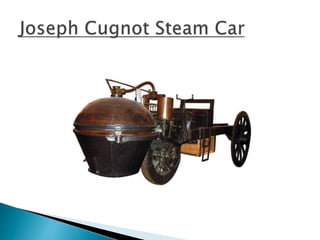
 The first car was built by Joseph Cugnot in 1769. It
was powered by a steam engine and was very slow.
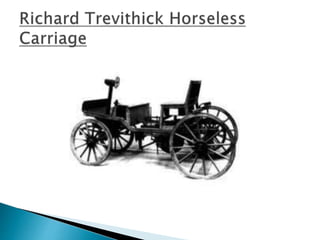
 Richard Trevithick improved the steam engine’s
design by making them smaller and lighter.
 In 1801 he put one on wheels. It was the 1st
horseless carriage that could transport passengers.
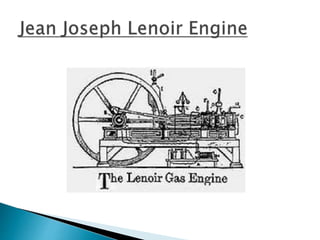
 Jean Joseph Lenoir was the first to build the one
cylinder engine, internal combustion engine.
 Nikolaus August Otto built the first four cylinder
engine.
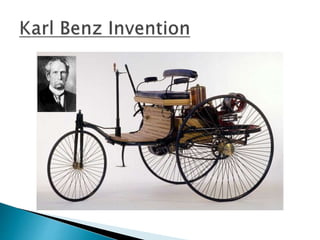
 Karl Benz, known as one of the founders of
Mercedes-Benz, was the first to build an automobile
powered by an internal combustion engine in 1885.
 In 1886 Gottlieb Daimler designed the first four
wheeled automobile. They also created the first
v-slanted engine.
 After 1886, Benz also invented accelerator for speed
regulation, battery ignition system, spark plug,
clutch, gear shift, and the radiator for cooling the
engine.
 With these improvements, he started with production
of the automobile, the first in the world, in the year
1888.
 However in the year 1893 that the first for wheeled
automobile was introduced by him.
 Today, the automobile industry is one of the
biggest in the world.
 In recent years tremendous changes have
taken place in the automobile industry.
 Two powerful forces have been at work:
◦ The challenges of foreign automotive
manufacturers
◦ Federal laws made by the Government covering:
 Automotive air pollution.
 Automotive Safety.
 Automotive fuel economy.
 These two forces have caused the manufacturers
to develop new generations of:
 Light weight vehicles
 Fuel efficient vehicles.
 This is an ongoing revolutionary process.
 Each year, automotive manufacturers bring out
new models that improve on fuel efficiency and
performance with less air pollution.
 The competition among manufacturers has
resulted in many innovations that are being
widely adopted.
 A few of these innovations include
◦ Antilock braking system (ABS)
◦ Traction- Control System (TCS)
◦ Four-wheel drive (4WD) or All- wheel drive (AWD)
◦ Electronically controlled and active suspension
system
◦ Supplemental restraint system ( air bags)
◦ Sequential port fuel injection and a host of other
innovations
 Engineering design and manufacturing skill have
made the modern motor car simple to operate and
economical to maintain
 To achieve utmost simplicity of operation, and thus
ensure greatest utility, engineers have made many
design improvements and have added devices from
time to time. E.g.
1. Electric self starter
2. Automotive oil pressure and engine temperature gauges
3. Synchromesh transmission
4. Automatic gear shifting mechanism
 Manufacturing skill, combined with improved
designs, has affected great savings so that
economical transportation has been become
available to many millions.
 At the same time improvements in
manufacturing method have made it possible
to use better material and closer tolerances
so that car life has been tremendously
increased.
 About 1500 separate parts are put together
to make an automobile.
 These parts are grouped into several systems.
 Each system is made up of two or more parts
that work together to perform a specific job.
 The automotive vehicles are produced in
large variety of sizes and shapes.
 All have the same basic parts and systems.
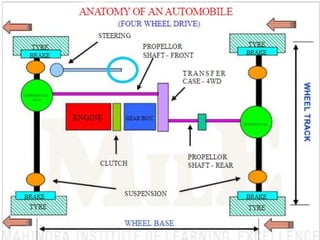
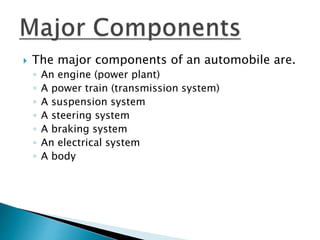
 The major components of an automobile are.
◦ An engine (power plant)
◦ A power train (transmission system)
◦ A suspension system
◦ A steering system
◦ A braking system
◦ An electrical system
◦ A body
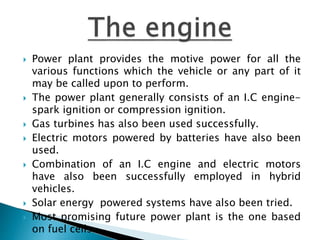
 Power plant provides the motive power for all the
various functions which the vehicle or any part of it
may be called upon to perform.
 The power plant generally consists of an I.C engine-
spark ignition or compression ignition.
 Gas turbines has also been used successfully.
 Electric motors powered by batteries have also been
used.
 Combination of an I.C engine and electric motors
have also been successfully employed in hybrid
vehicles.
 Solar energy powered systems have also been tried.
 Most promising future power plant is the one based
on fuel cells.
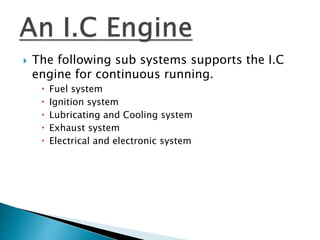
 The following sub systems supports the I.C
engine for continuous running.
 Fuel system
 Ignition system
 Lubricating and Cooling system
 Exhaust system
 Electrical and electronic system
 Supplies fuel to the engine
 Consists of
◦ Storage tank,
◦ Piping work , and,
◦ An arrangement for mixing fuel with air and
spraying into the engine cylinder.
 In conventional petrol engines a carburetor is used for
mixing the fuel with air.
 Present, electronic fuel injection (EFI) is used to spray fuel
air mixture.
 An electronic control module (ECM) control the functions
of EFI.
 Function is to supply high voltage surge at
the desired instant and of adequate strength
to produce a spark in the engine.
 Earlier electro mechanical system were used.
 Now days in modern engines electronic
systems are used.
 The lubrication system keeps all moving parts
inside the engine coated with layers of oil.
 This reduces wears on the parts.
 It also allows the parts move freely with little
power lost in making them move.
 Relatively less viscous lubricating oils are
used in engines, Whereas heavier oils and
greases are used in the transmission and
wheel bearings.
 The cooling system removes just enough heat so
the engine runs smoothly at the proper
temperature.
 It may be water cooling or oil cooling.
 A water pump circulates coolant between the
engine and the radiator.
 Cooler outside air flows through the radiator and
picks up and carries away the excess heat.
 A thermostat helps the coolant at the proper
temperature
 A fan helps keep air moving through the radiator.
 Exhaust system used to vent exhaust gases
with least back pressure.
 It also reduce the engine noise with the help
of muffler.
 Now a days converters are also fitted in the
exhaust pipe to reduce the harmful
constituents in the exhaust gases.
 It consists of storage battery, charging
system and starting system.
 The battery supplies electricity for starting
the engine, providing energy for spark, and
for all electrical devices in the vehicle.
 The charging system consists of mainly an
alternator and is used to continually charge
the battery.
 The starting system consists of starting
motor and is used to start the engine.
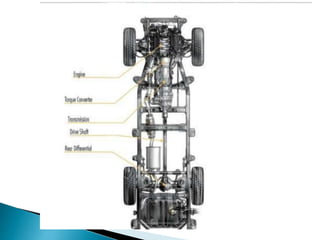
 The power train carries power from the
engine to the drive wheels.
 Major power train’s parts may include
◦ Clutch
◦ Transmission or transaxle
◦ Transfer case
◦ Driveshaft, and
◦ The differential
Introduction to automobile engineering

Introduction to automobile engineering

  • 1.
     The automobileis a self propelled vehicle that travels on land – William H Crouse  An automobile is a wheeled vehicle carrying its motive power unit – Kirpal Sing.  Automobile is a vehicle driven by an internal combustion engine and it is used for transportation of passengers and goods on the ground. Automobile can also be defined as a vehicle which can move by itself.  Examples : Car, jeep, bus, truck, scooter, etc
  • 2.
     The automobileshave been around for more than 100 years  The first car was built by Joseph Cugnot in 1769. It was powered by a steam engine and was very slow.  Richard Trevithick improved the steam engine’s design by making them smaller and lighter.  In 1801 he put one on wheels. It was the 1st horseless carriage that could transport passengers.  Jean Joseph Lenoir was the first to build the one cylinder engine, internal combustion engine.  Nikolaus August Otto built the first four cylinder engine.
  • 6.
     Karl Benz,known as one of the founders of Mercedes-Benz, was the first to build an automobile powered by an internal combustion engine in 1885.  In 1886 Gottlieb Daimler designed the first four wheeled automobile. They also created the first v-slanted engine.
  • 7.
     After 1886,Benz also invented accelerator for speed regulation, battery ignition system, spark plug, clutch, gear shift, and the radiator for cooling the engine.  With these improvements, he started with production of the automobile, the first in the world, in the year 1888.  However in the year 1893 that the first for wheeled automobile was introduced by him.
  • 9.
     Today, theautomobile industry is one of the biggest in the world.  In recent years tremendous changes have taken place in the automobile industry.  Two powerful forces have been at work: ◦ The challenges of foreign automotive manufacturers ◦ Federal laws made by the Government covering:  Automotive air pollution.  Automotive Safety.  Automotive fuel economy.
  • 10.
     These twoforces have caused the manufacturers to develop new generations of:  Light weight vehicles  Fuel efficient vehicles.  This is an ongoing revolutionary process.  Each year, automotive manufacturers bring out new models that improve on fuel efficiency and performance with less air pollution.  The competition among manufacturers has resulted in many innovations that are being widely adopted.
  • 11.
     A fewof these innovations include ◦ Antilock braking system (ABS) ◦ Traction- Control System (TCS) ◦ Four-wheel drive (4WD) or All- wheel drive (AWD) ◦ Electronically controlled and active suspension system ◦ Supplemental restraint system ( air bags) ◦ Sequential port fuel injection and a host of other innovations
  • 12.
     Engineering designand manufacturing skill have made the modern motor car simple to operate and economical to maintain  To achieve utmost simplicity of operation, and thus ensure greatest utility, engineers have made many design improvements and have added devices from time to time. E.g. 1. Electric self starter 2. Automotive oil pressure and engine temperature gauges 3. Synchromesh transmission 4. Automatic gear shifting mechanism
  • 13.
     Manufacturing skill,combined with improved designs, has affected great savings so that economical transportation has been become available to many millions.  At the same time improvements in manufacturing method have made it possible to use better material and closer tolerances so that car life has been tremendously increased.
  • 14.
     About 1500separate parts are put together to make an automobile.  These parts are grouped into several systems.  Each system is made up of two or more parts that work together to perform a specific job.  The automotive vehicles are produced in large variety of sizes and shapes.  All have the same basic parts and systems.
  • 16.
     The majorcomponents of an automobile are. ◦ An engine (power plant) ◦ A power train (transmission system) ◦ A suspension system ◦ A steering system ◦ A braking system ◦ An electrical system ◦ A body
  • 17.
     Power plantprovides the motive power for all the various functions which the vehicle or any part of it may be called upon to perform.  The power plant generally consists of an I.C engine- spark ignition or compression ignition.  Gas turbines has also been used successfully.  Electric motors powered by batteries have also been used.  Combination of an I.C engine and electric motors have also been successfully employed in hybrid vehicles.  Solar energy powered systems have also been tried.  Most promising future power plant is the one based on fuel cells.
  • 19.
     The followingsub systems supports the I.C engine for continuous running.  Fuel system  Ignition system  Lubricating and Cooling system  Exhaust system  Electrical and electronic system
  • 20.
     Supplies fuelto the engine  Consists of ◦ Storage tank, ◦ Piping work , and, ◦ An arrangement for mixing fuel with air and spraying into the engine cylinder.  In conventional petrol engines a carburetor is used for mixing the fuel with air.  Present, electronic fuel injection (EFI) is used to spray fuel air mixture.  An electronic control module (ECM) control the functions of EFI.
  • 21.
     Function isto supply high voltage surge at the desired instant and of adequate strength to produce a spark in the engine.  Earlier electro mechanical system were used.  Now days in modern engines electronic systems are used.
  • 22.
     The lubricationsystem keeps all moving parts inside the engine coated with layers of oil.  This reduces wears on the parts.  It also allows the parts move freely with little power lost in making them move.  Relatively less viscous lubricating oils are used in engines, Whereas heavier oils and greases are used in the transmission and wheel bearings.
  • 23.
     The coolingsystem removes just enough heat so the engine runs smoothly at the proper temperature.  It may be water cooling or oil cooling.  A water pump circulates coolant between the engine and the radiator.  Cooler outside air flows through the radiator and picks up and carries away the excess heat.  A thermostat helps the coolant at the proper temperature  A fan helps keep air moving through the radiator.
  • 24.
     Exhaust systemused to vent exhaust gases with least back pressure.  It also reduce the engine noise with the help of muffler.  Now a days converters are also fitted in the exhaust pipe to reduce the harmful constituents in the exhaust gases.
  • 25.
     It consistsof storage battery, charging system and starting system.  The battery supplies electricity for starting the engine, providing energy for spark, and for all electrical devices in the vehicle.  The charging system consists of mainly an alternator and is used to continually charge the battery.  The starting system consists of starting motor and is used to start the engine.
  • 26.
     The powertrain carries power from the engine to the drive wheels.  Major power train’s parts may include ◦ Clutch ◦ Transmission or transaxle ◦ Transfer case ◦ Driveshaft, and ◦ The differential