INDUSTRIALISATION IN
INDIA
PRESENTED BY :
ANINDA DAS
ANJALI PRIYADARSHI
ARADHANA TRIPATHI
ARPITA JAISWAL
ARVIND VERMA
INDUSTRIALIZATION IN
INDIA
 The Indian business scenario in past
 The phase of growth and development of Indian
industry
 Post independence industrialization
 Gandhian concept of industrialization
Ancient Period
(Upto 750 AD)
 India had developed scientific and elaborate system of
governance and managing people
 Trade practiced under the barter system
 Western coast hub of commercial activities in 6th century
BC
 India established link with other countries on commercial
terms
 Guild system to protect the interest of traders artisans and
producers
Period
(750 to 1757
AD)
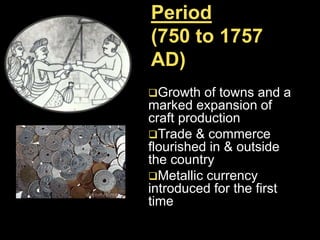
Growth of towns and a
marked expansion of
craft production
Trade & commerce
flourished in & outside
the country
Metallic currency
introduced for the first
time
Trade Routes
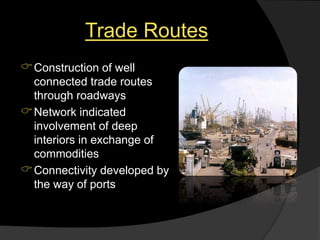
Construction of well
connected trade routes
through roadways
Network indicated
involvement of deep
interiors in exchange of
commodities
Connectivity developed by
the way of ports
BUSINESS
 Traders came from all
over the world
 Use of indigenous financial
instrument “hundi”
 No. of important industries
developed such as textiles,
metal work, stone work, sugar etc.
Establishment of Karkhanas
 Establishment of royal karkhanas
 Generation of employment through
“karkhanas”
 No market ~ Dependency of public
authority
Registration of Traders
1. Registration in employers court with
details of the nature and volume of
business
2. Strict laws to regulate and check unfair
trade practices
 Use of “Public Distribution System”
Artisans in Mughal India
Two types :
 Bazaar artisans
 independent
 Not employee of rich and powerful
 Lowly skilled
 Poor
 Exploited by merchants
 Super skilled artisan
 Employee of the karkhanas
 Eminent in his art
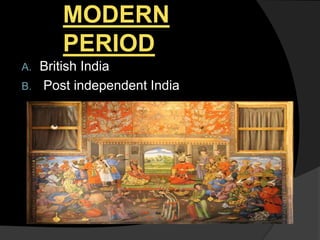
MODERN
PERIOD
A. British India
B. Post independent India
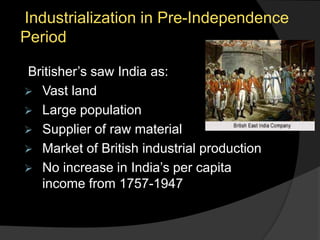
Industrialization in Pre-Independence
Period
Britisher’s saw India as:
 Vast land
 Large population
 Supplier of raw material
 Market of British industrial production
 No increase in India’s per capita
income from 1757-1947
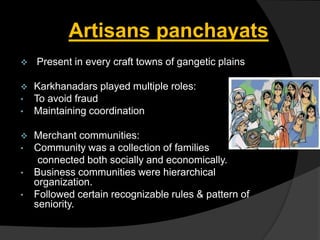
Artisans panchayats
 Present in every craft towns of gangetic plains
 Karkhanadars played multiple roles:
• To avoid fraud
• Maintaining coordination
 Merchant communities:
• Community was a collection of families
connected both socially and economically.
• Business communities were hierarchical
organization.
• Followed certain recognizable rules & pattern of
seniority.
Industrial Revolution &
Industrialization
(18th-19th Century )
 Major market for all manufactured goods
produced by industrial Britain.
 Supplier of raw materials.
 Exploitation of workers because of cheap
labor .
 Acts were passed :
• The Factories Act ,1948
• The Trade Union Act ,1926
• The Mines Act ,1952
Coal & Mines &
Mining
 First real commercial scale mining of
coal commenced in 1814.
 15000 tons of coal mined annually by
1831.
 Production of coal increased on demand
by railways , steam ships and other
industries.
Paper
 Bally mills established in Hooghly in 1870
followed few other mills.
Plantation industries
 One of biggest contribution of the British .
 Indigo , tea , rubber developed.
 Establishment of Tea Plantation in Assam in
1834.
 East India company gave inducements for
growing coffee by granting land on long lease.
Iron & steel
 First steel mill with modern production
methods established in 1808.
 The govt. made attempts to establish
the iron and steel company industry.
Cotton
industries:
 This industry suffered the most.
 Indian handloom replaced by cheap
cloth from Britain.
 First cotton mill started in Bombay in
1854.
 By the end of 19th century the number of
mills rose to 193.
Railways
 Revolutionalized the Indian transport
system
 Opened new frontiers for business at
distant location.
 Movement of people and goods fostered
the growth of every business.
Post and Telegraph
 Helped in breaking the barriers of time and
distance.
 Calcutta , Bombay , Madras and Peshawar
well all connected through telegraph .
Industrialization during the
beginning of 20th century (till
1947)
 Swadeshi movement 1905 gave a boost to Indian industries.
 JRD Tata established the first iron & steel industry in 1911 at
Jamshedpur.
 Growth of trade and auxiliaries to trade such as banking ,
insurance , warehousing , communication etc.
 In 1944 , industrialists and technocrats a plan 15 year
investment plan for India called the “Bombay plan”.
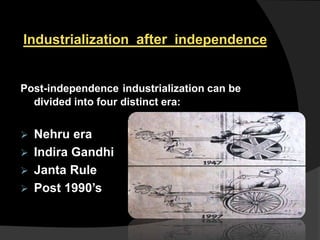
Industrialization after independence
Post-independence industrialization can be
divided into four distinct era:
 Nehru era
 Indira Gandhi
 Janta Rule
 Post 1990’s
Nehru’s Industriial policy
 Believe that a powerful state with centralized economy was essential.
 First 5 year plan was programmed of public expenditure.
 Second 5 year plan reflected Nehru’s vision of plan economic development and fabian
socialism.
 Socialistic pattern of society was key objective of social and economic policy.
 The second 5 year plan was moderate success.
 It was aborted in 1957 when foreign exchange crisis engulfed the country.
 Third plan (1961-65) reflected disconnect between target and performance ,
requirement and resources.
 Public policy in this era had set emotion a more or less stagnant colonial
economy .
Indira Gandhi’s Era (1960-70)
 During her regime ,two major shifts took place.
 Neglect of agriculture was reversed.
 In 1967, Industrial Licensing Policy Inquiry
Committee
 In 1969, Monopolies and Restrictive Trade
Practices (MRTP) Act introduced.
 In 1970, New Industrial Policy was setup that
confined the role of large business houses and
foreign companies to core heavy sectors.
The Janta Rule
 This government had lesser success in achieving industrial reforms
 Launched the Sixth Five-Year Plan, aiming to boost agricultural
production and rural industries
 Seeking to promote economic self-reliance and indigenous
industries, the government required multi-national corporations to
go into partnership with Indian corporations
 The legalisation of strikes and re-empowerment of trade unions
affected business efficiency and economic production.
 Genesis
• Balance of payment crisis
• License-permit-quota Raj
• To unshackle the industrial sector
from administrative and legal control
• To make industry competitive by
increasing efficiency
Implementation of NIP 1991
 Contraction of public sector
 Liberlaisation of industrial licensing
policy
 Introduction of Industrial Entrepreneurs
Memorandum for industries not requiring
compulsory licensing
 Liberalization of location policy
 Five year tax holidays to power
generation industries
 Divestment of PSUs
 Encouragement to Foreign Investment
 Permission to raise capital from foreign
markets
 MRTP Act replaced with Competition Act

industrialisation in india

  • 1.
    INDUSTRIALISATION IN INDIA PRESENTED BY: ANINDA DAS ANJALI PRIYADARSHI ARADHANA TRIPATHI ARPITA JAISWAL ARVIND VERMA
  • 2.
    INDUSTRIALIZATION IN INDIA  TheIndian business scenario in past  The phase of growth and development of Indian industry  Post independence industrialization  Gandhian concept of industrialization
  • 3.
    Ancient Period (Upto 750AD)  India had developed scientific and elaborate system of governance and managing people  Trade practiced under the barter system  Western coast hub of commercial activities in 6th century BC  India established link with other countries on commercial terms  Guild system to protect the interest of traders artisans and producers
  • 4.
    Period (750 to 1757 AD) Growthof towns and a marked expansion of craft production Trade & commerce flourished in & outside the country Metallic currency introduced for the first time
  • 5.
    Trade Routes Construction ofwell connected trade routes through roadways Network indicated involvement of deep interiors in exchange of commodities Connectivity developed by the way of ports
  • 6.
    BUSINESS  Traders camefrom all over the world  Use of indigenous financial instrument “hundi”  No. of important industries developed such as textiles, metal work, stone work, sugar etc.
  • 7.
    Establishment of Karkhanas Establishment of royal karkhanas  Generation of employment through “karkhanas”  No market ~ Dependency of public authority
  • 8.
    Registration of Traders 1.Registration in employers court with details of the nature and volume of business 2. Strict laws to regulate and check unfair trade practices  Use of “Public Distribution System”
  • 9.
    Artisans in MughalIndia Two types :  Bazaar artisans  independent  Not employee of rich and powerful  Lowly skilled  Poor  Exploited by merchants  Super skilled artisan  Employee of the karkhanas  Eminent in his art
  • 10.
    MODERN PERIOD A. British India B.Post independent India
  • 11.
    Industrialization in Pre-Independence Period Britisher’ssaw India as:  Vast land  Large population  Supplier of raw material  Market of British industrial production  No increase in India’s per capita income from 1757-1947
  • 12.
    Artisans panchayats  Presentin every craft towns of gangetic plains  Karkhanadars played multiple roles: • To avoid fraud • Maintaining coordination  Merchant communities: • Community was a collection of families connected both socially and economically. • Business communities were hierarchical organization. • Followed certain recognizable rules & pattern of seniority.
  • 13.
    Industrial Revolution & Industrialization (18th-19thCentury )  Major market for all manufactured goods produced by industrial Britain.  Supplier of raw materials.  Exploitation of workers because of cheap labor .  Acts were passed : • The Factories Act ,1948 • The Trade Union Act ,1926 • The Mines Act ,1952
  • 14.
    Coal & Mines& Mining  First real commercial scale mining of coal commenced in 1814.  15000 tons of coal mined annually by 1831.  Production of coal increased on demand by railways , steam ships and other industries.
  • 15.
    Paper  Bally millsestablished in Hooghly in 1870 followed few other mills. Plantation industries  One of biggest contribution of the British .  Indigo , tea , rubber developed.  Establishment of Tea Plantation in Assam in 1834.  East India company gave inducements for growing coffee by granting land on long lease.
  • 16.
    Iron & steel First steel mill with modern production methods established in 1808.  The govt. made attempts to establish the iron and steel company industry.
  • 17.
    Cotton industries:  This industrysuffered the most.  Indian handloom replaced by cheap cloth from Britain.  First cotton mill started in Bombay in 1854.  By the end of 19th century the number of mills rose to 193.
  • 18.
    Railways  Revolutionalized theIndian transport system  Opened new frontiers for business at distant location.  Movement of people and goods fostered the growth of every business. Post and Telegraph  Helped in breaking the barriers of time and distance.  Calcutta , Bombay , Madras and Peshawar well all connected through telegraph .
  • 19.
    Industrialization during the beginningof 20th century (till 1947)  Swadeshi movement 1905 gave a boost to Indian industries.  JRD Tata established the first iron & steel industry in 1911 at Jamshedpur.  Growth of trade and auxiliaries to trade such as banking , insurance , warehousing , communication etc.  In 1944 , industrialists and technocrats a plan 15 year investment plan for India called the “Bombay plan”.
  • 20.
    Industrialization after independence Post-independenceindustrialization can be divided into four distinct era:  Nehru era  Indira Gandhi  Janta Rule  Post 1990’s
  • 21.
    Nehru’s Industriial policy Believe that a powerful state with centralized economy was essential.  First 5 year plan was programmed of public expenditure.  Second 5 year plan reflected Nehru’s vision of plan economic development and fabian socialism.  Socialistic pattern of society was key objective of social and economic policy.  The second 5 year plan was moderate success.  It was aborted in 1957 when foreign exchange crisis engulfed the country.  Third plan (1961-65) reflected disconnect between target and performance , requirement and resources.  Public policy in this era had set emotion a more or less stagnant colonial economy .
  • 22.
    Indira Gandhi’s Era(1960-70)  During her regime ,two major shifts took place.  Neglect of agriculture was reversed.  In 1967, Industrial Licensing Policy Inquiry Committee  In 1969, Monopolies and Restrictive Trade Practices (MRTP) Act introduced.  In 1970, New Industrial Policy was setup that confined the role of large business houses and foreign companies to core heavy sectors.
  • 23.
    The Janta Rule This government had lesser success in achieving industrial reforms  Launched the Sixth Five-Year Plan, aiming to boost agricultural production and rural industries  Seeking to promote economic self-reliance and indigenous industries, the government required multi-national corporations to go into partnership with Indian corporations  The legalisation of strikes and re-empowerment of trade unions affected business efficiency and economic production.
  • 24.
     Genesis • Balanceof payment crisis • License-permit-quota Raj • To unshackle the industrial sector from administrative and legal control • To make industry competitive by increasing efficiency
  • 25.
    Implementation of NIP1991  Contraction of public sector  Liberlaisation of industrial licensing policy  Introduction of Industrial Entrepreneurs Memorandum for industries not requiring compulsory licensing  Liberalization of location policy  Five year tax holidays to power generation industries
  • 26.
     Divestment ofPSUs  Encouragement to Foreign Investment  Permission to raise capital from foreign markets  MRTP Act replaced with Competition Act