Industrial Culture and
   Industrialization

     Prof. Jorge V. Sibal
< sibal_jorgel@yahoo.com >
         March 2004
Industrialization and Culture

   Industrialization is the common
    aspiration of all less developed and
    developing countries.
   It is the process of introducing new
    technologies and cultures in order to
    transform the nation’s economy and
    productive capacity.
Role of Entrepreneurial
Industrializing Groups

   Economic development does not
    happen spontaneously or by luck.
    It is actually planned and executed
    (or ‘engineered”) by a coalition of
    entrepreneurial industrializing
    groups.
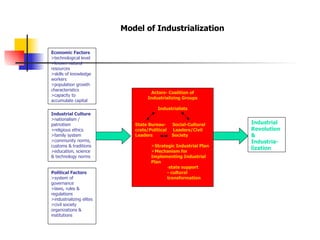
Model of Industrialization

Economic Factors
>technological level
>known natural
resources
>skills of knowledge
workers
>population growth
characteristics
                                    Actors- Coalition of
>capacity to
                                   Industrializing Groups
accumulate capital
                                       Industrialists
Industrial Culture
>nationalism /
patriotism                   State Bureau-     Social-Cultural   Industrial
>religious ethics            crats/Political   Leaders/Civil     Revolution
>family system               Leaders           Society           &
>community norms,                                                Industria-
customs & traditions                Strategic Industrial Plan
                                                                 lization
>education, science                 Mechanism for
& technology norms                  Implementing Industrial
                                    Plan
                                           -state support
Political Factors                          - cultural
>system of                                 transformation
governance
>laws, rules &
regulations
>industrializing elites
>civil society
organizations &
institutions
The Actors of Industrialization

1. Industrialists, entrepreneurs and other
  knowledge workers united by nationalism
  and patriotism from among the leaders of
  capitalist middle class, socialist
  intellectuals, landed dynastics (realists)
  and foreign settlers and naturalized
  Filipinos and their descendants like those
  of the Chinese, American and Spanish
  origins.
The Actors of Industrialization

2. State bureaucrats, technocrats and
  political leaders with patriotic and
  nationalist ideals
3. Civil society leaders and other
  progressive social-cultural organization
  leaders like religious, civic leaders,
  educators, researchers, entertainers,
  media personalities and other labor/NGO/
  pressure group leaders.
Vital Step in the Transformation

   The coalition of industrializing groups
    should dominate or occupy strategic
    positions in the country’s economic
    enterprises, political and socio-cultural
    institutions to be able to formulate and
    implement a national industrialization
    plan that will be supported actively by
    state and civil society institutions.
Many Forms of Industrialzation

    In 1960, Harvard University writers
 Clark Kerr, John T. Dunlop, Frederick H.
 Harbison and Charles A. Myers (KDHM)
 noted that industrialization in many
 forms, and not only capitalism and
 communism, is “stalking the earth,
 transforming almost all features of older
 and traditional societies”
Nationalism as the Real Force

“We began to develop in particular, a sense
 of importance of nationalism as a very
 real force at this stage in the history of
 the world. We also developed a sense of
 the decline of the importance of
 competing ideologies. More and more,
 the questions are technical as well as
 philosophical … technicians are taking
 their place along with theorists” (KDHM)
Roles of Industrializing
Actors

   Industrialists, entrepreneurs and other
    knowledge workers in the private, public
    and NGO sectors study and apply new
    technologies and industrial culture. They
    exercise leadership in the technical
    society and transform the skills, values,
    norms and responsibilities of the
    workforce.
Role of Industrialists &
Knowledge Workers

 “We may have a productive and educated
 labor force, but we do not have an
 effective entrepreneurial class who are
 the main drivers of growth in any
 country. Who else will create jobs after
 all? …. If this continues, we will be a
 country that creates nothing and imports
 everything”. John Gokongwei Jr.
Role of Government

   The state bureaucrats, technocrats and
    political leaders provide the national
    industrialization plan and programs to
    speed up industrialization.
    “Modern industrialization does not see
    the withering away of the state and its
    bureaucracy, rather the role of
    government agencies is expanded and
    enhanced” (KDHM).
Role of Government

   Contrary to the World Bank-IMF and WTO
    prescriptions, KDHM noted that the “role
    of government in countries entering upon
    industrialization, regardless of political
    form, may be expected to be greater
    than before… It is extremely unlikely
    that latecomers can carry out such
    development without relying very heavily
    on public operations”.
Role of Labor & Civil Society

   Civil society and labor leaders, whose
    traditional role is to watch over the
    excesses of the state and private sectors,
    have a very important role in the
    industrialization process, particularly in
    cultural transformation. (Alternatives to
    Globalization 2002).
Role of Labor & Civil Society

   Civil society sees global corporation as
    strong threats to peoples’ democracies,
    self reliant economies and national
    cultures. Global corporations have no
    loyalty to nations, communities or
    persons. Thus, local citizens’ movements
    align themselves with domestic
    enterprises which are more accountable
    to their stakeholders.
Role of Labor & Civil Society

   The new labor movement is transforming
    itself into social movement unionism as
    an active component of the civil society.
    "The protests of the world labor
    movement today are more in favor of
    industrialization than against it. In Israel,
    Ghana and Yugoslavia, labor
    organizations seek to assist the
    industrialization process". (KDHM)
The Need for Culture Change

   Alejandro Lichauco noted that there are
    powerful anti-industrialization elements
    that has aborted and retarded Philippine
    industrialization. To counter such moves,
    industrialists, government and civil
    society groups- schools, civic
    organizations, media, & even the church
    should launch a cultural revolution in
    support of national industrialization.
Types of industrializing groups

   The types of industrializing groups
    who may introduce new technologies
    and culture needed for the
    industrialization process are- middle
    class (capitalists), dynastic leaders,
    revolutionary intellectuals
    (socialists), colonial administrators
    and nationalist leaders.
Types of industrializing groups

   Middle class leaders are professionals
    (“schooled”), merchandizers (money
    handlers) and master craftsmen in origin.
    These leaders are the industrializing
    groups of England and United States of
    America, often believers of free
    enterprise doctrine of Adam Smith
Types of industrializing groups

   Dynastic leaders are the most
    conservative among the industrializing
    groups. They are rooted from the
    landlord class. The dynastic leaders are
    engineers of modern agriculture - from
    subsistence farming to commercial
    agriculture and trading.
Types of industrializing groups

   The dynastic leaders are of two
    categories - the decadents who often
    gain or lose their power forcefully by
    war or revolution, or the realists who
    adjust to the changing environments
    slowly just like the zaibatus (Meiji
    Shogunate) of Japan.
Types of industrializing groups

   The revolutionary intellectuals are
    also professionals (“educated”) but unlike
    the middle class groups who are believers
    of capitalism, they are Marxists or
    socialists. The revolutionary intellectuals
    are the industrializing groups of the
    Soviet Union and China.
Types of industrializing groups

   The last two industrializing elites, the
    colonial administrators and the
    nationalist leaders are extensions
    of the first three groups- the
    dynastic, capitalist middle class and
    socialist intellectuals.
Types of industrializing groups

   If any of the 3 industrializing elites
    expand outside of their country, they
    become colonial administrators
    (“alien or imperialists”) and those
    local elites who oppose them are
    called nationalist leaders.
Types of industrializing groups
   Colonial administrators are of two
    categories - the settler and non-settler
    type. The settler type are those who adopt and
    settle permanently in the country where they
    operate and hence contribute to the
    industrialization of their adopted country. In the
    Philippines, the insulares and the immigrant
    Chinese are examples of the settler type.
Types of industrializing groups

   The nationalist leaders are those
    who oppose the colonial
    administrators. As mentioned
    earlier, they originate from the
    dynastic, middle class and
    revolutionary intellectuals.
Types of elites and their
philosophies at present

   TYPE - Dynastic, Landlord type
    (Traditional Politician)
   ECONOMIC PHILOSOPHY
    -Mercantilism / Protectionist (Crony)
    Capitalism
   STRATEGIES - “Rentier” / State Sector
    led
Types of groups and their
philosophies
>TYPE - Traditional Middle Class
neo-liberal
>ECONOMIC PHILOSOPHY -
Private Sector led
>STRATEGIES - Private Capitalist
led / weak state
Types of industrializing groups
and their philosophies

   TYPE – Nationalist Middle Class
   ECONOMIC PHILOSOPHY - Private
    Sector led but with State Planning &
    Intervention
   STRATEGIES -Mixed Economics but
    Private Sector led
Types of groups and their
philosophies

   TYPE – Traditional Socialist/
    Revolutionary Intellectual
   ECONOMIC PHILOSOPHY-
    Socialist/State Enterprise led
   STRATEGIES - State Initiative and
    State Monopoly
Types of groups and their
philosophies

 >TYPE – Market   Socialist
 >ECONOMIC        PHILOSOPHY- Mixed
   Economics- State, Non-State
   (Private) & NGO Enterprises
 >STRATEGIES - Mixed Economics but
   State Sector led
Types of groups and their
philosophies

   TYPE – Colonial Administrators /
    Neo-Liberal Middle Class
   ECONOMIC PHILOSOPHY- Free
    Enterprise / Private Sector led
   STRATEGIES - Private Capitalist led /
    Weak State
Struggle for
Industrialization

   The struggle for industrialization is
    engineered      by    a    coalition   of
    industrializing   groups   aspiring   for
    independence, democracy & nationalism.
    These nationalist industrializing groups
    aspire to adapt the original philosophies
    and development strategies of the
    developed countries.
Causes of Failed Economic
Growth

   The     enemies       of     industrialization
    movements of developing countries are
    the anti-industrialization forces composed
    colonial administrators and their local
    neo-liberal allies.     They misguide the
    governments of developing nations by
    recommending or imposing free trade
    and liberalized economic policies that
    they themselves did not utilize.
Causes of Failed Economic
Growth

   Ha-Joon Chang (2002) calls this anti-
    industrialization strategy “kicking
    away the ladder”.
   Despite this opposition, KDHM predicted
    that the industrializing groups of a newer
    system are bound to win over the leaders
    of an older system. Hence the ultimate
    triumph of the industrializing forces.
Industrialization in the
Global Era

   The        anti-industrialization    forces
    propagated the myth of only two models
    of industrialization to choose from- the
    capitalist and the socialist models.
   But both models in reality propagated
    monopoly-dominated "free trade".
Causes of Failed Economic
Growth
   Both neo-liberal capitalist and socialist
    industrialization strategies were strategies of
    “kicking away the ladder”. The Asian NICs
    (South Korea, Taiwan, Singapore, Thailand and
    Malaysia) defied some WB-IMF conditions &
    insisted on nationalist development strategies in
    advancing their industrial development. China
    under the USSR failed to industrialize, calling
    USSR a social imperialist.
Cultural Transformation &
Industrialization

   Culture either speeds up or retards
    industrialization. Developing countries
    have segmented societies with wide class
    and culture gaps. The traditional
    dominant culture is reactive to the newer
    industrialization process and its industrial
    culture. To induce industrialization, the
    preexisting culture must adopt or be
    broken as industrialization proceeds.
Cultural Transformation &
Industrialization
   Industrialization modifies or destroys
    traditional cultures. As the industrializing
    groups adopt modern technologies in the
    economy via industrial revolution, a
    cultural transformation must be launched
    even ahead of the industrialization
    movement. This is a basic principle in
    organization        development         and
    development economics.
Are there signs that we can we
recover

   Cultural institutions like Churches, family
    system, mass media and entertainment,
    and community-based social institutions
    are mechanisms that facilitate the
    process of changing economies and
    societies. With the economy and speed
    of modern communication and
    transportation systems, ideas and cultural
    institutions are fast being modified.
Characteristics of Industrial
Culture

1. Nuclear family system that accentuate
  individual incentives to work, save and
  invest.
2. Open social structure that encourages
  equality of treatment and advancement
  on the basis of ability.
3. Religious and ethical values favorable to
  economic gain and growth, innovation
  and scientific change.
Characteristics of Industrial
Culture

4. Legal system that encourage economic
  growth through protection of property
  rights from arbitrary or capricious rule.
5. Strong central governmental
  organization and the sense of being a
  nation which can play a decisive role in
  economic development.
Deterrents to Industrial Culture

1. Extended family system that weakens
    industrial incentives to work, save and
    invest, and reserves managerial
    positions for family members regardless
    of competence of insiders and outsiders.
2. Class structure based on traditional
    social status rather than an economic
    performance.
Deterrents to Industrial Culture

3. Traditional religious and ethical values
  which oppose change and innovation,
  particularly in science and technology.
4. Traditional customs and social norms
  that deny individual and property rights
  and fail to honor contracts.
5. Decisive groups in society which hinder
  or prevent a strong nation-state.
Religion and Family Ties

   The protestant ethics in the West,
    particularly US, Britain and Scandinavia,
    have helped speed up industrialization
    through the promotion of the values of
    thrift, austerity and capital accumulation.
    This is also true in Confucian ethics in
    Asia. In Japan, culture and religion were
    preserved as modern technologies were
    being adopted.
Extended family system

   An extended family system prevalent in
    underdeveloped economies may also give
    advantages to industrialization where
    resources for capital formation are
    pooled, and it serves a cheap source of
    family labor. In underdeveloped
    countries, family workers normally work
    as unpaid family workers.
Principles of Industrial Culture

   Nationalism and Patriotism
   Desire for a Sovereign and Independent
    Nation
   Acceptance of Modern Sciences and
    Technologies
   Unity of industrializing actors-
    industrialists, state bureaucrats and
    social-cultural leaders.
The Philippine Experience

   While the Philippines is considered an
    economic sluggard in Asia, it was the
    second fastest growing economy in Asia
    in 1950s, next to Japan. One of the
    major factors for this fast economic
    growth was the nationalist industrial
    culture that prevailed among the Filipino
    industrializing groups.
Import Substitution Strategy

   The Philippines adopted a strategy of
    import substitution industrialization (ISI)
    as an option to the failed free trade
    strategies imposed for several decades by
    colonial powers Spain and the United
    States of America.
Nationalism
& Industrialization Strategy

   Frank Golay explained the “rise of the
    Filipino industrial class, with its
    entrepreneurial values” as one of the four
    sources of growth in the post-war period.
     The three others were- a) economic
    policy of import substitution, b) foreign
    inflow of capital mostly from war damage
    payments, and c) the development of the
    domestic market.
Nationalism
& Industrialization Strategy

The country produced captains of industry
 like Salvador Araneta and Hilarion M.
 Henares, Jr., the ideologues of the
 industrialization, Filemon Rodriguez, Col.
 Severo Santiago, Meneleo Carlos, Sr.,
 Pablo Silva, Jose Concecion, Sr. , Jose
 Marcelo, Jacinto families, and numerous
 others who pushed for industrialization
 and ‘Filipino First’ Policy”.
Kicking Away the Ladder,
Philippine Experience

   Import Substitution Industrialization (ISI)
    strategy was the successful first step in
    the industrialization of Japan, South
    Korea, Taiwan and other Asian NICs. In
    the Philippines however, the strategy was
    derailed by the anti-industrialization
    forces of the United States and its neo-
    liberal local allies.
Senator Claro M. Recto's
Explanation

   “American anti-industrialization policy was
    rationalized (way ahead of the ISI policy)
    sometime in 1945 or early 1946. The Bell
    Trade Act, approved and passed in April
    1946, was inconsistent with the ideas of
    industrialization of the Philippines.
    Ambassador Cowen openly advised our
    government and people to (remain) an
    agricultural and commercial economy."
Causes of ISI Failure

1. Most of the beneficiaries of the ISI
    programs were US firms (3 out of 4
    companies set up in 1950s were foreign
    subsidiaries and joint ventures).
2. Their investments were in tertiary
    processing and in capital intensive
    processes that were subsidized and
    protected by the state.
Causes of ISI Failure

3. There were limited forward and
  backward linkaging and these ISI
  industries managed to control the local
  market via industry cartels or oligopolies
  and monopolies. They did not expand to
  the export market for more efficiency,
  economies of scale and competitiveness.
Causes of ISI Failure

4. Colonial mentality led to wasteful
    spending. Foreign cultures created new
    needs, attitudes and values that
    developed costly tastes among the rich
    and the upper class that favored the
    purchase of imported goods. Many
    foreign & local firms practiced transfer
    pricing and patronized foreign suppliers
    instead of local producers.
Causes of ISI Failure

5. There was no genuine land reform
  program to increase the incomes of the
  rural population and expand the local
  market to encourage industrialization.
6. The ISI strategy institutionalized
  patronage politics and crony capitalism
  that preserved the dominance of the local
  dynastic elites and the neo-liberal
  technocrats in the political system.
Completion in Kicking the
Ladder

   With the BOP deficits, the government
    was forced to go to the IMF and adopted
    the policies of opening up the economy
    through peso devaluation and attracting
    foreign investments and export-oriented
    production. The government was
    reinforced with neo-liberal minded
    technocrats. The process of kicking the
    ladder was almost completed.
An experimental export-
oriented strategy

   The ISI strategy failed because it was
    derailed by anti-industrialization forces.
    Instead of clearing the obstacles to the
    ISI strategies for industrialization, it was
    completely abandoned in exchange of an
    experimental export-oriented strategy
    that brought the economy back to the
    free trade colonial past.
The Failure of the Experiment

   After several decades of globalization and
    trade liberalization, studies now show
    that “people in the high income countries
    account for 20% of world population but
    posses 90% of the GDP in the world. On
    the other hand, poorest people, which
    account for the lower 20% of world
    population, posses only 1% of GDP in the
    world” (ILO Director General Juan
    Somavia 1999, Takagi 2004)
Maneuvers of
Successful Asian NICs
   There were successful industrialization
    programs in Asia even under the aegis of
    the IMF-World Bank and WTO. Under the
    banner of patriotism or nationalism,
    industrialization programs were
    undertaken by the industrializing groups
    as a joint responsibility of the
    government, private and to a certain
    extent the labor sector.
Maneuvers of
Successful Asian NICs

   The spectacular growth of Japan was
    primarily due to activist industrial trade
    and technology policies of the state.
    With the absence of entrepreneurial
    class, the Meiji government established
    state factories in shipbuilding, mining,
    textiles (cotton, wool and silk), and
    military industries. These factories were
    later sold to private enterprises.
Maneuvers of
Successful Asian NICs

   Taiwan, South Korea, Singapore and
    Malaysia did the opposite of what the IMF
    prescribed. They first developed the
    ability to take care of their basic needs
    internally, rather than totally converting
    to an export-based production system”.
    (Alternatives to Globalization 2002).
Maneuvers of
Successful Asian NICs

   South Korea in 1960s pursued state
    initiated mobilization, similar to those
    done in socialist countries, aimed at
    nurturing high standards of work ethics
    and cooperative attitudes among
    workers. ‘Industrial workers’ were
    “exhorted to work harder in fighting the
    patriotic war against poverty…”.
Maneuvers of
Successful Asian NICs

   During the Asian financial crisis (1997),
    China did not follow the IMF’s
    prescription and refused to devalue the
    Renminbi. Those nations that followed
    the IMF’s prescription suffered economic
    and then political meltdown. Meantime,
    China’s foreign exchange reserves soared
    reaching US $ 230 billion (2003), the
    second largest in the world.
Maneuvers of
Successful Asian NICs

   "Following its own course, China’s new
    export economy is booming, drawing
    manufacturers from the West and
    throughout Asia to relocate production in
    China. Meanwhile, a brisk new pattern
    has arisen, tilting the economy away from
    an over-reliance on exports, which
    proved to be the Achilles heel of the
    Asian tiger economies” (Brahm 2003).
The New Philippine Cultural
Transformation

   Mass poverty cannot be eliminated or
    even relieved with globalization and
    liberalization. As what Japan and other
    Asian NICs realized long time ago, it is
    only through industrialization that the
    country will be able to achieve the ideals
    of nationalism, independence, democracy
    and progress.
The New Philippine Cultural
Transformation

   The struggle for national industrialization
    should be preceded by cultural
    transformation. The world’s people, as
    shown in Cancun, Doha and other
    momentous civil society uprisings, have
    risen up and pushed to greater heights
    the global cultural revolution.
The New Philippine Cultural
Transformation

   The country’s culture is “colonial and
    damaged” and the people exploited and
    kept in poverty. This has weakened the
    values of patriotism, nationalism and
    cooperation. Filipinos do not trust each
    other and rely solely on extended family
    system. It is the system of individual
    survival (or the crab mentality) that
    prevails in the average Filipino mind.
The New Philippine Cultural
Transformation

   Inculcating the new industrial culture
    among Filipinos is a must in order to
    speed up the much delayed and aborted
    national industrialization process. If the
    West has the Protestant ethics and most
    of Asia, the Confucian ethics that have
    pushed industrialization, the world’s civil
    society is now being aroused by the
    Christian ethics.
Christian Ethics

   German Catholic Heinrich Pesch S.J. in
    1918 wrote the book Ethics and National
    Development. He called these Christian
    Ethics a “solidaristic system of human
    work” with three basic principles.
Three Principles of
Christian Ethics

1. The economy must be regulated in
   accord with the virtues of (social) justice
   and (social) charity. It is the
   responsibility, and thus in the
   conscience of individuals to make the
   economy work for the good of all,
   especially the poor.
Three Principles of
Christian Ethics

2. The principle of subsidiarity
  (participatory democracy) where social
  and political institutions at higher levels
  ought to intervene only when the
  individuals and groups at the lower social
  and political levels cannot accomplish the
  tasks which the common good requires.
Three Principles of
Christian Ethics

3. The principle of autonomy and
  cooperation where people in various
  vocations and occupations perform
  various functions necessary for the
  development of the economy.
The New Philippine Cultural
Transformation

   It is time that all Filipinos should put in
    their respective minds and consciences
    the three basic principles of the Christian
    ethics in renewing our industrial culture.

   Thank you.
References:
            Brahm, Laurence (2003) “Zhu Rongi’s ‘Managed Marketization of the Chinese Economy”, China,
Enabling a New Era of Changes, Singapore: John Wiley & Sons (Asia) Pte Ltd.
            Boyer, Robert (1994) “Do Labor Institutions Matter for Economic Development? A ‘Regulation’
Approach of the OECD and Latin America with an Extension to Asia”, Workers, Economic Institutions and
Economic Growth in Asia (Gerry Rodgers-Ed), Geneva: International Institute for Labor Studies.
            Constantino, Renato (1984) Nationalist Alternative, Quezon City: Foundation for Nationalist
Studies.
            Gokongwei Jr., John (2004) “How to Make RP Economy Globally Competitive”, Philippine Daily
Inquirer, Feb. 23, 2004, p. B8.
            Ha-Joon Chang (2002) Kicking Away the Ladder, Development Strategy in Historical
Perspective, London: Anthem Press.
            International Forum on Globalization (2002) Alternative to Economic Globalization (A Better
World is Possible), San Francisco: Bennett Koehler Publishers, Inc


             Kerr, Clark, John T. Dunlop, Frederick H. Harbison and Charles A. Myers (KDHM 1960) Industrialism and
Industrial Man, Massachusetts: Harvard University Press.



             Lichauco, Alejandro (1988) Nationalist Economics, History, Theory and Practice, Quezon City: Institute
    for Rural Industrialization, Inc.
             Lichauco, Alejandro (1986) Towards a New Economic Order and the Conquest of Mass Poverty,
    Quezon City: SSP.
             Mar, Pamela and Frank-Jurgen Richter (2003) China, Enabling a New Era of Changes, Singapore: John
    Wiley & Sons (Asia) Pte Ltd.
             Munck, Ronaldo (2002) Globalization and Labor, Manila: Ibon Books
             Ofreneo, Rene E (1994) “The Labor Market, Protective Labor Institutions and Economic Growth in the
    Philippines”, Workers, Economic Institutions and Economic Growth in Asia (Gerry Rodgers-Ed), Geneva:
    International Institute for Labor Studies.
             Pesch S.J., Henry (1918) Ethics and the National Economy, Philippines: Divine Word Publications, Inc.
             Rodger, Gerry (1994) “Workers, Economic Institutions and Economic Growth in Asia, Geneva:
    International Institute for Labor Studies.
             Sibal, Jorge (2003), “Studies of Selected In-Company Training Strategies for Knowledge Workers in
    the Philippines: Tokyo: Asian Productivity Organization
    Takagi, Tsuyoshi (2004) “Global Economy and Decent Work”, Conference on Industrial Relations in Enterprises
    in the Age of Globalization of Economy, sponsored by the ILO Association of Japan, Inc., March 1, 2004,
    Mandarin Oriental Hotel, Makati City, Philippines.
    Warner, Malcolm (Ed.) (2003), Culture and Management in Asia, London: RoutledgeCurzon.
    Wurfel, David (1957) “Trade Union Development and Labor Relations Policy in the Philippines”, Industrial
    Labor Relations Review, Vol. 12, No. 4, July, pp. 582-608.
             Yong-bum Park (2002) “State Regulation, the Labor Market and Economic Development: The Republic
    of Korea”, Kicking Away the Ladder, Development Strategy in Historical Perspective (Ha-joon-Ed), London:
    Anthem Press.

Industrial culture & industrialization

  • 1.
    Industrial Culture and Industrialization Prof. Jorge V. Sibal < sibal_jorgel@yahoo.com > March 2004
  • 2.
    Industrialization and Culture  Industrialization is the common aspiration of all less developed and developing countries.  It is the process of introducing new technologies and cultures in order to transform the nation’s economy and productive capacity.
  • 3.
    Role of Entrepreneurial IndustrializingGroups  Economic development does not happen spontaneously or by luck. It is actually planned and executed (or ‘engineered”) by a coalition of entrepreneurial industrializing groups.
  • 4.
    Model of Industrialization EconomicFactors >technological level >known natural resources >skills of knowledge workers >population growth characteristics Actors- Coalition of >capacity to Industrializing Groups accumulate capital Industrialists Industrial Culture >nationalism / patriotism State Bureau- Social-Cultural Industrial >religious ethics crats/Political Leaders/Civil Revolution >family system Leaders Society & >community norms, Industria- customs & traditions Strategic Industrial Plan lization >education, science Mechanism for & technology norms Implementing Industrial Plan -state support Political Factors - cultural >system of transformation governance >laws, rules & regulations >industrializing elites >civil society organizations & institutions
  • 5.
    The Actors ofIndustrialization 1. Industrialists, entrepreneurs and other knowledge workers united by nationalism and patriotism from among the leaders of capitalist middle class, socialist intellectuals, landed dynastics (realists) and foreign settlers and naturalized Filipinos and their descendants like those of the Chinese, American and Spanish origins.
  • 6.
    The Actors ofIndustrialization 2. State bureaucrats, technocrats and political leaders with patriotic and nationalist ideals 3. Civil society leaders and other progressive social-cultural organization leaders like religious, civic leaders, educators, researchers, entertainers, media personalities and other labor/NGO/ pressure group leaders.
  • 7.
    Vital Step inthe Transformation  The coalition of industrializing groups should dominate or occupy strategic positions in the country’s economic enterprises, political and socio-cultural institutions to be able to formulate and implement a national industrialization plan that will be supported actively by state and civil society institutions.
  • 8.
    Many Forms ofIndustrialzation In 1960, Harvard University writers Clark Kerr, John T. Dunlop, Frederick H. Harbison and Charles A. Myers (KDHM) noted that industrialization in many forms, and not only capitalism and communism, is “stalking the earth, transforming almost all features of older and traditional societies”
  • 9.
    Nationalism as theReal Force “We began to develop in particular, a sense of importance of nationalism as a very real force at this stage in the history of the world. We also developed a sense of the decline of the importance of competing ideologies. More and more, the questions are technical as well as philosophical … technicians are taking their place along with theorists” (KDHM)
  • 10.
    Roles of Industrializing Actors  Industrialists, entrepreneurs and other knowledge workers in the private, public and NGO sectors study and apply new technologies and industrial culture. They exercise leadership in the technical society and transform the skills, values, norms and responsibilities of the workforce.
  • 11.
    Role of Industrialists& Knowledge Workers “We may have a productive and educated labor force, but we do not have an effective entrepreneurial class who are the main drivers of growth in any country. Who else will create jobs after all? …. If this continues, we will be a country that creates nothing and imports everything”. John Gokongwei Jr.
  • 12.
    Role of Government  The state bureaucrats, technocrats and political leaders provide the national industrialization plan and programs to speed up industrialization.  “Modern industrialization does not see the withering away of the state and its bureaucracy, rather the role of government agencies is expanded and enhanced” (KDHM).
  • 13.
    Role of Government  Contrary to the World Bank-IMF and WTO prescriptions, KDHM noted that the “role of government in countries entering upon industrialization, regardless of political form, may be expected to be greater than before… It is extremely unlikely that latecomers can carry out such development without relying very heavily on public operations”.
  • 14.
    Role of Labor& Civil Society  Civil society and labor leaders, whose traditional role is to watch over the excesses of the state and private sectors, have a very important role in the industrialization process, particularly in cultural transformation. (Alternatives to Globalization 2002).
  • 15.
    Role of Labor& Civil Society  Civil society sees global corporation as strong threats to peoples’ democracies, self reliant economies and national cultures. Global corporations have no loyalty to nations, communities or persons. Thus, local citizens’ movements align themselves with domestic enterprises which are more accountable to their stakeholders.
  • 16.
    Role of Labor& Civil Society  The new labor movement is transforming itself into social movement unionism as an active component of the civil society. "The protests of the world labor movement today are more in favor of industrialization than against it. In Israel, Ghana and Yugoslavia, labor organizations seek to assist the industrialization process". (KDHM)
  • 17.
    The Need forCulture Change  Alejandro Lichauco noted that there are powerful anti-industrialization elements that has aborted and retarded Philippine industrialization. To counter such moves, industrialists, government and civil society groups- schools, civic organizations, media, & even the church should launch a cultural revolution in support of national industrialization.
  • 18.
    Types of industrializinggroups  The types of industrializing groups who may introduce new technologies and culture needed for the industrialization process are- middle class (capitalists), dynastic leaders, revolutionary intellectuals (socialists), colonial administrators and nationalist leaders.
  • 19.
    Types of industrializinggroups  Middle class leaders are professionals (“schooled”), merchandizers (money handlers) and master craftsmen in origin.  These leaders are the industrializing groups of England and United States of America, often believers of free enterprise doctrine of Adam Smith
  • 20.
    Types of industrializinggroups  Dynastic leaders are the most conservative among the industrializing groups. They are rooted from the landlord class. The dynastic leaders are engineers of modern agriculture - from subsistence farming to commercial agriculture and trading.
  • 21.
    Types of industrializinggroups  The dynastic leaders are of two categories - the decadents who often gain or lose their power forcefully by war or revolution, or the realists who adjust to the changing environments slowly just like the zaibatus (Meiji Shogunate) of Japan.
  • 22.
    Types of industrializinggroups  The revolutionary intellectuals are also professionals (“educated”) but unlike the middle class groups who are believers of capitalism, they are Marxists or socialists. The revolutionary intellectuals are the industrializing groups of the Soviet Union and China.
  • 23.
    Types of industrializinggroups  The last two industrializing elites, the colonial administrators and the nationalist leaders are extensions of the first three groups- the dynastic, capitalist middle class and socialist intellectuals.
  • 24.
    Types of industrializinggroups  If any of the 3 industrializing elites expand outside of their country, they become colonial administrators (“alien or imperialists”) and those local elites who oppose them are called nationalist leaders.
  • 25.
    Types of industrializinggroups  Colonial administrators are of two categories - the settler and non-settler type. The settler type are those who adopt and settle permanently in the country where they operate and hence contribute to the industrialization of their adopted country. In the Philippines, the insulares and the immigrant Chinese are examples of the settler type.
  • 26.
    Types of industrializinggroups  The nationalist leaders are those who oppose the colonial administrators. As mentioned earlier, they originate from the dynastic, middle class and revolutionary intellectuals.
  • 27.
    Types of elitesand their philosophies at present  TYPE - Dynastic, Landlord type (Traditional Politician)  ECONOMIC PHILOSOPHY -Mercantilism / Protectionist (Crony) Capitalism  STRATEGIES - “Rentier” / State Sector led
  • 28.
    Types of groupsand their philosophies >TYPE - Traditional Middle Class neo-liberal >ECONOMIC PHILOSOPHY - Private Sector led >STRATEGIES - Private Capitalist led / weak state
  • 29.
    Types of industrializinggroups and their philosophies  TYPE – Nationalist Middle Class  ECONOMIC PHILOSOPHY - Private Sector led but with State Planning & Intervention  STRATEGIES -Mixed Economics but Private Sector led
  • 30.
    Types of groupsand their philosophies  TYPE – Traditional Socialist/ Revolutionary Intellectual  ECONOMIC PHILOSOPHY- Socialist/State Enterprise led  STRATEGIES - State Initiative and State Monopoly
  • 31.
    Types of groupsand their philosophies >TYPE – Market Socialist >ECONOMIC PHILOSOPHY- Mixed Economics- State, Non-State (Private) & NGO Enterprises >STRATEGIES - Mixed Economics but State Sector led
  • 32.
    Types of groupsand their philosophies  TYPE – Colonial Administrators / Neo-Liberal Middle Class  ECONOMIC PHILOSOPHY- Free Enterprise / Private Sector led  STRATEGIES - Private Capitalist led / Weak State
  • 33.
    Struggle for Industrialization  The struggle for industrialization is engineered by a coalition of industrializing groups aspiring for independence, democracy & nationalism. These nationalist industrializing groups aspire to adapt the original philosophies and development strategies of the developed countries.
  • 34.
    Causes of FailedEconomic Growth  The enemies of industrialization movements of developing countries are the anti-industrialization forces composed colonial administrators and their local neo-liberal allies. They misguide the governments of developing nations by recommending or imposing free trade and liberalized economic policies that they themselves did not utilize.
  • 35.
    Causes of FailedEconomic Growth  Ha-Joon Chang (2002) calls this anti- industrialization strategy “kicking away the ladder”.  Despite this opposition, KDHM predicted that the industrializing groups of a newer system are bound to win over the leaders of an older system. Hence the ultimate triumph of the industrializing forces.
  • 36.
    Industrialization in the GlobalEra  The anti-industrialization forces propagated the myth of only two models of industrialization to choose from- the capitalist and the socialist models.  But both models in reality propagated monopoly-dominated "free trade".
  • 37.
    Causes of FailedEconomic Growth  Both neo-liberal capitalist and socialist industrialization strategies were strategies of “kicking away the ladder”. The Asian NICs (South Korea, Taiwan, Singapore, Thailand and Malaysia) defied some WB-IMF conditions & insisted on nationalist development strategies in advancing their industrial development. China under the USSR failed to industrialize, calling USSR a social imperialist.
  • 38.
    Cultural Transformation & Industrialization  Culture either speeds up or retards industrialization. Developing countries have segmented societies with wide class and culture gaps. The traditional dominant culture is reactive to the newer industrialization process and its industrial culture. To induce industrialization, the preexisting culture must adopt or be broken as industrialization proceeds.
  • 39.
    Cultural Transformation & Industrialization  Industrialization modifies or destroys traditional cultures. As the industrializing groups adopt modern technologies in the economy via industrial revolution, a cultural transformation must be launched even ahead of the industrialization movement. This is a basic principle in organization development and development economics.
  • 40.
    Are there signsthat we can we recover  Cultural institutions like Churches, family system, mass media and entertainment, and community-based social institutions are mechanisms that facilitate the process of changing economies and societies. With the economy and speed of modern communication and transportation systems, ideas and cultural institutions are fast being modified.
  • 41.
    Characteristics of Industrial Culture 1.Nuclear family system that accentuate individual incentives to work, save and invest. 2. Open social structure that encourages equality of treatment and advancement on the basis of ability. 3. Religious and ethical values favorable to economic gain and growth, innovation and scientific change.
  • 42.
    Characteristics of Industrial Culture 4.Legal system that encourage economic growth through protection of property rights from arbitrary or capricious rule. 5. Strong central governmental organization and the sense of being a nation which can play a decisive role in economic development.
  • 43.
    Deterrents to IndustrialCulture 1. Extended family system that weakens industrial incentives to work, save and invest, and reserves managerial positions for family members regardless of competence of insiders and outsiders. 2. Class structure based on traditional social status rather than an economic performance.
  • 44.
    Deterrents to IndustrialCulture 3. Traditional religious and ethical values which oppose change and innovation, particularly in science and technology. 4. Traditional customs and social norms that deny individual and property rights and fail to honor contracts. 5. Decisive groups in society which hinder or prevent a strong nation-state.
  • 45.
    Religion and FamilyTies  The protestant ethics in the West, particularly US, Britain and Scandinavia, have helped speed up industrialization through the promotion of the values of thrift, austerity and capital accumulation. This is also true in Confucian ethics in Asia. In Japan, culture and religion were preserved as modern technologies were being adopted.
  • 46.
    Extended family system  An extended family system prevalent in underdeveloped economies may also give advantages to industrialization where resources for capital formation are pooled, and it serves a cheap source of family labor. In underdeveloped countries, family workers normally work as unpaid family workers.
  • 47.
    Principles of IndustrialCulture  Nationalism and Patriotism  Desire for a Sovereign and Independent Nation  Acceptance of Modern Sciences and Technologies  Unity of industrializing actors- industrialists, state bureaucrats and social-cultural leaders.
  • 48.
    The Philippine Experience  While the Philippines is considered an economic sluggard in Asia, it was the second fastest growing economy in Asia in 1950s, next to Japan. One of the major factors for this fast economic growth was the nationalist industrial culture that prevailed among the Filipino industrializing groups.
  • 49.
    Import Substitution Strategy  The Philippines adopted a strategy of import substitution industrialization (ISI) as an option to the failed free trade strategies imposed for several decades by colonial powers Spain and the United States of America.
  • 50.
    Nationalism & Industrialization Strategy  Frank Golay explained the “rise of the Filipino industrial class, with its entrepreneurial values” as one of the four sources of growth in the post-war period. The three others were- a) economic policy of import substitution, b) foreign inflow of capital mostly from war damage payments, and c) the development of the domestic market.
  • 51.
    Nationalism & Industrialization Strategy Thecountry produced captains of industry like Salvador Araneta and Hilarion M. Henares, Jr., the ideologues of the industrialization, Filemon Rodriguez, Col. Severo Santiago, Meneleo Carlos, Sr., Pablo Silva, Jose Concecion, Sr. , Jose Marcelo, Jacinto families, and numerous others who pushed for industrialization and ‘Filipino First’ Policy”.
  • 52.
    Kicking Away theLadder, Philippine Experience  Import Substitution Industrialization (ISI) strategy was the successful first step in the industrialization of Japan, South Korea, Taiwan and other Asian NICs. In the Philippines however, the strategy was derailed by the anti-industrialization forces of the United States and its neo- liberal local allies.
  • 53.
    Senator Claro M.Recto's Explanation  “American anti-industrialization policy was rationalized (way ahead of the ISI policy) sometime in 1945 or early 1946. The Bell Trade Act, approved and passed in April 1946, was inconsistent with the ideas of industrialization of the Philippines. Ambassador Cowen openly advised our government and people to (remain) an agricultural and commercial economy."
  • 54.
    Causes of ISIFailure 1. Most of the beneficiaries of the ISI programs were US firms (3 out of 4 companies set up in 1950s were foreign subsidiaries and joint ventures). 2. Their investments were in tertiary processing and in capital intensive processes that were subsidized and protected by the state.
  • 55.
    Causes of ISIFailure 3. There were limited forward and backward linkaging and these ISI industries managed to control the local market via industry cartels or oligopolies and monopolies. They did not expand to the export market for more efficiency, economies of scale and competitiveness.
  • 56.
    Causes of ISIFailure 4. Colonial mentality led to wasteful spending. Foreign cultures created new needs, attitudes and values that developed costly tastes among the rich and the upper class that favored the purchase of imported goods. Many foreign & local firms practiced transfer pricing and patronized foreign suppliers instead of local producers.
  • 57.
    Causes of ISIFailure 5. There was no genuine land reform program to increase the incomes of the rural population and expand the local market to encourage industrialization. 6. The ISI strategy institutionalized patronage politics and crony capitalism that preserved the dominance of the local dynastic elites and the neo-liberal technocrats in the political system.
  • 58.
    Completion in Kickingthe Ladder  With the BOP deficits, the government was forced to go to the IMF and adopted the policies of opening up the economy through peso devaluation and attracting foreign investments and export-oriented production. The government was reinforced with neo-liberal minded technocrats. The process of kicking the ladder was almost completed.
  • 59.
    An experimental export- orientedstrategy  The ISI strategy failed because it was derailed by anti-industrialization forces. Instead of clearing the obstacles to the ISI strategies for industrialization, it was completely abandoned in exchange of an experimental export-oriented strategy that brought the economy back to the free trade colonial past.
  • 60.
    The Failure ofthe Experiment  After several decades of globalization and trade liberalization, studies now show that “people in the high income countries account for 20% of world population but posses 90% of the GDP in the world. On the other hand, poorest people, which account for the lower 20% of world population, posses only 1% of GDP in the world” (ILO Director General Juan Somavia 1999, Takagi 2004)
  • 61.
    Maneuvers of Successful AsianNICs  There were successful industrialization programs in Asia even under the aegis of the IMF-World Bank and WTO. Under the banner of patriotism or nationalism, industrialization programs were undertaken by the industrializing groups as a joint responsibility of the government, private and to a certain extent the labor sector.
  • 62.
    Maneuvers of Successful AsianNICs  The spectacular growth of Japan was primarily due to activist industrial trade and technology policies of the state. With the absence of entrepreneurial class, the Meiji government established state factories in shipbuilding, mining, textiles (cotton, wool and silk), and military industries. These factories were later sold to private enterprises.
  • 63.
    Maneuvers of Successful AsianNICs  Taiwan, South Korea, Singapore and Malaysia did the opposite of what the IMF prescribed. They first developed the ability to take care of their basic needs internally, rather than totally converting to an export-based production system”. (Alternatives to Globalization 2002).
  • 64.
    Maneuvers of Successful AsianNICs  South Korea in 1960s pursued state initiated mobilization, similar to those done in socialist countries, aimed at nurturing high standards of work ethics and cooperative attitudes among workers. ‘Industrial workers’ were “exhorted to work harder in fighting the patriotic war against poverty…”.
  • 65.
    Maneuvers of Successful AsianNICs  During the Asian financial crisis (1997), China did not follow the IMF’s prescription and refused to devalue the Renminbi. Those nations that followed the IMF’s prescription suffered economic and then political meltdown. Meantime, China’s foreign exchange reserves soared reaching US $ 230 billion (2003), the second largest in the world.
  • 66.
    Maneuvers of Successful AsianNICs  "Following its own course, China’s new export economy is booming, drawing manufacturers from the West and throughout Asia to relocate production in China. Meanwhile, a brisk new pattern has arisen, tilting the economy away from an over-reliance on exports, which proved to be the Achilles heel of the Asian tiger economies” (Brahm 2003).
  • 67.
    The New PhilippineCultural Transformation  Mass poverty cannot be eliminated or even relieved with globalization and liberalization. As what Japan and other Asian NICs realized long time ago, it is only through industrialization that the country will be able to achieve the ideals of nationalism, independence, democracy and progress.
  • 68.
    The New PhilippineCultural Transformation  The struggle for national industrialization should be preceded by cultural transformation. The world’s people, as shown in Cancun, Doha and other momentous civil society uprisings, have risen up and pushed to greater heights the global cultural revolution.
  • 69.
    The New PhilippineCultural Transformation  The country’s culture is “colonial and damaged” and the people exploited and kept in poverty. This has weakened the values of patriotism, nationalism and cooperation. Filipinos do not trust each other and rely solely on extended family system. It is the system of individual survival (or the crab mentality) that prevails in the average Filipino mind.
  • 70.
    The New PhilippineCultural Transformation  Inculcating the new industrial culture among Filipinos is a must in order to speed up the much delayed and aborted national industrialization process. If the West has the Protestant ethics and most of Asia, the Confucian ethics that have pushed industrialization, the world’s civil society is now being aroused by the Christian ethics.
  • 71.
    Christian Ethics  German Catholic Heinrich Pesch S.J. in 1918 wrote the book Ethics and National Development. He called these Christian Ethics a “solidaristic system of human work” with three basic principles.
  • 72.
    Three Principles of ChristianEthics 1. The economy must be regulated in accord with the virtues of (social) justice and (social) charity. It is the responsibility, and thus in the conscience of individuals to make the economy work for the good of all, especially the poor.
  • 73.
    Three Principles of ChristianEthics 2. The principle of subsidiarity (participatory democracy) where social and political institutions at higher levels ought to intervene only when the individuals and groups at the lower social and political levels cannot accomplish the tasks which the common good requires.
  • 74.
    Three Principles of ChristianEthics 3. The principle of autonomy and cooperation where people in various vocations and occupations perform various functions necessary for the development of the economy.
  • 75.
    The New PhilippineCultural Transformation  It is time that all Filipinos should put in their respective minds and consciences the three basic principles of the Christian ethics in renewing our industrial culture.  Thank you.
  • 76.
    References: Brahm, Laurence (2003) “Zhu Rongi’s ‘Managed Marketization of the Chinese Economy”, China, Enabling a New Era of Changes, Singapore: John Wiley & Sons (Asia) Pte Ltd. Boyer, Robert (1994) “Do Labor Institutions Matter for Economic Development? A ‘Regulation’ Approach of the OECD and Latin America with an Extension to Asia”, Workers, Economic Institutions and Economic Growth in Asia (Gerry Rodgers-Ed), Geneva: International Institute for Labor Studies. Constantino, Renato (1984) Nationalist Alternative, Quezon City: Foundation for Nationalist Studies. Gokongwei Jr., John (2004) “How to Make RP Economy Globally Competitive”, Philippine Daily Inquirer, Feb. 23, 2004, p. B8. Ha-Joon Chang (2002) Kicking Away the Ladder, Development Strategy in Historical Perspective, London: Anthem Press. International Forum on Globalization (2002) Alternative to Economic Globalization (A Better World is Possible), San Francisco: Bennett Koehler Publishers, Inc Kerr, Clark, John T. Dunlop, Frederick H. Harbison and Charles A. Myers (KDHM 1960) Industrialism and Industrial Man, Massachusetts: Harvard University Press.
  • 77.
    Lichauco, Alejandro (1988) Nationalist Economics, History, Theory and Practice, Quezon City: Institute for Rural Industrialization, Inc. Lichauco, Alejandro (1986) Towards a New Economic Order and the Conquest of Mass Poverty, Quezon City: SSP. Mar, Pamela and Frank-Jurgen Richter (2003) China, Enabling a New Era of Changes, Singapore: John Wiley & Sons (Asia) Pte Ltd. Munck, Ronaldo (2002) Globalization and Labor, Manila: Ibon Books Ofreneo, Rene E (1994) “The Labor Market, Protective Labor Institutions and Economic Growth in the Philippines”, Workers, Economic Institutions and Economic Growth in Asia (Gerry Rodgers-Ed), Geneva: International Institute for Labor Studies. Pesch S.J., Henry (1918) Ethics and the National Economy, Philippines: Divine Word Publications, Inc. Rodger, Gerry (1994) “Workers, Economic Institutions and Economic Growth in Asia, Geneva: International Institute for Labor Studies. Sibal, Jorge (2003), “Studies of Selected In-Company Training Strategies for Knowledge Workers in the Philippines: Tokyo: Asian Productivity Organization Takagi, Tsuyoshi (2004) “Global Economy and Decent Work”, Conference on Industrial Relations in Enterprises in the Age of Globalization of Economy, sponsored by the ILO Association of Japan, Inc., March 1, 2004, Mandarin Oriental Hotel, Makati City, Philippines. Warner, Malcolm (Ed.) (2003), Culture and Management in Asia, London: RoutledgeCurzon. Wurfel, David (1957) “Trade Union Development and Labor Relations Policy in the Philippines”, Industrial Labor Relations Review, Vol. 12, No. 4, July, pp. 582-608. Yong-bum Park (2002) “State Regulation, the Labor Market and Economic Development: The Republic of Korea”, Kicking Away the Ladder, Development Strategy in Historical Perspective (Ha-joon-Ed), London: Anthem Press.