Prof. M.R.Ezhilkumar
Assistant Professor
Department of Civil Engineering
Sri Krishna College of Engineering and Technology
Coimbatore
ezhilkumar@skcet.ac.in
I only feel angry when I see waste.
When I see people throwing away
things we could use. – Mother
Teresa
1
17CE413
SOLID AND HAZARDOUS
WASTE MANAGEMENT
3.3 – Landfill gas management
SHWM – Module 3 – SANITARY LANDFILL AND HAZARDOUS WASTE MANAGEMENT  Mr.M.R.Ezhilkumar 2
Learning Outcomes
☼ Landfill gas
☼ Generation
☼ Movement
☼ Control
3.3 – Landfill gas management
SHWM – Module 3 – SANITARY LANDFILL AND HAZARDOUS WASTE MANAGEMENT  Mr.M.R.Ezhilkumar 3
Video Session
SHWM – Module 3 – SANITARY LANDFILL AND HAZARDOUS WASTE MANAGEMENT  Mr.M.R.Ezhilkumar 4
Landfill Gas
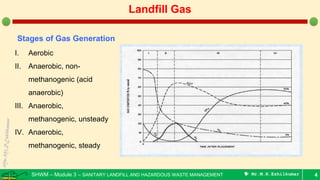
Stages of Gas Generation
I. Aerobic
II. Anaerobic, non-
methanogenic (acid
anaerobic)
III. Anaerobic,
methanogenic, unsteady
IV. Anaerobic,
methanogenic, steady
SHWM – Module 3 – SANITARY LANDFILL AND HAZARDOUS WASTE MANAGEMENT  Mr.M.R.Ezhilkumar 5
Landfill Gas
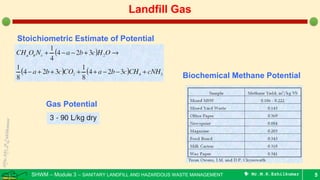
Stoichiometric Estimate of Potential
Gas Potential
Biochemical Methane Potential
SHWM – Module 3 – SANITARY LANDFILL AND HAZARDOUS WASTE MANAGEMENT  Mr.M.R.Ezhilkumar 6
Landfill Gas
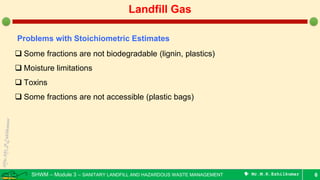
Problems with Stoichiometric Estimates
 Some fractions are not biodegradable (lignin, plastics)
 Moisture limitations
 Toxins
 Some fractions are not accessible (plastic bags)
SHWM – Module 3 – SANITARY LANDFILL AND HAZARDOUS WASTE MANAGEMENT  Mr.M.R.Ezhilkumar 7
Landfill Gas
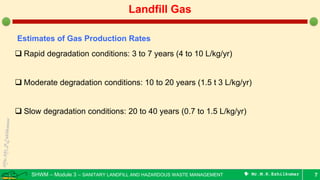
Estimates of Gas Production Rates
 Rapid degradation conditions: 3 to 7 years (4 to 10 L/kg/yr)
 Moderate degradation conditions: 10 to 20 years (1.5 t 3 L/kg/yr)
 Slow degradation conditions: 20 to 40 years (0.7 to 1.5 L/kg/yr)
SHWM – Module 3 – SANITARY LANDFILL AND HAZARDOUS WASTE MANAGEMENT  Mr.M.R.Ezhilkumar 8
Landfill Gas
Gas Enhancement Techniques
 Moisture Content
 Shredding
 Leachate Recycle
 Inoculum Addition
 Buffer
 Nutrient Addition
 Temperature
SHWM – Module 3 – SANITARY LANDFILL AND HAZARDOUS WASTE MANAGEMENT  Mr.M.R.Ezhilkumar 9
Landfill Gas
Gas Composition - Major Gases
 Methane (45 - 60 % by volume)
 Carbon Dioxide (40 - 60 % by volume)
 Nitrogen (2 - 5 % by volume)
 Oxygen (0.1 - 1.0 % by volume)
 Ammonia (0.1 - 1.0 % by volume)
 Hydrogen (0 - 0.2% by volume)
SHWM – Module 3 – SANITARY LANDFILL AND HAZARDOUS WASTE MANAGEMENT  Mr.M.R.Ezhilkumar 10
Landfill Gas
Gas Composition - Trace Gases (less than 0.6 % by volume)
 Odor causing compounds
 Aromatic hydrocarbons
 Chlorinated solvents
 Aliphatic hydrocarbons
 Alcohols
 Polyaromatic hydrocarbons
SHWM – Module 3 – SANITARY LANDFILL AND HAZARDOUS WASTE MANAGEMENT  Mr.M.R.Ezhilkumar 11
Landfill Gas
Why Bother with Landfill Gas?
 Odor
 Toxics
 Greenhouse Gas
 Explosive Gas
 Potential Energy Source
SHWM – Module 3 – SANITARY LANDFILL AND HAZARDOUS WASTE MANAGEMENT  Mr.M.R.Ezhilkumar 12
Landfill Gas
Landfill Gas Management
 • Containment
 – Natural barriers
 High groundwater table
 Streams/Waterbodies tied to
groundwater
 Impermeable geologic strata
 – Manmade barriers
 Composite liner
 Composite cover
 Cutoff walls
 Negative pressure trenches
 Positive pressure systems
(Brewers Stadium)
SHWM – Module 3 – SANITARY LANDFILL AND HAZARDOUS WASTE MANAGEMENT  Mr.M.R.Ezhilkumar 13
Landfill Gas
Landfill Gas Management
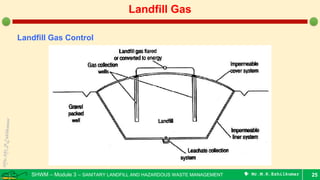
 Landfill Gas Collection Systems
 – Components
• Gas extraction wells or
trenches
• Gas extraction well heads
• Gas header pipes
• Condensate management
• Drip legs
• Condensate knockouts
• Control valves
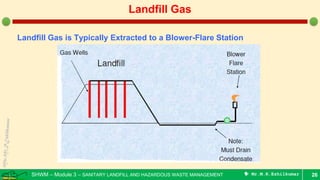
• Blower station
• Flare (open or closed)
SHWM – Module 3 – SANITARY LANDFILL AND HAZARDOUS WASTE MANAGEMENT  Mr.M.R.Ezhilkumar 14
Landfill Gas
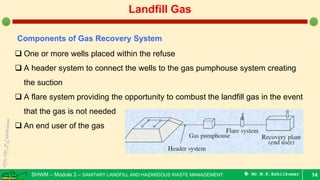
Components of Gas Recovery System
 One or more wells placed within the refuse
 A header system to connect the wells to the gas pumphouse system creating
the suction
 A flare system providing the opportunity to combust the landfill gas in the event
that the gas is not needed
 An end user of the gas
SHWM – Module 3 – SANITARY LANDFILL AND HAZARDOUS WASTE MANAGEMENT  Mr.M.R.Ezhilkumar 15
Landfill Gas
Landfill Gas Management
 Landfill Gas Collection Systems (continued)
 – Objective of system
• Migration control
• Regulatory compliance
• Energy recovery “$”
• Listen to clients needs
• Always consider health and safety
SHWM – Module 3 – SANITARY LANDFILL AND HAZARDOUS WASTE MANAGEMENT  Mr.M.R.Ezhilkumar 16
Landfill Gas
Landfill Gas Management
 Landfill Gas Collection System Design Steps
 – Consider objectives
 – Define limits of landfill
• Horizontally and vertically
 – Gas extraction wells or trenches
 – Layout gas wells
• Shallow wells - small ROI; • Deep wells - large ROI
• Typically 150’ ROI (per NR 500); • Liquid levels in landfill
SHWM – Module 3 – SANITARY LANDFILL AND HAZARDOUS WASTE MANAGEMENT  Mr.M.R.Ezhilkumar 17
Landfill Gas
Landfill Gas Management
 Landfill Gas Collection System Design Steps (continued)
– Locate gas header pipe
– Establish condensate management
– Adjust gas wells, if needed
– Prepare a well schedule (example)
• 0.5 to 1.5 cfm/slotted foot of pipe
– Determine gas generation and flow
SHWM – Module 3 – SANITARY LANDFILL AND HAZARDOUS WASTE MANAGEMENT  Mr.M.R.Ezhilkumar 18
Landfill Gas
Landfill Gas Management
 Landfill Gas Collection System Design Steps (continued)
– Header and blower sizing calculations
• Calculate by hand
• Spreadsheet
• Computer model KY GAS (Hardy cross method)
– Condensate calculations
– Select blower flare system
SHWM – Module 3 – SANITARY LANDFILL AND HAZARDOUS WASTE MANAGEMENT  Mr.M.R.Ezhilkumar 19
Landfill Gas
Landfill Gas Management
 Rules of Thumb for Header Design
• A velocity of 50 feet per second is the maximum allowed during concurrent
flow conditions
• A velocity of 30 feet per second is the maximum allowed during
countercurrent flow conditions
• A velocity of 30 feet per second is the maximum allowed within condensate
management structures
• A pressure drop of 1 inch water column per 100 feet of header is the
maximum allowed under any flow conditions
SHWM – Module 3 – SANITARY LANDFILL AND HAZARDOUS WASTE MANAGEMENT  Mr.M.R.Ezhilkumar 20
Landfill Gas
Landfill Gas Management
 Rules of Thumb for Header Design (continued)
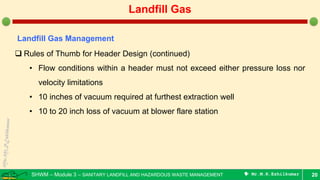
• Flow conditions within a header must not exceed either pressure loss nor
velocity limitations
• 10 inches of vacuum required at furthest extraction well
• 10 to 20 inch loss of vacuum at blower flare station
SHWM – Module 3 – SANITARY LANDFILL AND HAZARDOUS WASTE MANAGEMENT  Mr.M.R.Ezhilkumar 21
Landfill Gas
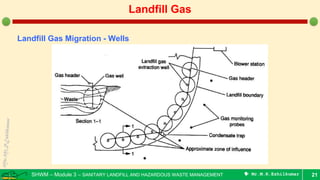
Landfill Gas Migration - Wells
SHWM – Module 3 – SANITARY LANDFILL AND HAZARDOUS WASTE MANAGEMENT  Mr.M.R.Ezhilkumar 22
Landfill Gas
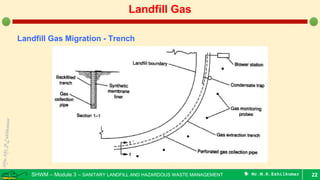
Landfill Gas Migration - Trench
SHWM – Module 3 – SANITARY LANDFILL AND HAZARDOUS WASTE MANAGEMENT  Mr.M.R.Ezhilkumar 23
Landfill Gas
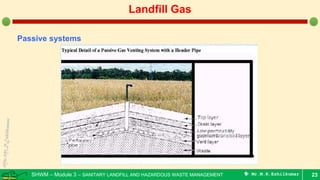
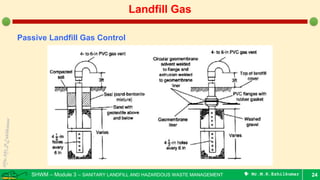
Passive systems
SHWM – Module 3 – SANITARY LANDFILL AND HAZARDOUS WASTE MANAGEMENT  Mr.M.R.Ezhilkumar 24
Landfill Gas
Passive Landfill Gas Control
SHWM – Module 3 – SANITARY LANDFILL AND HAZARDOUS WASTE MANAGEMENT  Mr.M.R.Ezhilkumar 25
Landfill Gas
Landfill Gas Control
SHWM – Module 3 – SANITARY LANDFILL AND HAZARDOUS WASTE MANAGEMENT  Mr.M.R.Ezhilkumar 26
Landfill Gas
Landfill Gas is Typically Extracted to a Blower-Flare Station
SHWM – Module 3 – SANITARY LANDFILL AND HAZARDOUS WASTE MANAGEMENT  Mr.M.R.Ezhilkumar 27
Landfill Gas
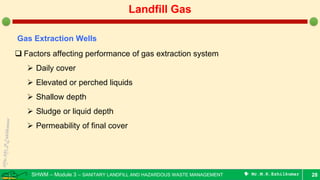
Gas Extraction Wells
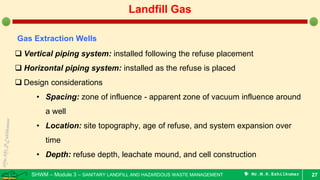
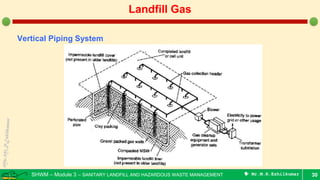
 Vertical piping system: installed following the refuse placement
 Horizontal piping system: installed as the refuse is placed
 Design considerations
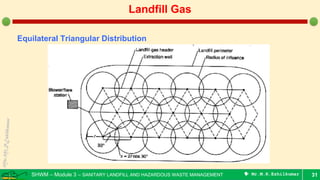
• Spacing: zone of influence - apparent zone of vacuum influence around
a well
• Location: site topography, age of refuse, and system expansion over
time
• Depth: refuse depth, leachate mound, and cell construction
SHWM – Module 3 – SANITARY LANDFILL AND HAZARDOUS WASTE MANAGEMENT  Mr.M.R.Ezhilkumar 28
Landfill Gas
Gas Extraction Wells
 Factors affecting performance of gas extraction system
 Daily cover
 Elevated or perched liquids
 Shallow depth
 Sludge or liquid depth
 Permeability of final cover
SHWM – Module 3 – SANITARY LANDFILL AND HAZARDOUS WASTE MANAGEMENT  Mr.M.R.Ezhilkumar 29
Landfill Gas
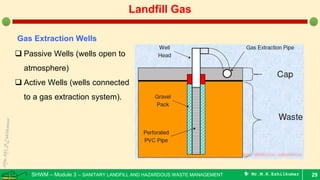
Gas Extraction Wells
 Passive Wells (wells open to
atmosphere)
 Active Wells (wells connected
to a gas extraction system).
SHWM – Module 3 – SANITARY LANDFILL AND HAZARDOUS WASTE MANAGEMENT  Mr.M.R.Ezhilkumar 30
Landfill Gas
Vertical Piping System
SHWM – Module 3 – SANITARY LANDFILL AND HAZARDOUS WASTE MANAGEMENT  Mr.M.R.Ezhilkumar 31
Landfill Gas
Equilateral Triangular Distribution
SHWM – Module 3 – SANITARY LANDFILL AND HAZARDOUS WASTE MANAGEMENT  Mr.M.R.Ezhilkumar 32
Landfill Gas
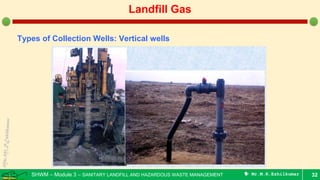
Types of Collection Wells: Vertical wells
SHWM – Module 3 – SANITARY LANDFILL AND HAZARDOUS WASTE MANAGEMENT  Mr.M.R.Ezhilkumar 33
Landfill Gas
Condensate collection and Pump Station
 Landfill gas condensate – as gas cools while it is transported through the gas
collection system a liquid is formed (cutting of vacuum to the wells), separated
from gas flow and collected in the low spots of the system
 Pumping station reservoir – condensate forced to drain into it from low spots
SHWM – Module 3 – SANITARY LANDFILL AND HAZARDOUS WASTE MANAGEMENT  Mr.M.R.Ezhilkumar 34
Landfill Gas
Gas Treatment Methods
 Gas flaring – controlled combustion unit, reduces odors and more
environmentally sound than passive venting, enclose flares more efficient than
open flares
 Gas processing and energy recovery – gas processed by removing water,
carbon dioxide, and other impurities
SHWM – Module 3 – SANITARY LANDFILL AND HAZARDOUS WASTE MANAGEMENT  Mr.M.R.Ezhilkumar 35
Landfill Gas
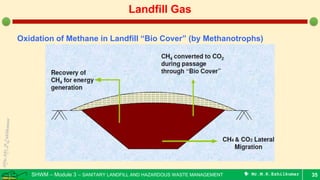
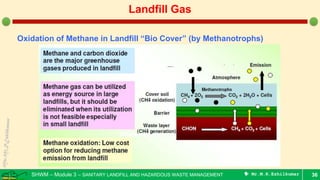
Oxidation of Methane in Landfill “Bio Cover” (by Methanotrophs)
SHWM – Module 3 – SANITARY LANDFILL AND HAZARDOUS WASTE MANAGEMENT  Mr.M.R.Ezhilkumar 36
Landfill Gas
Oxidation of Methane in Landfill “Bio Cover” (by Methanotrophs)
SHWM – Module 3 – SANITARY LANDFILL AND HAZARDOUS WASTE MANAGEMENT  Mr.M.R.Ezhilkumar 37
Landfill Gas
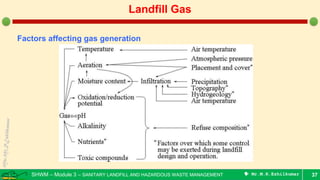
Factors affecting gas generation
SHWM – Module 3 – SANITARY LANDFILL AND HAZARDOUS WASTE MANAGEMENT  Mr.M.R.Ezhilkumar 38
Landfill Gas
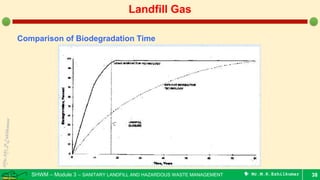
Comparison of Biodegradation Time
SHWM – Module 3 – SANITARY LANDFILL AND HAZARDOUS WASTE MANAGEMENT  Mr.M.R.Ezhilkumar 39
Assessment Time
Review
Question
Recommend a suitable landfill gas management
SHWM – Module 3 – SANITARY LANDFILL AND HAZARDOUS WASTE MANAGEMENT  Mr.M.R.Ezhilkumar 40

Landfill gas management

  • 1.
    Prof. M.R.Ezhilkumar Assistant Professor Departmentof Civil Engineering Sri Krishna College of Engineering and Technology Coimbatore ezhilkumar@skcet.ac.in I only feel angry when I see waste. When I see people throwing away things we could use. – Mother Teresa 1 17CE413 SOLID AND HAZARDOUS WASTE MANAGEMENT 3.3 – Landfill gas management
  • 2.
    SHWM – Module3 – SANITARY LANDFILL AND HAZARDOUS WASTE MANAGEMENT  Mr.M.R.Ezhilkumar 2 Learning Outcomes ☼ Landfill gas ☼ Generation ☼ Movement ☼ Control 3.3 – Landfill gas management
  • 3.
    SHWM – Module3 – SANITARY LANDFILL AND HAZARDOUS WASTE MANAGEMENT  Mr.M.R.Ezhilkumar 3 Video Session
  • 4.
    SHWM – Module3 – SANITARY LANDFILL AND HAZARDOUS WASTE MANAGEMENT  Mr.M.R.Ezhilkumar 4 Landfill Gas Stages of Gas Generation I. Aerobic II. Anaerobic, non- methanogenic (acid anaerobic) III. Anaerobic, methanogenic, unsteady IV. Anaerobic, methanogenic, steady
  • 5.
    SHWM – Module3 – SANITARY LANDFILL AND HAZARDOUS WASTE MANAGEMENT  Mr.M.R.Ezhilkumar 5 Landfill Gas Stoichiometric Estimate of Potential Gas Potential Biochemical Methane Potential
  • 6.
    SHWM – Module3 – SANITARY LANDFILL AND HAZARDOUS WASTE MANAGEMENT  Mr.M.R.Ezhilkumar 6 Landfill Gas Problems with Stoichiometric Estimates  Some fractions are not biodegradable (lignin, plastics)  Moisture limitations  Toxins  Some fractions are not accessible (plastic bags)
  • 7.
    SHWM – Module3 – SANITARY LANDFILL AND HAZARDOUS WASTE MANAGEMENT  Mr.M.R.Ezhilkumar 7 Landfill Gas Estimates of Gas Production Rates  Rapid degradation conditions: 3 to 7 years (4 to 10 L/kg/yr)  Moderate degradation conditions: 10 to 20 years (1.5 t 3 L/kg/yr)  Slow degradation conditions: 20 to 40 years (0.7 to 1.5 L/kg/yr)
  • 8.
    SHWM – Module3 – SANITARY LANDFILL AND HAZARDOUS WASTE MANAGEMENT  Mr.M.R.Ezhilkumar 8 Landfill Gas Gas Enhancement Techniques  Moisture Content  Shredding  Leachate Recycle  Inoculum Addition  Buffer  Nutrient Addition  Temperature
  • 9.
    SHWM – Module3 – SANITARY LANDFILL AND HAZARDOUS WASTE MANAGEMENT  Mr.M.R.Ezhilkumar 9 Landfill Gas Gas Composition - Major Gases  Methane (45 - 60 % by volume)  Carbon Dioxide (40 - 60 % by volume)  Nitrogen (2 - 5 % by volume)  Oxygen (0.1 - 1.0 % by volume)  Ammonia (0.1 - 1.0 % by volume)  Hydrogen (0 - 0.2% by volume)
  • 10.
    SHWM – Module3 – SANITARY LANDFILL AND HAZARDOUS WASTE MANAGEMENT  Mr.M.R.Ezhilkumar 10 Landfill Gas Gas Composition - Trace Gases (less than 0.6 % by volume)  Odor causing compounds  Aromatic hydrocarbons  Chlorinated solvents  Aliphatic hydrocarbons  Alcohols  Polyaromatic hydrocarbons
  • 11.
    SHWM – Module3 – SANITARY LANDFILL AND HAZARDOUS WASTE MANAGEMENT  Mr.M.R.Ezhilkumar 11 Landfill Gas Why Bother with Landfill Gas?  Odor  Toxics  Greenhouse Gas  Explosive Gas  Potential Energy Source
  • 12.
    SHWM – Module3 – SANITARY LANDFILL AND HAZARDOUS WASTE MANAGEMENT  Mr.M.R.Ezhilkumar 12 Landfill Gas Landfill Gas Management  • Containment  – Natural barriers  High groundwater table  Streams/Waterbodies tied to groundwater  Impermeable geologic strata  – Manmade barriers  Composite liner  Composite cover  Cutoff walls  Negative pressure trenches  Positive pressure systems (Brewers Stadium)
  • 13.
    SHWM – Module3 – SANITARY LANDFILL AND HAZARDOUS WASTE MANAGEMENT  Mr.M.R.Ezhilkumar 13 Landfill Gas Landfill Gas Management  Landfill Gas Collection Systems  – Components • Gas extraction wells or trenches • Gas extraction well heads • Gas header pipes • Condensate management • Drip legs • Condensate knockouts • Control valves • Blower station • Flare (open or closed)
  • 14.
    SHWM – Module3 – SANITARY LANDFILL AND HAZARDOUS WASTE MANAGEMENT  Mr.M.R.Ezhilkumar 14 Landfill Gas Components of Gas Recovery System  One or more wells placed within the refuse  A header system to connect the wells to the gas pumphouse system creating the suction  A flare system providing the opportunity to combust the landfill gas in the event that the gas is not needed  An end user of the gas
  • 15.
    SHWM – Module3 – SANITARY LANDFILL AND HAZARDOUS WASTE MANAGEMENT  Mr.M.R.Ezhilkumar 15 Landfill Gas Landfill Gas Management  Landfill Gas Collection Systems (continued)  – Objective of system • Migration control • Regulatory compliance • Energy recovery “$” • Listen to clients needs • Always consider health and safety
  • 16.
    SHWM – Module3 – SANITARY LANDFILL AND HAZARDOUS WASTE MANAGEMENT  Mr.M.R.Ezhilkumar 16 Landfill Gas Landfill Gas Management  Landfill Gas Collection System Design Steps  – Consider objectives  – Define limits of landfill • Horizontally and vertically  – Gas extraction wells or trenches  – Layout gas wells • Shallow wells - small ROI; • Deep wells - large ROI • Typically 150’ ROI (per NR 500); • Liquid levels in landfill
  • 17.
    SHWM – Module3 – SANITARY LANDFILL AND HAZARDOUS WASTE MANAGEMENT  Mr.M.R.Ezhilkumar 17 Landfill Gas Landfill Gas Management  Landfill Gas Collection System Design Steps (continued) – Locate gas header pipe – Establish condensate management – Adjust gas wells, if needed – Prepare a well schedule (example) • 0.5 to 1.5 cfm/slotted foot of pipe – Determine gas generation and flow
  • 18.
    SHWM – Module3 – SANITARY LANDFILL AND HAZARDOUS WASTE MANAGEMENT  Mr.M.R.Ezhilkumar 18 Landfill Gas Landfill Gas Management  Landfill Gas Collection System Design Steps (continued) – Header and blower sizing calculations • Calculate by hand • Spreadsheet • Computer model KY GAS (Hardy cross method) – Condensate calculations – Select blower flare system
  • 19.
    SHWM – Module3 – SANITARY LANDFILL AND HAZARDOUS WASTE MANAGEMENT  Mr.M.R.Ezhilkumar 19 Landfill Gas Landfill Gas Management  Rules of Thumb for Header Design • A velocity of 50 feet per second is the maximum allowed during concurrent flow conditions • A velocity of 30 feet per second is the maximum allowed during countercurrent flow conditions • A velocity of 30 feet per second is the maximum allowed within condensate management structures • A pressure drop of 1 inch water column per 100 feet of header is the maximum allowed under any flow conditions
  • 20.
    SHWM – Module3 – SANITARY LANDFILL AND HAZARDOUS WASTE MANAGEMENT  Mr.M.R.Ezhilkumar 20 Landfill Gas Landfill Gas Management  Rules of Thumb for Header Design (continued) • Flow conditions within a header must not exceed either pressure loss nor velocity limitations • 10 inches of vacuum required at furthest extraction well • 10 to 20 inch loss of vacuum at blower flare station
  • 21.
    SHWM – Module3 – SANITARY LANDFILL AND HAZARDOUS WASTE MANAGEMENT  Mr.M.R.Ezhilkumar 21 Landfill Gas Landfill Gas Migration - Wells
  • 22.
    SHWM – Module3 – SANITARY LANDFILL AND HAZARDOUS WASTE MANAGEMENT  Mr.M.R.Ezhilkumar 22 Landfill Gas Landfill Gas Migration - Trench
  • 23.
    SHWM – Module3 – SANITARY LANDFILL AND HAZARDOUS WASTE MANAGEMENT  Mr.M.R.Ezhilkumar 23 Landfill Gas Passive systems
  • 24.
    SHWM – Module3 – SANITARY LANDFILL AND HAZARDOUS WASTE MANAGEMENT  Mr.M.R.Ezhilkumar 24 Landfill Gas Passive Landfill Gas Control
  • 25.
    SHWM – Module3 – SANITARY LANDFILL AND HAZARDOUS WASTE MANAGEMENT  Mr.M.R.Ezhilkumar 25 Landfill Gas Landfill Gas Control
  • 26.
    SHWM – Module3 – SANITARY LANDFILL AND HAZARDOUS WASTE MANAGEMENT  Mr.M.R.Ezhilkumar 26 Landfill Gas Landfill Gas is Typically Extracted to a Blower-Flare Station
  • 27.
    SHWM – Module3 – SANITARY LANDFILL AND HAZARDOUS WASTE MANAGEMENT  Mr.M.R.Ezhilkumar 27 Landfill Gas Gas Extraction Wells  Vertical piping system: installed following the refuse placement  Horizontal piping system: installed as the refuse is placed  Design considerations • Spacing: zone of influence - apparent zone of vacuum influence around a well • Location: site topography, age of refuse, and system expansion over time • Depth: refuse depth, leachate mound, and cell construction
  • 28.
    SHWM – Module3 – SANITARY LANDFILL AND HAZARDOUS WASTE MANAGEMENT  Mr.M.R.Ezhilkumar 28 Landfill Gas Gas Extraction Wells  Factors affecting performance of gas extraction system  Daily cover  Elevated or perched liquids  Shallow depth  Sludge or liquid depth  Permeability of final cover
  • 29.
    SHWM – Module3 – SANITARY LANDFILL AND HAZARDOUS WASTE MANAGEMENT  Mr.M.R.Ezhilkumar 29 Landfill Gas Gas Extraction Wells  Passive Wells (wells open to atmosphere)  Active Wells (wells connected to a gas extraction system).
  • 30.
    SHWM – Module3 – SANITARY LANDFILL AND HAZARDOUS WASTE MANAGEMENT  Mr.M.R.Ezhilkumar 30 Landfill Gas Vertical Piping System
  • 31.
    SHWM – Module3 – SANITARY LANDFILL AND HAZARDOUS WASTE MANAGEMENT  Mr.M.R.Ezhilkumar 31 Landfill Gas Equilateral Triangular Distribution
  • 32.
    SHWM – Module3 – SANITARY LANDFILL AND HAZARDOUS WASTE MANAGEMENT  Mr.M.R.Ezhilkumar 32 Landfill Gas Types of Collection Wells: Vertical wells
  • 33.
    SHWM – Module3 – SANITARY LANDFILL AND HAZARDOUS WASTE MANAGEMENT  Mr.M.R.Ezhilkumar 33 Landfill Gas Condensate collection and Pump Station  Landfill gas condensate – as gas cools while it is transported through the gas collection system a liquid is formed (cutting of vacuum to the wells), separated from gas flow and collected in the low spots of the system  Pumping station reservoir – condensate forced to drain into it from low spots
  • 34.
    SHWM – Module3 – SANITARY LANDFILL AND HAZARDOUS WASTE MANAGEMENT  Mr.M.R.Ezhilkumar 34 Landfill Gas Gas Treatment Methods  Gas flaring – controlled combustion unit, reduces odors and more environmentally sound than passive venting, enclose flares more efficient than open flares  Gas processing and energy recovery – gas processed by removing water, carbon dioxide, and other impurities
  • 35.
    SHWM – Module3 – SANITARY LANDFILL AND HAZARDOUS WASTE MANAGEMENT  Mr.M.R.Ezhilkumar 35 Landfill Gas Oxidation of Methane in Landfill “Bio Cover” (by Methanotrophs)
  • 36.
    SHWM – Module3 – SANITARY LANDFILL AND HAZARDOUS WASTE MANAGEMENT  Mr.M.R.Ezhilkumar 36 Landfill Gas Oxidation of Methane in Landfill “Bio Cover” (by Methanotrophs)
  • 37.
    SHWM – Module3 – SANITARY LANDFILL AND HAZARDOUS WASTE MANAGEMENT  Mr.M.R.Ezhilkumar 37 Landfill Gas Factors affecting gas generation
  • 38.
    SHWM – Module3 – SANITARY LANDFILL AND HAZARDOUS WASTE MANAGEMENT  Mr.M.R.Ezhilkumar 38 Landfill Gas Comparison of Biodegradation Time
  • 39.
    SHWM – Module3 – SANITARY LANDFILL AND HAZARDOUS WASTE MANAGEMENT  Mr.M.R.Ezhilkumar 39 Assessment Time Review Question Recommend a suitable landfill gas management
  • 40.
    SHWM – Module3 – SANITARY LANDFILL AND HAZARDOUS WASTE MANAGEMENT  Mr.M.R.Ezhilkumar 40