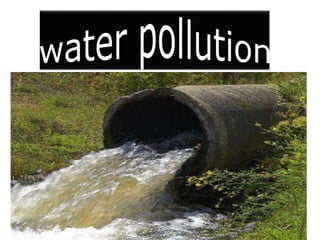
INDUSTRIAL WASTE
SOURCES
• it is caused by emission of
industrial waste [effluent] into
water bodies. It is the main source
–of water pollution
• Industrial waste includes organic
pollutants &toxic chemical. i.e
heavy metals
• Acid & alkalies
• Oils,lubricant,petroleum &grease
• Industrial waste enters from-
• Iron & steel industry
• Food industry
• Mines
• Organic chemical industries –
which includes paints
,dyes,pesticides,detergents,paper
etc.
POLLUTANTS INDUSTRIAL SOURCES IMPACT OF INDUSTRIAL
WASTE
•HEAVY METALS
1. LEAD
2. MERCURY
PAINT
INDUSTRY,SMELTINGCHEMICA
L INDUSTRIES
•LEAD INHIBIT ACTION OF
BODILY ENZYMES
•MERCURY TRANSFORMS
INTO WATER SOLUBLE
METHYLMERCURY BY
BACTERIAL ACTION &THUS
CONTAMINATES FISH
•ACIDS
1. SULPHIRIC ACID
MINE DRAINAGE ACID CAUSES CORROSION OF
METAL & CONCRETE
•ALKALIES TEXTILE &PAPER INDUSTRY ALKALIES IN INDUSTRIAL
WASTE AFFECTS AQUATIC LIFE
•OIL OIL REFINERIES OIL WASTE IS HARMFUL FOR
FISH & MARINE BIRDS
•PETROCHEMICAL PETROLEUM PLANTS PETROCHEMICAL ARE TOXIC
TO MARINE LIFE
THREE TYPES OF POLLUTANTS
• FOOD INDUSTRY
• ORGANIC CHEMICAL
INDUSTRY
• IRON & STEEL INDUSTRY
Food industry
The constituents of food &
agricultural waste water are
often complex to predict
Vegetable washing – generate
waste water with –
increased particulate
matter
Animal processing- generate
waste water with – added
antibiotics,pesticides etc.
Organic chemistry industry
• These industries
manufracture or use ,
complex organic chemicals
which includes pesticides
,paints,detergent,plastics
etc. the organic chemicals
contaminate waste water
with –reactant material, by
products, cleaning agents
etc.
IRON AND STEEL INDUSTRY
• Conservation of iron to
steel , contaminates
waste water with –
hydraulic oils. Treating
iron & steel products
for galvanizing [coating
with zinc] or chromium
plating results in acidic
rinse waters in waste
waters
Causes of water pollution
• Off shore drilling
• Offshore drilling involves
exploring of oil and gas
beneath the ocean floor.
Before drilling an offshore oil-
well, geologist first locate the
wells using magnetic surveys .
This is followed by drilling –
‘exploratory wells’ to find out
if there is a source of oil below
. On discovery of oil or gas a –
‘production well’ is drilled
and an ‘oil ring’ is built to
replace the exploratory
drilling rig.
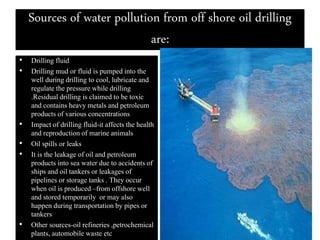
Sources of water pollution from off shore oil drilling
are:
• Drilling fluid
• Drilling mud or fluid is pumped into the
well during drilling to cool, lubricate and
regulate the pressure while drilling
.Residual drilling is claimed to be toxic
and contains heavy metals and petroleum
products of various concentrations
• Impact of drilling fluid-it affects the health
and reproduction of marine animals
• Oil spills or leaks
• It is the leakage of oil and petroleum
products into sea water due to accidents of
ships and oil tankers or leakages of
pipelines or storage tanks . They occur
when oil is produced –from offshore well
and stored temporarily or may also
happen during transportation by pipes or
tankers
• Other sources-oil refineries ,petrochemical
plants, automobile waste etc
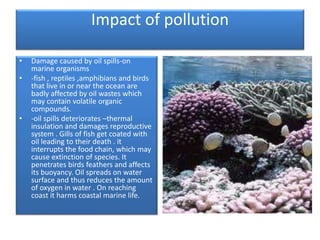
Impact of pollution
• Damage caused by oil spills-on
marine organisms
• -fish , reptiles ,amphibians and birds
that live in or near the ocean are
badly affected by oil wastes which
may contain volatile organic
compounds.
• -oil spills deteriorates –thermal
insulation and damages reproductive
system . Gills of fish get coated with
oil leading to their death . it
interrupts the food chain, which may
cause extinction of species. It
penetrates birds feathers and affects
its buoyancy. Oil spreads on water
surface and thus reduces the amount
of oxygen in water . On reaching
coast it harms coastal marine life.
Control of pollution
• Methods to improve offshore oil
drilling – to reduce water
pollution
• Apply a complete environmental
assessment analysis before oil
drilling
• Use drilling fluids which are
biodegradable and have low
aquatic toxicity .
• Develop better pollution control
measures which include removal
of oil by skimming or filtering
,dispersing oil into smaller
droplets and removing ‘oil
clumps’by using cogulating
agents.
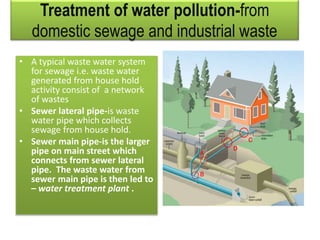
Treatment of water pollution-from
domestic sewage and industrial waste
• A typical waste water system
for sewage i.e. waste water
generated from house hold
activity consist of a network
of wastes
• Sewer lateral pipe-is waste
water pipe which collects
sewage from house hold.
• Sewer main pipe-is the larger
pipe on main street which
connects from sewer lateral
pipe. The waste water from
sewer main pipe is then led to
– water treatment plant .
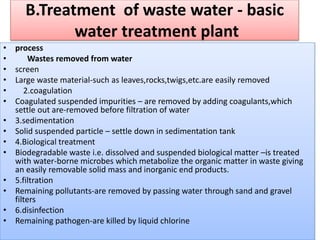
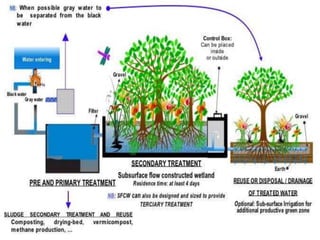
B.Treatment of waste water - basic
water treatment plant
• process
• Wastes removed from water
• screen
• Large waste material-such as leaves,rocks,twigs,etc.are easily removed
• 2.coagulation
• Coagulated suspended impurities – are removed by adding coagulants,which
settle out are-removed before filtration of water
• 3.sedimentation
• Solid suspended particle – settle down in sedimentation tank
• 4.Biological treatment
• Biodegradable waste i.e. dissolved and suspended biological matter –is treated
with water-borne microbes which metabolize the organic matter in waste giving
an easily removable solid mass and inorganic end products.
• 5.filtration
• Remaining pollutants-are removed by passing water through sand and gravel
filters
• 6.disinfection
• Remaining pathogen-are killed by liquid chlorine
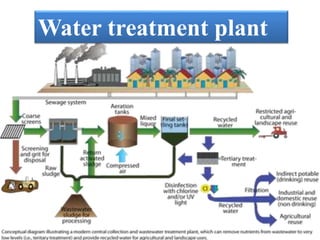
Water treatment plant
MAIN THREE STAGES OF WATER
TREATMENT
• Primary treatment
• Materials removed: organic and inorganic solids
• Method:
• Sedimentation{for suspended solids}
• Skimmimng{for light solids,oil&grease}
• Secondary treatment
• Materials removed: dissolved and suspended biological matter
• Method:
• Biological oxidation of organic matter
• Micro organisms break down chemical matter
• Chlorine kills the Micro organisms
•
• Tertiary treatment
• Materials removed: any remaining chemicals, minerals or organic matter
• Method:
• Physical disinfection
• Uses of chemicals
• Final disinfection:with usage of ozone disinfection &UV treatments
•
Industrial effluent treatment
methods
• Oil and grease: oil water seperator
• Acids and alkallies:neutralization under controlled
conditions
• Organic materials in waste water:distillation
& absorbtion
Bio degradable organics:
i. Activated sludge process(aerobic biochemical
process)
ii. Biological trickling filter process
Industrial waste

Industrial waste

  • 1.
  • 2.
    SOURCES • it iscaused by emission of industrial waste [effluent] into water bodies. It is the main source –of water pollution • Industrial waste includes organic pollutants &toxic chemical. i.e heavy metals • Acid & alkalies • Oils,lubricant,petroleum &grease • Industrial waste enters from- • Iron & steel industry • Food industry • Mines • Organic chemical industries – which includes paints ,dyes,pesticides,detergents,paper etc.
  • 3.
    POLLUTANTS INDUSTRIAL SOURCESIMPACT OF INDUSTRIAL WASTE •HEAVY METALS 1. LEAD 2. MERCURY PAINT INDUSTRY,SMELTINGCHEMICA L INDUSTRIES •LEAD INHIBIT ACTION OF BODILY ENZYMES •MERCURY TRANSFORMS INTO WATER SOLUBLE METHYLMERCURY BY BACTERIAL ACTION &THUS CONTAMINATES FISH •ACIDS 1. SULPHIRIC ACID MINE DRAINAGE ACID CAUSES CORROSION OF METAL & CONCRETE •ALKALIES TEXTILE &PAPER INDUSTRY ALKALIES IN INDUSTRIAL WASTE AFFECTS AQUATIC LIFE •OIL OIL REFINERIES OIL WASTE IS HARMFUL FOR FISH & MARINE BIRDS •PETROCHEMICAL PETROLEUM PLANTS PETROCHEMICAL ARE TOXIC TO MARINE LIFE
  • 4.
    THREE TYPES OFPOLLUTANTS • FOOD INDUSTRY • ORGANIC CHEMICAL INDUSTRY • IRON & STEEL INDUSTRY
  • 5.
    Food industry The constituentsof food & agricultural waste water are often complex to predict Vegetable washing – generate waste water with – increased particulate matter Animal processing- generate waste water with – added antibiotics,pesticides etc. Organic chemistry industry • These industries manufracture or use , complex organic chemicals which includes pesticides ,paints,detergent,plastics etc. the organic chemicals contaminate waste water with –reactant material, by products, cleaning agents etc.
  • 6.
    IRON AND STEELINDUSTRY • Conservation of iron to steel , contaminates waste water with – hydraulic oils. Treating iron & steel products for galvanizing [coating with zinc] or chromium plating results in acidic rinse waters in waste waters
  • 7.
    Causes of waterpollution • Off shore drilling • Offshore drilling involves exploring of oil and gas beneath the ocean floor. Before drilling an offshore oil- well, geologist first locate the wells using magnetic surveys . This is followed by drilling – ‘exploratory wells’ to find out if there is a source of oil below . On discovery of oil or gas a – ‘production well’ is drilled and an ‘oil ring’ is built to replace the exploratory drilling rig.
  • 8.
    Sources of waterpollution from off shore oil drilling are: • Drilling fluid • Drilling mud or fluid is pumped into the well during drilling to cool, lubricate and regulate the pressure while drilling .Residual drilling is claimed to be toxic and contains heavy metals and petroleum products of various concentrations • Impact of drilling fluid-it affects the health and reproduction of marine animals • Oil spills or leaks • It is the leakage of oil and petroleum products into sea water due to accidents of ships and oil tankers or leakages of pipelines or storage tanks . They occur when oil is produced –from offshore well and stored temporarily or may also happen during transportation by pipes or tankers • Other sources-oil refineries ,petrochemical plants, automobile waste etc
  • 9.
    Impact of pollution •Damage caused by oil spills-on marine organisms • -fish , reptiles ,amphibians and birds that live in or near the ocean are badly affected by oil wastes which may contain volatile organic compounds. • -oil spills deteriorates –thermal insulation and damages reproductive system . Gills of fish get coated with oil leading to their death . it interrupts the food chain, which may cause extinction of species. It penetrates birds feathers and affects its buoyancy. Oil spreads on water surface and thus reduces the amount of oxygen in water . On reaching coast it harms coastal marine life.
  • 10.
    Control of pollution •Methods to improve offshore oil drilling – to reduce water pollution • Apply a complete environmental assessment analysis before oil drilling • Use drilling fluids which are biodegradable and have low aquatic toxicity . • Develop better pollution control measures which include removal of oil by skimming or filtering ,dispersing oil into smaller droplets and removing ‘oil clumps’by using cogulating agents.
  • 12.
    Treatment of waterpollution-from domestic sewage and industrial waste • A typical waste water system for sewage i.e. waste water generated from house hold activity consist of a network of wastes • Sewer lateral pipe-is waste water pipe which collects sewage from house hold. • Sewer main pipe-is the larger pipe on main street which connects from sewer lateral pipe. The waste water from sewer main pipe is then led to – water treatment plant .
  • 13.
    B.Treatment of wastewater - basic water treatment plant • process • Wastes removed from water • screen • Large waste material-such as leaves,rocks,twigs,etc.are easily removed • 2.coagulation • Coagulated suspended impurities – are removed by adding coagulants,which settle out are-removed before filtration of water • 3.sedimentation • Solid suspended particle – settle down in sedimentation tank • 4.Biological treatment • Biodegradable waste i.e. dissolved and suspended biological matter –is treated with water-borne microbes which metabolize the organic matter in waste giving an easily removable solid mass and inorganic end products. • 5.filtration • Remaining pollutants-are removed by passing water through sand and gravel filters • 6.disinfection • Remaining pathogen-are killed by liquid chlorine
  • 14.
  • 15.
    MAIN THREE STAGESOF WATER TREATMENT • Primary treatment • Materials removed: organic and inorganic solids • Method: • Sedimentation{for suspended solids} • Skimmimng{for light solids,oil&grease} • Secondary treatment • Materials removed: dissolved and suspended biological matter • Method: • Biological oxidation of organic matter • Micro organisms break down chemical matter • Chlorine kills the Micro organisms • • Tertiary treatment • Materials removed: any remaining chemicals, minerals or organic matter • Method: • Physical disinfection • Uses of chemicals • Final disinfection:with usage of ozone disinfection &UV treatments •
  • 17.
    Industrial effluent treatment methods •Oil and grease: oil water seperator • Acids and alkallies:neutralization under controlled conditions • Organic materials in waste water:distillation & absorbtion Bio degradable organics: i. Activated sludge process(aerobic biochemical process) ii. Biological trickling filter process