KRITI GUPTA
ROLL NO: 118071
•Advantages and benefits
• Saving energy.
• Reducing pollutants.
• Conserve valuable resources.
• Stimulate the development of green technologies.
• Prevent emissions of harmful greenhouse gas emissions.
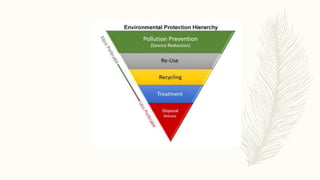
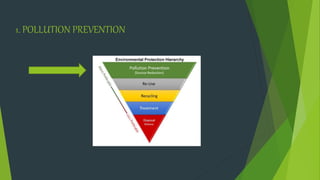
1. POLLUTION PREVENTION
1. Pollution Prevention
 (𝑃2) is any practice that reduces, eliminates, or prevents
pollution at its source, also known as "source reduction.“
 Resource conservation
 Using less energy
Specific pollution prevention approaches
 𝑃2
approaches can be applied to all potential and actual pollution-
generating activities.
 Prevention practices are essential for preserving wetlands, groundwater
sources and other critical ecosystems
 In the energy sector, it can reduce environmental damages from extraction,
processing, transport and combustion of fuels.
𝑷 𝟐
in different fields
In the industrial sector, examples of P2 practices include:
1. Modifying a production process to produce less waste
2. Using non-toxic or less toxic chemicals as cleaners, degreasers and other maintenance
chemicals
3. Implementing water and energy conservation practices
4. Reusing materials such as drums and pallets rather than disposing of them as waste
In the agricultural sector, P2 approaches include:
1. Reducing the use of water and chemical inputs;
2. Adoption of less environmentally harmful pesticides or cultivation of crop strains with
natural resistance to pests;
3. Protection of sensitive areas.
In homes and schools examples of P2 practices include:
1. Purchase a car with good fuel economy
2. Automatically turning off lights when not in use
3. Shift towards grain based diet
4. Buy products with little packaging as possible
2. RE-USE
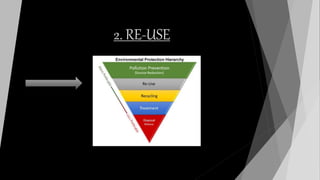
2. RE-USE
– Reuse is another effective Solid waste management strategy, in which the waste
is not allowed to enter into the disposal system.
– Reuse as using a waste product without further transformation and without
changing its shape or original nature.
– This process helps in minimizing the amount of wastes produced as end
product, saves the natural resources and reduces the costs associated with the
production and manufacturing.
Examples of industrial reuse
– A welding plant did not discard its empty wire spools , but returns them to the
suppliers, who reuses them
– Engine parts from vehicle engines refurbished and reused
– An oil refinery refine motor vehicle oil for reuse.
Individual Examples of reuse
 Old jars and pots: Old jars and pots can be used to store items in kitchen.
They can also be used to store loose items together such as computer wires.
 Tyres: Old tyres can either be sent to recycling station or can be used to
make tyre-swing.
 Used wood: Used wood can be used as firewood or can be used woodcrafts.
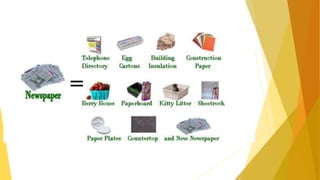
 Newspaper: Old newspapers can be used to pack items when you’re planning
to move to another home or store old items.
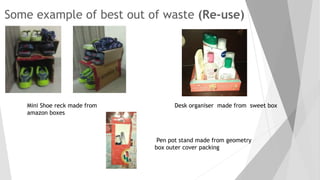
Some example of best out of waste (Re-use)
Mini Shoe reck made from
amazon boxes
Desk organiser made from sweet box
Pen pot stand made from geometry
box outer cover packing
 1. Old books: Your old books can be used by poor children or can be donated to
public libraries.
 2. Old clothes: Your unwanted clothes can be used by street children or can be
donated to charity institutions.
 3. Old electric equipment: Old electric equipment can be donated to schools
or NGO’s so that they can use them.
 4. Rechargeable batteries: Rechargeable batteries can be used again and again
and helps to reduce unnecessary wastage as opposed to regular batteries.
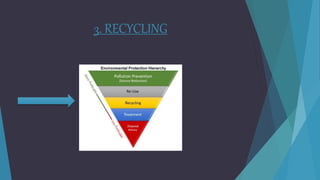
3. RECYCLING
3. RECYCLING
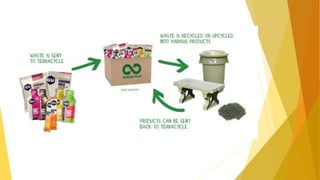
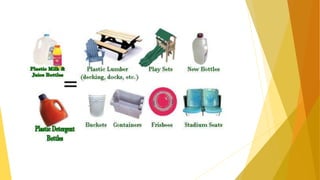
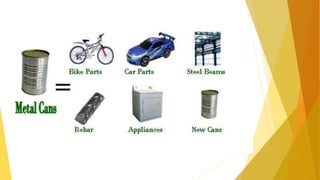
 In the recycling strategy, the waste materials are implemented in the production of
a new product. In this process, the waste materials of various forms are collected
and then processed.
 Landfills are full of items that could be recycled.
 Recycling puts objects through a process that allows them to be used again.
BENEFITS OF Recycle
 • reduces the need for land filling and incineration
 • prevents pollution
 • saves energy
 • decreases emissions of greenhouse gases that contribute to global climate
change
 • conserves natural resources
 • helps sustain the environment for future generations
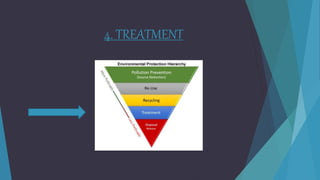
4. TREATMENT
WASTE TREATMENT
When a solid is cant be reused or recycled the third step treatment is used.
Reasons to treat solid waste or a pollutant
1. Reduce its volume
2. Reduce its toxicity
TREATMENT METHODS
 Hazardous waste can be treated by chemical, thermal, biological, and
physical methods.
 CHEMICAL methods include ion exchange, precipitation, oxidation and
reduction, and neutralization
 THERMAL methods is high-temperature incineration,
 BIOLOGICAL treatment of certain organic wastes, such as those from the
petroleum industry, is also an option.
#Bioremediation : “treatment that uses naturally occurring organisms to
break down hazardous substances into less toxic or non toxic substances
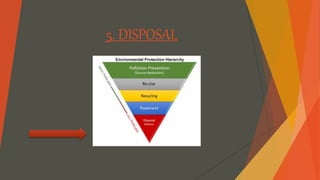
5. DISPOSAL
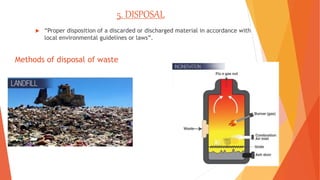
Methods of disposal of waste
 “Proper disposition of a discarded or discharged material in accordance with
local environmental guidelines or laws”.
5. DISPOSAL
Industrial symbiosis
 Association between two or more industrial facilities or companies in which the wastes
or byproducts of one become the raw materials for another.
 The Kalundborg experience shows that cooperation among different industries in the use
of waste increases the viability of the industries. At the same time, the demands from
society for resource conservation and environmental protection are met.
 Four industrial facilities—a power plant, an oil refinery, a plaster-board manufacturing
plant, and a biotechnology production facility—and the local municipality participate in
the Kalundborg symbiosis.
Different components of KALUNDBORG industrial symbiosis
 ASNAES a coal burning
electric power plant
 STATOIL a petroleum refinery.
 NOVONORDISK a
pharmaceutical firm using
microorganism to ferment
food grade material into
usable products.

waste managemnet hierarchial system

  • 1.
  • 3.
    •Advantages and benefits •Saving energy. • Reducing pollutants. • Conserve valuable resources. • Stimulate the development of green technologies. • Prevent emissions of harmful greenhouse gas emissions.
  • 4.
  • 5.
    1. Pollution Prevention (𝑃2) is any practice that reduces, eliminates, or prevents pollution at its source, also known as "source reduction.“  Resource conservation  Using less energy
  • 6.
    Specific pollution preventionapproaches  𝑃2 approaches can be applied to all potential and actual pollution- generating activities.  Prevention practices are essential for preserving wetlands, groundwater sources and other critical ecosystems  In the energy sector, it can reduce environmental damages from extraction, processing, transport and combustion of fuels.
  • 7.
    𝑷 𝟐 in differentfields In the industrial sector, examples of P2 practices include: 1. Modifying a production process to produce less waste 2. Using non-toxic or less toxic chemicals as cleaners, degreasers and other maintenance chemicals 3. Implementing water and energy conservation practices 4. Reusing materials such as drums and pallets rather than disposing of them as waste
  • 8.
    In the agriculturalsector, P2 approaches include: 1. Reducing the use of water and chemical inputs; 2. Adoption of less environmentally harmful pesticides or cultivation of crop strains with natural resistance to pests; 3. Protection of sensitive areas. In homes and schools examples of P2 practices include: 1. Purchase a car with good fuel economy 2. Automatically turning off lights when not in use 3. Shift towards grain based diet 4. Buy products with little packaging as possible
  • 9.
  • 10.
    2. RE-USE – Reuseis another effective Solid waste management strategy, in which the waste is not allowed to enter into the disposal system. – Reuse as using a waste product without further transformation and without changing its shape or original nature. – This process helps in minimizing the amount of wastes produced as end product, saves the natural resources and reduces the costs associated with the production and manufacturing.
  • 11.
    Examples of industrialreuse – A welding plant did not discard its empty wire spools , but returns them to the suppliers, who reuses them – Engine parts from vehicle engines refurbished and reused – An oil refinery refine motor vehicle oil for reuse.
  • 12.
    Individual Examples ofreuse  Old jars and pots: Old jars and pots can be used to store items in kitchen. They can also be used to store loose items together such as computer wires.  Tyres: Old tyres can either be sent to recycling station or can be used to make tyre-swing.  Used wood: Used wood can be used as firewood or can be used woodcrafts.  Newspaper: Old newspapers can be used to pack items when you’re planning to move to another home or store old items.
  • 13.
    Some example ofbest out of waste (Re-use) Mini Shoe reck made from amazon boxes Desk organiser made from sweet box Pen pot stand made from geometry box outer cover packing
  • 14.
     1. Oldbooks: Your old books can be used by poor children or can be donated to public libraries.  2. Old clothes: Your unwanted clothes can be used by street children or can be donated to charity institutions.  3. Old electric equipment: Old electric equipment can be donated to schools or NGO’s so that they can use them.  4. Rechargeable batteries: Rechargeable batteries can be used again and again and helps to reduce unnecessary wastage as opposed to regular batteries.
  • 15.
  • 16.
    3. RECYCLING  Inthe recycling strategy, the waste materials are implemented in the production of a new product. In this process, the waste materials of various forms are collected and then processed.  Landfills are full of items that could be recycled.  Recycling puts objects through a process that allows them to be used again.
  • 17.
    BENEFITS OF Recycle • reduces the need for land filling and incineration  • prevents pollution  • saves energy  • decreases emissions of greenhouse gases that contribute to global climate change  • conserves natural resources  • helps sustain the environment for future generations
  • 22.
  • 23.
    WASTE TREATMENT When asolid is cant be reused or recycled the third step treatment is used. Reasons to treat solid waste or a pollutant 1. Reduce its volume 2. Reduce its toxicity
  • 24.
    TREATMENT METHODS  Hazardouswaste can be treated by chemical, thermal, biological, and physical methods.  CHEMICAL methods include ion exchange, precipitation, oxidation and reduction, and neutralization  THERMAL methods is high-temperature incineration,  BIOLOGICAL treatment of certain organic wastes, such as those from the petroleum industry, is also an option. #Bioremediation : “treatment that uses naturally occurring organisms to break down hazardous substances into less toxic or non toxic substances
  • 25.
  • 26.
    Methods of disposalof waste  “Proper disposition of a discarded or discharged material in accordance with local environmental guidelines or laws”. 5. DISPOSAL
  • 28.
    Industrial symbiosis  Associationbetween two or more industrial facilities or companies in which the wastes or byproducts of one become the raw materials for another.  The Kalundborg experience shows that cooperation among different industries in the use of waste increases the viability of the industries. At the same time, the demands from society for resource conservation and environmental protection are met.  Four industrial facilities—a power plant, an oil refinery, a plaster-board manufacturing plant, and a biotechnology production facility—and the local municipality participate in the Kalundborg symbiosis.
  • 29.
    Different components ofKALUNDBORG industrial symbiosis  ASNAES a coal burning electric power plant  STATOIL a petroleum refinery.  NOVONORDISK a pharmaceutical firm using microorganism to ferment food grade material into usable products.