Shrinking the Waste
Stream
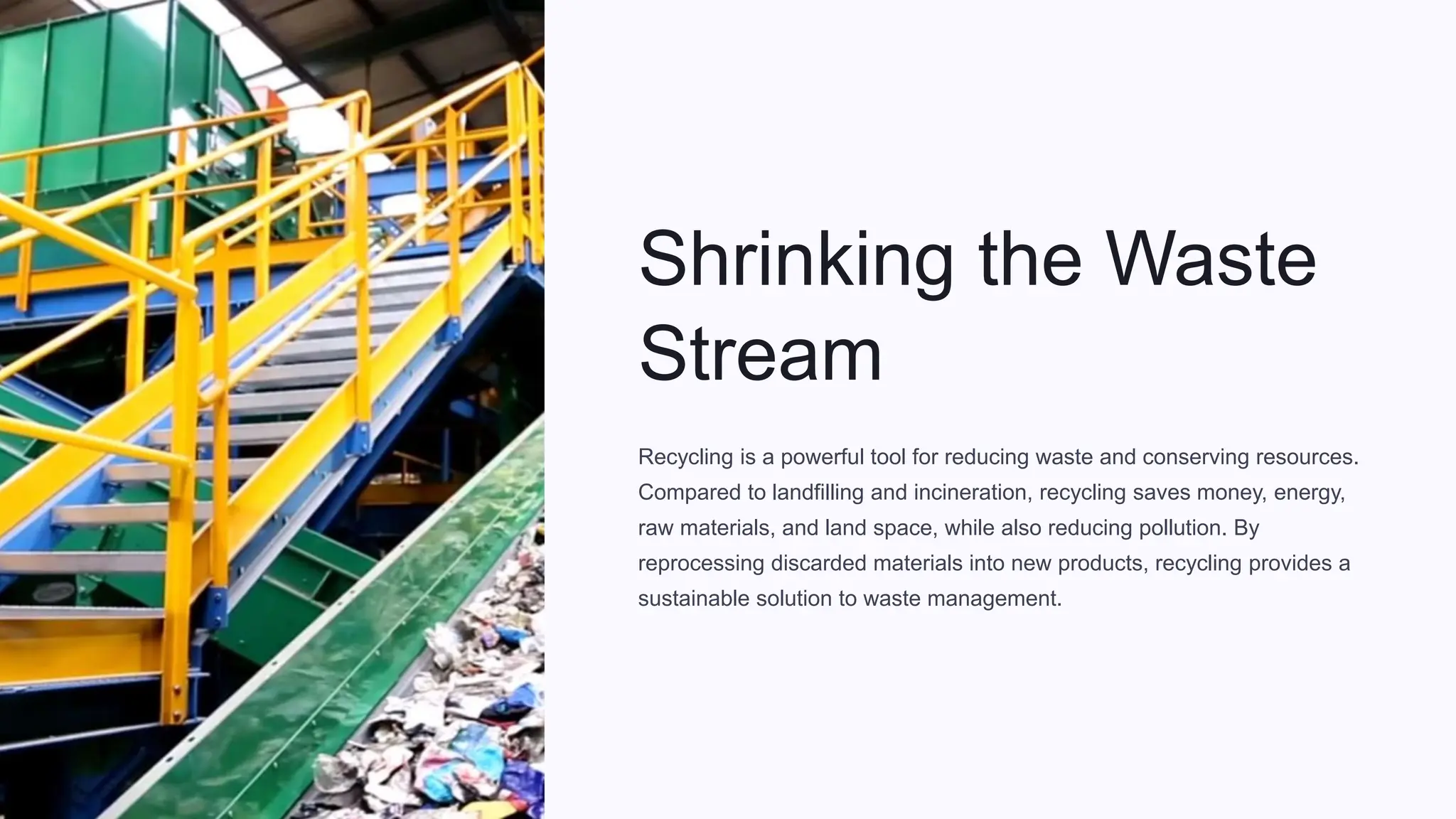
Recycling is a powerful tool for reducing waste and conserving resources.
Compared to landfilling and incineration, recycling saves money, energy,
raw materials, and land space, while also reducing pollution. By
reprocessing discarded materials into new products, recycling provides a
sustainable solution to waste management.
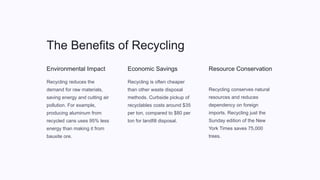
The Benefits of Recycling
Environmental Impact
Recycling reduces the
demand for raw materials,
saving energy and cutting air
pollution. For example,
producing aluminum from
recycled cans uses 95% less
energy than making it from
bauxite ore.
Economic Savings
Recycling is often cheaper
than other waste disposal
methods. Curbside pickup of
recyclables costs around $35
per ton, compared to $80 per
ton for landfill disposal.
Resource Conservation
Recycling conserves natural
resources and reduces
dependency on foreign
imports. Recycling just the
Sunday edition of the New
York Times saves 75,000
trees.
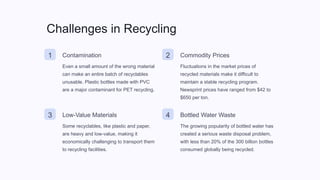
Challenges in Recycling
1 Contamination
Even a small amount of the wrong material
can make an entire batch of recyclables
unusable. Plastic bottles made with PVC
are a major contaminant for PET recycling.
2 Commodity Prices
Fluctuations in the market prices of
recycled materials make it difficult to
maintain a stable recycling program.
Newsprint prices have ranged from $42 to
$650 per ton.
3 Low-Value Materials
Some recyclables, like plastic and paper,
are heavy and low-value, making it
economically challenging to transport them
to recycling facilities.
4 Bottled Water Waste
The growing popularity of bottled water has
created a serious waste disposal problem,
with less than 20% of the 300 billion bottles
consumed globally being recycled.
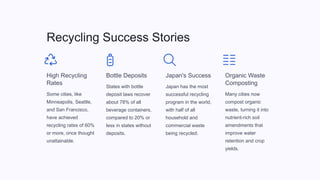
Recycling Success Stories
High Recycling
Rates
Some cities, like
Minneapolis, Seattle,
and San Francisco,
have achieved
recycling rates of 60%
or more, once thought
unattainable.
Bottle Deposits
States with bottle
deposit laws recover
about 78% of all
beverage containers,
compared to 20% or
less in states without
deposits.
Japan's Success
Japan has the most
successful recycling
program in the world,
with half of all
household and
commercial waste
being recycled.
Organic Waste
Composting
Many cities now
compost organic
waste, turning it into
nutrient-rich soil
amendments that
improve water
retention and crop
yields.
Reuse: The Best Option
Reusing Containers
Reusing glass and plastic beverage
containers is far more efficient than producing
new bottles. A reusable glass container
makes an average of 15 round-trips before
needing to be recycled.
Salvaging Materials
Some communities sort and reuse a variety
of materials received in their dumps, such as
stained-glass windows, brass fittings, fine
woodwork, and bricks from old houses.
Scavenging in Developing Countries
In many less-affluent nations, reusing
manufactured goods is an established
tradition, with entire populations making a
living by scavenging, sorting, and
reprocessing waste.
Reducing Waste
Reducing the production of throw-away
products is the most effective way to save
energy, materials, and money. Industries are
finding that reducing waste saves them
millions.
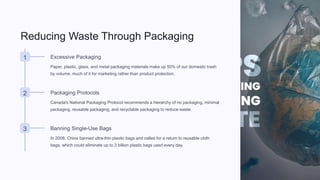
Reducing Waste Through Packaging
1 Excessive Packaging
Paper, plastic, glass, and metal packaging materials make up 50% of our domestic trash
by volume, much of it for marketing rather than product protection.
2 Packaging Protocols
Canada's National Packaging Protocol recommends a hierarchy of no packaging, minimal
packaging, reusable packaging, and recyclable packaging to reduce waste.
3 Banning Single-Use Bags
In 2008, China banned ultra-thin plastic bags and called for a return to reusable cloth
bags, which could eliminate up to 3 billion plastic bags used every day.
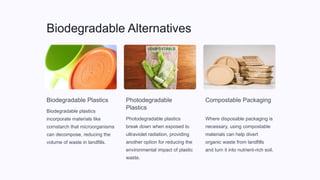
Biodegradable Alternatives
Biodegradable Plastics
Biodegradable plastics
incorporate materials like
cornstarch that microorganisms
can decompose, reducing the
volume of waste in landfills.
Photodegradable
Plastics
Photodegradable plastics
break down when exposed to
ultraviolet radiation, providing
another option for reducing the
environmental impact of plastic
waste.
Compostable Packaging
Where disposable packaging is
necessary, using compostable
materials can help divert
organic waste from landfills
and turn it into nutrient-rich soil.
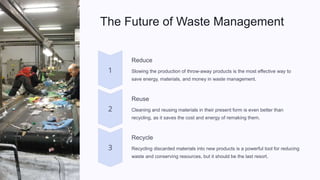
The Future of Waste Management
Reduce
Slowing the production of throw-away products is the most effective way to
save energy, materials, and money in waste management.
Reuse
Cleaning and reusing materials in their present form is even better than
recycling, as it saves the cost and energy of remaking them.
Recycle
Recycling discarded materials into new products is a powerful tool for reducing
waste and conserving resources, but it should be the last resort.
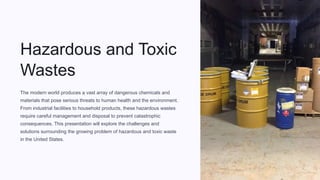
Hazardous and Toxic
Wastes
The modern world produces a vast array of dangerous chemicals and
materials that pose serious threats to human health and the environment.
From industrial facilities to household products, these hazardous wastes
require careful management and disposal to prevent catastrophic
consequences. This presentation will explore the challenges and
solutions surrounding the growing problem of hazardous and toxic waste
in the United States.
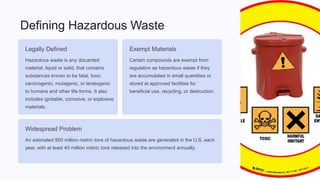
Defining Hazardous Waste
Legally Defined
Hazardous waste is any discarded
material, liquid or solid, that contains
substances known to be fatal, toxic,
carcinogenic, mutagenic, or teratogenic
to humans and other life-forms. It also
includes ignitable, corrosive, or explosive
materials.
Exempt Materials
Certain compounds are exempt from
regulation as hazardous waste if they
are accumulated in small quantities or
stored at approved facilities for
beneficial use, recycling, or destruction.
Widespread Problem
An estimated 900 million metric tons of hazardous waste are generated in the U.S. each
year, with at least 40 million metric tons released into the environment annually.
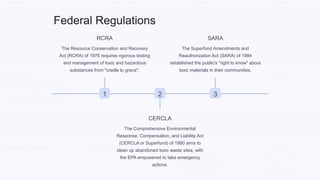
Federal Regulations
1
RCRA
The Resource Conservation and Recovery
Act (RCRA) of 1976 requires rigorous testing
and management of toxic and hazardous
substances from "cradle to grave".
2
CERCLA
The Comprehensive Environmental
Response, Compensation, and Liability Act
(CERCLA or Superfund) of 1980 aims to
clean up abandoned toxic waste sites, with
the EPA empowered to take emergency
actions.
3
SARA
The Superfund Amendments and
Reauthorization Act (SARA) of 1984
established the public's "right to know" about
toxic materials in their communities.
Superfund Sites
Scope of the Problem
The EPA estimates there are
at least 36,000 seriously
contaminated sites in the
U.S., with the GAO placing
the number much higher at
over 400,000. Originally,
1,671 sites were placed on
the National Priority List for
Superfund cleanup.
Funding Challenges
The Superfund was originally
financed by taxes on
hazardous waste producers,
but this "polluter pays" model
was allowed to expire in
1995. Since then, public tax
dollars have covered the
entire cost of the greatly
reduced program.
Cleanup Efforts
By 2004, over 1,000 of the
original NPL sites had been
cleaned up or contained.
However, total cleanup costs
are estimated between $370
billion and $1.7 trillion,
depending on the methods
used.
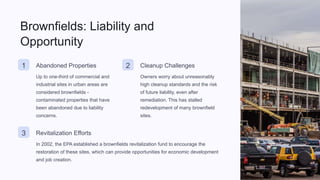
Brownfields: Liability and
Opportunity
1 Abandoned Properties
Up to one-third of commercial and
industrial sites in urban areas are
considered brownfields -
contaminated properties that have
been abandoned due to liability
concerns.
2 Cleanup Challenges
Owners worry about unreasonably
high cleanup standards and the risk
of future liability, even after
remediation. This has stalled
redevelopment of many brownfield
sites.
3 Revitalization Efforts
In 2002, the EPA established a brownfields revitalization fund to encourage the
restoration of these sites, which can provide opportunities for economic development
and job creation.
Reducing Hazardous Waste
Process
Modifications
Manufacturing
processes can be
redesigned to reduce
or eliminate waste
production, often
saving money through
decreased energy
and raw material use.
Recycling and
Reuse
Recycling and finding
beneficial uses for
industrial waste
products can
significantly reduce
the amount of
hazardous materials
entering the waste
stream.
Detoxification
Various physical,
chemical, and
biological processes
can be used to
convert hazardous
materials into less
toxic or non-
hazardous forms.
Secure Storage
For materials that
cannot be destroyed
or made non-
hazardous, secure,
monitored storage in
facilities like salt
mines or engineered
landfills is a
necessary solution.
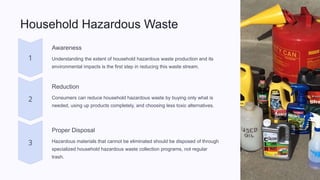
Household Hazardous Waste
Awareness
Understanding the extent of household hazardous waste production and its
environmental impacts is the first step in reducing this waste stream.
Reduction
Consumers can reduce household hazardous waste by buying only what is
needed, using up products completely, and choosing less toxic alternatives.
Proper Disposal
Hazardous materials that cannot be eliminated should be disposed of through
specialized household hazardous waste collection programs, not regular
trash.
Waste Management Strategies
Reduce
The most effective strategy is
to avoid generating waste in
the first place through
process improvements,
product redesign, and
consumer behavior changes.
Reuse and Recycle
Finding beneficial uses for
waste products, either within
the same industry or through
material exchanges, can
significantly reduce the
amount of hazardous waste.
Disposal
For unavoidable hazardous
waste, secure storage and
disposal methods like high-
temperature incineration or
engineered landfills are
necessary to prevent
environmental contamination.
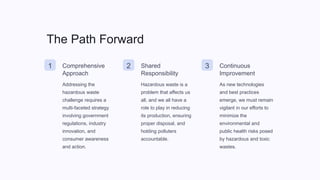
The Path Forward
1 Comprehensive
Approach
Addressing the
hazardous waste
challenge requires a
multi-faceted strategy
involving government
regulations, industry
innovation, and
consumer awareness
and action.
2 Shared
Responsibility
Hazardous waste is a
problem that affects us
all, and we all have a
role to play in reducing
its production, ensuring
proper disposal, and
holding polluters
accountable.
3 Continuous
Improvement
As new technologies
and best practices
emerge, we must remain
vigilant in our efforts to
minimize the
environmental and
public health risks posed
by hazardous and toxic
wastes.
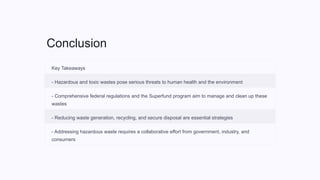
Conclusion
Key Takeaways
- Hazardous and toxic wastes pose serious threats to human health and the environment
- Comprehensive federal regulations and the Superfund program aim to manage and clean up these
wastes
- Reducing waste generation, recycling, and secure disposal are essential strategies
- Addressing hazardous waste requires a collaborative effort from government, industry, and
consumers

THE SOLID AND HAZARDOUS WASTE EFFECTS AND PREVENTION.pptx

  • 1.
    Shrinking the Waste Stream Recyclingis a powerful tool for reducing waste and conserving resources. Compared to landfilling and incineration, recycling saves money, energy, raw materials, and land space, while also reducing pollution. By reprocessing discarded materials into new products, recycling provides a sustainable solution to waste management.
  • 2.
    The Benefits ofRecycling Environmental Impact Recycling reduces the demand for raw materials, saving energy and cutting air pollution. For example, producing aluminum from recycled cans uses 95% less energy than making it from bauxite ore. Economic Savings Recycling is often cheaper than other waste disposal methods. Curbside pickup of recyclables costs around $35 per ton, compared to $80 per ton for landfill disposal. Resource Conservation Recycling conserves natural resources and reduces dependency on foreign imports. Recycling just the Sunday edition of the New York Times saves 75,000 trees.
  • 3.
    Challenges in Recycling 1Contamination Even a small amount of the wrong material can make an entire batch of recyclables unusable. Plastic bottles made with PVC are a major contaminant for PET recycling. 2 Commodity Prices Fluctuations in the market prices of recycled materials make it difficult to maintain a stable recycling program. Newsprint prices have ranged from $42 to $650 per ton. 3 Low-Value Materials Some recyclables, like plastic and paper, are heavy and low-value, making it economically challenging to transport them to recycling facilities. 4 Bottled Water Waste The growing popularity of bottled water has created a serious waste disposal problem, with less than 20% of the 300 billion bottles consumed globally being recycled.
  • 4.
    Recycling Success Stories HighRecycling Rates Some cities, like Minneapolis, Seattle, and San Francisco, have achieved recycling rates of 60% or more, once thought unattainable. Bottle Deposits States with bottle deposit laws recover about 78% of all beverage containers, compared to 20% or less in states without deposits. Japan's Success Japan has the most successful recycling program in the world, with half of all household and commercial waste being recycled. Organic Waste Composting Many cities now compost organic waste, turning it into nutrient-rich soil amendments that improve water retention and crop yields.
  • 5.
    Reuse: The BestOption Reusing Containers Reusing glass and plastic beverage containers is far more efficient than producing new bottles. A reusable glass container makes an average of 15 round-trips before needing to be recycled. Salvaging Materials Some communities sort and reuse a variety of materials received in their dumps, such as stained-glass windows, brass fittings, fine woodwork, and bricks from old houses. Scavenging in Developing Countries In many less-affluent nations, reusing manufactured goods is an established tradition, with entire populations making a living by scavenging, sorting, and reprocessing waste. Reducing Waste Reducing the production of throw-away products is the most effective way to save energy, materials, and money. Industries are finding that reducing waste saves them millions.
  • 6.
    Reducing Waste ThroughPackaging 1 Excessive Packaging Paper, plastic, glass, and metal packaging materials make up 50% of our domestic trash by volume, much of it for marketing rather than product protection. 2 Packaging Protocols Canada's National Packaging Protocol recommends a hierarchy of no packaging, minimal packaging, reusable packaging, and recyclable packaging to reduce waste. 3 Banning Single-Use Bags In 2008, China banned ultra-thin plastic bags and called for a return to reusable cloth bags, which could eliminate up to 3 billion plastic bags used every day.
  • 7.
    Biodegradable Alternatives Biodegradable Plastics Biodegradableplastics incorporate materials like cornstarch that microorganisms can decompose, reducing the volume of waste in landfills. Photodegradable Plastics Photodegradable plastics break down when exposed to ultraviolet radiation, providing another option for reducing the environmental impact of plastic waste. Compostable Packaging Where disposable packaging is necessary, using compostable materials can help divert organic waste from landfills and turn it into nutrient-rich soil.
  • 8.
    The Future ofWaste Management Reduce Slowing the production of throw-away products is the most effective way to save energy, materials, and money in waste management. Reuse Cleaning and reusing materials in their present form is even better than recycling, as it saves the cost and energy of remaking them. Recycle Recycling discarded materials into new products is a powerful tool for reducing waste and conserving resources, but it should be the last resort.
  • 9.
    Hazardous and Toxic Wastes Themodern world produces a vast array of dangerous chemicals and materials that pose serious threats to human health and the environment. From industrial facilities to household products, these hazardous wastes require careful management and disposal to prevent catastrophic consequences. This presentation will explore the challenges and solutions surrounding the growing problem of hazardous and toxic waste in the United States.
  • 10.
    Defining Hazardous Waste LegallyDefined Hazardous waste is any discarded material, liquid or solid, that contains substances known to be fatal, toxic, carcinogenic, mutagenic, or teratogenic to humans and other life-forms. It also includes ignitable, corrosive, or explosive materials. Exempt Materials Certain compounds are exempt from regulation as hazardous waste if they are accumulated in small quantities or stored at approved facilities for beneficial use, recycling, or destruction. Widespread Problem An estimated 900 million metric tons of hazardous waste are generated in the U.S. each year, with at least 40 million metric tons released into the environment annually.
  • 11.
    Federal Regulations 1 RCRA The ResourceConservation and Recovery Act (RCRA) of 1976 requires rigorous testing and management of toxic and hazardous substances from "cradle to grave". 2 CERCLA The Comprehensive Environmental Response, Compensation, and Liability Act (CERCLA or Superfund) of 1980 aims to clean up abandoned toxic waste sites, with the EPA empowered to take emergency actions. 3 SARA The Superfund Amendments and Reauthorization Act (SARA) of 1984 established the public's "right to know" about toxic materials in their communities.
  • 12.
    Superfund Sites Scope ofthe Problem The EPA estimates there are at least 36,000 seriously contaminated sites in the U.S., with the GAO placing the number much higher at over 400,000. Originally, 1,671 sites were placed on the National Priority List for Superfund cleanup. Funding Challenges The Superfund was originally financed by taxes on hazardous waste producers, but this "polluter pays" model was allowed to expire in 1995. Since then, public tax dollars have covered the entire cost of the greatly reduced program. Cleanup Efforts By 2004, over 1,000 of the original NPL sites had been cleaned up or contained. However, total cleanup costs are estimated between $370 billion and $1.7 trillion, depending on the methods used.
  • 13.
    Brownfields: Liability and Opportunity 1Abandoned Properties Up to one-third of commercial and industrial sites in urban areas are considered brownfields - contaminated properties that have been abandoned due to liability concerns. 2 Cleanup Challenges Owners worry about unreasonably high cleanup standards and the risk of future liability, even after remediation. This has stalled redevelopment of many brownfield sites. 3 Revitalization Efforts In 2002, the EPA established a brownfields revitalization fund to encourage the restoration of these sites, which can provide opportunities for economic development and job creation.
  • 14.
    Reducing Hazardous Waste Process Modifications Manufacturing processescan be redesigned to reduce or eliminate waste production, often saving money through decreased energy and raw material use. Recycling and Reuse Recycling and finding beneficial uses for industrial waste products can significantly reduce the amount of hazardous materials entering the waste stream. Detoxification Various physical, chemical, and biological processes can be used to convert hazardous materials into less toxic or non- hazardous forms. Secure Storage For materials that cannot be destroyed or made non- hazardous, secure, monitored storage in facilities like salt mines or engineered landfills is a necessary solution.
  • 15.
    Household Hazardous Waste Awareness Understandingthe extent of household hazardous waste production and its environmental impacts is the first step in reducing this waste stream. Reduction Consumers can reduce household hazardous waste by buying only what is needed, using up products completely, and choosing less toxic alternatives. Proper Disposal Hazardous materials that cannot be eliminated should be disposed of through specialized household hazardous waste collection programs, not regular trash.
  • 16.
    Waste Management Strategies Reduce Themost effective strategy is to avoid generating waste in the first place through process improvements, product redesign, and consumer behavior changes. Reuse and Recycle Finding beneficial uses for waste products, either within the same industry or through material exchanges, can significantly reduce the amount of hazardous waste. Disposal For unavoidable hazardous waste, secure storage and disposal methods like high- temperature incineration or engineered landfills are necessary to prevent environmental contamination.
  • 17.
    The Path Forward 1Comprehensive Approach Addressing the hazardous waste challenge requires a multi-faceted strategy involving government regulations, industry innovation, and consumer awareness and action. 2 Shared Responsibility Hazardous waste is a problem that affects us all, and we all have a role to play in reducing its production, ensuring proper disposal, and holding polluters accountable. 3 Continuous Improvement As new technologies and best practices emerge, we must remain vigilant in our efforts to minimize the environmental and public health risks posed by hazardous and toxic wastes.
  • 18.
    Conclusion Key Takeaways - Hazardousand toxic wastes pose serious threats to human health and the environment - Comprehensive federal regulations and the Superfund program aim to manage and clean up these wastes - Reducing waste generation, recycling, and secure disposal are essential strategies - Addressing hazardous waste requires a collaborative effort from government, industry, and consumers