WASTE
MANAGEMENT
WHAT ARE WASTES?
Waste (also known as rubbish, trash, refuse, garbage, junk, litter, and
ort) is unwanted or useless materials. In biology, waste is any of the
many unwanted substances or toxins that are expelled from living
organisms, metabolic waste; such as urea and sweat.
BaselConventionDefinitionofWastes
“substances or objects which are disposed of or are intended to be
disposed of or are required to be disposed of by the provisions of the
law”
Disposal means
“any operation which may lead to resource recovery, recycling,
reclamation, direct re-use or alternative uses (Annex IVB of the Basel
convention)”
BASEL CONVENTION
 The Basel Convention on the Control of Transboundary Movements
of Hazardous Wastes and Their Disposal, usually known simply as
Basel Convention, is an international treaty that was designed to
reduce the movements of hazardous waste between nations, specially
to prevent transfer of hazardous waste from developed to less
developed countries (LDCs). It does not, however, address the
movement of radioactive waste. The convention is also intended to
minimize the amount and toxicity of wastes generated, to ensure their
environmentally sound management as closely as possible to the
source of generation, and to assist LDCs in environmentally sound
management of the hazardous and other wastes they generate.
 The Convention was opened for signature on 22nd March 1989, and
entered into force on 5 May 1992.
THE DEFINITION…………
 Produced by the United Nations Statistics Division
(U.N.S.D.):
"Wastes are materials that are not prime products (that is
products produced for the market) for which the generator
has no further use in terms of his/her own purposes of
production, transformation or consumption, and of which
he/she wants to dispose. Wastes may be generated during
the extraction of raw materials, the processing of raw
materials into intermediate and final products, the
consumption of final products, and other human activities.
Residuals recycled or reused at the place of generation are
excluded."
KINDS OF WASTES
Solid wastes: wastes in solid forms, domestic, commercial and
industrial wastes
Examples: plastics, styrofoamcontainers,bottles,
cans,papers, scrapiron, and other trash
Liquid Wastes: wastes in liquidform
Examples: domestic washings,chemicals,oils, waste
water from ponds, manufacturingindustries
and other sources
ACCORDINGTO EPA REGULATIONS,SOLID
WASTE IS
 Any garbage or refuse (Municipal Solid Waste)
 Sludge from a wastewater treatment plant, water
supply treatment plant, or air pollution control
facility
 Other discarded material
 Solid, liquid, semi-solid, or contained gaseous
material from industrial, commercial, mining, and
agricultural operations, and from community
activities
http://www.epa.gov/epaoswer/osw/basifact.htm#solidwaste
CLASSIFICATION OFWASTES
ACCORDINGTOTHEIR PROPERTIES
Bio-degradable
can be degraded (paper, wood, fruits and others)
Non-biodegradable
cannot be degraded (plastics, bottles, old machines,cans,
styrofoam containers and others)
CLASSIFICATIONOFWASTESACCORDINGTO
THEIR EFFECTS ON HUMAN HEALTHANDTHE
ENVIRONMENT
Hazardous wastes
 Substances unsafe to use commercially, industrially,
agriculturally, or economically and have any of the following
properties- ignitability, corrosivity, reactivity & toxicity.
Non-hazardous
 Substances safe to use commercially, industrially,
agriculturally, or economically and do not have any of those
properties mentioned above. These substances usually create
disposal problems.
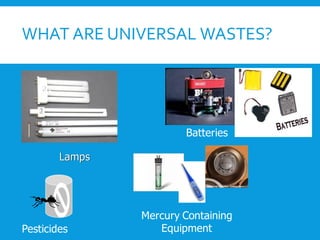
WHAT ARE UNIVERSAL WASTES?
Batteries
Lamps
Mercury Containing
Equipment
Pesticides
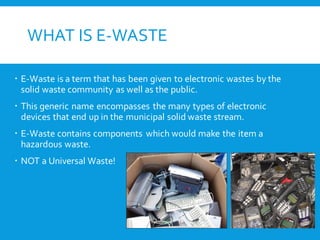
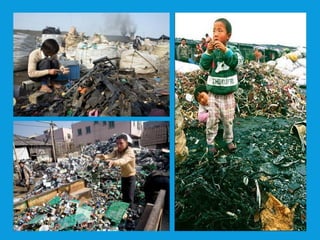
WHAT IS E-WASTE
 E-Waste is a term that has been given to electronic wastes by the
solid waste community as well as the public.
 This generic name encompasses the many types of electronic
devices that end up in the municipal solid waste stream.
 E-Waste contains components which would make the item a
hazardous waste.
 NOT a Universal Waste!
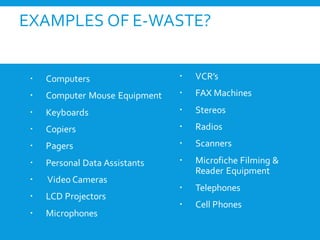
EXAMPLES OF E-WASTE?
 Computers
 Computer Mouse Equipment
 Keyboards
 Copiers
 Pagers
 Personal Data Assistants
 Video Cameras
 LCD Projectors
 Microphones
 VCR’s
 FAX Machines
 Stereos
 Radios
 Scanners
 Microfiche Filming &
Reader Equipment
 Telephones
 Cell Phones
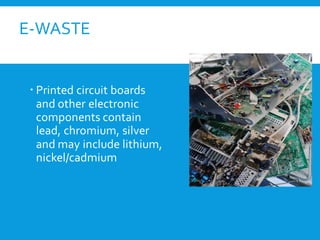
E-WASTE
 Printed circuit boards
and other electronic
components contain
lead, chromium, silver
and may include lithium,
nickel/cadmium
WHAT DO I DO WITH E-WASTE?
 As long as the scrap metal will be recycled,
it is exempt from RCRA hazardous waste requirements per 40 CFR
261.6(a)(3)(ii)
 Speculative accumulation is not allowed!
 If disposed of, a hazardous waste determination must be made
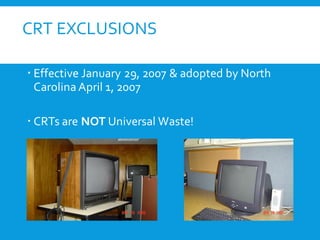
CRT EXCLUSIONS
 Effective January 29, 2007 & adopted by North
Carolina April 1, 2007
 CRTs are NOT Universal Waste!
CRT EXCLUSIONS
40 CFR 261.39
Used intact CRTs are NOT solidwastes unless they are:
Disposedof
Speculatively accumulated (as definedin 261.1(c)(8)) byCRT collectorsor glass processors
Exported for recyclinganddo not meet the requirements of 261.40
Used, brokenCRTs must be stored:
 In a buildingwith roof, floor, and walls
 Placed in container constructed, filled, and closed to minimize releases to the
environmentof CRT glass
 Properlylabeled: “Do not mix…”and
“Used cathode ray tube(s) – contains leaded glass” or “Leaded glass from
televisionsor computers”
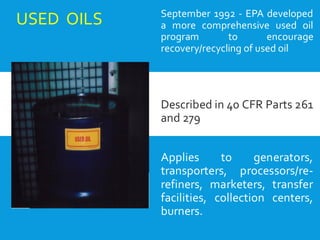
USED OILS September 1992 - EPA developed
a more comprehensive used oil
program to encourage
recovery/recycling of used oil
Described in 40 CFR Parts 261
and 279
Applies to generators,
transporters, processors/re-
refiners, marketers, transfer
facilities, collection centers,
burners.
REQUIREMENTS FOR OTHER
USED OIL HANDLERS
40 CFR 279
Subpart D - Collection
Centers/Aggregation Pts
Subpart E -Transporters/Transfer
Facilities
Subpart F - Processors/Re-refiners
Subpart G - Off Specification Burners
Subpart H - Marketers
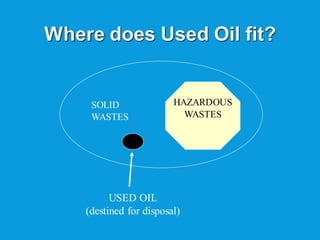
Where does Used Oil fit?
SOLID
WASTES
HAZARDOUS
WASTES
USED OIL
(destined for disposal)
USED OIL DEFINED - G.S. 130A-290(B)
Criteria For Used Oil:
 Origin: crude/synthetic oil
 Use: used as a lubricant, coolant, non-contact heat-transfer fluid, hydraulic
fluid, buoyant or other similar use
 Contamination: by physical/chemical impurities
EXAMPLES OF USED OIL
 Used motor oil
 Used hydraulic oil
 Used transmission & brake fluid
 Spent synthetic cutting & machine oils
 Spent quench oils
 Non-PCB transformer oils
 CFC contaminated oils from refrigeration units/air conditioning
units
USED OIL DOES NOT INCLUDE
 Petroleum based products not used as a lubricant or in other
protective applications
 Gasoline, diesel fuel, mineral spirits, kerosene
 Vegetable oils
 Animal oils
 Antifreeze
MANAGEMENT REQUIREMENTS
40 CFR 279.22
 Store only in containers and/or tanks
 Good condition, no visible leaks
 Label “UsedOil”
 Respond to releases
 Other Regs: DWQ - SPCC (40CFR 112)
UST - standards for USTs (40 CFR 280)
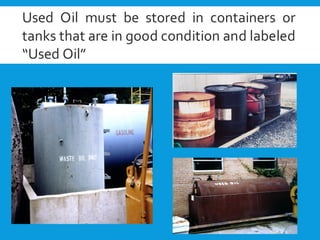
Used Oil must be stored in containers or
tanks that are in good condition and labeled
“Used Oil”
USED OIL RESTRICTIONS
 Do NOT use for road oiling, dust control or weed abatement
 Do NOT dischargeinto sewers, stormdrains, surface waters,
septic tanks, groundwaters or onto the ground
 Do NOT disposeof in any landfill
 Burning in oil-fired space heaters – source, capacity &
venting requirements (40CFR279.23)
CLASSIFICATION OFWASTES
ACCORDINGTOTHEIR ORIGIN AND
TYPE
 Municipal Solid wastes: Solid wastes that include household garbage, rubbish, construction &
demolition debris, sanitation residues, packaging materials, trade refuges etc. are managed by any
municipality.
 Bio-medical wastes: Solid or liquid wastes including containers, intermediate or end products
generated during diagnosis, treatment & research activities of medical sciences.
 Industrial wastes: Liquid and solid wastes that are generated by manufacturing & processing units
of various industries like chemical, petroleum, coal, metal gas, sanitary & paper etc.
 Agricultural wastes: Wastes generated from farming activities. These substances are mostly
biodegradable.
 Fishery wastes: Wastes generated due to fishery activities. These are extensively found in coastal
& estuarine areas.
 Radioactive wastes: Waste containing radioactive materials. Usually these are byproducts of
nuclear processes. Sometimes industries that are not directly involved in nuclear activities, may
also produce some radioactive wastes, e.g. radio-isotopes, chemical sludge etc.
 E-wastes: Electronic wastes generated from any modern establishments. They may be described
as discarded electrical or electronic devices. Some electronic scrap components, such as CRTs, may
contain contaminants such as Pb, Cd, Be or brominated flame retardants.
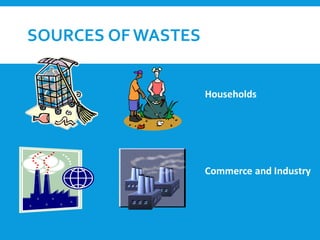
SOURCES OF WASTES
Households
Commerce and Industry
IMPACTS OF WASTE IF NOT MANAGED WISELY
•Affects our health
•Affects our socio-economicconditions
•Affects our coastal and marine environment
•Affects our climate
•GHGs are accumulating in Earth’s atmosphere as a resultof human
activities,causing global mean surface air temperature and
subsurface ocean temperature to rise.
•Rising global temperatures are expected to raise sea levels and change
precipitationand other local climate conditions.
•Changing regional climates could alter forests, cropyields, and water
supplies.
•This could also affecthuman health, animals, and many types of
ecosystems.
•Deserts might expand into existing rangelands, and features of some of
our national parks might be permanently altered.
IMPACTS OFWASTE…
- Some countries are expected to become warmer,
although sulfates might limit warming in some areas.
- Scientists are unable to determine which parts of
those countries will become wetter or drier, but there
is likely to be an overall trend toward increased
precipitation and evaporation, more intense
rainstorms, and drier soils.
- Whether rainfall increases or decreases cannot be
reliably projected for specific areas.
IMPACTS OFWASTE….
 Activitiesthathavealteredthe chemicalcompositionoftheatmosphere:
- BuildupofGHGsprimarilycarbondioxide(CO2) methane(CH4), and nitrous
oxide(N20).
- C02 is releasedtotheatmospherebytheburningoffossilfuels,woodandwood
products,andsolidwaste.
- CH4 is emittedfromthedecompositionof organicwastesinlandfills,theraising
of livestock,andtheproductionandtransportofcoal,naturalgas,andoil.
- N02is emittedduringagriculturalandindustrialactivities,aswellas during
combustionofsolidwasteandfossilfuels.In1977, theUS emittedaboutone-
fifthoftotalglobalGHGs.
SOURCES OF HUMAN EXPOSURES
Exposures occurs through
 Ingestion of contaminated water or food
 Contact with disease vectors
 Inhalation
 Dermal
POINTS OF CONTACT
 Soil adsorption, storage and biodegrading
 Plant uptake
 Ventilation
 Runoff
 Leaching
 Insects, birds, rats, flies and animals
 Direct dumping of untreated waste in seas, rivers and lakes results in
the plants and animals that feed on it
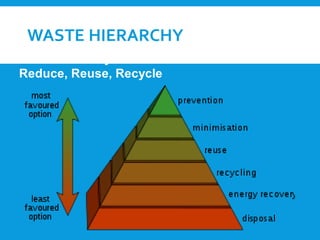
WASTE HIERARCHY
Waste hierarchy refers to 3 Rs
Reduce, Reuse, Recycle
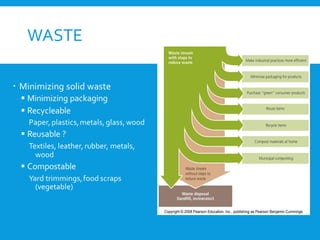
WASTE
 Minimizing solid waste
▪ Minimizing packaging
▪ Recycleable
Paper, plastics,metals, glass, wood
▪ Reusable ?
Textiles, leather, rubber, metals,
wood
▪ Compostable
Yard trimmings,food scraps
(vegetable)
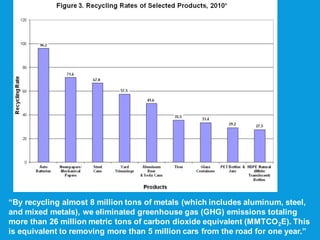
“By recycling almost 8 million tons of metals (which includes aluminum, steel,
and mixed metals), we eliminated greenhouse gas (GHG) emissions totaling
more than 26 million metric tons of carbon dioxide equivalent (MMTCO2E). This
is equivalent to removing more than 5 million cars from the road for one year.”
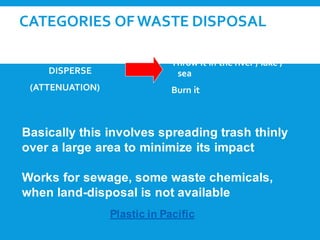
CATEGORIES OFWASTE DISPOSAL
1. DILUTE AND
DISPERSE
(ATTENUATION)
Throw it in the river / lake /
sea
Burn it
Basically this involves spreading trash thinly
over a large area to minimize its impact
Works for sewage, some waste chemicals,
when land-disposal is not available
Plastic in Pacific
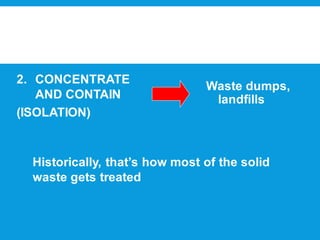
2. CONCENTRATE
AND CONTAIN
(ISOLATION)
Waste dumps,
landfills
Historically, that’s how most of the solid
waste gets treated
USEFUL OPTIONS
 Resource recovery
 Composting
 Vermicomposting
 Energy recovery
 Incineration
 Pyrolysis
 Gasification
 Bio-methanation or
anaerobic digestion
IMPACTS OF WASTE ON HEALTH
Chemical poisoning through chemical inhalation
Uncollected waste can obstruct the storm water runoff resulting
in flood
Low birth weight
Cancer
Congenital malformations
Neurological disease
IMPACTS OF WASTE ON HEALTH
 Nausea and vomiting
 Increase in hospitalization of diabetic residents living near
hazard waste sites.
 Mercury toxicity from eating fish with high levels of mercury.
Goorah, S., Esmyot, M., Boojhawon, R. (2009).TheHealth Impact of Nonhazardous SolidWaste
Disposalin aCommunity:Thecaseof the MareChicose Landfill in Mauritius. Journalof Environment
Health, 72(1) 48-54
Kouznetsova, M., Hauang,X., Ma, J., Lessner, L. & Carpenter, D. (2007). IncreasedRateof
Hospitalization for Diabetes andResidential Proximity of Hazardous wasteSites. Environmental
Health Perspectives, 115(1)75-75
Barlaz, M., Kaplan, P., Ranjithan, S. & Rynk, R. (2003) Evaluating EnvironmentalImpacts of solidWaste
ManagementAlternatives. BioCycle, 52-56.
EFFECTS OFWASTE ON ANIMALS
AND AQUATICS LIFE
 Increase in mercury level in fish due to disposal of mercury in
the rivers.
 Plastic found in oceans ingested by birds.
 Resulted in high algal population in rivers and sea.
 Degrades water and soil quality.
IMPACTS OF WASTE ON
ENVIRONMENT
 Waste breaks down in landfills to form methane, a potent
greenhouse gas
 Change in climate and destruction of ozone layer due to waste
biodegradable
 Littering, due to waste pollutions, illegal dumping, Leaching: is a
process by which solid waste enter soil and ground water and
contaminating them.
 U.S. Environment Protection Agency (2009)
WHAT SHOULD BE DONE
 Reduce Waste
- Reduce office paper waste by implementing a formal policy to duplex
all draft reports andby making training manualsandpersonnel
information available electronically.
- Improve product designto use less materials.
- Redesignpackaging to eliminate excessmaterial while maintaining
strength.
- Work with customers to design and implementa packaging return
program.
- Switch to reusable transport containers.
- Purchase products in bulk.
WHATSHOULD BE DONE
Reuse
- Reuse corrugated moving boxes internally.
- Reuse office furnitureand supplies, such as interoffice envelopes, file folders, and paper.
- Use durable towels, tablecloths, napkins, dishes, cups, and glasses.
- Use incoming packaging materials for outgoing shipments.
- Encourage employees to reuse officematerials rather than purchase new ones.
WHATSHOULD BE DONE
Donate/Exchange
- old books
- old clothes
- old computers
- excess building materials
- old equipment to local organizations
WHATSHOULD BE DONE
Employee Education
- Develop an “office recycling procedures” packet.
- Send out recycling reminders to all employees including
environmental articles.
- Train employees on recycling practices prior to implementing
recycling programs.
- Conduct an ongoing training process as new technologies are
introduced and new employees join the institution.
WHATSHOULD BE DONE
Employee Education
- education campaign on waste management that includes
an extensive internal web site, quarterly newsletters, daily
bulletins, promotional signs and helpful reference labels
within the campus of an institution.
WHATSHOULD BE DONE
Conduct outreach program adopting an
ecologically sound waste management system
which includes:
 waste reduction
 segregation at source
 composting
 recycling and re-use
 more efficient collection
 more environmentally sound disposal

Waste Management | Hazardous Waste Management

  • 1.
  • 2.
    WHAT ARE WASTES? Waste(also known as rubbish, trash, refuse, garbage, junk, litter, and ort) is unwanted or useless materials. In biology, waste is any of the many unwanted substances or toxins that are expelled from living organisms, metabolic waste; such as urea and sweat. BaselConventionDefinitionofWastes “substances or objects which are disposed of or are intended to be disposed of or are required to be disposed of by the provisions of the law” Disposal means “any operation which may lead to resource recovery, recycling, reclamation, direct re-use or alternative uses (Annex IVB of the Basel convention)”
  • 3.
    BASEL CONVENTION  TheBasel Convention on the Control of Transboundary Movements of Hazardous Wastes and Their Disposal, usually known simply as Basel Convention, is an international treaty that was designed to reduce the movements of hazardous waste between nations, specially to prevent transfer of hazardous waste from developed to less developed countries (LDCs). It does not, however, address the movement of radioactive waste. The convention is also intended to minimize the amount and toxicity of wastes generated, to ensure their environmentally sound management as closely as possible to the source of generation, and to assist LDCs in environmentally sound management of the hazardous and other wastes they generate.  The Convention was opened for signature on 22nd March 1989, and entered into force on 5 May 1992.
  • 4.
    THE DEFINITION…………  Producedby the United Nations Statistics Division (U.N.S.D.): "Wastes are materials that are not prime products (that is products produced for the market) for which the generator has no further use in terms of his/her own purposes of production, transformation or consumption, and of which he/she wants to dispose. Wastes may be generated during the extraction of raw materials, the processing of raw materials into intermediate and final products, the consumption of final products, and other human activities. Residuals recycled or reused at the place of generation are excluded."
  • 5.
    KINDS OF WASTES Solidwastes: wastes in solid forms, domestic, commercial and industrial wastes Examples: plastics, styrofoamcontainers,bottles, cans,papers, scrapiron, and other trash Liquid Wastes: wastes in liquidform Examples: domestic washings,chemicals,oils, waste water from ponds, manufacturingindustries and other sources
  • 6.
    ACCORDINGTO EPA REGULATIONS,SOLID WASTEIS  Any garbage or refuse (Municipal Solid Waste)  Sludge from a wastewater treatment plant, water supply treatment plant, or air pollution control facility  Other discarded material  Solid, liquid, semi-solid, or contained gaseous material from industrial, commercial, mining, and agricultural operations, and from community activities http://www.epa.gov/epaoswer/osw/basifact.htm#solidwaste
  • 7.
    CLASSIFICATION OFWASTES ACCORDINGTOTHEIR PROPERTIES Bio-degradable canbe degraded (paper, wood, fruits and others) Non-biodegradable cannot be degraded (plastics, bottles, old machines,cans, styrofoam containers and others)
  • 8.
    CLASSIFICATIONOFWASTESACCORDINGTO THEIR EFFECTS ONHUMAN HEALTHANDTHE ENVIRONMENT Hazardous wastes  Substances unsafe to use commercially, industrially, agriculturally, or economically and have any of the following properties- ignitability, corrosivity, reactivity & toxicity. Non-hazardous  Substances safe to use commercially, industrially, agriculturally, or economically and do not have any of those properties mentioned above. These substances usually create disposal problems.
  • 9.
    WHAT ARE UNIVERSALWASTES? Batteries Lamps Mercury Containing Equipment Pesticides
  • 10.
    WHAT IS E-WASTE E-Waste is a term that has been given to electronic wastes by the solid waste community as well as the public.  This generic name encompasses the many types of electronic devices that end up in the municipal solid waste stream.  E-Waste contains components which would make the item a hazardous waste.  NOT a Universal Waste!
  • 11.
    EXAMPLES OF E-WASTE? Computers  Computer Mouse Equipment  Keyboards  Copiers  Pagers  Personal Data Assistants  Video Cameras  LCD Projectors  Microphones  VCR’s  FAX Machines  Stereos  Radios  Scanners  Microfiche Filming & Reader Equipment  Telephones  Cell Phones
  • 12.
    E-WASTE  Printed circuitboards and other electronic components contain lead, chromium, silver and may include lithium, nickel/cadmium
  • 13.
    WHAT DO IDO WITH E-WASTE?  As long as the scrap metal will be recycled, it is exempt from RCRA hazardous waste requirements per 40 CFR 261.6(a)(3)(ii)  Speculative accumulation is not allowed!  If disposed of, a hazardous waste determination must be made
  • 14.
    CRT EXCLUSIONS  EffectiveJanuary 29, 2007 & adopted by North Carolina April 1, 2007  CRTs are NOT Universal Waste!
  • 15.
    CRT EXCLUSIONS 40 CFR261.39 Used intact CRTs are NOT solidwastes unless they are: Disposedof Speculatively accumulated (as definedin 261.1(c)(8)) byCRT collectorsor glass processors Exported for recyclinganddo not meet the requirements of 261.40 Used, brokenCRTs must be stored:  In a buildingwith roof, floor, and walls  Placed in container constructed, filled, and closed to minimize releases to the environmentof CRT glass  Properlylabeled: “Do not mix…”and “Used cathode ray tube(s) – contains leaded glass” or “Leaded glass from televisionsor computers”
  • 17.
    USED OILS September1992 - EPA developed a more comprehensive used oil program to encourage recovery/recycling of used oil Described in 40 CFR Parts 261 and 279 Applies to generators, transporters, processors/re- refiners, marketers, transfer facilities, collection centers, burners.
  • 18.
    REQUIREMENTS FOR OTHER USEDOIL HANDLERS 40 CFR 279 Subpart D - Collection Centers/Aggregation Pts Subpart E -Transporters/Transfer Facilities Subpart F - Processors/Re-refiners Subpart G - Off Specification Burners Subpart H - Marketers
  • 19.
    Where does UsedOil fit? SOLID WASTES HAZARDOUS WASTES USED OIL (destined for disposal)
  • 20.
    USED OIL DEFINED- G.S. 130A-290(B) Criteria For Used Oil:  Origin: crude/synthetic oil  Use: used as a lubricant, coolant, non-contact heat-transfer fluid, hydraulic fluid, buoyant or other similar use  Contamination: by physical/chemical impurities
  • 21.
    EXAMPLES OF USEDOIL  Used motor oil  Used hydraulic oil  Used transmission & brake fluid  Spent synthetic cutting & machine oils  Spent quench oils  Non-PCB transformer oils  CFC contaminated oils from refrigeration units/air conditioning units
  • 22.
    USED OIL DOESNOT INCLUDE  Petroleum based products not used as a lubricant or in other protective applications  Gasoline, diesel fuel, mineral spirits, kerosene  Vegetable oils  Animal oils  Antifreeze
  • 23.
    MANAGEMENT REQUIREMENTS 40 CFR279.22  Store only in containers and/or tanks  Good condition, no visible leaks  Label “UsedOil”  Respond to releases  Other Regs: DWQ - SPCC (40CFR 112) UST - standards for USTs (40 CFR 280)
  • 24.
    Used Oil mustbe stored in containers or tanks that are in good condition and labeled “Used Oil”
  • 25.
    USED OIL RESTRICTIONS Do NOT use for road oiling, dust control or weed abatement  Do NOT dischargeinto sewers, stormdrains, surface waters, septic tanks, groundwaters or onto the ground  Do NOT disposeof in any landfill  Burning in oil-fired space heaters – source, capacity & venting requirements (40CFR279.23)
  • 26.
    CLASSIFICATION OFWASTES ACCORDINGTOTHEIR ORIGINAND TYPE  Municipal Solid wastes: Solid wastes that include household garbage, rubbish, construction & demolition debris, sanitation residues, packaging materials, trade refuges etc. are managed by any municipality.  Bio-medical wastes: Solid or liquid wastes including containers, intermediate or end products generated during diagnosis, treatment & research activities of medical sciences.  Industrial wastes: Liquid and solid wastes that are generated by manufacturing & processing units of various industries like chemical, petroleum, coal, metal gas, sanitary & paper etc.  Agricultural wastes: Wastes generated from farming activities. These substances are mostly biodegradable.  Fishery wastes: Wastes generated due to fishery activities. These are extensively found in coastal & estuarine areas.  Radioactive wastes: Waste containing radioactive materials. Usually these are byproducts of nuclear processes. Sometimes industries that are not directly involved in nuclear activities, may also produce some radioactive wastes, e.g. radio-isotopes, chemical sludge etc.  E-wastes: Electronic wastes generated from any modern establishments. They may be described as discarded electrical or electronic devices. Some electronic scrap components, such as CRTs, may contain contaminants such as Pb, Cd, Be or brominated flame retardants.
  • 27.
  • 28.
    IMPACTS OF WASTEIF NOT MANAGED WISELY •Affects our health •Affects our socio-economicconditions •Affects our coastal and marine environment •Affects our climate •GHGs are accumulating in Earth’s atmosphere as a resultof human activities,causing global mean surface air temperature and subsurface ocean temperature to rise. •Rising global temperatures are expected to raise sea levels and change precipitationand other local climate conditions. •Changing regional climates could alter forests, cropyields, and water supplies. •This could also affecthuman health, animals, and many types of ecosystems. •Deserts might expand into existing rangelands, and features of some of our national parks might be permanently altered.
  • 29.
    IMPACTS OFWASTE… - Somecountries are expected to become warmer, although sulfates might limit warming in some areas. - Scientists are unable to determine which parts of those countries will become wetter or drier, but there is likely to be an overall trend toward increased precipitation and evaporation, more intense rainstorms, and drier soils. - Whether rainfall increases or decreases cannot be reliably projected for specific areas.
  • 30.
    IMPACTS OFWASTE….  Activitiesthathavealteredthechemicalcompositionoftheatmosphere: - BuildupofGHGsprimarilycarbondioxide(CO2) methane(CH4), and nitrous oxide(N20). - C02 is releasedtotheatmospherebytheburningoffossilfuels,woodandwood products,andsolidwaste. - CH4 is emittedfromthedecompositionof organicwastesinlandfills,theraising of livestock,andtheproductionandtransportofcoal,naturalgas,andoil. - N02is emittedduringagriculturalandindustrialactivities,aswellas during combustionofsolidwasteandfossilfuels.In1977, theUS emittedaboutone- fifthoftotalglobalGHGs.
  • 31.
    SOURCES OF HUMANEXPOSURES Exposures occurs through  Ingestion of contaminated water or food  Contact with disease vectors  Inhalation  Dermal
  • 32.
    POINTS OF CONTACT Soil adsorption, storage and biodegrading  Plant uptake  Ventilation  Runoff  Leaching  Insects, birds, rats, flies and animals  Direct dumping of untreated waste in seas, rivers and lakes results in the plants and animals that feed on it
  • 33.
    WASTE HIERARCHY Waste hierarchyrefers to 3 Rs Reduce, Reuse, Recycle
  • 34.
    WASTE  Minimizing solidwaste ▪ Minimizing packaging ▪ Recycleable Paper, plastics,metals, glass, wood ▪ Reusable ? Textiles, leather, rubber, metals, wood ▪ Compostable Yard trimmings,food scraps (vegetable)
  • 35.
    “By recycling almost8 million tons of metals (which includes aluminum, steel, and mixed metals), we eliminated greenhouse gas (GHG) emissions totaling more than 26 million metric tons of carbon dioxide equivalent (MMTCO2E). This is equivalent to removing more than 5 million cars from the road for one year.”
  • 36.
    CATEGORIES OFWASTE DISPOSAL 1.DILUTE AND DISPERSE (ATTENUATION) Throw it in the river / lake / sea Burn it Basically this involves spreading trash thinly over a large area to minimize its impact Works for sewage, some waste chemicals, when land-disposal is not available Plastic in Pacific
  • 37.
    2. CONCENTRATE AND CONTAIN (ISOLATION) Wastedumps, landfills Historically, that’s how most of the solid waste gets treated
  • 38.
    USEFUL OPTIONS  Resourcerecovery  Composting  Vermicomposting  Energy recovery  Incineration  Pyrolysis  Gasification  Bio-methanation or anaerobic digestion
  • 39.
    IMPACTS OF WASTEON HEALTH Chemical poisoning through chemical inhalation Uncollected waste can obstruct the storm water runoff resulting in flood Low birth weight Cancer Congenital malformations Neurological disease
  • 40.
    IMPACTS OF WASTEON HEALTH  Nausea and vomiting  Increase in hospitalization of diabetic residents living near hazard waste sites.  Mercury toxicity from eating fish with high levels of mercury. Goorah, S., Esmyot, M., Boojhawon, R. (2009).TheHealth Impact of Nonhazardous SolidWaste Disposalin aCommunity:Thecaseof the MareChicose Landfill in Mauritius. Journalof Environment Health, 72(1) 48-54 Kouznetsova, M., Hauang,X., Ma, J., Lessner, L. & Carpenter, D. (2007). IncreasedRateof Hospitalization for Diabetes andResidential Proximity of Hazardous wasteSites. Environmental Health Perspectives, 115(1)75-75 Barlaz, M., Kaplan, P., Ranjithan, S. & Rynk, R. (2003) Evaluating EnvironmentalImpacts of solidWaste ManagementAlternatives. BioCycle, 52-56.
  • 41.
    EFFECTS OFWASTE ONANIMALS AND AQUATICS LIFE  Increase in mercury level in fish due to disposal of mercury in the rivers.  Plastic found in oceans ingested by birds.  Resulted in high algal population in rivers and sea.  Degrades water and soil quality.
  • 42.
    IMPACTS OF WASTEON ENVIRONMENT  Waste breaks down in landfills to form methane, a potent greenhouse gas  Change in climate and destruction of ozone layer due to waste biodegradable  Littering, due to waste pollutions, illegal dumping, Leaching: is a process by which solid waste enter soil and ground water and contaminating them.  U.S. Environment Protection Agency (2009)
  • 43.
    WHAT SHOULD BEDONE  Reduce Waste - Reduce office paper waste by implementing a formal policy to duplex all draft reports andby making training manualsandpersonnel information available electronically. - Improve product designto use less materials. - Redesignpackaging to eliminate excessmaterial while maintaining strength. - Work with customers to design and implementa packaging return program. - Switch to reusable transport containers. - Purchase products in bulk.
  • 44.
    WHATSHOULD BE DONE Reuse -Reuse corrugated moving boxes internally. - Reuse office furnitureand supplies, such as interoffice envelopes, file folders, and paper. - Use durable towels, tablecloths, napkins, dishes, cups, and glasses. - Use incoming packaging materials for outgoing shipments. - Encourage employees to reuse officematerials rather than purchase new ones.
  • 45.
    WHATSHOULD BE DONE Donate/Exchange -old books - old clothes - old computers - excess building materials - old equipment to local organizations
  • 46.
    WHATSHOULD BE DONE EmployeeEducation - Develop an “office recycling procedures” packet. - Send out recycling reminders to all employees including environmental articles. - Train employees on recycling practices prior to implementing recycling programs. - Conduct an ongoing training process as new technologies are introduced and new employees join the institution.
  • 47.
    WHATSHOULD BE DONE EmployeeEducation - education campaign on waste management that includes an extensive internal web site, quarterly newsletters, daily bulletins, promotional signs and helpful reference labels within the campus of an institution.
  • 48.
    WHATSHOULD BE DONE Conductoutreach program adopting an ecologically sound waste management system which includes:  waste reduction  segregation at source  composting  recycling and re-use  more efficient collection  more environmentally sound disposal