INDUSTRIAL TRAINING
AT
IFAD MULTIPRODUCTS LIMITED
The objective of industrial training
• To achieve practical knowledge about food processing,
manufacturing, preservation and production of
convenience food items from raw materials.
• From this training we can know about the unit operation of
the machineries, quality control department and their
function.
• We can know about the hygienic condition that
maintained for consumer preference products.
• We also know about the research on future development
of food and food products.
IFAD MULTI PRODUCTSLIMITEDis the unit of IFAD group that started as IFAD
AUTOS in 1985. IFAD Multi Products Ltd. institutedin 2003.
It is situated at Boro Rangamatia, Jirabo,Ashulia, Dhaka.
It began its journey by erecting one of the largest automated flour mills in the
nation and currently contends as one of the leading suppliers of flour products
At present the company is also a major manufacturer and supplier of instant
noodles, stick noodles, a varied range of biscuits and cookies, cake, salt,
packaged whole spices and bottled drinking water
Basic Information of the Industry
Number of plant in IMPL
In this industry the number of total unit is 7
• IFAD Flour plant
• IFAD Water plant
• IFAD Salt plant
• IFAD Noodles plant
• IFAD Biscuit plant
• IFAD Snacks plant
• IFAD Cake plant
Flour Plant
Introduction of Flour Plant
• It is the first plant by which IMPL starts its journey.
• It is fully automated Italian flour mill and produces
premium quality Atta, Moyda, Suji and maintains
maximum hygienic condition by comparing with national
and international law.
• The mill is accredited with ISO 9001:2008, ISO 2008,
14001:2004 and HACCP certifications
Definition
• Flour: Flour is a powder which is made by grinding cereal
grains or other seeds or roots.
• Mayda: Mayda is the refining of wheat and generally
contain high in protein remove of bran particles.
• Semolina: This is the heart of wheat.10% of wheat. When
10% semolina is produced then the flour quality is low
FLOW CHART OF FLOUR PRODUCTION
wheat purchease
Raw material intake
Pre cleaning
Raw material store in silo
Mixing wheat(mixing as per recurment )
Aspertion and separation
Stone separator
Drum seperator
Dumpening(wash by water)
Scourer(whole germ remove)
Milling
Roller
Grinding seive/ plant shifter
Packaging
Storage of products
Magnatic
seperator(Iron
remove)
Inspection occured
on purchasing
wheat
Dust,iron part,big
particles are
removes
Data, Dust remove
Material in
tempering bin(12
hours)
1. Screw
Conveyer (Atta,
Moyda)
2. Purifier(
Semolina)
3. Bran
finisher(Bran)
Broken and
immature wheat
remove
stone remove
Product in Flour Unit
IFAD Atta
Ingredients: Wheat
Product Type: Flour
SKU (Stock Keeping Unit): 1kg, 2kg, 50kg
Enriched with sufficient Protein,
Vitamins & Minerals
IFAD Brown Atta:
• Ingredients: Wheat
• SKU (Stock Keeping Unit): 1kg
• Enriched with sufficient Protein,
• Vitamins & Minerals
• Full Presence of Natural fibre
IFAD Suji
Product Type: Semolina
Ingredient: Wheat
SKU(Stock Keeping Unit): 1/2kg
Enriched with sufficient Protein,
Vitamins & Minerals
IFAD Moyda
Product Type: Flour
Ingredients: Wheat
SKU (Stock Keeping Unit): 1kg, 2kg,
50kg
Enriched with sufficient Protein,
Vitamins & Minerals
QUALITY CONTROL OF FLOUR PLANT
For maximum production of desired product with most
acceptable quality for consumer those following test are
performed on raw wheat
• Moisture test
• Gluten test
• PSI test
• Fallen number value
• Ash test
• Granule size inspection
• Physical inspection test
Biscuit plant
Introduction of Biscuit plant
• Biscuit is a term used for a variety of baked, commonly
flour-based food product. It is generally called either
cookie or crackers.
• Biscuits plant is established in IMPL at 2012. At present
various types of biscuit produced by IFAD in different
favour depend in consumer preference.
Ingredients for Biscuit production
There are many ingredients used
for production of different kinds of
biscuit.
Common Ingredients:
• IFAD wheat flour
• Sugar
• Water
• Edible vegetables fats & oil
• Salt
• Food graded flavor
• Leaving agent
• Permitted Emulsifier
Preservatives:
• SBC( Sodium bicarbonate)
• ABC(Ammonium bicarbonate)
• Lactic Acid
• Citric Acid
• SMBS(Sodium meta bisulphate)
• Etc.
Other Ingredients:
• Butter
• Kaju
• Jeera
• Cocoa Powder
• Invert Syrup
Flow Chat for biscuit production
The basic process of biscuit is
Mixing
Forming
Baking
Brushing & Cooling
Packaging
Storage
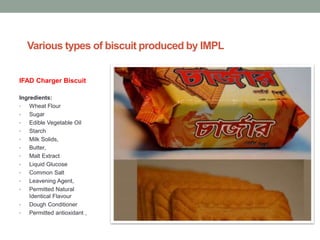
Various types of biscuit produced by IMPL
IFAD Charger Biscuit
Ingredients:
• Wheat Flour
• Sugar
• Edible Vegetable Oil
• Starch
• Milk Solids,
• Butter,
• Malt Extract
• Liquid Glucose
• Common Salt
• Leavening Agent,
• Permitted Natural
Identical Flavour
• Dough Conditioner
• Permitted antioxidant ,
IFAD Orange Biscuits
Ingredients:
• Wheat Flour
• Sugar refined
• Edible Vegetable
Oil
• Starch Solids
• Milk Solids,
• Butter,
• Malt Extract
• Liquid Glucose
• Common Salt
• Leavening Agent,
• Permitted Natural
Identical Flavour
• Dough Conditioner
• Permitted
antioxidant
IFAD Mixed Fruit Cream Biscuits
Ingredients:
• Wheat Flour
• Sugar refined
• Edible Vegetable Oil
• Starch Solids
• Milk Solids,
• Butter,
• Malt Extract
• Liquid Glucose
• Common Salt
• Leavening Agent,
• Permitted Natural
Identical Flavour
• Dough Conditioner
• Permitted antioxidant
IFAD Choco Delight
Ingredients:
• Wheat Flour
• Sugar refined
• Edible Vegetable Oil
• Choco Butter
• Milk Solids
• Choco Butter,
• Milk Solid
• Liquid Glucose
• Common Salt
• Leavening Agent
• Permitted Natural
Identical Flavour
• Dough Conditioner
• Permitted antioxidant
IFAD Jeera Biscuits
Ingredients: Wheat
Flour, Sugar, Cumin, Edible Vegetable Oil,
LeaveningAgent,
Common Salt, Emulsifier Dough
Conditioner, PermittedAntioxidant, Natural
Identical Flavour,
IFAD Choco Chips Biscuit
SKU (Stock Keeping Unit): 260gm
IFAD Nankhatai Biscuit
SKU (Stock Keeping Unit): 100gm,
260gm
IFAD Cheesy Biscuit
SKU (Stock Keeping Unit): 50gm,
300gm
IFAD Sweet & Salty Biscuit
SKU (Stock Keeping Unit): 65gm
IFAD Kaju Delight Biscuit
SKU (Stock Keeping Unit): 60gm,
260gm
IFAD Choco Cream Biscuit
SKU (Stock Keeping Unit): 80gm
Water plant
 Water is very essential for our existence. It is a major nutrient
for our health & body. But polluted water is very dangerous for
our body. So purification of water is very important.
Reverse osmosis (RO) is a membrane technology filtration
method that removes many types of large molecules and ions
from solutions by applying pressure to the solution when it is on
one side of a selective membrane.
Flow diagram of water Treatment process
Water pump
Reserve tank
Multifilter
Activated carbon filter
Microfilter
Reverse Osmosis Plant
Reserve tank
Ozone tank
UV disinfection unit
Bottle rinse
Bottle filling
Labelling and band roll
Wrapping
Store
Date code
Q.C test: Fe, Ar,
Hardness, Ph,
TDS,
Q.C test: Cl test
QC test: Oral test
Q.C test:Ozone test
Q.C test: Ozone
test test}test}
IFAD Premium Drinking Water
Water 500ML
TDS : <250mg/L
Arsenic: Nil
Cadmium: < 0.003mg/L
Lead: < 0.01mg/L
Chloride: < 250mg/L
Nitrite: Nil
Nitrate: < 4mg/L
Cyanide: Nil
pH: 6.4-7.4
Water 1500ML
TDS:<250mg/L
Arsenic:Nil
Cadmium:<0.003mg/L
Lead:<0.01mg/L
Chloride:<250mg/L
Nitrite:Nil
Nitrate:<4mg/L
Cyanide:Nil
pH:6.4-7.4
Quality control of water
Chemical test
pH
Alkaline test
Arsenic test
Iron test
Chloride test
TDS (total dissolving
solid) test
Ozone test
Microbiological test
Coliform bacteria test
Tolerance level
maximum 4 /dose
Aerobic bacteria test.
Noodles Plant
Introduction of Noodles
Noodles are a staple food in many culture made from
unleavened dough which is stretched or rolled flat and cut
into one of a variety of shapes.
.Noodles plant is established in IFAD in 2012.
IMPL mainly produce two types of noodles
Instant noodles
Stick noodles
Ingredients used in Noodles Production
Ingredients for Instant Noodles
• Flour (28-30% gluten)
• Starch powder
• Water
• Salt
• Vegetable oil
• Vitamin B2
• Antioxidant (TBHQ)
• CMC
• Pum oil
Ingredients for Stick noodles
• Flour (gluten percentage is 32-38%)
• Water
• Starch powder
• CMC
• Antioxidant
• Salt
Flow chart of stick noodles production
Flour shifting
Ingredient mixing
Making sheet from dough
Cooling
Rolling
Moulding
Drying
Cutting
Scaling
Packaging
6 hours in at
45-50°C
155-160mm)
Flow chart of instant noodles production:
Ingredient mixing (mixture)
Making sheet from dough
Rolling
Noodles forming
Cooking
Cooling
Cutting
Frying
Cooling and oil separation
Cupping
Packaging
In160 at 3-4 min
92-96°C at 4-5 to
5 min
Types of Instant Noodles
Eggy Noodles with chicken
flavour
Ingredients: Wheat Flour, Edible
Vegetable Oil, Starch Powder, Iodized
Salt, Permitted Antioxidant
Eggy noodles with masala
flavour
Ingredients: Wheat Flour, Edible
Vegetable Oil, Starch Powder,
Iodized Salt, Permitted
Types of Stick Noodles
IFAD Stick Noodles is produce in
two different size.
IFAD stick Noodles in 180
grams packets
IFAD stick Noodles in 300
grams packets
Ingredients: Wheat Flour, Iodized
Salt, Egg, Starch Powder
Quality control test during Noodles production
During instant noodles
production
Gluten test
Acid value test
Moister test
During Stick noodles
production
Ash test
Protein test
Moisture test
Physical test
QUALITY CONTROL
Defination
• Quality of foods may be defined as the composite of those
characteristics that differentiate individual units of a product,
have significance in determining the degree of acceptability of
that unit by the buyer.
• Quality control may be defined as the maintenance of quality
at levels and tolerances acceptable to the buyer while
minimizing costs for the vendor.
• Quality assurance, or QA for short, refers to planned and
systematic production processes that provide confidence in a
product's suitability for its intended purpose. It is a set of
activities intended to ensure that products satisfy customer
requirements in a systematic, reliable fashion. QA cannot
absolutely guarantee the production of quality products.
Responsibilities of the QC department
Some of the specific responsibilities of the quality control department may be listed
as follows
 Inspection of supplies and materials
 Inspection of raw products
 Scheduling of operations
 Measurement of production efficiency
 Measurement of equipment efficiency
 Inspection of the finished product
 Warehousing controls
 Shipping and storage controls
 Preparation of specifications and procedures in written handbook form
 Preparation of statistical procedures and schedules
 Sanitation inspections
 Conformances to local and federal regulations
 Waste disposal control
 Basis for pricing policy
 Basis for inventory policy
 Basis for evaluating individual personal performances
Functions of QC department
Establishment of specifications
Development of Test Procedures
Development of Sampling Procedures
Recording and Reporting
Trouble Shooting
Special Problems
Training of Personnel
HACCP
HACCP (Hazard Analysis and Critical Control Points) is a system,
which identifies specific hazards and preventative measures for their
control to minimize the risk of producing defective products and
services for the each step of the food chain. HACCP has been
adopted by all major food companies and are mandatory for exports
to certain countries.
HACCP determines the critical limits in the critical control points
(ccps) in the process and determines the critical limits by monitoring
and applying a mandatory and inhibiting factors.
Principle of HACCP
Conduct a hazard analysis
Identify critical control points
Establish critical limits for each critical control point
Establish critical control point monitoring requirements
Establish corrective actions
Establish record keeping procedures
Establish procedures for verifying The HACCP system is
working as intended

Industrial training

  • 1.
  • 2.
    The objective ofindustrial training • To achieve practical knowledge about food processing, manufacturing, preservation and production of convenience food items from raw materials. • From this training we can know about the unit operation of the machineries, quality control department and their function. • We can know about the hygienic condition that maintained for consumer preference products. • We also know about the research on future development of food and food products.
  • 3.
    IFAD MULTI PRODUCTSLIMITEDisthe unit of IFAD group that started as IFAD AUTOS in 1985. IFAD Multi Products Ltd. institutedin 2003. It is situated at Boro Rangamatia, Jirabo,Ashulia, Dhaka. It began its journey by erecting one of the largest automated flour mills in the nation and currently contends as one of the leading suppliers of flour products At present the company is also a major manufacturer and supplier of instant noodles, stick noodles, a varied range of biscuits and cookies, cake, salt, packaged whole spices and bottled drinking water Basic Information of the Industry
  • 4.
    Number of plantin IMPL In this industry the number of total unit is 7 • IFAD Flour plant • IFAD Water plant • IFAD Salt plant • IFAD Noodles plant • IFAD Biscuit plant • IFAD Snacks plant • IFAD Cake plant
  • 5.
  • 6.
    Introduction of FlourPlant • It is the first plant by which IMPL starts its journey. • It is fully automated Italian flour mill and produces premium quality Atta, Moyda, Suji and maintains maximum hygienic condition by comparing with national and international law. • The mill is accredited with ISO 9001:2008, ISO 2008, 14001:2004 and HACCP certifications
  • 7.
    Definition • Flour: Flouris a powder which is made by grinding cereal grains or other seeds or roots. • Mayda: Mayda is the refining of wheat and generally contain high in protein remove of bran particles. • Semolina: This is the heart of wheat.10% of wheat. When 10% semolina is produced then the flour quality is low
  • 8.
    FLOW CHART OFFLOUR PRODUCTION wheat purchease Raw material intake Pre cleaning Raw material store in silo Mixing wheat(mixing as per recurment ) Aspertion and separation Stone separator Drum seperator Dumpening(wash by water) Scourer(whole germ remove) Milling Roller Grinding seive/ plant shifter Packaging Storage of products Magnatic seperator(Iron remove) Inspection occured on purchasing wheat Dust,iron part,big particles are removes Data, Dust remove Material in tempering bin(12 hours) 1. Screw Conveyer (Atta, Moyda) 2. Purifier( Semolina) 3. Bran finisher(Bran) Broken and immature wheat remove stone remove
  • 9.
    Product in FlourUnit IFAD Atta Ingredients: Wheat Product Type: Flour SKU (Stock Keeping Unit): 1kg, 2kg, 50kg Enriched with sufficient Protein, Vitamins & Minerals
  • 10.
    IFAD Brown Atta: •Ingredients: Wheat • SKU (Stock Keeping Unit): 1kg • Enriched with sufficient Protein, • Vitamins & Minerals • Full Presence of Natural fibre
  • 11.
    IFAD Suji Product Type:Semolina Ingredient: Wheat SKU(Stock Keeping Unit): 1/2kg Enriched with sufficient Protein, Vitamins & Minerals
  • 12.
    IFAD Moyda Product Type:Flour Ingredients: Wheat SKU (Stock Keeping Unit): 1kg, 2kg, 50kg Enriched with sufficient Protein, Vitamins & Minerals
  • 13.
    QUALITY CONTROL OFFLOUR PLANT For maximum production of desired product with most acceptable quality for consumer those following test are performed on raw wheat • Moisture test • Gluten test • PSI test • Fallen number value • Ash test • Granule size inspection • Physical inspection test
  • 14.
  • 15.
    Introduction of Biscuitplant • Biscuit is a term used for a variety of baked, commonly flour-based food product. It is generally called either cookie or crackers. • Biscuits plant is established in IMPL at 2012. At present various types of biscuit produced by IFAD in different favour depend in consumer preference.
  • 16.
    Ingredients for Biscuitproduction There are many ingredients used for production of different kinds of biscuit. Common Ingredients: • IFAD wheat flour • Sugar • Water • Edible vegetables fats & oil • Salt • Food graded flavor • Leaving agent • Permitted Emulsifier Preservatives: • SBC( Sodium bicarbonate) • ABC(Ammonium bicarbonate) • Lactic Acid • Citric Acid • SMBS(Sodium meta bisulphate) • Etc. Other Ingredients: • Butter • Kaju • Jeera • Cocoa Powder • Invert Syrup
  • 17.
    Flow Chat forbiscuit production The basic process of biscuit is Mixing Forming Baking Brushing & Cooling Packaging Storage
  • 18.
    Various types ofbiscuit produced by IMPL IFAD Charger Biscuit Ingredients: • Wheat Flour • Sugar • Edible Vegetable Oil • Starch • Milk Solids, • Butter, • Malt Extract • Liquid Glucose • Common Salt • Leavening Agent, • Permitted Natural Identical Flavour • Dough Conditioner • Permitted antioxidant ,
  • 19.
    IFAD Orange Biscuits Ingredients: •Wheat Flour • Sugar refined • Edible Vegetable Oil • Starch Solids • Milk Solids, • Butter, • Malt Extract • Liquid Glucose • Common Salt • Leavening Agent, • Permitted Natural Identical Flavour • Dough Conditioner • Permitted antioxidant
  • 20.
    IFAD Mixed FruitCream Biscuits Ingredients: • Wheat Flour • Sugar refined • Edible Vegetable Oil • Starch Solids • Milk Solids, • Butter, • Malt Extract • Liquid Glucose • Common Salt • Leavening Agent, • Permitted Natural Identical Flavour • Dough Conditioner • Permitted antioxidant
  • 21.
    IFAD Choco Delight Ingredients: •Wheat Flour • Sugar refined • Edible Vegetable Oil • Choco Butter • Milk Solids • Choco Butter, • Milk Solid • Liquid Glucose • Common Salt • Leavening Agent • Permitted Natural Identical Flavour • Dough Conditioner • Permitted antioxidant
  • 22.
    IFAD Jeera Biscuits Ingredients:Wheat Flour, Sugar, Cumin, Edible Vegetable Oil, LeaveningAgent, Common Salt, Emulsifier Dough Conditioner, PermittedAntioxidant, Natural Identical Flavour, IFAD Choco Chips Biscuit SKU (Stock Keeping Unit): 260gm IFAD Nankhatai Biscuit SKU (Stock Keeping Unit): 100gm, 260gm
  • 23.
    IFAD Cheesy Biscuit SKU(Stock Keeping Unit): 50gm, 300gm IFAD Sweet & Salty Biscuit SKU (Stock Keeping Unit): 65gm IFAD Kaju Delight Biscuit SKU (Stock Keeping Unit): 60gm, 260gm IFAD Choco Cream Biscuit SKU (Stock Keeping Unit): 80gm
  • 24.
  • 25.
     Water isvery essential for our existence. It is a major nutrient for our health & body. But polluted water is very dangerous for our body. So purification of water is very important. Reverse osmosis (RO) is a membrane technology filtration method that removes many types of large molecules and ions from solutions by applying pressure to the solution when it is on one side of a selective membrane.
  • 26.
    Flow diagram ofwater Treatment process Water pump Reserve tank Multifilter Activated carbon filter Microfilter Reverse Osmosis Plant Reserve tank Ozone tank UV disinfection unit Bottle rinse Bottle filling Labelling and band roll Wrapping Store Date code Q.C test: Fe, Ar, Hardness, Ph, TDS, Q.C test: Cl test QC test: Oral test Q.C test:Ozone test Q.C test: Ozone test test}test}
  • 27.
    IFAD Premium DrinkingWater Water 500ML TDS : <250mg/L Arsenic: Nil Cadmium: < 0.003mg/L Lead: < 0.01mg/L Chloride: < 250mg/L Nitrite: Nil Nitrate: < 4mg/L Cyanide: Nil pH: 6.4-7.4
  • 28.
  • 29.
    Quality control ofwater Chemical test pH Alkaline test Arsenic test Iron test Chloride test TDS (total dissolving solid) test Ozone test Microbiological test Coliform bacteria test Tolerance level maximum 4 /dose Aerobic bacteria test.
  • 30.
  • 31.
    Introduction of Noodles Noodlesare a staple food in many culture made from unleavened dough which is stretched or rolled flat and cut into one of a variety of shapes. .Noodles plant is established in IFAD in 2012.
  • 32.
    IMPL mainly producetwo types of noodles Instant noodles Stick noodles
  • 33.
    Ingredients used inNoodles Production Ingredients for Instant Noodles • Flour (28-30% gluten) • Starch powder • Water • Salt • Vegetable oil • Vitamin B2 • Antioxidant (TBHQ) • CMC • Pum oil Ingredients for Stick noodles • Flour (gluten percentage is 32-38%) • Water • Starch powder • CMC • Antioxidant • Salt
  • 34.
    Flow chart ofstick noodles production Flour shifting Ingredient mixing Making sheet from dough Cooling Rolling Moulding Drying Cutting Scaling Packaging 6 hours in at 45-50°C 155-160mm) Flow chart of instant noodles production: Ingredient mixing (mixture) Making sheet from dough Rolling Noodles forming Cooking Cooling Cutting Frying Cooling and oil separation Cupping Packaging In160 at 3-4 min 92-96°C at 4-5 to 5 min
  • 35.
    Types of InstantNoodles Eggy Noodles with chicken flavour Ingredients: Wheat Flour, Edible Vegetable Oil, Starch Powder, Iodized Salt, Permitted Antioxidant Eggy noodles with masala flavour Ingredients: Wheat Flour, Edible Vegetable Oil, Starch Powder, Iodized Salt, Permitted
  • 36.
    Types of StickNoodles IFAD Stick Noodles is produce in two different size. IFAD stick Noodles in 180 grams packets IFAD stick Noodles in 300 grams packets Ingredients: Wheat Flour, Iodized Salt, Egg, Starch Powder
  • 37.
    Quality control testduring Noodles production During instant noodles production Gluten test Acid value test Moister test During Stick noodles production Ash test Protein test Moisture test Physical test
  • 38.
  • 39.
    Defination • Quality offoods may be defined as the composite of those characteristics that differentiate individual units of a product, have significance in determining the degree of acceptability of that unit by the buyer. • Quality control may be defined as the maintenance of quality at levels and tolerances acceptable to the buyer while minimizing costs for the vendor. • Quality assurance, or QA for short, refers to planned and systematic production processes that provide confidence in a product's suitability for its intended purpose. It is a set of activities intended to ensure that products satisfy customer requirements in a systematic, reliable fashion. QA cannot absolutely guarantee the production of quality products.
  • 40.
    Responsibilities of theQC department Some of the specific responsibilities of the quality control department may be listed as follows  Inspection of supplies and materials  Inspection of raw products  Scheduling of operations  Measurement of production efficiency  Measurement of equipment efficiency  Inspection of the finished product  Warehousing controls  Shipping and storage controls  Preparation of specifications and procedures in written handbook form  Preparation of statistical procedures and schedules  Sanitation inspections  Conformances to local and federal regulations  Waste disposal control  Basis for pricing policy  Basis for inventory policy  Basis for evaluating individual personal performances
  • 41.
    Functions of QCdepartment Establishment of specifications Development of Test Procedures Development of Sampling Procedures Recording and Reporting Trouble Shooting Special Problems Training of Personnel
  • 42.
    HACCP HACCP (Hazard Analysisand Critical Control Points) is a system, which identifies specific hazards and preventative measures for their control to minimize the risk of producing defective products and services for the each step of the food chain. HACCP has been adopted by all major food companies and are mandatory for exports to certain countries. HACCP determines the critical limits in the critical control points (ccps) in the process and determines the critical limits by monitoring and applying a mandatory and inhibiting factors.
  • 43.
    Principle of HACCP Conducta hazard analysis Identify critical control points Establish critical limits for each critical control point Establish critical control point monitoring requirements Establish corrective actions Establish record keeping procedures Establish procedures for verifying The HACCP system is working as intended