

TEMPERING OF CHOCOLATEBROWN AND HAPPYBY CHEF PRADIP
What is tempering?	The purpose of tempering chocolate is to pre-crystallise the cocoa butter in the chocolate, which is related to the working temperature of the chocolate. During tempering, the cocoa butter in the chocolate changes into a stable crystalline form. It ensures the hardness, shrinking force and gloss of the finished product after it has cooled. If the chocolate is melted in the normal way (between 40 and 45 °C) then left to cool to working temperature, the finished product will not be glossy. If you make the effort of using a special way of bringing chocolate up to the right working temperature, you are guaranteed to get the desired end result. And that is what we mean by tempering: bringing chocolate up to the right working temperature so that there are sufficient stable crystals. The 3 factors which are important during tempering are time, temperature and movement
Tempering with calletsPre-crystallisation is very easy if you add chocolate which has already been tempered to the melted chocolate. Callebaut Callets are useful for this. Callets have of course already been tempered. In other words, they are already in the required crystalline form, and can be added to the melted chocolate. The required quantity of Callets depends upon the temperature of the melted chocolate and the Callets. When the melted chocolate reaches a temperature of approximately 40 °C, you can add 15% to 20% Callets at ambient temperature (between 15 and 20 °C).
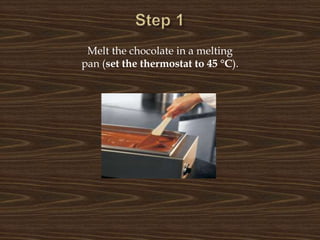
Step 1Melt the chocolate in a melting pan (set the thermostat to 45 °C).
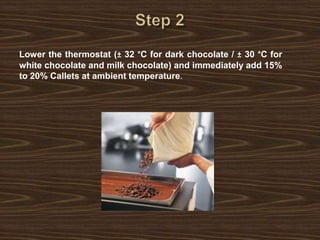
Step 2Lower the thermostat (± 32 °C for dark chocolate / ± 30 °C for white chocolate and milk chocolate) and immediately add 15% to 20% Callets at ambient temperature.
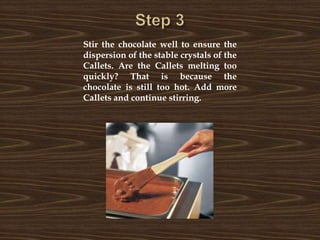
Step 3Stir the chocolate well to ensure the dispersion of the stable crystals of the Callets. Are the Callets melting too quickly? That is because the chocolate is still too hot. Add more Callets and continue stirring.
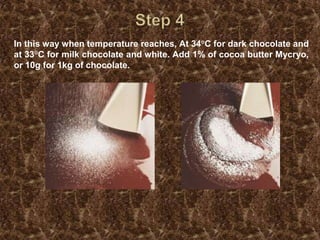
Step 4In this way when temperature reaches, At 34°C for dark chocolate and at 33°C for milk chocolate and white. Add 1% of cocoa butter Mycryo, or 10g for 1kg of chocolate.
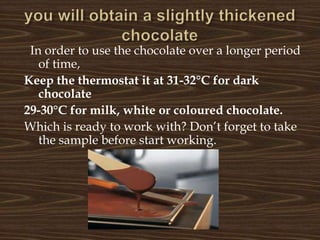
you will obtain a slightly thickened chocolate  In order to use the chocolate over a longer period of time, Keep the thermostat it at 31-32°C for dark chocolate  29-30°C for milk, white or coloured chocolate.Which is ready to work with? Don’t forget to take the sample before start working.
THANK YOU By B&H team

Chocolate tempering

  • 1.
    TEMPERING OF CHOCOLATEBROWNAND HAPPYBY CHEF PRADIP
  • 2.
    What is tempering? Thepurpose of tempering chocolate is to pre-crystallise the cocoa butter in the chocolate, which is related to the working temperature of the chocolate. During tempering, the cocoa butter in the chocolate changes into a stable crystalline form. It ensures the hardness, shrinking force and gloss of the finished product after it has cooled. If the chocolate is melted in the normal way (between 40 and 45 °C) then left to cool to working temperature, the finished product will not be glossy. If you make the effort of using a special way of bringing chocolate up to the right working temperature, you are guaranteed to get the desired end result. And that is what we mean by tempering: bringing chocolate up to the right working temperature so that there are sufficient stable crystals. The 3 factors which are important during tempering are time, temperature and movement
  • 3.
    Tempering with calletsPre-crystallisationis very easy if you add chocolate which has already been tempered to the melted chocolate. Callebaut Callets are useful for this. Callets have of course already been tempered. In other words, they are already in the required crystalline form, and can be added to the melted chocolate. The required quantity of Callets depends upon the temperature of the melted chocolate and the Callets. When the melted chocolate reaches a temperature of approximately 40 °C, you can add 15% to 20% Callets at ambient temperature (between 15 and 20 °C).
  • 4.
    Step 1Melt thechocolate in a melting pan (set the thermostat to 45 °C).
  • 5.
    Step 2Lower thethermostat (± 32 °C for dark chocolate / ± 30 °C for white chocolate and milk chocolate) and immediately add 15% to 20% Callets at ambient temperature.
  • 6.
    Step 3Stir thechocolate well to ensure the dispersion of the stable crystals of the Callets. Are the Callets melting too quickly? That is because the chocolate is still too hot. Add more Callets and continue stirring.
  • 7.
    Step 4In thisway when temperature reaches, At 34°C for dark chocolate and at 33°C for milk chocolate and white. Add 1% of cocoa butter Mycryo, or 10g for 1kg of chocolate.
  • 8.
    you will obtaina slightly thickened chocolate In order to use the chocolate over a longer period of time, Keep the thermostat it at 31-32°C for dark chocolate 29-30°C for milk, white or coloured chocolate.Which is ready to work with? Don’t forget to take the sample before start working.
  • 9.
    THANK YOU ByB&H team