Prerequisite Programs
Ravi
Damani
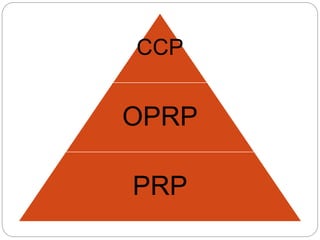
CCP
OPRP
PRP
PRP
PRPs are “procedures, including Good Manufacturing Practices, that
address operational conditions providing the foundation for the HACCP
system.” These are general control measures applicable across all areas
of food processing and aimed at maintaining a safe and hygienic
environment. They do not control specific hazards or steps in the
process.
Examples:
Supplier control
Cleaning and sanitation
Personal hygiene
Training
OPRP
OPRPs are special types of PRPs. They are also control measures
aimed at maintaining a safe and hygienic environment. But, unlike
regular PRPs, they do control specific hazards and steps in the
process.
The main differences between OPRPs and CCPs is that OPRPs aren’t
based on critical limits and they don’t have “absolute” control over the
hazard. This means that while OPRPs are essential, their failure
doesn’t automatically mean a product is unsafe.
Examples:
Glass and metal control
Specific sanitation procedures to prevent cross-contamination at a
certain part of the line
CCP
CCP is “a step at which control can be applied and is essential to prevent
or eliminate a food safety hazard or reduce it to an acceptable level.”
Examples:
A specified heat process, like pasteurization
Refrigeration of precooked foods
CCPs are based on the idea of critical limits, which are thresholds used
to determine safe and unsafe conditions. They are considered to have
“absolute” control over the hazard.
For example, an HACCP team may decide that, for safety, a meat
product needs to be heated to a minimum internal temperature of 165°
and held there for 15 seconds. As long as these thresholds are met, the
product is considered safe. If these thresholds are not met, the product is
not considered safe.
Oprp vs ccp

Oprp vs ccp

  • 1.
  • 2.
  • 3.
    PRP PRPs are “procedures,including Good Manufacturing Practices, that address operational conditions providing the foundation for the HACCP system.” These are general control measures applicable across all areas of food processing and aimed at maintaining a safe and hygienic environment. They do not control specific hazards or steps in the process. Examples: Supplier control Cleaning and sanitation Personal hygiene Training
  • 4.
    OPRP OPRPs are specialtypes of PRPs. They are also control measures aimed at maintaining a safe and hygienic environment. But, unlike regular PRPs, they do control specific hazards and steps in the process. The main differences between OPRPs and CCPs is that OPRPs aren’t based on critical limits and they don’t have “absolute” control over the hazard. This means that while OPRPs are essential, their failure doesn’t automatically mean a product is unsafe. Examples: Glass and metal control Specific sanitation procedures to prevent cross-contamination at a certain part of the line
  • 5.
    CCP CCP is “astep at which control can be applied and is essential to prevent or eliminate a food safety hazard or reduce it to an acceptable level.” Examples: A specified heat process, like pasteurization Refrigeration of precooked foods CCPs are based on the idea of critical limits, which are thresholds used to determine safe and unsafe conditions. They are considered to have “absolute” control over the hazard. For example, an HACCP team may decide that, for safety, a meat product needs to be heated to a minimum internal temperature of 165° and held there for 15 seconds. As long as these thresholds are met, the product is considered safe. If these thresholds are not met, the product is not considered safe.