Biscuit And Cookies
BY
Pintu Choudhary
Master of Technology
( Food Science and Technology)
Indian Institute of Crop Processing Technology
Ministry of Food Processing Industries
Government of India
Thanjavur - 613005
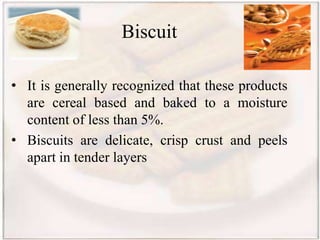
Biscuit
• It is generally recognized that these products
are cereal based and baked to a moisture
content of less than 5%.
• Biscuits are delicate, crisp crust and peels
apart in tender layers
Status of bakery industry in India
• The annual production of bakery products was 50 lakh
tones in 2004-05 with estimated value of Rs. 69 billion
• The organized sector has a market share of 45 per cent
and the balance 55 per cent is with the unorganized sector
in the baked products.
• The large organized sector players who are prominent in
the high- and medium-price segments include Britannia,
Modern Industries Ltd.
Source: FSSAI report 2004-2005
Status of bakery industry in India
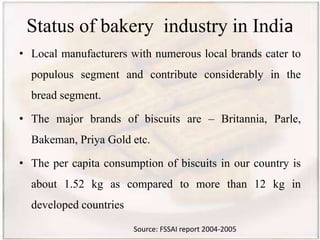
• Local manufacturers with numerous local brands cater to
populous segment and contribute considerably in the
bread segment.
• The major brands of biscuits are – Britannia, Parle,
Bakeman, Priya Gold etc.
• The per capita consumption of biscuits in our country is
about 1.52 kg as compared to more than 12 kg in
developed countries
Source: FSSAI report 2004-2005
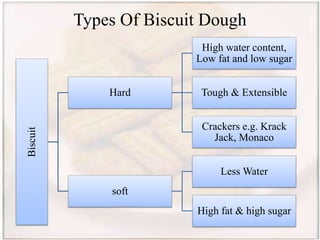
Types Of Biscuit Dough
Biscuit
Hard
High water content,
Low fat and low sugar
Tough & Extensible
Crackers e.g. Krack
Jack, Monaco
soft
Less Water
High fat & high sugar
Classification of Biscuits
By degree of
enrichment and
processing
Hard dough
biscuits
Semi hard
dough biscuits
Soft dough
biscuits
By method of shaping
Embossed
cutting
Rotary
mounding
Rotary
cutting
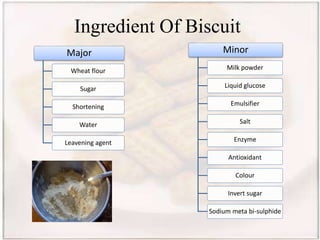
Ingredient Of Biscuit
Major
Wheat flour
Sugar
Shortening
Water
Leavening agent
Minor
Milk powder
Liquid glucose
Emulsifier
Salt
Enzyme
Antioxidant
Colour
Invert sugar
Sodium meta bi-sulphide
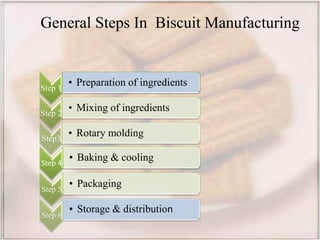
General Steps In Biscuit Manufacturing
Step 1
• Preparation of ingredients
Step 2
• Mixing of ingredients
Step3
• Rotary molding
Step 4
• Baking & cooling
Step 5
• Packaging
Step 6
• Storage & distribution
Preparation Of Ingredient
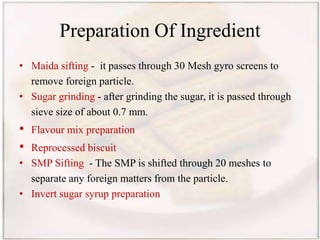
• Maida sifting - it passes through 30 Mesh gyro screens to
remove foreign particle.
• Sugar grinding - after grinding the sugar, it is passed through
sieve size of about 0.7 mm.
• Flavour mix preparation
• Reprocessed biscuit
• SMP Sifting - The SMP is shifted through 20 meshes to
separate any foreign matters from the particle.
• Invert sugar syrup preparation
Mixing Section
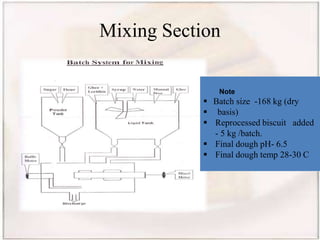
Note
 Batch size -168 kg (dry
 basis)
 Reprocessed biscuit added
- 5 kg /batch.
 Final dough pH- 6.5
 Final dough temp 28-30 C
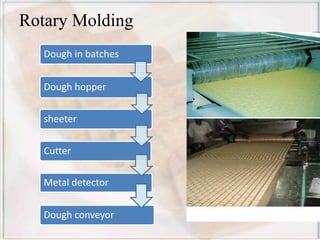
Dough in batches
Dough hopper
sheeter
Cutter
Metal detector
Dough conveyor
Rotary Molding
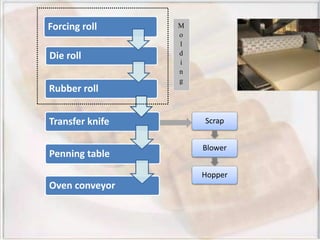
Forcing roll
Die roll
Rubber roll
Transfer knife
Penning table
Oven conveyor
M
o
l
d
i
n
g
Scrap
Blower
Hopper
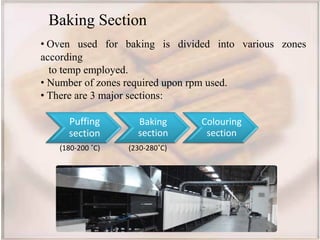
• Oven used for baking is divided into various zones
according
to temp employed.
• Number of zones required upon rpm used.
• There are 3 major sections:
(230-280˚C)(180-200 ˚C)
Puffing
section
Baking
section
Colouring
section
Baking Section
Cooling Of Biscuit
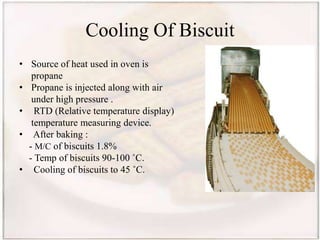
• Source of heat used in oven is
propane
• Propane is injected along with air
under high pressure .
• RTD (Relative temperature display)
temperature measuring device.
• After baking :
- M/C of biscuits 1.8%
- Temp of biscuits 90-100 ˚C.
• Cooling of biscuits to 45 ˚C.
Cookies
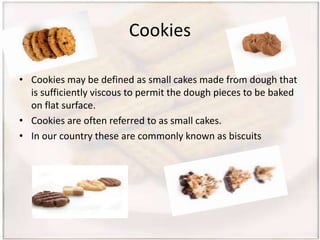
• Cookies may be defined as small cakes made from dough that
is sufficiently viscous to permit the dough pieces to be baked
on flat surface.
• Cookies are often referred to as small cakes.
• In our country these are commonly known as biscuits
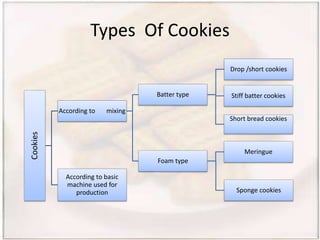
Types Of CookiesCookies
According to mixing
Batter type
Drop /short cookies
Stiff batter cookies
Short bread cookies
Foam type
Meringue
Sponge cookies
According to basic
machine used for
production
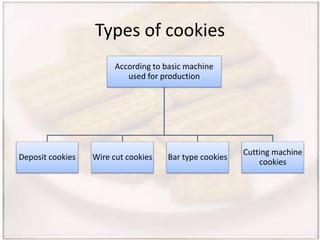
Types of cookies
According to basic machine
used for production
Deposit cookies Wire cut cookies Bar type cookies
Cutting machine
cookies
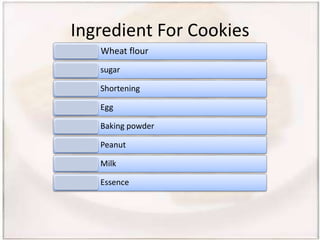
Ingredient For Cookies
Wheat flour
sugar
Shortening
Egg
Baking powder
Peanut
Milk
Essence
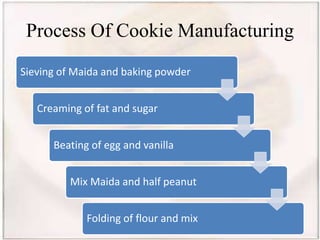
Process Of Cookie Manufacturing
Sieving of Maida and baking powder
Creaming of fat and sugar
Beating of egg and vanilla
Mix Maida and half peanut
Folding of flour and mix
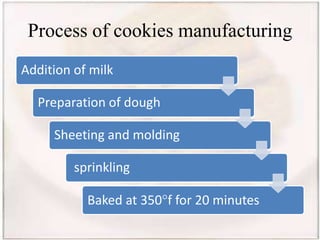
Process of cookies manufacturing
Addition of milk
Preparation of dough
Sheeting and molding
sprinkling
Baked at 350f for 20 minutes
References
• Oxford University Press, "Oxford Dictionaries Online: 'biscuit'“
• Biscuit" (http://www.merriamwebster. com/dictionary/biscuit).
Merriam Webster. Retrieved 14 January 2010.
• "Cookie" (http://www.merriamwebster. com/dictionary/cookie).
Merriam Webster. Retrieved 14 January 2010.
• 10. ^ David, Elizabeth (17 Nov 1977). "Yeast Buns and Small Tea
Cakes". English Bread and Yeast Cookery.
• Illustrated by Wendy Jones (1 ed.). Allen Lane. sec. "Soft Biscuits".
ISBN 9780713910261.
• "Biscuits & Cookies
(http://www.foodtimeline.org/foodcookies.html). Food Timeline.
Retrieved 15 January 2010
Biscuit and cookies

Biscuit and cookies

  • 1.
    Biscuit And Cookies BY PintuChoudhary Master of Technology ( Food Science and Technology) Indian Institute of Crop Processing Technology Ministry of Food Processing Industries Government of India Thanjavur - 613005
  • 2.
    Biscuit • It isgenerally recognized that these products are cereal based and baked to a moisture content of less than 5%. • Biscuits are delicate, crisp crust and peels apart in tender layers
  • 3.
    Status of bakeryindustry in India • The annual production of bakery products was 50 lakh tones in 2004-05 with estimated value of Rs. 69 billion • The organized sector has a market share of 45 per cent and the balance 55 per cent is with the unorganized sector in the baked products. • The large organized sector players who are prominent in the high- and medium-price segments include Britannia, Modern Industries Ltd. Source: FSSAI report 2004-2005
  • 4.
    Status of bakeryindustry in India • Local manufacturers with numerous local brands cater to populous segment and contribute considerably in the bread segment. • The major brands of biscuits are – Britannia, Parle, Bakeman, Priya Gold etc. • The per capita consumption of biscuits in our country is about 1.52 kg as compared to more than 12 kg in developed countries Source: FSSAI report 2004-2005
  • 5.
    Types Of BiscuitDough Biscuit Hard High water content, Low fat and low sugar Tough & Extensible Crackers e.g. Krack Jack, Monaco soft Less Water High fat & high sugar
  • 6.
    Classification of Biscuits Bydegree of enrichment and processing Hard dough biscuits Semi hard dough biscuits Soft dough biscuits By method of shaping Embossed cutting Rotary mounding Rotary cutting
  • 7.
    Ingredient Of Biscuit Major Wheatflour Sugar Shortening Water Leavening agent Minor Milk powder Liquid glucose Emulsifier Salt Enzyme Antioxidant Colour Invert sugar Sodium meta bi-sulphide
  • 8.
    General Steps InBiscuit Manufacturing Step 1 • Preparation of ingredients Step 2 • Mixing of ingredients Step3 • Rotary molding Step 4 • Baking & cooling Step 5 • Packaging Step 6 • Storage & distribution
  • 9.
    Preparation Of Ingredient •Maida sifting - it passes through 30 Mesh gyro screens to remove foreign particle. • Sugar grinding - after grinding the sugar, it is passed through sieve size of about 0.7 mm. • Flavour mix preparation • Reprocessed biscuit • SMP Sifting - The SMP is shifted through 20 meshes to separate any foreign matters from the particle. • Invert sugar syrup preparation
  • 10.
    Mixing Section Note  Batchsize -168 kg (dry  basis)  Reprocessed biscuit added - 5 kg /batch.  Final dough pH- 6.5  Final dough temp 28-30 C
  • 11.
    Dough in batches Doughhopper sheeter Cutter Metal detector Dough conveyor Rotary Molding
  • 12.
    Forcing roll Die roll Rubberroll Transfer knife Penning table Oven conveyor M o l d i n g Scrap Blower Hopper
  • 13.
    • Oven usedfor baking is divided into various zones according to temp employed. • Number of zones required upon rpm used. • There are 3 major sections: (230-280˚C)(180-200 ˚C) Puffing section Baking section Colouring section Baking Section
  • 14.
    Cooling Of Biscuit •Source of heat used in oven is propane • Propane is injected along with air under high pressure . • RTD (Relative temperature display) temperature measuring device. • After baking : - M/C of biscuits 1.8% - Temp of biscuits 90-100 ˚C. • Cooling of biscuits to 45 ˚C.
  • 15.
    Cookies • Cookies maybe defined as small cakes made from dough that is sufficiently viscous to permit the dough pieces to be baked on flat surface. • Cookies are often referred to as small cakes. • In our country these are commonly known as biscuits
  • 16.
    Types Of CookiesCookies Accordingto mixing Batter type Drop /short cookies Stiff batter cookies Short bread cookies Foam type Meringue Sponge cookies According to basic machine used for production
  • 17.
    Types of cookies Accordingto basic machine used for production Deposit cookies Wire cut cookies Bar type cookies Cutting machine cookies
  • 18.
    Ingredient For Cookies Wheatflour sugar Shortening Egg Baking powder Peanut Milk Essence
  • 19.
    Process Of CookieManufacturing Sieving of Maida and baking powder Creaming of fat and sugar Beating of egg and vanilla Mix Maida and half peanut Folding of flour and mix
  • 20.
    Process of cookiesmanufacturing Addition of milk Preparation of dough Sheeting and molding sprinkling Baked at 350f for 20 minutes
  • 21.
    References • Oxford UniversityPress, "Oxford Dictionaries Online: 'biscuit'“ • Biscuit" (http://www.merriamwebster. com/dictionary/biscuit). Merriam Webster. Retrieved 14 January 2010. • "Cookie" (http://www.merriamwebster. com/dictionary/cookie). Merriam Webster. Retrieved 14 January 2010. • 10. ^ David, Elizabeth (17 Nov 1977). "Yeast Buns and Small Tea Cakes". English Bread and Yeast Cookery. • Illustrated by Wendy Jones (1 ed.). Allen Lane. sec. "Soft Biscuits". ISBN 9780713910261. • "Biscuits & Cookies (http://www.foodtimeline.org/foodcookies.html). Food Timeline. Retrieved 15 January 2010