Toffees
• The word “toffee” is derived from the word “taffy” which means 
sticky. 
• Originally the toffee contained brown sugar, invert syrup and glucose 
syrup and fat. It was high moisture product similar to butter scotch.
Toffees 
• The unique thing about toffees is “Maillard Reaction” which is 
manifested by interaction between reducing sugar and protein 
content. 
• The reducing sugars are usually provided by either Invert Syrup or by 
Glucose Syrup 
• Protein is provided by milk solids.
Oil in water Emulsion 
• Toffees are defined as oil in water dispersion where fat globules are 
dispersed in water phase. Though toffees contain a very little amount 
of moisture, but still it is called O/W emulsion because of the fact that 
aqueous phase is made of sugar and glucose syrup matrix
Another Definition 
• A complex blend of fat globules in varying sizes surrounded by a high 
concentration of sugar solution in which non fat milk solids are 
dispersed and dissolved.”
Difference between caramel and toffee 
• No there is no difference between caramel and toffee. However it is 
said that caramels have higher moisture and fat content compared to 
toffees which are a bit harder.
Major Ingredients of Toffee
Sugar 
• Sugar is one of the major components of toffees and caramels. 
• Some is added in the form of sweetened condensed milk. 
• While rest is added in the form of crystalline sugar.
42 DE Glucose syrup 
• It not only provides the bulk 
• Source of reducing sugar 
• Doctor sugar 
• Lowers water activity 
• Resists drying out.
Condensed Milk 
• Sweetened condensed milk provide 
• Fat 
• Protein 
• Sugar.
Fat 
• Though butter/milk fat is more commonly added. 
• However, now vegetable fat is also added as it can be easily tailored.
Optional Ingredients: Milk Powder 
• It is the best alternative to sweetened condensed milk
Whey Powder 
• It is used to make whey tofees 
• Provide protein for maillard reaction 
• It also helps in emulsification.
Hydrolysed Whey Syrup 
• Whey syrup is hydrolysed to produce glucose and galactose which 
can be easily concentrated compared to lactose. 
• Whey syrup is used when cheesy flavour is desirable in toffees.
Invert Sugar Syrup 
• Not used much why? Cost of course
Brown Sugar 
• The use of brown sugar has been curtailed. 
• Brown sugar enhances both color and flavour.
Emulsifiers 
• They are added to disperse fat globules 
• E.g are lecithin or monoglycerides like GMS. 
• If enough milk solids are present than there is no use of adding 
emulsifier. 
• However adding small amount of emulsifiers reduces the cost as milk 
solids are expensive. 
• Too much fat dispersion is not desirable. 
• As surface fat allows easy cutting 
• Or otherwise the knife should be coated with Teflon 
(PTFE)Polytetraflouroethylene.
68 DE Glucose Syrup or Higher 
• It is used as a direct replacement of Invert syrup. 
• It improves the keeping quality as unlike invert syrup it is less 
hygroscopic. 
• Also it is cheaper than invert syrup.
Isomerized Glucose Syrup 
• It is made from corn syrup and is a mixture of glucose and fructose 
similar to invert syrup. 
• Made from glucose isomerase. 
• The degree of conversion could vary from0-100%. 
• 50% conversion is a direct replacement for invert syrup. 
• While 100% conversion is a source of fructose. 
• However, its use is less as it affects the keeping qualities of toffees.
Salt 
• Salt enhances the flavour of the toffees. 
• The common percentage used is 0.5%.
Flavors 
• Flavors could be added like vanilla. 
• However even if made without addition of flavour. Then flavour due 
to maillard reaction is enough.
Color 
• Commonly added color is caramel (i.e of burnt sugar).
Process for making toffee 
1. DISSOLVING 
Sugars are dissolved in a mixture of sugar and and glucose syrup.
Emulsifying 
• The fat and skim milks solids are then added. The skim milk solids are 
then added as emulsifying agent for caramels termed as oil in water 
emulsion.
Cooking 
• Cooked to 124 degrees centigrade. However, it may differ from 
person to person.
Shaping the Toffee. 
• There are three methods 
• A) Slab process 
• B) Cut and Wrap process 
• C) Depositing.
The Slab Process: 
• The toffee is poured over water cooled slabs. 
• The slabs are greased with some amount of vegetable fat. 
• Turned up and down to allow rapid cooling as caramel is a poor 
conductor of heat. 
• It is then cut into sheets and then cut into individual pieces.
Cut and Wrap Process 
• The toffee is first cooled over a metal drum and is then fed into batch 
rollers to shape the mass into the cone and then into a rope. 
• The rope is then pass through further rollers to further reduce the 
thickness of rope. 
• The product is then cut with a rotating knife. 
• The pieces are then fed into the wrapping paper. 
• And twist wrapped
Depositing 
• The caramel or toffee is made by depositing it into either starch 
moulds or chocolate shells which are later on sealed with the help of 
chocolate. 
• Another choice is to deposit in rubber moulds. 
• But in the depositing method moulding is done when hot to maintain 
the flow nature of caramel. 
• And after depositing it must be cooled subsequently, heat is difficult 
to abstract from caramel due to its low water activity. 
• Cooling must be done above the dew point to avoid condensation.
Some key points 
• The final cooking temperature is 125-145 °C. 
• At this stage 6-8% moisture is left. This type of caramel is pleasant in 
taste.
Some key points 
• Increasing temperature upto 145°C must be used with caramels of 
places with hotter climates. 
• The moisture left is around 3% and chew characteristics are poor.
Some key points 
• A stable caramel has 1.2-1.4 parts of sucrose to every part of reducing 
sugar so as to prevent the phenomenon of graining. 
• If you increase the sucrose beyond this ration then chances of 
graining will increase. 
• And if you increase reducing sugar then it will affect the keeping 
qualities.
Some key points 
• The tendency of caramel to grain is more if 
• A) kept at warmer climates. 
• B) Higher milk solids increase viscosity and reduces chances of 
graining. 
• C) Mechanical agitation which incorporates air.
Some key points 
• Glucose syrup with higher DE produces hard caramels that have 
better flow properties whereas GS with lower DE produces both 
harder and chewable caramels.
Some Key points 
Maltose syrup gives caramel with 
lighter in color and thus gives a 
creamy appearance
Some key points 
• Presence of higher milk solids particularly casein makes caramels a bit 
harder.
Some key points 
• Due to the presence of reducing sugars and milk proteins, maillard 
reaction takes place. 
• Maillard reaction is slow upto a temperature of 40°C, but increases 
rapidly above the temperature of 95°C. 
• As temperature increases, maillard reaction increases and 
subsequently color and flavour enhances. 
• Caramellization of sucrose also contributes to flavour of caramels.
Some key points 
• Fat percentage is around (4-20)%. Low fat content gives caramels that 
are harder in texture. 
• While high amount of fat without emulsifier causes oiling on the 
surface of caramel because of improper emulsification. 
• Antioxidants are also added to maintain fresh flavour of caramels like 
BHA (Butylated Hydroxy anisole), PG (Propyl gallate)
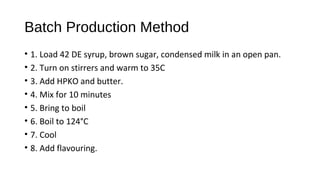
Batch Production Method 
• 1. Load 42 DE syrup, brown sugar, condensed milk in an open pan. 
• 2. Turn on stirrers and warm to 35C 
• 3. Add HPKO and butter. 
• 4. Mix for 10 minutes 
• 5. Bring to boil 
• 6. Boil to 124°C 
• 7. Cool 
• 8. Add flavouring.
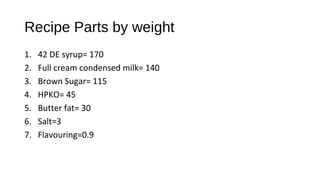
Recipe Parts by weight 
1. 42 DE syrup= 170 
2. Full cream condensed milk= 140 
3. Brown Sugar= 115 
4. HPKO= 45 
5. Butter fat= 30 
6. Salt=3 
7. Flavouring=0.9

Toffees

  • 1.
  • 2.
    • The word“toffee” is derived from the word “taffy” which means sticky. • Originally the toffee contained brown sugar, invert syrup and glucose syrup and fat. It was high moisture product similar to butter scotch.
  • 3.
    Toffees • Theunique thing about toffees is “Maillard Reaction” which is manifested by interaction between reducing sugar and protein content. • The reducing sugars are usually provided by either Invert Syrup or by Glucose Syrup • Protein is provided by milk solids.
  • 4.
    Oil in waterEmulsion • Toffees are defined as oil in water dispersion where fat globules are dispersed in water phase. Though toffees contain a very little amount of moisture, but still it is called O/W emulsion because of the fact that aqueous phase is made of sugar and glucose syrup matrix
  • 5.
    Another Definition •A complex blend of fat globules in varying sizes surrounded by a high concentration of sugar solution in which non fat milk solids are dispersed and dissolved.”
  • 6.
    Difference between carameland toffee • No there is no difference between caramel and toffee. However it is said that caramels have higher moisture and fat content compared to toffees which are a bit harder.
  • 7.
  • 8.
    Sugar • Sugaris one of the major components of toffees and caramels. • Some is added in the form of sweetened condensed milk. • While rest is added in the form of crystalline sugar.
  • 9.
    42 DE Glucosesyrup • It not only provides the bulk • Source of reducing sugar • Doctor sugar • Lowers water activity • Resists drying out.
  • 10.
    Condensed Milk •Sweetened condensed milk provide • Fat • Protein • Sugar.
  • 11.
    Fat • Thoughbutter/milk fat is more commonly added. • However, now vegetable fat is also added as it can be easily tailored.
  • 12.
    Optional Ingredients: MilkPowder • It is the best alternative to sweetened condensed milk
  • 13.
    Whey Powder •It is used to make whey tofees • Provide protein for maillard reaction • It also helps in emulsification.
  • 14.
    Hydrolysed Whey Syrup • Whey syrup is hydrolysed to produce glucose and galactose which can be easily concentrated compared to lactose. • Whey syrup is used when cheesy flavour is desirable in toffees.
  • 15.
    Invert Sugar Syrup • Not used much why? Cost of course
  • 16.
    Brown Sugar •The use of brown sugar has been curtailed. • Brown sugar enhances both color and flavour.
  • 17.
    Emulsifiers • Theyare added to disperse fat globules • E.g are lecithin or monoglycerides like GMS. • If enough milk solids are present than there is no use of adding emulsifier. • However adding small amount of emulsifiers reduces the cost as milk solids are expensive. • Too much fat dispersion is not desirable. • As surface fat allows easy cutting • Or otherwise the knife should be coated with Teflon (PTFE)Polytetraflouroethylene.
  • 18.
    68 DE GlucoseSyrup or Higher • It is used as a direct replacement of Invert syrup. • It improves the keeping quality as unlike invert syrup it is less hygroscopic. • Also it is cheaper than invert syrup.
  • 19.
    Isomerized Glucose Syrup • It is made from corn syrup and is a mixture of glucose and fructose similar to invert syrup. • Made from glucose isomerase. • The degree of conversion could vary from0-100%. • 50% conversion is a direct replacement for invert syrup. • While 100% conversion is a source of fructose. • However, its use is less as it affects the keeping qualities of toffees.
  • 20.
    Salt • Saltenhances the flavour of the toffees. • The common percentage used is 0.5%.
  • 21.
    Flavors • Flavorscould be added like vanilla. • However even if made without addition of flavour. Then flavour due to maillard reaction is enough.
  • 22.
    Color • Commonlyadded color is caramel (i.e of burnt sugar).
  • 23.
    Process for makingtoffee 1. DISSOLVING Sugars are dissolved in a mixture of sugar and and glucose syrup.
  • 24.
    Emulsifying • Thefat and skim milks solids are then added. The skim milk solids are then added as emulsifying agent for caramels termed as oil in water emulsion.
  • 25.
    Cooking • Cookedto 124 degrees centigrade. However, it may differ from person to person.
  • 26.
    Shaping the Toffee. • There are three methods • A) Slab process • B) Cut and Wrap process • C) Depositing.
  • 27.
    The Slab Process: • The toffee is poured over water cooled slabs. • The slabs are greased with some amount of vegetable fat. • Turned up and down to allow rapid cooling as caramel is a poor conductor of heat. • It is then cut into sheets and then cut into individual pieces.
  • 28.
    Cut and WrapProcess • The toffee is first cooled over a metal drum and is then fed into batch rollers to shape the mass into the cone and then into a rope. • The rope is then pass through further rollers to further reduce the thickness of rope. • The product is then cut with a rotating knife. • The pieces are then fed into the wrapping paper. • And twist wrapped
  • 29.
    Depositing • Thecaramel or toffee is made by depositing it into either starch moulds or chocolate shells which are later on sealed with the help of chocolate. • Another choice is to deposit in rubber moulds. • But in the depositing method moulding is done when hot to maintain the flow nature of caramel. • And after depositing it must be cooled subsequently, heat is difficult to abstract from caramel due to its low water activity. • Cooling must be done above the dew point to avoid condensation.
  • 30.
    Some key points • The final cooking temperature is 125-145 °C. • At this stage 6-8% moisture is left. This type of caramel is pleasant in taste.
  • 31.
    Some key points • Increasing temperature upto 145°C must be used with caramels of places with hotter climates. • The moisture left is around 3% and chew characteristics are poor.
  • 32.
    Some key points • A stable caramel has 1.2-1.4 parts of sucrose to every part of reducing sugar so as to prevent the phenomenon of graining. • If you increase the sucrose beyond this ration then chances of graining will increase. • And if you increase reducing sugar then it will affect the keeping qualities.
  • 33.
    Some key points • The tendency of caramel to grain is more if • A) kept at warmer climates. • B) Higher milk solids increase viscosity and reduces chances of graining. • C) Mechanical agitation which incorporates air.
  • 34.
    Some key points • Glucose syrup with higher DE produces hard caramels that have better flow properties whereas GS with lower DE produces both harder and chewable caramels.
  • 35.
    Some Key points Maltose syrup gives caramel with lighter in color and thus gives a creamy appearance
  • 36.
    Some key points • Presence of higher milk solids particularly casein makes caramels a bit harder.
  • 37.
    Some key points • Due to the presence of reducing sugars and milk proteins, maillard reaction takes place. • Maillard reaction is slow upto a temperature of 40°C, but increases rapidly above the temperature of 95°C. • As temperature increases, maillard reaction increases and subsequently color and flavour enhances. • Caramellization of sucrose also contributes to flavour of caramels.
  • 38.
    Some key points • Fat percentage is around (4-20)%. Low fat content gives caramels that are harder in texture. • While high amount of fat without emulsifier causes oiling on the surface of caramel because of improper emulsification. • Antioxidants are also added to maintain fresh flavour of caramels like BHA (Butylated Hydroxy anisole), PG (Propyl gallate)
  • 39.
    Batch Production Method • 1. Load 42 DE syrup, brown sugar, condensed milk in an open pan. • 2. Turn on stirrers and warm to 35C • 3. Add HPKO and butter. • 4. Mix for 10 minutes • 5. Bring to boil • 6. Boil to 124°C • 7. Cool • 8. Add flavouring.
  • 40.
    Recipe Parts byweight 1. 42 DE syrup= 170 2. Full cream condensed milk= 140 3. Brown Sugar= 115 4. HPKO= 45 5. Butter fat= 30 6. Salt=3 7. Flavouring=0.9