See discussions, stats, and author profiles for this publication at: https://www.researchgate.net/publication/315658615
Enzymes As a Flour Improvers
Presentation · April 2015
DOI: 10.13140/RG.2.2.31426.38081
CITATIONS
0
READS
1,465
1 author:
Some of the authors of this publication are also working on these related projects:
Natural Food Toxicants from Animal Resources. View project
Modification Starch and its applications in Food processing View project
Mohamed G. E. Gadallah
Facultad de Agronomía,
43 PUBLICATIONS   186 CITATIONS   
SEE PROFILE
All content following this page was uploaded by Mohamed G. E. Gadallah on 27 March 2017.
The user has requested enhancement of the downloaded file.
25.04.2015
1
Enzymes
As a Flour Improvers
25 April 2015 1Flour Improvers @ Dr. Mohamed Gadallah
‫الدقيق‬ ‫محسنات‬ ‫اإلنزيمات‬
Dr. Mohamed Gadallah
Food Sciences and Human Nutrition
Agriculture and Veterinary Medicine
Qassim University
25 April 2015 2Flour Improvers @ Dr. Mohamed Gadallah
25.04.2015
2
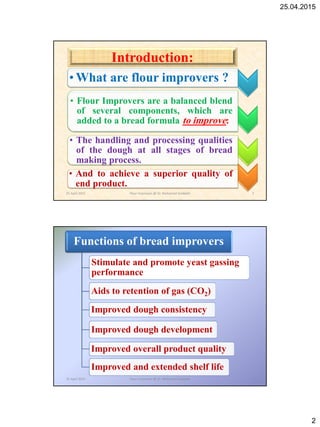
• What are flour improvers ?
• Flour Improvers are a balanced blend
of several components, which are
added to a bread formula to improve:
• The handling and processing qualities
of the dough at all stages of bread
making process.
• And to achieve a superior quality of
end product.
Introduction:
25 April 2015 3Flour Improvers @ Dr. Mohamed Gadallah
Functions of bread improvers
Stimulate and promote yeast gassing
performance
Aids to retention of gas (CO2)
Improved dough consistency
Improved dough development
Improved overall product quality
Improved and extended shelf life
25 April 2015 4Flour Improvers @ Dr. Mohamed Gadallah
25.04.2015
3
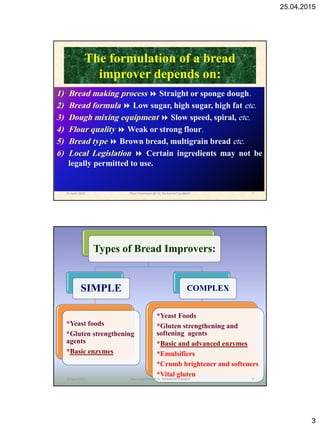
The formulation of a bread
improver depends on:
1) Bread making process  Straight or sponge dough.
2) Bread formula  Low sugar, high sugar, high fat etc.
3) Dough mixing equipment  Slow speed, spiral, etc.
4) Flour quality  Weak or strong flour.
5) Bread type  Brown bread, multigrain bread etc.
6) Local Legislation  Certain ingredients may not be
legally permitted to use.
25 April 2015 5Flour Improvers @ Dr. Mohamed Gadallah
Types of Bread Improvers:
SIMPLE
*Yeast foods
*Gluten strengthening
agents
*Basic enzymes
COMPLEX
*Yeast Foods
*Gluten strengthening and
softening agents
*Basic and advanced enzymes
*Emulsifiers
*Crumb brightener and softeners
*Vital gluten
25 April 2015 6Flour Improvers @ Dr. Mohamed Gadallah
25.04.2015
4
25 April 2015 7Flour Improvers @ Dr. Mohamed Gadallah
For decades, enzymes such as malt and
fungal alpha-amylases have been used in
bread-making.
The importance of enzymes is likely to
increase as consumers demand more
natural products free of chemical additives.
For example, enzymes can be used to
replace potassium bromate, a chemical
additive that has been banned in a number
of countries.
25 April 2015 8Flour Improvers @ Dr. Mohamed Gadallah
25.04.2015
5
Morever, they are natural as they can
obtained from micro-organisms by way of
fermentation or from vegetable or animal
tissue by means of exteraction.
Enzymes are highly specific, that is, if they
are pure enough they act on selected
targets and only have to be added in small
quantities.
25 April 2015 9Flour Improvers @ Dr. Mohamed Gadallah
25 April 2015 10Flour Improvers @ Dr. Mohamed Gadallah
25.04.2015
6
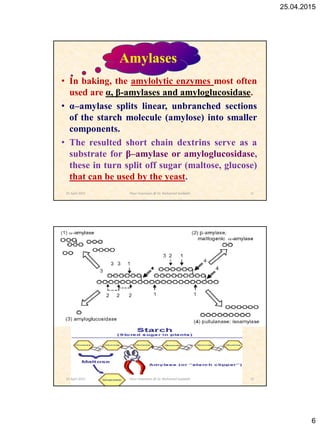
• In baking, the amylolytic enzymes most often
used are α, β-amylases and amyloglucosidase.
• α–amylase splits linear, unbranched sections
of the starch molecule (amylose) into smaller
components.
• The resulted short chain dextrins serve as a
substrate for β–amylase or amyloglucosidase,
these in turn split off sugar (maltose, glucose)
that can be used by the yeast.
Amylases
25 April 2015 11Flour Improvers @ Dr. Mohamed Gadallah
25 April 2015 12Flour Improvers @ Dr. Mohamed Gadallah
25.04.2015
7
enhances flavour and browning and
prolongs the shelf life (Crumb Softness)
increase the fermenting power
and thus the bread volume yield
reduce the dough viscosity
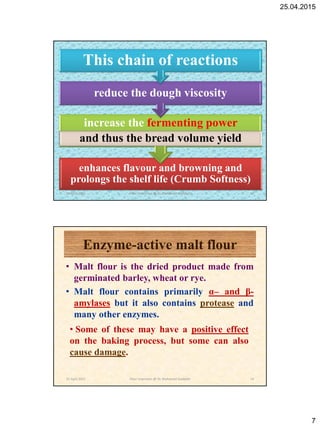
This chain of reactions
25 April 2015 13Flour Improvers @ Dr. Mohamed Gadallah
Enzyme-active malt flour
• Malt flour is the dried product made from
germinated barley, wheat or rye.
• Malt flour contains primarily α– and β-
amylases but it also contains protease and
many other enzymes.
• Some of these may have a positive effect
on the baking process, but some can also
cause damage.
25 April 2015 14Flour Improvers @ Dr. Mohamed Gadallah
25.04.2015
8
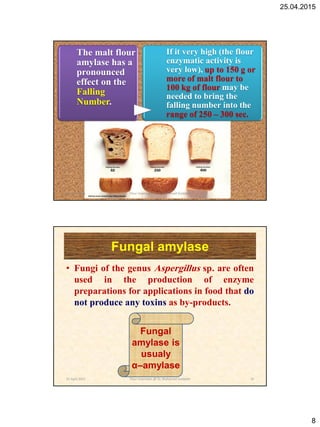
The malt flour
amylase has a
pronounced
effect on the
Falling
Number.
If it very high (the flour
enzymatic activity is
very low), up to 150 g or
more of malt flour to
100 kg of flour may be
needed to bring the
falling number into the
range of 250 – 300 sec.
25 April 2015 15Flour Improvers @ Dr. Mohamed Gadallah
Fungal amylase
• Fungi of the genus Aspergillus sp. are often
used in the production of enzyme
preparations for applications in food that do
not produce any toxins as by-products.
Fungal
amylase is
usualy
α–amylase
25 April 2015 16Flour Improvers @ Dr. Mohamed Gadallah
25.04.2015
9
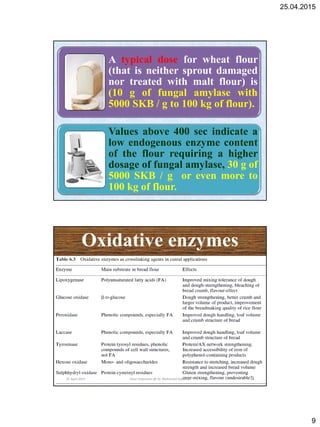
A typical dose for wheat flour
(that is neither sprout damaged
nor treated with malt flour) is
(10 g of fungal amylase with
5000 SKB / g to 100 kg of flour).
Values above 400 sec indicate a
low endogenous enzyme content
of the flour requiring a higher
dosage of fungal amylase, 30 g of
5000 SKB / g or even more to
100 kg of flour.25 April 2015 17Flour Improvers @ Dr. Mohamed Gadallah
Oxidative enzymes
25 April 2015 18Flour Improvers @ Dr. Mohamed Gadallah
25.04.2015
10
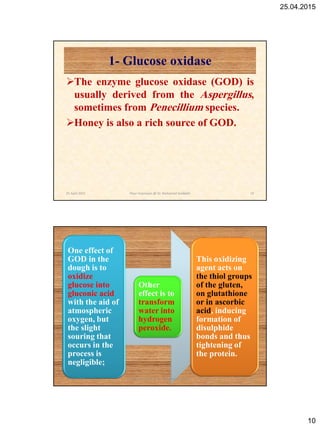
1- Glucose oxidase
The enzyme glucose oxidase (GOD) is
usually derived from the Aspergillus,
sometimes from Penecillium species.
Honey is also a rich source of GOD.
25 April 2015 19Flour Improvers @ Dr. Mohamed Gadallah
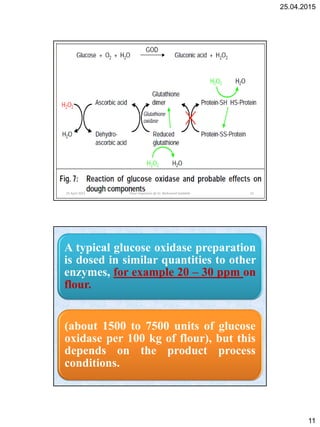
One effect of
GOD in the
dough is to
oxidize
glucose into
gluconic acid
with the aid of
atmospheric
oxygen, but
the slight
souring that
occurs in the
process is
negligible;
Other
effect is to
transform
water into
hydrogen
peroxide.
This oxidizing
agent acts on
the thiol groups
of the gluten,
on glutathione
or in ascorbic
acid, inducing
formation of
disulphide
bonds and thus
tightening of
the protein.
25 April 2015 20Flour Improvers @ Dr. Mohamed Gadallah
25.04.2015
11
25 April 2015 21Flour Improvers @ Dr. Mohamed Gadallah
25 April 2015 22Flour Improvers @ Dr. Mohamed Gadallah
A typical glucose oxidase preparation
is dosed in similar quantities to other
enzymes, for example 20 – 30 ppm on
flour.
(about 1500 to 7500 units of glucose
oxidase per 100 kg of flour), but this
depends on the product process
conditions.
25.04.2015
12
2- Lipoxygenase
One enzyme from soy flour, lipoxygenase, also
has an oxidative effect on the gluten.
During the oxidation of the lipids by
lipoxygenase, peroxides are formed that have
a cross-linking effect on thiol groups resulted
gluten-strengthening and bleaching effect.
The maximum quantities used are
usually 0.5% of soy flour to
achieve a light colored crumb.
25 April 2015 23Flour Improvers @ Dr. Mohamed Gadallah
Hemicellulase, Pentosanase
and Xylanase
• Wheat flour contains about 2-3 % pentosans
that can bind up to ten times their weight of
water.
• These pentosans belong to the category of
the hemicelluloses.
25 April 2015 24Flour Improvers @ Dr. Mohamed Gadallah
25.04.2015
13
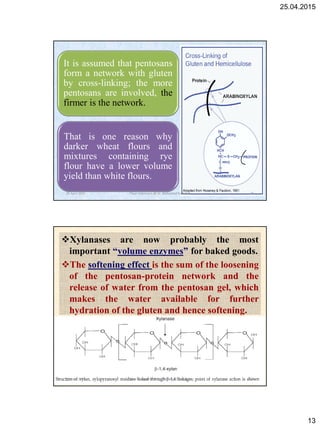
It is assumed that pentosans
form a network with gluten
by cross-linking; the more
pentosans are involved, the
firmer is the network.
That is one reason why
darker wheat flours and
mixtures containing rye
flour have a lower volume
yield than white flours.
25 April 2015 25Flour Improvers @ Dr. Mohamed Gadallah
Xylanases are now probably the most
important “volume enzymes” for baked goods.
The softening effect is the sum of the loosening
of the pentosan-protein network and the
release of water from the pentosan gel, which
makes the water available for further
hydration of the gluten and hence softening.
25 April 2015 26Flour Improvers @ Dr. Mohamed Gadallah
25.04.2015
14
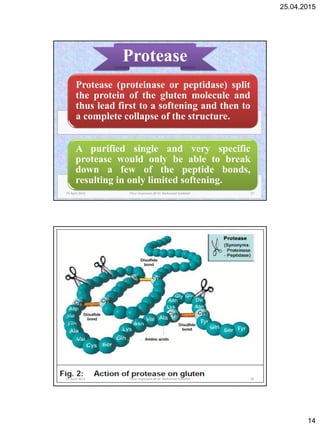
Protease (proteinase or peptidase) split
the protein of the gluten molecule and
thus lead first to a softening and then to
a complete collapse of the structure.
A purified single and very specific
protease would only be able to break
down a few of the peptide bonds,
resulting in only limited softening.
Protease
25 April 2015 27Flour Improvers @ Dr. Mohamed Gadallah
25 April 2015 28Flour Improvers @ Dr. Mohamed Gadallah
25.04.2015
15
• The use of protease is less of a problem
with flours that are rich in gluten.
First
• It is even very common in the production
of pan bread, where a soft dough that
precisely fills the tin is required.
Second
• Proteases are also very useful in the
production of cracker, biscuit or wafer
where elasticity of the gluten is not
desirable.
Third
25 April 2015 29Flour Improvers @ Dr. Mohamed Gadallah
Lipolytic enzymes
There are also polar lipids in wheat flour,
namely phospholipids and glycolipids,
which can be converted into more
hydrophilic forms by some special lipases
or phospholipases.
Lipase enzyme converts non-polar lipids
into diglycerides and monoglycerides, i.e.
emulsifiers.
25 April 2015 30Flour Improvers @ Dr. Mohamed Gadallah
25.04.2015
16
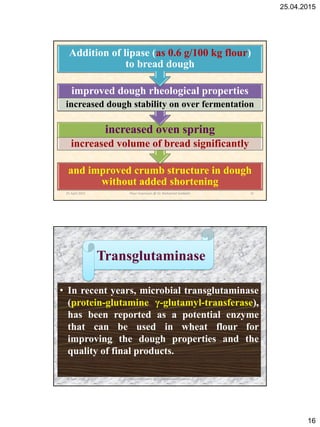
and improved crumb structure in dough
without added shortening
increased oven spring
increased volume of bread significantly
improved dough rheological properties
increased dough stability on over fermentation
Addition of lipase (as 0.6 g/100 kg flour)
to bread dough
25 April 2015 31Flour Improvers @ Dr. Mohamed Gadallah
• In recent years, microbial transglutaminase
(protein-glutamine γ-glutamyl-transferase),
has been reported as a potential enzyme
that can be used in wheat flour for
improving the dough properties and the
quality of final products.
Transglutaminase
25 April 2015 32Flour Improvers @ Dr. Mohamed Gadallah
25.04.2015
17
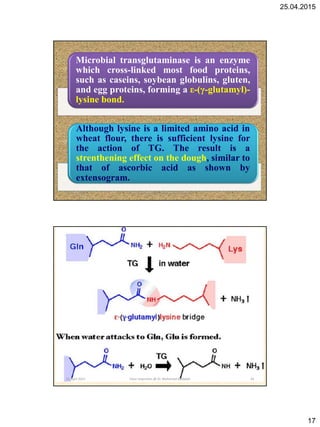
Microbial transglutaminase is an enzyme
which cross-linked most food proteins,
such as caseins, soybean globulins, gluten,
and egg proteins, forming a ε-(γ-glutamyl)-
lysine bond.
Although lysine is a limited amino acid in
wheat flour, there is sufficient lysine for
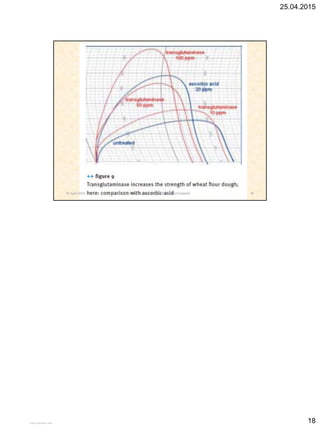
the action of TG. The result is a
strenthening effect on the dough, similar to
that of ascorbic acid as shown by
extensogram.
25 April 2015 33Flour Improvers @ Dr. Mohamed Gadallah
25 April 2015 34Flour Improvers @ Dr. Mohamed Gadallah
25.04.2015
18
25 April 2015 35Flour Improvers @ Dr. Mohamed Gadallah
View publication statsView publication stats

Flour improvers.

  • 1.
    See discussions, stats,and author profiles for this publication at: https://www.researchgate.net/publication/315658615 Enzymes As a Flour Improvers Presentation · April 2015 DOI: 10.13140/RG.2.2.31426.38081 CITATIONS 0 READS 1,465 1 author: Some of the authors of this publication are also working on these related projects: Natural Food Toxicants from Animal Resources. View project Modification Starch and its applications in Food processing View project Mohamed G. E. Gadallah Facultad de Agronomía, 43 PUBLICATIONS   186 CITATIONS    SEE PROFILE All content following this page was uploaded by Mohamed G. E. Gadallah on 27 March 2017. The user has requested enhancement of the downloaded file.
  • 2.
    25.04.2015 1 Enzymes As a FlourImprovers 25 April 2015 1Flour Improvers @ Dr. Mohamed Gadallah ‫الدقيق‬ ‫محسنات‬ ‫اإلنزيمات‬ Dr. Mohamed Gadallah Food Sciences and Human Nutrition Agriculture and Veterinary Medicine Qassim University 25 April 2015 2Flour Improvers @ Dr. Mohamed Gadallah
  • 3.
    25.04.2015 2 • What areflour improvers ? • Flour Improvers are a balanced blend of several components, which are added to a bread formula to improve: • The handling and processing qualities of the dough at all stages of bread making process. • And to achieve a superior quality of end product. Introduction: 25 April 2015 3Flour Improvers @ Dr. Mohamed Gadallah Functions of bread improvers Stimulate and promote yeast gassing performance Aids to retention of gas (CO2) Improved dough consistency Improved dough development Improved overall product quality Improved and extended shelf life 25 April 2015 4Flour Improvers @ Dr. Mohamed Gadallah
  • 4.
    25.04.2015 3 The formulation ofa bread improver depends on: 1) Bread making process  Straight or sponge dough. 2) Bread formula  Low sugar, high sugar, high fat etc. 3) Dough mixing equipment  Slow speed, spiral, etc. 4) Flour quality  Weak or strong flour. 5) Bread type  Brown bread, multigrain bread etc. 6) Local Legislation  Certain ingredients may not be legally permitted to use. 25 April 2015 5Flour Improvers @ Dr. Mohamed Gadallah Types of Bread Improvers: SIMPLE *Yeast foods *Gluten strengthening agents *Basic enzymes COMPLEX *Yeast Foods *Gluten strengthening and softening agents *Basic and advanced enzymes *Emulsifiers *Crumb brightener and softeners *Vital gluten 25 April 2015 6Flour Improvers @ Dr. Mohamed Gadallah
  • 5.
    25.04.2015 4 25 April 20157Flour Improvers @ Dr. Mohamed Gadallah For decades, enzymes such as malt and fungal alpha-amylases have been used in bread-making. The importance of enzymes is likely to increase as consumers demand more natural products free of chemical additives. For example, enzymes can be used to replace potassium bromate, a chemical additive that has been banned in a number of countries. 25 April 2015 8Flour Improvers @ Dr. Mohamed Gadallah
  • 6.
    25.04.2015 5 Morever, they arenatural as they can obtained from micro-organisms by way of fermentation or from vegetable or animal tissue by means of exteraction. Enzymes are highly specific, that is, if they are pure enough they act on selected targets and only have to be added in small quantities. 25 April 2015 9Flour Improvers @ Dr. Mohamed Gadallah 25 April 2015 10Flour Improvers @ Dr. Mohamed Gadallah
  • 7.
    25.04.2015 6 • In baking,the amylolytic enzymes most often used are α, β-amylases and amyloglucosidase. • α–amylase splits linear, unbranched sections of the starch molecule (amylose) into smaller components. • The resulted short chain dextrins serve as a substrate for β–amylase or amyloglucosidase, these in turn split off sugar (maltose, glucose) that can be used by the yeast. Amylases 25 April 2015 11Flour Improvers @ Dr. Mohamed Gadallah 25 April 2015 12Flour Improvers @ Dr. Mohamed Gadallah
  • 8.
    25.04.2015 7 enhances flavour andbrowning and prolongs the shelf life (Crumb Softness) increase the fermenting power and thus the bread volume yield reduce the dough viscosity This chain of reactions 25 April 2015 13Flour Improvers @ Dr. Mohamed Gadallah Enzyme-active malt flour • Malt flour is the dried product made from germinated barley, wheat or rye. • Malt flour contains primarily α– and β- amylases but it also contains protease and many other enzymes. • Some of these may have a positive effect on the baking process, but some can also cause damage. 25 April 2015 14Flour Improvers @ Dr. Mohamed Gadallah
  • 9.
    25.04.2015 8 The malt flour amylasehas a pronounced effect on the Falling Number. If it very high (the flour enzymatic activity is very low), up to 150 g or more of malt flour to 100 kg of flour may be needed to bring the falling number into the range of 250 – 300 sec. 25 April 2015 15Flour Improvers @ Dr. Mohamed Gadallah Fungal amylase • Fungi of the genus Aspergillus sp. are often used in the production of enzyme preparations for applications in food that do not produce any toxins as by-products. Fungal amylase is usualy α–amylase 25 April 2015 16Flour Improvers @ Dr. Mohamed Gadallah
  • 10.
    25.04.2015 9 A typical dosefor wheat flour (that is neither sprout damaged nor treated with malt flour) is (10 g of fungal amylase with 5000 SKB / g to 100 kg of flour). Values above 400 sec indicate a low endogenous enzyme content of the flour requiring a higher dosage of fungal amylase, 30 g of 5000 SKB / g or even more to 100 kg of flour.25 April 2015 17Flour Improvers @ Dr. Mohamed Gadallah Oxidative enzymes 25 April 2015 18Flour Improvers @ Dr. Mohamed Gadallah
  • 11.
    25.04.2015 10 1- Glucose oxidase Theenzyme glucose oxidase (GOD) is usually derived from the Aspergillus, sometimes from Penecillium species. Honey is also a rich source of GOD. 25 April 2015 19Flour Improvers @ Dr. Mohamed Gadallah One effect of GOD in the dough is to oxidize glucose into gluconic acid with the aid of atmospheric oxygen, but the slight souring that occurs in the process is negligible; Other effect is to transform water into hydrogen peroxide. This oxidizing agent acts on the thiol groups of the gluten, on glutathione or in ascorbic acid, inducing formation of disulphide bonds and thus tightening of the protein. 25 April 2015 20Flour Improvers @ Dr. Mohamed Gadallah
  • 12.
    25.04.2015 11 25 April 201521Flour Improvers @ Dr. Mohamed Gadallah 25 April 2015 22Flour Improvers @ Dr. Mohamed Gadallah A typical glucose oxidase preparation is dosed in similar quantities to other enzymes, for example 20 – 30 ppm on flour. (about 1500 to 7500 units of glucose oxidase per 100 kg of flour), but this depends on the product process conditions.
  • 13.
    25.04.2015 12 2- Lipoxygenase One enzymefrom soy flour, lipoxygenase, also has an oxidative effect on the gluten. During the oxidation of the lipids by lipoxygenase, peroxides are formed that have a cross-linking effect on thiol groups resulted gluten-strengthening and bleaching effect. The maximum quantities used are usually 0.5% of soy flour to achieve a light colored crumb. 25 April 2015 23Flour Improvers @ Dr. Mohamed Gadallah Hemicellulase, Pentosanase and Xylanase • Wheat flour contains about 2-3 % pentosans that can bind up to ten times their weight of water. • These pentosans belong to the category of the hemicelluloses. 25 April 2015 24Flour Improvers @ Dr. Mohamed Gadallah
  • 14.
    25.04.2015 13 It is assumedthat pentosans form a network with gluten by cross-linking; the more pentosans are involved, the firmer is the network. That is one reason why darker wheat flours and mixtures containing rye flour have a lower volume yield than white flours. 25 April 2015 25Flour Improvers @ Dr. Mohamed Gadallah Xylanases are now probably the most important “volume enzymes” for baked goods. The softening effect is the sum of the loosening of the pentosan-protein network and the release of water from the pentosan gel, which makes the water available for further hydration of the gluten and hence softening. 25 April 2015 26Flour Improvers @ Dr. Mohamed Gadallah
  • 15.
    25.04.2015 14 Protease (proteinase orpeptidase) split the protein of the gluten molecule and thus lead first to a softening and then to a complete collapse of the structure. A purified single and very specific protease would only be able to break down a few of the peptide bonds, resulting in only limited softening. Protease 25 April 2015 27Flour Improvers @ Dr. Mohamed Gadallah 25 April 2015 28Flour Improvers @ Dr. Mohamed Gadallah
  • 16.
    25.04.2015 15 • The useof protease is less of a problem with flours that are rich in gluten. First • It is even very common in the production of pan bread, where a soft dough that precisely fills the tin is required. Second • Proteases are also very useful in the production of cracker, biscuit or wafer where elasticity of the gluten is not desirable. Third 25 April 2015 29Flour Improvers @ Dr. Mohamed Gadallah Lipolytic enzymes There are also polar lipids in wheat flour, namely phospholipids and glycolipids, which can be converted into more hydrophilic forms by some special lipases or phospholipases. Lipase enzyme converts non-polar lipids into diglycerides and monoglycerides, i.e. emulsifiers. 25 April 2015 30Flour Improvers @ Dr. Mohamed Gadallah
  • 17.
    25.04.2015 16 and improved crumbstructure in dough without added shortening increased oven spring increased volume of bread significantly improved dough rheological properties increased dough stability on over fermentation Addition of lipase (as 0.6 g/100 kg flour) to bread dough 25 April 2015 31Flour Improvers @ Dr. Mohamed Gadallah • In recent years, microbial transglutaminase (protein-glutamine γ-glutamyl-transferase), has been reported as a potential enzyme that can be used in wheat flour for improving the dough properties and the quality of final products. Transglutaminase 25 April 2015 32Flour Improvers @ Dr. Mohamed Gadallah
  • 18.
    25.04.2015 17 Microbial transglutaminase isan enzyme which cross-linked most food proteins, such as caseins, soybean globulins, gluten, and egg proteins, forming a ε-(γ-glutamyl)- lysine bond. Although lysine is a limited amino acid in wheat flour, there is sufficient lysine for the action of TG. The result is a strenthening effect on the dough, similar to that of ascorbic acid as shown by extensogram. 25 April 2015 33Flour Improvers @ Dr. Mohamed Gadallah 25 April 2015 34Flour Improvers @ Dr. Mohamed Gadallah
  • 19.
    25.04.2015 18 25 April 201535Flour Improvers @ Dr. Mohamed Gadallah View publication statsView publication stats