Library Paper
Of
Food Laws, Standards & Regulations ( FST 322 )
Topic:- BRC (British Retail Consortium)
Submitted to :- Submitted by:-
Dr. Ankur Ojha Vimal Kumar
Assistant Professor Reg No.-114168
Department of Food Science and Technology B.Tech (2014-2018)
NIFTEM SONIPAT HARYANA BATCH C2
Out line
 ABOUT BRC GLOBAL STANDARDS
 OVERVIEW OF BRC
 BRC GLOBAL STANDARDS FOR FOOD SAFTEY
 BRC GLOBAL STANDARDS FOR PACKAGING
 BRC GLOBAL STANDARDS FOR DISTRIBUTION AND STORAGE
 BRC GLOBAL STANDARDS FOR AGENTS AND BROKERS
 BRC GLOBAL STANDARDS FOR CONSUMER PRODUCTS
 BRC GLOBAL STANDARDS FOR RETAIL
 WHY CHOOSE THE BRC GLOBAL STANDARD?
ABOUT BRC GLOBAL STANDARDS
• BRC Global Standards is a leading brand and consumer protection organisation, used by over 25,000
certificated suppliers over 130 countries, with certification issued through a global network of accredited
certification bodies. BRC Global Standards' guarantee the standardisation of quality, safety and
operational criteria and ensure that manufacturers fulfil their legal obligations and provide protection for
the end consumer. BRC Global Standards are now often a fundamental requirement of leading retailers,
manufacturers and food service organisations. for :-
• 1. Food Saftey
• 2. Packaging
• 3. Storage And Distribution
• 4. Agents And Brokers
• 5. Consumer Products
• 6. Retail
OVERVIEW OF BRC
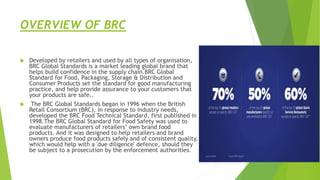
 Developed by retailers and used by all types of organisation,
BRC Global Standards is a market leading global brand that
helps build confidence in the supply chain.BRC Global
Standard for Food, Packaging, Storage & Distribution and
Consumer Products set the standard for good manufacturing
practice, and help provide assurance to your customers that
your products are safe..
 The BRC Global Standards began in 1996 when the British
Retail Consortium (BRC), in response to industry needs,
developed the BRC Food Technical Standard, first published in
1998.The BRC Global Standard for Food Safety was used to
evaluate manufacturers of retailers’ own brand food
products. And it was designed to help retailers and brand
owners produce food products safely and of consistent quality,
which would help with a 'due diligence' defence, should they
be subject to a prosecution by the enforcement authorities.
BRC GLOBAL STANDARDS FOR FOOD SAFTEY
 BRC Global Standard for Food Safety is developed by food industry experts from retailers, manufacturers
and food service organisations to ensure it is a rigorous and detailed, yet easy to understand the BRC Global
Standard.First published in 1998 it is now in its 7th issue and well established globally defined by many
leading global specifiers.
 It provides a framework to manage product safety, integrity, legality and quality, and the operational
controls for these criteria, in the food and food ingredient manufacturing, processing and packing industry.
 The BRC Global Standard focuses on:-
1. The importance of management commitment
2. HACCP (Hazard Analysis and Critical Control Point) based food safety programmes
3. Quality management systems
4. Auditing good manufacturing processes – it is not just a paperwork audit
5. Auditing areas which often have the highest rate of product recalls and
withdrawals, such as labelling and packing
6. Developing systems to reduce exposure to food fraud
7. Ensuring consistency of the audit process
8. Providing a BRC Global Standard that is portable enough to allow Additional
Modules to be added to reduce audit burden
9. Promoting greater resilience, transparency and traceability in the supply
chain
The BRC Global Standard is divided into seven sections.
1. SENIOR MANAGEMENT COMMITMENT AND CONTINUAL IMPROVEMENT
Consistent food safety is the responsibility of everyone within the company,
however, the starting point for an effective food safety plan is the commitment
of senior management to the implementation of the BRC Global Standard and
continual development. This includes providing adequate resources, effective
communication, system reviews, actions taken and opportunities for
improvement.

 2. THE FOOD SAFETY PLAN (HACCP)
 The BRC Global Standard requires the development of an effective HACCP (Hazard Analysis and
Critical Control Point) programme based on the requirements of the internationally recognised
Codex Alimentarius system.
 3. FOOD SAFETY AND QUALITY MANAGEMENT SYSTEM
 This section sets out the requirements for the management of food safety and quality. This includes
requirements for product specifications, supplier approval, traceability, and the management of
incidents and product recalls.
 4. SITE STANDARDS
 This section sets out expectations for the production environment including the layout and
maintenance of the buildings and equipment, cleaning, pest control, waste management and foreign
body controls.
 5. PRODUCT CONTROL
 The requirements for product design and development stage including allergen management,
product and ingredient provenance, product packaging and product inspection and testing.
BRC GLOBAL STANDARDS FOR PACKAGING
 Packaging is a fundamental part of any brand. It defines product integrity, security and drives
innovation. Consumers are attracted to strong and recognisable products that need to be consistent
in size, colour and shape. Packaging is therefore an integral part of the manufacturing process.
 The BRC Global Standard for Packaging and Packaging Materials is the first Packaging Standard in the
world to be recognised by the Global Food Safety Initiative (GSFI) benchmarking committee. It’s why
over 3,500 suppliers in over 80 countries have chosen to be certificated to this scheme and is
recommended or accepted by specifiers worldwide.
 The BRC Packaging Standard can be used by any manufacturer producing packaging materials for all
types of products - from food to consumer products - at all levels: primary, secondary and tertiary.
ISSUE 5: JULY 2015
 Issue 5 of the BRC Global Standard was published in July 2015 after consultation with industry
experts and we’ve designed the Standard to help you adopt good manufacturing practices and
support quality management systems. This will help you develop and manufacture safe, legal
packaging materials that meet the quality levels expected by your customers and consumers.
 The BRC Global Standard is divided into eight manufacturing technologies:
 Glass manufacture and forming
 Papermaking and conversion
 Metal forming
 Rigid plastics forming
 Flexible plastics manufacture
 Other manufacturing
 Print processes
 Chemical processes
 The BRC Global Standard consists of six sections:
 1. SENIOR MANAGEMENT COMMITMENT
 For any packaging quality management system to be effective it is essential that
management personnel are fully aware of the requirements and are committed to the
implementation.
 2. HAZARD AND RISK MANAGEMENT SYSTEM
 The basis for the programme is an effective Hazard and Risk Analysis based on the principles from
the internationally recognised Codex Alimentarius system and encompasses HACCP.
 3. PRODUCT SAFETY AND QUALITY MANAGEMENT
 Sets out requirements for the technical management of product quality and hygiene practices,
building upon the principles of ISO 9000. This includes requirements for product specifications,
supplier monitoring, traceability, and the management of incidents and product recalls.
 4. SITE STANDARDS
 Sets out expectations for the production environment including the layout and maintenance of the
buildings and equipment, cleaning, pest control and waste management. This includes a specific
section on managing foreign body and chemical controls.
 5. PRODUCT AND PROCESS CONTROL
 Includes the requirements at the product design and development stage including, quality
assurance, process control and product inspection and testing.
 6. PERSONNEL
 The standards needed for staff training, protective clothing and personal hygiene.
BRC GLOBAL STANDARDS FOR DISTRIBUTION
AND STORAGE
 Originally introduced in 2006, the BRC Global Standard for Storage and
Distribution provides the essential certification link between the range of BRC
Global Standards manufacturing Standards and the end user, such as the
retailer or the food service company.
 Developed by multi-stakeholder groups including industry representatives
from certification bodies, food service organizations and retailers, the BRC
Global Standard is designed to reflect best practice and facilitate a process of
continuous improvement through a well-designed risk-based product safety
management system.
 The objective of the BRC Global Standard is to ensure that product integrity
during the storage and distribution are maintained, and that customer
confidence is upheld through audit and certification. The third edition of the
BRC Global Standard for Storage and Distribution was published in 2016.
 STRUCTURE OF THE BRC GLOBAL STANDARDS
 1. Senior management commitment and continuous improvement
 2. Hazard and risk analysis
 3. Quality management system
 4. Site and building standards
 5. Vehicle operating standards
 6. Facility management
 7. Good operating practices
 8. Personnel
BRC GLOBAL STANDARDS FOR AGENTS AND
BROKERS
 Agents and Brokers (non-manufacturing traders) who buy, sell or facilitate the trade of
products, provide a critical link in the movement and trade of products, and influence supplier
product safety and quality standards, as well as being responsible for maintaining an effective
chain of traceability.
 The BRC Global Standard for Agents and Brokers has been developed to provide a framework for
managing product safety, quality and legality for these non-manufacturing businesses in the
food and packaging industries.
 THE BRC GLOBAL STANDARD IS AIMED AT:
 Brokers: Companies that purchase or ‘take title to’ products for resale to manufacturers, other
brokers, retailers or food service companies, but not directly to the consumer
 Agents or non-manufacturing service providers: Companies that trade between a manufacturer
or broker and their customers, but do not own or take title to the goods
 Importers/Exporters: Companies that facilitate the movement of products across national
boundaries, satisfying legal and customs requirements. Importers and exporters may also be
agents and/or brokers
The BRC Global Standard is divided into five sections
 1. SENIOR MANAGEMENT COMMITMENT AND CONTINUAL IMPROVEMENT
Consistent product safety is the responsibility of everyone within the company. The starting point for an effective product safety
plan is the commitment of senior management to the implementation of the BRC Global Standard and continual development.
This includes providing adequate resources, effective communication, system reviews, actions taken and opportunities for
improvement
 2. HAZARD AND RISK ASSESSMENT
The BRC Global Standard requires the development of a product safety plan covering the services/operations that the company
manages or specifies. This is based on the principles of hazard and risk analysis (commonly known as HACCP in the food industry)
and must be documented, comprehensive, fully implemented and maintained
 3. PRODUCT SAFETY AND QUALITY MANAGEMENT SYSTEM
Sets out the requirements for the management of product safety and quality. This includes requirements for document control,
internal auditing, control of non-conforming product and the management of incidents and product recalls
4. SUPPLIER AND SUBCONTRACTED SERVICE MANAGEMENT The selection and management of product
manufacturers, subcontractors and service providers is key to the management of product safety. A risk-based approach is used
to ensure that products and services are only sourced from approved manufacturers, following agreed specifications, with a
traceable and transparent supply chain
5. PERSONNEL
Sets out the standard needed to ensure employees are adequately trained and instructed and are demonstrably competent to
carry out their activities
BRC GLOBAL STANDARDS FOR CONSUMER PRODUCTS
 The new issue of the Consumer Products Standards Issue 4 in 2016 has been fully
revised to:
 Recognise the diversity of products included within Consumer Products
 Align the Standard with the actual buying expectations of specifiers whilst encouraging
continuous improvement
 Simplify the requirement and terminology to make it easier to understand
 Widen the scope to include products for wholesale sale and components/raw materials
 Ensure that requirements were risk based
 Introduce an entry Foundation level and Higher level to encourage continuous
improvement

 To achieve these objectives we have divided Consumer Products into two separate
Standards
 Global Standard for Consumer Products – General Merchandise
 Global Standard for Consumer Products – Personal Care and Household
 Each of the Standards can be certificated at either Foundation Level or at Higher level. This
enables both flexibility to reflect customer’s needs depending on the product sector and product
/brand risk and provides a clear pathway for continuous development.
 The Standards have been developed by groups of industry experts to ensure they are rigorous and
detailed but clearly focused on the key issues to produce safe, legal products in accordance with
customer quality requirements. The Standards provide a framework to manage product safety,
integrity, legality and quality, and the operational controls for these criteria.
 Both Standards focus on
 The importance of management commitment
 Product risk assessments to ensure the products design is safe and legal before production
 Process risk assessment as a tool to ensure that potential issues in the production of the products
have been understood, prioritized and effectively managed
 The design and maintenance of the factory and production environment to ensure this is suitable
to manufacture and protect products from contamination
 An effective product testing and sampling process
WHAT’S IN THE CONSUMER PRODUCTS STANDARDS?
 1. SENIOR MANAGEMENT COMMITMENT
 Consistent product safety is the responsibility of everyone within the company, however, the
starting point for an effective product safety plan is the commitment of senior management
to the implementation of the Standard and continual development. This includes providing
adequate resources, effective communication, system reviews, actions taken and
opportunities for improvement
 2. PRODUCT RISK MANAGEMENT
 The first step in supplying safe and legal products is to ensure the design or formulation
meets legal requirements is safe for the consumer to use and will not fail in the expected
life of the product. This section looks at understanding legislative requirements and the
process of testing products safety and legality and the suitability of intended product
packaging before starting to manufacture
 3. PRODUCT SAFETY AND QUALITY MANAGEMENT SYSTEM
 This section sets out the requirements for the management of product safety and quality
and draws on many of the principles found in ISO Standards. This includes requirements for
product specifications, supplier approval, traceability, and the management of incidents and
product recalls
4. SITE STANDARDS
This section sets out expectations for the production environment including the layout and
maintenance of the buildings and equipment, cleaning, pest control and waste management
5. PRODUCT INSPECTION AND TESTING
Identifies requirements for product testing, sampling and maintenance of reference samples
6. PROCESS CONTROL
Based on the principles of Hazard and risk assessment this section looks at how the
manufacturing process is managed and controlled to ensure production of consistently safe and
legal products to the expected quality. This includes contamination controls, control of the
packing operation and product release
7. PERSONNEL
This section sets out the standards needed for staff training, and where applicable protective
clothing and personal hygiene
BRC GLOBAL STANDARDS FOR RETAIL
Introduced in 2016, the BRC Global Standard for Retail provides essential
certification for organizations that retail food products, as well as hard lines. The
BRC Global Standard covers the activity of retailing, as well as commissary,
sourcing, and in store production
Retailers are the last step in the food supply chain prior to the consumer, and
play a critical role in managing the supply chain, as well as the delivery of goods
and services to the consumer
This BRC Global Standard is, therefore, designed to promote best practice on
product safety, quality and the operational criteria required to fulfil obligations
with regard to legal compliance and consumer protection
WHY CHOOSE THE BRC GLOBAL STANDARD?
 BENEFITS OF THE BRC GLOBAL STANDARD
 Global Recognition - The BRC Global Standard for Storage and Distribution is a leading global
scheme and is internationally recognised as a badge of quality and used by specifiers in all
parts of the world
 The Best Auditors - All our audits are carried out by a global network of highly trained
certification bodies and training partners. We set exceptionally high standards when it comes
to the competence, qualifications and experience of our auditors. All BRC certification body
performance is closely managed/monitored by BRC Global Standards which other schemes don't
do
 Customer Confidence - Whether you’re an established global supplier or based in an emerging
market, the BRC Global Standard will ensure your customers have confidence in your
production programs and supply chain management. Many retailers, brand owners, raw
material processors and packaging manufacturers around the world support the use of the BRC
Standard and accept it as part of their supplier approval process
 Brand Recognition - You can display the BRC Global Standards logo on your publicity materials,
stationery and website and your business will appear on the BRC Global Standards Directory.
The BRC Global Standards Directory can share your audit report and certificate which
significantly reduces your administrative burden
 Cost Effective - If your business is prepared, the only cost will be that of the audit as
determined by your cerfication body. Wider global recognition of the BRC Global Standard by
your customers reduces the need for expensive duplicate audits
 Support - We have an established BRC Global Standards Technical Team, which is highly
experienced in the storage and distribution industries, and are available to answer any
technical questions
 Standards Development - We have expert International Technical Committees to ensure the
on-going development of the BRC Global Standard can be achieved by a process of
collaboration and industry feedback keeping it relevant and practical
REFERENCE
 https://www.brcglobalstandards.com/

BRITISH RETAIL CONSORTIUM

  • 1.
    Library Paper Of Food Laws,Standards & Regulations ( FST 322 ) Topic:- BRC (British Retail Consortium) Submitted to :- Submitted by:- Dr. Ankur Ojha Vimal Kumar Assistant Professor Reg No.-114168 Department of Food Science and Technology B.Tech (2014-2018) NIFTEM SONIPAT HARYANA BATCH C2
  • 2.
    Out line  ABOUTBRC GLOBAL STANDARDS  OVERVIEW OF BRC  BRC GLOBAL STANDARDS FOR FOOD SAFTEY  BRC GLOBAL STANDARDS FOR PACKAGING  BRC GLOBAL STANDARDS FOR DISTRIBUTION AND STORAGE  BRC GLOBAL STANDARDS FOR AGENTS AND BROKERS  BRC GLOBAL STANDARDS FOR CONSUMER PRODUCTS  BRC GLOBAL STANDARDS FOR RETAIL  WHY CHOOSE THE BRC GLOBAL STANDARD?
  • 3.
    ABOUT BRC GLOBALSTANDARDS • BRC Global Standards is a leading brand and consumer protection organisation, used by over 25,000 certificated suppliers over 130 countries, with certification issued through a global network of accredited certification bodies. BRC Global Standards' guarantee the standardisation of quality, safety and operational criteria and ensure that manufacturers fulfil their legal obligations and provide protection for the end consumer. BRC Global Standards are now often a fundamental requirement of leading retailers, manufacturers and food service organisations. for :- • 1. Food Saftey • 2. Packaging • 3. Storage And Distribution • 4. Agents And Brokers • 5. Consumer Products • 6. Retail
  • 4.
    OVERVIEW OF BRC Developed by retailers and used by all types of organisation, BRC Global Standards is a market leading global brand that helps build confidence in the supply chain.BRC Global Standard for Food, Packaging, Storage & Distribution and Consumer Products set the standard for good manufacturing practice, and help provide assurance to your customers that your products are safe..  The BRC Global Standards began in 1996 when the British Retail Consortium (BRC), in response to industry needs, developed the BRC Food Technical Standard, first published in 1998.The BRC Global Standard for Food Safety was used to evaluate manufacturers of retailers’ own brand food products. And it was designed to help retailers and brand owners produce food products safely and of consistent quality, which would help with a 'due diligence' defence, should they be subject to a prosecution by the enforcement authorities.
  • 5.
    BRC GLOBAL STANDARDSFOR FOOD SAFTEY  BRC Global Standard for Food Safety is developed by food industry experts from retailers, manufacturers and food service organisations to ensure it is a rigorous and detailed, yet easy to understand the BRC Global Standard.First published in 1998 it is now in its 7th issue and well established globally defined by many leading global specifiers.  It provides a framework to manage product safety, integrity, legality and quality, and the operational controls for these criteria, in the food and food ingredient manufacturing, processing and packing industry.  The BRC Global Standard focuses on:- 1. The importance of management commitment 2. HACCP (Hazard Analysis and Critical Control Point) based food safety programmes 3. Quality management systems 4. Auditing good manufacturing processes – it is not just a paperwork audit
  • 6.
    5. Auditing areaswhich often have the highest rate of product recalls and withdrawals, such as labelling and packing 6. Developing systems to reduce exposure to food fraud 7. Ensuring consistency of the audit process 8. Providing a BRC Global Standard that is portable enough to allow Additional Modules to be added to reduce audit burden 9. Promoting greater resilience, transparency and traceability in the supply chain The BRC Global Standard is divided into seven sections. 1. SENIOR MANAGEMENT COMMITMENT AND CONTINUAL IMPROVEMENT Consistent food safety is the responsibility of everyone within the company, however, the starting point for an effective food safety plan is the commitment of senior management to the implementation of the BRC Global Standard and continual development. This includes providing adequate resources, effective communication, system reviews, actions taken and opportunities for improvement. 
  • 7.
     2. THEFOOD SAFETY PLAN (HACCP)  The BRC Global Standard requires the development of an effective HACCP (Hazard Analysis and Critical Control Point) programme based on the requirements of the internationally recognised Codex Alimentarius system.  3. FOOD SAFETY AND QUALITY MANAGEMENT SYSTEM  This section sets out the requirements for the management of food safety and quality. This includes requirements for product specifications, supplier approval, traceability, and the management of incidents and product recalls.  4. SITE STANDARDS  This section sets out expectations for the production environment including the layout and maintenance of the buildings and equipment, cleaning, pest control, waste management and foreign body controls.  5. PRODUCT CONTROL  The requirements for product design and development stage including allergen management, product and ingredient provenance, product packaging and product inspection and testing.
  • 8.
    BRC GLOBAL STANDARDSFOR PACKAGING  Packaging is a fundamental part of any brand. It defines product integrity, security and drives innovation. Consumers are attracted to strong and recognisable products that need to be consistent in size, colour and shape. Packaging is therefore an integral part of the manufacturing process.  The BRC Global Standard for Packaging and Packaging Materials is the first Packaging Standard in the world to be recognised by the Global Food Safety Initiative (GSFI) benchmarking committee. It’s why over 3,500 suppliers in over 80 countries have chosen to be certificated to this scheme and is recommended or accepted by specifiers worldwide.  The BRC Packaging Standard can be used by any manufacturer producing packaging materials for all types of products - from food to consumer products - at all levels: primary, secondary and tertiary. ISSUE 5: JULY 2015  Issue 5 of the BRC Global Standard was published in July 2015 after consultation with industry experts and we’ve designed the Standard to help you adopt good manufacturing practices and support quality management systems. This will help you develop and manufacture safe, legal packaging materials that meet the quality levels expected by your customers and consumers.
  • 9.
     The BRCGlobal Standard is divided into eight manufacturing technologies:  Glass manufacture and forming  Papermaking and conversion  Metal forming  Rigid plastics forming  Flexible plastics manufacture  Other manufacturing  Print processes  Chemical processes  The BRC Global Standard consists of six sections:  1. SENIOR MANAGEMENT COMMITMENT  For any packaging quality management system to be effective it is essential that management personnel are fully aware of the requirements and are committed to the implementation.
  • 10.
     2. HAZARDAND RISK MANAGEMENT SYSTEM  The basis for the programme is an effective Hazard and Risk Analysis based on the principles from the internationally recognised Codex Alimentarius system and encompasses HACCP.  3. PRODUCT SAFETY AND QUALITY MANAGEMENT  Sets out requirements for the technical management of product quality and hygiene practices, building upon the principles of ISO 9000. This includes requirements for product specifications, supplier monitoring, traceability, and the management of incidents and product recalls.  4. SITE STANDARDS  Sets out expectations for the production environment including the layout and maintenance of the buildings and equipment, cleaning, pest control and waste management. This includes a specific section on managing foreign body and chemical controls.  5. PRODUCT AND PROCESS CONTROL  Includes the requirements at the product design and development stage including, quality assurance, process control and product inspection and testing.  6. PERSONNEL  The standards needed for staff training, protective clothing and personal hygiene.
  • 11.
    BRC GLOBAL STANDARDSFOR DISTRIBUTION AND STORAGE  Originally introduced in 2006, the BRC Global Standard for Storage and Distribution provides the essential certification link between the range of BRC Global Standards manufacturing Standards and the end user, such as the retailer or the food service company.  Developed by multi-stakeholder groups including industry representatives from certification bodies, food service organizations and retailers, the BRC Global Standard is designed to reflect best practice and facilitate a process of continuous improvement through a well-designed risk-based product safety management system.  The objective of the BRC Global Standard is to ensure that product integrity during the storage and distribution are maintained, and that customer confidence is upheld through audit and certification. The third edition of the BRC Global Standard for Storage and Distribution was published in 2016.
  • 12.
     STRUCTURE OFTHE BRC GLOBAL STANDARDS  1. Senior management commitment and continuous improvement  2. Hazard and risk analysis  3. Quality management system  4. Site and building standards  5. Vehicle operating standards  6. Facility management  7. Good operating practices  8. Personnel
  • 13.
    BRC GLOBAL STANDARDSFOR AGENTS AND BROKERS  Agents and Brokers (non-manufacturing traders) who buy, sell or facilitate the trade of products, provide a critical link in the movement and trade of products, and influence supplier product safety and quality standards, as well as being responsible for maintaining an effective chain of traceability.  The BRC Global Standard for Agents and Brokers has been developed to provide a framework for managing product safety, quality and legality for these non-manufacturing businesses in the food and packaging industries.  THE BRC GLOBAL STANDARD IS AIMED AT:  Brokers: Companies that purchase or ‘take title to’ products for resale to manufacturers, other brokers, retailers or food service companies, but not directly to the consumer  Agents or non-manufacturing service providers: Companies that trade between a manufacturer or broker and their customers, but do not own or take title to the goods  Importers/Exporters: Companies that facilitate the movement of products across national boundaries, satisfying legal and customs requirements. Importers and exporters may also be agents and/or brokers
  • 14.
    The BRC GlobalStandard is divided into five sections  1. SENIOR MANAGEMENT COMMITMENT AND CONTINUAL IMPROVEMENT Consistent product safety is the responsibility of everyone within the company. The starting point for an effective product safety plan is the commitment of senior management to the implementation of the BRC Global Standard and continual development. This includes providing adequate resources, effective communication, system reviews, actions taken and opportunities for improvement  2. HAZARD AND RISK ASSESSMENT The BRC Global Standard requires the development of a product safety plan covering the services/operations that the company manages or specifies. This is based on the principles of hazard and risk analysis (commonly known as HACCP in the food industry) and must be documented, comprehensive, fully implemented and maintained  3. PRODUCT SAFETY AND QUALITY MANAGEMENT SYSTEM Sets out the requirements for the management of product safety and quality. This includes requirements for document control, internal auditing, control of non-conforming product and the management of incidents and product recalls 4. SUPPLIER AND SUBCONTRACTED SERVICE MANAGEMENT The selection and management of product manufacturers, subcontractors and service providers is key to the management of product safety. A risk-based approach is used to ensure that products and services are only sourced from approved manufacturers, following agreed specifications, with a traceable and transparent supply chain 5. PERSONNEL Sets out the standard needed to ensure employees are adequately trained and instructed and are demonstrably competent to carry out their activities
  • 15.
    BRC GLOBAL STANDARDSFOR CONSUMER PRODUCTS  The new issue of the Consumer Products Standards Issue 4 in 2016 has been fully revised to:  Recognise the diversity of products included within Consumer Products  Align the Standard with the actual buying expectations of specifiers whilst encouraging continuous improvement  Simplify the requirement and terminology to make it easier to understand  Widen the scope to include products for wholesale sale and components/raw materials  Ensure that requirements were risk based  Introduce an entry Foundation level and Higher level to encourage continuous improvement   To achieve these objectives we have divided Consumer Products into two separate Standards  Global Standard for Consumer Products – General Merchandise  Global Standard for Consumer Products – Personal Care and Household
  • 16.
     Each ofthe Standards can be certificated at either Foundation Level or at Higher level. This enables both flexibility to reflect customer’s needs depending on the product sector and product /brand risk and provides a clear pathway for continuous development.  The Standards have been developed by groups of industry experts to ensure they are rigorous and detailed but clearly focused on the key issues to produce safe, legal products in accordance with customer quality requirements. The Standards provide a framework to manage product safety, integrity, legality and quality, and the operational controls for these criteria.  Both Standards focus on  The importance of management commitment  Product risk assessments to ensure the products design is safe and legal before production  Process risk assessment as a tool to ensure that potential issues in the production of the products have been understood, prioritized and effectively managed  The design and maintenance of the factory and production environment to ensure this is suitable to manufacture and protect products from contamination  An effective product testing and sampling process
  • 17.
    WHAT’S IN THECONSUMER PRODUCTS STANDARDS?  1. SENIOR MANAGEMENT COMMITMENT  Consistent product safety is the responsibility of everyone within the company, however, the starting point for an effective product safety plan is the commitment of senior management to the implementation of the Standard and continual development. This includes providing adequate resources, effective communication, system reviews, actions taken and opportunities for improvement  2. PRODUCT RISK MANAGEMENT  The first step in supplying safe and legal products is to ensure the design or formulation meets legal requirements is safe for the consumer to use and will not fail in the expected life of the product. This section looks at understanding legislative requirements and the process of testing products safety and legality and the suitability of intended product packaging before starting to manufacture  3. PRODUCT SAFETY AND QUALITY MANAGEMENT SYSTEM  This section sets out the requirements for the management of product safety and quality and draws on many of the principles found in ISO Standards. This includes requirements for product specifications, supplier approval, traceability, and the management of incidents and product recalls
  • 18.
    4. SITE STANDARDS Thissection sets out expectations for the production environment including the layout and maintenance of the buildings and equipment, cleaning, pest control and waste management 5. PRODUCT INSPECTION AND TESTING Identifies requirements for product testing, sampling and maintenance of reference samples 6. PROCESS CONTROL Based on the principles of Hazard and risk assessment this section looks at how the manufacturing process is managed and controlled to ensure production of consistently safe and legal products to the expected quality. This includes contamination controls, control of the packing operation and product release 7. PERSONNEL This section sets out the standards needed for staff training, and where applicable protective clothing and personal hygiene
  • 19.
    BRC GLOBAL STANDARDSFOR RETAIL Introduced in 2016, the BRC Global Standard for Retail provides essential certification for organizations that retail food products, as well as hard lines. The BRC Global Standard covers the activity of retailing, as well as commissary, sourcing, and in store production Retailers are the last step in the food supply chain prior to the consumer, and play a critical role in managing the supply chain, as well as the delivery of goods and services to the consumer This BRC Global Standard is, therefore, designed to promote best practice on product safety, quality and the operational criteria required to fulfil obligations with regard to legal compliance and consumer protection
  • 20.
    WHY CHOOSE THEBRC GLOBAL STANDARD?  BENEFITS OF THE BRC GLOBAL STANDARD  Global Recognition - The BRC Global Standard for Storage and Distribution is a leading global scheme and is internationally recognised as a badge of quality and used by specifiers in all parts of the world  The Best Auditors - All our audits are carried out by a global network of highly trained certification bodies and training partners. We set exceptionally high standards when it comes to the competence, qualifications and experience of our auditors. All BRC certification body performance is closely managed/monitored by BRC Global Standards which other schemes don't do  Customer Confidence - Whether you’re an established global supplier or based in an emerging market, the BRC Global Standard will ensure your customers have confidence in your production programs and supply chain management. Many retailers, brand owners, raw material processors and packaging manufacturers around the world support the use of the BRC Standard and accept it as part of their supplier approval process  Brand Recognition - You can display the BRC Global Standards logo on your publicity materials, stationery and website and your business will appear on the BRC Global Standards Directory. The BRC Global Standards Directory can share your audit report and certificate which significantly reduces your administrative burden
  • 21.
     Cost Effective- If your business is prepared, the only cost will be that of the audit as determined by your cerfication body. Wider global recognition of the BRC Global Standard by your customers reduces the need for expensive duplicate audits  Support - We have an established BRC Global Standards Technical Team, which is highly experienced in the storage and distribution industries, and are available to answer any technical questions  Standards Development - We have expert International Technical Committees to ensure the on-going development of the BRC Global Standard can be achieved by a process of collaboration and industry feedback keeping it relevant and practical
  • 22.