PACKAGING AESTHETIC AND
GRAPHIC DESIGN
Presented By- Kartika Vijay Patil
MIT college of food technology, Pune.
AESTHETIC PACKAGING
Aesthetics can be defined as an appreciation for
art and beauty.
Or
A combination of things that are pleasing to look at.
 Aesthetic packaging
The packaging design is important from a
functional and aesthetic point of view. The
functionality is achieved by selecting the most
suitable materials and packaging system which
relays on the product to be packaged.
UNDERSTANDING THE CONSUMER IMPACT OF
AESTHETIC PACKAGING DESIGN
 Packaging aesthetics could make or break the first
impression of your product
 The psychology of packaging design has become a top
concern of marketers, as evidence accumulates that
visual aesthetics play a major role of a product's success.
CONTI…
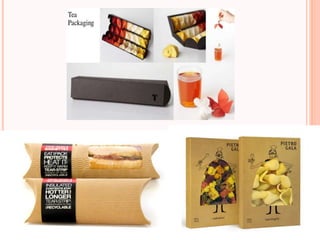
 Good-looking packaging design – such as the curvy
Coca-Cola bottles or the Altoids mints tins – significantly
increases the likelihood that a consumer will choose the
product even if it is more expensive and an unfamiliar
brand, a USC study has found.
 “Consumers appreciate and are willing to pay more for
something that is new and different and visually
pleasing to them,” said Martin Reimann, the study’s lead
author and a USC doctoral candidate of psychology.
 The implications of the power of aesthetic packaging
could level the playing field for new products entering a
competitive market and suggest that investing in
beautiful packaging pays off, Reimann said.
GRAPHIC DESIGN
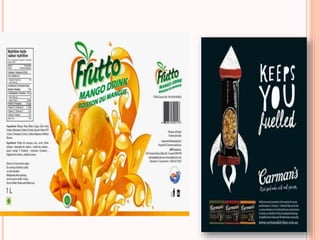
 Packaging is the face of your brand. Even a tiny
package must speak for your entire company in
your absence.
 Beautiful, yet Functional
 Packaging that Evokes Desire
 Leverage a Good Brand
CONTI…
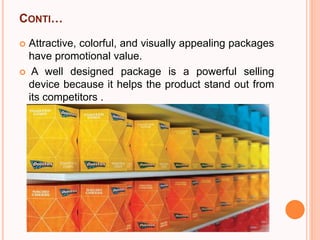
 Attractive, colorful, and visually appealing packages
have promotional value.
 A well designed package is a powerful selling
device because it helps the product stand out from
its competitors .
BARCODING
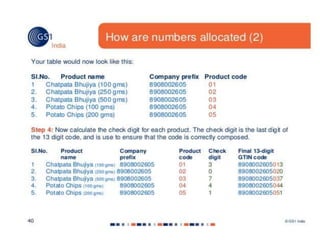
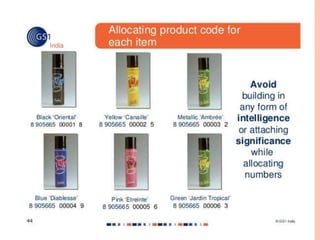
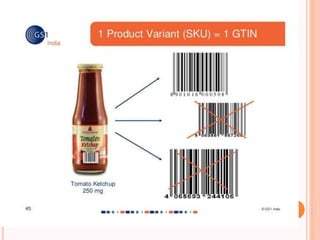
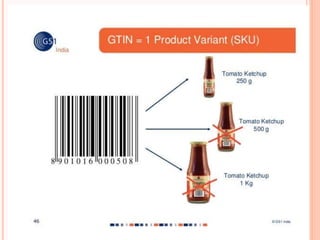
 A barcode is the small image of lines (bars) and spaces
that is affixed to retail store items, ID cards, and postal
mails to identify a particular product , person, or location.
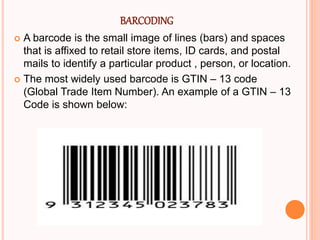
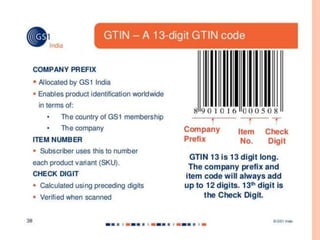
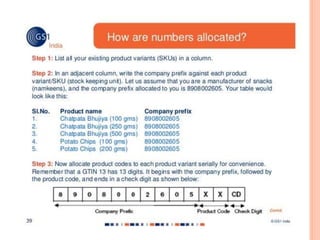
 The most widely used barcode is GTIN – 13 code
(Global Trade Item Number). An example of a GTIN – 13
Code is shown below:
CONTI…
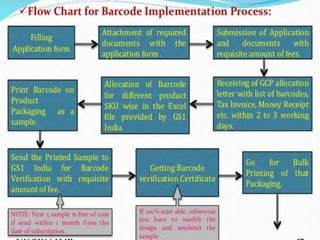
 GS1 India is only authorized organization in India for providing
the Barcodes.
 Connecting India to the world GS1 India is a not-for-profit,
standards based organization, promoted by the Ministry of
Commerce, Govt. of India
 Board members include representatives from:
 Ministry of Commerce
 BIS
 FICCI
 ASSOCHAM
 FIEO
 SPICES BOARD
 CII
 IMC
 IIP
 APEDA
 Affiliated to GS1 Global, based in Brussels, Belgium
CONTI…
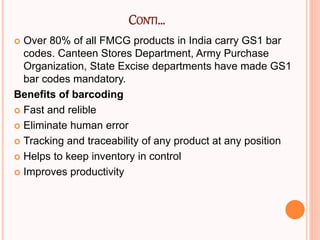
 Over 80% of all FMCG products in India carry GS1 bar
codes. Canteen Stores Department, Army Purchase
Organization, State Excise departments have made GS1
bar codes mandatory.
Benefits of barcoding
 Fast and relible
 Eliminate human error
 Tracking and traceability of any product at any position
 Helps to keep inventory in control
 Improves productivity
FOOD PACKAGING LAWS AND
REGULATIONS
PACKAGING LAWS AND REGULATIONS
 The packaging laws and regulations affecting food products
are mainly covered under the
 Standards of Weights and Measures Act, 1976
 Standards of Weights and Measures (packaged
commodities) Rules, 1977
 The AGMARK Rules relate to the quality specifications and
needs of certain agricultural products.
 The Prevention of Food Adulteration Act 1954
 The Fruit Product Order 1955 The Meat Food Product Order
1973
 The Vegetable Oil Products (Control) Order 1947
 The Edible Oil Packaging (Regulation) Order 1948
 The Solvent Extraction Oil. Deoiled Meat and Edible Flour
(control) Order 1967
 The Milk & Milk Products Order 1992
 Infant Milk substitute, Feeding Bottles and Infant Foods Act
1992
FOOD SAFETY AND STANDARDS AUTHORITY OF INDIA
(FSSAI)
 Regulates the packaging of all food products in India.
The regulations pertaining to food packaging is laid out
in the Food Safety and Standards (Packaging and
Labeling) Regulations, 2011.
 “All food which is placed in a package of any nature, in
such a manner that the contents cannot be changed
without tampering it and which is ready for sale to the
consumer must comply with the food packaging
regulations in India”.
GENERAL REQUIREMENTS FOR THE CONTAINER
 A utensil or container will be unfit for packaging if:
 Rusty
 Not securely packed and sealed;
 Major dents, rust, perforations and seam distortions;
 Leaks
 Chipped and rusty;
 A copper or brass containers which are not properly
tinned;
 Containers made of aluminium not conforming in
chemical composition to IS:20 specification for Cast
Aluminium & Aluminium Alloy for utensils or IS:21
specification for Wrought Aluminium and Aluminium Alloy
for utensils.
CONTI…
 Containers made of plastic materials should conform to the following
Indian Standards Specification, used as appliances or receptacles
for packing or storing whether partly or wholly, food articles namely:
 IS : 10146 (Specification for Polyethylene in contact with foodstuffs);
 IS : 10142 (Specification for Styrene Polymers in contact with foodstuffs);
 IS : 10151 (Specification for Polyvinyl Chloride (PVC), in contact with
foodstuffs);
 IS : 10910 (Specification for Polypropylene in contact with foodstuffs);
 IS : 11434 (Specification for Ionomer Resins in contact with foodstuffs);
 IS: 11704 Specification for Ethylene Acrylic Acid (EAA) copolymer.
 IS: 12252 – Specification for Poly ethylene terephathalates (PET).
 IS: 12247 – Specification for Nylon 6 Polymer;
 IS: 13601 – Ethylene Vinyl Acetate (EVA);
 IS: 13576 – Ethylene Metha Acrylic Acid (EMAA);
 Tin and plastic containers once used, shall not be re-used for packaging
of edible oils and fats.
PACKAGING REQUIREMENTS FOR VARIOUS PRODUCTS
 The following packaging requirement is applicable for
milk and milk products only:
 Bottling or filling of containers should be mechanical and the
sealing of the containers shall be carried out automatically.
 Wrapping or packaging may not be re-used for dairy products.
 Sealing should be carried out in the establishment in which
the last heat-treatment of drinking milk or liquid milk-base
products has been carried out.
 Immediately after packaging, the dairy products should be
placed in the rooms provided for storage.
 Packaging Requirements for Edible Oil or Fat
 Tin plate used for the manufacture of tin containers for
packaging edible oils and fats should conform to the
standards of prime grade quality contained in BIS Standards.
CONTI…
 The following packaging requirement is applicable for fruits and
vegetable products:
 Container in which any fruit product is packed should be so sealed
that it cannot be opened without destroying the licensing number and
the special identification mark of the manufacture to be displayed on
the top or neck of the bottle.
 For canned fruits, juices and vegetables, sanitary top cans made up
of suitable kind of tin plates should be used.
 For bottled fruits, juices and vegetables, only bottles/ jars capable of
giving hermetic seal should be used.
 Juices, squashes, crush, cordials, syrups, barley waters and other
beverages should be packed in clean bottles securely sealed. These
products when frozen and sold in the form of ice should be packed in
suitable cartons. Juices and Pulps may be packed in wooden barrels
when sulphited.
 For packing preserves, jams, jellies, and marmalades, new cans,
clean jars, new canisters, bottles, chinaware jars, aluminium
containers may be used and it should be securely sealed.
CONTI…
 For pickles, clean bottles, jars, wooden casks, tin
containers covered from inside with polythene lining of 250
gauge or suitable lacquered cans should be used.
 For tomato ketchups and sauces, clean bottles should be
used. If acidity does not exceed 0.5% as acetic acid, open
top sanitary cans can also be used.
 Candied fruits and peels and dried fruits and vegetables
can be packed in paper bags, cardboard or wooden
boxes, new tins, bottles, jars, aluminium and other suitable
approved containers.
 Fruits and vegetable products can also be packed in
aseptic and flexible packaging material having good grade
quality conforming to the standards laid down by BIS.
CONTI…
 The following packaging requirement is applicable
for canned meat products:
 New sanitary top cans made from suitable kind of tin
plate should be used. The cans should be lacquered
internally; they should be sealed hermetically after
filling. The lacquer used should be sulphur resistant and
should not be soluble in fat or brine.
 Cans used for filling pork luncheon meat should be
coated internally with edible gelatin, lard or lined with
vegetable parchment paper before being filled.
 Meat products packed in hermetically sealed containers
should be processed to withstand spoilage under
commercial conditions of storage and transport.
CONTI…
 The following packaging requirement is applicable for
drinking water (both packaged and mineral water):
 All drinking water that is packaged must be packed in clean,
hygienic, colourless, transparent and tamperproof
bottles/containers made of polyethylene (PE) (conforming to
IS:10146 or polyvinyl chloride (PVC) conforming to IS :
10151 or polyalkylene terephthalate (PET and PBT)
conforming to IS : 12252 or polypropylene conforming to IS :
10910 or foodgrade polycarbonate or sterile glass bottles
suitable for preventing possible adulteration or
contamination of the water. All packaging materials of plastic
origin should pass the prescribed overall migration and
colour migration limits.
FOOD LABELING
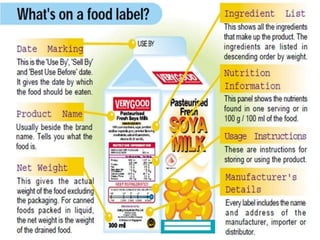
Food labeling is a
 Tool to promote and protect public health by providing
accurate nutritional information.
 An instrument of marketing and product promotion.
‘Labeling is any written, electronic, or graphic
communications on the packaging. A panel found
on a package of food which contains a variety of
information about the nutritional value of the food
item.”
Objective of labeling
 Brand Identification
 Description
 Promotion
FOODSAFETY AND STANDARDS(PACKAGINGANDLABELING)
REGULATIONS, 2011
 General Requirements:
 1. Every pre-packaged food shall carry a label containing
information.
 2.The particulars of declaration required under these
Regulations to be specified on the label shall be in English or
Hindi
 3. Pre-packaged food shall not be described or presented on
any label or in any labeling manner that is false, misleading or
deceptive or is likely to create an erroneous impression
regarding its character in any respect;
 4. Label in pre-packaged foods shall be applied in such a
manner that they will not become separated from the
container.
 . The disclosure of information on food labels in India is
primarily governed by the Prevention of Food Adulteration Act
of 1954, which focuses mainly on basic product information
with less emphasis on health and nutritional information.
CONTENTS IN A FOOD LABEL
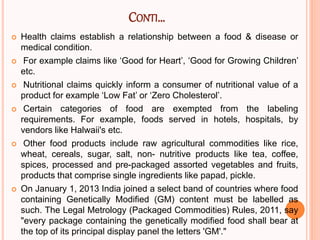
 As per the Indian Regulations a food label must have
 1. Product name and category of food
 2. An ingredient list in descending order of weight
 3. Logo for Vegetarian / Non Vegetarian Food
 4. Nutrition facts panel or information which includes
energy, protein, carbohydrate (sugars) & fat
 5. The shelf life (Use by or Best before date)
 6. Storage conditions
 7. The name & address of the manufacturer, packer and /
or seller
 8. The country of origin (in case of imported foods)
 9. The weight
 10. Instructions for use.
CONTI…
 Health claims establish a relationship between a food & disease or
medical condition.
 For example claims like ‘Good for Heart’, ‘Good for Growing Children’
etc.
 Nutritional claims quickly inform a consumer of nutritional value of a
product for example ‘Low Fat’ or ‘Zero Cholesterol’.
 Certain categories of food are exempted from the labeling
requirements. For example, foods served in hotels, hospitals, by
vendors like Halwaii's etc.
 Other food products include raw agricultural commodities like rice,
wheat, cereals, sugar, salt, non- nutritive products like tea, coffee,
spices, processed and pre-packaged assorted vegetables and fruits,
products that comprise single ingredients like papad, pickle.
 On January 1, 2013 India joined a select band of countries where food
containing Genetically Modified (GM) content must be labelled as
such. The Legal Metrology (Packaged Commodities) Rules, 2011, say
"every package containing the genetically modified food shall bear at
the top of its principal display panel the letters 'GM'."
Packaging asthetic and graphic design/ labelling

Packaging asthetic and graphic design/ labelling

  • 1.
    PACKAGING AESTHETIC AND GRAPHICDESIGN Presented By- Kartika Vijay Patil MIT college of food technology, Pune.
  • 2.
    AESTHETIC PACKAGING Aesthetics canbe defined as an appreciation for art and beauty. Or A combination of things that are pleasing to look at.  Aesthetic packaging The packaging design is important from a functional and aesthetic point of view. The functionality is achieved by selecting the most suitable materials and packaging system which relays on the product to be packaged.
  • 3.
    UNDERSTANDING THE CONSUMERIMPACT OF AESTHETIC PACKAGING DESIGN  Packaging aesthetics could make or break the first impression of your product  The psychology of packaging design has become a top concern of marketers, as evidence accumulates that visual aesthetics play a major role of a product's success.
  • 4.
    CONTI…  Good-looking packagingdesign – such as the curvy Coca-Cola bottles or the Altoids mints tins – significantly increases the likelihood that a consumer will choose the product even if it is more expensive and an unfamiliar brand, a USC study has found.  “Consumers appreciate and are willing to pay more for something that is new and different and visually pleasing to them,” said Martin Reimann, the study’s lead author and a USC doctoral candidate of psychology.  The implications of the power of aesthetic packaging could level the playing field for new products entering a competitive market and suggest that investing in beautiful packaging pays off, Reimann said.
  • 6.
    GRAPHIC DESIGN  Packagingis the face of your brand. Even a tiny package must speak for your entire company in your absence.  Beautiful, yet Functional  Packaging that Evokes Desire  Leverage a Good Brand
  • 8.
    CONTI…  Attractive, colorful,and visually appealing packages have promotional value.  A well designed package is a powerful selling device because it helps the product stand out from its competitors .
  • 10.
    BARCODING  A barcodeis the small image of lines (bars) and spaces that is affixed to retail store items, ID cards, and postal mails to identify a particular product , person, or location.  The most widely used barcode is GTIN – 13 code (Global Trade Item Number). An example of a GTIN – 13 Code is shown below:
  • 11.
    CONTI…  GS1 Indiais only authorized organization in India for providing the Barcodes.  Connecting India to the world GS1 India is a not-for-profit, standards based organization, promoted by the Ministry of Commerce, Govt. of India  Board members include representatives from:  Ministry of Commerce  BIS  FICCI  ASSOCHAM  FIEO  SPICES BOARD  CII  IMC  IIP  APEDA  Affiliated to GS1 Global, based in Brussels, Belgium
  • 12.
    CONTI…  Over 80%of all FMCG products in India carry GS1 bar codes. Canteen Stores Department, Army Purchase Organization, State Excise departments have made GS1 bar codes mandatory. Benefits of barcoding  Fast and relible  Eliminate human error  Tracking and traceability of any product at any position  Helps to keep inventory in control  Improves productivity
  • 20.
    FOOD PACKAGING LAWSAND REGULATIONS
  • 21.
    PACKAGING LAWS ANDREGULATIONS  The packaging laws and regulations affecting food products are mainly covered under the  Standards of Weights and Measures Act, 1976  Standards of Weights and Measures (packaged commodities) Rules, 1977  The AGMARK Rules relate to the quality specifications and needs of certain agricultural products.  The Prevention of Food Adulteration Act 1954  The Fruit Product Order 1955 The Meat Food Product Order 1973  The Vegetable Oil Products (Control) Order 1947  The Edible Oil Packaging (Regulation) Order 1948  The Solvent Extraction Oil. Deoiled Meat and Edible Flour (control) Order 1967  The Milk & Milk Products Order 1992  Infant Milk substitute, Feeding Bottles and Infant Foods Act 1992
  • 22.
    FOOD SAFETY ANDSTANDARDS AUTHORITY OF INDIA (FSSAI)  Regulates the packaging of all food products in India. The regulations pertaining to food packaging is laid out in the Food Safety and Standards (Packaging and Labeling) Regulations, 2011.  “All food which is placed in a package of any nature, in such a manner that the contents cannot be changed without tampering it and which is ready for sale to the consumer must comply with the food packaging regulations in India”.
  • 23.
    GENERAL REQUIREMENTS FORTHE CONTAINER  A utensil or container will be unfit for packaging if:  Rusty  Not securely packed and sealed;  Major dents, rust, perforations and seam distortions;  Leaks  Chipped and rusty;  A copper or brass containers which are not properly tinned;  Containers made of aluminium not conforming in chemical composition to IS:20 specification for Cast Aluminium & Aluminium Alloy for utensils or IS:21 specification for Wrought Aluminium and Aluminium Alloy for utensils.
  • 24.
    CONTI…  Containers madeof plastic materials should conform to the following Indian Standards Specification, used as appliances or receptacles for packing or storing whether partly or wholly, food articles namely:  IS : 10146 (Specification for Polyethylene in contact with foodstuffs);  IS : 10142 (Specification for Styrene Polymers in contact with foodstuffs);  IS : 10151 (Specification for Polyvinyl Chloride (PVC), in contact with foodstuffs);  IS : 10910 (Specification for Polypropylene in contact with foodstuffs);  IS : 11434 (Specification for Ionomer Resins in contact with foodstuffs);  IS: 11704 Specification for Ethylene Acrylic Acid (EAA) copolymer.  IS: 12252 – Specification for Poly ethylene terephathalates (PET).  IS: 12247 – Specification for Nylon 6 Polymer;  IS: 13601 – Ethylene Vinyl Acetate (EVA);  IS: 13576 – Ethylene Metha Acrylic Acid (EMAA);  Tin and plastic containers once used, shall not be re-used for packaging of edible oils and fats.
  • 25.
    PACKAGING REQUIREMENTS FORVARIOUS PRODUCTS  The following packaging requirement is applicable for milk and milk products only:  Bottling or filling of containers should be mechanical and the sealing of the containers shall be carried out automatically.  Wrapping or packaging may not be re-used for dairy products.  Sealing should be carried out in the establishment in which the last heat-treatment of drinking milk or liquid milk-base products has been carried out.  Immediately after packaging, the dairy products should be placed in the rooms provided for storage.  Packaging Requirements for Edible Oil or Fat  Tin plate used for the manufacture of tin containers for packaging edible oils and fats should conform to the standards of prime grade quality contained in BIS Standards.
  • 26.
    CONTI…  The followingpackaging requirement is applicable for fruits and vegetable products:  Container in which any fruit product is packed should be so sealed that it cannot be opened without destroying the licensing number and the special identification mark of the manufacture to be displayed on the top or neck of the bottle.  For canned fruits, juices and vegetables, sanitary top cans made up of suitable kind of tin plates should be used.  For bottled fruits, juices and vegetables, only bottles/ jars capable of giving hermetic seal should be used.  Juices, squashes, crush, cordials, syrups, barley waters and other beverages should be packed in clean bottles securely sealed. These products when frozen and sold in the form of ice should be packed in suitable cartons. Juices and Pulps may be packed in wooden barrels when sulphited.  For packing preserves, jams, jellies, and marmalades, new cans, clean jars, new canisters, bottles, chinaware jars, aluminium containers may be used and it should be securely sealed.
  • 27.
    CONTI…  For pickles,clean bottles, jars, wooden casks, tin containers covered from inside with polythene lining of 250 gauge or suitable lacquered cans should be used.  For tomato ketchups and sauces, clean bottles should be used. If acidity does not exceed 0.5% as acetic acid, open top sanitary cans can also be used.  Candied fruits and peels and dried fruits and vegetables can be packed in paper bags, cardboard or wooden boxes, new tins, bottles, jars, aluminium and other suitable approved containers.  Fruits and vegetable products can also be packed in aseptic and flexible packaging material having good grade quality conforming to the standards laid down by BIS.
  • 28.
    CONTI…  The followingpackaging requirement is applicable for canned meat products:  New sanitary top cans made from suitable kind of tin plate should be used. The cans should be lacquered internally; they should be sealed hermetically after filling. The lacquer used should be sulphur resistant and should not be soluble in fat or brine.  Cans used for filling pork luncheon meat should be coated internally with edible gelatin, lard or lined with vegetable parchment paper before being filled.  Meat products packed in hermetically sealed containers should be processed to withstand spoilage under commercial conditions of storage and transport.
  • 29.
    CONTI…  The followingpackaging requirement is applicable for drinking water (both packaged and mineral water):  All drinking water that is packaged must be packed in clean, hygienic, colourless, transparent and tamperproof bottles/containers made of polyethylene (PE) (conforming to IS:10146 or polyvinyl chloride (PVC) conforming to IS : 10151 or polyalkylene terephthalate (PET and PBT) conforming to IS : 12252 or polypropylene conforming to IS : 10910 or foodgrade polycarbonate or sterile glass bottles suitable for preventing possible adulteration or contamination of the water. All packaging materials of plastic origin should pass the prescribed overall migration and colour migration limits.
  • 30.
    FOOD LABELING Food labelingis a  Tool to promote and protect public health by providing accurate nutritional information.  An instrument of marketing and product promotion. ‘Labeling is any written, electronic, or graphic communications on the packaging. A panel found on a package of food which contains a variety of information about the nutritional value of the food item.” Objective of labeling  Brand Identification  Description  Promotion
  • 31.
    FOODSAFETY AND STANDARDS(PACKAGINGANDLABELING) REGULATIONS,2011  General Requirements:  1. Every pre-packaged food shall carry a label containing information.  2.The particulars of declaration required under these Regulations to be specified on the label shall be in English or Hindi  3. Pre-packaged food shall not be described or presented on any label or in any labeling manner that is false, misleading or deceptive or is likely to create an erroneous impression regarding its character in any respect;  4. Label in pre-packaged foods shall be applied in such a manner that they will not become separated from the container.  . The disclosure of information on food labels in India is primarily governed by the Prevention of Food Adulteration Act of 1954, which focuses mainly on basic product information with less emphasis on health and nutritional information.
  • 32.
    CONTENTS IN AFOOD LABEL  As per the Indian Regulations a food label must have  1. Product name and category of food  2. An ingredient list in descending order of weight  3. Logo for Vegetarian / Non Vegetarian Food  4. Nutrition facts panel or information which includes energy, protein, carbohydrate (sugars) & fat  5. The shelf life (Use by or Best before date)  6. Storage conditions  7. The name & address of the manufacturer, packer and / or seller  8. The country of origin (in case of imported foods)  9. The weight  10. Instructions for use.
  • 33.
    CONTI…  Health claimsestablish a relationship between a food & disease or medical condition.  For example claims like ‘Good for Heart’, ‘Good for Growing Children’ etc.  Nutritional claims quickly inform a consumer of nutritional value of a product for example ‘Low Fat’ or ‘Zero Cholesterol’.  Certain categories of food are exempted from the labeling requirements. For example, foods served in hotels, hospitals, by vendors like Halwaii's etc.  Other food products include raw agricultural commodities like rice, wheat, cereals, sugar, salt, non- nutritive products like tea, coffee, spices, processed and pre-packaged assorted vegetables and fruits, products that comprise single ingredients like papad, pickle.  On January 1, 2013 India joined a select band of countries where food containing Genetically Modified (GM) content must be labelled as such. The Legal Metrology (Packaged Commodities) Rules, 2011, say "every package containing the genetically modified food shall bear at the top of its principal display panel the letters 'GM'."