Approaches in Social Sciences
1. Structural-Functionalism
2. Marxism
3. Symbolic Interactionism
4. Psychoanalysis
5. Rational Choice
6. Institutionalism
7. Feminist Theory
8. Hermeneutical Phenomenology
9. Human-Environment Systems
Structural Functionalism
What is
Structural
Functionalism?
Structural
Relating to the way
something is built or organized.
Functionalism
A theory that stresses the
interdependence of the patterns and
institutions of a society and their
interaction in maintaining cultural and
social unity.
Structural Functionalism
Functionalism, also called structural-
functional theory, sees society as a
structure with interrelated parts designed to
meet the biological and social needs of the
individuals in that society.
Structural Functionalism
*It is a sociological theory that attempts
to explain why society functions the way
it does by focusing on relationships
between various social institutions that
make up society.
Who are the
proponents of this
theory?
Theorists Responsible
*Auguste Comte
*Herbert Spencer
*Talcott Parsons
*Robert Merton
*Gabriel Almond and Bingham Powell
*Kingsley Davis and Wilbert E. Moore
Key Ideas Behind
the Theory
Key Ideas
1. Systems have a property of order and
interdependent parts.
2. Systems tend towards self-maintaining
order or equilibrium.
3. The system may be static or involved in an
ordered process of change.
Key Ideas
4. The nature of one part of the system
has an impact on the form that other
parts take.
5. Systems maintain boundaries within
their environments.
Key Ideas
6. Allocation and integration are two fundamental
processes necessary for a given state of equilibrium
within a system.
7. Systems tend towards self-maintenance involving
control of boundaries and relationships of parts to
the whole, control of the environment and control of
tendencies to change the system from within.
Key Assumptions
about the Theory
Key Assumptions
*Societies and social units have order and
interdependent parts like a biological organism
held together by cooperation and orderliness.
*Societies and social units work toward the
natural or smooth working of the system, ie
towards equilibrium.
Key Assumptions
*Societies and social units, just as
natural(external) environments, are
separate or distinct but adapt to each
other-if one or more parts conflict
with others, others must adapt.
Criticisms about
the Theory
Criticisms
*In the 1960s, functionalism was criticized for
being unable to account for social change, or
for structural contradictions and conflict.
*It ignores inequalities including race, gender,
class, which causes tension and conflict.
Example
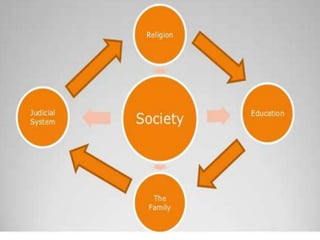
How these institutions create balance in the
society. Concept map

Structural Functionalism

  • 1.
    Approaches in SocialSciences 1. Structural-Functionalism 2. Marxism 3. Symbolic Interactionism 4. Psychoanalysis 5. Rational Choice 6. Institutionalism 7. Feminist Theory 8. Hermeneutical Phenomenology 9. Human-Environment Systems
  • 2.
  • 3.
  • 4.
    Structural Relating to theway something is built or organized.
  • 5.
    Functionalism A theory thatstresses the interdependence of the patterns and institutions of a society and their interaction in maintaining cultural and social unity.
  • 6.
    Structural Functionalism Functionalism, alsocalled structural- functional theory, sees society as a structure with interrelated parts designed to meet the biological and social needs of the individuals in that society.
  • 7.
    Structural Functionalism *It isa sociological theory that attempts to explain why society functions the way it does by focusing on relationships between various social institutions that make up society.
  • 9.
    Who are the proponentsof this theory?
  • 10.
    Theorists Responsible *Auguste Comte *HerbertSpencer *Talcott Parsons *Robert Merton *Gabriel Almond and Bingham Powell *Kingsley Davis and Wilbert E. Moore
  • 11.
  • 12.
    Key Ideas 1. Systemshave a property of order and interdependent parts. 2. Systems tend towards self-maintaining order or equilibrium. 3. The system may be static or involved in an ordered process of change.
  • 13.
    Key Ideas 4. Thenature of one part of the system has an impact on the form that other parts take. 5. Systems maintain boundaries within their environments.
  • 14.
    Key Ideas 6. Allocationand integration are two fundamental processes necessary for a given state of equilibrium within a system. 7. Systems tend towards self-maintenance involving control of boundaries and relationships of parts to the whole, control of the environment and control of tendencies to change the system from within.
  • 15.
  • 16.
    Key Assumptions *Societies andsocial units have order and interdependent parts like a biological organism held together by cooperation and orderliness. *Societies and social units work toward the natural or smooth working of the system, ie towards equilibrium.
  • 17.
    Key Assumptions *Societies andsocial units, just as natural(external) environments, are separate or distinct but adapt to each other-if one or more parts conflict with others, others must adapt.
  • 18.
  • 19.
    Criticisms *In the 1960s,functionalism was criticized for being unable to account for social change, or for structural contradictions and conflict. *It ignores inequalities including race, gender, class, which causes tension and conflict.
  • 20.
  • 22.
    How these institutionscreate balance in the society. Concept map