CULTURAL
RELATIVISM
&
ETHNOCENTRISM
RYAN JAVIER CUMBE
Instructor
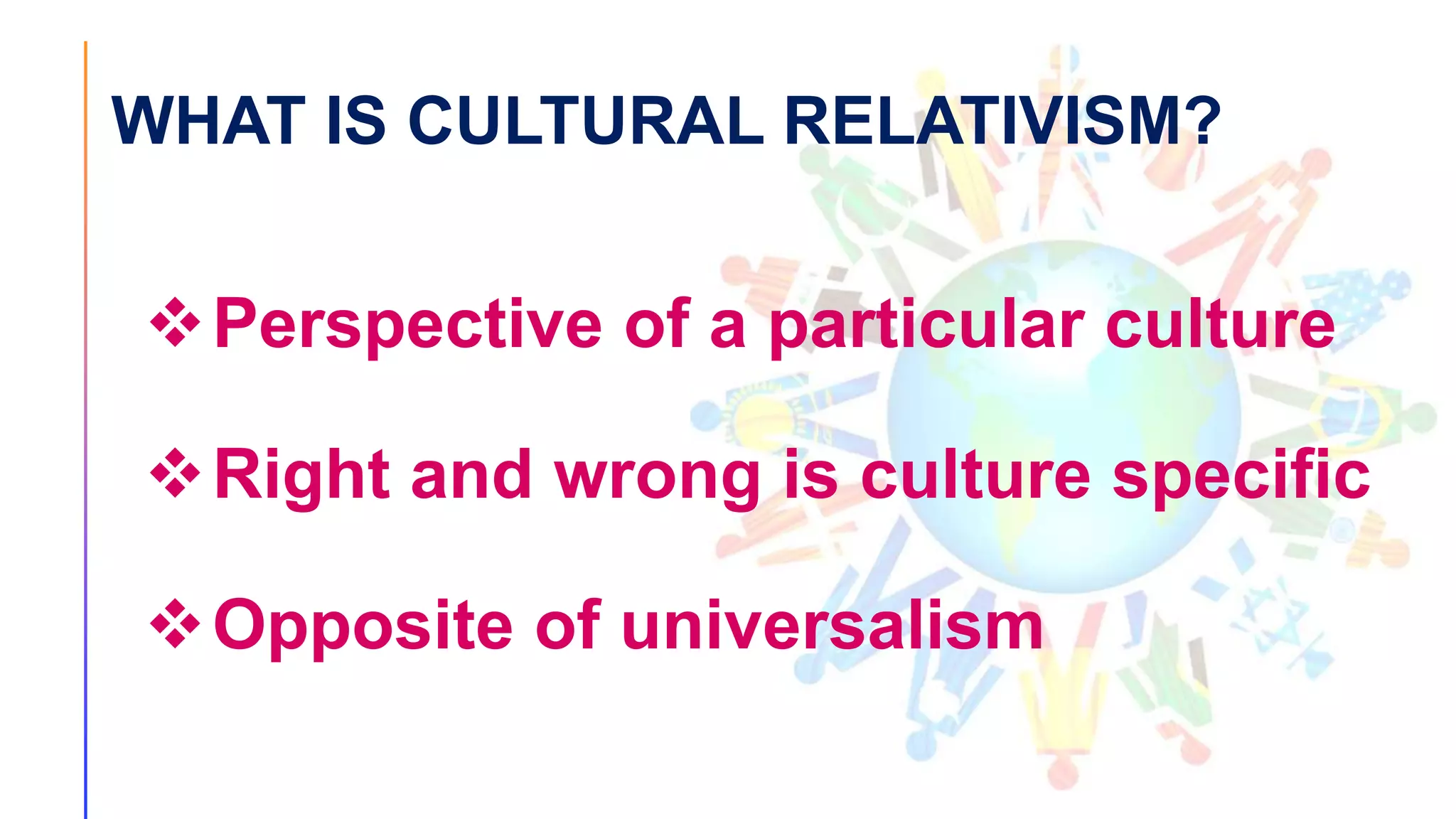
WHAT IS CULTURAL RELATIVISM?
Perspective of a particular culture
Right and wrong is culture specific
Opposite of universalism
Cultural Relativism
“The ‘right’ way is the way which the ancestors used
and which has been handed down. The notion of right is in
the folkways. It is not outside of them, of independent
origin, and bought to test them. In the folkways, whatever
is, is right.
This is because they are traditional, and therefore
contain in themselves the authority of the ancestral
ghosts. When we come to the folkways we are at the end of
our analysis.”
- William Graham Sumner (1906:sociologist)
Cultural Relativism
•Why is this a problem for ethics?
It has persuaded people to be skeptical about ethics.
It challenges our belief in the objectivity and
universality of moral truth.
 It says, in effect, there is no such thing as universal
truth in ethics.
 There are only the various cultural codes, and nothing
more.
6 CLAIMS MADE BY
CULTURAL RELATIVISM
1. Different societies have different moral codes;
2. There is no objective standard that can be used to judge one societal
code better than another;
3. The moral code of our own society has no special status; it is merely one
among many;
4. There is no “universal truth” in ethics – that is, there are no moral truths
that hold for all peoples at all times;
5. The moral code of a society determines what is right [and wrong] within
that society;
6. It is arrogance for us to try to judge the conduct of other peoples.
Response to Relativism
• We need to ask: But is it true?
• One way to get at the truth: Realize it’s self-
defeating:
oWhat if another society favors intolerance? (Nazism)
oA cultural relativist can’t criticize the Nazis for being
intolerant, if they’re following their moral code.
oSame with slave-owners, the architects of genocide,
frivolous wars, etc.
o“When in Rome.” doesn’t work all the time.
BENEFITS OF CULTURAL RELATIVISM
o Encourage people to be open minded
o Promotes tolerance
o Promotes cooperation
o Makes people respectful
CRITICISMS OF CULTURAL
RELATIVISM
o Make a person or community feel superior
o Cause a hindrance to reform
o Not logical
o Cause conflict and confusion
o Leads to soft universalism
Cultural Relativism:
Consequences
We could no longer say that the customs of other societies are morally
inferior to our own.
• Chinese societies repressing political dissent (free speech?)
• But we know that political oppression seems wrong whenever it occurs!
We could no longer criticize the code of our own society
• An Indian can’t criticize the caste system
• If it is in the Indian’s culture, it’s morality right (so the relativist argues)
The idea of moral progress is called into doubt.
• We think some social changes are for the better
• Examples: women, slavery, racism, and more!
• We’d have to reject as immoral some people we hold in high esteem:
Martin Luther King Jr., Gandhi, America’s Founding Fathers
SHARED VALUES
• Might there be less difference between cultures?
• We need to ask why they believe what they do.
• We’ll find that values are often universal, while belief systems are
not.
• Examples
 Fictional Example: Eating animals and ancestors
 Eskimos: “Life is hard, and the margin of safety small.”
One mother might not be able to care for all of her children;
traveling often, nursing, clothes
Males were hunters; suffered higher death rates
Infanticide was a last option to ensure the family’s survival
SHARED VALUES
 Eskimos: caring for the young in the society
 Truth-telling
 No one would believe anyone
 There’s no reason to communicate
 Society requires communication among people
 Society itself would be impossible
 Murder
No one would ever feel safe; would be “on guard” 24/7
Avoiding contact with others to be safe
THE POINT: there are some moral rules that all societies must embrace,
because those rules are necessary for societies to exist.
THE CULTURAL DIFFERENCES
ARGUMENT
1. Different cultures have different moral
codes.
2. Therefore, there is no objective truth
in morality. Right and wrong are only
matters of opinion, and opinions vary
from culture to culture.
James Rachels (1941-2003)
• American Philosopher
• Taught at University of Alabama
• Published numerous books and articles on Ethics
• His textbooks on Ethics has gone through 6 editions and
continues to be one of the most popular used in college
classrooms.
Rachels’ Two Criticism of the
Cultural Argument
•The argument is invalid
•Premise I exaggerates the extent
of cultural disagreement
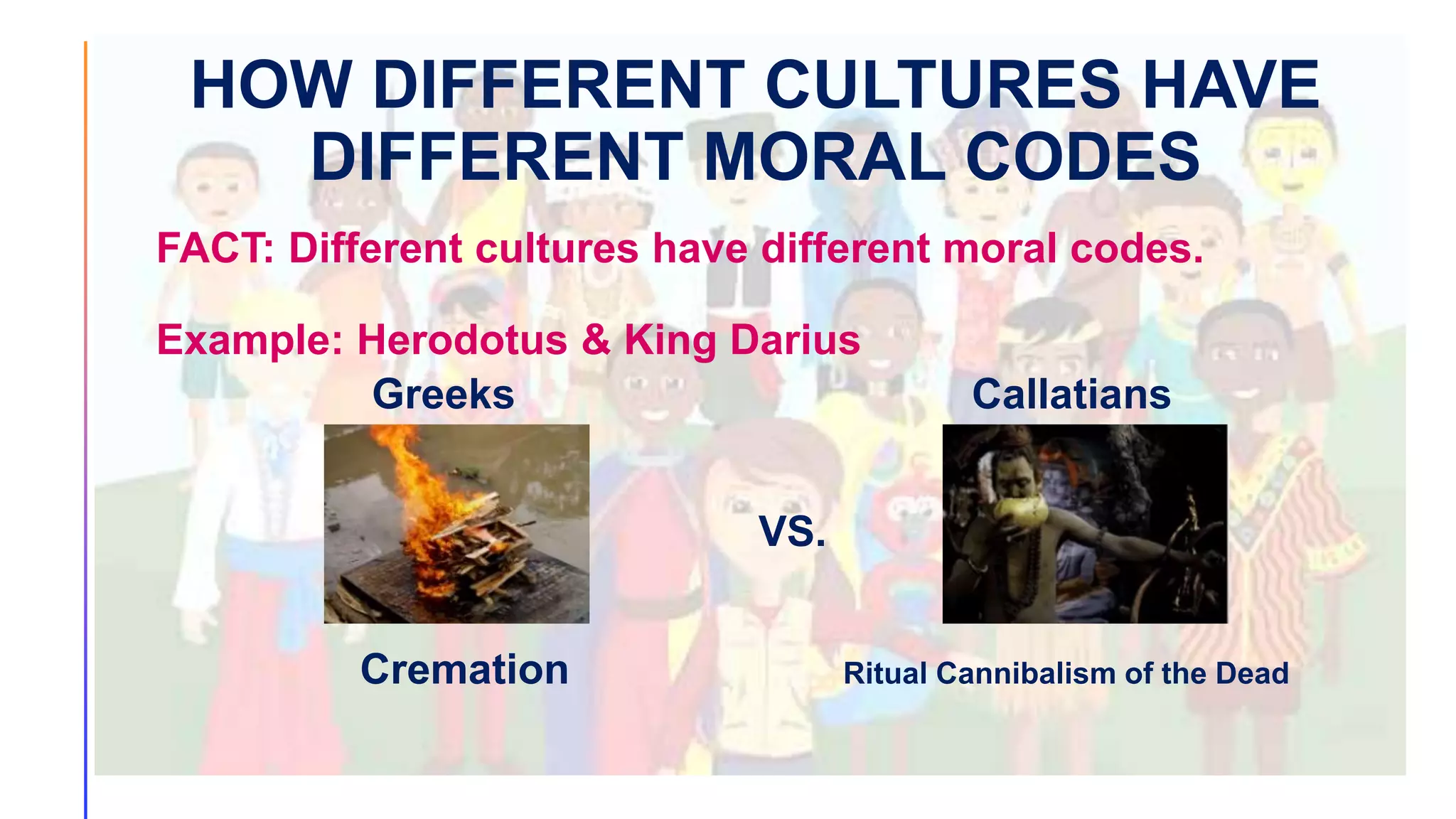
HOW DIFFERENT CULTURES HAVE
DIFFERENT MORAL CODES
FACT: Different cultures have different moral codes.
Example: Herodotus & King Darius
Greeks Callatians
VS.
Cremation Ritual Cannibalism of the Dead
Deductive Validity
Valid
1. If I get an A, then I’ll pass this course.
2. I am getting an A.
3. Therefore, I’ll pass the course.
Invalid
1. If I get an A, then I’ll pass this course.
2. I’m passing the course
3. Therefore, I’m getting an A.
SHAPE OF EARTH ARGUMENT
•Different cultures have drastically
different beliefs about the shape of
the earth
•Therefore , there is no objective truth
about the Earth’s shape
The Education Argument
• Had you been taught a different set of values then you
would embrace those values.
• Therefore, people only have the moral values they
were brought up to accept those particular values.
• Consequently, moral truths are created by each
distinct culture and there are no objective
Not so much disagreement after all….
• Some values are shared by most all cultures
Truth-telling, promise keeping, prohibitions against murder
• May apparent moral disagreement reveal underlying agreements
Both Callatians and Greeks respected the dead
• Some apparent moral disagreements are the result of the hardships of life
Eskimos & analogy drowning child
• Some apparent moral disagreements are the result of underlying factual
disagreements
Pro-choice v/s Pro-life
A Cotemporary Example……
ESKIMOS
Different Moral Practices
• Polygamy
• Regular Sexual Access to other
• Men’s Wives
• Women can break the
arrangements by leaving
• Infanticide (girls)
• Elderly “euthanasia”
CATEGORIES OF CULTURAL RELATIVISM
• CRITICAL
- poses questions about
cultural practices in terms of
who is accepting them and
why
- recognizes oppressors,
winners, victims
- a critique
• ABSOLUTE
- whatever goes on in a
culture must not be
questioned by outsiders
- Holocaust?
Judging a Practice as Undesirable
• Is there an independent standard of right and wrong?
Does the practice promote or hinder the welfare of the
people affected by it?
Why are we reluctant to speak up?
HOWEVER: Nothing about “tolerance” requires us to say
that all belief, all religions, and all social practices are
equally admirable. To condemn a particular practice IS
NOT to say that the whole society is inferior.
LESSONS OF RELATIVISM
• Relativism teaches us some valuable lessons, even if it’s mistaken in some key
areas.
• What we can learn from relativism?
It warns us about assuming that our preferences are rooted in some absolute
rational standard. Example:
 Monogamous marriage? (Mormonism)
 Eating the dead? (Greeks and Callatians)
 Modesty of dress? (Justin Timberlake and Janet Jackson, 2004)
It reminds us to keep an open mind.
ETHNOCENTRISM
• Ethnocentrism is judging another culture.
• It is a form of bias, where we tend to immediately
judge another culture as ‘bad’ or wrong based
upon their actions, if their values are not aligned
with our beliefs.
• We all do it, some time or the other, mostly not
even realizing that we’re being ethnocentric at
that moment.
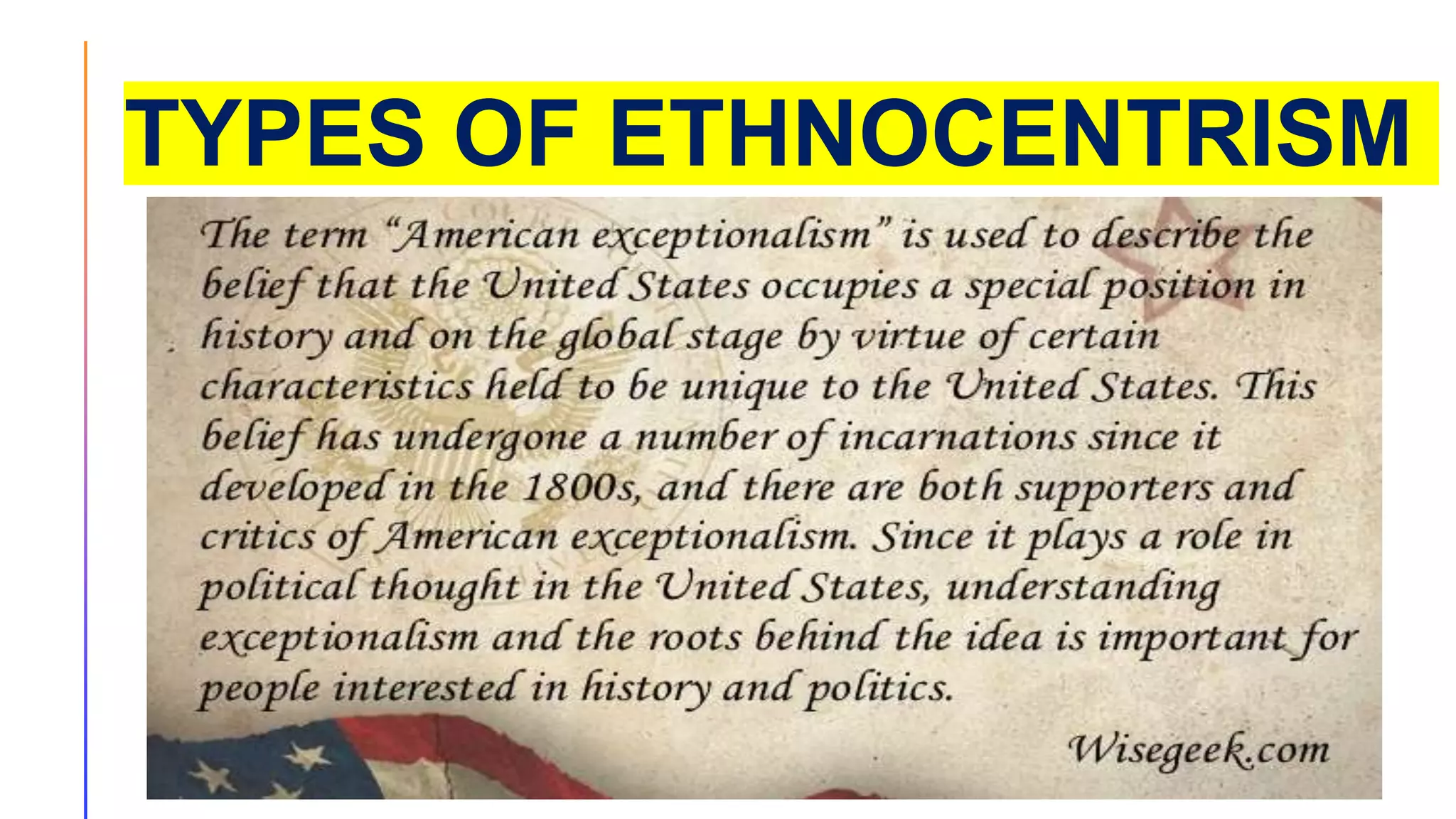
TYPES OF ETHNOCENTRISM
Cultural relativism & Ethnocentrism

Cultural relativism & Ethnocentrism

  • 1.
  • 4.
    WHAT IS CULTURALRELATIVISM? Perspective of a particular culture Right and wrong is culture specific Opposite of universalism
  • 5.
    Cultural Relativism “The ‘right’way is the way which the ancestors used and which has been handed down. The notion of right is in the folkways. It is not outside of them, of independent origin, and bought to test them. In the folkways, whatever is, is right. This is because they are traditional, and therefore contain in themselves the authority of the ancestral ghosts. When we come to the folkways we are at the end of our analysis.” - William Graham Sumner (1906:sociologist)
  • 6.
    Cultural Relativism •Why isthis a problem for ethics? It has persuaded people to be skeptical about ethics. It challenges our belief in the objectivity and universality of moral truth.  It says, in effect, there is no such thing as universal truth in ethics.  There are only the various cultural codes, and nothing more.
  • 7.
    6 CLAIMS MADEBY CULTURAL RELATIVISM 1. Different societies have different moral codes; 2. There is no objective standard that can be used to judge one societal code better than another; 3. The moral code of our own society has no special status; it is merely one among many; 4. There is no “universal truth” in ethics – that is, there are no moral truths that hold for all peoples at all times; 5. The moral code of a society determines what is right [and wrong] within that society; 6. It is arrogance for us to try to judge the conduct of other peoples.
  • 8.
    Response to Relativism •We need to ask: But is it true? • One way to get at the truth: Realize it’s self- defeating: oWhat if another society favors intolerance? (Nazism) oA cultural relativist can’t criticize the Nazis for being intolerant, if they’re following their moral code. oSame with slave-owners, the architects of genocide, frivolous wars, etc. o“When in Rome.” doesn’t work all the time.
  • 9.
    BENEFITS OF CULTURALRELATIVISM o Encourage people to be open minded o Promotes tolerance o Promotes cooperation o Makes people respectful
  • 10.
    CRITICISMS OF CULTURAL RELATIVISM oMake a person or community feel superior o Cause a hindrance to reform o Not logical o Cause conflict and confusion o Leads to soft universalism
  • 11.
    Cultural Relativism: Consequences We couldno longer say that the customs of other societies are morally inferior to our own. • Chinese societies repressing political dissent (free speech?) • But we know that political oppression seems wrong whenever it occurs! We could no longer criticize the code of our own society • An Indian can’t criticize the caste system • If it is in the Indian’s culture, it’s morality right (so the relativist argues) The idea of moral progress is called into doubt. • We think some social changes are for the better • Examples: women, slavery, racism, and more! • We’d have to reject as immoral some people we hold in high esteem: Martin Luther King Jr., Gandhi, America’s Founding Fathers
  • 12.
    SHARED VALUES • Mightthere be less difference between cultures? • We need to ask why they believe what they do. • We’ll find that values are often universal, while belief systems are not. • Examples  Fictional Example: Eating animals and ancestors  Eskimos: “Life is hard, and the margin of safety small.” One mother might not be able to care for all of her children; traveling often, nursing, clothes Males were hunters; suffered higher death rates Infanticide was a last option to ensure the family’s survival
  • 13.
    SHARED VALUES  Eskimos:caring for the young in the society  Truth-telling  No one would believe anyone  There’s no reason to communicate  Society requires communication among people  Society itself would be impossible  Murder No one would ever feel safe; would be “on guard” 24/7 Avoiding contact with others to be safe THE POINT: there are some moral rules that all societies must embrace, because those rules are necessary for societies to exist.
  • 14.
    THE CULTURAL DIFFERENCES ARGUMENT 1.Different cultures have different moral codes. 2. Therefore, there is no objective truth in morality. Right and wrong are only matters of opinion, and opinions vary from culture to culture.
  • 15.
    James Rachels (1941-2003) •American Philosopher • Taught at University of Alabama • Published numerous books and articles on Ethics • His textbooks on Ethics has gone through 6 editions and continues to be one of the most popular used in college classrooms.
  • 16.
    Rachels’ Two Criticismof the Cultural Argument •The argument is invalid •Premise I exaggerates the extent of cultural disagreement
  • 17.
    HOW DIFFERENT CULTURESHAVE DIFFERENT MORAL CODES FACT: Different cultures have different moral codes. Example: Herodotus & King Darius Greeks Callatians VS. Cremation Ritual Cannibalism of the Dead
  • 18.
    Deductive Validity Valid 1. IfI get an A, then I’ll pass this course. 2. I am getting an A. 3. Therefore, I’ll pass the course. Invalid 1. If I get an A, then I’ll pass this course. 2. I’m passing the course 3. Therefore, I’m getting an A.
  • 19.
    SHAPE OF EARTHARGUMENT •Different cultures have drastically different beliefs about the shape of the earth •Therefore , there is no objective truth about the Earth’s shape
  • 20.
    The Education Argument •Had you been taught a different set of values then you would embrace those values. • Therefore, people only have the moral values they were brought up to accept those particular values. • Consequently, moral truths are created by each distinct culture and there are no objective
  • 21.
    Not so muchdisagreement after all…. • Some values are shared by most all cultures Truth-telling, promise keeping, prohibitions against murder • May apparent moral disagreement reveal underlying agreements Both Callatians and Greeks respected the dead • Some apparent moral disagreements are the result of the hardships of life Eskimos & analogy drowning child • Some apparent moral disagreements are the result of underlying factual disagreements Pro-choice v/s Pro-life
  • 22.
    A Cotemporary Example…… ESKIMOS DifferentMoral Practices • Polygamy • Regular Sexual Access to other • Men’s Wives • Women can break the arrangements by leaving • Infanticide (girls) • Elderly “euthanasia”
  • 23.
    CATEGORIES OF CULTURALRELATIVISM • CRITICAL - poses questions about cultural practices in terms of who is accepting them and why - recognizes oppressors, winners, victims - a critique • ABSOLUTE - whatever goes on in a culture must not be questioned by outsiders - Holocaust?
  • 25.
    Judging a Practiceas Undesirable • Is there an independent standard of right and wrong? Does the practice promote or hinder the welfare of the people affected by it? Why are we reluctant to speak up? HOWEVER: Nothing about “tolerance” requires us to say that all belief, all religions, and all social practices are equally admirable. To condemn a particular practice IS NOT to say that the whole society is inferior.
  • 26.
    LESSONS OF RELATIVISM •Relativism teaches us some valuable lessons, even if it’s mistaken in some key areas. • What we can learn from relativism? It warns us about assuming that our preferences are rooted in some absolute rational standard. Example:  Monogamous marriage? (Mormonism)  Eating the dead? (Greeks and Callatians)  Modesty of dress? (Justin Timberlake and Janet Jackson, 2004) It reminds us to keep an open mind.
  • 27.
    ETHNOCENTRISM • Ethnocentrism isjudging another culture. • It is a form of bias, where we tend to immediately judge another culture as ‘bad’ or wrong based upon their actions, if their values are not aligned with our beliefs. • We all do it, some time or the other, mostly not even realizing that we’re being ethnocentric at that moment.
  • 28.
  • 30.