DEVELOPMENT OF SOCIOLOGY
Sociology emerged as a separate discipline in the nineteenth centuryThis was a time of great social upheaval due largely to the French and Industrial RevolutionsSeveral early sociologists shaped the direction of the disciplineThe Development of Sociology
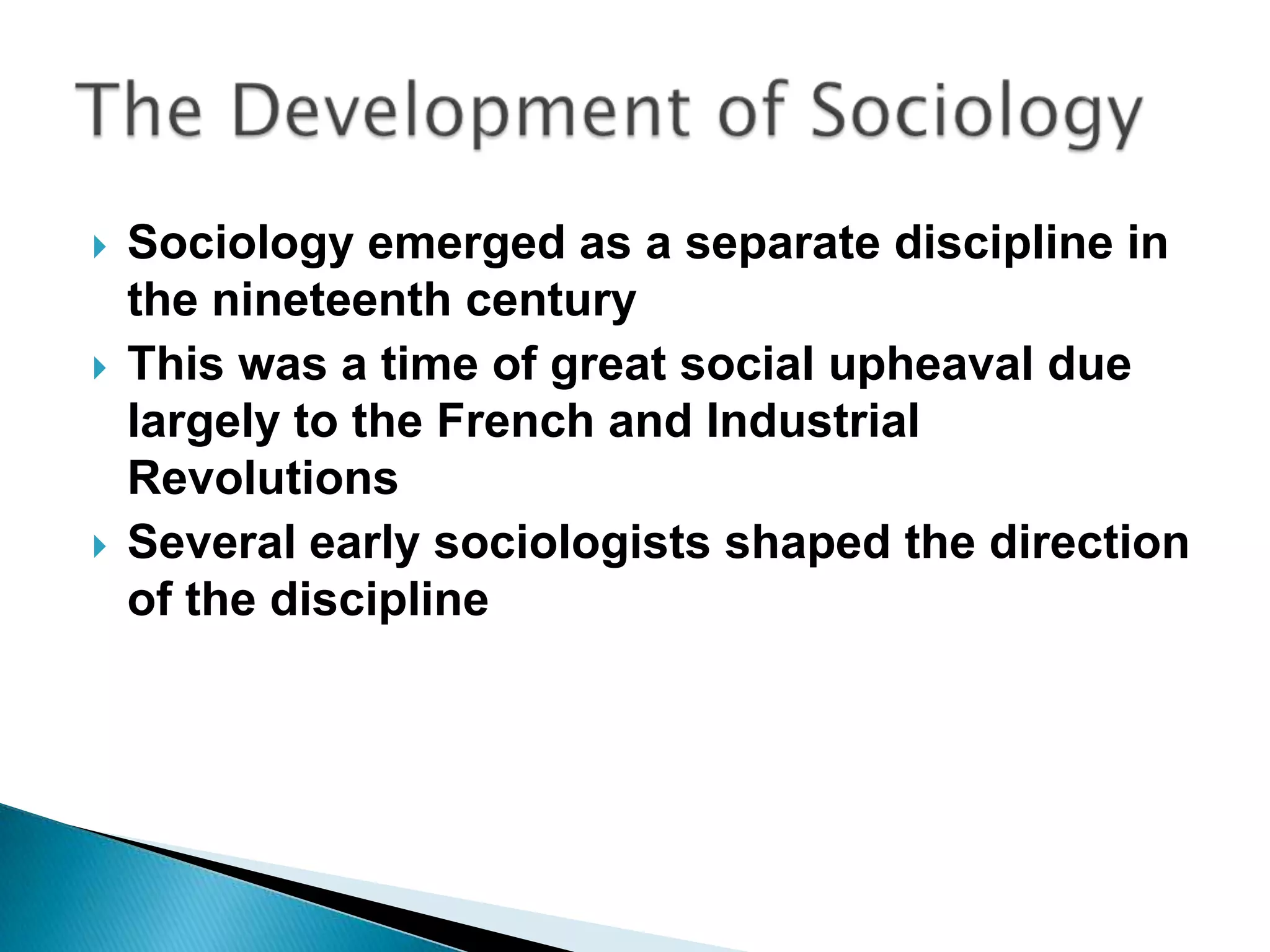
Responsible for coining the term “sociology”Set out to develop the “science of man” that would be based on empirical observationFocused on two aspects of society:Social Statics—forces which produce order and stability
Social Dynamics—forces which contribute to social changeAuguste Comte (1798-1857)
Authored one of the earliest analyses of culture and life in the United States entitled Theory and Practice of Society in AmericaTranslated Comte’s Positive Philosophy into EnglishHarriet Martineau (1802-1876)Harriet Martineau
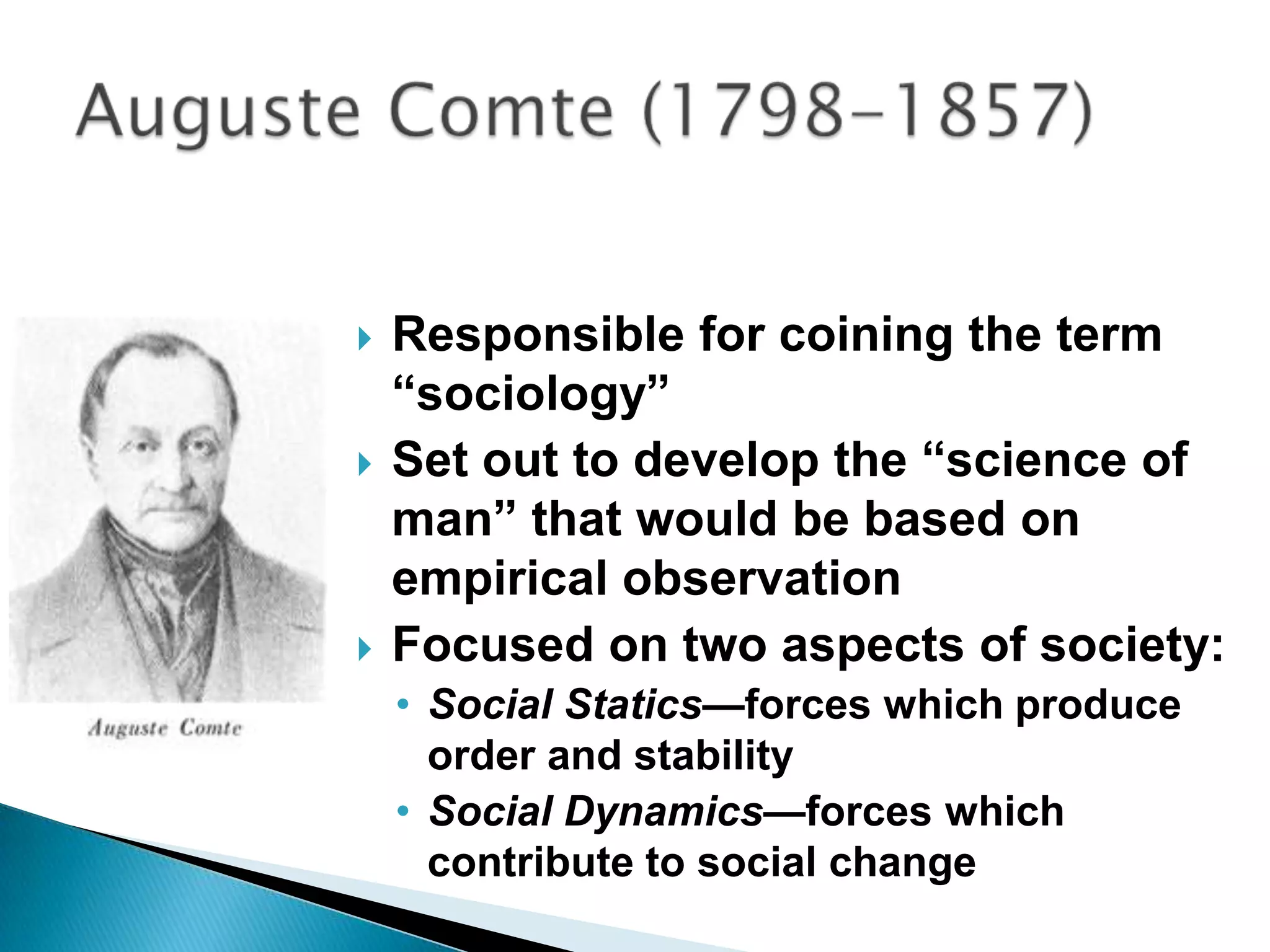
Authored the first sociology text, Principles of SociologyMost well known for proposing a doctrine called “Social Darwinism”Suggested that people who could not compete were poorly adapted to the environment and inferior
This is an idea commonly called survival of the fittestHerbert Spencer (1820-1903)
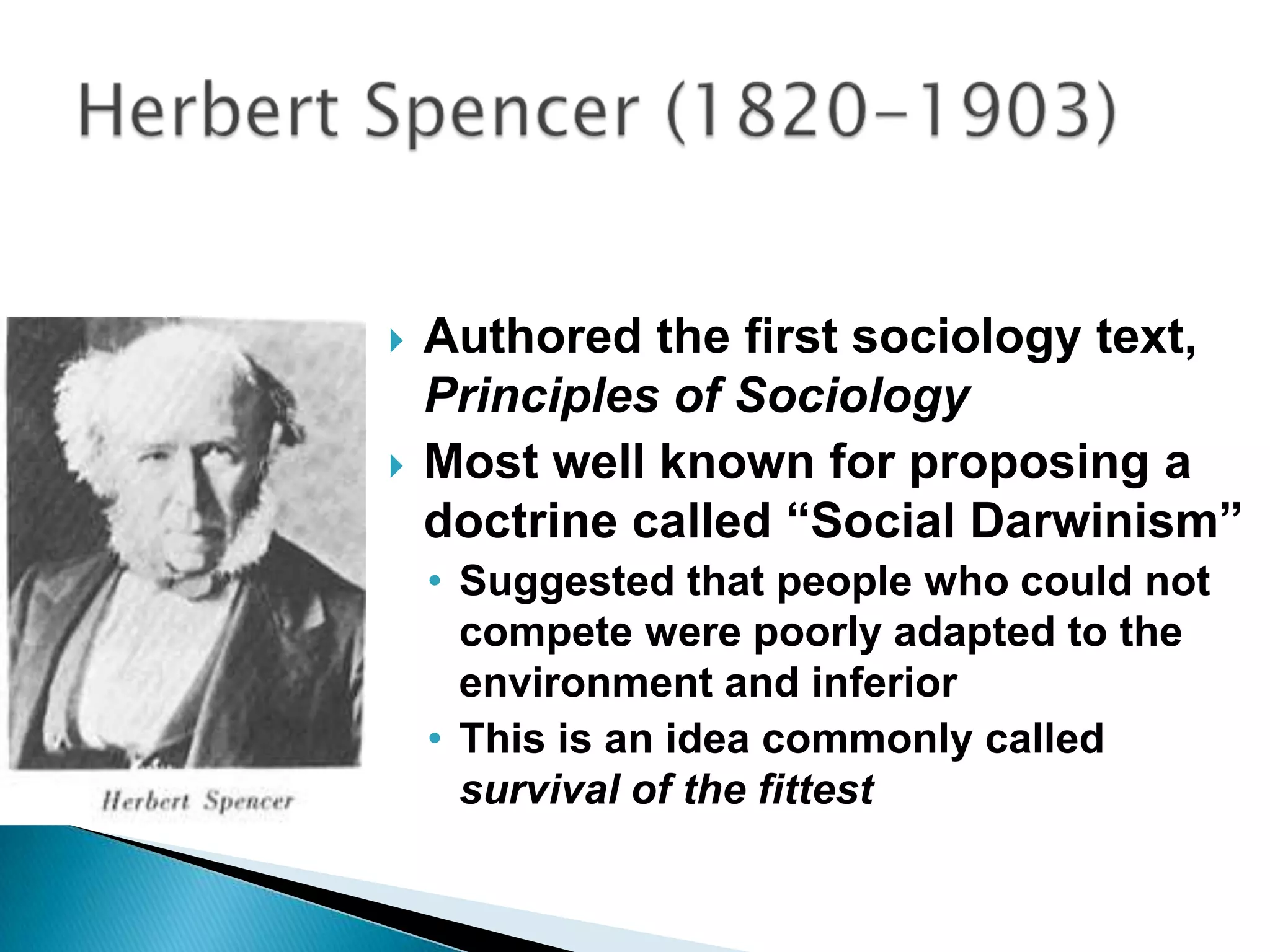
Marx is the father of conflicttheorySaw human history in a continual state of conflict between two major classes:Bourgeoisie—owners of the means of production (capitalists)
Proletariat—the workersPredicted that revolution would occur producing first a socialist state, followed by a communist societyKarl Marx (1818-1883)
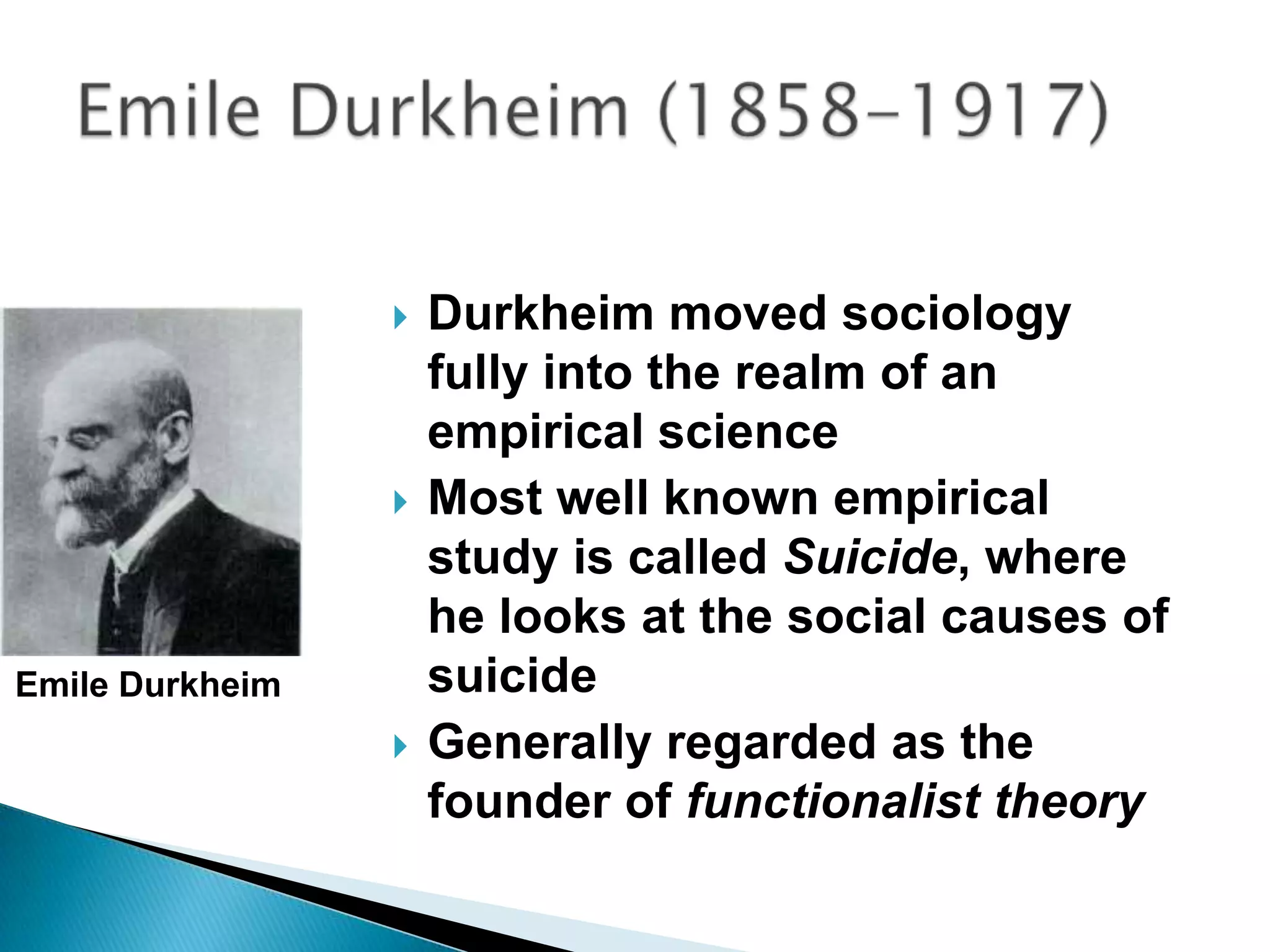
Durkheim moved sociology fully into the realm of an empirical scienceMost well known empirical study is called Suicide, where he looks at the social causes of suicideGenerally regarded as the founder of functionalist theoryEmile Durkheim (1858-1917)Emile Durkheim
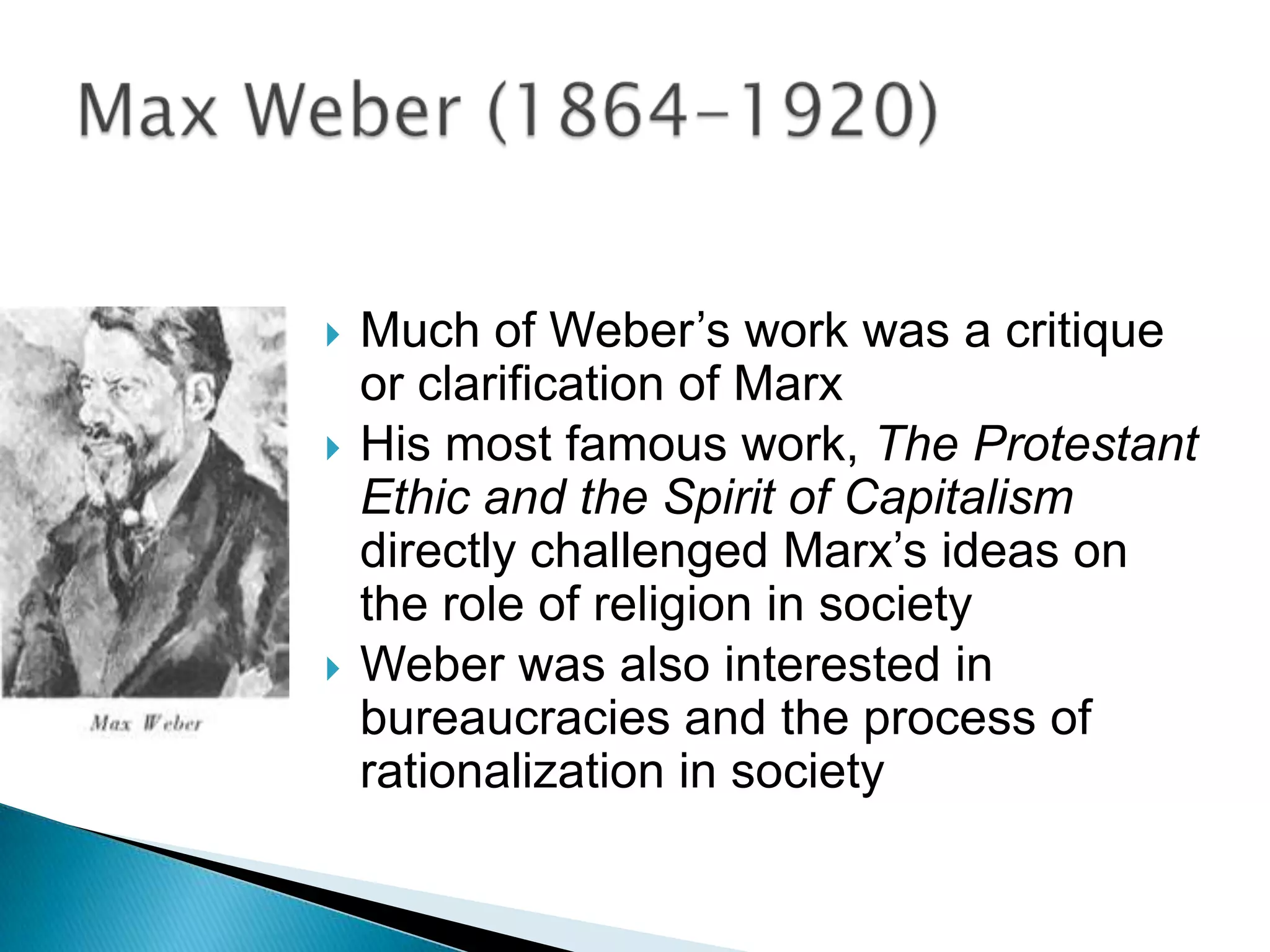
Much of Weber’s work was a critique or clarification of MarxHis most famous work, The Protestant Ethic and the Spirit of Capitalism directly challenged Marx’s ideas on the role of religion in societyWeber was also interested in bureaucracies and the process of rationalization in societyMax Weber (1864-1920)
The Development of Sociology in the United StatesAmerican sociology had its beginnings at the University of Chicago in the early 20th centuryThe early emphasis was on empirical study of communities and neighborhoodsLater, East Coast schools such as Columbia and Harvard Universities began sociology departments, producing scholars such as W.E.B. Dubois, Talcott Parsons, and Robert MertonHome page of the University of the Chicago Sociology Dep’t
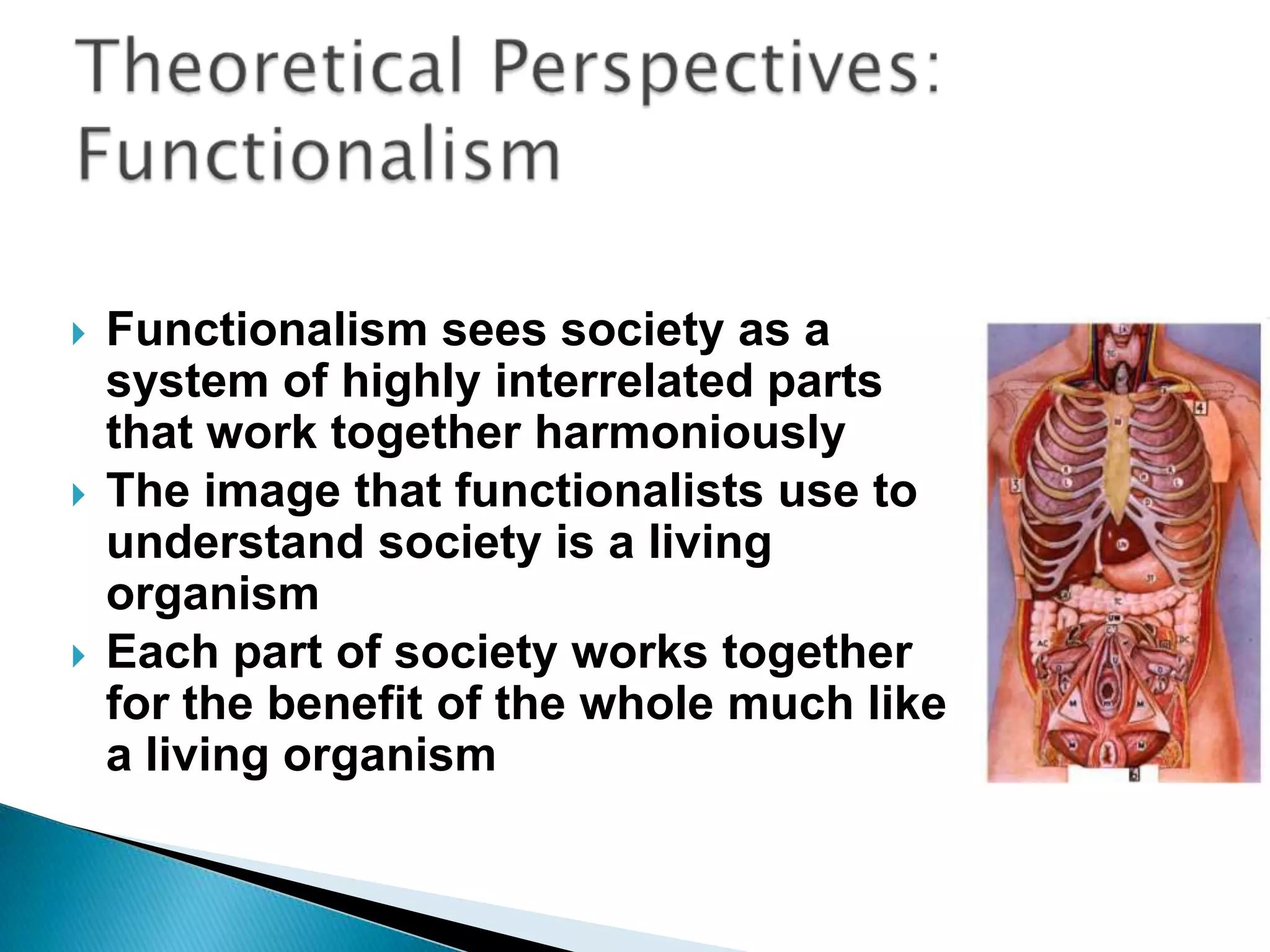
Functionalism sees society as a system of highly interrelated parts that work together harmoniouslyThe image that functionalists use to understand society is a living organismEach part of society works together for the benefit of the whole much like a living organismTheoretical Perspectives:  Functionalism

Development of sociology

  • 1.
  • 2.
    Sociology emerged asa separate discipline in the nineteenth centuryThis was a time of great social upheaval due largely to the French and Industrial RevolutionsSeveral early sociologists shaped the direction of the disciplineThe Development of Sociology
  • 3.
    Responsible for coiningthe term “sociology”Set out to develop the “science of man” that would be based on empirical observationFocused on two aspects of society:Social Statics—forces which produce order and stability
  • 4.
    Social Dynamics—forces whichcontribute to social changeAuguste Comte (1798-1857)
  • 5.
    Authored one ofthe earliest analyses of culture and life in the United States entitled Theory and Practice of Society in AmericaTranslated Comte’s Positive Philosophy into EnglishHarriet Martineau (1802-1876)Harriet Martineau
  • 6.
    Authored the firstsociology text, Principles of SociologyMost well known for proposing a doctrine called “Social Darwinism”Suggested that people who could not compete were poorly adapted to the environment and inferior
  • 7.
    This is anidea commonly called survival of the fittestHerbert Spencer (1820-1903)
  • 8.
    Marx is thefather of conflicttheorySaw human history in a continual state of conflict between two major classes:Bourgeoisie—owners of the means of production (capitalists)
  • 9.
    Proletariat—the workersPredicted thatrevolution would occur producing first a socialist state, followed by a communist societyKarl Marx (1818-1883)
  • 10.
    Durkheim moved sociologyfully into the realm of an empirical scienceMost well known empirical study is called Suicide, where he looks at the social causes of suicideGenerally regarded as the founder of functionalist theoryEmile Durkheim (1858-1917)Emile Durkheim
  • 11.
    Much of Weber’swork was a critique or clarification of MarxHis most famous work, The Protestant Ethic and the Spirit of Capitalism directly challenged Marx’s ideas on the role of religion in societyWeber was also interested in bureaucracies and the process of rationalization in societyMax Weber (1864-1920)
  • 12.
    The Development ofSociology in the United StatesAmerican sociology had its beginnings at the University of Chicago in the early 20th centuryThe early emphasis was on empirical study of communities and neighborhoodsLater, East Coast schools such as Columbia and Harvard Universities began sociology departments, producing scholars such as W.E.B. Dubois, Talcott Parsons, and Robert MertonHome page of the University of the Chicago Sociology Dep’t
  • 13.
    Functionalism sees societyas a system of highly interrelated parts that work together harmoniouslyThe image that functionalists use to understand society is a living organismEach part of society works together for the benefit of the whole much like a living organismTheoretical Perspectives: Functionalism
  • 14.
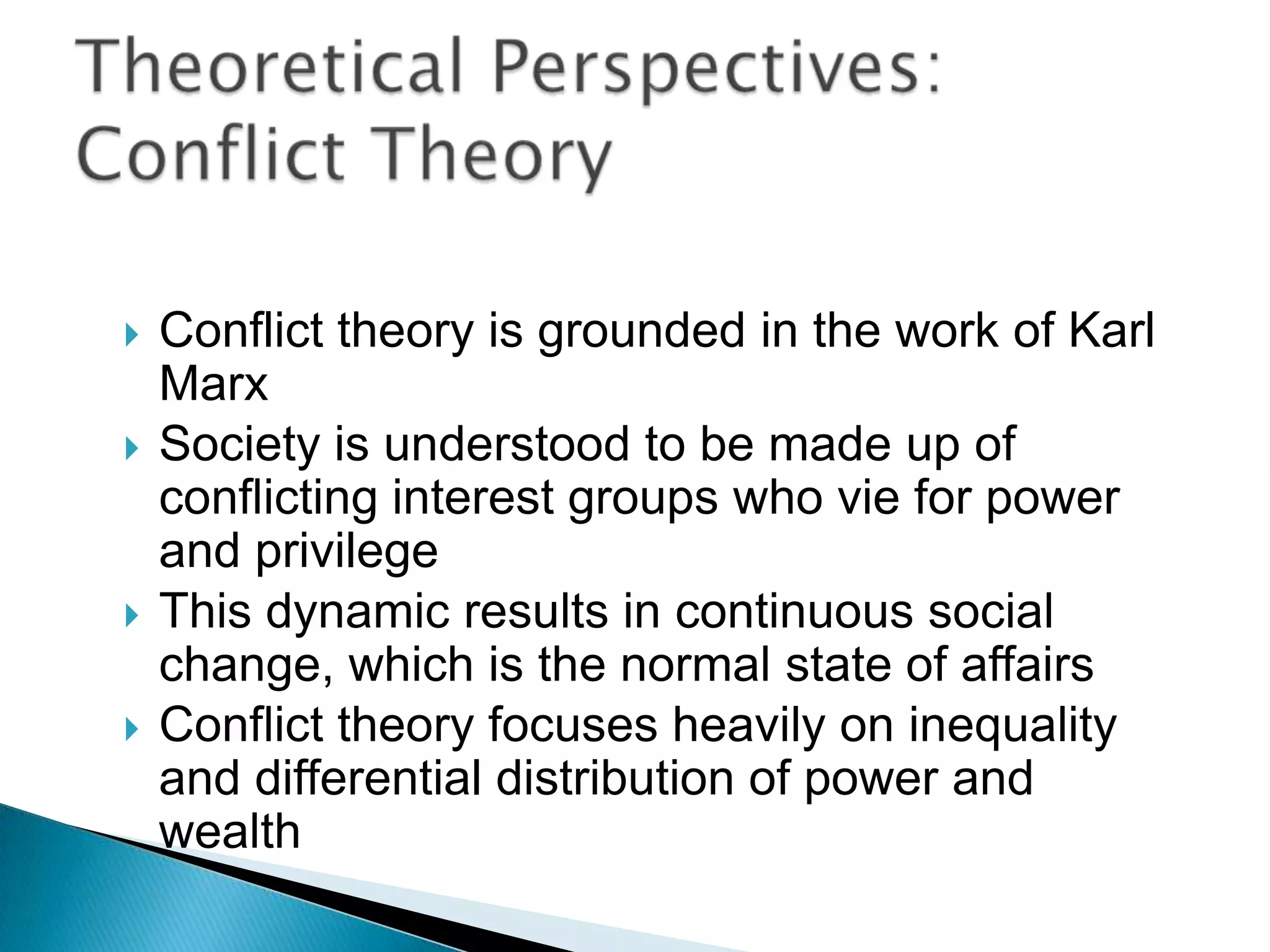
    Conflict theory isgrounded in the work of Karl MarxSociety is understood to be made up of conflicting interest groups who vie for power and privilegeThis dynamic results in continuous social change, which is the normal state of affairsConflict theory focuses heavily on inequality and differential distribution of power and wealthTheoretical Perspectives: Conflict Theory
  • 15.
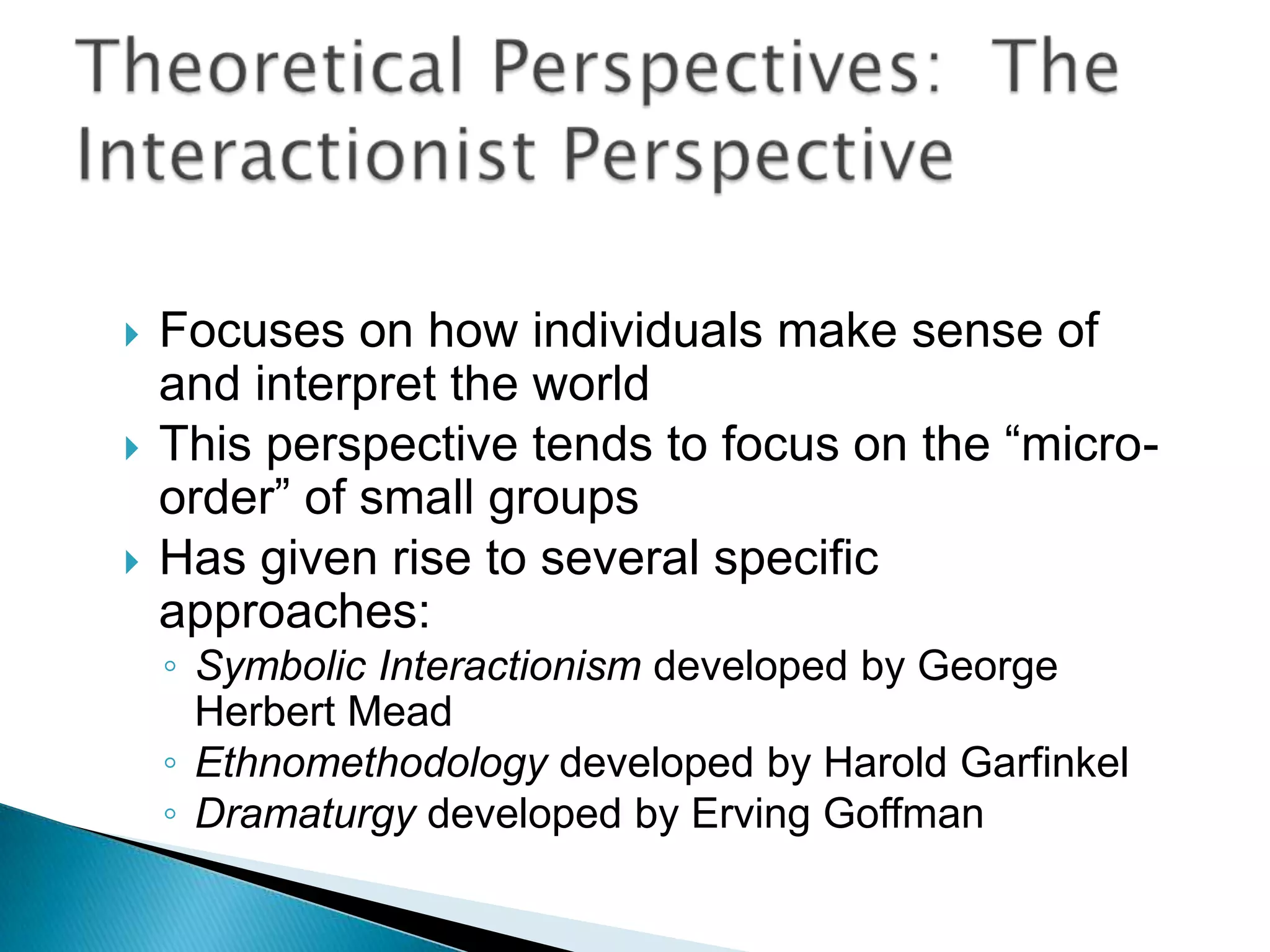
    Focuses on howindividuals make sense of and interpret the worldThis perspective tends to focus on the “micro-order” of small groupsHas given rise to several specific approaches:Symbolic Interactionism developed by George Herbert MeadEthnomethodology developed by Harold GarfinkelDramaturgy developed by Erving GoffmanTheoretical Perspectives: The Interactionist Perspective