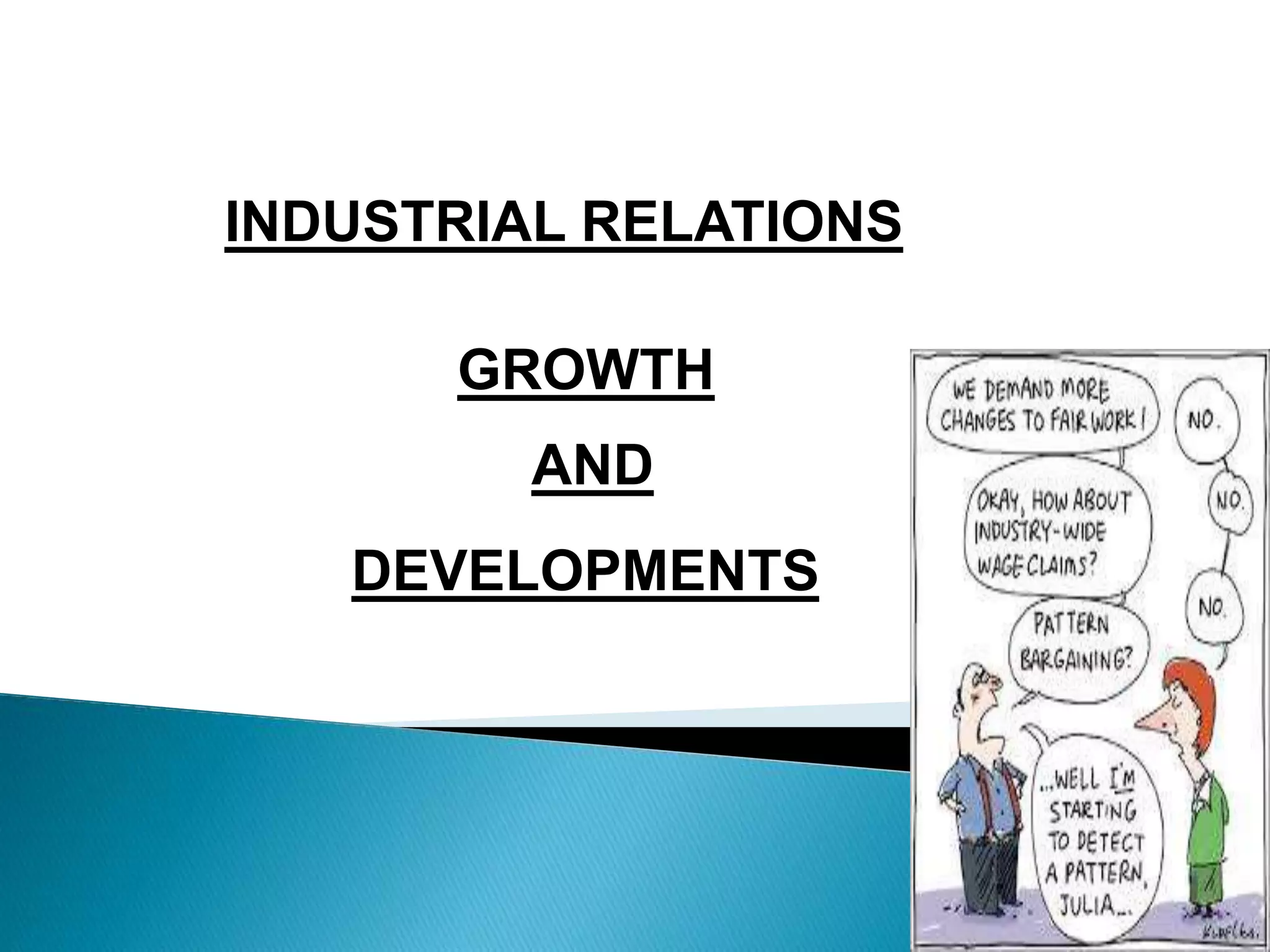
INDUSTRIAL RELATIONS
GROWTH
AND
DEVELOPMENTS
CONCEPT OF INDUSTRIAL RELATION
(IR)
Industrial relations are the outcome of
employment relationships essentially
between the-
employer
•employers
•Employers’
associations
employee
•employees
•Trade
unions
government
•government
•Courts and
tribunals
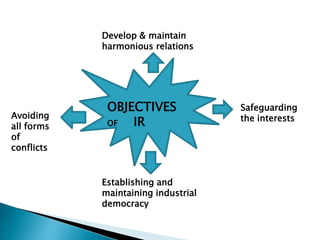
OBJECTIVES
OF IR
Develop & maintain
harmonious relations
Safeguarding
the interests
Establishing and
maintaining industrial
democracy
Avoiding
all forms
of
conflicts
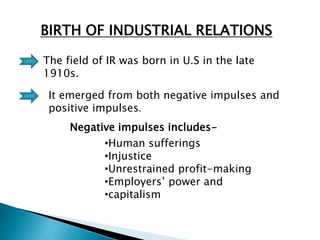
BIRTH OF INDUSTRIAL RELATIONS
The field of IR was born in U.S in the late
1910s.
It emerged from both negative impulses and
positive impulses.
Negative impulses includes-
•Human sufferings
•Injustice
•Unrestrained profit-making
•Employers’ power and
•capitalism
POSITIVE IMPULSES OF IR
• Need for the improvement in the
working condition.
• Improvement in the relationship
between the employer and employees.
Through a combination of-
•Education
•Legal reforms
•Scientific discoveries
•Higher sense of ethics & responsibility.
INDUSTRIAL RELATIONS UNDER BRITISH RULE
India was expected to be a colonial market
for British goods.
Establishment of the first cotton mill in Mumbai
in 1853 and jute mill in Kolkata.
Working condition of the workers, at that
time, were harsh with very low pay.
This gave rise to various
disputes between the
management and employees.
Disputes between the management
and employees.
Due to this, Factories Act, 1881
was established and granted
certain rights to the workers.
IR UNDER 1ST AND 2ND WORLD WAR
During 1st world war, prices of all product went up
and profit soared, but the wages of employees were
still same.
Due to this, the rate of strikes were quite high at that
time.
During this time, The Workmen’s Compensation Act,
1923, The Trade Union Act, 1926 and The Trade
Disputes Act, 1927 were established.
Due to this, the workers started getting shares in
the profit but still their share and wages were low
for survival.
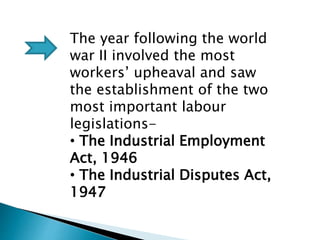
The year following the world
war II involved the most
workers’ upheaval and saw
the establishment of the two
most important labour
legislations-
• The Industrial Employment
Act, 1946
• The Industrial Disputes Act,
1947
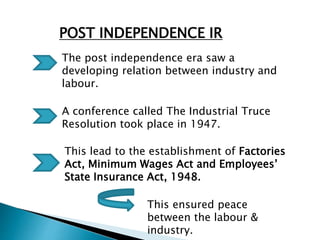
POST INDEPENDENCE IR
The post independence era saw a
developing relation between industry and
labour.
A conference called The Industrial Truce
Resolution took place in 1947.
This lead to the establishment of Factories
Act, Minimum Wages Act and Employees’
State Insurance Act, 1948.
This ensured peace
between the labour &
industry.
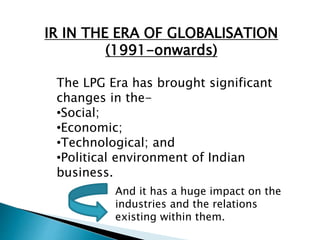
IR IN THE ERA OF GLOBALISATION
(1991-onwards)
The LPG Era has brought significant
changes in the-
•Social;
•Economic;
•Technological; and
•Political environment of Indian
business.
And it has a huge impact on the
industries and the relations
existing within them.
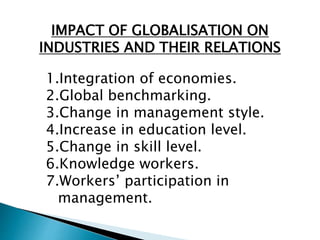
IMPACT OF GLOBALISATION ON
INDUSTRIES AND THEIR RELATIONS
1.Integration of economies.
2.Global benchmarking.
3.Change in management style.
4.Increase in education level.
5.Change in skill level.
6.Knowledge workers.
7.Workers’ participation in
management.
RECENT DEVELOPMENTS IN
INDUSTRIAL RELATIONS
1.New actors and the emerging
dynamics.
•Employers
•Employers’ association
•Employees
•Trade unions
•Government
•Courts & tribunals •Consumers and
•Community
2. Pro-labour-pro-societal
policies.
3. Declining Trade Union
density.
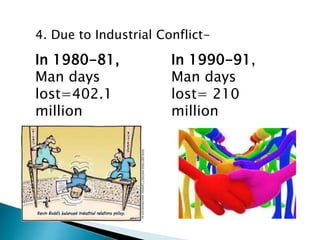
4. Due to Industrial Conflict-
In 1980-81,
Man days
lost=402.1
million
In 1990-91,
Man days
lost= 210
million
In 2003-04, man days lost=
6.39 million
The total number strikes and lockouts
went down to 13.6% from 552 in 2003
to 477 in 2004.
The Payment of Wages
(amendment) Act, 2005,
enhanced the wage ceiling from
Rs.1600 per month to Rs. 6000
per month, with effect from 9th
Nov. 2005.
…but still we are lacking somewhere
in maintaining industrial
relationships….
CONCLUSION
There is no denying the fact that management
philosophy is undergoing a sea change over
the last few decades. Management’s focus is
changing from managing workers to that of
managing work. The organizations today
realize that human resource is the greatest
asset and are adopting policies like
competence building, job rotation etc, which
promote the overall development of the
workers and thus, helps in establishing and
maintaining good relations at the work place.
PRESENTED BY-
Roll no. 180- Tripti Singh
182- Utkarsh Singh
188- Vinay Shukla
193- Aditya Kejriwal
UNDER THE
SUPERVISION OF-
Prof.S.C.Das
THANK YOU

industrial relation-growth & development)

  • 1.
  • 3.
    CONCEPT OF INDUSTRIALRELATION (IR) Industrial relations are the outcome of employment relationships essentially between the- employer •employers •Employers’ associations employee •employees •Trade unions government •government •Courts and tribunals
  • 4.
    OBJECTIVES OF IR Develop &maintain harmonious relations Safeguarding the interests Establishing and maintaining industrial democracy Avoiding all forms of conflicts
  • 6.
    BIRTH OF INDUSTRIALRELATIONS The field of IR was born in U.S in the late 1910s. It emerged from both negative impulses and positive impulses. Negative impulses includes- •Human sufferings •Injustice •Unrestrained profit-making •Employers’ power and •capitalism
  • 7.
    POSITIVE IMPULSES OFIR • Need for the improvement in the working condition. • Improvement in the relationship between the employer and employees. Through a combination of- •Education •Legal reforms •Scientific discoveries •Higher sense of ethics & responsibility.
  • 8.
    INDUSTRIAL RELATIONS UNDERBRITISH RULE India was expected to be a colonial market for British goods. Establishment of the first cotton mill in Mumbai in 1853 and jute mill in Kolkata. Working condition of the workers, at that time, were harsh with very low pay. This gave rise to various disputes between the management and employees.
  • 9.
    Disputes between themanagement and employees. Due to this, Factories Act, 1881 was established and granted certain rights to the workers.
  • 10.
    IR UNDER 1STAND 2ND WORLD WAR During 1st world war, prices of all product went up and profit soared, but the wages of employees were still same. Due to this, the rate of strikes were quite high at that time. During this time, The Workmen’s Compensation Act, 1923, The Trade Union Act, 1926 and The Trade Disputes Act, 1927 were established. Due to this, the workers started getting shares in the profit but still their share and wages were low for survival.
  • 11.
    The year followingthe world war II involved the most workers’ upheaval and saw the establishment of the two most important labour legislations- • The Industrial Employment Act, 1946 • The Industrial Disputes Act, 1947
  • 12.
    POST INDEPENDENCE IR Thepost independence era saw a developing relation between industry and labour. A conference called The Industrial Truce Resolution took place in 1947. This lead to the establishment of Factories Act, Minimum Wages Act and Employees’ State Insurance Act, 1948. This ensured peace between the labour & industry.
  • 13.
    IR IN THEERA OF GLOBALISATION (1991-onwards) The LPG Era has brought significant changes in the- •Social; •Economic; •Technological; and •Political environment of Indian business. And it has a huge impact on the industries and the relations existing within them.
  • 14.
    IMPACT OF GLOBALISATIONON INDUSTRIES AND THEIR RELATIONS 1.Integration of economies. 2.Global benchmarking. 3.Change in management style. 4.Increase in education level. 5.Change in skill level. 6.Knowledge workers. 7.Workers’ participation in management.
  • 15.
    RECENT DEVELOPMENTS IN INDUSTRIALRELATIONS 1.New actors and the emerging dynamics. •Employers •Employers’ association •Employees •Trade unions •Government •Courts & tribunals •Consumers and •Community
  • 16.
  • 17.
    4. Due toIndustrial Conflict- In 1980-81, Man days lost=402.1 million In 1990-91, Man days lost= 210 million
  • 18.
    In 2003-04, mandays lost= 6.39 million The total number strikes and lockouts went down to 13.6% from 552 in 2003 to 477 in 2004.
  • 19.
    The Payment ofWages (amendment) Act, 2005, enhanced the wage ceiling from Rs.1600 per month to Rs. 6000 per month, with effect from 9th Nov. 2005.
  • 20.
    …but still weare lacking somewhere in maintaining industrial relationships….
  • 21.
    CONCLUSION There is nodenying the fact that management philosophy is undergoing a sea change over the last few decades. Management’s focus is changing from managing workers to that of managing work. The organizations today realize that human resource is the greatest asset and are adopting policies like competence building, job rotation etc, which promote the overall development of the workers and thus, helps in establishing and maintaining good relations at the work place.
  • 22.
    PRESENTED BY- Roll no.180- Tripti Singh 182- Utkarsh Singh 188- Vinay Shukla 193- Aditya Kejriwal UNDER THE SUPERVISION OF- Prof.S.C.Das
  • 23.