COMMUNITY IN
DIFFERENT PERSPECTIVES
MR. CARL PATRICK S. TADEO
SHS TEACHER
Nature of a Community
It is a sociological construct.
It has fuzzy boundaries
It can exist within a larger community.
It may move.
A community is…
‘super-organic organism or system,’ made
up of the thoughts, outlook and conduct of
individual human beings full of divisions
and conflicts brought about by differences.
Differences: religion, ethnicity, gender, access to resources, class,
educational level, income level, ownership of properties, language,
personality, etc.
ETYMOLOGICAL ORIGIN
Community – Late Middle English Term
-Latin – ‘communitas’ – fellowship
- Latin roots – communis – common
- com – with or together
- munire – to strengthen, to fortify
COMMUNITY IN DIFF. PERSPECTIVE
•Social Science Perspective
•Institutional Perspective
•Civil Society Perspective
•Organic/ Grassroot Level Perspective
SOCIAL SCIENCE PERSPECTIVE
Political Science
•Conceptualized the ideal (political) community
•Polis (city-state) – composed of various classes, each
performing roles and functions in pursuit of communal
goals (Plato)
•Aristotle – emphasized the role of political institutions in
maintaining and sustaining order within a community
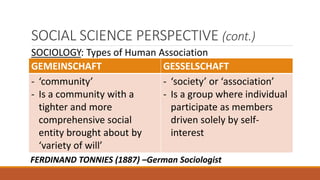
SOCIAL SCIENCE PERSPECTIVE (cont.)
GEMEINSCHAFT GESSELSCHAFT
- ‘community’
- Is a community with a
tighter and more
comprehensive social
entity brought about by
‘variety of will’
- ‘society’ or ‘association’
- Is a group where individual
participate as members
driven solely by self-
interest
SOCIOLOGY: Types of Human Association
FERDINAND TONNIES (1887) –German Sociologist
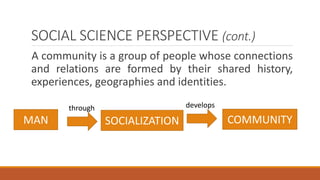
SOCIAL SCIENCE PERSPECTIVE (cont.)
A community is a group of people whose connections
and relations are formed by their shared history,
experiences, geographies and identities.
MAN SOCIALIZATION COMMUNITY
developsthrough
INSTITUTIONAL PERSPECTIVE
Social Institutions – arise from voluntary shared agreements among individuals that generally
also shape their behaviors as collective; perform functions of community
Institutions – established rules that ensure the regular and predictable behavior

Community in different perspectives

  • 1.
    COMMUNITY IN DIFFERENT PERSPECTIVES MR.CARL PATRICK S. TADEO SHS TEACHER
  • 3.
    Nature of aCommunity It is a sociological construct. It has fuzzy boundaries It can exist within a larger community. It may move.
  • 4.
    A community is… ‘super-organicorganism or system,’ made up of the thoughts, outlook and conduct of individual human beings full of divisions and conflicts brought about by differences. Differences: religion, ethnicity, gender, access to resources, class, educational level, income level, ownership of properties, language, personality, etc.
  • 5.
    ETYMOLOGICAL ORIGIN Community –Late Middle English Term -Latin – ‘communitas’ – fellowship - Latin roots – communis – common - com – with or together - munire – to strengthen, to fortify
  • 6.
    COMMUNITY IN DIFF.PERSPECTIVE •Social Science Perspective •Institutional Perspective •Civil Society Perspective •Organic/ Grassroot Level Perspective
  • 7.
    SOCIAL SCIENCE PERSPECTIVE PoliticalScience •Conceptualized the ideal (political) community •Polis (city-state) – composed of various classes, each performing roles and functions in pursuit of communal goals (Plato) •Aristotle – emphasized the role of political institutions in maintaining and sustaining order within a community
  • 8.
    SOCIAL SCIENCE PERSPECTIVE(cont.) GEMEINSCHAFT GESSELSCHAFT - ‘community’ - Is a community with a tighter and more comprehensive social entity brought about by ‘variety of will’ - ‘society’ or ‘association’ - Is a group where individual participate as members driven solely by self- interest SOCIOLOGY: Types of Human Association FERDINAND TONNIES (1887) –German Sociologist
  • 9.
    SOCIAL SCIENCE PERSPECTIVE(cont.) A community is a group of people whose connections and relations are formed by their shared history, experiences, geographies and identities. MAN SOCIALIZATION COMMUNITY developsthrough
  • 10.
    INSTITUTIONAL PERSPECTIVE Social Institutions– arise from voluntary shared agreements among individuals that generally also shape their behaviors as collective; perform functions of community Institutions – established rules that ensure the regular and predictable behavior