Globalization: the integration of
regional economies, societies, and
 cultures through globe-spanning
 networks of communication and
           development.

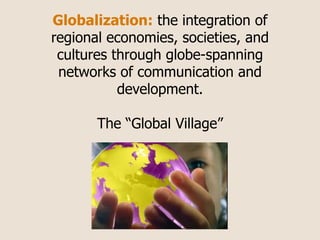
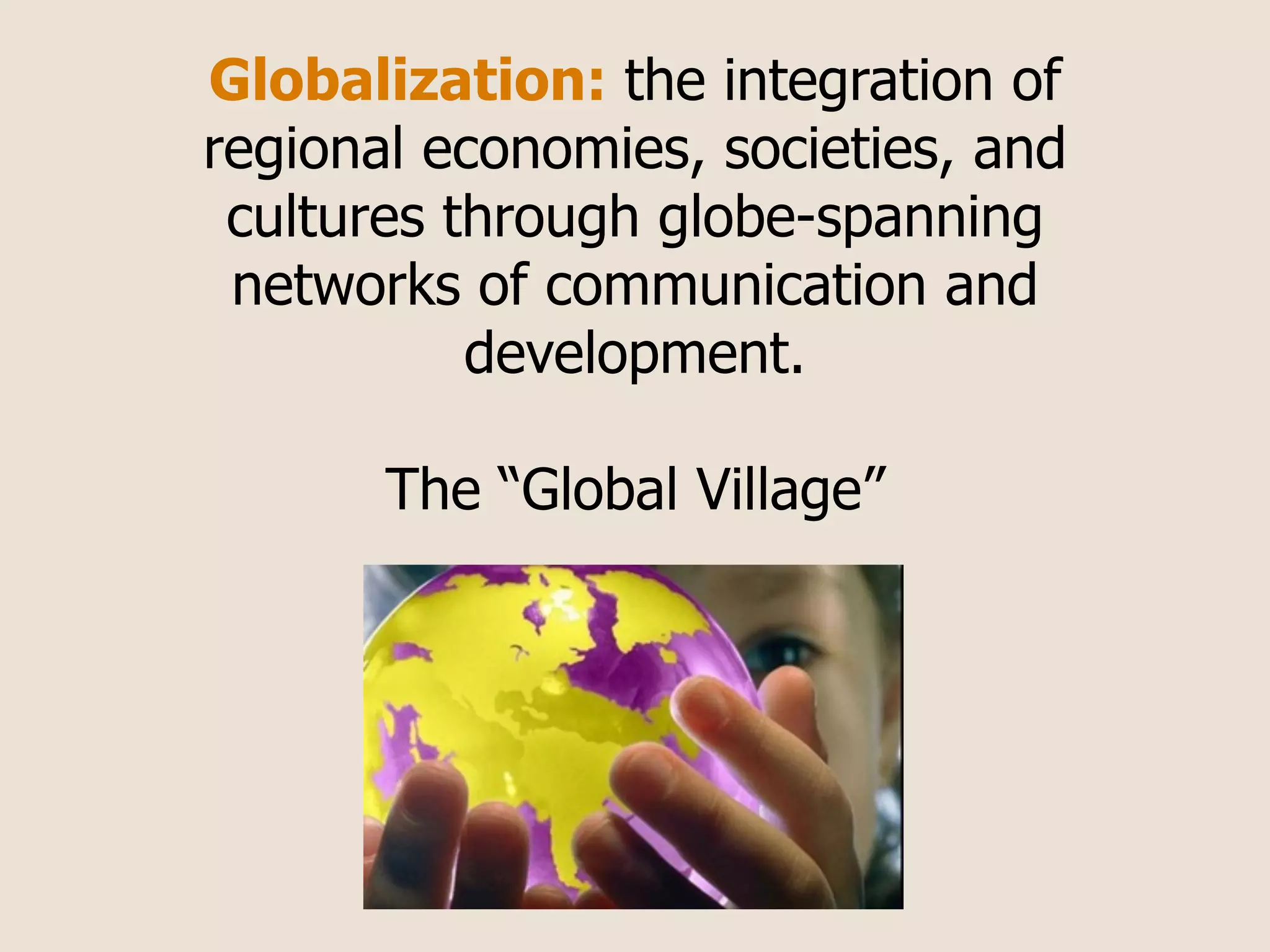
       The “Global Village”
Globalization has changed the world
permanently, for both better and worse.
Path to globalization:

•   After World War II, politicians wanted to
    break down borders hampering trade, to
    increase prosperity and interdependence
    thereby decreasing the chance of future
    war.
•   They formed a framework for
    international commerce and finance...
•   ...and founded several international
    institutions intended to oversee the
    processes of globalization, to mediate
    trade disputes and set up a uniform
    platform of trading, in pursuit of the goal
    of reducing tariffs and barriers to trade
Examples:
•   The World Bank

•   The International Monetary Fund

•   The World Trade Organization

•   Europe's Maastricht Treaty

•   The North American Free Trade Agreement (NAFTA)
Globalization has various aspects which
affect the world in several different
ways
Ecological impact: cross-boundary
water and air pollution, over-fishing of the
ocean, and the spread of invasive species.
Since many factories are built in
developing countries with less
environmental regulation, globalism and
free trade may increase pollution, leading
to climate change.
Discussion topic:
Economic development historically has
required a "dirty" industrial stage, for
example the industrial era in the U.S.
which contributed to its becoming a
superpower, and it is argued that
developing countries should not now, via
regulation, be prohibited from similarly
increasing their standard of living.
Agree or disagree?
These global environmental challenges
might be solved with international
cooperation
Cultural impact: growth of cross-cultural
contacts, cultural dispersal, the desire to
increase one's standard of living and enjoy
foreign products and ideas, adopt new
technology and practices, and participate
in a "world culture".
Some complain about the resulting
consumerism and loss of languages...
...while others consider multiculturalism to
promote peace and understanding
between peoples.
Social impact: development of the
system of non-governmental organizations
(NGOs) as main agents of global public
policy, including humanitarian aid and
developmental efforts.
Economic interdependence:
•   The decision of a commodities trader in
    New York affects a farmer in Africa.
•   The parts of a single car come from many
    different countries.
•   The banking crisis in one market wreaks
    havoc in another.
Globalization has generated significant
international opposition over concerns
that it has increased inequality and
environmental degradation.
Global trade liberalization has enticed U.S.
corporations to relocate to poor countries
where employees agree to work for low
wages, with low labor and environmental
standards. It allows them to manufacture
products and to cheaply extract natural
resources from these countries without
having to pay the costs which wages and
environmental regulations demand.
In the Midwestern United States,
globalization has eaten away at its
competitive edge in industry and
agriculture, lowering the quality of life in
locations that have not adapted to the
change.
The laid off manufacturing sector workers
are forced into the service sector where
wages and benefits are low, and turnover
is high. This has contributed to the
deterioration of the middle class which is
a major factor in the increasing economic
inequality in the United States.
Discussion topic: People in the lower
class will have a much harder time
climbing out of poverty because of the
absence of the middle class as a stepping
stone.
In poorer countries, opportunities in richer
countries drive talent away, leading to a
phenomenon called brain drain. Brain
drain or human capital flight is a large
emigration of individuals with technical
skills or knowledge, normally due to
conflict, lack of opportunity, political
instability, or health risks.
•   To fill the human resource gap created by
    brain drain, Africa employs up to 150,000
    expatriate professionals at a cost of
    around $4 billion a year
•   Brain drain, coupled with the loss of
    trained professionals due to HIV/AIDS,
    severely erodes the valuable human
    capital critically needed for economic
    growth and human development
Another example often used by anti-
globalization protestors is the use of
sweatshops, for example by clothing and
sports shoe manufacturers. They set up
factories in a poor country, then if labor
laws alter in those countries and stricter
rules govern the manufacturing process,
the factories are simply closed down and
relocated to other nations with more
conservative, laissez-faire economic
policies.
Ideas for change:
•   Anti-sweatshop campaigns and education
•   Supporting legislation that would legally
    require companies to respect human and
    worker rights by prohibiting the import,
    sale, or export of sweatshop goods.
•   Legislation for core standards including no
    child labor, no forced labor, freedom of
    association, right to organize and bargain
    collectively, as well as the right to decent
    working conditions.
Ideas for change:
•   Stand in opposition to the unregulated
    political power of large, multi-national
    corporations that have the power to
    leverage trade agreements-- which in
    some instances damage the environment
    (particularly air quality index and rain
    forests), and local governments’
    sovereignty to determine labor rights,
    health and safety legislation
Ideas for change:
•   Change regulations which do not allow
    countries to grow food for their own
    people (but rather for export)
•   Expose dishonest practices (example: a
    factory in Central America which is
    accused of harsh working environments,
    low wages, forced overtime, and illegal
    working conditions for minors-- gives
    propaganda tours to convince visitors that
    workers are well-treated and taken care of
    in their plants)
The Winners: Corporations & The Rich


•   The world’s largest 500 corporations
    control over 70% of world trade.
•   For example, in the 1990s, 80% of the
    entire production of world grain was
    distributed by just two companies.
    *source: UN Food & Agriculture Organization, "Trends in World and
    Agricultural Trade"
The Winners: Corporations & The Rich
•   Individuals seem to be benefiting from the
    global economy too. Between 1994 and
    1998 alone, the 200 richest people in the
    world more than doubled their net worth
    to more than $1 trillion.
•   Meanwhile, disparities continue to grow:
    In 1960, the income gap between the
    richest fifth of the world's population and
    the poorest fifth was 30 to 1; in 1997 it
    was 74 to 1.
    *source: UNICEF, "State of the World's Children 2000"
The Losers:
•   Workers
•   Small farmers
•   The environment
Where do you stand?
•   Proponents of laissez-faire capitalism, and
    some libertarians, say that higher degrees
    of political and economic freedom in the
    form of democracy and capitalism in the
    developed world are ends in themselves
    and also produce higher levels of material
    wealth.
•   They see globalization as the beneficial
    spread of liberty and capitalism.
Where do you stand?
•   The Global Justice Movement describes
    the loose collection of individuals and
    groups who advocate "fair trade" rules
    and are critical of current institutions of
    global economics such as the World Trade
    Organization.
Is it possible to be both pro- and
    anti-globalization at the same time?

•   Support the globalization of communication

•   Support increased opportunity for development

•   Encourage increased direct transborder collaboration
    between governments; diversity and innovation in world
    politics

•   Support closer ties between the various peoples and
    cultures of the world through, for example, foreign aid,
    assistance for refugees, and global environmental issues

•   Oppose the global expansion of corporate power

•   Oppose unequal distribution of resources
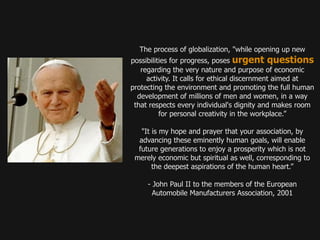
The process of globalization, "while opening up new
possibilities for progress, poses urgent questions
   regarding the very nature and purpose of economic
     activity. It calls for ethical discernment aimed at
protecting the environment and promoting the full human
  development of millions of men and women, in a way
 that respects every individual's dignity and makes room
          for personal creativity in the workplace.”

   "It is my hope and prayer that your association, by
  advancing these eminently human goals, will enable
  future generations to enjoy a prosperity which is not
 merely economic but spiritual as well, corresponding to
       the deepest aspirations of the human heart.”

     - John Paul II to the members of the European
       Automobile Manufacturers Association, 2001
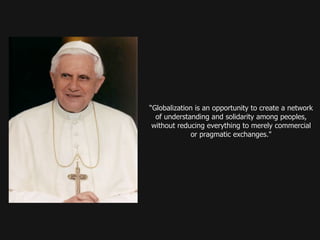
“Globalization is an opportunity to create a network
  of understanding and solidarity among peoples,
 without reducing everything to merely commercial
              or pragmatic exchanges."
How   Vincent expanded the circle of solidarity:
       - rely on God’s transforming power
 - allow God to change attitudes and persons
 - thereby open the door to the possibility of
           changing society’s structures

Globalization

  • 1.
    Globalization: the integrationof regional economies, societies, and cultures through globe-spanning networks of communication and development. The “Global Village”
  • 2.
    Globalization has changedthe world permanently, for both better and worse.
  • 3.
    Path to globalization: • After World War II, politicians wanted to break down borders hampering trade, to increase prosperity and interdependence thereby decreasing the chance of future war. • They formed a framework for international commerce and finance...
  • 4.
    ...and founded several international institutions intended to oversee the processes of globalization, to mediate trade disputes and set up a uniform platform of trading, in pursuit of the goal of reducing tariffs and barriers to trade
  • 5.
    Examples: • The World Bank • The International Monetary Fund • The World Trade Organization • Europe's Maastricht Treaty • The North American Free Trade Agreement (NAFTA)
  • 6.
    Globalization has variousaspects which affect the world in several different ways
  • 7.
    Ecological impact: cross-boundary waterand air pollution, over-fishing of the ocean, and the spread of invasive species. Since many factories are built in developing countries with less environmental regulation, globalism and free trade may increase pollution, leading to climate change.
  • 8.
    Discussion topic: Economic developmenthistorically has required a "dirty" industrial stage, for example the industrial era in the U.S. which contributed to its becoming a superpower, and it is argued that developing countries should not now, via regulation, be prohibited from similarly increasing their standard of living. Agree or disagree?
  • 9.
    These global environmentalchallenges might be solved with international cooperation
  • 10.
    Cultural impact: growthof cross-cultural contacts, cultural dispersal, the desire to increase one's standard of living and enjoy foreign products and ideas, adopt new technology and practices, and participate in a "world culture". Some complain about the resulting consumerism and loss of languages...
  • 11.
    ...while others considermulticulturalism to promote peace and understanding between peoples.
  • 12.
    Social impact: developmentof the system of non-governmental organizations (NGOs) as main agents of global public policy, including humanitarian aid and developmental efforts.
  • 13.
    Economic interdependence: • The decision of a commodities trader in New York affects a farmer in Africa. • The parts of a single car come from many different countries. • The banking crisis in one market wreaks havoc in another.
  • 14.
    Globalization has generatedsignificant international opposition over concerns that it has increased inequality and environmental degradation.
  • 15.
    Global trade liberalizationhas enticed U.S. corporations to relocate to poor countries where employees agree to work for low wages, with low labor and environmental standards. It allows them to manufacture products and to cheaply extract natural resources from these countries without having to pay the costs which wages and environmental regulations demand.
  • 16.
    In the MidwesternUnited States, globalization has eaten away at its competitive edge in industry and agriculture, lowering the quality of life in locations that have not adapted to the change.
  • 17.
    The laid offmanufacturing sector workers are forced into the service sector where wages and benefits are low, and turnover is high. This has contributed to the deterioration of the middle class which is a major factor in the increasing economic inequality in the United States.
  • 18.
    Discussion topic: Peoplein the lower class will have a much harder time climbing out of poverty because of the absence of the middle class as a stepping stone.
  • 19.
    In poorer countries,opportunities in richer countries drive talent away, leading to a phenomenon called brain drain. Brain drain or human capital flight is a large emigration of individuals with technical skills or knowledge, normally due to conflict, lack of opportunity, political instability, or health risks.
  • 20.
    To fill the human resource gap created by brain drain, Africa employs up to 150,000 expatriate professionals at a cost of around $4 billion a year • Brain drain, coupled with the loss of trained professionals due to HIV/AIDS, severely erodes the valuable human capital critically needed for economic growth and human development
  • 21.
    Another example oftenused by anti- globalization protestors is the use of sweatshops, for example by clothing and sports shoe manufacturers. They set up factories in a poor country, then if labor laws alter in those countries and stricter rules govern the manufacturing process, the factories are simply closed down and relocated to other nations with more conservative, laissez-faire economic policies.
  • 22.
    Ideas for change: • Anti-sweatshop campaigns and education • Supporting legislation that would legally require companies to respect human and worker rights by prohibiting the import, sale, or export of sweatshop goods. • Legislation for core standards including no child labor, no forced labor, freedom of association, right to organize and bargain collectively, as well as the right to decent working conditions.
  • 23.
    Ideas for change: • Stand in opposition to the unregulated political power of large, multi-national corporations that have the power to leverage trade agreements-- which in some instances damage the environment (particularly air quality index and rain forests), and local governments’ sovereignty to determine labor rights, health and safety legislation
  • 24.
    Ideas for change: • Change regulations which do not allow countries to grow food for their own people (but rather for export) • Expose dishonest practices (example: a factory in Central America which is accused of harsh working environments, low wages, forced overtime, and illegal working conditions for minors-- gives propaganda tours to convince visitors that workers are well-treated and taken care of in their plants)
  • 25.
    The Winners: Corporations& The Rich • The world’s largest 500 corporations control over 70% of world trade. • For example, in the 1990s, 80% of the entire production of world grain was distributed by just two companies. *source: UN Food & Agriculture Organization, "Trends in World and Agricultural Trade"
  • 26.
    The Winners: Corporations& The Rich • Individuals seem to be benefiting from the global economy too. Between 1994 and 1998 alone, the 200 richest people in the world more than doubled their net worth to more than $1 trillion. • Meanwhile, disparities continue to grow: In 1960, the income gap between the richest fifth of the world's population and the poorest fifth was 30 to 1; in 1997 it was 74 to 1. *source: UNICEF, "State of the World's Children 2000"
  • 27.
    The Losers: • Workers • Small farmers • The environment
  • 28.
    Where do youstand? • Proponents of laissez-faire capitalism, and some libertarians, say that higher degrees of political and economic freedom in the form of democracy and capitalism in the developed world are ends in themselves and also produce higher levels of material wealth. • They see globalization as the beneficial spread of liberty and capitalism.
  • 29.
    Where do youstand? • The Global Justice Movement describes the loose collection of individuals and groups who advocate "fair trade" rules and are critical of current institutions of global economics such as the World Trade Organization.
  • 30.
    Is it possibleto be both pro- and anti-globalization at the same time? • Support the globalization of communication • Support increased opportunity for development • Encourage increased direct transborder collaboration between governments; diversity and innovation in world politics • Support closer ties between the various peoples and cultures of the world through, for example, foreign aid, assistance for refugees, and global environmental issues • Oppose the global expansion of corporate power • Oppose unequal distribution of resources
  • 31.
    The process ofglobalization, "while opening up new possibilities for progress, poses urgent questions regarding the very nature and purpose of economic activity. It calls for ethical discernment aimed at protecting the environment and promoting the full human development of millions of men and women, in a way that respects every individual's dignity and makes room for personal creativity in the workplace.” "It is my hope and prayer that your association, by advancing these eminently human goals, will enable future generations to enjoy a prosperity which is not merely economic but spiritual as well, corresponding to the deepest aspirations of the human heart.” - John Paul II to the members of the European Automobile Manufacturers Association, 2001
  • 32.
    “Globalization is anopportunity to create a network of understanding and solidarity among peoples, without reducing everything to merely commercial or pragmatic exchanges."
  • 33.
    How Vincent expanded the circle of solidarity: - rely on God’s transforming power - allow God to change attitudes and persons - thereby open the door to the possibility of changing society’s structures